• The mistake of abandoning personality via One D&D

    The mistake of abandoning personality via One D&D

    Due to the massive scale of the two playtests that have come out for the next iteration of Dungeons & Dragons reviewing them seems impractical. Unlike Unearthed Arcana they are dozens of pages, with some mechanical changes that make the game a bit easier, some that are hefty.

    Overall One D&D’s tabletop test is backwards compatible so far. A current character could be converted and on a level playing field just by selecting a 1st level Feat.

    In a surprising turn, the Backgrounds available via the One D&D playtest “origins” remove story elements. That’s the first time during the current popularity of D&D that Wizards of the Coast has made a story reduction rather than expansion. No longer are there any personality suggestions, nor personality associated with Backgrounds or Races. That is coupled with changing Inspiration away from rewarding role play to rewarding roll play. The second One D&D playtest also removes Inspiration as a role-play reward and just shoves it to rolling a 1 on a d20.

    This is a mistake.

    Every other change in 5e has been about expanding the stories that are told while expanding how they can be told using our silly dice and paper game.

    Removing Traits, Ideals, Bonds and Flaws is a reduction of story content, a reduction of the style of play which surged D&D into the mainstream. It’s a damn shame.

    Personality isn’t just part of the social pillar. These tiny tools available via backgrounds aren’t locked away from combat scenes. Story and dice should co-exist in modern Dungeons & Dragons. That’s what we see in various livestreams and podcast actual plays. It is one of the grand differentiators from video gaming and board gaming.

    The rules of D&D should include character personality beyond alignment. TIBF expands on alignment and can even replace it, as a better and simpler system with story power.

    No, the TIBF system isn’t perfect. But it’s better than it not existing.

    Fixing Traits, Ideals, Bonds and Flaws

    • Reduce them from the one to two sentence structure to a one to three word phrase.
    • Consolidate the Traits, Ideals and Bonds into a single section and pick two or three there.
    • Have a main list of suggestions rather than have them directly tied to specific Backgrounds, with examples at the Background.
    • Continue to reward role play at the table — my suggestion is to have a specific d20 (I use gold).
    • Have Inspiration dice capped at proficiency bonus uses per long rest, rather than just a cap of one available. People are more likely to use something that they have more than one use of – the potion problem.

    As a lover of backgrounds, I want them to succeed. I want more of them, a lot more. The addition of minor Feats to Backgrounds is glorious (I’m in the process of adding the most common first level Feats to each of my released backgrounds)

    Custom Backgrounds for 5th edition Dungeons & Dragons

    And yes, every response to every playtest survey has me saying this. I don’t expect it to change, and it’s sad that the guidance towards story will be reduced in the 2024 version of the ruleset.

  • Beer Review: +1 Charisma Pale Ale from Boundary Bay

    Beer Review: +1 Charisma Pale Ale from Boundary Bay

    A beer? For nerds! It’s getting to be more and more common these days. Classic Bellingham brewery Boundary Bay’s +1 Charisma took a journey down to me via a coworker.

    Once upon a time I was a distributor for Boundary Bay. I’m not any longer. Their Scotch Ale was one of the beers at my wedding, and I consider it one of the best of that variety.

    This beer was a gift from a friend.

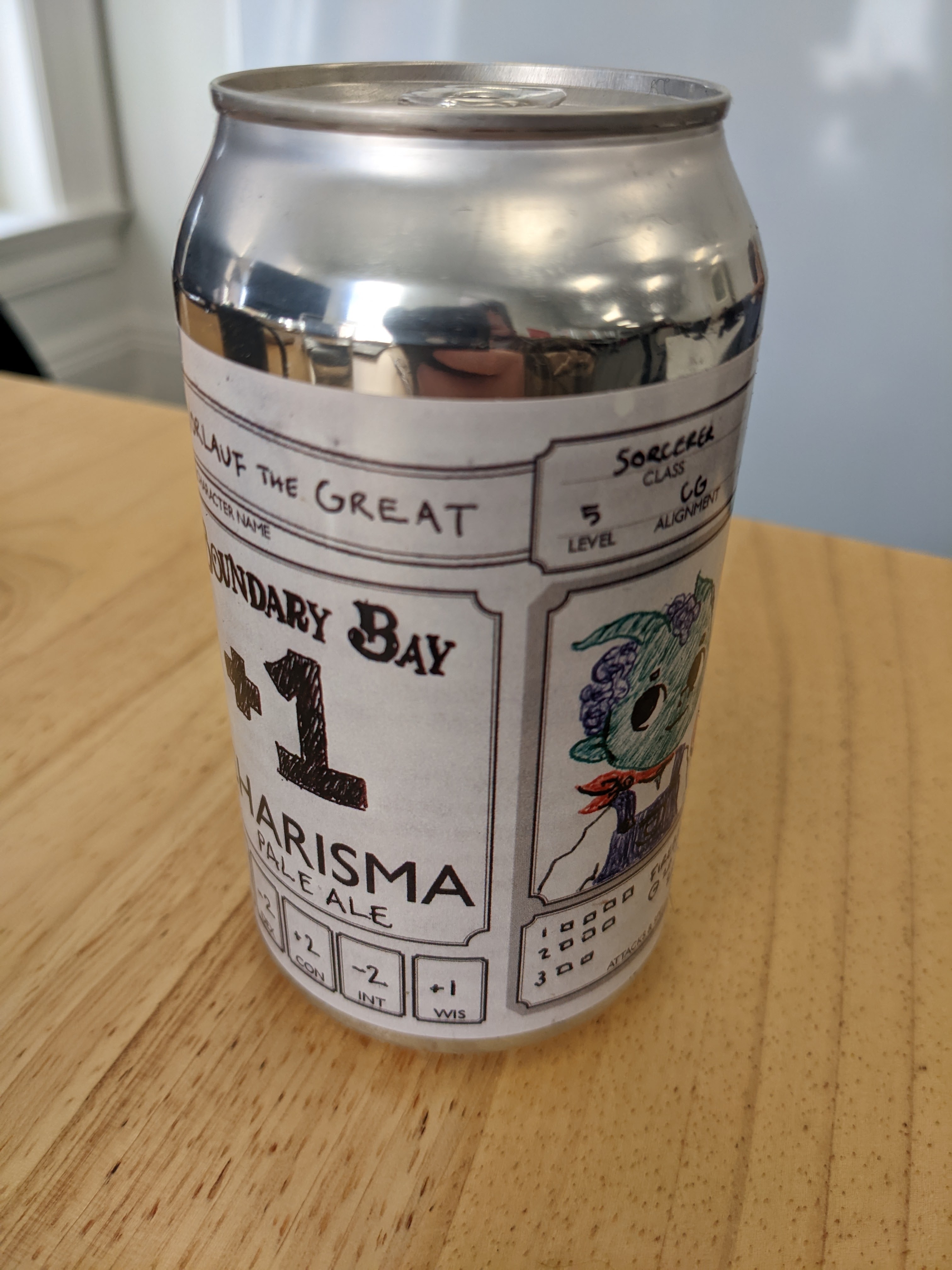
    Boundary Bay +1 Charisma Bay Ale

    Close up of +1 Charisma's 12 ounce can. It looks like a character sheet.

    Beer Review

    First, let’s talk about the beer like a beer.

    Reminiscent of their classic IPA with lighter hop character. It has bitterness, like a classic pale or western IPA. There’s some malt character, providing a crispness. A good balance with the mosaic and moteuka hops.

    Boundary Bay didn’t overdue anything and for someone in the PNW or who regularly drinks strong beer this could be considered a session at only 5.5% ABV and 42 IBU.

    If you are looking for a easy drinking, quality beer that treads that line between West Coast IPA and classic Pale Ale with no haze or sweetness this should be on your game table.

    It currently isn’t on the tap list nor available for order on the website, which tells me this is a Bellingham, WA only release.

    D&D Character Review

    The can art is a Dungeons & Dragons character sheet, and properly done.

    Vorlauf the Great is a 5th level sorcerer with a brewer background. The art makes it look like a custom lineage (hop plant humanoid).

    Str: +1
    Dex: -2
    Con: +2
    Int: -2
    Wis: +1
    Cha: +1

    That’s a valid set of stats for the AC 14, speed 30, initiative -2, +3 proficiency bonus character with the Saving Throws all correctly done. Their preferred spell is Fireball, though I would have been tempted to use something with acid or Hideous Laughter, because it’s a beverage.

    The available spell slots are true to the game, as is the Brewer’s Tools. There is a custom magic item, an Ale of Bewitching (Wondrous, Rare). The section Features and Traits includes the tasting notes.

    Unlike many who dabble in D&D inspired merchandise, Boundary Bay’s artist seems to actually play the game. This character isn’t merely an homage, it’s the real deal. This is a playable, if not quite optimized character. I’ll be adding Vorlauf as an NPC to one of my games.

  • Timelines in the World of the Everflow

    Timelines in the World of the Everflow

    The timeline of the World of the Everflow is getting harder for me to track. There have been six campaigns with some overlap in both reality and at the table. In order for me to keep better track of events and so that the players and their characters have a better idea of events in the past prior to the campaign I started to build a timeline.

    The desire is that these are basically small phrases containing history, not a book of common knowledge to study. I’ll be adding to this as the players remind me of events, create things from their own history or ask questions.

    Current day

    Uprising & Rebellion 2 and Gendarmmes of Sheljar

    One year ago

    Red Oak burns, allowing red dragons to be born; Uprising & Rebellion 1; 7th Fleet of Daoud encamps to the south of Kirtin-on-the-Lake

    Five years ago

    Dragons and the Ken fly to Kirtin-on-the-Lake; Sheljar is freed from Necromancy and the Tunneling Nightmares; some Scholars (Diviner, Necromancer) are made public; Kin can learn magic

    Six years ago

    Goblin Queen’s Fleet lands near Sheljar; Discovery of the Lorebook of Divination; Children of Chorl created; Eruption of Dakan Thaeeb; Lorebook Hunters start their search

    Twenty-seven years ago

    Sheljar falls to the Necromancer

    Twenty-eight years ago

    Born Generation

    Seventy years ago

    Crinth Confederation re-structures to stop expansion of Azsel

    One hundred and twenty-two years ago

    Kirtin loses Kirtin-on-the-Lake again

    Two hundred and twenty-four years ago

    Kirtin retakes Kirtin-on-the-Lake

    Four hundred and sixty-four years ago

    Daoud takes Kirtin-on-the-Lake

    Seventeen hundred years ago

    Az and Sel establish the Bond, rising to godhood; other bondings besides dogs are discovered; the Goliath nation of Galinor disappears

    Two thousand years ago

    Church of Quar controls the Everflow and the Font of Two paths, becoming a continent wide faith; Mehmd closes off the empire with foreigners only allowed at Gate

    Millenia ago

    Quar and the gods create Habergeon, the Everflow and separate the Lands of the Six Kingdoms from the world of magic

  • Introducing Militia Actions to support base defense in urban rebellion play

    Introducing Militia Actions to support base defense in urban rebellion play

    In my Uprising & Rebellion Campaign Two the players decided to take on the Mayor’s forces in the open, rather than the dead of night or through obfuscation. In response the Mayor and his forces attacked their home base, the Rusty Clam. Dungeons & Dragons doesn’t do great for large battles.

    A few tweaks I made to more represent the fiction of a rebellious militia and their allies defending their most significant resource were;

    • Have the minions represent half of a squad. The idea here was that the lesser trained guards would break morale when they lost half their group.
    • Allow the PCs to set up themselves up where they wanted. This is their territory. They know it best.
    • Added actions to represent the other rebels and commoners who side with the goals of the uprising. These Militia Actions operate similar to Lair Actions. That initial use has been modified here.

    Militia Actions

    For the session these operated as a Lair Action for each PC. They were taken on the initiative count 10 after their own initiative, which worked out as PC1, enemy1, Militia Action1. That part was a success.

    Each Militia Action was tied to a saving throw by the NPCs. These were designed for Tier 2 play as that’s where the PCs in question are at this time, but since I used cantrips as a guideline they are easy to adjust.

    Funnel – the militia and/or commoners in support of your cause build a wall using objects or themselves to block a path. This wall is 5′ long per tier of play. A successful Strength save (DC 10/15/20/25 based on tier) enables the enemy to ignore the wall.

    Falling or Thrown Objects – the militia and/or commoners in support of your cause pick up objects nearby and throw them at the enemy. These objects do 1d8 damage per tier of play in a space that is 5×5/10x/10/15×15/20×20 by tier. A successful Dex save results in half damage (DC 10/15/20/25).

    Overturn Stand or Cart – the militia and/or commoners in support of your cause create an area of difficult terrain by using common objects to clutter the path. Any enemy passing through the area moves must use twice their movement through the 5×5/10x/10/15×15/20×20 space by tier. They may attempt to move at normal speed, and if using the Dash or Disengage actions, must succeed on a Con save (DC 10/15/20/25) or take 1d6 per tier damage and fall Prone.

    (this one needs the most work)

    Harass – the militia and/or commoners in support of your cause harass and pester the enemies in such a way that limits their defenses. This can be done by word or by minor physical altercation. The next attack by that enemy NPC or intelligent monster is at disadvantage. A successful Int save (DC 10/15/20/25) results in no disadvantage.

    Distract – the militia and/or commoners in support of your cause harass and pester the enemies in such a way that limits their attacks. This can be done by word or by minor physical altercation. The next attack against that enemy NPC or intelligent monster is at advantage. A successful Int save (DC 10/15/20/25) results in no advantage.

    Rally – the militia and/or commoners in support of your cause shouts in support of the PCs. The PCs are then granted 1d6 temporary hit points per tier of play. A successful Cha save (DC 10/15/20/25) by the leader of the enemy results in no temporary hit points being granted, this is to represent their ability to speak over or interrupt the rallying calls.

    Changes for the future?

    I may tie these to various skills or tools rather than saving throws. I had the players roll, and asking players to roll under for a success just didn’t make sense.

    Finally, I think I would allow a summoned swarm from the Propagandist use these when the Propagandist commands them via a bonus action. This would help raise the power level of a subclass that lacks in combat, though in many campaigns this wouldn’t be enough.

    Design Goals

    The primary inspirations for these actions were to mimic some of the play of Assassin’s Creed, where the small crowd of neutrals and allies can support your violence. There are also scenes in Black Sails where the common people of Nassau join the fight against the British. The invasion of Tear and other conflicts in the Wheel of Time feature actions by commoners supporting the heroes too. Various Robin Hood tales, the rescue of The Shire, the movie Aladdin, and so many other tales have common peoples helping the heroes by impeding the enemy.

    While highly urbanized campaigns aren’t common in D&D, they should be supported. The literature and other inspirations for the game do have these elements. Our game can include them in ways that are more than just background story.

    What improvements do you see needing attention?

  • The Willow trailer is more proof that there’s never been a better time to be a fan of fantasy

    The Willow trailer is more proof that there’s never been a better time to be a fan of fantasy

    Back in the 1980s there was a cute little movie called Willow. Featuring Warwick Davis, Val Kilmer and others, the film opened well and then petered out. But among certain fans it maintained this legacy and appeal. There’s a little person (Davis), even littler people (two Brownies), Kilmer with a sword! and extraordinary effects. The story is quite a traditional tale of people without anything in common trying to save the world.

    Eventually when it was on video tape it developed a reputation as a grand adventure and we all loved it.

    Now, there’s a new Willow — with the same message, better effects and even more of everything. The cast is wider and the story more grand. It looks like an epic Dungeons & Dragons tale.

    That trailer shows every member of the party featured in the spotlight. Some are noble. Others are urchins. There are sorcerers and fighters. Davis is back and so are the Brownies. The princess is now longer a baby. Where the original Willow explores just a single continent in the world the new series explores the world and more.

    It’s an epic fantasy tale and another example of the wide variety of fantasy that is available in the 2020s. Sword & Sorcery, Epics, Grim dark, Magipunk, comedy and more subgenres of fantasy are available. Every streaming platform is hoping for a tentpole series, with none dominating right now.

    Like, there’s a lot of fantasy and there’s more to come.

    Honor Among Thieves looks like it will great. Wheel of Time is still in the Top 10 for Prime Video Streams. House of the Dragon and Rings of Power are battling every week to be the most watched non-sports/awards show. Legends of Vox Machina season two is still to come. Witcher season three. Shadow and Bone.

    Outlander, Last Kingdom and Black Sails are genre adjacent in that they are period shows that people who play D&D think of when they play D&D.

    All of this isn’t powered by franchises like Marvel, DC, Star Wars or Star Trek.

    Fantasy is capturing global imaginations and our dreams. We’re watching. We’re playing. We’re creating new stories with the old tropes seen a right angle so as to capture the people who we’ve always been. Fantasy is built around tales of cooperation among those with different backgrounds, skill sets and races. Fantasy is built around the authentic statement that the diverse group is the strong group — it’s been true for the millennia of myths about dragons and the people who fight them.

  • Counting in the Land of Kon

    Counting in the Land of Kon

    The smogpunk land of goblins in the World of the Everflow was set apart from the Kingdom of Sheljar, Crinth, and other areas for a few millennia. Within this separation the goblins and hobgoblins changed from the standard tropes.

    In the Everflow they answer to the Queen Mother. Everyone is organized around their family’s history of developing teknology for one of the various guilds. Inventiveness and cleverness are more important than fighting and viciousness.

    To emphasize these differences, but still capture traditional goblinoid feelings there should be a some differences in language. This discovery of numerals from the 13th century feels proper for the gobkon of the world.

    It works in a printing press, scribbled on paper or carved into wood.

    Will it ever see the table? Probably not. Or maybe just one or two numbers in a handout for the players to demonstrate the differences between their lands with the languages of Telse (Common) and the rest of the Six Kingdoms.

    If there was a campaign book for the World of the Everflow this could be a tiny sidebar for flavor, not a rule for use.

  • “I’m not even supposed to be here today” — add a Clerk background to D&D

    “I’m not even supposed to be here today” — add a Clerk background to D&D

    Since Dungeons & Dragons is anachronistic, most people, and basically every player character, know how to write. But what about those that know how to write and count better? The late middle ages were a time when there was a rapid need for more writers, more accountants. Guilds needed to track the money they were bringing in.

    If your D&D world has many guilds it would have many clerks. Some of those clerks may get bored of quill and ink, or precisely measuring liquids, or whatever mundane task their employer has for them — so they head out on adventures, which is what happened in real life too. Lots of clerks got involved with murdering.

    Backlit by a candle, a hand holds a quill just prior to dipping it into a small jar of ink.
    Photo by cottonbro on Pexels.com

    Clerk

    You are someone who counts fast, keeps precise notes, reads for others, writes for others. You are meticulous and detailed. When

    Skill Proficiencies: Investigation, Insight
    Tool Proficiencies: Calligrapher’s Tools
    Languages: One language
    Equipment: Common clothes, tabard, abacus, merchant’s scale, jar (precisely 1 quart), pouch, signet ring, 10 gp

    Feature: Measure Twice

    You can rapidly and accurately account for large quantities of coins or other staples, assessing their value using just a single action. Clerks are also able to stretch large quantities of staples further than expected. If you need more than 50 of an item a Clerk needs 10% less of that item. For example, 900 ball bearings works just as well for a Clerk as 1000. Or if others would need 50′ of rope the Clerk can make do with 45′.

    Alternate Background: Tax Collector

    You are a representative of the government, collecting fees and taxes for the services they provide. Maybe you work at a toll bridge, a city gate, or you wander to various farms. Some pay in gold, most in silver or even copper. You’ll take barter too. The Barony needs the funds however it can get them.

    A just collector may go easy on a family in years of struggle. An unjust may continually take. Your character’s behavior and history is up to you.

    The Tax collector has the same skills, tools, and languages as the Clerk. The difference is in their Feature and in their role in society.

    Feature: Forgotten Refund

    Knowing the ways of governments you are able to assume the debts of a group that owe. You can also find a way to get a tax refund for yourself or others, or avoid paying the full amount. If normally the government takes 10% you would only pay 5%. If you are short gold, you may visit another tax collector, if one can be found, to get 5 times your proficiency bonus as a refund.

    Design Goals

    Clerks were so common in the late middle ages they killed a lot of people. Which sounds a lot like D&D adventurers, so why not have a Background based on them. Sure, they could be represented by Sages and Acolytes or other thinkers.

    But, I’ve watched too many Clerks movies, and so needed to honor the OG clerks in a special way. Don’t be murdered by clerks, be the clerks that murder.

    Custom Backgrounds for 5th edition Dungeons & Dragons

  • Assigning Social and Exploration Experience in Uprising & Rebellion

    Assigning Social and Exploration Experience in Uprising & Rebellion

    In my campaigns we use experience points rather than milestone levelling. But, we also spend time in the social and exploration pillars, where the game as designed provides little guidance towards the experience that should be rewarded for success overcoming obstacles beyond traps.

    Rewarding the play I want to see, I have given out xp for solved plot points and discoveries. In the past these have been given out at the end of a session without the players knowing ahead of time what their character rewards would be.

    I’m going to attempt to pull back that veil, listing out major plots and side quests with xp values. My goal is so that the player characters will be rewarded for developing their stories and the overall campaign.

    Major plots

    Daoud’s 7th Fleet vs Twilight and Shadow the Black Dragons vs the Mayor with the Blue Dragons vs assembling Kirtinish forces on the east shore – 10,000 xp

    Kirtin-on-the-Lake is now torn between two of the Six Kingdoms and the separate appeals of two groups of Ken. Twilight and Shadow seem to thrive on misery, sucking up negative emotions from the war. The Mayor has gifted the Blue dragons significant territory and their co-operation requires unbonding from animal companions.

    The 7th Fleet wants to take the city back to Daoud. It is actually a massive cavalry army with horses, riding dogs and warbirds. Kirtin’s forces sit, waiting for the three sides to destroy each other and sweep back into the city as welcomed heroes.

    Our heroes haven’t picked a side, because they are all bad. In the past they’ve hoped for trade or normality looking to Sheljar for inspiration.

    via the Fantasy City Generator

    Lorebooks – 5,000 xp

    Our heroes have the Lorebook of Illusions and the Crate of Conjuration. They suspect there is another Lorebook locally and a fourth may be in The Ferments. They know not what power the Lorebooks provide, just that a group called the Scholars control them and the Proctors are a violent segment of Ken who are trying to acquire the various books. The world knows that the Folio of Necromancy and the Lorebook of Divination are in Sheljar.

    Defending their books from other Proctors or Scholars is as important as finding more, probably.

    Unseat the Mayor – 7,500 xp — COMPLETED

    The Mayor has turned his back on Daoud and joined with the Blue Dragons and their Ken allies. Even if the heroes cannot yet sway the four-sided war, the group wants the Mayor eliminated via election, appointment or violence — he just needs to be gone.

    Side quests

    Where is Wilkie? – 2,500 xp — COMPELETED

    One of their allies, Wilkie, former leader of the Dock District Guard fled. With their leader in hiding the Dock District has dissolved back to an ad hoc militia. The group of heroes had trusted Wilkie to defend their district.

    Missing Printers – 2,500 xp — COMPLETED

    The printing press and gobkon printers’ office burnt down in a dragon strike. No bodies were found. Once in hiding, then public, the Society of Veil and Shadow has again disappeared. Their pro-Sheljar message remains known, but there have been no broadsheets in three passings of Feylf.

    Is the new flag of quill and sword related to their absence?

    Bounties – 2,500 xp — COMPLETED

    Each of the known heroes has a bounty of 2,500 gold on them. This is mostly because the Mayor hates them for the murder of the gnome during his festival. But also because they keep trying to inspire the people toward concepts like freedom and respect.

    Character quests

    Keldrass wants to repair the bonds broken by the black dragons and help protect the city from the Ken.

    Gardar wants to increase the trade with Mehmd, earn respect outside of the caste system there and maybe have his own Goltoppa team.

    Seymore wants to teach commoners magic, because even though he doesn’t trust it the people need the power. He’s done a bit of this by spreading Minor Illusion.

    Req wants to maintain the independence of the Dock District.

  • Batons and short staves – two new finesse weapons

    Batons and short staves – two new finesse weapons

    In 5th edition D&D I create a lot of rogues. This is a change for me, for in my earlier forays into Dungeons & Dragons, I mostly played clerics, bards and paladins. Part of the appeal of the rogue in 5e, is that it has became the main skill-monkey class. Mostly mundane there are interesting stories to be told via the mastermind, the inquisitive, the scout and the propagandist.

    One thing I find lacking for three of those options is the narrative around using a weapon that knocks opponents unconscious. While the rule set allows any weapon that does enough damage to kill to be declared a non-fatal blow, there’s something about an mastermind smacking a thief upside the head with a baton and knocking them out.

    Three batons
    By Bill Smith from the Metropolitan Police Heritage Centre

    Common within the literatures that inspire our game are also tales about short staves that flip about stabbing with the point and smacking with the side — see various interpretations of Sherlock Holmes. My campaign needed one of these because a player in Uprising and Rebellion Campaign Two is a streetsweeper. Their broom handle makes sense as a weapon for them.

    And so, the baton and the short stave were born.

    Baton

    Type: Simple | Cost: 5 gp | Weight: .5 lbs | Damage: 1d4 | Type: Bludgeoning | Properties: Light, Finesse | Mastery: Nick

    Short stave (broom handle)

    Type: Martial | Cost: 5 cp | Weight: 2 lbs | Damage: 1d8 | Type: Bludgeoning | Properties: Finesse | Mastery: Sap

    The baton is just a refined club so that you can play as Sticks from the Vlad Taltos Saga. The short stave (broom handle) is based on the rapier, the current best weapon for a rogue, but merely bludgeoning and cheap.

    There’s nothing game breaking from these additions. There’s no power creep.

    There is a whole lot more story. And that’s the whole point to Full Moon Storytelling — story creep.

    Masteries were added on Oct. 15, 2025

  • Twilight Fables – a sourcebook designed for 5e D&D focusing on European folklore

    Twilight Fables – a sourcebook designed for 5e D&D focusing on European folklore

    As an active participant on ENWorld, I watched the Twilight Fables project grow from idea to concept through approach and playtest. As an already funded project, supporting it on Kickstarter means my readers will not be backing a failed project — it’s done. The books have had proofs printed. Rod Waibel has a different approach than typical for this Kickstarter.

    So I invited him to share it with the readers of Full Moon Storytelling, because you might enjoy a few more monsters for your D&D game.


    Twilight Fables is now being shipped to backers.

    If you didn’t get it then, but want it now, head to Izegrim Creations store to purchase a limited run of the same hardcovers backers get. The pdf is also available for 5e D&D and OSR. The DriveThruRPG versions can be purchased here (5e, OSR).

    A montage of art in Twilight Fables

    Note: The original folklore was dark with mature themes and may include triggering subjects.  Think more Brothers Grimm and less modern fairy tales.  Reader discretion is advised.

    From the Twilight Fables Kickstarter.

    What is Twilight Fables

    Twilight Fables is a sourcebook designed for 5e focusing on the original European folklore as it was told generations ago. More Brothers Grimm and much less Disney, if you will. When Dungeons & Dragons was created, most of the monsters were based, albeit loosely, on folklore. However, it was in the vision of those who were creating it, so creatures like drow, kobolds, goblins, etc. don’t resemble anything like the folklore that created them. 5e D&D has been out a while, and there has been a ton of content created for it, but I found this area lacking.

    Wizards of the Coast recently came out with a fey-themed book, and while a great product in its own right, it was nothing like original folklore. I felt that those old stories, approached with the appropriate caution, could lend to exciting and interesting adventures of their own. I say “approach with caution” as no accident. For those unfamiliar, many of those stories were allegories of caution directed toward children. “Stay away from that creek, because there’s a terrible monster there that will eat you!” “Remain pure and chaste or you’ll turn into a terrible creature!” That sort of thing.

    Since much of folklore was created during dark times (literally the Dark Ages), there are several instances of abuse and suffering. For example, the original story of Hansel and Gretel is even darker than most realize when you learn why they kept getting lost in the woods. Ableism, sexism, child abuse, and consent issues show up often in those stories. Therefore, I made it a point to address this right up front in the book, and put a disclaimer on the cover. People can skip right past those sections that deal with these issues easily by a displayed marker if they want to avoid any triggering event.

    [Dave here: Rod and his team put a disclaimer on the individual creatures that are most likely to bring up the worst memories people have.]

    You may be asking yourself, “Why bother creating something that has so many problematic themes?” Fair question. Quite frankly, it’s because outside of those few monsters, the lore is rich with great stories and potential. As long as we approach it with an informed perspective and have the agency to control which portions we use, there’s a ton of value in this book. And it’s good to have the option. I did my very best to minimize those problem areas and advise that such issues should not be included in the typical game. I stress how consent among all the players at your table is recommended before incorporating any potential problem areas.

    Now that that’s out of the way, what exactly does Twilight Fables include?

    An example of the layout in Twilight Fables.
    • There are more than 200 creatures, all with detailed page entries. Reference the included screenshots to see some of the changes that the core books did not have. These include but are not limited to quirks, lore, suggestions on incorporating them into your game, spell lists within the stat block have been removed and replaced with detailed spellcasting abilities, etc. 
    • [Dave here: the expanded lore and quirks are a great addition to the game]
    • Dozen of magical artifacts pulled from mythology and lore
    • Crafting rules
    • Tons of player options, including warlock patrons, cleric and ranger subclasses, races, feats, and spells.
    • Lore of the Otherworld (Fey Realm) as it was explained in folklore, including living in the Fey Realm, the Seelie and Unseelie Courts, and becoming an Archfey yourself!
    • A plug-in-play campaign that can be used in your existing campaign to shake things up a bit.

    Where can I learn more?

    On Kickstarter

    Website: Twilight Fables | Facebook: Izegrim Creations | Twitter: @IzegrimC

    Let’s say I want to get this, what do I get if I back the Kickstarter?

    I’m taking a slightly different approach to running this Kickstarter from other companies. Most companies offer a PDF and a hard or soft copy. That’s great, because that’s what the majority will use. However, when I did Chromatic Dungeons last summer, I learned it’s just as important to listen to the minority, because they deserve to get what they want as well. So for Twilight Fables, the digital package includes a PDF like usual of the main book. But then it also includes a PDF with no background, for ease of reading and printing. And it includes an RTF version for those with visual impairments and for those who want to cut and paste information easily. Also included are tokens and markdown files for those who use VTT gaming. That’s all for LESS than most companies are asking for just a core PDF.

    Beyond that is the actual hard copy option of the book. I’ve had the advance copies in my hand already, and I was pleased with the quality. I’d love to get the $50,000 stretch goal because that allows me to get offset printing with glossy pages, gilded pages, and ribbon bookmark. But if that doesn’t happen, it’s OK because the Print on Demand book is still of very good quality.

    And that’s pretty much it! No crazy stretch goals that put the project at risk for delivery. 

    Let me close in saying how much I appreciate the support from everyone. From the great artists I got to work with, including the legendary Gerald Brom and Darlene the Artist, to all of the backers who support me!