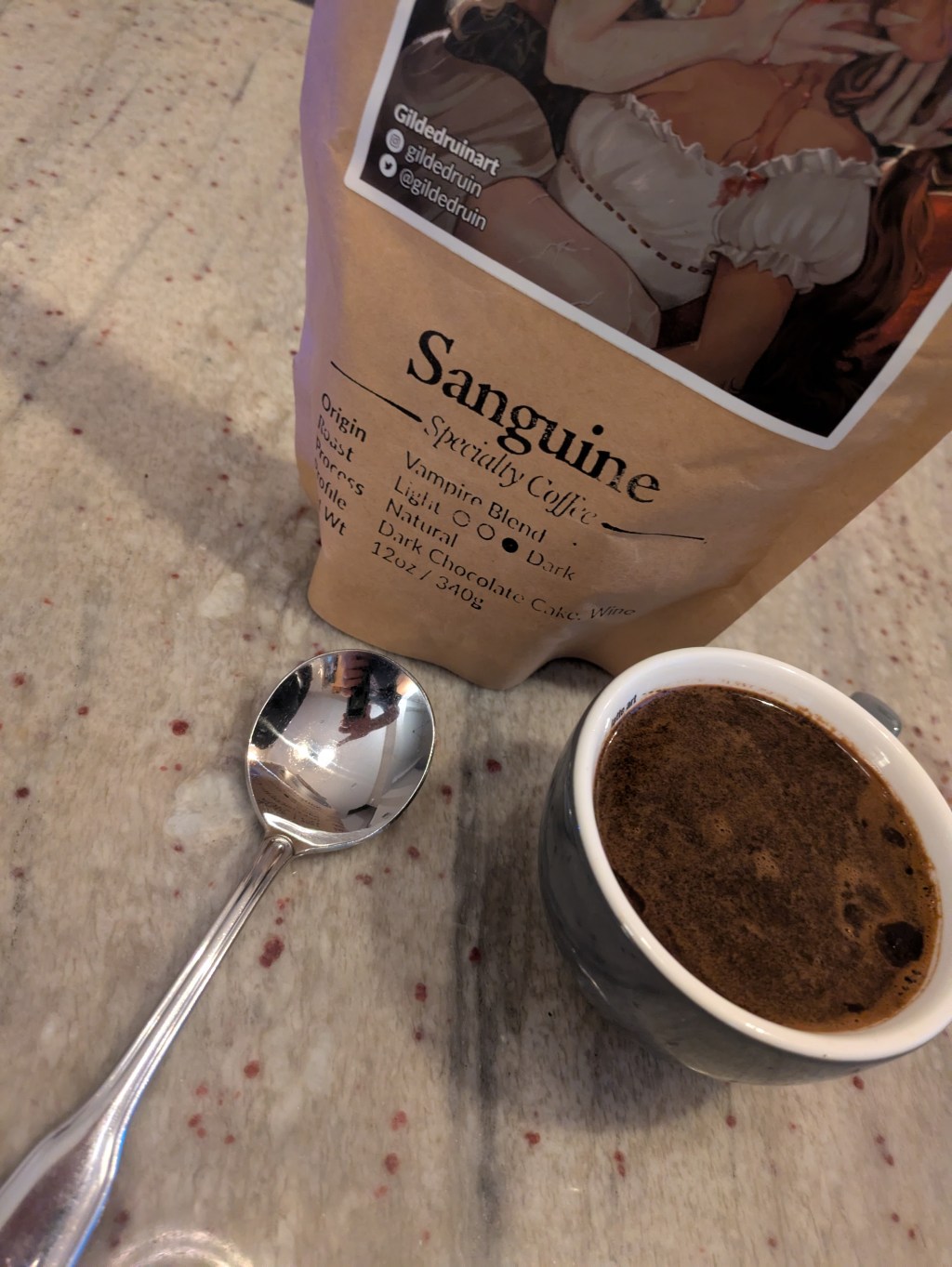
Found Familiar is third wave roasting style coffees in bags with geeky art. Their Sanguine Vampire Blend is inspired by, well, vampires.
As a former professional coffee taster my first, and most important note, is that if you like your coffee you are doing it right. Also, as a former taster, I decided that in 2025 I’m going to do a cupping of each new coffee I taste, because I don’t want to lose the skill. This will also help me maintain my sense of taste for wine, beer, food, etc.
Sanguine Vampire Blend tasting notes
This coffee was cupped at home, using a Baratza grinder, my kettle, a cup and one of my spoons from back in the day. It was tasted across a few temps. Additionally I’ve enjoyed espresso and cortados with Sanguine from a Breville Barista Touch and pour overs using a Chemex with paper filters with cream and without.
On the break: Aroma of dark fruit, cherry or blackberries. Medium to strong roast.
First slurp: Light, medium body without acid. Notes closer to dark cherry, mild acid, cocoa.
Third slurp: Picks up roast better as cools. Stronger dark chocolate rather than cocoa. Bright cherry rather than dark?
Lightly drying after spitting — think like eating a walnut
Who should buy Sanguine?
This is a great coffee for espresso, macchiato and cortado drinkers. There’s complexity to it, and it does pair well with the heavy chocolate and berry desserts as Found Familiar mentions.
As a straight black cup of coffee it’s not as dark as I’d want — the vast majority of my 15 years of coffee experience were in second wave places (though I did stints in 3rd too).
If you enjoy a lot of cream the roast may not get through like you want, unless you mostly go for 3rd wave profiles. Those that don’t use a lot of cream will enjoy it, especially with a bit of sugar, which I’ve found brings out the fruit notes.
What makes Found Familiar different?
There are several geek-roasters. What I like about Found Familiar is their support of artists and one of my preferred mapmakers. I’ve also purchased the Run D&D t-shirt twice because like many middle aged people I grew.
Note: The coffee was purchased by myself and there was no expectation from the company that I would do a review.
I didn’t do quite as much writing for public consumption as I have in most years since I started blogging regularly in 2008. Some of that reduction was due to me taking a step back at Sounder at Heart, focusing my work content on video briefings and emails, and Full Moon Storytelling being a “when inspired” project rather than an income generator.
Here at Full Moon Storytelling my most popular writings over the past year were older materials.
In fact, that’s where my biggest D&D related project ever came from, and one of my favorites of 2024. I helped out with Worlds To-Go: The Elysians.
My contributions were five custom backgrounds, most completely new, plus formalization of sports rules including inventing two new sports — The Pentiad and Constellations (a team juggling sport that creates constellations).
Here on FMS my favorite of the year was Goodbye Alignment. Hello short-form personality. In that article I encourage people to continue to use personality traits in their games, but make them as short as alignment! Then the DM and other players can grant Inspiration based off of something small enough to remember as opposed to the original 5e personality system that was six long sentences that no one remembered.
I stutter. Sometimes a little. Sometimes a lot. A personal essay I felt compelled to write after a re-watch of Agents of SHIELD, it also falls into the not-well-read column, but it meant a lot for me to share this about myself. It was not the only personal essay of the year. The other was about how the fragmented storytelling technique of D&D may fit me better than novels or short fiction.
Soccer stories
For the most part at Sounder at Heart I’m now the weekly columnist, sending out a large newsletter that covers one important topic, plus everything else you need to know for the week.
Choosing the best of these was easy, because one of them helped change the approach from the organization towards the US Open Cup — Ship’s Log, May 7: Let’s win trophies again.
My second favorite was about using the Club World Cup to sell the world’s best players on the region that I’ve chosen as home for all of my adult life — Ship’s Log, Dec. 6: Selling Seattle.
I still dipped into journalism, covering Defiance’s new coach and the new practice facility. Walking through history is one of my favorite pieces of soccer writing ever (and there’s about 5000 of those).
Factal
Most of my writing at Factal is in emails. Some additional material is in the various Global Security Briefings I hosted this year, covering news like the Key Bridge collapse, bomb cyclones, DANA storms, mpox, Olympics security and more. On the blog I supplemented editors’ writings on Olympics security and for our year in review.
Finding me on social
Mastodon or a bridge if you are on Bluesky (where I prefer to have most of my RPG and soccer thoughts)
Instagram (mostly pics of my dog, the moon and soccer stuff)
LinkedIn (almost all safety news, intelligence and marketing)
P.S. That jersey on the header was for the soccer team I sponsored this fall. I’ll be sponsoring again in the spring, because supporting my friends is fun.
But, you’re still left trying to be creative within those techniques.
Take the five-room dungeon, the short essay of dungeons. It’s an introduction/guardian, puzzle/social encounter, trick/setback, climax/big bad, and the resolution or plot twist.
This generally follows the basic plot graph in literature. It’s familiar, fast and can be done in one sitting if you time things well.
How do you fill that out? What’s the source of creativity?
Use pop songs!
No, really, they often follow a similar arc, but have a chorus that echoes the main theme of the song. This idea first sprung to mind with Apollo, by SYML.
Rather than five-rooms, we’re going to go with seven events because of the chorus. The song provides the creative prompts to fill these out.
Introduction/Entry — on the steps of a temple the party sees a golden altar being shined, hears talks of other wonders when a dark cloud blots the sky. A raven and a wolf rush to the altar, tossing it aside, fleeing to the countryside.
Note: after the intro the PCs determine the order of approach.
Social encounter — Interview the group talking of other wonders and the goals for the faith. Secrets and clues include a song that is unsung and a build up of a military force by the faith.
Choral echo — Tracking the raven and wolf leads to a moonlit glade with an empty space framed by 7 monoliths.
Setback — The huntress on wolf back, she rides with bow drawn, ready to fight. If the party sings the unsung song there is an attack. She only appears at night, under a full moon.
Choral echo — If the party rights the altar themselves and shines it to bright gold they discover a medallion that prevents the poison on the arrows from taking effect on the group (immunity from the poison condition in an emanation of 10′ from the one wearing the medallion).
Climax — The songmaker arrives when one of the party bends their knee (falling unconscious qualifies, as does voluntary submission)
Resolution (always last) — When the songmaker and huntress are both defeated a flock of ravens blots out the full moon. The wonders fall and a song echoes at their altars “I am. I was. I will be.”
Yes, that’s quick and dirty. Tuning that to a party shouldn’t be too difficult. Maps and expanding on the secrets can turn it into a decent short adventure facing off against avatars of gods in any D&D world.
Sure, that works for Apollo, but what about other songs?
Intro — In history there was a party with many attendees scheduled at any outsider’s home. Celebrations are held in town honoring the host and diminishing the current leaders
Chorus — One of the hosts dies, their partner is blamed in efforts by the current leadership to reduce influence
Puzzle — How did the person die? Clues include a neighbor’s dog, poor health, a nearby sea, a long drink together prior to the party
Chorus — The commoners in the community ignore the other surviving families, focusing instead on the surviving partner as both suspect and hero
Setback — Both partner-hosts haunt the house, interfering with ideas at solutions, causing the group to collect extra clues that may or may not be relevant.
Climax — PCs discover that the old money in the area is the reason for the death, as they didn’t want the new money to interfere. If the PCs share this with the commoners there is an uprising.
Resolution — The house remains haunted, after the PCs solve the mystery of the death, though the group can live there undisturbed.
Did you just use a Taylor Swift song?
Yes, I did.
Not every pop song will work
Just like not every TV show, movie or book is a good inspiration for a D&D adventure or campaign, not every song is.
But, if you find out at 9 in the morning that you’re DMing in the afternoon you can adapt the five-room dungeon using the chorus to help with theme and secrets.
Playing the song that inspires you on repeat can help you focus your energy. Sketch out the quick map including notable fantastic elements, make certain your secrets and clues work in a multi-nodal fashion.
Fill the monsters or opponents that fit the song (ravens, wolves, ghosts). The NPCs are in the song as well (commoners from LGAD or clergy in Apollo).
Connect a couple events to the characters and/or past adventures.
The chorus can either be tucked into various other scenes, can be dream sequences, portents, or speeches from various NPCs rather than specific events.
The rules for the 2024 D&D Utilize [Action] are rather simple per the Free Rules and the Player’s Handbook. The magic is hidden in the siege engine blurb in the Dungeon Masters Guide.
Simply, Utilize lets you use non-magical items that take more than a bare moment to activate.
You normally interact with an object while doing something else, such as when you draw a sword as part of the Attack action. When an object requires an action for its use, you take the Utilize action.
Within the siege equipment rules, you can see the potential for Utilize. There, each engine has a different number of utilizations that it takes — frequently these are things like aim, load, fire. Each engine requires between one and five rounds for a single person to use these massive elements of war.
What’s the magic in a catapult? Nothing, normally.
But an enterprising DM will realize that there is an implied crew in siege engines. Full staffed these can be used within a normal combat round.
Also, and probably more intriguing, is the implication of time pressure.
Imagine now an opponent using mangonel. It takes two Utilize to load, two to aim and one action to fire. In our example we’ll use a crew of three, which lets the mangonel fire every other round and the crew do some other annoying things.
Our heroes are on a mission to take out the emplacement of the siege engine.
The weapon itself has an AC of 15 with 100 HP. It could take a long time to damage it.
Taking out the crew is easier, of course. And thanks to the number of Utilize [Action] required the DM and PCs know the time it takes to make the mangonel no longer effective at attacking their allies. Each loss of a crew member slows down the enemy and grants your allies time to act in other ways.
It’s a clock, without a clock.
You can also use this technique for a chase scene!
Let’s say your PCs run to the docks, board a sailing vessel and need to get going fast. Maybe it’s a ketch, with a main mast and an aft mast and foresail.
Quick and speedy let’s say that setting the sails requires two at the aft, one at the foresail and three at the main, plus there are two utilize actions needed to release the lines. Yes, this is highly gamist, but allows a scene to develop.
That’s an eight segment clock for the party to escape. Maybe they have an artificer with a servant, or a familiar that can help. Maybe the rogue uses Fast Hands. These can speed things up, for sure.
The group knows, quickly that while under assault they need eight actions in order to be undersail and then the enemy will be behind them.
No need for fiddly rolls, unless they take a wound or condition that would limit the ability to succeed at these mundane tasks.
Building ad hoc clocks from the Utilize [Action] can also be done with traps (the number required to disarm or the number before the flooded room no longer offers room for breath).
Maybe do similar with rituals and the Magic [Action]. Is the group raiding a grove where evil druids are conducting a multi-step ritual to bring the mushrooms to life in order to choke out a local farm?
Come up with a number of Magic actions that are required for success. Now the two groups both know the timing of success.
If there are seven druids that need 14 Magic actions to succeed they can choose to all ignore the PCs and perform their magic or some can address the PCs. The solution is up to them and creates an interesting balance of choice.
No, these aren’t the clocks of Blades in the Dark. They still create a sense of timing and urgency within your game.
Being a Dungeon Master is intimidating. At it’s biggest level it can seem like you are supposed to run an entire world, know all the rules to the game, spotlight every player-character equally and help everyone have fun.
There are many ways to make it simpler than that;
Focus only on the world with which the PCs interact
Skip rules that aren’t meaningful at the time
Rotate the spotlight as appropriate to the table
Get feedback from players in order to improve
There are other ways too. I’m a big fan of the Lazy GM series.
2024 Dungeons & Dragons helps make it easier in their Dungeon Masters Guide by incorporating some, but not all of SlyFlourish’s ideas. One notable thing is the tracking sheets — theirs and different from his, but that’s fine. Not everything needs to be the same.
The layout of the new book is much better for new DMs. It also has excellent examples on how to spiral out from the characters while building a world, using Greyhawks as an example. There are micro adventures, which may not give enough information, but they do show that one doesn’t need a lot of notes to run a session. My sessions are usually a single notecard for example.
Overall the ’24 DMG is a good to great book for Dungeon Masters early in their experience. It’s also handy that those tracking sheets are all available for free!
But, (sorry WotC), there is a flaw in how easy it is to be a DM in this modern era.
Those wonderful tracking sheets aren’t really part of DnDBeyond.com
They exist, but without integration.
What could make it easier to DM in the DnD Beyond era?
When you Create a Campaign on Beyond it should start with that Game Expectations sheet. The notes should be replaced with the Campaign Journal.
These are wonderful tools, and they are completely unsupported.
Adding the sheets or similar fields to the campaign page would help a DM as they introduce the players to the game-to-be. They’d all be able to see what the story is about.
Right now those pre-session one-sheets and the like need to be shared on the web, via email, Discord, at the table, or other tools rather than in the platform that Wizards of the Coast owns. It’s a silly gap in integration.
Make it easier to share variant rules and setting information
Currently, Beyond lets you share all of your books or none of your books. But that doesn’t help for a specific campaign.
Currently, Beyond lets you share books in a deeper layer of content sharing, but doesn’t let you pick and choose rules (like attributes, extra feats, no feats, encumbrance)
The above was updated at 8:57 pm on Nov 27, 2024
My current Age of Myths campaign would make sense to permit Strixhaven, Theros and Dragonlance rules. It’s absurd for it to include the Illrigger, Ravenloft, or Lord of the Rings (TM).
Imagine how much easier it would be for a DM and the table to say “these are the rules we are using for this campaign” and then toggle those rules and books either on our off.
Currently that’s a player-by-player decision within the character creator.
But what type of encumbrance a table is using isn’t a player-by-player decision. That’s a table decision. The appropriate setting and adventure rules aren’t most or none, but a delicate basis that sets the tone for the next several months or years of hanging out with your friends.
Wizards of the Coast and the D&D team can make it even easier for DMs by changing some architecture of their semi-walled garden in such a way that they already believe works, because it’s in their brand new book.