Roleplaying is more than a stat block. It’s that stat block, plus the personality of a character you assume for however that game lasts. Early in D&D and the hobby’s history that personality would be as simple as the class, race and maybe alignment. That resulted in a pattern where many characters had the same personality.
As alignment faded, and especially during the surge in actual plays, personalities became vibrant. Original 5e even tried to reward personality using the traits, ideals, bonds, and flaws system plus alignment. It was too much to handle for a few hours a week of fun.
How can we simplify the personality?
By using archetypes from fiction — these pull at our souls because they are common. BUT. A character with a singular archetype is also boring, just like the idea that every single lawful good Paladin has the same personality is boring.
It’s the intersection of two or three archetypes that makes a character interesting. They need positive and flawed attributes, and tension.
Their archetypes are a version of short-form personality. Ejecting trope-y D&D concepts by force and giving your character simple ways to remember who they are in their soul is easy — especially if you use their card system — which I’m backing.
Two positive attributes, one flaw; both in a single word — you can remember that. You probably are already playing that way!
Xabal, my goblin artificer, is quick-witted, kind, and overthinking.
That’s more interesting than chaotic good.
I started to listen to Scriptnotes because it helped me be a better DM and rare short fiction writer, not because I think I’ll be in a writer’s room someday. And now they’re both working on D&D TV projects. Craig Mazin is working with HBO on the Baldur’s Gate series while John August is working on the Ravenloft project. Almost every episode mentions D&D.
Other things to help inspire your game, help you play, or help you design
Any Human Ever creates short bios based on the history of our world. It can be a start to seeding interesting NPCs.
Dyson Logos Small Shop Series — now with 14 small shops in a market road of a city, these help me more than dungeons.
Scipio’s Resources for RPG creators — bookmark this if you ever think you are going to publish for pay. The assembly of resources is excellent.
British Columbia has a floating island that keeps disappearing. Welcome to spooky season. Floating islands are fascinating enough, but what if it pops in and out of the fey realms regularly? What if it isn’t haunted, but everyone that lives on it thinks that the village on the edge of the lake are the haunters? This could be a fun one-shot.
You know I have strong thoughts on using cultures rather than languages. Two other bloggers riffed on those concepts over the summer.
All of us agree that you should use Culture rather than Language at your D&D table. Pick the system that works best at yours — I may run Melestrua’s version in my next campaign.
Dice are six thousand years older than previously thought, and American. Remember, your D&D tech doesn’t have to mirror Western and Central Europe. It can, but even then, it doesn’t have to mirror a single era.
I love Adempz idea of using Success Thresholds rather than single-roll DCs. Having ways to expand the mechanical heft of a social or exploration encounter is good! This is a variant on stealing Blades in the Dark clocks, basically.
M.T. Black fleshed out traveling in a way I need to use at the table. D&D travelling used to be a significant element of the game, but now is frequently ignored. Swift, simple mechanics that amplify story and setting like Black does here are perfect.
Traipse offers a new way to think about commonality via 1, 10, 100000. Within the World of the Everflow dragons in the Age of Myths were closer to 10, but in the modern era of Uprising and Rebellion they are 100,000 — extremely common, almost like humans. Those are two different levels of danger.
What links should I include in the next edition of Lore Collage?
Within our fantasy worlds are massive cites. There are lots of problems with the scale of some of these cities — they need farms, roads, and light because residents are up at all hours. Settings like Ravnica and Eberron deal with the largest cites via magic. Those worlds with less magic manage metropolises with some magic, some magically imbued races and hand-waving. One of those hands we can wave relates to light.
Magic is the simple way to add light to cities. Another way to have them with some level of light for safety and to encourage all races to reside within is via a public lantern system. For about 150 years this was the process in Western Europe and Northeast America. People would go through and light lanterns along the street. Those shops and establishments that wanted business in the evening or early morning would do the same.
These workers would live split lives as early risers and night owls.
Let’s crank all of this up to d20 and make them potential heroes. Meet the Lamplighter, for “in darkness there is light.”
This post was originally published in 2021 for 5e D&D only.
You know your neighborhood. You don’t have a favorite bar, or food stand, or favorite bakery — they all are you favorite. They know your route, you know when every one gets up or goes to sleep. You know the street urchin, the acolyte, the haberdasher, the goblin family that makes the best trinkets (maybe you have one favorite). They all know you too.
Getting around the city you use a run-jump parkour along the crates and awnings, somehow never letting your lighting candle go out. You flow through the streets and alleys. You’re a great observer and with the other Lamplighters the group always knows the secrets and rumors of a land — a nobleman leaving the tavern too late, a merchant up too early with visitors on the stoop, a door left opened. And you know the guilds and gangs of the underground, because when your lights go out they are there, ready to do their work. They know you, and never act against you (unless you count putting out a light early), because you are a beloved symbol of the city. You are a Lamplighter.
Lamplighter (5.5e / 2024)
Ability scores: Dexterity, Charisma, Wisdom Feat: Music of the Street Skill Proficiencies: Insight and Athletics or Acrobatics Tool Proficiency: Carpenter’s Tools Equipment: Common Clothes, Ladder, 5 Flasks Oil, Flint & Steal, 5 Candles, Hourglass, Signal Whistle, Pouch with 2 GP and 7 SP or 20 gold pieces
Origin Feat: Music of the Street
Dance of the Street . Through a mix of jumping and tumbling, non-magical difficult terrain is not difficult for you as long as there are solid surfaces available in your movement, or you have a pole of some kind. Your jump distance increases by your proficiency bonus.
Song of the Street. After spending an hour in a bar, market, restaurant or other third place in a new non-magical urban area hostile humanoids are indifferent to you.
Rhythm of the Street. When fighting more than one creature at melee range you are able to assess the pattern of combat. Twice per short or long rest you may use your Reaction to add your proficiency bonus to your Armor Class when a melee attack would hit you.
Lamplighter (Black Flag/ToV)
Skill Proficiencies: Insight and Athletics or Acrobatics Additional Proficiencies: Thieves Cant Equipment: Common Clothes, Ladder, 5 Flasks Oil, Flint & Steal, 5 Candles, Hourglass, Signal Whistle, Pouch with 2 GP and 7 SP or 20 gold pieces.
Talent You are familiar with the rhythm and beat of the streets. Pick one of the following Talents;
Athletic
Aware
Quick
Lamplighter (5e/2014)
Skill Proficiencies: Acrobatics, Insight Tool Proficiencies: None Languages: Thieves Cant, one other language (as always, use Cultures instead of Languages) Equipment: Common Clothes, Ladder, 5 Flasks Oil, Flint & Steal, 5 Candles, Hourglass, Signal Whistle, Pouch with 2 GP and 7 SP
Feature: Songs of the Street
When visiting a new town or city you quickly pick up the rhythm of the streets. The Lamplighter is able to figure out what neighborhoods and buildings are most active at what times, when the urchins and gangs are out, when the guards are on patrol. The pace of a city and its people is second nature to the Lamplighter.
In your hometown your knowledge is more accurate and more complete, and you will always know someone who will help you in a time of need.
Lamplighter Design Goals
Frankly, this background started with Lin-Manuel Miranda’s Jack in Mary Poppins Returns. The lamplighters featured throughout the movie, riding bikes, lighting the neighborhoods of London, and inspiring people to be their best through song, dance, and conversation. There are some bard themes, but nothing is magical besides a few people loving their town and making it better.
Beyond what Jack does in the movie, there’s also an opportunity for a Lamplighter in the massive cities of not-quite Eberron levels of magic. These workers are active at dawn and dusk. As Waterdeep, Skuld, Calimport and other transition between night and day the neighborhoods transition too. Lamplighters are not guards or police. They fill of space of advisor, guide, and concerned citizen.
They know that the world’s largest cities need the hope and safety that lanterns provide. Without that comforting light what is a city anyway?
Custom Backgrounds for 5th edition Dungeons & Dragons
Worlds with mild or pervasive magic, magic that’s not merely for combat should have more rituals. These rituals would be to represent the fictions around hedge mages, working mages, knacks, folk magic and the like.
But how do we do this in a world that isn’t just low magic, but nearly no trained magic — by Ritual casting Cantrips.
Now, that seems counter intuitive. In D&D and the rest of the 5e ecosystem we’re used to seeing cantrips as a less than six second flash of action. The non-combat ones, especially the four most flavorful ones, aren’t powerful.
That’s exactly why we’re stealing those four and turning them into rituals for the hedge mage, the folk witch, the knacked one.
Converting to Rituals
Currently the casting time is one Magic Action or Action for Druidcraft, Elementalism, Prestidigitation and Thaumaturgy.
Make the ritual last 10 minutes, 1 hour, or 8 hours.
Expand the impact of these spells exponentially.
Give them to commoners.
Do not let the trained casters cast these as rituals as they are less powerful than constantly casting using an Action.
Do let casters have the higher impacts when their combat cantrips get more powerful.
Druidcraft
From the 5.2 SRD;
Whispering to the spirits of nature, you create one of the following effects within range.
Weather Sensor. You create a Tiny, harmless sensory effect that predicts what the weather will be at your location for the next 24 hours. The effect might manifest as a golden orb for clear skies, a cloud for rain, falling snowflakes for snow, and so on. This effect persists for 1 round.
Bloom. You instantly make a flower blossom, a seed pod open, or a leaf bud bloom.
Sensory Effect. You create a harmless sensory effect, such as falling leaves, spectral dancing fairies, a gentle breeze, the sound of an animal, or the faint odor of skunk. The effect must fit in a 5-foot Cube.
Fire Play. You light or snuff out a candle, a torch, or a campfire.
Adjustments by effect
Weather Sensor. 10-minute ritual. The forecast is for the next two days. 1-hour ritual. The forecast is for the next four days. 8-hour ritual. The forecast is for the next eight days.
Bloom. 10-minute ritual. You can create two blooms. 1-hour ritual. You can create four blooms. 8-hour ritual. You can create eight blooms. These blooms last as long as the ritual.
Sensory Effect and Fire Play. 10-minute ritual. You may create two of those effects in a 10-foot cube. 1-hour ritual. You may create three of those effects in a 20-foot cube. 8-hour ritual. You may create four effects in a 40-foot cube. Sensory Effect and Fire Play can be combined when part of a ritual.
Elementalism
The various effects are similar to Sensory Effect and Fire Play, but with minor changes.
10-minute ritual. You may beckon or sculpt two elements. The effect can be within a 10-foot cube or square. Effects that last a minute last two minutes instead.
1-hour ritual. You may beckon or sculpt three elements. The effect can be within a 20-foot cube or square. Effects that last a minute last four minutes instead.
8-hour ritual. You may beckon or sculpt up to four elements. The effect can be within a 40-foot cube or square. Effects that last a minute last 10 minutes instead.
Full Moon Storytelling is brought to you by Kristin Clark of Keller-Williams Lake Washington If you are looking to buy or sell a home in King or Pierce County, Washington support Full Moon Storytelling by supporting Kristin.
She’s my partner in everything I do.
Prestidigitation
This is the most complex of the flavor cantrips.
Sensory Effect and Fire Play. 10-minute ritual. You may create two of those effects in a 10-foot cube. 1-hour ritual. You may create three of those effects in a 20-foot cube. 8-hour ritual. You may create four effects in a 40-foot cube. Sensory Effect and Fire Play can be combined when part of a ritual.
Clean or Soil. 10-minute ritual. The size of impacted area increases to 2-cubic feet. 1-hour ritual. The size of the impacted area increases to 4-cubic feet. 8-hour ritual. The size of the impacted area increases to 10-cubic feet or one Large (or smaller) creature.
Minor Sensation. 10-minute ritual. The size of impacted area increases to 2-cubic feet for two hours. 1-hour ritual. The size of the impacted area increases to 4-cubic feet for four hours. 8-hour ritual. The size of the impacted area increases to 10-cubic feet or one Large (or smaller) creature for eight hours.
Magic Mark. 10-minute ritual. The mark lasts two hours. 1-hour ritual. The mark lasts four hours. 8-hour ritual. The mark lasts a day.
Minor Creation. 10-minute ritual. The item or image lasts for a minute. 1-hour ritual. The item or image lasts for ten minutes. 8-hour ritual. The item or image lasts for 1 hour.
Thaumaturgy
Altered Eyes. Booming Voice. Fire Play. Tremors. 10-minute ritual. The effect lasts for 2 minutes. 1-hour ritual. The item or image lasts for ten minutes. 8-hour ritual. The item or image lasts for 1 hour.
Invisible Hand. 10-minute ritual. You can influence two doors. 1-hour ritual. You can influence four doors. 8-hour ritual. You can influence 16 doors at once.
Phantom Sound. 10-minute ritual. You can create two sounds. 1-hour ritual. You can create four sounds. 8-hour ritual. You can create 16 sounds at once.
This work includes material from the System Reference Document 5.2.1 (“SRD 5.2.1”) by Wizards of the Coast LLC, available at https://www.dndbeyond.com/srd. The SRD 5.2.1 is licensed under the Creative Commons Attribution 4.0 International License, available at https://creativecommons.org/licenses/by/4.0/
In the Lands of the Everflow
Before The Born Generation and the return of magic the rare, mild magicks of the world were the Bonding, the clandestine Scholars, and extremely rare ritual casters who could only cast these four Cantrips and Rituals as per Black Flag’s Ritualist Talent (page 81). Even the Scholars could only cast using rituals during the three thousands years without magic, but those rituals were casting normal spells at that length of time and then holding concentration on them until they were needed.
Marketing new tabletop roleplaying game supplements and games is harder than ever. Social media is less dominated by a single platform than at any time since 2010. Successful crowdfunding seems to demand being a previously known brand. Nooneclicksonlinksany more.
Probably the most frustrating nature of the zero-click world is that the early tricks are now also being suppressed — “link in comment/bio” doesn’t help. Second most annoying is that even on platforms that do not suppress links no one clicks on links.
For authors and other RPG creators that’s horrible. You have a product to sell and all the tracking data and systems you grew on no longer work.
Sales are down because for a decade or longer you pointed people where to go and they went there. Big tech changed and people changed behaviors. Small tech didn’t solve that.
Your new book feels dormant. Your maps aren’t selling. Your Etsy page is dead.
What can you do?
Lean into Zero Click Marketing.
First coined by Amanda Natividad, Zero Click Marketing is the general concept that if people aren’t clicking on your links you must interest them in ways that make them seek your product and/or brand. Natividad and her full-time boss at SparkToro have a book coming that explains the concept.
Applying these concepts can be a difficult transition for those of us that worked in marketing for the past 15 years or so. Being trained on calls to action, UTM tracking, click-through rates and more established a system you wanted to work forever. It didn’t last.
Zero click feels wrong at first. Attribution is harder than ever for numerous reasons (dark social, generative AI, Google summaries). And yet you need to sell your game, your supplement, your art.
Here’s how TTRPG creators can lean into zero click marketing to help others find their products
Now, I’m going to include more links. I don’t pretend that you will click all of them. I don’t need you to do that, because these fundamentals are what I’m currently using in my full-time marketing gig and how I see others who buy-in to zero-click marketing operate.
Remonstered! The Monsters Know What They’re Doing
Owning a lot of Ammann’s books, I’m going to present practical examples building on his latest book. These examples may be extremely basic or they may be new ideas for Keith Ammann and his team.
Find your audience
This isn’t necessarily a zero-click fundamental, but without it zero-click can’t work. Audience dispersal is huge. There’s more platform choice than at any point in the internet’s modern history — the Fediverse, ATProtocol, Meta’s suite, LinkedIn, forums, Discord, YouTube, TikTok (both versions), newsletters, blogs, etc. The gaming community on all of those is strong enough to sell unique products.
Being on all of them effectively is nigh-impossible for all but the largest gaming corporations. Do not attempt this.
Find your audience using your past, using an audience marketing tool like SparkToro, or copying those who are most like yourself. Then you build or continue to build there.
Exist on rented land
Yes, being on social platforms means you are likely on rented land and the owners of that land can tear away the systems and methods that used to work at any time. That can be devastating emotionally and for your business — unless you build on the rented land in a way that is natural, individual and participatory. No platform change has ever removed that.
You aren’t there to constantly push a product. You are there because you offer a unique personal voice about the games you love. Sometimes there’s a product involved. Mostly there’s not.
Case study: Remonstered! The Monsters Know What They’re Doing
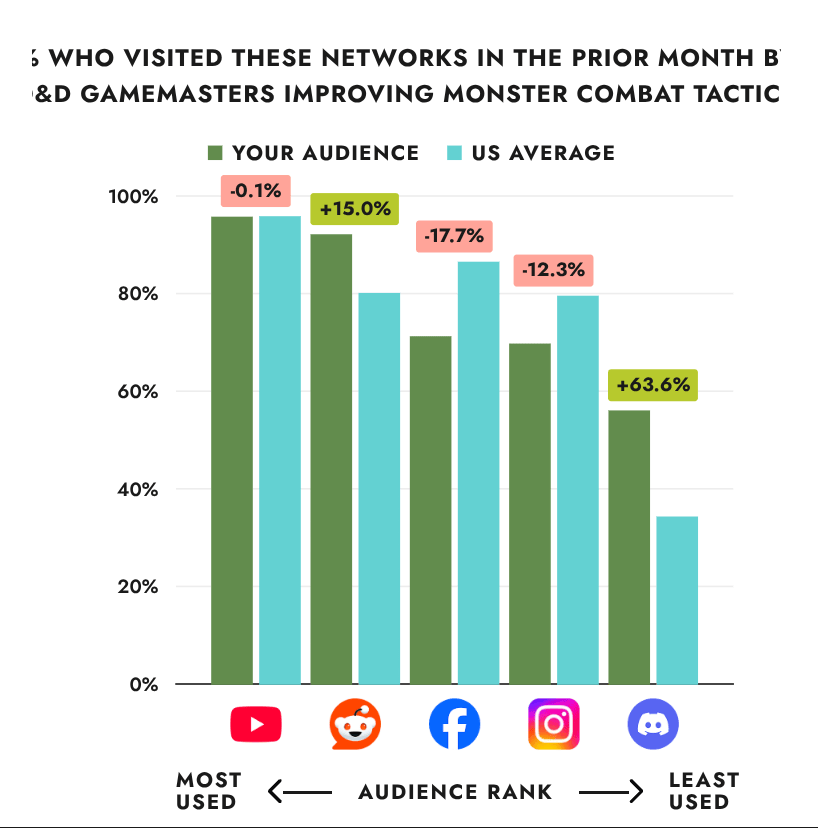
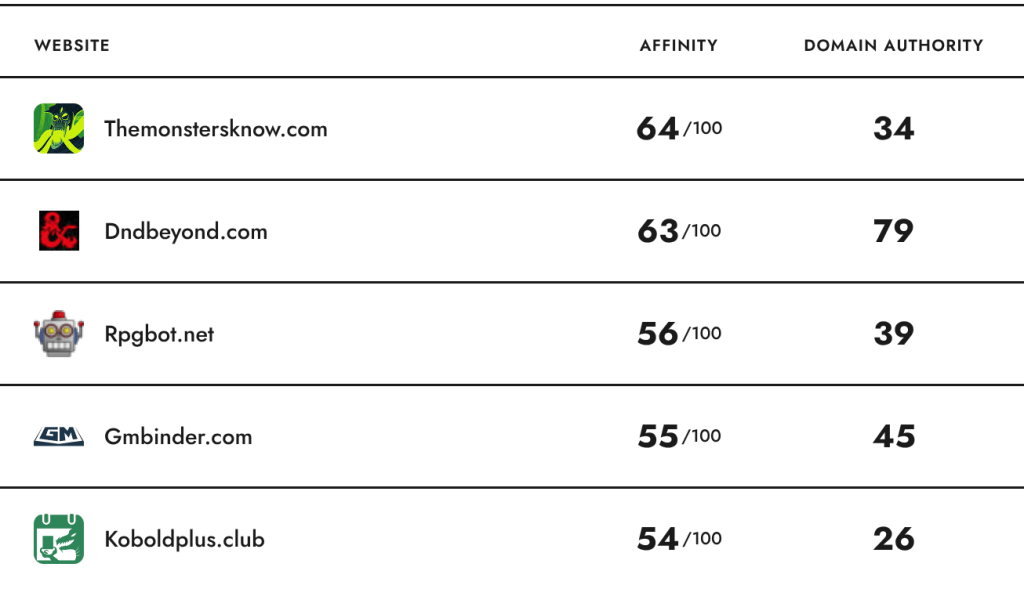
According to SparkToro, D&D gamemasters improving monster combat tactics over index on the following social platforms when compared to the general public — reddit, Discord.
Yes, this is different from the two other similar audiences I tested. Non-D&D fantasy players tend to over-index on X/Twitter while D&D social players and world builders see Pinterest enter the top 5.
Ammann needs to be present where the conversations about D&D monster tactics happen. Being on Discord is an easier win because that audience is very present there. Reddit is also popular. Paid Sparktoro likely shows presence in Bluesky, TikTok, Threads and more.
Build your distinct voice there
Knowing where your audience is and where you are comfortable means that’s where you should build your brand for marketing. Those are often seen as dirty words because of the style of commodity marketing, click bait and outright lying that can exist.
Here, for the small creator when using the word brand I’m talking about the identity of yourself and your creations. When I’m talking about marketing that’s a reference to building interest in your creations. That’s it.
Your voice should have a clear identity, as should your products. If I were selling a creation from Full Moon Storytelling it would be “story creep within D&D that empowers more support for the social pillar, especially by leaning into third places, cultural differences and building distinct enemies who challenge player characters across all three pillars.” If I were building towards marketing a product I would extend those conversations without necessarily linking or even naming my product every time.
I would just be me, more often.
Case study: Remonstered! The Monsters Know What They’re Doing
Ammann does build on rented land currently. I think his most popular platform currently is Bluesky and Discord, though there are certainly other rented lands where he exists.
Extending those conversations regularly that lean into what Remonstered! is without necessarily mentioning it every time would be natural and normal.
It’s not about selling; it’s not even about marketing.
It’s about identity.
There’s another gap that Ammann could build towards — the second most important website for his audience is DnDBeyond.
It’s awesome to see that the audience description already knows of Keith’s owned land (I’ll discuss that more in a bit).
There are two ways to take advantage of that massive audience Beyond.
Offer advice on how to build in ideas from the book within Beyond. That could include how to use Homebrew, how to use the new scene prep or how to structure encounters within Beyond. Those tips should capture audience interest.
Participate in their forums. According to SparkToro Beyond has more than 7 million monthly visitors. Wizards of the Coast uses a much larger number, recently claiming 20 million. Whichever is accurate doesn’t matter. What matters is that this is rented land where an identity can be built via their forums.
Own your territory
Rented land must be used. There’s a potential to go viral there that is impossible on your own blog these days. But that doesn’t mean you abandon your blog.
It means your blog posts can become fragments to share on social platforms, useful references for your product, a way to send emails (every blog and newsletter service can do both things now) and establishes the home where you clearly link your purchasable products, crowdfunding and sponsorship opportunities (Patreon, ko-fi, itch, etc).
Your land is where you build what you send elsewhere.
This reinforces your identity when people search for it — zero-click marketing is essentially owning a search for your identity. Your clips and shorter content on various social platforms show people who you are in small bites. Your land (blog/newsletter) show people how to support that.
Case study: Remonstered! The Monsters Know What They’re Doing
The Monsters Know does a great job of owning the space. Remember that chart above? Gamemasters who want to know how to more effectively use the monsters in D&D and other fantasy games go there.
Ammann also sends out newsletters from that blog. It can be followed via RSS and it auto-posts to a few social platforms as well. You should do this with your blog too. Just don’t think that auto-posts are enough. That link back to your blog will be clicked so infrequently it won’t matter, until it does.
Chunking out your posts to send to the rented land is great. Don’t give away the whole hog though. Give people enough from a blog post that they are both smarter than they were while also searching to learn more.
Maintain your identity
No matter the platforms you are on you have to be yourself. Small RPG studios and independent creators don’t need to be everything at once. They can’t be.
Your identity, your brand, should be tight and understood quickly. It can still be diverse. See my presence as a story-first social DM who also enjoys sports, coffee and Puget Sound — that’s my space.
Use hashtags or topics to clarify specific posts, to connect a statement to a specific product, but also know that a distinct identity is what people want to see.
You may want to know what your audience is talking about throughout the open internet. While Google Alerts used to be a good way of tracking that I find it misses most social conversations.
AlertMouse can replace that for a single topic for free. I use AlertMouse to understand ways that other creators are using the 5e ecosystem to expand on non-combat pillars of play. Then I participate in those conversations either here on the blog or on their social platforms.
Case study: Remonstered! The Monsters Know What They’re Doing
Not studying Ammann’s presence on his primary platforms recently I’ll need to work from memory when we first met on a platform neither of use now, and his known presence on shared Discords.
On those Discords he’s present offering advice on tactics, on writing, on discoveries when using other systems. This is excellent.
One thing I’d like to see more is the chunking out of lessons from the old book to the new one — show us a bit of what’s changing. Show us the why.
Take those bits from the owned land and share them on the platforms where the audience either exists already or where he wants to build it. If either of those include Bluesky (ATProtocol) or Mastodon (Fediverse) setting up BridgyFed can dramatically expand that audience without more work.
*I asked Keith Ammann if I could feature his latest book in this blog post, but am not compensated for this work. Some of these ideas may not work for Remonstered! Some may. Modern marketing requires more experimentation and effort than the 20-teens.
*SparkToro, nor Amanda Natividad, sponsored this post either. I use their tools professionally in my full-time work and would do so if I ever decide to make gaming products. I strongly recommend Amanda’s podcast for short-form audio to understand modern marketing.
*I also use AlertMouse to track and build various stories on Full Moon Storytelling. Using this code gives you more tracking over the conversations that you need to monitor.
In review
No one clicks on links any more.
People are still buying things, usually using a search to find what they want after being interested in the product over time.
Establish an identity with creations that people are interested in using both rented (social platforms) and owned (blog, newsletter, podcast) land.
Participate as a unique individual worthy of support with consistent themes.
Blog again, and then use those posts as the foundation of smaller content. Do not include links, not even in comments, on most platforms.
No one clicks on links any more. Don’t worry about that.
Shortly after the critical success and box office miss of Dungeons & Dragons: Honor Among Thieves Paramount ordered a sequel script. John Francis Daley and Jonathan Goldstein wrote it. Paramount, pre-Skydance acquisition, rejected it.
That movie project is not dead, according to Daley-Goldstein who wrote, directed and produced Honor Among Thieves. Hasbro and their core producers are welcoming the duo to shop the script.
Directors John Francis Daley and Jonathan Goldstein say rights holder Hasbro remains determined to find a new studio home for “Dungeons & Dragons 2.”
…
“Yeah, absolutely,” Goldstein told DeAngelo when asked whether anyone was still trying to make the economics work. “I think Hasbro is a big believer in it, and if they can figure out a studio partner to make it work, they’ll want to proceed. As are our producers.”
Now, there are a lot of reasons why Hasbro would be interested in the movie being made.
They’d share the cost, though both Paramount and Hasbro took impingements.
Stranger Things is no longer a cultural phenomena. The expansion series are not generating the interest the original five season series did.
The Forgotten Realms project run by Shawn Levy and written by Drew Crello after Rawson Marshall Thuber’s original writing is dead.
The D&D Documentary run by Joe Manganiello and Kyle Newman is probably dead as it missed the 50th year anniversary it was announced for, by a lot, while remaining in pre-production.
It’s going to be a while before D&D for TV or movies are back, and from the above you may notice that lots of projects don’t make it from publicly acknowledged to publicly available — the only one not on the list in the post-covid environment is a single episode of Secret Level.
Additionally Hasbro-Wizards of the Coast had some involvement in Onward!, Stranger Things and are adjacent to sometime competitor/sometime cohort Critical Roles’ two animated series, kinda.
Fantasy TV and movies are in a bit of a downturn lately. The Game of Thrones follow-ups aren’t as popular as that powerhouse. Cancellations despite strong critical reception are common. Cancellations of shows that were putting up numbers are common. Willow gone. Shadow & Bone gone. Six of Crows, announced and never made. Wheel of Time gone, but coming back animated. Rings of Power’s slow release schedule probably meant you forgot about it.
When Paramount rejected the D&D:2 script they were scaling way back in order to get bought, eventually by Skydance. They are pulling out of that slow two years.
Maybe the new Skydance-Paramount merger could mean they get back involved. David Ellison has a history of working with Hasbro, with Paramount before he owned them, and it is the press tour for his movie with Daley-Goldstein where the news of D&D:2 remaining in market became public.
There’s additional pressure on Paramount and probably Warner Bros to get movies into the pipeline — their merger includes promises of 30+ movies total from the two legacy studios. To avoid lengthy legal battles one or both may start announcing a slate of projects soon, especially ones that are made in the U.S.
Hasbro will want a film because they want to maintain interest in D&D the Brand — placements in big box stores, theaters, the top of Amazon — that can’t happen from core D&D. Plus, they never really released a book to go along with Honor Among Thieves, instead they merely credited Daley with co-writing one chapter in one book.
The new “franchise” format should support co-releases much better. The seasons system could capture a Season of Thieves easily.
Brandon Sanderson’s TV project, and the massive RPGs going along with it, are building up.
Maybe competition, the legal issues around the merger of mergers, and the knowledge that Honor Among Thieves held streaming legs for two full years is going to push D&D:2 from written to pre-production.
Full Moon Storytelling is brought to you by Kristin Clark of Keller-Williams Lake Washington If you are looking to buy or sell a home in King or Pierce County, Washington support Full Moon Storytelling by supporting Kristin.
She’s my partner in everything I do.
Fediverse reactions
Full Moon Storytelling is brought to you by Kristin Clark of Keller-Williams Lake Washington If you are looking to buy or sell a home in King or Pierce County, Washington support Full Moon Storytelling by supporting Kristin.