Category: World of the Everflow

My homebrew world where tales of animal companionship, forgotten magic, and the question of who controls information are told.

  • Chupmolea Transit Center of Sheljar

    When the Queen’s Fleet discovered Sheljar they landed in the NW suburbs where the cliffs become hills. There’s a cave system that they originally used to hide their aixips. Now, after the elimination of the Necromancer and the Tunneling Nightmares, their little neighborhood among the hills is a densely populated, for the Free City of Sheljar, space that is a transit hub by sea and sky. Each of the guilds are represented in the many dozen gobkons that have settled in the space.

    The main space where all peoples of the Everflow interact with these goblins, hobgoblins, and mulgobs is the Chupmolea Transit Center of Sheljar. It has space for seafaring vessels, multiple sky gondolla cables and a spire for airxips to dock as well.

    Paths

    1. A cable car gondola to the Grand Entry to the Free City of Sheljar.
    2. A harbor with regular small ferry service to the City Center.
    3. A cable car gondola to the City Center.
    4. Exit to the Chupmolea Square, the main plaza in the goblin suburb. There are hills to the Western Wildes beyond the plaza.
    5. A high, arcing bridge to a tiny island now occupied by a dwarven family.
    6. Swyns café.

    Peoples

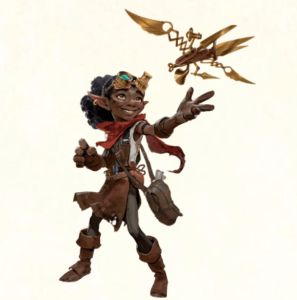
    Chupmolea – Grand Mistress of cables, she rode with the Queen’s Fleet as part of a minor house. Her quick thought to connect the bog-city via sky-cable gondola earned her two flags. On her left shoulder are now five flags, two from her house and three she earned. She has a hook-spear used to guide gondolas to their spaces.

    Swyn – a mulgoblin that discovered the power of coffee. Their café is a center of gossip and a primary spot for non-goblins to meet goblins. Swyn is always in an oilcloth apron (effective as leather armor), has random burn scars from roasting coffee, and carries a small, for them, cup of coffee.

    Blerxa and Patha – two goblins of different guilds, these sisters are arguing over maintaining a connection to the Queen. Blerxa has many more flags on her left shoulder, nearly running out of space. Patha has a single flag for self and one for house.

    Umikdrael Honorfeet – one of the dwarves from the nearby isle. He seems a bit lost and flustered by all the damn noise. He is constantly glancing at his notebook and then at the skyline. There is a lantern drake sitting on his hat.

    Peculiars

    The air reeks of burning tar from tar trees. There are fresh trees in the hills. But here in the city they are burned to power numerous teknikal devices.

    A constant clamor of mekiniks hammers in the background and foreground. There are grinding gears, ratchets, pneumatics and other systems that cause this neighborhood always loud.

    Unfortunately the brackish waters of the bog-city in this area are covered with a thin film of soot and tar.

    I’m doing Lore 24, an attempt to write small lore elements daily in the year 2024. Each element will be something that’s come up in play or will come up in play within my homebrew World of the Everflow — there will be actionable threads for PCs to grab onto and advance the story.

  • “Mom, where do dragonborn come from?”

    “Mom, where do dragonborn come from?”

    That’s a question I didn’t have an answer for. A player wanted to be a dragonborn, but they don’t exist in the world as I built it. That’s not always a great reason to not allow a race.

    When you build a limited world players either need to buy-in completely or you can work together to figure out how the character fits.

    When a player asked to be a warforged he came up with an incredible backstory. They were the only warforged, built by those that became gods. Wakened for unknown reasons (we knew it was because of the rediscovery of the powers that those who created them used) the warforged is an outsider who knows that the myths of the founding are reality, that idyllic times of the past can be recreated using the same tools that the past used.

    This also made sense because the player wasn’t familiar with the world as it is. Instead they created what it was and together the player and character learned the current reality.

    When I was approached about a player being a dragonborn I wasn’t ready. We worked the character in with no backstory, knowing that at some point it will come up again.

    Then DnDBeyond presented the following idea;

    The Rise of Dragonborn and Kobolds

    As the Dungeon Master, you can craft unique origins for draconic folk like dragonborn and kobolds. You could decide that the burst of magical energy released by a dragon’s death could lead to the spontaneous emergence of these people in nearby areas. Just as mysteriously as a dragon egg could appear, a dragonborn infant could be found napping among resting sheep. In such a case, would the party be responsible for ensuring the child’s safety? And what will they do or say if the child has been imbued with some of the dead dragon’s memories? Such an ill-fate could lead the child to grow up to resent the party and even become a villain themselves.

    What Happens When a Dragon Dies in D&D?

    Now, my brain started flowing.

    The dragonborn PC would be the ‘child’ of the first dragon the party had slain. They would be the embodiment of some part of the dead black dragon, with others born of the slaying being all of the evil parts. Some would even be able to bond and break bonds of animals. Black dragons hoarding bondings, making them incredibly hated in the World of the Everflow.

    The player took this up, learning about his characters birthing through play. The group has encountered a few other dragonborn, always black.

    This also gives the group something to think about — they’re about to fight up to three more dragons. What will that mean for the future dragonkin? Will they be mostly evil as the first dragonkin?

    Lessons for any DM

    • When a player approaches to play something unallowed in your world try to discover a lore path towards yes
    • Is it just the mechanics they want? Re-lore the banned item into something that makes sense
    • Use this opportunity to build a world together, rather than have it be only the DM’s world
    • Every thing you read is prep for your next session

  • Riff off everything — adding official monsters to your unofficial world

    Riff off everything — adding official monsters to your unofficial world

    Earlier today Wizards of the Coast released eleven free monsters in the Monstrous Compendium 2: Dragonlance Creatures. These are available for anyone with a free or paid account on DnDBeyond. You can access them through frontpage access.

    My campaign world doesn’t need more monsters, but it does need more ideas. That’s a great way to look at settings and adventures — they are other people’s ideas to put into your world. That’s a short cut to worldbuilding, and a great one.

    Goblins in the World of the Everflow are part of a smog-punk society building gadgets, very much like Tinker Gnomes, but grimy and greasy. Today’s release is an opportunity for me to use several new inventions in my world.

    The Nevermind Gnome Inventor has three inventions. The Flying Fangtrap is a springwork device with tiny wings that pinch and pierce to do damage and may even stop the movement of the target.

    In my world the Thunderscream gadget is an opportunity to latch onto the concepts from the Airmatics and Waterwerks Alliance. They could build a cannon of screaming sounds that damage like a breath weapon.

    Of course the Alchems Sisterhood would invent Flash Powder, the blinding simple fireworks that can aid the goblin to escape.

    The more complex Nevermind Gnome Mastermind has even more inventions that I will use at my table.

    Clockwork Claws that act like a third arm, or even a first or second arm; Chattergrab is essentially a grenade that is a bear trap; Phasmoball would be another invention from the Alchems.

    In just this one free download the World of the Everflow has six new inventions for goblins. You can borrow from official materials for your own world too.

    Maybe your world needs some undead knights? Use the Foresworn.

    Another variety of magical giantkin? Irda.

    Humanoid walruses? Thanoi.

    A unicorn older than every forest? Forest Master has impressive powers and is not the passive unicorn at the game’s core.

    Everything you encounter can be part of your session prep or worldbuilding, especially if it is a free release from the creators of the game.

    Fediverse Reactions
  • Timelines in the World of the Everflow

    Timelines in the World of the Everflow

    The timeline of the World of the Everflow is getting harder for me to track. There have been six campaigns with some overlap in both reality and at the table. In order for me to keep better track of events and so that the players and their characters have a better idea of events in the past prior to the campaign I started to build a timeline.

    The desire is that these are basically small phrases containing history, not a book of common knowledge to study. I’ll be adding to this as the players remind me of events, create things from their own history or ask questions.

    Current day

    Uprising & Rebellion 2 and Gendarmmes of Sheljar

    One year ago

    Red Oak burns, allowing red dragons to be born; Uprising & Rebellion 1; 7th Fleet of Daoud encamps to the south of Kirtin-on-the-Lake

    Five years ago

    Dragons and the Ken fly to Kirtin-on-the-Lake; Sheljar is freed from Necromancy and the Tunneling Nightmares; some Scholars (Diviner, Necromancer) are made public; Kin can learn magic

    Six years ago

    Goblin Queen’s Fleet lands near Sheljar; Discovery of the Lorebook of Divination; Children of Chorl created; Eruption of Dakan Thaeeb; Lorebook Hunters start their search

    Twenty-seven years ago

    Sheljar falls to the Necromancer

    Twenty-eight years ago

    Born Generation

    Seventy years ago

    Crinth Confederation re-structures to stop expansion of Azsel

    One hundred and twenty-two years ago

    Kirtin loses Kirtin-on-the-Lake again

    Two hundred and twenty-four years ago

    Kirtin retakes Kirtin-on-the-Lake

    Four hundred and sixty-four years ago

    Daoud takes Kirtin-on-the-Lake

    Seventeen hundred years ago

    Az and Sel establish the Bond, rising to godhood; other bondings besides dogs are discovered; the Goliath nation of Galinor disappears

    Two thousand years ago

    Church of Quar controls the Everflow and the Font of Two paths, becoming a continent wide faith; Mehmd closes off the empire with foreigners only allowed at Gate

    Millenia ago

    Quar and the gods create Habergeon, the Everflow and separate the Lands of the Six Kingdoms from the world of magic

  • Introducing Militia Actions to support base defense in urban rebellion play

    Introducing Militia Actions to support base defense in urban rebellion play

    In my Uprising & Rebellion Campaign Two the players decided to take on the Mayor’s forces in the open, rather than the dead of night or through obfuscation. In response the Mayor and his forces attacked their home base, the Rusty Clam. Dungeons & Dragons doesn’t do great for large battles.

    A few tweaks I made to more represent the fiction of a rebellious militia and their allies defending their most significant resource were;

    • Have the minions represent half of a squad. The idea here was that the lesser trained guards would break morale when they lost half their group.
    • Allow the PCs to set up themselves up where they wanted. This is their territory. They know it best.
    • Added actions to represent the other rebels and commoners who side with the goals of the uprising. These Militia Actions operate similar to Lair Actions. That initial use has been modified here.

    Militia Actions

    For the session these operated as a Lair Action for each PC. They were taken on the initiative count 10 after their own initiative, which worked out as PC1, enemy1, Militia Action1. That part was a success.

    Each Militia Action was tied to a saving throw by the NPCs. These were designed for Tier 2 play as that’s where the PCs in question are at this time, but since I used cantrips as a guideline they are easy to adjust.

    Funnel – the militia and/or commoners in support of your cause build a wall using objects or themselves to block a path. This wall is 5′ long per tier of play. A successful Strength save (DC 10/15/20/25 based on tier) enables the enemy to ignore the wall.

    Falling or Thrown Objects – the militia and/or commoners in support of your cause pick up objects nearby and throw them at the enemy. These objects do 1d8 damage per tier of play in a space that is 5×5/10x/10/15×15/20×20 by tier. A successful Dex save results in half damage (DC 10/15/20/25).

    Overturn Stand or Cart – the militia and/or commoners in support of your cause create an area of difficult terrain by using common objects to clutter the path. Any enemy passing through the area moves must use twice their movement through the 5×5/10x/10/15×15/20×20 space by tier. They may attempt to move at normal speed, and if using the Dash or Disengage actions, must succeed on a Con save (DC 10/15/20/25) or take 1d6 per tier damage and fall Prone.

    (this one needs the most work)

    Harass – the militia and/or commoners in support of your cause harass and pester the enemies in such a way that limits their defenses. This can be done by word or by minor physical altercation. The next attack by that enemy NPC or intelligent monster is at disadvantage. A successful Int save (DC 10/15/20/25) results in no disadvantage.

    Distract – the militia and/or commoners in support of your cause harass and pester the enemies in such a way that limits their attacks. This can be done by word or by minor physical altercation. The next attack against that enemy NPC or intelligent monster is at advantage. A successful Int save (DC 10/15/20/25) results in no advantage.

    Rally – the militia and/or commoners in support of your cause shouts in support of the PCs. The PCs are then granted 1d6 temporary hit points per tier of play. A successful Cha save (DC 10/15/20/25) by the leader of the enemy results in no temporary hit points being granted, this is to represent their ability to speak over or interrupt the rallying calls.

    Changes for the future?

    I may tie these to various skills or tools rather than saving throws. I had the players roll, and asking players to roll under for a success just didn’t make sense.

    Finally, I think I would allow a summoned swarm from the Propagandist use these when the Propagandist commands them via a bonus action. This would help raise the power level of a subclass that lacks in combat, though in many campaigns this wouldn’t be enough.

    Design Goals

    The primary inspirations for these actions were to mimic some of the play of Assassin’s Creed, where the small crowd of neutrals and allies can support your violence. There are also scenes in Black Sails where the common people of Nassau join the fight against the British. The invasion of Tear and other conflicts in the Wheel of Time feature actions by commoners supporting the heroes too. Various Robin Hood tales, the rescue of The Shire, the movie Aladdin, and so many other tales have common peoples helping the heroes by impeding the enemy.

    While highly urbanized campaigns aren’t common in D&D, they should be supported. The literature and other inspirations for the game do have these elements. Our game can include them in ways that are more than just background story.

    What improvements do you see needing attention?