Category: Playing D&D

Custom Backgrounds, classes, advice and more about Dungeons & Dragons

  • Arise & Descend: Finally a Long Rest

    Arise & Descend: Finally a Long Rest

    Awf Hornjaw et Loragwyn and the Brigade (formerly Droop’s Brigade) may have reached the end of Lost Mines of Phandelver. Or not. It’s hard to know. Everyone’s favorite axe-wizard and friends may have killed their final enemy, and they may even have rescued a Rockseeker brother.

    After putting session recaps on pause for a while, I’m returning to recapping our near-weekly campaign that started with D&D’s Starter Set and is likely to continue in Avernus. Recaps will only be written after Long Rests.

    There may be spoilers. Don’t read on if you don’t want them.

    Photo by Jeremy Bishop on Pexels.com

    Pages: 1 2

  • Taien Sahul – the ripper lizard

    Taien Sahul – the ripper lizard

    Out in the lands of Mehmd mammals and avians are rare. Many of the ecological and domestic niches are instead filled by lizards, amphibians and dinosaur-like creatures. The Taien Sahul are small saurs based on the Velociraptor by Sam Stockdale at ENWorld.

    In Mehmd they tend to roam the wilderness, though certain tribes of Unkempt in the South and the Isles use them as companions. When free they roam in packs of 9 or so (3d6). Their Pounce needs quite a distance in order to be used, but when the commit they tend to rush prey quickly. Taien Sahul can survive in deserts, having advantage on CON checks to deal with dehydration.

    Photo by Innermost Limits on Pexels.com

    Taien Sahul – the ripper lizard
    Small beast, unaligned

    Armor Class 13 (natural)
    Hit Points 3 (1d6)
    Speed 45 ft., climb 10 ft.

    STR 7 (–2)
    DEX 15 (+2)
    CON 10 (+0)
    INT 3 (–4)
    WIS 14 (+2)
    CHA 7 (–2)

    Skills Perception +4, Stealth +4
    Senses passive Perception 14
    Languages —
    Challenge: ½ CR 50 xp

    Keen Sight: The raptor has advantage on sight-based Perception (WIS) checks.
    Pounce: If the raptor moves at least 30 feet straight toward a target and then hits with a claw attack on the same turn, that target must succeed on a DC 10 Strength saving throw or be knocked prone. If a target is prone, the raptor can make one bite attack against it as a bonus action.
    Pack Tactics: The raptor has advantage on an attack roll against a target if at least one of the raptor’s allies is within 5 feet of the target and isn’t incapacitated.

    ACTIONS
    Multiattack: The raptor makes two melee attacks, usually using both claws unless they’ve pounced.
    Bite: Melee Weapon Attack: +4 to hit, reach 5 ft., one target. Hit: 1d4+2 piercing damage.
    Claws: Melee Weapon Attack: +4 to hit, reach 5 ft., one target. Hit: 1d4+2 slashing damage.

  • Inspiration Is Everywhere: Trees

    Inspiration Is Everywhere: Trees

    There’s a doc open on my computer almost every day. I’m crafting an original D&D adventure for a charity game come spring time. For that adventure I’m researching various tree-monsters. These are common in the fiction which is inspired by and that inspired Dungeons & Dragons. There’s Treants/Ents from Lord of the Rings and the Flying Forest and Sentient Trees of The Magicians.

    Within the game there are Awakened Shrubs and Awakened Trees in the Basic Rules. Kobold Press introduces us to a Dragonleaf Tree, in Tome of Beasts for 5e.

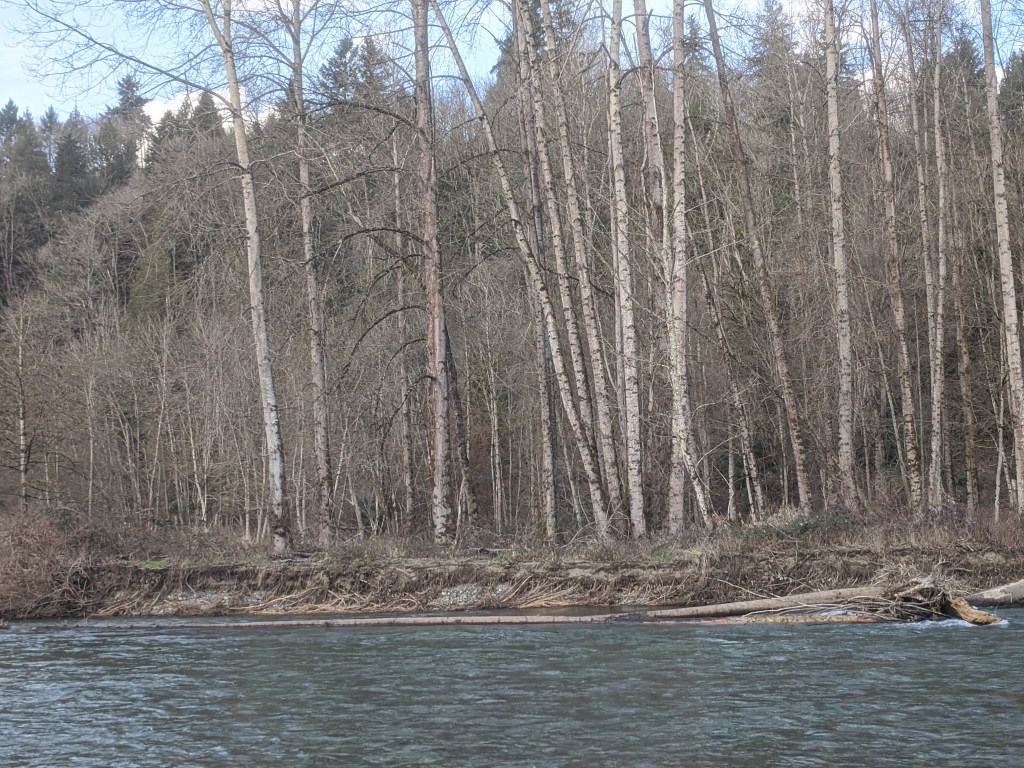
    But trees can help us with more than just monsters. They can inspire creative decisions. Look at this stand across the river.

    There’s some scarring from disease, or something, several dozen feet up. Take a closer look at that.

    Put your “not in the real world” hat on. What if that scaring was from a massive beast? What if the Giant Elk of this realm were so huge that their antlers (looking it up, yes elk have antlers) rubbed off that bark that’s a full 30 feet or so above the river.

    What happens when a herd of them walk the river during logging season with their massive legs crushing through or between the barges? Or are these Elk the friends of your woodland dwelling elves, gnomes, goblins, or other races? Are they ridden like elephants?

    The answers are up to you.

    Trees are also our mighty connection to history.

    Tolkien recognized that. The age of trees is why the Ents knew so much and also why they’d become peaceful and rooted. When you see so much life pass before you are the little lives so precious?

    In the World of the Everflow, the Dragonleaf Trees are ancient, from the era before legends, when Dragons and the other Ken were part of the world of Kin. But they are also dying. A breed that is honored while also being forgotten. They do not seed. They do not spread. There are only twenty or so of these ancient trees left, with almost all of them in the Tree District of Qin.

    When a tree is a millennia old what does that signal in your world? Are they like the trees of Solace in Krynn, with homes and workplaces scattered within the branches? Or is it a single tree from the time before time the sits alone in a desert, with roots that stretch hundreds of feet down and branches in the sky that reach to the clouds, a trade post surrounding this tree so big that it creates its own climate?

    Every journey you take. Every book you read. Every show or movie you watch. Every song you here. Every social media post you scan.

    They’re all inspiration for your world, your character, your dreams. Share them with your table.

  • Latest Unearthed Arcana further uncouples race from mechanics

    Latest Unearthed Arcana further uncouples race from mechanics

    When a new Unearthed Arcana drops much of the focus is on the mechanics. They are mechanical tests after all. In some cases the development team removes story mentions to not taint the survey results. This UA drop is focused on playing as Undead or Fey. The purpose is to test Dhampir (emergent vampires, kinda), Hexblood (emergent hags, kinda), Reborn (those that hover between living and dead, mostly).

    Photo by freestocks.org on Pexels.com

    The mechanics are intriguing. The Dhampir has a bite attack that uses Constitution for its damage stat, which makes sense. The Hexblood has a superior version of Message and Arcane Eye combo. Reborn are sleepless, with a kind of elvish trance available.

    More important than the new racial options and mechanics is the sidebar titled Design Note: Changes to Racial Traits. Thanks to Justice Arman for calling this out on Twitter and forcing me to look deeper into the change.

    Let’s take it piece by piece.

    The first paragraph further emphasizes the small changes in Tasha’s Cauldron of Everything. It’s a solid reminder of the product and the small steps already taken.

    In 2020, the book Tasha’s Cauldron of Everything introduced the option to customize several of your character’s racial traits, specifically the Ability Score Increase trait, the Language trait, and traits that give skill, armor, weapon, or tool proficiencies.

    From UNEARTHED ARCANA 2021: Gothic Lineages

    Paragraph two is a reminder that the work is not done. Forward all D&D books are removing those elements from races that are purely cultural, as well as the Ability Score increase. This will obviously, and *necessarily*, impact the current races (a change that will be simpler via DnDBeyond and other digital systems than those with physical books. There will still be physical and magical differences for the characters with certain races.

    Following in that book’s footsteps, the race options in this article and in future D&D books lack the Ability Score Increase trait, the Language trait, the Alignment trait, and any other trait that is purely cultural. Racial traits henceforth reflect only the physical or magical realities of being a player character who’s a member of a particular lineage. Such traits include things like darkvision, a breath weapon (as in the dragonborn), or innate magical ability (as in the forest gnome). Such traits don’t include cultural characteristics, like language or training with a weapon or a tool, and the traits also don’t include an alignment suggestion, since alignment is a choice for each individual, not a characteristic shared by a lineage.

    The final paragraph is a strong reminder that a character is not the normal part of any culture, species, lineage, or race. The player-character occupies a unique space within a D&D world. They are heroes or anti-heroes, not paragons of a racial group.

    Finally, going forward, the term “race” in D&D refers only to the suite of game features used by player
    characters. Said features don’t have any bearing on monsters and NPCs who are members of the same species or lineage, since monsters and NPCs in D&D don’t rely on race or class to function. Moreover, DMs are empowered to customize the features of the creatures in their game as they wish.

    The multi-year critique directed at D&D in regards to its history and legacy of racism and racial-tinged rules is having an impact — a slow one. This are necessary changes. Some of them are small. Some of them are big.

    To borrow from Jemma Simmons, Agents of SHIELD, “The steps you take don’t need to be big. They just need to take you in the right direction.”

    These are steps in the right direction. This is progress. The path forward is exciting.

  • Tips about naming your characters

    Tips about naming your characters

    Naming characters can be hard. For a DM coming up with names at the spur of the moment can lead to a stoppage in play as their mind struggles to find something appropriate for the NPC that was supposed to be a background character, but your players have thrust that individual into a major role.

    For most players, naming a character is a rare event. It is usually the first or last thing that they do. Then, it’s over until the next campaign starts. Still, you want to get the proper name for your character, because you will carry it with you for a long time*.

    *strong exceptions for rogues, criminals, urchins, and the like.

    As someone who both creates way too many PCs, and once named a formerly non-notable NPC “Anderson” after the car dealer across the street from the restaurant hosting our session I’ve developed a few tricks to naming characters.

    Easy Button

    Those of you using DnDBeyond.com probably already know this, but the Fantasy Name Generator has well over 100 different naming categories. Click the category and it will spit out ten names. Simple is as simple does. Sometimes you’ll hit those buttons a dozen times to get the one you like.

    Xanathar’s Guide to Everything

    All the way back in November of 2017 Wizards of the Coast released Xanathar’s Guide to Everything. The book is most well known for being the first official significant expansion of character classes in 5th edition. Those people into optimization ranted against the inclusion of almost 20 pages of names.

    Frankly, it was a poor critique.

    There are so many more people picking up the game every day, every month, every year. They don’t have the knowledge base that stretches back editions. They may not want unofficial sources for fantasy names.

    Xanathar’s includes official lists of fantasy names as well as dozens of real cultures that are often captured within your gaming table. This section is one of the forgotten joys of Xanathar’s Guide to Everything. Cracking the book open to those sections should help inspire your next character’s name.

    Use Athletes for Inspiration

    After working in sports for nearly 15 years, there should be little surprise that they become part of my gaming paradigm. There’s a reason that Sports as a Tool exists in my worlds.

    Sports, particularly Olympic sports and soccer/football, are an excellent way to discover wonderful inspiration for names. Just look at the recent MLS SuperDraft.

    Mitch Guitar was drafted. Who doesn’t want to make a Bard called Mith Lyre now?

    Sondre Norheim was drafted. Could that be your next dwarf named after a powerful elven king? Yes.

    Real people and cultures can inspire your name. Honor those peoples through the name of your character.

    To discover new names head to a reference website covering a sport with international play. Click on a league outside of the mainstream, click a team at random, and combine a two-four players’ names. Drop a couple letters, or add a few. Research those players because their lives can help inspire you the same way that reading Tolkien can inspire you.

    Sports Reference, Soccerway, and Transfermarkt are my favorite places to do this.

    As a DM, I try to have a small selection of NPCs already made up ahead of a session. These index card sized characters are there because my players will always surprise me. Most of their names have come from various athletes around the world. Some will be consistent within a certain set of cultures, while others recognize that the fantasy worlds in which we play are generally as interconnected as the modern world in which we live.

    Your naming conventions should embrace the fact that the peoples travel extensively.

    How do you name your characters?