Category: Playing D&D

Custom Backgrounds, classes, advice and more about Dungeons & Dragons

  • So, you got into ShantyTok, now what

    So, you got into ShantyTok, now what

    Nearly everyone on the internet has heard The Wellerman a dozen times, with different variations popping up every day. Maybe you’ve even experimented with other sea shanties, because frankly when you are stuck at home the unity of the working-class’s songs helps you feel like you are part of something greater than yourself.

    That’s a large part of the reason that ShantyTok exploded off of Tik Tok to take over all social media. Now, it’s even inspired people to start talking about the best film about the Age of Sail — Master & Commander.

    Frankly, you need to add shanties to your D&D game too. There lots of ways to do this, from just a single character to an entire campaign. Do it. Have fun. Embrace the zeitgeist, and make your gaming community a group of unified purpose — surviving a sea and sometimes even a captain that hates you.

    Every Class Can Be A Pirate/Privateer/Sailor

    First and foremost, realize that any and every class can be a sailor of sorts. The obvious way is through the use of the Sailor/Pirate/Privateer Background. You already know this. You also know about the Swashbuckler, because you are a wise soul.

    But there is more than that. Every single Bard in the core D&D game can fill a role on a pirate ship, so can every Rogue. Most Clerics make sense, etcetera, etc. Be creative in the roles and purpose on a ship. Your concept belongs there, even a fully armored Paladin, with those drawbacks, belongs aboard a galleon in the Age of Sail.

    Just a quick glance at Tasha’s Cauldron of Everything shows some great concepts for your shanty-singing adventurer;

    • Artificer: Artillerist – Who needs gunpowder when you have magic cannons?
    • Cleric: Order Domain – Someone has to keep the law of the ship and boost the crew.
    • Druid: Circle of Stars – The blessings of the sky are vital during a trip across thousands of miles of ocean.
    • Rogue: Phantom – The latter Pirates of the Caribbean movies lean into tales where dead men talk.
    • Warlock: The Fathomless – duh

    Making the sea even a small element of a campaign gives space for your shanty-singing glory.

    Seas of Voldari

    What if every character was part of the story of the sea? That’s what Tribality’s Seas of Voldari explores. Their words describe the setting and ruleset well.

    The Seas of Vodari campaign setting was created to support seafaring adventures that focus on the crew of a ship hunting sea monsters, exploring mysterious uncharted islands, visiting bustling port cities, following maps to find buried treasure, and battling cutthroat pirates. The setting is also well suited to running campaigns in its large port cities, with swashbuckling heroes getting mixed up with fierce rivals, notorious crime syndicates, feuding nobles, and scheming politicians.

    From the sales page for Seas of Voldari

    The added classes, races, and backgrounds make life at sea the key element of most adventures. Add them to your existing campaign and your players have more options to enjoy their sugar & rum & tea.

    Be Creative: Add Shanties As A Landlubber

    While The Wellerman is all about the Age of Sail, shanties were not confined to life at sea. There are shanties about building railroads, working mines, and every other activity that requires a group to work in unison in miserable conditions — the marching and running songs of soldiers are related to shanties.

    Hi ho, hi ho
    It’s off to work we go

    Yes, your dwarves should sing shanties. Your drudge cutting down trees for the lumberyard should sing shanties. Your Bard at the bar should sing shanties, and so should your Battle Master.

    All times of needed unity are appropriate for the musical style.

    Other Inspirations

    Step away from The Wellerman. Listen to The Longest Johns or one of the many playlists built to feature shanties.

    This can add more ideas during campaign prep or character building.

    Watch Black Sails. It’s Hulu, Starz, and Prime (season 1) for no additional charge. The season one trailer opens you to the TV prequel for Treasure Island, but it’s season 4 that gets my blood pumping.

    There’s also the now-classic cartoon Pirates of Dark Water, which is especially handy if you want a Seas of Voldari campaign. It’s hard to track it down, but if you can find it the mix of piracy and fantasy is perfect for a Dungeons & Dragons.

    The films, books, comics, and such inspired by life at sea is numerous. Your approaches to integrating that into your campaign should be as big as the ocean.

    For forty days or even more,
    the line went slack then tight once more,
    All boats were lost, there were only four
    and still that whale did go.

    The quest of the Wellerman is the quest of Ahab, and a familiar quest for any adventurer, because it’s never done, merely paused for a bit of song and rum.

  • Prekx, Gujri, and Shrubbrs – the best fencers this side of Flowing Lake

    Prekx, Gujri, and Shrubbrs – the best fencers this side of Flowing Lake

    Prekx was happy to get hired for this job. Anytime he could get further from the village with all their suspicious eyes was good. Many still thought of him as a goblin, and not just a fence maker. Even now, with his reputation after building Gujri, the steel goat, to find the gaps and holes faster than real goats and at no loss of meat there were those who thought about the attack from his former tribe. Prekx didn’t even know his tribe. He’s just known the land around Flowing Lake.

    Growing up under the care of the mage Alizon, he learned what magic could do and that if you know the proper gestures, and words, and components you can just do things. Not normal things – big, impressive things. That’s how he learned the spells that helped him make up for his weak size — Mold Earth and Mage Hand.

    Magic helped him overcome size and strength. It introduced him to carpentry and the fine works of woodcarving. It helped him build Shrubbrs – that tiny cluster of branches and roots and thorns with a heart of fire-stone. Magic is where he turned, because that’s where he had his friend.

    Gujri would find the hole in the fence. Then Prekx and Shrubbrs would join the steel goat there to clear some land around it, make it easy for the human to repair. Instead of standing in brambles they would have space.

    Then it was off to towards the river. Someone needed a string-metal fence. Normals couldn’t make that. It’s a little invention that he came up with using his artifice. Lighter, and stronger, the string-metal fences were become popular. They will hold out the vermin, hopefully. There’s a flock of cockatrice and a cluster of giant spiders that are an issue lately.

    Maybe he can fence those towards each other? It would be easier than a herd of sheep being petrified or chicken coop covered in webs.

    “Gujri! Get over here,” Prekx shouts.

    The only answer is the crank of rusted metal. That’s another problem altogether.

    Photo by Artur Roman on Pexels.com

    Fence Making is Magic – an Artificer build

    The concept for this character started in a simple place. I was working on horse fencing, which is hard, physical drudgery. The thought sprung into my head ‘how would a D&D hero do this?’

    That starts with Mold Earth and Mage Hand. Between those most of the digging and walking over back-and-forth, back-and-forth, back-and-forth, sorry distracted by all that walking, just makes things easier. I looked into a sorcerer for that, but unfortunately it didn’t quite represent what I wanted.

    From there, taking the Feat: Magic Initiate became obvious. In order to be an expert carpenter (the closest tool to a fence maker in the game) meant one of three choices. Artificer felt better than Rogue and Bard. The reason for that is that the handy assistance from the built companions just made too much sense.

    Shrubbrs and Girji would be invaluable aids in maintaining and building a fence. Not only that, but a worker on the edge of a civilized area could use the extra defensive help from a steel goat.

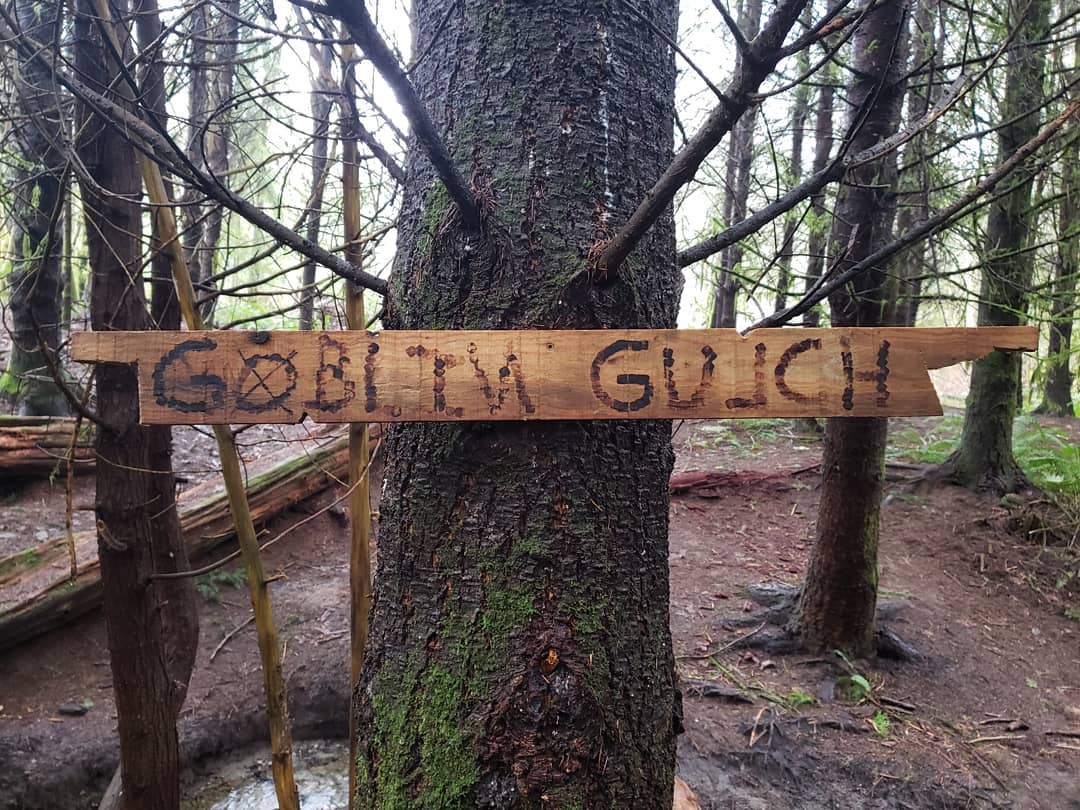
    Throw in a cool photo of Goblin Gulch, and now, a character is born.

    Goblin Gulch by Nick Wietzel

    There will probably be a deeper dive into Goblin Gulch later, but in Prekx’s case he left the Gulch when young.

    Prekx Booyahg Booyahg Booyahg of the Gulch is a goblin artificer, steel defender.

    He’s Flowing Lake’s (an idea I came up with during the recent flooding) best fence maker. That background was based on the Folk Hero, with minor tweaks.

    For the flaws I leaned into the goblin tribe he left, saying that the ruler there wants Prekx dead. Also, he learned to hate bullying from his youth as a goblin. He learned to love magic from his latter youth as a student with Alizon.

    His sincerity he picked up because he’s damn good at his job and he’s a goblin. He will never hide either of those things.

    Finally, he’s confident in his abilities and do what he can to instill confidence in others. But at times he will misuse long words because his education started late.

  • These are the three reasons I’m getting Candlekeep Mysteries

    These are the three reasons I’m getting Candlekeep Mysteries

    On a Tuesday during the depths of winter Wizards of the Coast announced their latest product release for Dungeons & Dragons — Candlekeep Mysteries. The adventure anthology format is not new to 5th edition. Previous releases Tales from the Yawning Portal and Ghosts of Saltmarsh were both collections, rather than full paths that are designed to be a campaign.

    Candlekeep Mysteries is different though. The design intent is that the 17 adventures can be completed in just a single session of a few hours. That’s a great tool for people who struggle to keep a group of players together meeting regularly for a massive path that takes months. Getting 2-4 others together for just 2-4 hours is much easier than planning a weekly session that lasts years.

    17 One-Shots

    That’s one of the key reasons to get this book. As someone who designs a massive world, I lean towards the campaign format. But that means throwing together a single session as more and more friends want to try to game is difficult.

    Now, I’ll have a resource of shorter content than the Starter Set or Stranger Things Boxed Set. Neither of those are able to be completed in 4 hours, though the Stranger Things box can probably be done in ten or so, even with someone as verbose as me.

    Having a book of one shots on hand will be an excellent addition to my DM tool chest.

    The Alt Cover Is Art

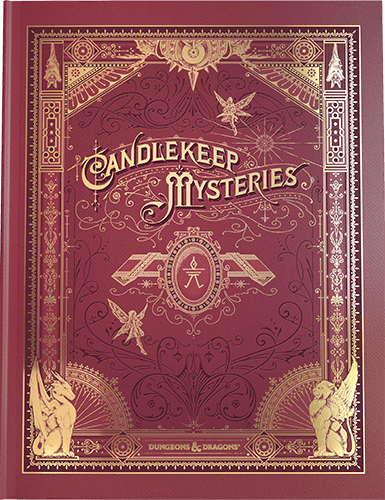
    Candlekeep Mysteries alternate cover is a soft finish deepish red with gold lettering and accent art. It appears as you might dream a tome on the shelves of the famed library-keep might look. There are arcane symbols and guardian drakes.
    The alternate cover is available at your local gaming store on March 16.

    Put that on a shelf in a public space, and your non-gaming friends will think you own a fancy tome. It’s brilliant and evocative. The only way you can get it is by supporting your local gaming store. You should always support your local, and particularly so in the current pandemic-economy which threatens their very existence.

    Yes, the other cover is more like your other books, and certain completionists might like that look. Me, I’m no longer interested in hiding my passion for D&D. I want fancy books and knickknacks that inspire people to ask me about my shelf space — whenever they can enter my home safely again.

    Embracing Critical Diversity

    Looking over the 19 authors behind the tome you see people who not only come from diverse backgrounds, but who are vocal in their critique of D&D’s history and present. These voices were not shunted aside, but instead featured in official product.

    And that diversity shows up in the adventure details that were released already. Kretchmer’s adventure features a wheel-chair accessible dungeon. This is a historically accurate detail that makes sense within a realm of magic. Official products embracing that design decision is wonderful. If you are creating adventures or other RPG content Jennifer’s reference Accessibility in Gaming is vital.

    Barber is a Black veteran from Canada who has critiqued Wizards, D&D, and other games for the way they address issues for his communities. Kwan is one of the voices behind Asians Represent. His voice has elevated the discourse regarding Asian themes within gaming. Now, both will feature in official product.

    As Jeremy Crawford states so often, “a diverse group is a strong group.”

    This collection of authors, editors, artists, and more embraces that concept and provides the DM with content that breathes that very statement. It is a brave and responsible action by a company to not only accept the often harsh criticism, but to take those critics and give them a larger voice.

    Pages: 1 2

  • Heroes Come From Everywhere

    Heroes Come From Everywhere

    If you didn’t get the clue from Darius Dondermonger, I enjoy heroes with interesting backstories. A cheese maker can become a famed ranger. Your cleric may have just been a mercenary, or a candlemaker. That butcher in the village that was conscripted? They’re now one of the realm’s greatest fighters.

    Photo by Daisa TJ on Pexels.com

    Backgrounds are the D&D rule that best embraces this concept in 5e. Toss in a dose of Xanathar’s Guide to Everything Chapter 1: Section: This Is Your Life and you’re on your way to having a backstory that embraces the pre-hero version of your character.

    Still, it takes a player that is willing to embrace that zero part of your zero-to-hero journey. It’s up to you to embrace the idea that a fence maker can become a powerful sorcerer.

    That’s essentially what the “My Next D&D Character Is…” thought-bombs are over on twitter. They are the embrace that these unconventional Dungeons & Dragons concepts are as valid as the the mercenary, the head of the local thieves guild, the student-wizard, the acolyte-cleric. Normal people get caught up in grand stories. Your adventuring party and character creation should embrace that.

    Make someone who is just exhausted by all the strife, or a town ball hero, the neighborhood helper/do gooder, the chessmaster, or so many more ideas.

    Throw off the yoke of convention and make the story that you want to tell. Make the character that embraces some small aspect of you, your friends, or just that person down the street – amplify that and create. All stories are valid. Everyone can become a hero.

    For the most part, when creating these types of characters with no homebrew rules I start with the Folk Hero Background (the Guild Artisan is #2), and then remove all of the skills, languages, and tools. The mechanics are then built around the profession. Use the tool that makes sense, add two skills that fit the closest to the concept, and then add a language or another tool to round out the idea.

    In DnDBeyond.com this is done in standard character creation during step 4, custom background. There’s then a choice of 2 skills + [options]. You will also be asked which feature to adopt (Rustic Hospitality is likely the best). It’s quick and easy, and part of the core system as 5th edition is designed.

    The more complex way is to partner with your DM to build custom backgrounds from scratch, or connect with me and take one of my 40+ concepts out for a test drive.

    Who is your next zero-to-hero?

  • Darius Dondermonger – inspired by dragons and cheese.

    Darius Dondermonger – inspired by dragons and cheese.

    Character concepts come from all sorts of places. Sometimes they grow over years, tended like a rare flower they sprout and bloom after long care. Then there are those that burst forth from your mind to page (actual or digital) in a flurry.

    Darius Dondermonger came into being when two roads combined. The first road originated some time ago, when the D&D released the Drakewarden. Dragons are quite important in the World of the Everflow, so I knew I would revisit the Drakewarden. The second road came when grocery shopping. We needed cheese, lots of cheeses. Yes, we’re fans of charcuterie. These roads merged when reading about Dragon’s Milk Stout’s web-RPG release. As often happens, flavor started to inspire the story.

    The Chef Feat in Tasha’s Cauldron of Everything is quite useful for someone who latches onto flavors like this. That pushed towards a Variant Human so that the foods he creates can help heal and/or inspire his companions towards greatness.

    Darius Dondermonger kept growing. From a legacy family in a small village, Darius was to be the head of household and manage the ageing of grana (think Parmesean and similar cheeses). Some of these for decades. They use adjuncts at times. That is what sent him to the forests and hills of the area.

    He is also flawed. Not only does he prefer the hunt for herbs and the like to management, he also prefers the making of cheese to business. That’s part of why he rejects the full family name. The other part is that he does not feel he’s earned that name, for he has lost something special to them.

    Lastly, he took on Dunder, due to his companion’s, and later his own, connection to thunder & lightning.

    He is more than just a ranger, more than just a cheesemonger specializing in aged cheeses – Darius Dondermonger has a small dragon companion and has discovered that he is also part dragon. The family’s most exclusive grana comes from their age-old connection to drakes, wyverns, and all of dragonkind.

    That same blood compels Darius to travel away from town, for someone with his powers cannot just work the books of Amberhearth and Highwall’s greatest cheese makers. Someone with the blood of dragons must, must, pursue a grander destiny — and also find that which they’ve lost.