Tag: homebrew

  • Chupmolea Transit Center of Sheljar

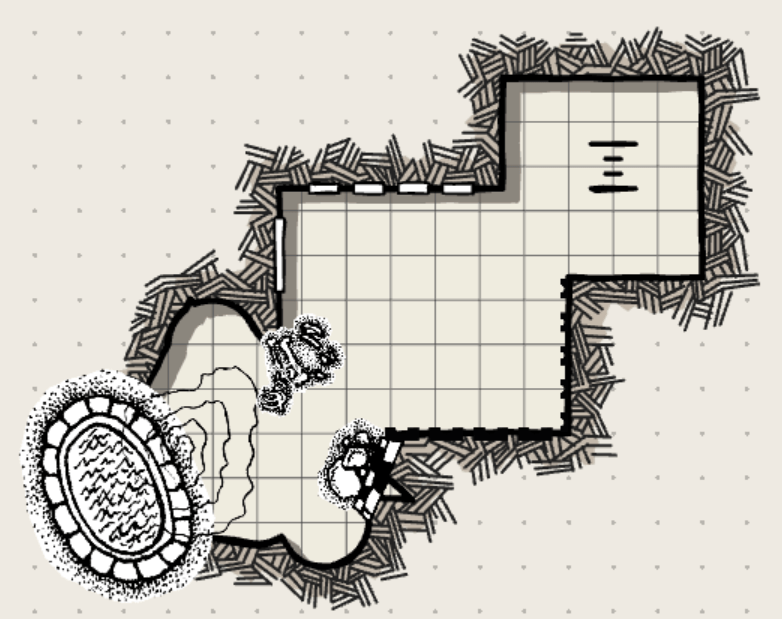
    When the Queen’s Fleet discovered Sheljar they landed in the NW suburbs where the cliffs become hills. There’s a cave system that they originally used to hide their aixips. Now, after the elimination of the Necromancer and the Tunneling Nightmares, their little neighborhood among the hills is a densely populated, for the Free City of Sheljar, space that is a transit hub by sea and sky. Each of the guilds are represented in the many dozen gobkons that have settled in the space.

    The main space where all peoples of the Everflow interact with these goblins, hobgoblins, and mulgobs is the Chupmolea Transit Center of Sheljar. It has space for seafaring vessels, multiple sky gondolla cables and a spire for airxips to dock as well.

    Paths

    1. A cable car gondola to the Grand Entry to the Free City of Sheljar.
    2. A harbor with regular small ferry service to the City Center.
    3. A cable car gondola to the City Center.
    4. Exit to the Chupmolea Square, the main plaza in the goblin suburb. There are hills to the Western Wildes beyond the plaza.
    5. A high, arcing bridge to a tiny island now occupied by a dwarven family.
    6. Swyns café.

    Peoples

    Chupmolea – Grand Mistress of cables, she rode with the Queen’s Fleet as part of a minor house. Her quick thought to connect the bog-city via sky-cable gondola earned her two flags. On her left shoulder are now five flags, two from her house and three she earned. She has a hook-spear used to guide gondolas to their spaces.

    Swyn – a mulgoblin that discovered the power of coffee. Their café is a center of gossip and a primary spot for non-goblins to meet goblins. Swyn is always in an oilcloth apron (effective as leather armor), has random burn scars from roasting coffee, and carries a small, for them, cup of coffee.

    Blerxa and Patha – two goblins of different guilds, these sisters are arguing over maintaining a connection to the Queen. Blerxa has many more flags on her left shoulder, nearly running out of space. Patha has a single flag for self and one for house.

    Umikdrael Honorfeet – one of the dwarves from the nearby isle. He seems a bit lost and flustered by all the damn noise. He is constantly glancing at his notebook and then at the skyline. There is a lantern drake sitting on his hat.

    Peculiars

    The air reeks of burning tar from tar trees. There are fresh trees in the hills. But here in the city they are burned to power numerous teknikal devices.

    A constant clamor of mekiniks hammers in the background and foreground. There are grinding gears, ratchets, pneumatics and other systems that cause this neighborhood always loud.

    Unfortunately the brackish waters of the bog-city in this area are covered with a thin film of soot and tar.

    I’m doing Lore 24, an attempt to write small lore elements daily in the year 2024. Each element will be something that’s come up in play or will come up in play within my homebrew World of the Everflow — there will be actionable threads for PCs to grab onto and advance the story.

  • “Mom, where do dragonborn come from?”

    “Mom, where do dragonborn come from?”

    That’s a question I didn’t have an answer for. A player wanted to be a dragonborn, but they don’t exist in the world as I built it. That’s not always a great reason to not allow a race.

    When you build a limited world players either need to buy-in completely or you can work together to figure out how the character fits.

    When a player asked to be a warforged he came up with an incredible backstory. They were the only warforged, built by those that became gods. Wakened for unknown reasons (we knew it was because of the rediscovery of the powers that those who created them used) the warforged is an outsider who knows that the myths of the founding are reality, that idyllic times of the past can be recreated using the same tools that the past used.

    This also made sense because the player wasn’t familiar with the world as it is. Instead they created what it was and together the player and character learned the current reality.

    When I was approached about a player being a dragonborn I wasn’t ready. We worked the character in with no backstory, knowing that at some point it will come up again.

    Then DnDBeyond presented the following idea;

    The Rise of Dragonborn and Kobolds

    As the Dungeon Master, you can craft unique origins for draconic folk like dragonborn and kobolds. You could decide that the burst of magical energy released by a dragon’s death could lead to the spontaneous emergence of these people in nearby areas. Just as mysteriously as a dragon egg could appear, a dragonborn infant could be found napping among resting sheep. In such a case, would the party be responsible for ensuring the child’s safety? And what will they do or say if the child has been imbued with some of the dead dragon’s memories? Such an ill-fate could lead the child to grow up to resent the party and even become a villain themselves.

    What Happens When a Dragon Dies in D&D?

    Now, my brain started flowing.

    The dragonborn PC would be the ‘child’ of the first dragon the party had slain. They would be the embodiment of some part of the dead black dragon, with others born of the slaying being all of the evil parts. Some would even be able to bond and break bonds of animals. Black dragons hoarding bondings, making them incredibly hated in the World of the Everflow.

    The player took this up, learning about his characters birthing through play. The group has encountered a few other dragonborn, always black.

    This also gives the group something to think about — they’re about to fight up to three more dragons. What will that mean for the future dragonkin? Will they be mostly evil as the first dragonkin?

    Lessons for any DM

    • When a player approaches to play something unallowed in your world try to discover a lore path towards yes
    • Is it just the mechanics they want? Re-lore the banned item into something that makes sense
    • Use this opportunity to build a world together, rather than have it be only the DM’s world
    • Every thing you read is prep for your next session

  • Barbers and bloodletters – hedge healers belong in your D&D campaign

    Barbers and bloodletters – hedge healers belong in your D&D campaign

    Waterdeep, Tear, Dragaera City, Tajar, Zobeck — whatever the city in your world, there are barbers. The technology exists, and the art of Dungeons & Dragons provides a dazzling array of hair and beard styles that go well beyond those from the real world. But how would you play a barber or stylist in D&D?

    That’s easy, via backgrounds. They’re what you were before. Maybe some heroes, especially rogues and bards, would learn to use their common implements as weapons. But anyone could be a stylist or barber before.

    Get your shave and a haircut for two silver.

    Photo by RODNAE Productions on Pexels.com

    Barber

    Whether in a big city or travelling between cities, you are an expert at maintaining hair whether on face or head. With your scissors or razor you create art with hair. Additionally you are capable of non-magical healing. Depending on your practice you may use leaches, your blades or some other form of blood letting.

    Barbers, under any name, are also strong conversationalists. When others are in your stool or chair they feel welcome, sharing the conversation of the neighborhood and their own life.

    Skill Proficiencies: Insight, Medicine
    Tool Proficiencies: Barber’s Tools, Healer’s Kit
    Languages: No additional languages
    Equipment: Barber’s kit, two Healer’s Kits, two vials of perfume, a stool, pouch with 5 gold.

    Feature: Bloodletting

    Whether via razors or leaches, using an action the Barber grants a willing creature the ability to expand a hit die to heal or recover from certain non-magical conditions (Charmed, Frightened, Incapacitated, Paralyzed, Poisoned, Unconscious). The creature takes on a level of exhaustion.

    Personality traits would be similar to the Folk Hero, the Acolyte and the Fisher.

    Barber’s Kit

    Cost: 25 gp | Weight: 2 lbs

    Proficiency with Barber’s Tools means that you are familiar with how to style hair — cutting it, braiding it, etc. You can color it with various dyes as well. The kit includes a couple razors, scissors, a silver mirror, lotions, dyes, hair ties and other small items to help the barber.

    Photo by Nikolaos Dimou on Pexels.com

    Design Goals

    Once upon a time I read, played and DMed in al-Qadim. The Arab/Turk/etc-ish setting included a barber, part healer and part friendly ear. That barber and their role in post-Renaissance England as “surgeons” fits many of the worlds of D&D.

    They aren’t common in literature and games that inspire our games. That’s okay. They should be. Visiting a barber should be part of the story, even in magical worlds. Mending and Prestidigitation don’t trim your locks or beards.

    Have a conversation, look better, maybe get a tiny bit of natural healing (no, it doesn’t work like this in real life). Also, I really like my stylist Chamaine.

    Custom Backgrounds for 5th edition Dungeons & Dragons

  • Adding Feats to 5e Backgrounds

    Adding Feats to 5e Backgrounds

    Spelljammer is already on printing two. That’s because they need to make some changes to the Hadozee for reasons of insensitivity. They’re good changes and Wizards of the Coast is changing the processes that allowed the culturally insensitive material to appear first too. This new printing has other errata too.

    The one that sticks out is the addition of Feats to every Background.

    “These backgrounds each give a feat. If a character takes a background from elsewhere and doesn’t get a feat from that background, the character gains one of the following feats of the player’s choice: Magic Initiate, Skilled, or Tough.”

    Dragonlance will have something similar. For Dragonlance this was because these are characters in a war. They must be stronger, tougher, etc. In Spelljammer it kind of makes sense. Normal people aren’t space halflings and asteroid dwarves.

    Similar to the Dragonlance decision my world has an additional feat at first level. In the case of the World of the Everflow these choices are;

    • Kin get a Bonded Companion.
    • Ken get a feat that grants a cantrip.
    • Kon get Artificer Initiate and the Rock Gnome’s tinker ability.

    Similar to the Dragonlance decision to add Feats this was done to add flavor, speaking to the types of powers that people from various continents have.

    With One D&D’s playtest we know there’s a chance at adding Feats for everyone at 1st level.

    What if the One D&D system of 1st Level Feats was added to 5e now?

    You could add Feats to any character in the current game with a minor, but not overwhelming, increase in power with a few simple guidelines.

    1. Only allow Feats that don’t have a +1 to an attribute.
    2. Don’t allow the +5/-10 Feats.
    3. Don’t allow Lucky.
    4. Don’t allow Polearm Master

    That’s it.

    Now you can have flavorful feats in your 5e game at 1st level.

    Instead, attach Feats to Backgrounds

    Now, my current world attaches Feats to racial choices, but one could choose to go the path of Dragonlance, Spelljammer, and Strixhaven. Each of those books assigns their unique Backgrounds specific Feats for flavor.

    A more flexible system would be to attach Feats on a small curve. Those Feats would be selected to emphasize specific stories typically told regarding that Background.

    Using my most popular original Background, the Tinker, as an example. We’ll include the three default Feats from the errata — Magic Initiate, Skilled, Tough. Then only selecting Feats from the Player’s Handbook, Tasha’s Cauldron of Everything, and Xanathar’s Guide to Everything since those are a core book and the two rules expansions.

    Actor reminds me of Paden Fain. Artificer Initiate seems obvious. Linguist fits the wanderer mold. Ritual Caster makes sense to capture the one who picks up hedge magic.

    Putting those on a chart with a curve using two dice can influence the commonality of the Feats.

    Roll 2d4 or choose your favorite.

    2. Magic Initiate
    3. Tough
    4. Linguist
    5. Actor
    6. Skilled
    7. Ritual Caster
    8. Artificer Initiate

    Since it looks likely that Before We Were Heroes won’t be ready before the 2024 edition, I’m thinking of adding that Feat guidance to each listed Background.

    Have another Background you’d like a Feat Chart for, ask in comments.

  • Introducing Militia Actions to support base defense in urban rebellion play

    Introducing Militia Actions to support base defense in urban rebellion play

    In my Uprising & Rebellion Campaign Two the players decided to take on the Mayor’s forces in the open, rather than the dead of night or through obfuscation. In response the Mayor and his forces attacked their home base, the Rusty Clam. Dungeons & Dragons doesn’t do great for large battles.

    A few tweaks I made to more represent the fiction of a rebellious militia and their allies defending their most significant resource were;

    • Have the minions represent half of a squad. The idea here was that the lesser trained guards would break morale when they lost half their group.
    • Allow the PCs to set up themselves up where they wanted. This is their territory. They know it best.
    • Added actions to represent the other rebels and commoners who side with the goals of the uprising. These Militia Actions operate similar to Lair Actions. That initial use has been modified here.

    Militia Actions

    For the session these operated as a Lair Action for each PC. They were taken on the initiative count 10 after their own initiative, which worked out as PC1, enemy1, Militia Action1. That part was a success.

    Each Militia Action was tied to a saving throw by the NPCs. These were designed for Tier 2 play as that’s where the PCs in question are at this time, but since I used cantrips as a guideline they are easy to adjust.

    Funnel – the militia and/or commoners in support of your cause build a wall using objects or themselves to block a path. This wall is 5′ long per tier of play. A successful Strength save (DC 10/15/20/25 based on tier) enables the enemy to ignore the wall.

    Falling or Thrown Objects – the militia and/or commoners in support of your cause pick up objects nearby and throw them at the enemy. These objects do 1d8 damage per tier of play in a space that is 5×5/10x/10/15×15/20×20 by tier. A successful Dex save results in half damage (DC 10/15/20/25).

    Overturn Stand or Cart – the militia and/or commoners in support of your cause create an area of difficult terrain by using common objects to clutter the path. Any enemy passing through the area moves must use twice their movement through the 5×5/10x/10/15×15/20×20 space by tier. They may attempt to move at normal speed, and if using the Dash or Disengage actions, must succeed on a Con save (DC 10/15/20/25) or take 1d6 per tier damage and fall Prone.

    (this one needs the most work)

    Harass – the militia and/or commoners in support of your cause harass and pester the enemies in such a way that limits their defenses. This can be done by word or by minor physical altercation. The next attack by that enemy NPC or intelligent monster is at disadvantage. A successful Int save (DC 10/15/20/25) results in no disadvantage.

    Distract – the militia and/or commoners in support of your cause harass and pester the enemies in such a way that limits their attacks. This can be done by word or by minor physical altercation. The next attack against that enemy NPC or intelligent monster is at advantage. A successful Int save (DC 10/15/20/25) results in no advantage.

    Rally – the militia and/or commoners in support of your cause shouts in support of the PCs. The PCs are then granted 1d6 temporary hit points per tier of play. A successful Cha save (DC 10/15/20/25) by the leader of the enemy results in no temporary hit points being granted, this is to represent their ability to speak over or interrupt the rallying calls.

    Changes for the future?

    I may tie these to various skills or tools rather than saving throws. I had the players roll, and asking players to roll under for a success just didn’t make sense.

    Finally, I think I would allow a summoned swarm from the Propagandist use these when the Propagandist commands them via a bonus action. This would help raise the power level of a subclass that lacks in combat, though in many campaigns this wouldn’t be enough.

    Design Goals

    The primary inspirations for these actions were to mimic some of the play of Assassin’s Creed, where the small crowd of neutrals and allies can support your violence. There are also scenes in Black Sails where the common people of Nassau join the fight against the British. The invasion of Tear and other conflicts in the Wheel of Time feature actions by commoners supporting the heroes too. Various Robin Hood tales, the rescue of The Shire, the movie Aladdin, and so many other tales have common peoples helping the heroes by impeding the enemy.

    While highly urbanized campaigns aren’t common in D&D, they should be supported. The literature and other inspirations for the game do have these elements. Our game can include them in ways that are more than just background story.

    What improvements do you see needing attention?