Tag: homebrew

  • Taien Sahul – the ripper lizard

    Taien Sahul – the ripper lizard

    Out in the lands of Mehmd mammals and avians are rare. Many of the ecological and domestic niches are instead filled by lizards, amphibians and dinosaur-like creatures. The Taien Sahul are small saurs based on the Velociraptor by Sam Stockdale at ENWorld.

    In Mehmd they tend to roam the wilderness, though certain tribes of Unkempt in the South and the Isles use them as companions. When free they roam in packs of 9 or so (3d6). Their Pounce needs quite a distance in order to be used, but when the commit they tend to rush prey quickly. Taien Sahul can survive in deserts, having advantage on CON checks to deal with dehydration.

    Photo by Innermost Limits on Pexels.com

    Taien Sahul – the ripper lizard
    Small beast, unaligned

    Armor Class 13 (natural)
    Hit Points 3 (1d6)
    Speed 45 ft., climb 10 ft.

    STR 7 (–2)
    DEX 15 (+2)
    CON 10 (+0)
    INT 3 (–4)
    WIS 14 (+2)
    CHA 7 (–2)

    Skills Perception +4, Stealth +4
    Senses passive Perception 14
    Languages —
    Challenge: ½ CR 50 xp

    Keen Sight: The raptor has advantage on sight-based Perception (WIS) checks.
    Pounce: If the raptor moves at least 30 feet straight toward a target and then hits with a claw attack on the same turn, that target must succeed on a DC 10 Strength saving throw or be knocked prone. If a target is prone, the raptor can make one bite attack against it as a bonus action.
    Pack Tactics: The raptor has advantage on an attack roll against a target if at least one of the raptor’s allies is within 5 feet of the target and isn’t incapacitated.

    ACTIONS
    Multiattack: The raptor makes two melee attacks, usually using both claws unless they’ve pounced.
    Bite: Melee Weapon Attack: +4 to hit, reach 5 ft., one target. Hit: 1d4+2 piercing damage.
    Claws: Melee Weapon Attack: +4 to hit, reach 5 ft., one target. Hit: 1d4+2 slashing damage.

  • Inspiration Is Everywhere: Trees

    Inspiration Is Everywhere: Trees

    There’s a doc open on my computer almost every day. I’m crafting an original D&D adventure for a charity game come spring time. For that adventure I’m researching various tree-monsters. These are common in the fiction which is inspired by and that inspired Dungeons & Dragons. There’s Treants/Ents from Lord of the Rings and the Flying Forest and Sentient Trees of The Magicians.

    Within the game there are Awakened Shrubs and Awakened Trees in the Basic Rules. Kobold Press introduces us to a Dragonleaf Tree, in Tome of Beasts for 5e.

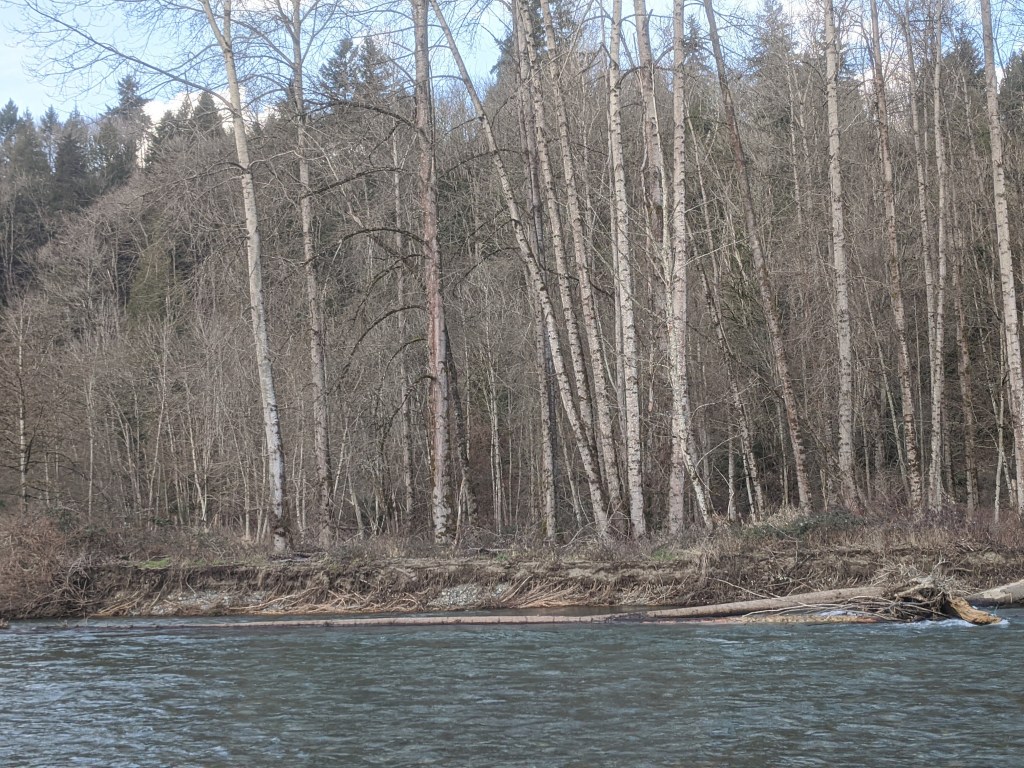
    But trees can help us with more than just monsters. They can inspire creative decisions. Look at this stand across the river.

    There’s some scarring from disease, or something, several dozen feet up. Take a closer look at that.

    Put your “not in the real world” hat on. What if that scaring was from a massive beast? What if the Giant Elk of this realm were so huge that their antlers (looking it up, yes elk have antlers) rubbed off that bark that’s a full 30 feet or so above the river.

    What happens when a herd of them walk the river during logging season with their massive legs crushing through or between the barges? Or are these Elk the friends of your woodland dwelling elves, gnomes, goblins, or other races? Are they ridden like elephants?

    The answers are up to you.

    Trees are also our mighty connection to history.

    Tolkien recognized that. The age of trees is why the Ents knew so much and also why they’d become peaceful and rooted. When you see so much life pass before you are the little lives so precious?

    In the World of the Everflow, the Dragonleaf Trees are ancient, from the era before legends, when Dragons and the other Ken were part of the world of Kin. But they are also dying. A breed that is honored while also being forgotten. They do not seed. They do not spread. There are only twenty or so of these ancient trees left, with almost all of them in the Tree District of Qin.

    When a tree is a millennia old what does that signal in your world? Are they like the trees of Solace in Krynn, with homes and workplaces scattered within the branches? Or is it a single tree from the time before time the sits alone in a desert, with roots that stretch hundreds of feet down and branches in the sky that reach to the clouds, a trade post surrounding this tree so big that it creates its own climate?

    Every journey you take. Every book you read. Every show or movie you watch. Every song you here. Every social media post you scan.

    They’re all inspiration for your world, your character, your dreams. Share them with your table.

  • Fighter: Conscript, version 1.3

    Fighter: Conscript, version 1.3

    In general I’m fascinated with Tier 1 play. But there’s another trope that I enjoy — the old-timer who retreated from the life of adventure and war, but who for some reason gets called back into it. They’ve done their best to avoid violence. Instead violence seeks them out. The Fighter: Conscript (final name TBD) has seen things. Things no one else should see.

    When they get the call to return to their former life they are no longer concerned with having the best weapon and the best armor. Their wits and experience taught them that any tool can be used for any job.

    Design Goals

    With this subclass the desire was to build a character who attempted to retire from their life of violence. They still know how to fight, they just stopped. Then, for whatever the cause, they re-entered the realm of warfare. Most often this transition occurs when they are on their farm, in their tavern, working their forge.

    They use the weapons at hand and the armor of peasants, and yet fight like the mightiest warriors. The build should support the use of simple weapons and lesser armors with Strength being the primary stat.

    Fighter: Conscript

    You are a light fighter who once served as a conscript in a standing army or militia. While there you learned the horrors of war. You also learned how to survive. You fought with what was available. Then, the war ended.

    Now, you attempt to forget your past. Your neighbors may look at you as a hero or a villain. That depends on your behavior and their opinion of the forces for which you fought. You go about your days, an expert smith, carpenter, vintner, or other artisan.

    Recently you’ve felt the call. You are duty bound to pick up your sickle, spear, gambeson, and those well-worn boots again. Your people need help, and you are called to serve.

    Tough as Nails

    Starting at third level you may choose to use your Strength bonus to Armor Class rather than Dexterity when wearing any light armor or medium armor.

    Plowshares into Swords

    At third level you gain the following abilities as a reflection of your life after service.

    • You are proficient in improvised weapons.
    • When using simple or and improvised weapons you gain +1 to damage on a successful attack.
    • You gain proficiency in an Artisan’s Tool. If you are already proficient in an Artisan’s Tool you may instead choose to have expertise in that Tool.
    • When recovering spent ammunition you recover all of it, rather than half.

    Wise Beyond Years

    At seventh level you gain proficiency in Insight and Intimidation. If you already have one or both of these skills you may take any Wisdom skill instead.

    Heart of the Lion

    At tenth level you are noted for refusal to give up the fight. You have advantage on saving throws that would impose the following conditions: Charmed, Exhaustion, Frightened, or Stunned.

    Rally from Defeat

    At 15th level you inspire your teammates. When an ally within 30 feet fails a saving throw that causes damage you may use a reaction to grant them temporary hit points equal to your Fighter level + your Wisdom bonus and they may reroll the saving throw. They must accept the second result. Your ally must be able to hear you. This ability may be used proficiency bonus number of times per long rest.

    Bones of Steel

    At 18th level your Armor Class is adjusted by both your Strength and your Dexterity Bonus. This bonus is not subjected to a limit based on the armor. When you take damage you may use a reaction to spend a Hit Die to recover Hit Points as if you were taking a short rest.

  • Add a Herding Dog to your D&D Game

    Add a Herding Dog to your D&D Game

    Animal companions are a tradition in Dungeons & Dragons. The Ranger with a hunting dog; the halfling riding a wolfhound; the dogs guarding the entry to the castle — all have status as tropes. In the standard rules the “Mastiff” represents all of these.

    But not every dog is a mass of muscle, teeth, and bark.

    Belgian Shepherd by Fouquier ॐ declared public domain at https://flic.kr/p/2i12JQq

    Other dogs exist in any fantasy world. These doggos deserve game-love, too. Inspired by Ambrose, the ranger in the game where my dwarven axe-wizard Awf slings spells and swings a battle axe like some kind of D&D version of John Casey, the Herding Dog leapt into existence.

    The desire with the Herding Dog was to not have an increase in power for a medium canine, but represent how shepherds, collies, sheepdogs, and other AKC Herding Group members are different from the working group types that the Mastiff embraces.

    There’s a small dip in strength, constitution, and damage with the most significant boosts being adding Animal Handling (to embrace the ability to make the herd go places) and Pack Tactics (to represent that herding dogs often work in groups).

    The minor changes give this dog a different identity, stay at the same power level, and give Ambrose a friend that isn’t purely a means to biting enemies. We’re using the Herding Dog in our campaign. Let me know if you decide to add it to your own.

    Terriers and Retrievers are on my list of potential design additions.