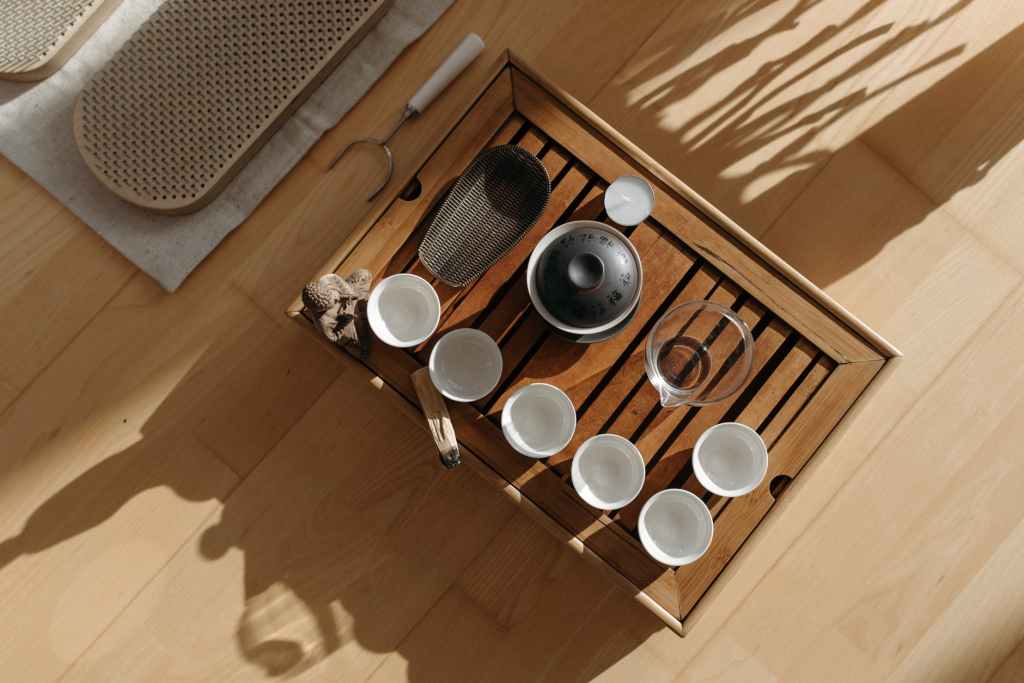
Tea, tisanes, rooibos, herbal concoctions and other similar hot drinks are staples in many cultures of the real world and fit so many Dungeons & Dragons cultures as well. The sub-culture around ceremony and expertise makes sense as a Background in 5th edition.
Why would a Tea Master go adventuring? They could be searching for a new supply; have run out of their own supply; know that there is a threat to the trade routes they depend upon; heard from the nobility of a need for the government; have a loyal customer that needs aid. A Tea Master like many service types develops a relationship with the people they serve. Those connections are easy to leverage into relationships that help power story — plus they have tea.
You are a server of fine teas. Maybe you worked in a tea shop, or were a tea merchant, or were the tea master for a noble estate. You prepare teas and small bites of food for the thinking peoples in the area. This can be as simple as a cuppa or an elaborate ritual.
You may be an expert in particular types of tea (powders, fermented, naturals, or combination). These teas and tisanes may come from your local community or come from other lands far from your origin. Regardless, you start with 24 servings of your favorite tea or tisane (tisane=herbal tea). When creating your tea master consider the peoples you served tea to in the past, consider who taught you the ceremony(ies) you know. Use these flavor decisions to embrace your role as a Tea Master.
Skill Proficiencies: History and Insight. If you are using cultures rather than languages, then replace history as per those rules. Tool Proficiencies: None Languages: Two languages Equipment: Alms box with 25 silver, bell or whistle or hand drum, tea set for 6 including tea for 4 ceremonies for 6 (10 pounds and 25 gp value), fine clothes, waterskin
Feature: Tea Ceremony
Performing a 1 hour ritualistic ceremony you serve tea often with small plates of food, but that is not required. The ceremony is patient and calming, shifting NPC attitude from hostile to indifferent or indifferent to friendly, if the NPC can be convinced to partake in the full ceremony. PCs partaking in a tea ceremony can use Hit Dice to heal as if the time was spent on a Short Rest.
Personality Traits that make sense for the Tea Master could be from the Acolyte, the Guild Artisan, the Hermit, or the Sage. Mix and match these as necessary.
There are a few reasons I wanted to make the Tea Master. During my time in the Middle East I experienced a couple versions of tea ceremonies. These were done as a welcome to a home or to a camp. In my personal life I have also experienced the elaborate high tea that used to be part of the nobility of England. These seemed to fit the social portion of D&D, especially as they stretch back in time to the days which inspire our stories.
Within fiction there are two tea ceremonies that stand out in my mind — both from The Lion, The Witch, and The Wardrobe. Tumnus uses a tea ceremony to distract and then poison Lucy. The Witch uses a tea ceremony and foods to make Edmund think that she is not a threat. Both examples fit the literature that inspires our game.
There was also a desire to make the tea ‘rules’ different than coffee ‘rules.’ The two are similar in that they are water with vegetation that often provides stimulation as well as being from locales far from the founding cultures of the game. Both belong in D&D, because they were in Europe in the era that inspired the game AND because D&D is about much more than Europe.
Another goal was to remove specificity of culture from the tea ceremony. Tea ceremonies do not have the direct lineage that coffee does (coffee houses have a direct lineage to Ottoman cafes). Tea is a more widespread crop with various cultures celebrating the leaf. So make your tea ceremony your own. Celebrate a real culture, create a pastiche, or invent a new one — do it honoring real cultures that you are a member of or that you’ve studied.
Custom Backgrounds for 5th edition Dungeons & Dragons
Animal companions are a vital part of my campaign world. Much of the reason the World of the Everflow and the Land of Six Kingdoms exists is because I want to explore the connection between humans and dogs. Since this is Dungeons & Dragons that also means exploring the connection between halflings and riding dogs, kobolds and ratters, elves and sighting dogs, goliaths and huskies.
D&D only has one natural dog. There’s also blink dogs, wolves, dire wolves, and a few other mystical beasts. But the real world has dogs that range from one pound to a couple hundred, dogs that are able to swim forever, dogs that are able to detect scent so well they detect cancer, dogs that pull sleds for hundreds of miles.
Fifth edition is simpler than reality, and every other version of the “editions” of D&D, only various basic editions could be classified as simple. It doesn’t need 150 breeds of dogs. It does need more than the mastiff. Here are nine other types of dogs to help expand your D&D game.
Mastiffs or War Dogs
Part of the 5th edition D&D SRD, the mastiff can be summoned by various spells and magic items and ridden by small humanoids. Though described as a hound, the art for mastiffs tends towards bulky. They are war dogs, clearly. Maybe they also represent breeds that guard through violence and intimidation rather than as an early warning system.
Mastiffs and war dogs should always be medium.
Herding dogs
These dogs herd animals, you already figured that out. Whether they are shepherds or certain terriers or heelers, they enjoy large groups.
Herding dogs are usually medium, but small is appropriate.
Guardian dogs
There are a few types of guardian dogs. Where in D&D the mastiff represents the guard dog that is violent and intimidating a guardian dog represents those breeds that act as an early warning system. They observe a space and warn their companions that danger is coming.
Rather than stat this out, the two guardian dogs in my current game are simple. They do 1 HP of damage on attacks, have half hit points of a mastiff, and are small. These represent the terrier breeds that aren’t eliminating vermin but are barking a lot (there’s some crossover in the real world). What makes them special is the ability, once per long rest, to “cast” Alarm as a ritual without any use of spell components. Rather than invent a new ability, creating a small area that the dogs can sense entry into and then bark a lot makes things simple.
Guardian dogs can be small and sometimes medium.
Working dogs
Where the mastiff represents breeds that are violent, working dogs have two main roles in our world of fantasy — the mount and the cart/sled puller. These are big doggos. They never tire. They love you so much they want to work harder. Give them the mastiff stats, but with max HP and a boost of 2 to Constitution. They have disadvantage on attack rolls.
Give a working dog Beast of Burden, you can find that on the Mule. They are tireless, and have advantage on strength or constitution checks that would impose exhaustion.
Working dogs are medium, maybe even large — this is a fantasy world.
Retrieving dogs
Aslan is a red lab and Amira was a golden/yellow mix. These are the dogs that taught me what dogs are. Retrievers haven’t appeared in my game yet. The rules are simple. A retriever fetches. At the end of a combat 100% of ammunition can be found within ten minutes, unless magically hidden or a critical fail was rolled. Additionally, when they are within 30′ of their companion and that companion’s target their companion always has at least 1 piece of ammunition. They do not provoke attacks of opportunity, ever. They use the mastiff stats.
Retrieving dogs are usually medium, but small works.
Water dogs
Labs are funny because they are both retriever and water dogs, but that’s complicated. 5e isn’t supposed to be complicated. So your lab needs to be one or the other. Or get a spaniel. They’re cool too, all dogs are cool. There’s lots of water dogs that basically forget that they are supposed to run on land, not jump in every pond, crick, or ocean they find. And yet. Water dogs do just that.
Mechanically? Use the mastiff, because simple. Drop Keen Hearing & Smell and drop the bite to a d4+1. Add on a swimming speed of 40 and resistance to cold damage.
Water dogs can be medium or small.
Hound or sighting dogs
The dog that helps hunters and trackers is a capable tracker who can sight prey from great distances. These hounds are frequent companions of rangers and other outdoorsy types.
Mastiffs, the base D&D dog, already have Keen Sight & Hearing, so what does a dog that’s even better have? Let’s lean on Elven Accuracy. Whenever tracking, hounds and sighting dogs are able to reroll one of their advantage dice. When their companion is tracking the help of a hound or sighter means that companion has the same. A sighting dog or smell-hound can use the Help action as a Bonus Action for a ranged or melee attack respectfully. Other changes from the mastiff are a drop of strength and constitution by 2 points, reducing their damage, attack bonus, and hit points.
Hounds and sighting dogs are evenly split between medium and small.
Vermin hunting dogs
Certain breeds were meant to get rid of rats, badgers, foxes etc. They are nimble (Dex 16, AC 14) pack animals (Pack Tactics) who are brave (advantage against fear). They will chase a small animal into its home, enjoying that chase through darkness (darkvision 10′). They aren’t strong (Str 9) or tough (HP 2). They’re just fierce. Their bite does 1d4-1 hit points of damage, minimum one. On a successful bite the victim must make a DC: 10 strength check or be grappled.
Many tunneling societies will partner up with vermin hunters, to include, but not limited to, kobolds, gnomes, dwarves, goblins, drow. Sure these dogs may bring rats back to their companions. This is both good and bad and good and bad.
Vermin hunters are small, with some being tiny and a few being medium.
Messenger or racing dogs
These dogs are fast. Whippets, greyhounds and others are real world breeds who are racers. In the World of the Everflow messenger dogs are used to send letters between places. These dogs just have to move, except when they don’t. They sleep hard and eat as much as a working dog.
They have a movement of 60′ and are able to use the Dash Action as a Bonus Action. Additionally their dexterity is 16, giving them an AC of 13. They do not provoke attacks of opportunity. They only do 1 HP of damage on attacks. Otherwise they have the stats of a mastiff.
Most messenger dogs are small. Some could be medium.
Toy or companion dogs
Some dogs are beloved by their companions, but not by everyone else. That’s fine. Everyone deserves dog love. Maybe an eccentric wizard carries one in their pouch, or a bard has one in their pocket, or the king has a medium sized one on its lap constantly. These aren’t dogs for adventuring. These are dogs for socializing.
A toy dog can cast Friends once per long rest. They have 1 HP and an 8 constitution. Their bite does no damage, but causes disadvantage on the next attack roll for the victim. If they are targeted by an attack the attacker may suffer from Hellish Rebuke originating from the toy dog causing psychic damage.
Toy dogs are usually small, maybe tiny, but some medium flooffs think that they are toys and will crawl up in your lap no matter what you want.
What’s the first type of dog you’re adding to your game?
There were a massive amount of products announced at the first ever Dungeons & Dragons Direct. The next seven months or so of D&D tabletop games are now known.
The big three were the adventures or mixed adventure-setting books. They are either very new concepts, or very old settings being revisited. Each of the main adventure books guides towards certain types of stories.
Like the previous collections of adventures (Candlekeep Mysteries, Tales from the Yawning Portal) Radiant Citadel assembles what you need ahead of time. Unlike those previous tales there are through lines in these Journeys. Working in a writers room concept meant that continuity chain could connect the disparate adventures.
Story ideas: Here’s the thing. This is a new concept, so I can’t lean into my own background for ideas. Maybe that’s the point. Ajit put together a team where I don’t need to worry about telling my story — they’re helping me tell their stories. Get Radiant Citadel because learning about others is fun.
Much of the attention towards Spelljammer is that the longstanding online joke about it being confirmed was finally true. It’s also in a new for 5th edition format as a multi-book package in a slipcase with a DM’s screen and large format map. Spelljammer is wild. There are space elves, murder comets, asteroid spiders, ships that look like dragonflies and ships that look like mindflayer heads. Wildspace is D&D on space drugs.
Story Ideas: Spelljammer combines the Age of Sail/Piracy with space travel, dragons, and some of the creepiest aberrations in D&D’s catalog. Borrow from Our Flag Means Death, Black Sails, Farscape, Firefly, Star Trek. Exploration of the unknown should be a key element. Your ship should practically be a character, it is that important.
Dragonlance: Title to be Announced Shadow of the Dragon Queen
Story ideas: The original Dragonlance novels put big heroes, in big situations, solving the world’s problems. It was romantic and heroic. Inside that original trilogy were a group of great friends. They were different peoples, different cultures. They didn’t necessarily work towards the same goals, but they worked together because that’s what friends do, especially soldiers. This new take on Dragonlance seems to be a gritty way to tell stories of fellowship tested by violence — Band of Brothers, Falcon & Winter Soldier, Ender’s Game’s subplots, Last Kingdom.
Other D&D Direct Announcements
The new starter set, Dragon of Stormwreck Isle, looks to be both a tighter adventure and an enterprising way to combine digital tools with the physical product. There will be guides for new DMs and videos about how to roleplay. Another new digital product are the new Monstrous Compendiums. The first is 10 free monsters from the Spelljammer setting. There will be more for Spelljammer as well as other setting.
Several more books are being released in foreign languages, a great expansion beyond the core three. There are also two cases to help power tactical play without minis. These campaign cases of tokens and maps look to be solid aids for home play.
Neverwinter and Baldur’s Gate: 3 had significant updates. Neverwinter is leaning on dragons, good. It’s got the dungeons figured out. BG3 is still in early access and a year out from conventional play.
Also a year out? The D&D movie. Dungeons & Dragons: Honor among Thieves comes out March 3, 2023.
Finally, there are two board games coming out. Onslaught is a tactical-skirmish game with two factions facing off while some monsters try to kill both. It looks like it will be a quick fun physical version of a videogame shooter. The Dragonlance ‘battle game’ is supposed to combine mass combat in a cooperative manner with the story of the Dragonlance adventure.
After a few years of major product announcements coming via multi-day livestreams that emulate conventions, the 2022 announcement leans heavy into the TV and video game sectors with a “Direct.” This makes a lot of sense when you see in the announcement trailer there are both video game and motion picture clues.
You can watch the D&D Direct at 9 AM PT on Thursday April 21st. Considering that Dungeons and Dragons is now a global phenomena this time is as good as it can be since it will be during working hours in Seattle/LA, NYC, and London.
Wizards of the Coast broke the Direct into three significant chunks and says that it will address “2022 and Beyond.” Yes, it’s possible that the Beyond references WotC buying DnDBeyond. But it also means we will get insight into the 2023 and maybe even the 2024 edition update.
Books and Accessories
We are almost certainly going to find out about Spelljammer. There was the Unearthed Arcana and several hints with the giff, Boo, and the mindflayer. The
Dragonlance will probably also be announced. Fizban’s Treasury of Dragons mentioned the popular romantic fantasy bookline and setting. The originators of the novels have a new trilogy coming this summer. There’s a natural opportunity maximize the zeitgeist, even if both the modern game product and novels aren’t directly related.
The days of announcing just one product at a time are over. D&D is a large enough brand with a large enough staff there will be overlapping efforts to expand the now mainstream brand.
Video Game Updates
Baldur’s Gate 3 is the big one. We’ll probably get a major update on the current beta playtest, as well as hints at other future video games. There are several projects in development both internally and externally.
This is the area where there have been the least public clues so far.
With shooting done and a release date of March 3, 2023 there is a chance that we see a teaser for the film during Direct, if not then, by the start of summer. It’s time for the project hype to start ramping up.
Daley & Goldstein are already working on another Hasbro/eOne project M.A.S.K.. IMDB credits both as writers on the project that will be part of a shared universe with G.I. Joe.
A small chance exists that D&D would announce another movie project.
Once upon a time Joe Manganiello developed a Dragonlance script that was likely a movie at the time. With Weiss and Hickman returning to novel writing, could the Magic Mike star resurrect his project officially and not just as a piece of fanfic? Would a boutique series make more sense?
They aren’t going to spend time talking about the D&D adjacent projects from Critical Role, Adventure Zone and the gobs of genre projects on Prime, Netflix, HBO Max, etc. Because while all of those projects help boost fantasy and D&D they are not official.
What project are you most excited to get more details about during D&D Direct?
Following the Russia invasion of Ukraine is part of my day job. Watching the refugees flee and the bombings of civilian areas makes one feel a bit helpless. It can feel hopeless and helpless. Some people have found ways to combine their passions to help raise funds for organizations that are active in and around the warzone.
What I like about this bundle is that Morrus put a theme together of various peaceful elements from their Patreon, repackaged them for this, and has committed to immediately releasing the product when the month is up. You can get the following for as little as a dollar;
Over on the DMs Guild they partnered with creators and with Wizards of the Coast so that 100% of proceeds will go to the Doctors Without Borders. There are four bundles within their omnibus bundle.
Usually a player whose DM is generous? Get the Player Options bundle. This one is also great for DMs who want NPCs built using player rules.
There are two DM bundles both at $20. Bundle 1 has the Festival of Magic, which is great, and Alyth’s Blueprints for Home & Business, which is on my wishlist. There’s a bunch of other stuff too. My favorite from Bundle 2 is Fae, Fi, Fo, Fum: A Collection of Folklore Inspired NPCs. I might get both, even though I run custom worlds and stories.
Combined you could get all five of this bundles, winding up with about 100 new elements and adventures to add to your game, all while helping people who are suffering (both DEC and DWB are helping in other conflicts too).
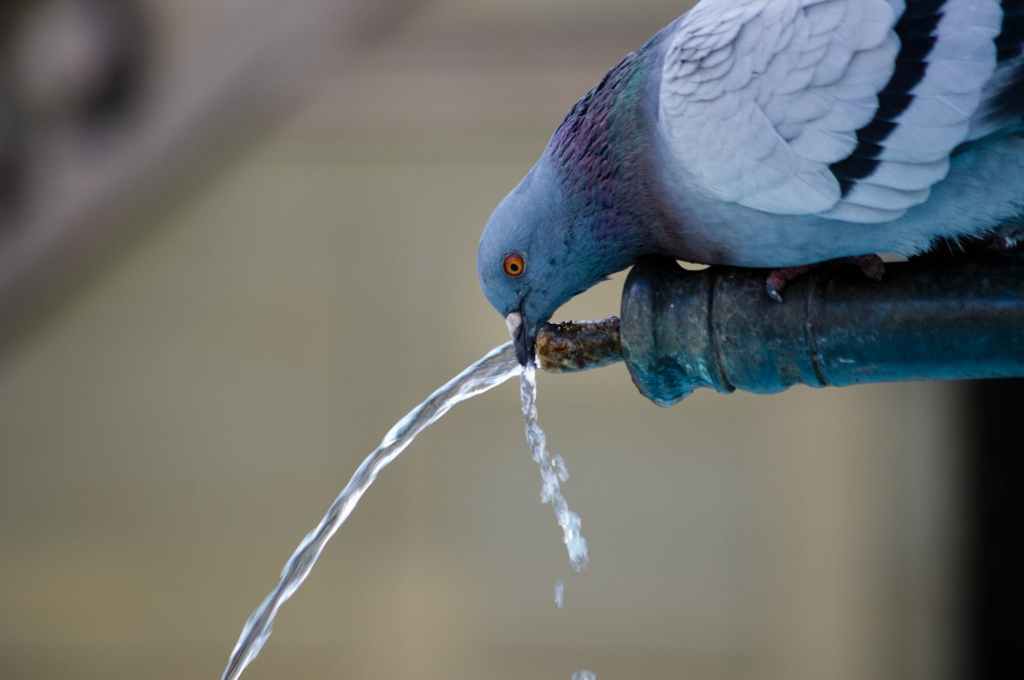
Worlds of points of light in a wilderness, or fallen empires, or warring kingdoms, or with merchant guilds that control trade need ways for far-ranging communities to stay in touch. In the real world this meant messenger pigeons, in Game of Thrones there were crows and ravens to communicate. Other fictions use dogs, or just a hearty human that trudges through awful conditions to keep the ties of society together — The Postman by David Brin, or the Pony Express in reality.
Your Dungeons & Dragons worlds also need these messengers. They make sense and fit the fiction so well. A Messenger in D&D also doesn’t need to be confined to the animals of the real world. A Ravnica or Eberron game might use a tiny ornithopter. Fastieths fit in Eberron and parts of the Six Kingdoms. Spiders or bats fit in Ravenloft. There’s a flavor of messenger companion for every world.
You are the connection between disparate homesteads, towns, or cities. Conveying the messages and scrolls between the communities rapidly without magic you bring news, warning, and joy to peoples who often struggle to keep in touch or that would take weeks to travel and deliver the message themselves. Often welcomed in strange towns, a messenger sometimes wears an official uniform of a ruling power and at others is a freelancer working without direction from above. You and your messenger companion are a symbol of civilization even in the furthest outposts.
Skill Proficiencies: Animal Handling, Nature Tool Proficiencies: None Languages: Two Languages Equipment: One animal messenger companion, travelers clothes, a scroll case with a dozen pages, a quill, an ink pot, a whistle or bell or other command device, a pouch with 5 gp
Choose an animal that is your messenger’s companion and conveyance, and discuss with the DM how the companion will fit into the adventure. These come in four primary groups, and a few examples are provided. Don’t feel limited to the specific animals listed, but use them for guidance regarding their abilities, if, gods forbid, they enter combat.
Small land animals — cats, dogs, iguanas, otters, monkeys, not-quite-giant spiders
Medium land animals — axe beaks, ponies, fastieths, antelopes
Small flying animals — pigeons, crows, ravens, owls, bats
Your messenger companion begins the game with a network of three destinations and the ability to find its way back to you where you sent it from. When delivering a message to a known destination on the network it travels at a fast pace and does so with no penalty to a stealth check (your messenger companion add your proficiency bonus and your Wisdom bonus to their stealth at all times). If you plan to move from your location when you send a message you can instruct your messenger companion to deliver the message and then go to a different destination. You and your messenger companions have a number of network destinations of proficiency bonus +1. If your companion perishes you must train a new one. This takes several weeks of downtime.
Natural weather has less impact on your own travels. Survival and/or Constitution checks made due to harsh natural weather are made with advantage.
Traits, Ideals, Bonds, Flaws: At this time use the Sage, Outlander, or Folk Hero for inspiration.
Messenger Design Goals
Starting with the idea that greyhounds would be perfect canine versions of messenger pigeons, this background just kept growing and growing in its scope. Eventually I spun out the Far Talker as a similar but different role in the world.
Neither snow nor rain nor heat nor gloom of night stays these couriers from the swift completion of their appointed rounds.
Emulating those words was vital, but needed to not be game breaking.
The non-magically empowered companion couldn’t be built out of Find Familiar, which was considered. My world’s bonded companions are meant to be non-magical. While the phrasing of the ability is a bit long, it’s mostly an ability that adds flavor. The messenger companion is not going to change a D&D party’s combat power.
The tea leaves seemed to indicate that Wizards of the Coast would be going back to Dragonlance. Once one of the strongest lines of fantasy novels, Dragonlance encapsulates stories of absent but powerful gods; mighty romantic heroes; that good and evil can work together; that it is always right to help those you love. Krynn was the first world upon which I ran campaigns. I own the Atlas of Krynn still. I owned the recipe book at some time. The first six books were as much a part of my youth as Lord of the Rings and Wheel of Time.
For someone with this background, and who had stepped away from D&D for 20 years, seeing Heroes of Krynn be released as the latest Unearthed Arcana set of a nostalgia bomb. As a rather religious child, the allegory within Weis & Hickman’s books was something that was empowering. The tales they told were ones my even more religious mother could accept. Dragonlance was a path past the Satanic Panic.
I’m ready for the land of naval Minotaur, Irda, Kender, and so many dragons. The UA only gave us one of those.
Kender
“These short-statured beings have a knack for producing the right tools in every situation.”
What I like
I love kender, just like I love halflings. Played kender in both a Dragonlance and a Spelljammer campaign back in my youth. All the flavor from history I like (I know many hated them). The modern take which says that their items aren’t stolen is good.
Taunt is great. Bravery is good.
What I don’t like
There’s no need to make the Aces ability magical. Just say it happens. Let the lore of the campaign decide the how. Also, the options within the Aces are a complex layer of dice rolls and limited lists. ThinkingDM breaks out exactly which items you can find in your pocket.
Absolutely. I’d allow them in my home campaign right now.
Lunar Magic Sorcerer
“You, or someone from your lineage, has been exposed to the concentrated magic of the moon (or moons) of your world, imbuing you with lunar magic. Perhaps your ancestor was involved in a druidic ritual involving an eclipse, or maybe a mystical fragment of a moon crashed near you. However you came to have your magic, your connection to the moon is obvious when you cast sorcerer spells.”
What I like
They got rid of calendar tracking, which is great. Most people don’t want to bother with tracking moon cycles. The payoff isn’t there for a majority of tables. Maybe if you have a table like my first one there’s one player who wants you to build a calendar and track that stuff.
Adding spells to every Sorcerer subclass just makes sense. Please errata that into every Sorc.
The flexibility to change what lunar phase you are attached to means you can be a different type of lower-case mage every day, and later whenever you want.
What I don’t like
There’s enough to keep track of when switching between lunar phases that most players will probably just settle on one phase, similar to how Eladrin are used in play. All the power of being able to switch isn’t useful if you don’t do it.
Will I use it in play?
Allowed immediately. My world has four moons, and it just makes sense for them to be connected to powers.
Knight of Solamnia
“You have trained to be a valorous warrior known as a Knight of Solamnia. Strict rules guide your every action, and you work to uphold them as you strive to defend the weak and oppose all forms of evil. Your honor is as important to you as your life.”
Probably not. In my youth I was a bit of a religious zealot and knight fan, and would have played this constantly.
I’m going to put the four feats related to this background here, because they’ll almost certainly be taken as a set.
Squire Solamnia
Your training in the ways of the Knights of Solamnia
What I like
Martial Training is better than two current feats that are rather weak. Then again, most character concepts that would take this feat don’t need any Martial Training.
Encouraging Rally is a nice buff similar to warlord concepts, the Purple Dragon Knight, probably some bards. It’s nice side benefit.
What I don’t like
Defensive Rider is unlikely to come up in most games.
The single use per day of Encouraging Rally is weak, but that’s to be expected since this feat is already about a feat-and-a-half.
Will I use it in play?
This will be allowed at my table immediately. No one should ever take Weapon Master or any of the armor feats except Heavy Armor Master (which I would just make Armor Master and allow the benefit of damage reduction to any level of armor worn).
Knight of the Crown
“You are a Knight of Solamnia aligned with the Order of the Crown, a group that extols the virtues of cooperation, loyalty, and obedience. You excel in group combat.”
What I like
Tactical Teamwork is another warlord-esque ability, which is great to see.
The “feat chain” makes sense. You have to be a squire before you are a knight and locking this into level 4+ makes sense.
What I don’t like
Getting to use Tactical Teamwork only twice a day at fourth level is disappointing.
Will I use it in play?
Probably not. Reaction based advantage for close combat won’t come up enough for me.
Knight of the Sword
“You are a Knight of Solamnia aligned with the Order of the Sword, a group devoted to heroism and courage. Bravery steels your spirit.”
What I like
The extra saving throw proficiency granted by Disciplined Spirit is great.
What I don’t like
Tying Hit Dice into Willpower doesn’t feel right. Yes, hit dice are your own willpower, but is the strength of my will going to help a friend? I guess that fits many narratives, but I’m not sold.
Will I use it in play?
A moderate chance, especially if I play a Fighter that starts at higher level, because I would probably mimic the traditional Solamnia path of Squire, Crown, Sword, Rose.
Knight of the Rose
“You are a Knight of Solamnia aligned with the Order of the Rose, a group known for leadership, justice, and wisdom.”
What I like
Bolstering Rally is similar to Inspiring Leader, with a few more limits on how many times you can use it, but a likely larger amount of temporary hit points gained.
What I don’t like
Connecting Bolstering Rally to Constitution.
Will I use it in play?
Yep. Absolutely. This is great for so many characters I enjoy playing.
Mage of High Sorcery
“Your talent for magic came to the attention of the Mages of High Sorcery, an organization of spellcasters that study magic and prevent its misuse. You’ve trained among the Mages, but whether or not you’ll face the dangerous tests required to become a true member of the group remains to be determined.”
All fey peoples in my world start with the ability to cast spells, and it would make a lot of sense for them to use this background.
This background starts a feat chain, like the Solamnia background does. They are with the one you gain upon getting the feat and then the three options you may take later.
Initiate of High Sorcery
“You’ve received training from magic-users affiliated with the Mages of High Sorcery.”
What I like
The attachment to one of the moons of Krynn is rather flavorful.
What I don’t like
1 cantrip and 1 spell is less powerful than the Solamnia version of the beginner feat. That’s probably fine if the character is already a spellcaster, since they are a bit more powerful than martials.
Will I use it in play?
Yep, though I would suggest just taking Magic Initiate instead.
Adept of the Black Robes
“Your ambition and loyalty to the Order of the Black Robes has been recognized.”
What I like
Throwing your own essence into your damage spells via Life Channel is the type of story creep I love. I’d usually just use odd number of HD because the rounding up statement.
Protective Magic ties back to the ability score increase from Initiate of High Sorcery, which might mean you have two different spell casting stats.
Will I use it in play?
I want to use it yesterday. This would have been great with Awf.
Divinely Favored
“A god has chosen you to carry a spark of their divine power.”
What I like
In Dragonlance alignment matters. Connecting the spells gained to your alignment is perfect for this setting.
What I don’t like
This is weaker than Magic Initiate and the only reason to take it is to get Divine Communications later.
Will I use it in play?
No.
Divine Communications
“Your connection to your god deepens”
What I like
Augury and Commune are potent story devices when used well. Taking this feat is a clarion call to your DM that you two will be regularly talking to gods.
What I don’t like
This makes Linguist useless (it already was).
It’s easy to lose track of 1d4 long rests for two different spells. Your abilities will recharge on different days.
Will I use it in play?
I think this should be allowed without Divine Favored, and will be at my table.
Rather than a one sheet that’s built for players, and the way the game is played, this is the common knowledge sheet that’s built for characters. The goal is a the level of knowledge that every single member of the adventuring party would have (some exceptions for extreme outsider situations).
Magic is only a generation old in the Lands of the Everflow. Just over one passing of the Dragon (the 4th moon) ago, a born generation came about that all knew minor magics. Just seven years ago the eruption of Cortez broke the barriers of magic. The Lorebook Hunters found the Tome of Divination and the Folio of Necromancy. As magic returned to the world so did dragons, and elves, and goblins with their smog-punk teknology. Magic is real; and the world is not ready for the Born Generation as they age. Some empires fade, others rise, and peoples throughout see the beacon of a Free Sheljar as a new way to govern as the Lands of the Everflow continue to shake under threats for teknology, dragons, and magic.
The Six Kingdoms
Kon
Crinth
Azsel
Mira
Mehmd
Sheljar
The Slope
Fey Isles
Telse
Kirtin
Qin
KotL
Daoud Green Lands
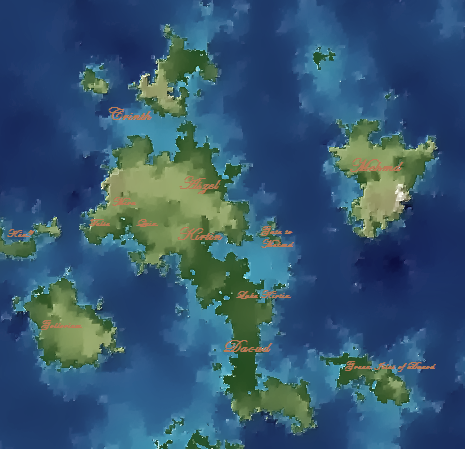
A word map of the six kingdoms
That’s a word-map of the Six Kingdoms with a few of the major cities that have featured in the various campaigns. This gives indications to their relative distance from each other. Since the commoner wouldn’t necessarily have an accurate map, the word-map demonstrates the proximity of the lands to each other.
This map is highly inaccurate, the fanciful dreams of an inauthentic narrator from the Fey Isles.
Azsel
A highly structured society built around small families and packs, the Kingdom of Azsel is mostly hin/halflings and their dog companions that trace their lineage to Az and Sel, the first bondings. Every King and Queen traces their lineage to Az, sometimes clearly and sometimes not. Azselites tend to be hierarchical, loyal, and have a strong sense of superiority because of their founder being the one who enabled bondings.
They are an expansionist society pushing against Crinth in the West and Kirtin in the South. They tend to ignore Mehmd. Messenger dogs keep outlying cities, towns, and forts in touch with the capital.
Crinth Confederation
Not really a singular government, the Crinth Confederation is a loose alliance of the northernmost peoples in the Land of the Everflow. Named after the River Crinth, the Confederation is ‘headquartered’ in Thornewall. Goliaths are most common here, particularly those that roam the plains, forest, and tundra. Crinthians have the strongest connection to nature and their architecture attempts to blend living plants into their homes and buildings. Myths from Crinth talk about a time when the bonded animals were large enough for homesteads to be carried on their backs — turtles, birds, mastiffs, snakes.
Daoud, the Green Lands, and the Emerald Isle
The grandest fleets of the Six Kingdoms come from Daoud. Naval power is so important to this dispersed nation that even the armies are called navies. Daoud’s forces will raid using rivers, and that’s how they’ve captured Kirtin-on-the-Lake, but also why they struggle to advance into the more mountainous territories of Kirtin and Qin. A land of warmth and greenery, Daoud is full of bright colors and loose fabrics. Similar to Mehmd, there is more variety in bonding with monkeys and fish being common enough, including some who carry their bonded fish in special bags and bowls while they travel.
Kirtin-on-the-Lake
Once the winter capital of Kirtin, the city has changed hands several times over the centuries. Currently it is controlled by Daoud. The largest university in the Six Kingdoms predates both Kirtin and Daoud, and may connect to the times before legends.
Kirtin
A land at war to the north and to the south, having lost one capital, the people of Kirtin all serve a summer season in the militia. In recent years this has meant service on the Slope, in the past these defensive posts were scattered throughout the mountain homeland of Kirtin. The former Summer Capital of Kirtin, Kirtin-in-the-Sky is a city of winding spires along a cliff face where it is difficult to tell the difference between natural and person-made. Once the center of learning, Kirtin is now a nation of defense.
The Slope
Coming down from the mountains The Slope is a frontier land not really controlled by Kirtin or Azsel. Both of those kingdoms send forces to the area regularly, usually in a soft-conflict as the villages along the Slope are unconcerned with empire. Many of Kirtin’s national militia serve on the Slope now that the kingdom has mostly given up on retaking the former winter capital, Kirtin-on-the-Lake.
Mehmd
The peoples of Mehmd bond not just with the warm-blooded as the rest of the Six Kingdoms, Mehmd also bonds with lizards and ‘saurs. Oft considered the least of the Six, Mehmd is sometimes considered just a city-state, rather than a kingdom. Water is somewhat scarce as the city sits just beyond the rain shadow from the mountains of Kirtin. Mehmd’s rocky land is crossed with aqueducts and canals taking water to the city.
Gate to the Wastes
Mehmd’s largest city is the only one that the rest of the Six Kingdoms encounter. Gate is open to all, but closes of the lands beyond. It is also the largest city of the Six Kingdoms, but on a tiny amount of land.
Sheljar
A dead kingdom until the Lorebook Hunters established the Free City of Sheljar. Prior to the Born Generation Sheljar was a mighty empire the controlled all of the West and the lands of the Everflow. A trade empire with major cities on its eastern coasts, Sheljar’s exports included the holy waters of the Font of Two Paths, gems and glassware from Bell’an’faire, alcohols from The Ferments, and stones from the various mountains. It is now fractured, with independent city-states throughout its former lands.
As magic started to seep back into the Six Kingdoms Sheljar was dominated by a Necromancer. The marsh-city came home to thousands of undead and a family of monsters known as Tunneling Nightmares who spewed vomit of bones and created sunken tunnels throughout the underbelly of the city.
The Free City is mostly confined to a few isles in the marsh-city. Its main tenant is that all thinking peoples are equal and worthy. They have eliminated most of the undead and all (?) of the Nightmares. They killed the Necromancer.
Telse, Mira, Qin and the other cities near the Everflow and its two rivers.
Telse
The towns of Upper and Lower Telse are dominated by the Orthodox Church of Quar. The main feature is the fountain, pool, and the two rivers that flow forth to both Qin and Mira. Many other faiths also treat the towns for pilgrimage. From the Born Generation to the present day those pilgrims have overwhelmed the town. The Mayor and Bishop rule together, frustratingly looking at the Free City of Sheljar as a threat.
Qin and Mira
The two trade cities didn’t fall to the Necromancer and took in many refugees. Both are ruled by trade societies. In Qin these guilds are centered around the trade routes. In Mira they are centered around the craft or goods created.
Other Lands
Few of the other lands outside of the Six Kingdoms are well known. Two have recently become quite important.
Queen’s Land
From Shejar to the northwest stands a series of island spires and a storm. According to the gobkon beyond that is their own homeland. The matrilineal kingdom is full of smog and caste, with the creation of new technologies being the currency of power.
Fey Isles
This series of islands well beyond the Sea of Gallinor is where the dragons and their friends originate. A land of bewildering magic there are colleges and schools to advance the art of the arcane. Only the Oriq, outcasts, are believed to not be able to channel the mystical into reality.
Races
Kin, the People of Love and Companionship
Nearly all of the kin have bonded companions. While dogs and birds are the most common of these, there are also some lizards, horses, and quite rarely fish. Mechanically this is in essence a Feat.
Goliaths
The giants of the Land of the Everflow, goliaths are most often found on the edges of cities, or out in the wilderness, though they are the most common peoples in the Crinth Confederation. On the Western Wildes, on the Cliffs of Galinor, is a singular tribe of goliaths. They most commonly bond with birds, often using the small creatures to make up for their larger fingers. Not just gentle giants, goliaths are generally warmer to strangers and live in large multifamily groups. Their homes will have open windows across many levels.
Hin, or Halflings
The largers will call them halflings, but the hin are half of nothing. Fond of canines some hin ride their bonds, others have small little herds. Hin are loyal to a fault. They enjoy flavors – cooking, tea, coffee, beer, wine, anything that can entertain their mouth and nose. They are most common in Azsel and the Western Wildes where Sheljar once ruled.
Human
Most common of all peoples, humans run the gamut of sizes, shapes, and bondings. There are humans bonded with horses, canines, avians, and so much more. They are a menagerie. It is common for the offspring of Hin and Goliath, or Hin and Human, or Goliath and Human to all be called human as their characteristics of humans are all across the spectrum of what makes life amazing. They are most common in everywhere but Azsel (Hin) and Crinth (Goliath).
Ken, the People of Knowledge and Magic
These fey peoples have mystical powers, all able to cast magic spells of varying kinds. Mechanically this means that ever Ken starts with a feat that grants magic of some type.
Dragons
They hoard things and/or emotions. While most peoples in the Land of the Everflow think that always means treasure the ale drakes hoard alcohol; black dragons hoard companionship; faerie dragons hoard joy and mirth; red dragons gather rage. All have powerful magic, which leads some of the peoples to swear fealty to the dragons. Most in the Six Kingdoms still think dragons are a story of trouble over the hill, rather trouble right here in the city.
Dwarves
Often the student-warriors and defenders of the colleges, the stout folk are generally evokers and abjurers. Channeling magic into hard violence and shielding others from it. Tending towards dour and serious, when they do unwind they unwind as hard a magic missile. Many keep the various drakes (non-thinking dragon-kin) as pets, but this is not the bond of the Six Kingdoms.
Elves
Changing the real world through their summoning powers and abilities to reshape reality, elves of the Fey Isles are aloof and superior. Looking down on the other humanoids for their “lesser” powers the elves like to present themselves as the equals to dragons (they are not).
Gnomes
The smallest of the fey, gnomes master the arts of emotion. Changing the way peoples feel or what they experience, gnomes are artists. They want to experience all emotions, at once, if they can. At times some from the Six Kingdoms have seen gnomes with smaller dragons and thought they are bonded. They are not. They’re just great friends with faerie, ale, and others of the weaker types. Gnomes are so fascinated by the Bonding that they have learned to speak with the animals.
No Rock Gnomes are part of the Ken. There are rumors among the Ken that Gobkons were once gnomes. This is heretical.
Kon, the People of Teknology and Konstruct
From the Land of Queen and Konstruct, these goblins are more misunderstood by the people of the Everflow than any other. Covered in soot and grime they are teknical marvels capable of building airxips powered by tar trees, clacketing cycles to move themselves, signal towers and so much more bizarre inventions. Coming in three sizes (Goblin, Hobgoblin, Mulgob) some sages from the Six Kingdoms have theorized that they are related to halflings, humans, and goliaths.
Mechanically this means that every character starts with Artificer Initiate and Rock Gnome Tinker.
People of Chorl
The creations of a rogue Scholar, these peoples are centaurs, aarakocra, minotaurs, fauns, and other blends of beast and human. They are outsiders, shunned due to their being the result Chorl’s use of transmutation magics. They are most common in the unsettled lands of the Western Wildes. The Chorl-ites only gather by animal type.
The Moons
Circled by four moons, Aur is roughly the size of Earth. The moons are part a major part of the calendar, and each is centered within different regions.
Feyelf (7 days) – dominant in the Queens Land
Glibbon or Glight (31 days) – dominant in Mehmd, Azsel
Kin (78 days) – dominant in Sheljar, Kirtin, Daoud
Dragon (6220 days) – dominant in Crinth, Fey Isles
The Days
These are the days in the Religion of Quar, the former lands of Sheljar, and Daoud.
Elmsday starts the week and honors Selley (Goddess of Birth, Life and Death) and Belsem (Goddess of the Untamed).
Bell’an’Aur is the second day of the week. It starts with a rejection of that which can’t be tamed and ends with a dinner celebrating Aur. In Kirtin and Crinth this is Feylfday, the day when Feylf is full, shortly after sunset.
Quarsday is the third day. It celebrates Quar (God of Rivers, Mountains)
Day of Glight honors the Lord of Knowledge. In developed lands the afternoons are given to learning.
Torday honors Torq (Goddess of Sea and Storm).
Az and Sel is day six. This honors not a god within the Wildes/Kirtin/Daoud, but the man and dog that legend says discovered the bonding. Nik is also frequently honored on this day. Azsel recognizes Az and Sel as man and dog that were raised to the gods.
Day of Oun is the end of the week. Oun and Obscon are not honored or celebrated, instead the Lords of the End are respected in that all things end. They are often feared.
Religions
Neither the Ken nor the Kon are religious. Within the Land of the Everflow there are four major pantheons each with distinct God-groups. The most influential of these is the Orthodox Church of Quar which centers Quar, the Lord of Life and Rivers. Other gods within the group are Belsem (Goddess Nature, the Wild, the Untames), Torq (Scion of the Seas, Storms), Oun and Obscon (Twins of Ending, Death, Souls, Trickery, Darkness), Selley (Goddess of Life and Bondings) and Glight (Knowledge, Study). There is also a Free Church of Quar, an offshoot that objects to the mercantile power of the Bishop. Both churches are most influential in old Sheljar, Kirtin, and Daoud.
Up in Crinth the most influential pantheon is The Siblings. The god-group are two parents with sextuplets. The Parents are Glight (Light, Knowledge) and Selley (Birth, Moons, Passion). Both have minor roles in the Orthodox Church. The Siblings represent the Hearth, Trickery, Crafts, Beasts, Spirit, and Unity.
Over in Mehmd the God of Unity from The Siblings is worshipped as the sole god, with all others gods being an aspect of Unity.
In Azsel both Az and Sel, the First Bondings, are worshipped as Gods. Though they were a real pairing of hin and mastiff as the source of bonding the two represent the power of companionship, life, war, nature and people all together.
The Everflow
The Font of Two Paths, or the Everflow, is the magical water that emerges from the cliffside above Telse. When captured from the falls or not significantly intermixed the Everflow has healing powers. The Orthodox Church of Quar controls access to the Everflow in nearly every community. The Church uses its control of the Everflow to have a presence in all cities and most towns throughout the Six Kingdoms.
Lorebooks
Every school of magic as well as the hybrid colleges and certain traditions that aren’t usually connected to arcane magic (Druidic, Bards, Tricksters, etc) has a Lorebook hidden somewhere within the Six Kingdoms. The Scholar and their two Students are the only people who know where these books are.
The world knows that the government of the Free City of Sheljar has both the Lorebook of Divination (Scholar Cortez) and Folio of Necromancy (Scholar Rohan, The Necromancer). The other of the two dozen books, once assumed to just be a singular book, are all considered to be part of the reason for the Born Generation and the return to magic (when Cortez caused the eruption at the Glass Tower) to come to the Land of the Everflow.
For a couple generations Renton was Boeing mechanics and engineers, and the people who supported them. Somehow despite these strong union jobs the reputation of Renton was negative. The rest of the 425 felt like Renton wasn’t worthy of the area code.
Down here on the southern tip of Lake Washington there’s a little boom.
Over the past 15 years, Renton has been doing things a bit different. The economy has shifted, the dining improved, and the reputation is tired. The City of Dragons is also the City of Seahawks and the City of Sounders.
That’s not the only modern tech hub. Directly on the water is Southport, which combines great office space and a high-end hotel with views of both Bellevue and Seattle. There are also restaurants directly on the lake, something rare in the other ‘burbs surrounding it. Maybe someday there will be a water taxi connecting Southport to UW and South Lake Union (and maybe later up along the eastside).
The Dragon Erasmus looks out over Renton
The City of Dragons is also host to the billion-dollar division of Hasbro, Wizards of the Coast. For this, and other reasons, Renton has a statue of a dragon downtown, little dragons to indicate parking lots in the core of the city, dragon art on retail spaces awaiting tenants, and my heart.
Located in the mountainous region of southeast Jalisco, Cuautla is a small community of about 3,000 people. Fundamental to the special connection between Renton and Cuautla, are Cuautla’s “Absent Sons,” of which many live in or near Renton. The “Absent Sons,” as they are referred to in Cuautla, are a band of greater Puget Sound Region restauranteurs who left Cuautla when they were young men, came to the United States, and opened the majority of the Mexican restaurants we patronize today: Azteca, La Fuente, La Hacienda, Las Margaritas, Mayas, Mazatlan, Tapatios, Taqueria Guaymas, and Torero’s to name just a few.
Renton Memorial Stadium, that once hosted the Sounders in USL play
River Days
Once upon a time I moved away from Renton, thinking I’d never come back. I saw the world. Now, I own a home here and have realized that my city continues to grow into a place where I want to be — diverse, welcoming, friendly, with walkable distinct neighborhoods.
Source The first three episodes of The Legend of Vox Machina were just released on Amazon Prime Video. The show is based on the first campaign of “Critical Role”; a Dungeons and Dragons live play podcast and twitch stream. So far three episodes have been released; it is difficult to judge whether or not the […]