Tag: Uprising and Rebellion

  • Allies and Adversaries in Uprising and Rebellion

    Allies and Adversaries in Uprising and Rebellion

    My current campaign of episodic adventures is starting to get complicated. These notes are mostly for myself, so that the various threads and multi-session characters do not get out of control as people drop in and drop out. Uprising and Rebellion Campaign Two is crafted for that type of play, but pushes me to track NPCs and threads a bit more than typical D&D campaigns.

    Read: Common knowledge in the World of the Everflow.

    Heroes

    These are the Player Characters, some active, some dormant, and all controlled by not-the-DM.

    Req (dwarf, paladin) — He travelled to Kirtin-on-the-Lake in an early wave of emigration from the Lands of the Ken. Part of the Society, he helped the Dock District get free from the Mayor’s influence. The dwarf has a penchant for ale, often forgets names of his friends, and is responsible for forming the Dock District Militia (mostly other longshoreman with glaives).

    Seymore (halfling, rogue) — One of the constants in the Dock District is Seymore’s proselytizing for freedom for all. Working as a streetsweeper, he provided light in the darkness, now his words try to do more as he joins the Society and pushes back against the Mayor, the Ken, and the Empire of Daoud.

    Gardar (human, warlock/sorcerer) — From the land of Mehmd, this one-time cooper and weaponsmith lost his first animal companion to tragedy, fled his former master and now seeks to rid the influence of the Dragons and their allies.

    Keldrass (black dragonborn, monk) — An early traveler from the Fey Isles, he abandoned the quest of those people to study what makes the Kin special and unique. Still confused by these diverse societies without magic but with a love for animals.

    Skrunk (goliath, wild barbarian) — The former coffee roaster lost control when infected with some kind of dragon-kin magic. He has two giant turkeys, a little bit of magic and a lot of rage. He was once plagued by gnomes and Paiddrois both. The Society have used his giant turkey-cart to help transport things.

    Dormant

    Habergeon (warforged, cleric) — The world’s first, and possibly only, warforged, Habergeon was crafted during the fall of a previous age back when magic was plentiful and those who are now gods walked the world as mortals.

    Nerinmil (half-elf, warlock-rogue) — Also in the early wave of travel from Ken to the Land of the Everflow, Nerinmil stands against his ancestors in their quest to oppress the People of Fellowship.

    Grera (mulgoblin, cleric) — Rescued from the jaculus encampment Grera joined the Society in efforts to learn more about the wide variety of peoples in the world. He is the primary connection between the Kon working in the back of the Rusty Clam and the active agents of the Society.

    Roland (human, rogue-thief) — the former sage was recently fired from his position in local university. His teachings challenged Daoud’s control of Kirtin-on-the-Lake. He has a small cat that avoids all conflict.

    Whym (halfling ranger-gloom stalker) — the former circus member is of noble heart and fights to protect those who are threatened by darkness. She has a huge dog, Kelb.

    Galanodel (elf rogue-propagandist) — the former journalist in Ken has combined techniques learned while working in the lands of magic with the praktikum of the gobkons. Now he publishes broadsheets in Kirtin-on-the-Lake pushing warnings against his own kind as well as building support for an independent KotL.
    Allies

    Auger (goliath, professor) — One of Roland’s friends at the U, Odger is a font of knowledge. His library-classroom is a safe haven outside of the Dock District and reachable via a fountain and the sewers.

    Penzer (human, bar owner) — He is the owner of the Rusty Clam, the impromptu headquarters of the Society. There is a once-secret backroom with a tar-tree powered printing press (the press can also be powered by the sap of the black dragontree). Penzer generally hears rumors around the Docks.

    Gregr and Robare (humans, longshorefolk) — Two of the men armed by Req, they have crewed a boat requisitioned by the Society and helped rid the jaculus from the docks. They aren’t great fighters, and try to avoid conflict. They are willing to support the Society in all non-violent actions.

    Wilkie (human, captain of Dock District guard) — No longer the only “full-time” employee of the Guard, this former Daoudian guardsman felt more familiarity with the Docks than the Mayor’s officials. He can be a source of knowledge about what’s going on in neighboring Districts or the Mayor’s forces.

    He was captain with a unit of four full-time Warriors (2 human attackers, 2 halfling defenders). Their five dogs are one mastiff (Wiklie), two herding dogs, and two guard terriers (can set an Alarm as a ritual with no components). They wear chain shirts, glaives, a ruby dagger, and short bows. Wilkie has a longsword and shield. All but one of these died. Denny is the only remaining guard.

    Lily Evertruse (elf, wizard) — Lily scared off the faerie dragon at the Mayor’s Three Fulls party. She seemed friendly with Habergeon and willing to aid the group in their efforts.

    Thorbolt Moorcok (human, vintner) — The head of Moorcok manor and vineyard was befriended by Req as the dwarf helped the family cleanup and rebuild after a group of Dragonsworn attempted to kill the Professor Rollo Silverfin, a Scholar of Illusions.

    Becca (human, conjurer) — She stole a few slates of conjuration to learn extraordinary magic, to include spreading certain spells (Infestation, Sword Burst, ???) to the general public. She is an ally, but also wants to spread magical knowledge to everyone.

    Jasmyne (human, retired captain of Mayor’s guard) — Jasmyne and her monkey enjoy causing small troubles for the Mayor’s not-quite-allies. She also thinks the current Mayor is a buffoon who doesn’t match the strength of his father.

    Resources

    The Bundle of Illusion (a random number of books) and the Slates of Conjuration are in possession/control of the group. The Slates of Conjuration were accessed by Augr’s students, who eventually spread spells to the general public.

    Req created the Dock District Guard (see Wilkie, above). There is also the ad hoc militia which are longshorefolk with bill hooks (uses glaive stats).

    Seymore expanded his network of sweeps and lighters into Duskside.

    The group also has significant influence over the broadsheet produced by two goblins and a mulgob in a backroom at the Rusty Clam.

    Nerinmil has a significant piece of lore.

    Habergeon holds a divine favor.

    Adversaries

    Qiddrot The Dark and Pathlean The Shadow (black dragons) — These hoarders of fellowship are breaking the companion bonds. Their adolescent companion was killed by the group in an ambush. They have met with the Mayor, who learned that the Blacks do not respect the treaty between the Dragons and the City.

    Gnomes — A small group of bold illusionists that seem to be allied with the Blacks, these illusionists and enchanters willingly broke the Treaty in order to help steal joy and happiness.

    Elmsday Fleet of Daoud — Settled just outside the city, the Elmsday Fleet is not under control of the Mayor. The Society has yet to interact with the Fleet as it looms to insert itself on the side of oppression.

    Proctors of Grace — an Evoker, Abjurer, and Diviner that travel together seeking to remove magic from the Six Kingdoms. They are hunting the Scholars and the Lorebooks.

    Former Mayor-Governor Roreldus Androouet le Riche, Servant of the Queen and Commander of the Northern Fleet and the 3rd Marines (human, banneret) —  a weak man more concerned with power than justice. Will do nearly anything to maintain the place of prominence in Kirtin-on-the-Llake. The Northern Fleet are two boats that roam the lake and are maintained on Androouet Isle in the middle of the lake. The 3rd Marines no longer exist.

    Tanazir the Greaty Wyrm — When alive this blue dragonwas influencing the mayor through promises of wealth. The deceit and corruption made Kirtin-on-the-Lake nearly unlivable as so many leaders and upper class were looking out for themselves.

    Laudra (elf, rogue) — Discovered during the Mayor’s party she uses magic to drift among the Kin. A thief and general troublemaker who seems be ruling Rat Horn. She has two dwarf assistants and some amount of fandom within the working class.

    Jaculus (group, all dead) — Req did capture a jaculus egg. These minor dragons stole fine art and gems from Dock District boots and retreated to an encampment to the north-east of Kirtin-on-the-Lake. The group fought off a few allied Ken.

    Paper Drake (singular, dead) — The folding book drake that once rode in Habergeon’s book pouch escaped during a rest in Odger’s library-classroom. It was quite interested in his most special books on the highest ring of knowledge within the tower.

    Paiddrois The Twilight (dead adolescent black dragon) — First of the Blacks to interact with the Society, Paiddrois was the least powerful and most aggressive of dragons to enter the city. His boldness was a herald of things to come, but also what lead to his death.

    Clues and Portents

    The dragontrees need at least one dragon and 8 other spellcasters to be reawakened. The Red Oak was the first of these and now geysers of flame spew out from it. No new egg has been seen yet. These ceremonies can only happen on when at least two moons are full. The next opportunity is in two days and coincides with a major Daoudian festival in the city.

    Black dragons break the bond of companionship between the Kin and their beasts. At least three dozen of these bonds have been broken. All appearances are that the black dragons hoard these connections. Jaculus hoard gems and fine art. Paper drakes hoard knowledge and appear to want to raid the University of Kirtin. All dragons hoard something and the chromatics seem to hoard emotions. Five of their 11 gnome and dwarf allies have been killed. Four in Winterhome of Shamal and one at the Mayor’s celebration.

  • Goltoppa, a Mehmdian sport in the World of the Everflow

    Goltoppa, a Mehmdian sport in the World of the Everflow

    Fantasy sports can be a fun way to add depth and cultural to a campaign world. One of my players in Uprising & Rebellion is playing a character from Mehmd and invented the sport of Goltoppa. He adapted some of the cultural touchpoints from the hidden empire, placing them into the common state of the game and has asked for it to be featured in a session soon. The character in question is not a Goltoppa player or coach.


    Goltoppa

    by JayDubTheGamer

    Playing Surface:

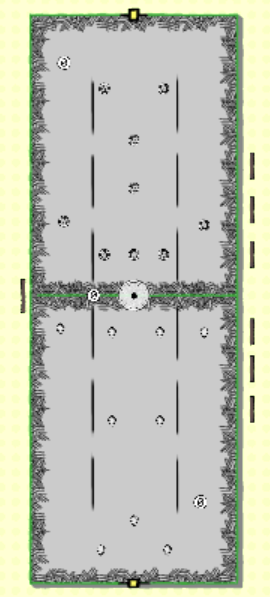
    A goltoppa field created using Dungeon Scrawl

    The game is played on an open, flat, dirt field, generally free of rocks & debris, that is 360 feet  long by 144 feet wide. The field is split lengthwise down the entirety of the center into 72 feet wide halves, and crosswise at 120 feet intervals. These six resulting areas are marked off with white paint borders. Particularly enterprising/wealthy teams have been known to pay to have the sections magicked to different colors. Straddling the centerline at each end of the playing field is a netted goal, 9 feet wide by 3 feet tall. One narrow end of the field is to be facing North, indicating the “head” of the field. Three referees patrol the playing surface to control the action during the run of play.

    Players:

    Goltoppa is played by two opposing teams, consisting of 9 starting players on each side. Teams are permitted to ‘dress’ 3 bench players for each contest, to be subbed into the game in the event of injury. Players may not be subbed into the game for strategic reasons or in the event of a player’s expulsion from the contest. A player’s uniform shall consist of a sleeveless tunic, belted at the waist & extending to mid-thigh, in the primary color of one of the six teams currently representing the league’s six social strata: Noble (violet), Military (red), Religious (white), Artisan (gold), Farmer/Fisher (green), Merchant (blue). Note that players are recruited to represent these strata, and need not be members of them. Additionally, players shall wear sandals that wrap up around their calves, with linen padding over their shins. Each team dresses one Left & Right “Slasher,” designated by a black sash that goes diagonally from either left or right shoulder to opposing hip, with the shoulder covered indicating which side of the field they may patrol. Players may wear short pants as well.

    Play:

     The game is played in two 36 minute halves. At the start of the game, a coin toss determines initial possession, which begins via kicking a ball onto the field from a position to the left of the goal which the possessing team is defending. The ball is traditionally made from a treated cow’s stomach filled with air, or a leather ball of approximately the same size . There are no goalies; all players may attempt to kick the ball toward or away from the goal, or to a teammate. Additionally, each team’s Slashers are allowed to catch the ball on the fly in their hands and run with it to the border of whichever section of the field they currently occupy, at which point they must kick the ball themselves unless trying to place the ball in the opposing goal. A Slasher with possession of the ball may be leg tackled by the opposing team. A successful leg tackle means the Slasher must kick the ball to a teammate (only) from the spot of the tackle. Tackling with one’s arms, striking a Slasher above the waist, or attempting to strip the ball from a Slasher’s hands by a player other than an opposing Slasher is not allowed. A ball that goes out of the field of play results in a change of possession, with the new possessing team kicking the ball into the field of play from the sideline spot where the referees determine the ball crossed out of the field.

    Scoring:

    A score happens whenever the ball is put into the net during the run of play, A ball kicked into the net scores 2 points; a ball placed into the net by hand scores 5 points.

    Penalties:

    Rough Play: Arm tackles; deliberate leg tackles of a non-Slasher; headbutts; intentional hands to the face or back of an opponent – Offending player off the field for 3 minutes.

    Stripping: An attempt to pull the ball from the hands of a Slasher by a non-Slasher – Offending player off the field for 3 minutes.

    Catching: Non-Slasher making deliberate contact with his hands to the ball, especially with an effort to control the ball – Offending player off the field for 2 minutes.

    Scooping: Slasher attempting to pick the ball up off the field, rather than catching it on the fly. This includes a ball that bounces before being caught – Offending player off the field for 1 minute.

    Offsides: Slasher maintaining possession of the ball beyond the area of the field where he caught it, or crossing from his designated half of the field – Change of possession from the spot; no kick to inbound the ball needed.

    Belligerence: Fighting; intentional physical contact/intimidation toward a referee – Offending player ejected.


    Playing Goltoppa at the table

    There will be a series of contested checks to determine scoring. These will use the Tool Sports: Goltoppa and have a few skills that can connect to them.

    My first thought is a way to generate scoring similar to what is described by JayDubTheGamer would be to have five contested checks by half. That’s a lot of rolling, but provides some variety of results and capability of multiple players participating.

    Winning a check by 1-5 results in two points. Winning a check by more than 5 results in 5 points. Winning a check by more than 10 results in seven points and winning by 15 or more is good for nine points.

    Losing a check by less than 5 results in two points for your own team. Any natural 1 means that you have given up a five-pointer or have committed a foul, rolling their next challenge at Disadvantage. Any natural 20 means that you have scored a five-pointer.

    This should generate scores that look a bit like early 20th century American football or current rugby.

    Applying skills

    Acrobatics and Athletics will be the most used skills, most frequently connecting to Dexterity and Strength. It would also make sense for someone in a coaching position to use Intelligence with one of those and for a character playing the captain to use Charisma.

    I would allow up to one role to use Deception in order to get away with a foul. That team would have Advantage on the next check, but if they lose that roll their next roll would be at Disadvantage.

    An example:

    Violet teamBlue teamScore
    137Violet 5: Blue 0
    1620 (natural)Violet 2: Blue 7
    915Violet 0: Blue 5
    1212Violet 2: Blue 2
    415Violet 0: Blue 7
    1st half9 points21 points
    29Violet 0: Blue 5
    20 (natural)7Violet 12: Blue 0
    1411Violet 2: Blue 2
    186Violet 7: Blue 0
    39Violet 0: Blue 5
    2nd half21 points12 points
    FINAL30 points33 points

    Yes, that’s ten rolls for a non-combat encounter. Which feels like a bit, but the descriptions are at most two sentences, show the shifts in momentum, and feel like watching a sport when including those descriptions especially around the nat 20s.

    We’ll see how it runs at the table.

  • Integrating social narrative into combat – legendary points connected to a dragon’s hoard

    Integrating social narrative into combat – legendary points connected to a dragon’s hoard

    In the World of the Everflow all dragons have hoards. At this point of Uprising and Rebellion the group has met those that hoard books (paper dragons), jewels and fine art (jaculus), animal companions (black dragons) and strife (blue dragons).

    Heading towards the final faceoff with the great wyrm blue dragon there’s a desire to connect the size of the hoard in that Wyrm’s sphere of influence to its power – subsequently allowing actions by the players to reduce the hoard.

    This will be done by combining the Legendary Resistance and Legendary Action pools. Legendary Resistance will still be a use and lose item while Legendary Actions will be regained at the start of the dragon’s next turn. A pool of physical objects will symbolize the size of the pool. This will represent the intelligence the group learns about the Wyrm.

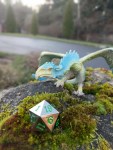
    A blue-green dragon atop a mossy rock leers over a large d20. Behind it is a river
    The Wyrm watches the d20 rolls

    The Blue Wyrm currently resides in the mayor’s palace, having thrived off the strife caused by the rebellion and the Mayor’s corruption. But the heroes have shown that their rebellion is built on hope, a less stratified society and a city capable of trade again. Now just three dragons stand in the way of freedom, possibly.

    Things the characters could do to reduce strife;

    • Healing, feeding Kirtin-on-the-Lake’s residents
    • Freeing animal companions bound to Shadow and Darkness, the two black dragons
    • Increasing trade of desired goods within the war torn city
    • Establishing a popular governance path after the Mayor’s abdication
    • Reducing the size of the 7th Fleet encampment outside of the city
    • Teaching utility cantrips

    I’m certain the party will surprise me with other ideas.

    Things that can increase strife;

    • War with the 7th Fleet
    • Teaching more attack cantrips
    • The Mayor reclaiming the seat of government
    • Open battle in the streets

    They will again surprise me with ideas that create a less peaceful city.

    The Wyrm is going to start with five legendary points in the penultimate session for this story arc. The session will be split between the plan to pick the territory of battle (palace, tunnel, cave) and preparations that could include reducing the Wyrm’s power.

    This tweak to the standard rules should connect a social session to the grand combat ending the Wyrm’s arc.

  • Introducing Militia Actions to support base defense in urban rebellion play

    Introducing Militia Actions to support base defense in urban rebellion play

    In my Uprising & Rebellion Campaign Two the players decided to take on the Mayor’s forces in the open, rather than the dead of night or through obfuscation. In response the Mayor and his forces attacked their home base, the Rusty Clam. Dungeons & Dragons doesn’t do great for large battles.

    A few tweaks I made to more represent the fiction of a rebellious militia and their allies defending their most significant resource were;

    • Have the minions represent half of a squad. The idea here was that the lesser trained guards would break morale when they lost half their group.
    • Allow the PCs to set up themselves up where they wanted. This is their territory. They know it best.
    • Added actions to represent the other rebels and commoners who side with the goals of the uprising. These Militia Actions operate similar to Lair Actions. That initial use has been modified here.

    Militia Actions

    For the session these operated as a Lair Action for each PC. They were taken on the initiative count 10 after their own initiative, which worked out as PC1, enemy1, Militia Action1. That part was a success.

    Each Militia Action was tied to a saving throw by the NPCs. These were designed for Tier 2 play as that’s where the PCs in question are at this time, but since I used cantrips as a guideline they are easy to adjust.

    Funnel – the militia and/or commoners in support of your cause build a wall using objects or themselves to block a path. This wall is 5′ long per tier of play. A successful Strength save (DC 10/15/20/25 based on tier) enables the enemy to ignore the wall.

    Falling or Thrown Objects – the militia and/or commoners in support of your cause pick up objects nearby and throw them at the enemy. These objects do 1d8 damage per tier of play in a space that is 5×5/10x/10/15×15/20×20 by tier. A successful Dex save results in half damage (DC 10/15/20/25).

    Overturn Stand or Cart – the militia and/or commoners in support of your cause create an area of difficult terrain by using common objects to clutter the path. Any enemy passing through the area moves must use twice their movement through the 5×5/10x/10/15×15/20×20 space by tier. They may attempt to move at normal speed, and if using the Dash or Disengage actions, must succeed on a Con save (DC 10/15/20/25) or take 1d6 per tier damage and fall Prone.

    (this one needs the most work)

    Harass – the militia and/or commoners in support of your cause harass and pester the enemies in such a way that limits their defenses. This can be done by word or by minor physical altercation. The next attack by that enemy NPC or intelligent monster is at disadvantage. A successful Int save (DC 10/15/20/25) results in no disadvantage.

    Distract – the militia and/or commoners in support of your cause harass and pester the enemies in such a way that limits their attacks. This can be done by word or by minor physical altercation. The next attack against that enemy NPC or intelligent monster is at advantage. A successful Int save (DC 10/15/20/25) results in no advantage.

    Rally – the militia and/or commoners in support of your cause shouts in support of the PCs. The PCs are then granted 1d6 temporary hit points per tier of play. A successful Cha save (DC 10/15/20/25) by the leader of the enemy results in no temporary hit points being granted, this is to represent their ability to speak over or interrupt the rallying calls.

    Changes for the future?

    I may tie these to various skills or tools rather than saving throws. I had the players roll, and asking players to roll under for a success just didn’t make sense.

    Finally, I think I would allow a summoned swarm from the Propagandist use these when the Propagandist commands them via a bonus action. This would help raise the power level of a subclass that lacks in combat, though in many campaigns this wouldn’t be enough.

    Design Goals

    The primary inspirations for these actions were to mimic some of the play of Assassin’s Creed, where the small crowd of neutrals and allies can support your violence. There are also scenes in Black Sails where the common people of Nassau join the fight against the British. The invasion of Tear and other conflicts in the Wheel of Time feature actions by commoners supporting the heroes too. Various Robin Hood tales, the rescue of The Shire, the movie Aladdin, and so many other tales have common peoples helping the heroes by impeding the enemy.

    While highly urbanized campaigns aren’t common in D&D, they should be supported. The literature and other inspirations for the game do have these elements. Our game can include them in ways that are more than just background story.

    What improvements do you see needing attention?

  • Assigning Social and Exploration Experience in Uprising & Rebellion

    Assigning Social and Exploration Experience in Uprising & Rebellion

    In my campaigns we use experience points rather than milestone levelling. But, we also spend time in the social and exploration pillars, where the game as designed provides little guidance towards the experience that should be rewarded for success overcoming obstacles beyond traps.

    Rewarding the play I want to see, I have given out xp for solved plot points and discoveries. In the past these have been given out at the end of a session without the players knowing ahead of time what their character rewards would be.

    I’m going to attempt to pull back that veil, listing out major plots and side quests with xp values. My goal is so that the player characters will be rewarded for developing their stories and the overall campaign.

    Major plots

    Daoud’s 7th Fleet vs Twilight and Shadow the Black Dragons vs the Mayor with the Blue Dragons vs assembling Kirtinish forces on the east shore – 10,000 xp

    Kirtin-on-the-Lake is now torn between two of the Six Kingdoms and the separate appeals of two groups of Ken. Twilight and Shadow seem to thrive on misery, sucking up negative emotions from the war. The Mayor has gifted the Blue dragons significant territory and their co-operation requires unbonding from animal companions.

    The 7th Fleet wants to take the city back to Daoud. It is actually a massive cavalry army with horses, riding dogs and warbirds. Kirtin’s forces sit, waiting for the three sides to destroy each other and sweep back into the city as welcomed heroes.

    Our heroes haven’t picked a side, because they are all bad. In the past they’ve hoped for trade or normality looking to Sheljar for inspiration.

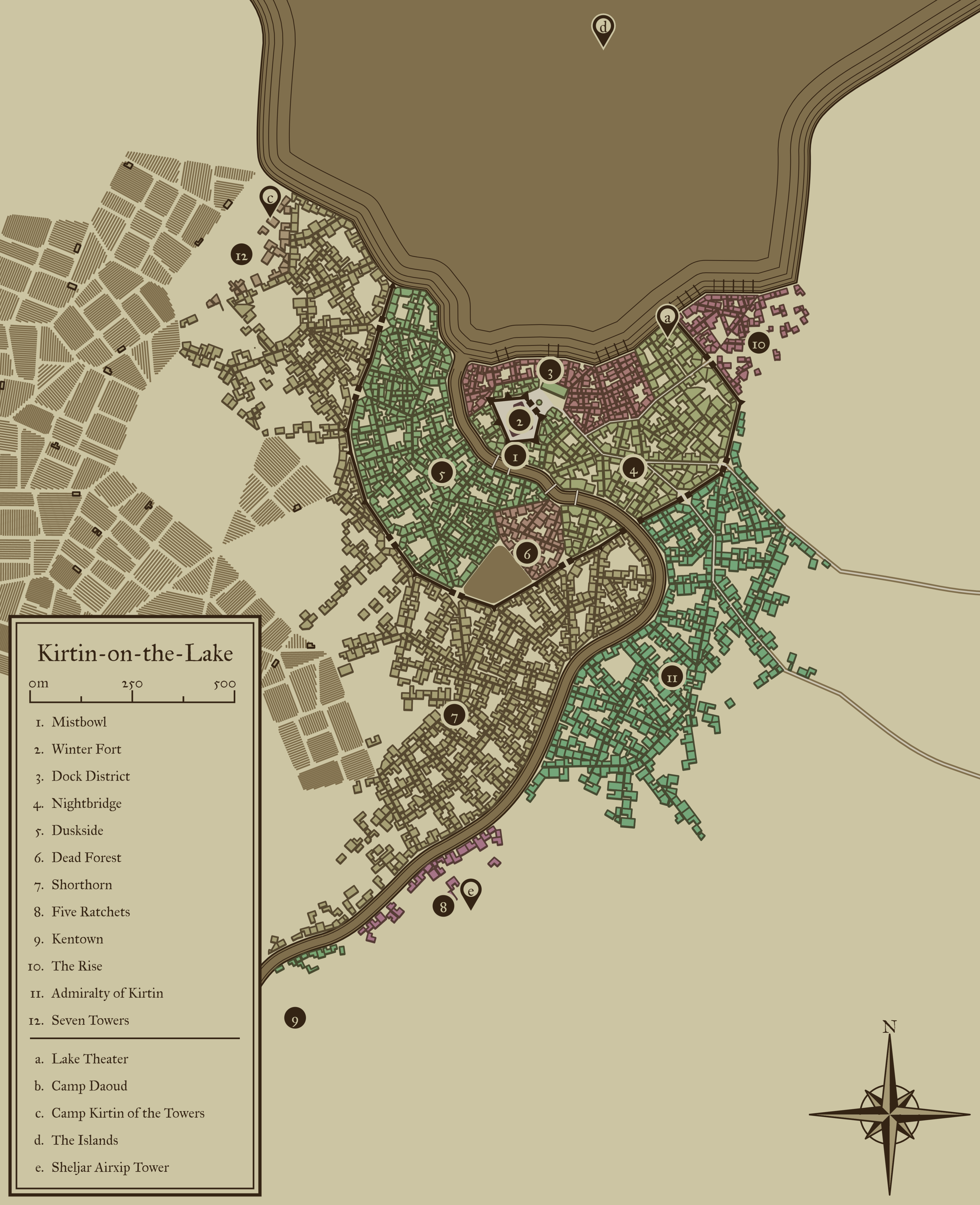
    via the Fantasy City Generator

    Lorebooks – 5,000 xp

    Our heroes have the Lorebook of Illusions and the Crate of Conjuration. They suspect there is another Lorebook locally and a fourth may be in The Ferments. They know not what power the Lorebooks provide, just that a group called the Scholars control them and the Proctors are a violent segment of Ken who are trying to acquire the various books. The world knows that the Folio of Necromancy and the Lorebook of Divination are in Sheljar.

    Defending their books from other Proctors or Scholars is as important as finding more, probably.

    Unseat the Mayor – 7,500 xp — COMPLETED

    The Mayor has turned his back on Daoud and joined with the Blue Dragons and their Ken allies. Even if the heroes cannot yet sway the four-sided war, the group wants the Mayor eliminated via election, appointment or violence — he just needs to be gone.

    Side quests

    Where is Wilkie? – 2,500 xp — COMPELETED

    One of their allies, Wilkie, former leader of the Dock District Guard fled. With their leader in hiding the Dock District has dissolved back to an ad hoc militia. The group of heroes had trusted Wilkie to defend their district.

    Missing Printers – 2,500 xp — COMPLETED

    The printing press and gobkon printers’ office burnt down in a dragon strike. No bodies were found. Once in hiding, then public, the Society of Veil and Shadow has again disappeared. Their pro-Sheljar message remains known, but there have been no broadsheets in three passings of Feylf.

    Is the new flag of quill and sword related to their absence?

    Bounties – 2,500 xp — COMPLETED

    Each of the known heroes has a bounty of 2,500 gold on them. This is mostly because the Mayor hates them for the murder of the gnome during his festival. But also because they keep trying to inspire the people toward concepts like freedom and respect.

    Character quests

    Keldrass wants to repair the bonds broken by the black dragons and help protect the city from the Ken.

    Gardar wants to increase the trade with Mehmd, earn respect outside of the caste system there and maybe have his own Goltoppa team.

    Seymore wants to teach commoners magic, because even though he doesn’t trust it the people need the power. He’s done a bit of this by spreading Minor Illusion.

    Req wants to maintain the independence of the Dock District.