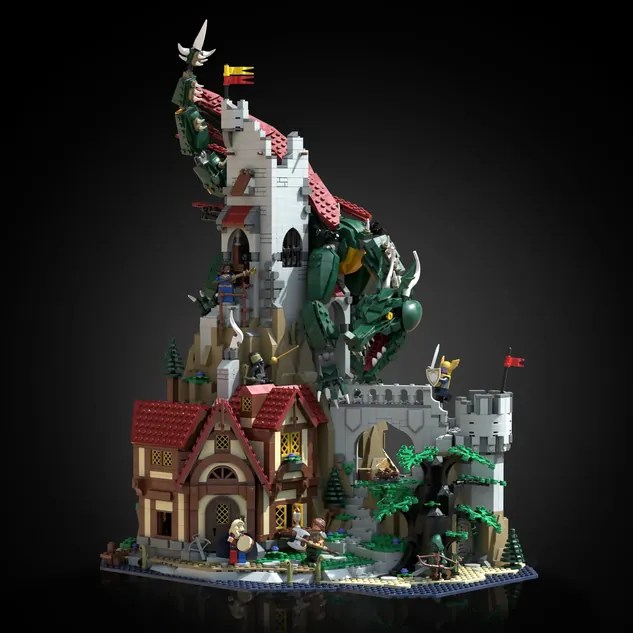
Of course I voted in the LEGO Idea x Dungeons & Dragons event. Back in high school I used LEGO’s castle and pirate sets while playing D&D. When LEGO announced the contest the one I liked best brought back those memories. But it also brought back memories of stereotypical D&D. And it won.
That may be a house, but it’s probably an inn or tavern. “You meet in a tavern” is a D&D trope.
Next is a bit of wilderness adventure. There’s a stream and a tree. Because you have to travel to the castle.
Inside that castle is also a cave system, with a Beholder. Beholders are giant floating eyeballs with extra eyeballs that shoot magic spells at you. They are one of the classic monsters in the game.
Of course there’s also a traditional castle. That castle’s tower is wrapped up by a dragon. Finally we have the dragon of Dungeons & Dragons. The party is split, of course, because despite the axiom to not split the party they frequently do split. One is climbing the exterior of the tower while another walks along the halls of the castle.
The six minifigs make a great party. Again from left to right, they look like a half-orc rapier wielding fighter/rogue, a Black human wizard or sorcerer, a likely elven bard, maybe a fire genasi barbarian, a tiefling paladin, and a rogue or ranger.
That’s pretty good variety of role, of identity and of mini-figs.
I cannot wait to get this. It will be great on my desk for me to look at or on the shelf behind me so that people on video calls can see it.
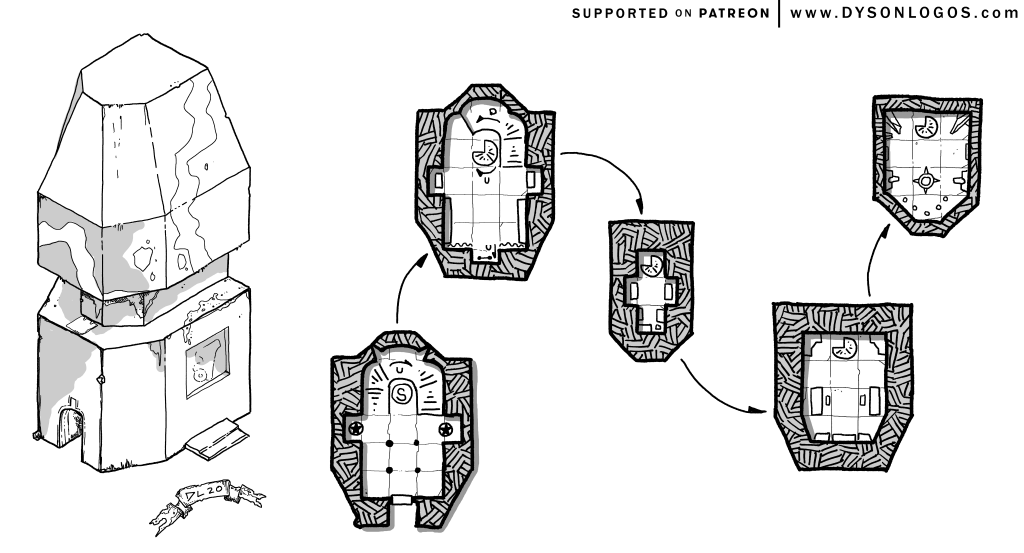
After the quick, safe ride on the sky-cable, you arrive at the top of a small tower. On the isle with the City Center this temple was abandoned when all of Sheljar turned their backs upon Oun and Obscon. These twin gods of death, endings, and darkness were rejected when the dead started to walk the earth again.
The gondola stops atop the pillar shape of the temple, in a haphazard wooden frame, with large hole knocked out of the roof.
Map by Dyson Logos, released as part of his commercially available project.
This narrow temple is cramped for hobgoblins, mulgoblins, goliath and large animals. These tight turns in the cold stone pass quickly as most try to exit the dark temple to dark powers as fast as they can. Though the Necromancer had nothing to do with Oun and Obscon the stench of death is too strong.
On the ground floor a search can result in finding the sealed secret door with an Intelligence check (DC 18). Intelligence, Culture (Sheljar), Religion are proficiencies that may apply if the characters act in ways that would connect them.
That secret door is sealed tight with iron bands. A Strength check (DC 20) can break through. Athletics and certain tools will help open it. Magic could be used as well.
If there is a desire to see how long that secret door has been sealed those that succeeded on the various checks would know that the seal is 25 years old, just as the Necromancer was coming to power. Is there a connection? Why not open the door and find out?
I’m doing Lore 24, an attempt to write small lore elements daily in the year 2024. Each element will be something that’s come up in play or will come up in play within my homebrew World of the Everflow — there will be actionable threads for PCs to grab onto and advance the story.
When the goblins and the Lorebook Hunters decided to make Sheljar into a Free City, where all thinking peoples were respectedm there was a vast, several mile separation between the suburbs and caves that the goblins discovered and the former City Center with its library, temples, city hall and palace.
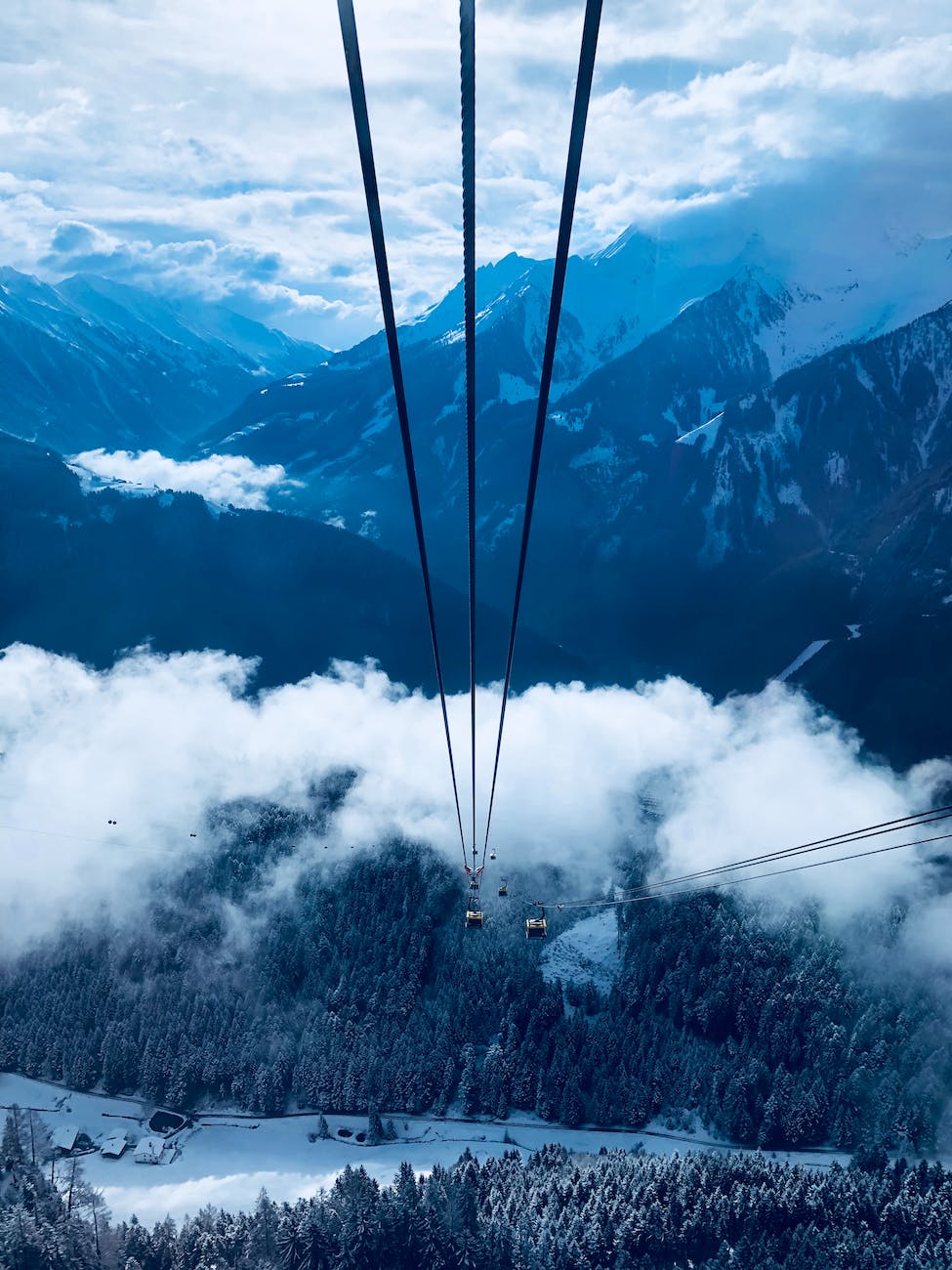
The First Sky-cable was constructed to connect these places without worry about bridges, or Tunneling Nightmares, or frightening island of zombies. Now it is the most travelled sky-cable. The gondola rides high, so high that its towers peak above the frequent fogs.
So high the weather is different.
Photo by Constantin on Pexels.com. Gondola image for example. It doesn’t look exactly like this.
As the players ride this sky-cable gondola they are in their first “hallway.” This path is dangerous. They are in a space where weather is different. There are creatures that may threaten them. This fastest route to the City Center may not be the shortcut they expected.
Hazards
Roll 2d4 about halfway through the journey in the sky.
2. Uninvited guest — There is someone aboard the gondola with the party. The illusioned elf works for the Proctors of Grace. It casts Detect Magic while Invisible. If it detect magic it attacks. Use the stat block for the Evoker Wizard if the party is in Tier 2. If they are only Tier 1 use the Evil Mage.
3. Frayed cable — The character with the highest Passive Investigation notices the cable is frayed. The group will need to discover a way to get the gondola to the next tower 100′ away or fix the cable. Tinker’s Tools, Vehicles (air), Vehicles (water) offer some solutions. The DC should be 15. If no one succeeds in fixing the cable and it does break there are rudimentary parachutes that reduce the falling damage to one half on a successful Dexterity save of 10. They are 60′ in the air.
4. High winds — The gondola shakes violently. Each character should make a Strength saving throw (DC 13) or take 2d6 HP of damage and fall prone. Those that save take half damage and suffer no other effects. This is frightening but should have little impact on their ability to travel.
5. Freezing rain — Though it was a moderate day beneath the fogs there is freezing rain up in the sky. Each character suffers 3d6 damage. A successful constitution saving throw (DC 10) results in half damage.
6. Isle of horrors — With a Wisdom Check of 10 the party makes out a small island in the bog-city that seems to be overtaken by skeletons with a leader on a skeletal boar. This island is not hosting a tower.
7. What’s that? — 0ff in the distance, at the statue there is a large, white winged creature. An Intelligence Check, DC 20, recognizes it as a white dragon. Ken would role with advantage. Skills that could apply are Culture (Ken), Arcana. A player could convince the DM of other skills being applicable. The dragon does not attack. It lurks, watching.
8. Sabotage — The group notices the tower they just passed being attacked by group (party size +1) of zombies. If half of the zombies are destroyed the others retreat. The characters start 90′ from the zombies. They are able to stop or reverse the gondola. If the zombies are able to do 65 hit points of damage to the tower (AC 12) the tower falls.
If they complete the trip they stop at the bell tower of a semi-abandoned temple in the City Center.
Our intrepid heroes have discovered the the Free City of Sheljar isn’t a place of safety. Sheljar may be a dreamy government of respect for all, it is also a place of undeath, dragons and technology too fragile to survive with not enough people in the city to maintain it.
I’ll admit these DCs and language probably don’t match the standard D&D style. Today’s Dungeon 23 exercise came up against a my go-to-bed soon deadline.
I’m doing Lore 24, an attempt to write small lore elements daily in the year 2024. Each element will be something that’s come up in play or will come up in play within my homebrew World of the Everflow — there will be actionable threads for PCs to grab onto and advance the story.
When the Queen’s Fleet discovered Sheljar they landed in the NW suburbs where the cliffs become hills. There’s a cave system that they originally used to hide their aixips. Now, after the elimination of the Necromancer and the Tunneling Nightmares, their little neighborhood among the hills is a densely populated, for the Free City of Sheljar, space that is a transit hub by sea and sky. Each of the guilds are represented in the many dozen gobkons that have settled in the space.
The main space where all peoples of the Everflow interact with these goblins, hobgoblins, and mulgobs is the Chupmolea Transit Center of Sheljar. It has space for seafaring vessels, multiple sky gondolla cables and a spire for airxips to dock as well.
Exit to the Chupmolea Square, the main plaza in the goblin suburb. There are hills to the Western Wildes beyond the plaza.
A high, arcing bridge to a tiny island now occupied by a dwarven family.
Swyns café.
Peoples
Chupmolea – Grand Mistress of cables, she rode with the Queen’s Fleet as part of a minor house. Her quick thought to connect the bog-city via sky-cable gondola earned her two flags. On her left shoulder are now five flags, two from her house and three she earned. She has a hook-spear used to guide gondolas to their spaces.
Swyn – a mulgoblin that discovered the power of coffee. Their café is a center of gossip and a primary spot for non-goblins to meet goblins. Swyn is always in an oilcloth apron (effective as leather armor), has random burn scars from roasting coffee, and carries a small, for them, cup of coffee.
Blerxa and Patha – two goblins of different guilds, these sisters are arguing over maintaining a connection to the Queen. Blerxa has many more flags on her left shoulder, nearly running out of space. Patha has a single flag for self and one for house.
Umikdrael Honorfeet – one of the dwarves from the nearby isle. He seems a bit lost and flustered by all the damn noise. He is constantly glancing at his notebook and then at the skyline. There is a lantern drake sitting on his hat.
Peculiars
The air reeks of burning tar from tar trees. There are fresh trees in the hills. But here in the city they are burned to power numerous teknikal devices.
A constant clamor of mekiniks hammers in the background and foreground. There are grinding gears, ratchets, pneumatics and other systems that cause this neighborhood always loud.
Unfortunately the brackish waters of the bog-city in this area are covered with a thin film of soot and tar.
I’m doing Lore 24, an attempt to write small lore elements daily in the year 2024. Each element will be something that’s come up in play or will come up in play within my homebrew World of the Everflow — there will be actionable threads for PCs to grab onto and advance the story.
This is the main gate to Sheljar is the Grand Entry. Before the Necromancer and the Tunneling Nightmares, the Grand Entry would see thousands enter and start the gentle switchbacks down the 500-foot cliffside. There is a massive waterfall from the river the road from Telse follows at this point. Stone gates covered in glass guard the switchback path down to the bog city. There are a couple rickety, but new, cable lines that run from a secondary gate to two separate bog-isles. There is also a rapid descent used by climbing and flying companions.
Back to the Grand Entry to the Free City of Sheljar.
Once through the gates the vantage point shows all of the bog-city and its surroundings, when the fogs aren’t covering the lowlands. There are four paths available, three personalities and a few things that someone new to the region is sure to remember.
Paths
The switchbacks have a low stone or wood edge with ropes every foot up for 5 feet along the outer edge. There are posts every eight to ten feet. The once cobbled stones are frequently loose.
The river is low and slow, heading from the communities to the south by southheast, and what is now the shell of an active volcano. When the volcano erupted there was a mudflow the ripped through the old barriers preventing barges and rivercraft from going over the cliff.
The main cable runs from the left of the river, if you are facing the cliff looking out over the bog-city, to the large island near the northern edge of the bog that has the old city center with the library of Sheljar, the palace, and a few other government buildings.
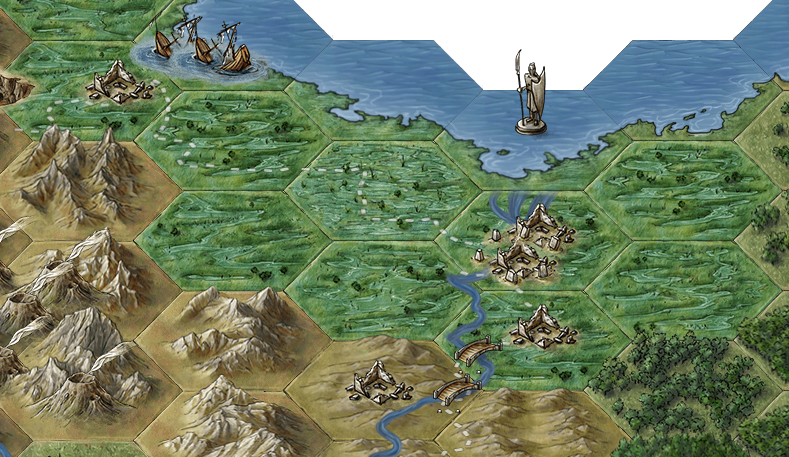
A hex map that shows Entrytown, the bog-city of Sheljar, the statue, harbor, and what is now the goblin village to the west.
People
Guardian Bilth Ferien – wrapped in the cloak of the free city Bilth is a former ferryman who now is the senior government representative at the Grand Entry. His animal companion is a massive horned ox. A human, likely with some goliath in his ancestry, Bilth is 6’9″ tall and wields a staff only a fool would call quarter. The are five other guards with him in daylight hours. Bilth is strong and enduring.
Cablemistress Shelmigarii – a tiny goblin, Shelmigarii runs the cable system. She always has either a wrench or hammer in one hand. Aiding her are a crew of four mulgoblins (bugbears) Her hobgoblin husband often runs the nightshift. They are all done up in oilcloth and canvas with big floppy hats common for Kon. Shel is smart and charismatic.
Fek – a gnome fascinated both by the functioning cable system and by near-constant stream of Kin-ish returnees with their animal companions, Fek is slightly in the way, not helping. They are always taking notes in their notebooks. They clearly are able to cast spells, but none have seen it happen yet. They are smart and dexterous.
Peculiars
The stone of the main gates is covered in colored glass baubles from Bel’an’faire off to the far south. These baubles can glow in the sunshine and now with magic’s return are frequently lit at night.
A giant statue, with a head level to the top of the cliffm can be seen at the edge of the harbor except on the foggiest days. From behind it is humanoid in the clothing of ancient Sheljar prior to it being the center of an empire, roughly 3,000 years old.
There is a frequent fog over the bog-city, hovering about 25-50 feet above the islands. Once called the Stench of Sheljar it is now purely natural, hiding the extent of occupation from those along the cliffs or at sea.
The gobkon on the cables are surrounded by mountain goats and scavenging birds. None are animal companions. These will follow people who choose to climb down the sheer cliff.
I’m doing Lore 24, an attempt to write small lore elements daily in the year 2024. Each element will be something that’s come up in play or will come up in play within my homebrew World of the Everflow — there will be actionable threads for PCs to grab onto and advance the story.
Full Moon Storytelling is brought to you by Kristin Clark of Keller-Williams Lake Washington If you are looking to buy or sell a home in King or Pierce County, Washington support Full Moon Storytelling by supporting Kristin.