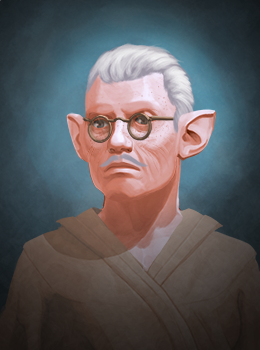
Opening up an NPC creation series with a character I should have made ages ago – one with glasses. If you don’t know me, I’m basically finger-blind. Without glasses or contacts I am unable to count how many fingers you would be holding up if you are more than a couple feet away from me. And yet, I never have played a character or NPC with glasses. I actively avoided it.
Heading over to DM Heroes, I hit the random button until it turned up a character with glasses. Then, it was about creating a character with an interesting background who was not a quest giver. Because as Rue says, “Make us non-quest related. Just people in your world. Living. Existing.”
First up is a Simple Index Card Version of an NPC. These are designed so with just a few words you can know who an NPC is from a basic description of appearance, to some basic motivations. In Willowrush’s case he’s a former soldier who once fought for the realm, but now works as a cooper. In my deep belief that everyone in your D&D world should have a hobby he is a fisher. He is not skilled in fishing though. He just enjoys doing the calmness of fishing with his friends. He can get dreamy about his past, but also doesn’t like to talk about it. Orne recently lost his beaver – Tryn. He’s just newly bonded with an otter – Orla.
Orne’s best friend is a librarian named Incirion Vadu, a goblin. You can often find them at the river together, ignoring work. Incirion knows Mending, and will often have an extra pair of glasses for Orne.
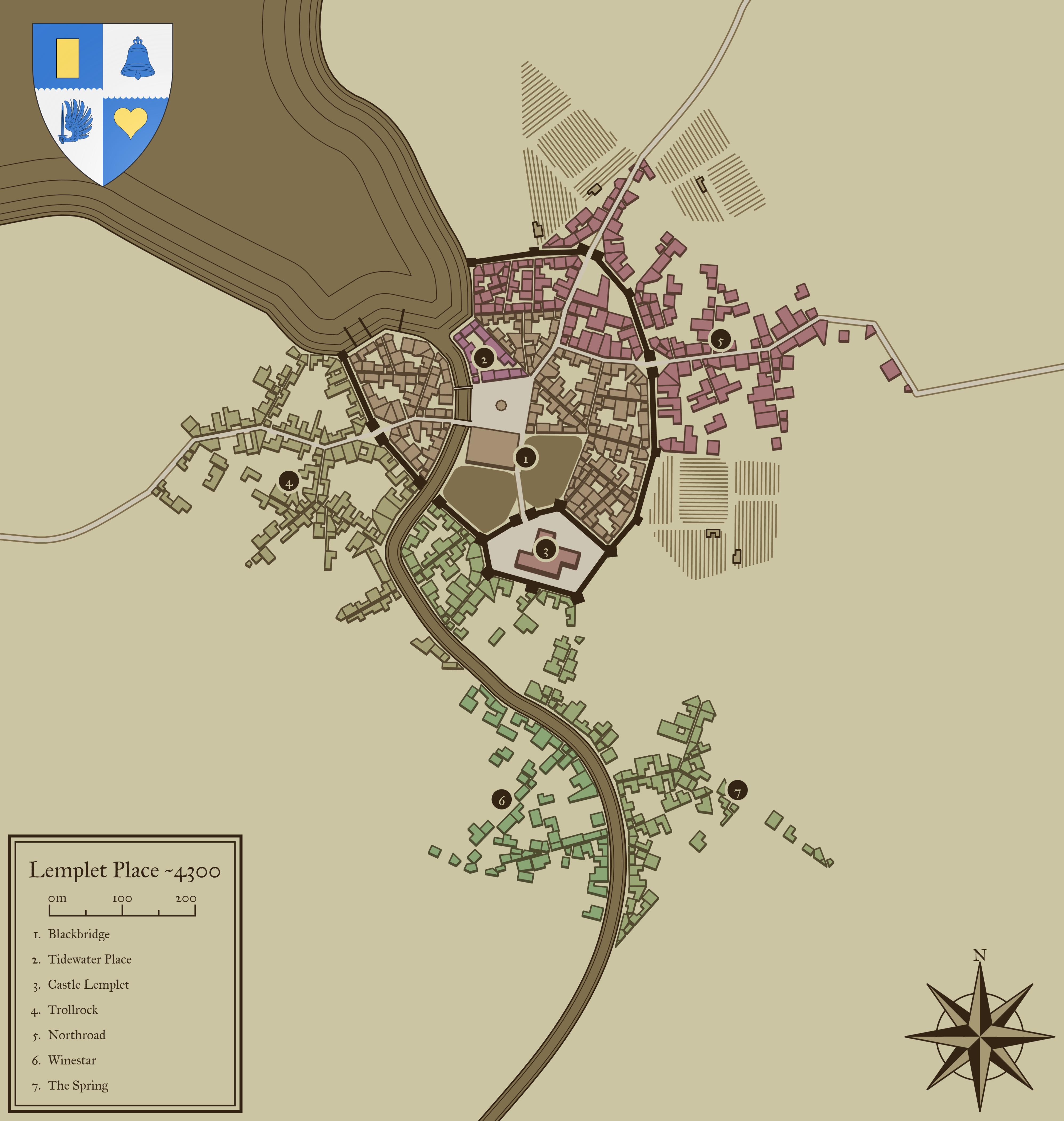
Winestar is a neighborhood built along the rolling ridge of the Lemplet River. It’s a mix of farmsteads with a few crafts to support their needs. Most of the good produced enter the walled part of the city via barge or float. The Spring, across the river, is up on a cliffside, and is generally more wealthy than Winestar, especially those parts that are next to the castle walls. Within Winestar you will, of course, find many small vintners, with most of the homes at least having a passing hobby of wine creation. In general, Winestar produces luxury goods whereas Northroad is sustenance farming.
Lemplet Place is a city of about 4,300 people.
Blackbridge – known for the eponymous bridge, the downtown of Lemplet Place
Tidewater Place – the slums, used to flood with high tide
Castle Lemplet – originally built as a exterior castle, the city has grown around it
Trollrock – the northern block surrounds a huge rock hill with a cave inside, no trolls though
Northroad – sustenance farming
Winestar – grapevines, orchards
The Spring – for the wealthy that moved out of the city
How will you use Orne Willowrush in your campaign?
This set of rules was shared with me by one of my fellow players in Arise & Descend. When they aren’t playing in our near-weekly game they also DM. Recently they noticed a gap in rules for naval warfare. Unlike Ghosts of Saltmarsh, this rule set is for when the party are on other vessels in a fleet or when the story may demand that the group zoom out from the single ship to a small conflict between two fleets.
Dave, not me, my friend, asked if I would share these for feedback. I have edited for copy, but have not playtested these rules.
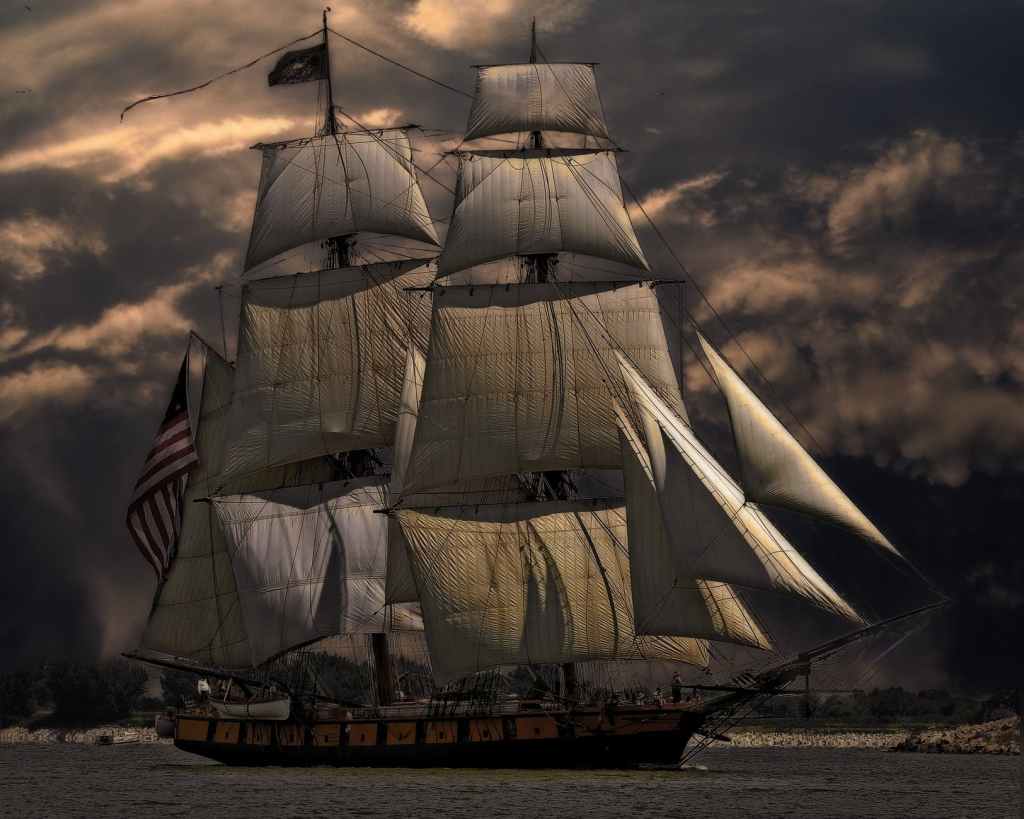
Tall ships on the sea are a great setting for a D&D campaign. The romance of the high seas has driven stories for centuries, and finding adventure there can spice up any campaign.
I have a homebrew campaign running, and in it my players have gotten themselves involved in a civil war on an island nation. Of course, any war like this is going to involve some pretty intense naval battles that I wanted my players to take part in.
However, when I looked into rules and systems for running naval battles, there wasn’t anything that really worked for what I wanted. There is some really fun stuff in the Unearthed Arcana “Of Ships and Sea,” which was refined for the Ghosts of Saltmarsh adventure. Those are great if you’re running a full on naval campaign, with all sorts of rules for maintaining a crew and a ship over long periods of time.
What I couldn’t find, though, is something for a major set piece battle to conclude my players current story arc. So I’ve come up with some rules and a system for running a naval battle that I think could be useful to other DMs looking to change up their player’s experience.
One quick note at the top: This system assumes your PCs will be on the ships, and that the players themselves will make decisions for those ships. Story-wise, this creates a bit of a problem. Either your players are in command of the ships they’re on or your players are controlling an NPC instead of their own character. If you’re like me, and you’ve always wondered why Han Solo was given the rank of General when he’s done nothing to qualify for that rank, the former is a bit hard to swallow. But some players won’t like the way the immersion is broken for the latter. It’s a small wrinkle, but it’s still there, and you might want to address it with your players.
Preparation and Ship Stat Blocks
Rather than playing as a character, each player will take over a ship. Each ship will have a stat block which will include Strength, Dexterity, and Constitution scores. Wisdom, Intelligence, and Charisma scores will all be zero. Ships are also immune to most effects, because they’re… ya know… ships. They are vulnerable to fire attacks.
Strength will relate to the amount of damage each attack can cause. The modifiers for various attacks will be based on this score. You add some flavor to this by giving a bonus to a STR score to a ship with a veteren crew, or a penalty to a ship with lots of novice or pressed sailors who aren’t as motivated.
Dexterity will relate to ship movement and speed. A ship’s base speed is 300 feet, adjusted for 50 feet per Dex modifier. For example: A ship with a 14 Dexterity (+2) should have 400 feet of movement. Ships get -3 to their Dexterity score for each size above large.
Constitution works similarly, but will relate to ship AC and hull HP. The base hull HP is 100, adjusted by 10 HP per Con modifier. For example: A ship with a 16 Constitution should have 130 HP. Ships should get +3 to their Constitution for each size above large.
On top of hull HP, each ship will have a number of crew members. Max crew number should be equal to the length of the ship. A large ship (100 feet long) will have a max crew of 100, whereas a gargantuan ship (200 feet long) will have a max crew of 200.
Max crew is in relation to the number of actions a ship can take. A ship can carry more than its max crew, but cannot take anymore actions because of it. For example, if a ship with a max crew of 100 gains 30 more crew after sinking another ship, putting it’s total at 130, it still can only take four actions.
Ships get one action per 25 crew members per turn, rounded down. For example, a ship with 100 crew members gets four actions per turn. But as they lose crew members, they lose the manpower to do as much. So once they go below 100 crew members, they only get 3 actions. A ship with 25 or fewer crew members cannot attack. They can only change course, make repairs, or tend the wounded.
Note: When building your stat blocks, make sure to pay attention to how each ship is balanced. Perhaps a flagship of the fleet has 200 crew members, meaning it gets eight actions. But such a large ship is ungainly and probably has half the movement of a smaller ship. You might even consider saying changing course on a ship that size takes two actions.
The ship’s actions are as follows
Change Course, Drop, or Raise Anchor: Ship changes to a different heading, drops anchor to stop, or raises anchor to get under way.
Arrow volley – Ranged Weapon Attack: + STR to hit. reach 150/400 ft., one target. Hit 2d10 + STR crew.
Ballistae – Ranged Weapon Attack: + STR to hit. reach 200/500 ft., one target. Hit 2d12 + STR piercing damage to hull HP.
Take Cover – Crew members are ordered to take cover. Arrow volley damage (crew casualties) is halved.
Repair damage – Crew members repair their damaged hull. Heal 1d10 + CON hull HP.
Tend the wounded – Crew members give medical treatment to their fallen crew members, allowing them to return to the fight. Replace 1d8 + CON crew.
Grapple and board – When a ship moves within 50 feet of another, they can attempt to grapple and board. The attacking ship will roll a Strength check +1 for every 10 crew members rounding down contested by a Constitution save +1 for every 10 crew members rounding down. The boarded ship can choose to fail this save. Once the two ships are grappled together, they are both restrained.
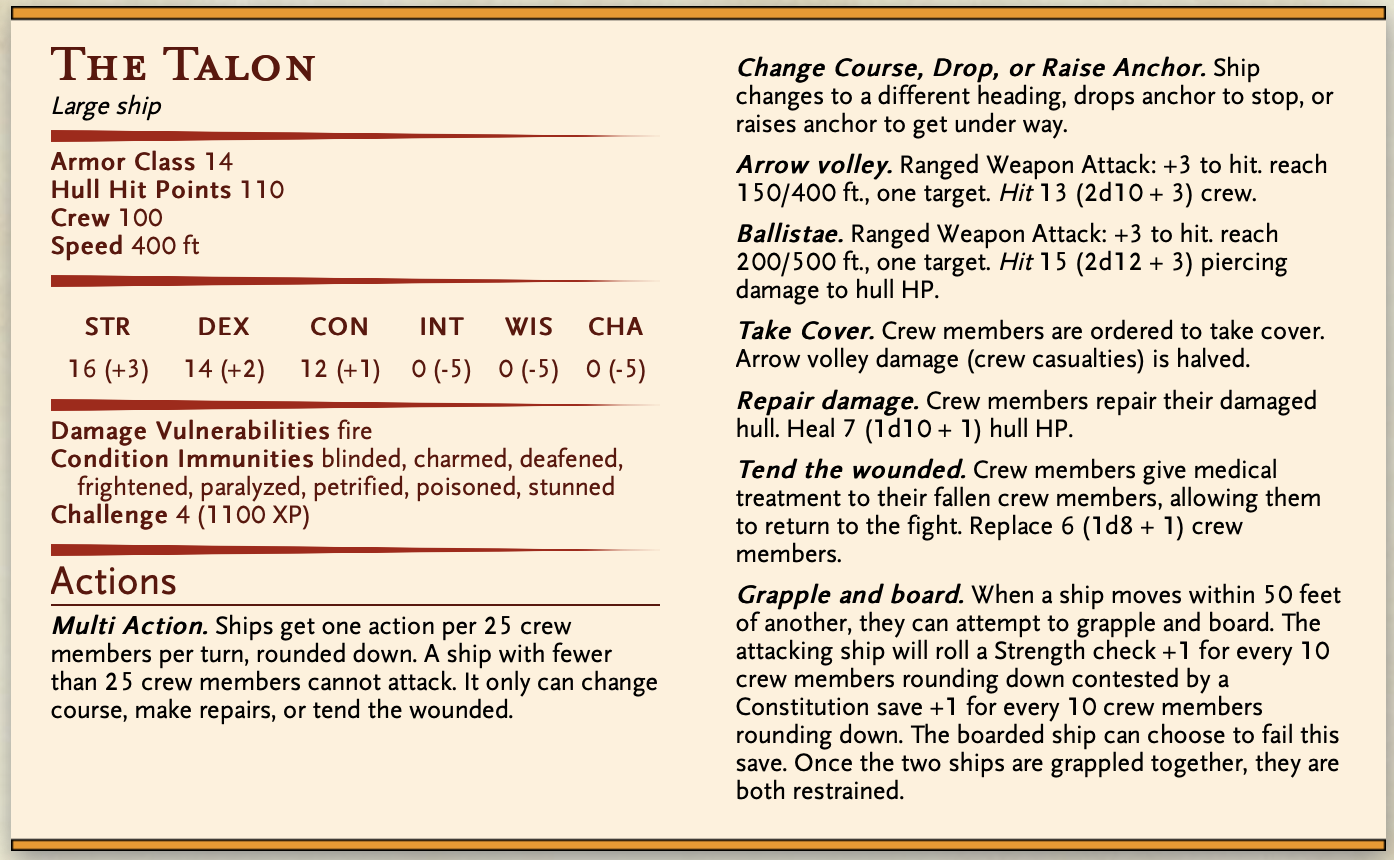
After including all the actions, a ship’s stat block should look like this
When a ship’s hull HP drops to zero, the ship sinks. Any ship that enters the space in which a ship sank may pick up the remaining crew members. All crew members will be rescued. If an ally of the sunk ship moves into the space they add all the crew members to their current crew. If an enemy ship moves into that space they add half the crew members to their crew.
This is because sailors don’t want to drown and know that if they try to fight the ship rescuing them, they will be left behind. Half the surviving crew members will join the fight in the new ship because they’re either pressed or sailors for hire therefore sailing for one ship or another is all the same to them. The other half will willingly go below decks as prisoners as that’s preferable to drowning.
Setting up Battle
The battlemap for these engagements should be a grid on primarily open sea, though some islands or a coastline can certainly add some tactical flavor. One square on the grid should equal 50 feet. Since ships are large and slow-moving objects in a large area, each round is equivalent to about 6 minutes. Ships will be sized to 50 foot squares.
Medium = 50 feet long (a large yacht)
Large = 100 feet long (a sloop or a brig)
Huge = 150 feet long (galleon or a schooner)
Gargantuan = 200+ feet long (frigate or Ship of the Line)
Movement
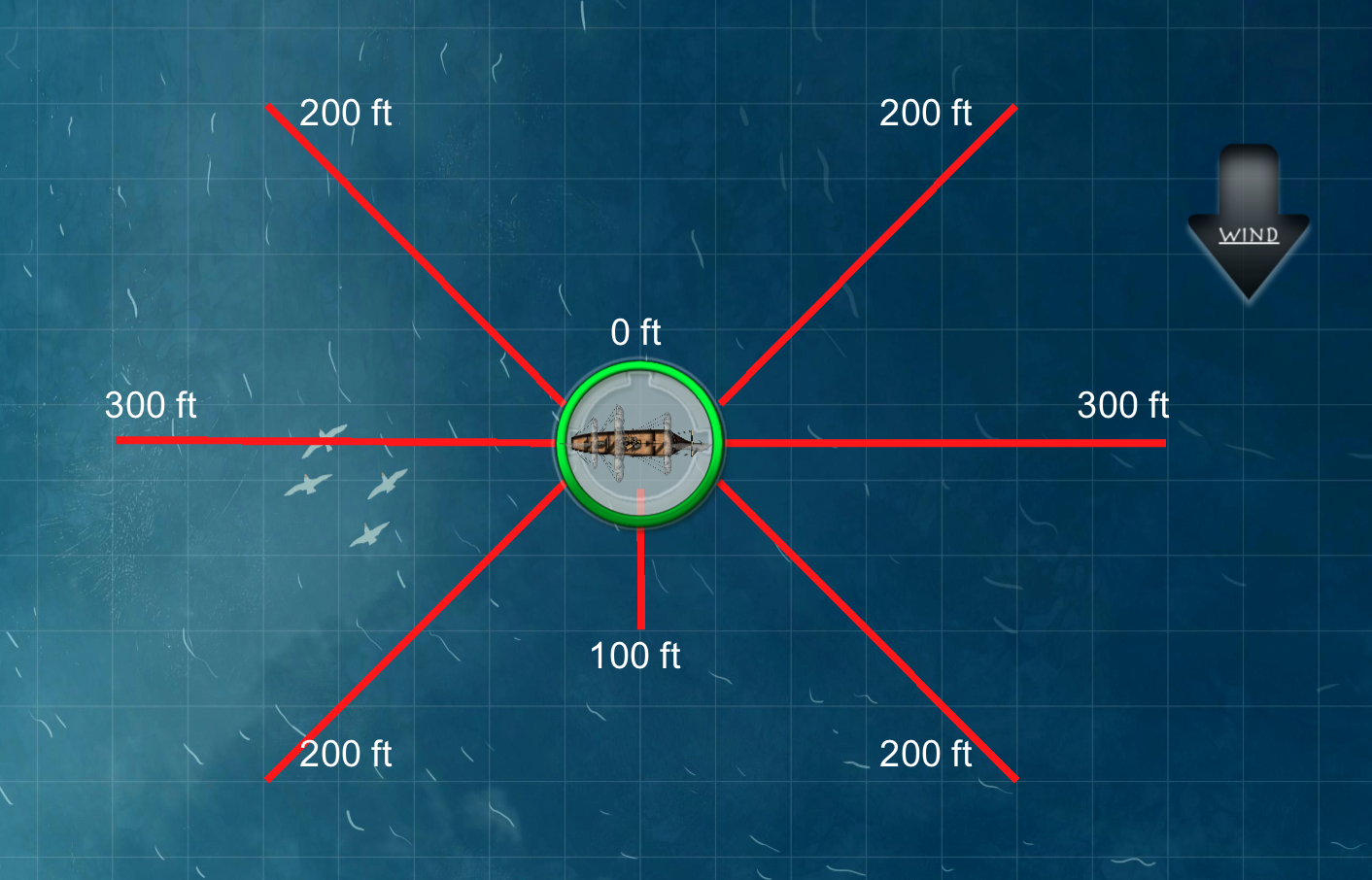
When it comes to sailing ships, the wind is an important factor. A token should be placed on the map to indicate the direction of the wind. A ship may not sail directly into the wind, but can sail at a 45 degree angle towards the wind. Ships sail fastest going perpendicular to the wind, so when they head 90 degrees from the wind, they have full movement. Sailing away from the wind is the slowest, so ships headed the same direction as the wind have one-third speed, rounded to the nearest 50 feet. Quartering the wind (45 degree angle in any direction towards or away from the wind) will give ships two-thirds speed rounded to the nearest 50 feet.
In practice, it should look as follows. The diagram below is for a ship with 300 ft of movement:
It takes one action to change course or drop anchor to stop, but if no action is taken to correct course, the ship will spend it’s full available movement each turn continuing in the same direction.
If a ship’s movement will lead it to hit another ship or some other obstacle, it must use one of its actions to change course or stop.
A ship cannot attack through an allied ship’s space, but must move to a space with a clear shot at its target if it wants to take an attack action.
Boarding Rules
Of course, no high seas adventure would be complete without the chance to board another ship. As an action, a ship within 50 feet of another can take the Grapple and Board actions. If that action is successful, the two ships are tied together and restrained. While two ships are grappled and restrained, they attack each other. Each ship gets one action for each 25 crew members rounding down per round. They can attack or retreat and break free.
Attack: +1 for each 10 crew members rounding down. Damage 1d10+1 for each 10 crew members rounding down.
Retreat: Strength check +1 for every 10 crew members rounding down contested by a Constitution save +1 for every 10 crew members rounding down. The enemy ship can choose to fail this save.
Once one ship has less than half crew, the rest of the crew will surrender. If a ship already is down to half a crew, it will surrender as soon as it is grappled. The winning ship has two options:
Bring captured crew aboard their own ship, adding half of the surviving crew of the captured ship to their crew member total (and taking the other half prisoner), and scuttling the captured ship.
Add half the surviving crew of the captured ship to the crew member total (taking the other half prisoner) then split the new crew total evenly to take command of both ships.
If your entire party is on a single ship, or if more than one of your player’s ships grapple on to a single enemy, you might want to replace this grapple roll with a full encounter and ship-based battlemap.
Adding Your Player’s Traits
Most of these ships will be pretty similar in capabilities. But you can add some variation to these fights by giving bonuses based on your players’ character classes and traits. Story-wise, your player’s heroes will have spent some time with the crew members of their ship teaching them some new skills and talents, which gives those crews certain advantages in battle.
For example, in my campaign, I have four PCs, a Barbarian, a Paladin, a Ranger, and a Wizard. For my final battle, I will have them all on separate ships (which each player will control), and give the following bonuses:
Barbarian: He’s great at close quarters combat so his ship will have advantage on his Grapple and Board Strength check and +5 to his boarding attack.
Paladin: She’s a healer and a tank so her ship will be resistant to Arrow Volley (she loses half the crew members per volley, down to a quarter with the Take Cover action), and she has a +5 to her Tend Wounded action.
Ranger: She’s a classic ranged fighter so her ship will have no range disadvantage for her Arrow Volley or Ballistae actions, and get a +5 to her Arrow Volley damage.
Wizard: He loves to cast Expeditious Retreat on himself and keep moving in battle so his ship will have an extra 150 feet of movement, and he can add fire damage to his Ballistae action.
You should add your own bonuses based on the personality and favorite tactics of your characters.
Final Notes
Another big change you could add to this is adding cannons, assuming you’re playing with the Firearms rules. Since I don’t use them in my campaign, I didn’t think too hard on how they would work. But that doesn’t mean you couldn’t adapt this for Firearms rules.
An optional rule you might use is to add changes to the wind direction. If you want to use this, choose a random interval (or roll for one) such as 3 rounds or 15 minutes (real time), and roll either a d4 or d8 to choose a random change in wind direction.
And finally, this is all pretty complicated, and might be a bit much to throw at a party in one session. I would advise bringing these concepts slowly. For example, put your players on a single ship that you control, and give them each one of the ship’s actions to use as they see fit. Then you can slowly bring in concepts like wind direction, movement, or boarding one at a time, so that by the time your players reach their climactic battle, they are comfortable with all these rules and the tools at their disposal.
Hopefully this can give you a framework to build an epic and memorable naval battle to your campaign. If you have any thoughts or suggestions for improvements to this, I’d love to hear them.
Distances in the modern world are measured quite accurately. Whether you use Google Maps (or whatever your favorite similar app is) or even just wayfinding markers, much of the inhabited world is known. The distance from place to place is precise. But when you’re wandering the wilderness your characters do not need that level of precision, nor would they have it.
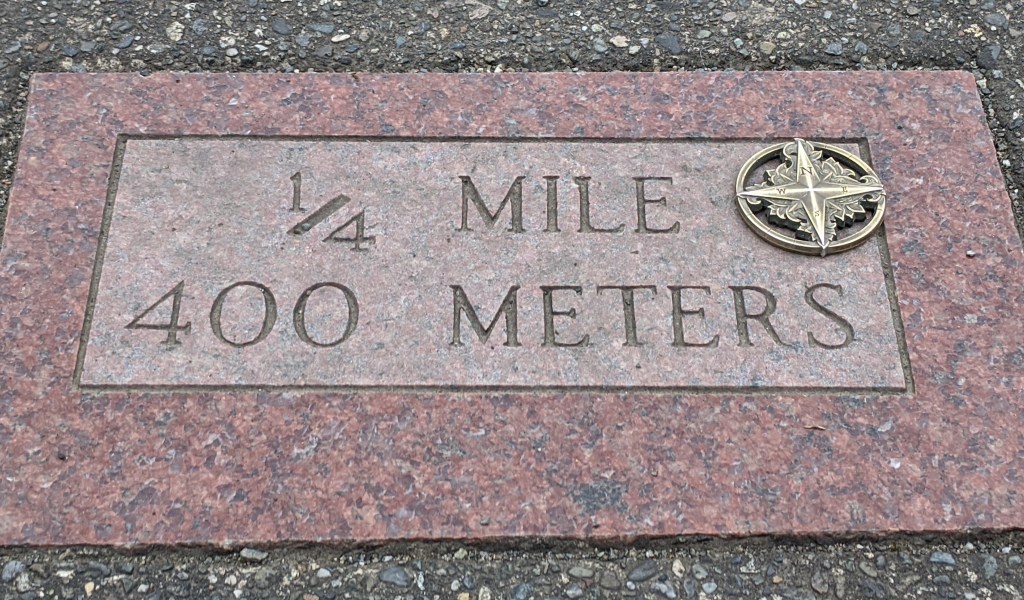
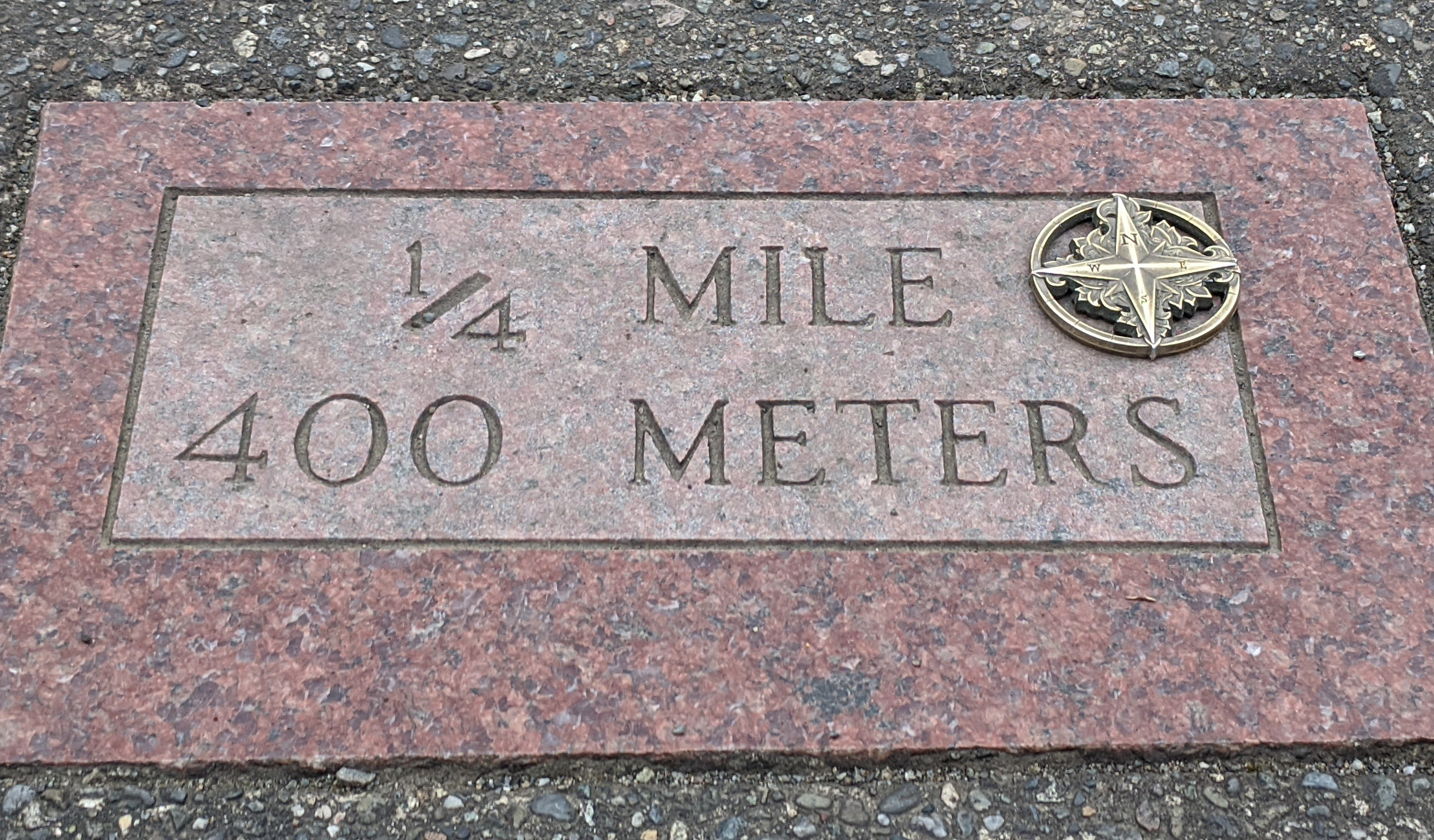
A sign indicating a distance of 1/4 mile or 400 meters from the last marker.
Miles, why?
A mile originated as 1000 paces of road and marked off by an ancient fallen empire. It later gets corrupted by locals to mean dozens of dozens of slightly different things. They only make sense in a world where there was a unitary fallen empire that had a vast majority of its residents be of the medium races.
This makes sense in some fantasy worlds, but not many. A single cohesive empire within the primary region is a story that is sometimes told, but only those that marched soldiers would use a mile.
Now, for players, rather than characters, the mile has the advantage of being what Americans use for distance, and the majority of Dungeons and Dragons players are Americans. It’s a handy shorthand for distance.
It remains though a measure of distance with an accuracy that is meaningless. It does not matter if the next village/cave/castle/dragon is 7.2 miles away.
Immersive Travel Distances
What matters is “how long does it take to get there?“
That’s what characters need to know. Thereby that’s what DMs need to know. Travel time is the key. How many encounters (social, exploration, or combat) will happen during the journey. Do the characters need to stock up on supplies? Do they need to find a cart or mount due to the distance? Do they need to hurry?
So throw out the mile. It’s unnecessarily precise for your game. Just like the number of minutes you travel don’t matter in the majority of your sessions. Abilities that impact travel are measured in time, not mileage.
Replace miles with a measure of distance that relates to what the characters know. Make it simple enough that your players know what it is as well.
Introducing the League
Borrow from the league. This is a great measure to use in your game world. Yes, it’s also based in that ancient empire. In this case it was the marching distance that a soldier could travel on a road in an hour. It works out to basically 3 miles, which is extra handy, because that’s the number of miles that D&D says a human character travels in an hour.
This means you do not need to convert any of your maps that display mileage. Just divide it by 3 and you know how many leagues separate the two locations – easy.
Throw in some variants similar to Welsh measures of distance with the short yoke, the lateral yoke, and the long yoke, and you can capture the nature of travel by shorter races, pony/dog/donkey, horse. These slightly different names help with immersion because in D&D there are essentially four different speeds that matter.
*animals don’t like being ridden for quite as long as humans like to march.
Introducing the Daylong Journey
That last column is another measurement that matters – the day. In a given adventuring day a party should take two rests and a long rest. They could do those overnight or during the daylight, depending on the party makeup and whether there is a need to hide from baddies.
Take those rests whether or not there is combat. The fact of the matter is that when people or horses march of hours and hours and hours they need to rest. There’s even a mechanic for forced marches (pg 181 of the PHB) if you want to avoid those rests and push through. Those groups run the risk of exhaustion.
There is no historic English word for a daylong journey, so just call it a daylong journey in Common. But also recognize that some societies might abbreviate it. The common perception of halflings in most fantasy worlds might call it a Joun’ or just a Daylong. Those cultures that use carts or dogs or ponies might not use a different word. They just know they travel a tiny bit faster, but not a lot faster than humans.
You can still use the page 182 PHB chart about Fast or Slow travel too. Fast travel is 33% faster than normal travel and harms your passive traits like Perception and/or Survival for tracking. Slow travel is 33% increase in time spent travelling, but you can use Stealth for the group (as a reminder a group check means each player rolls for success and if 50% or more succeed the group succeeds).
To Sum Up
Don’t get caught up in granularity.
You’re going on an adventure, not a trip to the grocery store.
Do use measurements that your characters care about – a league and daylong journey.
Use a system that most of your group likes, which could still be the boring mile.
The mechanics of Dungeons & Dragons don’t force you to choose a pastime or hobby. Outside of Bards and the various Backgrounds that include entertainment and arts there is no obligation or hint that a character should do things besides fight, interact socially to solve or cause problems, or explore a wildernesses and dungeons.
With a limited number of skills and tools you might weaken your character if you take something without a direct impact on their ability to perform as an asset in the adventuring party – so what?
Be a tiny bit weaker and add something that your character enjoys doing that has nothing to do with defeating dragons or wandering dungeons. In the real world in the eras upon which D&D reflects, this was common. Commoners worked less than we do in the modern era.
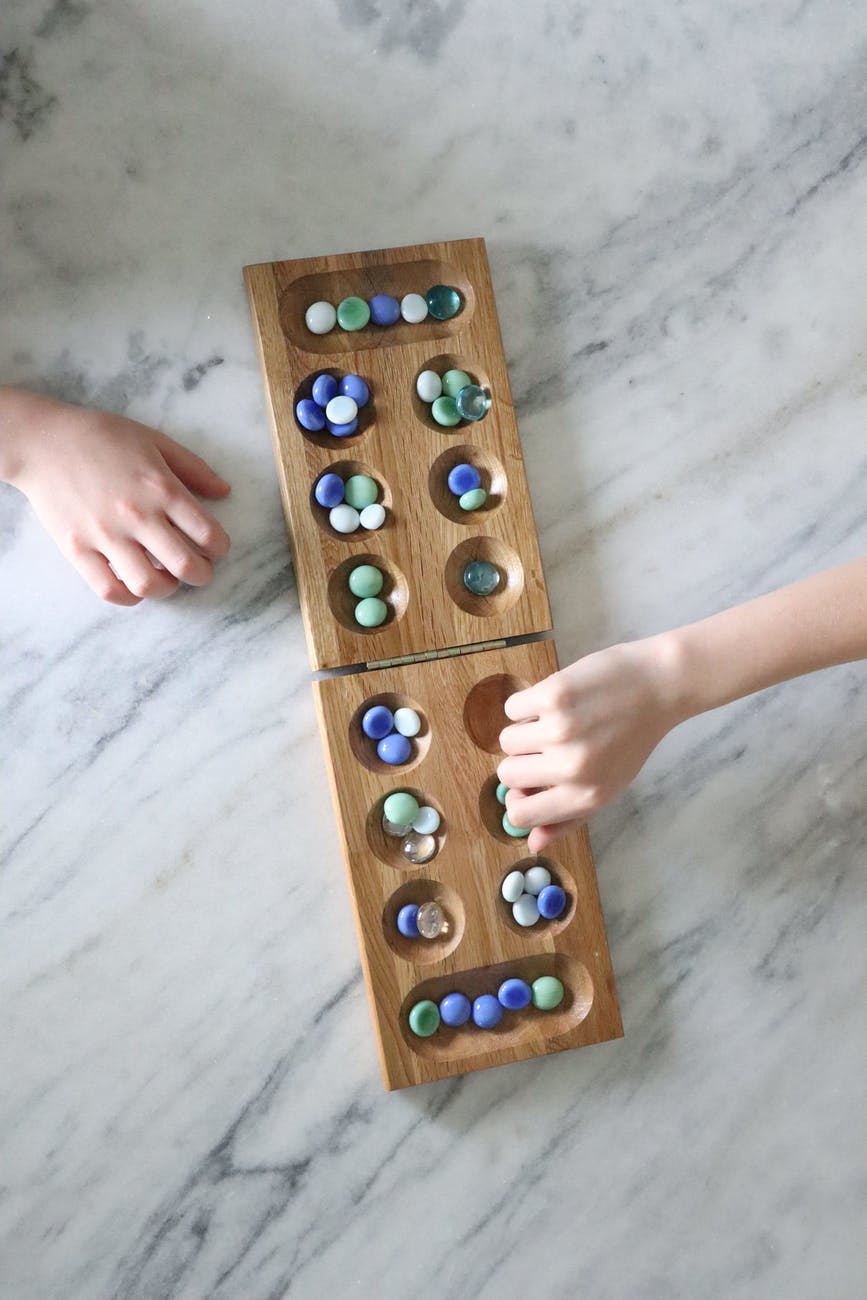
Look at games like draughts, chess, mancala, 9-man morris, hnefatafl, and others lost to history. People had time. They did things with that time that they enjoyed.
They sang songs. Told tales. Wrote dumb epic poems that we still read.
So what does your character do when they aren’t living their life and when they aren’t dungeoning or dragoning?
Burn a tool or skill on this – or don’t! – maybe they enjoy doing something that they are bad at.
Maybe your next PC or NPC is the world’s best tafl player, or the local community’s worst singer. Maybe they make little sweaters for the elves that aren’t actually elves, and then they meet real elves. Maybe they are the old man that talks story to the children of his town.
These elements may show in just a sentence or two in a given gaming session. That’s okay. It’s part of who they are and what they do, even if a d20 isn’t involved.
Backgrounds offer so much space to establish who you character was before they entered the stress and conflict of adventuring life. The combination of skill selection, tools, languages, equipment, and personality are a story unto themselves. Jim the Fighter and Nancy the Fighter are similar because of what they do now, but they are also different because of what they did then. Jim was a Noble, raised among the upper class — prim and proper. Nancy was an Urchin, raised on the streets she could sneak among crowds to avoid fights, usually.
And unlike classes, there’s still a lot of uncovered ground. Many tales of what your hero was aren’t encapsulated in the current official backgrounds. The common laborer – the fence builder, the ditch digger, the lumber mover, the stevedore, the longshoreman – is currently ignored.
In trying to fill that niche, while also playing with the idea that utility cantrips are valid parts of a Background, the Remarkable Drudge comes to life. This implementation differs from the earlier version of Seven Backgrounds for Games in the World of the Everflow in one primary way. In the past, the power level of a 1st level character was such that cantrips were folded into the feature. To keep the Drudge and the other Fantastical Backgrounds appropriate to generic D&D worlds the decision is made to replace a single skill and a single tool/language with one cantrip. An evaluation of various Feats available in the Player’s Handbook, Xanathar’s Guide to Everything, and Tasha’s Cauldron of Everything shows the value of a cantrip is slightly more than a skill, but not much more than a skill.
Let’s meet the Remarkable Drudge.
Remarkable Drudge
You are a laborer, often ignored and yet the reason why the community runs as smoothly as it does. You may work the docks, the stockyards, the lumberyards, or lay the planks to improve the dirt roads into wooden streets. Your hard work is the foundation of civilization. But, you’ve also learned, or been born with, a simple spell to make your work a bit easier. The small spell provides utility for you and your coworkers. It may be a hand that can bring you the necessary tool from a distance, the ability to change the shape of earth or water, a way to shout instructions to someone across the field, or a way to light a fire. No matter what your little spells gain you a bit more respect and value than others in your line of work.
Over the years you’ve learned that anything can be a hammer, or a shovel, or well, what you need. When you don’t have the tool or mundane item designed for the job you are usually able to find something else that will work for it – maybe it’s a rock, a brick, a busted up board, or something from someone else’s pack. An imperfect tool is better than no tool at all.
Suggested Characteristics
Drudges are hard workers and celebrate their completed projects with gusto. Frequently working in teams they are warm to those who work hard and cold to those who do not.
For now, use the Personality Traits, Ideals, Bonds, and Flaws of the Folk Hero.
Custom Backgrounds for 5th edition Dungeons & Dragons
Proficiency with farmer’s tools means that you are familiar with the operations of a farm, orchard, vineyard, or other cropland. You are knowledgeable in the typical crops within an area, to include when to plant and harvest them. You also know their market value in most lands.
Components: Farmer’s Tools include a hand trowel, a bag of seeds, a hand rake, a mallet, shears, a bucket, and 10 feet of rope. When near a homestead they would be able to easily borrow a hoe or other full size implements.
Animal Handling: Familiar working in tandem with animals you are able to gain the cooperation from domesticated animals and can give common commands in languages you know.
Nature: You are able to identify the plants and fungus that are consumed as food, often knowing what cultures would typically raise those crops.
Survival: In the wilds you are generally able to locate some produce that provide a minimum level of nourishment.
Forecast: Your understanding of weather patterns is such that you are able to predict the weather for the next few hours. You can sense if there will be a natural change in temperature, wind, precipitation, etc when you have a view of the sky.
Farmer’s Tools
Activity
DC
Identify culture/race raising common crops
10
Give domesticated animal a simple command
15
Weather forecast for the next few hours
15
Identify culture/race raising rare crops
20
Farmer’s Tools are designed to use the tools guidance in Xanathar’s Guide to Everything.
We’re speeding towards my first ever livestream of Dungeons & Dragons. There’s a thrill and excitement to this. Unlike most who jump into livestreaming, my playing group is not a set of people who I’ve done this with before. Only one of the players is part of my regular gaming group (I’ve never DMd for them). The two celebrities are the people I know the best. Many wouldn’t plan to jump into streaming this way, but for me the game came together as a desire to help YachtCon: Back to School generate community while donating to the Autism Center at Seattle Children’s Hospital, to act as an evangelist for D&D, and to add some South Sound/Tacoma Defiance flavor to my life after missing it for so long.
One of the thrills about creating this game is meeting new players. Each of the participants met with me for a one-on-one session zero. In every single one of these the players didn’t just build a combat oriented “build” but worked on backstory and connections towards the adventure on hand.
It was thrilling to see this!
There are several reasons why backstory developed. Fifth edition leans into this with Backgrounds. Every participant knows that their DM is into story creep rather than pure roll play. Plus, it isn’t surprising that those willing to generously donate their time and money to the cause would be those whose passions for the game include social, exploration, and combat encounters.
It will be up to me to take these characters and get at least a small mention of their pasts into the three-hour tour that is DD:253 – Invasion of the Trees (Sunday March 21 at 7p). All of our characters, from Lorenzo to Du-Rag to the ones you are about to meet, are here to help the small town of Prosperityburg solve a simple problem – why did Castle Highberg stop responding to messages?
A map of the Dusk Shores and the Spring Mountains
On this campaign of discovery Du-Rag and Lorenzo will be joined by a ragtag group of adventurers. The rest of the group is made up of;
Lennel is a tortle warlock, connected to the sea. He values the connection between the port town and the Dusk Sea, working to build camaraderie between the peoples.
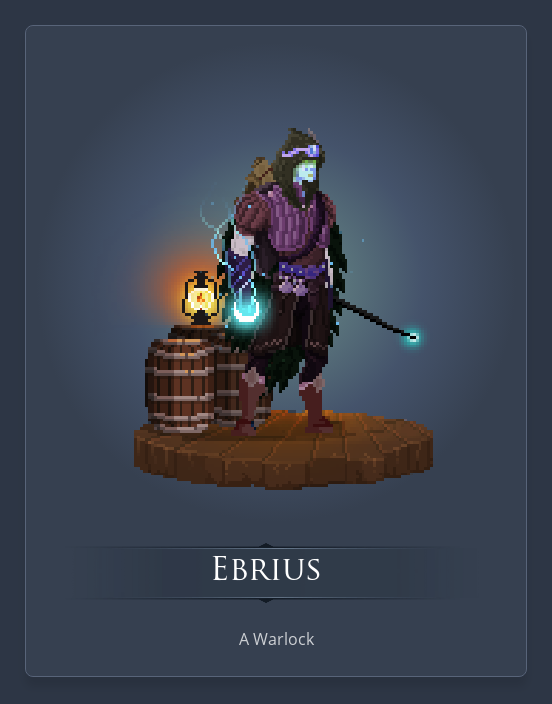
Ebrius is our second warlock. A tiefling, he works to help the helpless.
Yelfir is a goliath fighter. Born in mountains, she tests her strength and serves the greater good of the community.
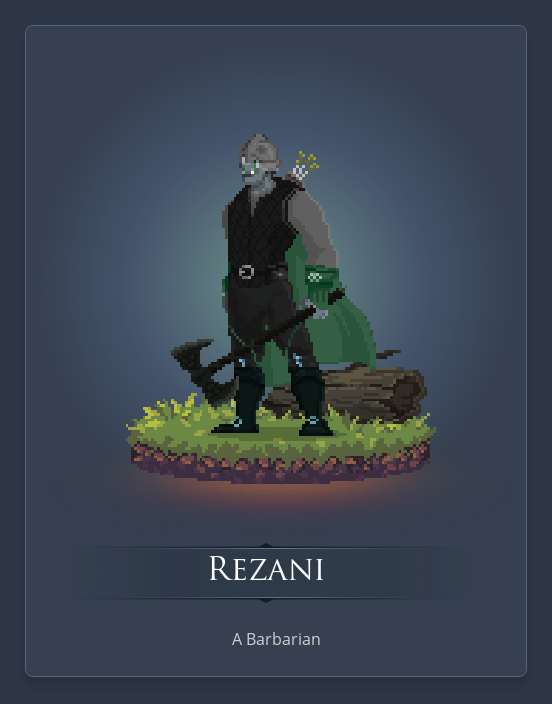
Joining Yelfir on the frontline is another axe-wielder. A half-orc barbarian, Rezani shuns armor as he stares down the greatest dangers.
When not stabbing you with sharp wit Qulile will stab with a rapier and a dagger. The swashbuckling fishfolk knows the run of the streets and remains calm under pressure, right up until the point he runs.
Together this group of misfits joins Du-Rag (half-orc cleric) and Lorenzo (human bard) serving the city that sits along Badd Bay in the shadow of the Spring Mountains north of the Weald of Aspirations. The defiant land that they call home is threatened. Rising together they will attempt to stop the Invasion of the Trees.
Many D&D worlds are anachronistic in their approach to the world space. The inn has rooms with bunks for a single person. Clothing and bathing habits also mimic our current world. Reading is common.
Here’s the thing — the idea that these things are too modern for a “real” approach to world building is wrong. The ancient world through the Renaissance contained modern conveniences, and they didn’t have magic.
Beer Factories
No, your average inn or tavern will not have canned tall boys to crush when the adventurers visit. They most certainly would have lower carbonation beers that are mass produced, not just niche ales, lagers, meads, and such. Beer factories were present in ancient Egypt.
Archaeologists found eight huge units — each is 20 meters (about 65 feet) long and 2.5 meters (about 8 feet) wide. Each unit includes some 40 pottery basins in two rows, which had been used to heat up a mixture of grains and water to produce beer, Waziri said.
That’s a lot of beer. In Curse of Strahd there’s the embrace of a rather large winery.
Embrace this. Have a popular beer, wine, liquor, etc within a region. Develop trade routes with it. Maybe your character tried it when their richer friend gifted them a bottle, jar, or cask. Maybe they carry a small vial of their favorite with them to remember home. Were they part of the merchant class that helped ship the goods from town to town?
Related to beer is that recipe books go back to the dawn of writing. Your brewer or vintner could be producing a recipe from many towns over, not due to word of mouth, but because the recipe is known to the world.
Grab Heroes Feast for some modern foods inspired by Dungeons & Dragons, or just follow Dollop of History for pre-WWII foods going back to the early Middle Ages.
And, of course, the Redwall Feasts bot has foods that work for any indulgent culture.
Your world can and should include the senses of taste and smell. Street foods and walkups should exist. Develop a vibrant food culture not because it adds verisimilitude, but because it expands the stories you can tell with D&D.
Four Fey-folk are explored in the March 11 Unearthed Arcana drop. This includes the classic Fairy, two animal-folk (rabbit and owl), and a Fey Hobgoblin. While all of these races are connected to the Feywild, they are not called out specifically as being from the Feywild, just connected to it. Only the Fairy is Fey, by creature category. In some ways this makes the other three racial options (the document does not call them out as lineages) like “normal” Elves rather than Eladarin. If this UA gets strong feedback there will be two Hobgoblins in existence, one a martial warrior and the other that creates a unique bond through gift giving.
The “Creating Your Character” section provides special character-creation rules for the race options in this article. The races that use these rules can coexist seamlessly with races that use other rules. For example, the race options in the Player’s Handbook have built-in ability score increases, while the races in this article don’t. Race options from both sources can adventure together. If you’d like a race that doesn’t appear in this article, such as an elf or a dwarf, to have similar ability score flexibility, the book Tasha’s Cauldron of Everything provides a rule, called Customizing Your Origin, that gives you that flexibility. That book also gives you the option of building your own race, rather than choosing an existing one. That option is called the Custom Lineage. No matter which option you choose for your character—a race in this article, a Player’s Handbook race, a race modified by the Customizing Your Origin rule, or a Custom Lineage—you can adventure with characters who are built with a different option. This sidebar builds on the design note in our previous Unearthed Arcana, “Gothic Lineages.”
Any fey centered story has to have fairies as playable characters. Fifth edition is finally adding them. They fly, of course. The Fairy joins Aarakocra and Feral Tieflings as able to fly at first level. Owlfolk join that group shortly. These are the only races limited away from some versions of Adventurers League.
All of the abilities just make sense for what we expect from fairies, but the one that stands out to me as unique and situationally potent is Fey Passage. The ability of a small fey to enter nearly sealed spaces fits so much of the legend and lore surrounding these peoples.
Hobgoblin of the Feywild
Whereas the Volo’s version of Hobgoblins focused on every single one of them being at least a light fighter, those Hobgoblins with connections to the Feywild are helpers. Rather than armor or weapon proficiencies, your Hobgoblin gains a leveling version of the Help action. This is much more interesting flavor.
Hopefully when the Fey Hobgoblin gets dialed into official material the two version appear more like subraces, rather than having similar, but still different abilities. There is language drift between the new Fortune from the Many and the old Saving Face. Also, the older version of the Hobgoblin is just weaker. Three proficiencies is just weaker than Fey Gift and Fey Ancestry.
Owlfolk
Another flying creature, of course. The choice to be either medium or small makes sense, as there is variation in size for real owls, as well as the stories upon which the Owlfolk are based. There are two sight based abilities, but neither directly relate to Perception. This UA does insert a third scale of Darkvision. It should likely be changed to either 60′ or 120′ to be inline with other races. 5e is about those kinds of simplicity.
My favorite ability for Owlfolk is Magic Sight. Adding a ritual spell makes so much sense for a race that is so storied in wisdom and intelligence. It combines well with spellcasters and martial types. Hopefully there are more races that access rituals rather than the now standard 1 per long rest usage of a 1st level spell.
Rabbitfolk
Hip, hop and hippity hop. Yes, there will be a Rabbitfolk Bard in my future. There’s some interesting mirroring of Halfling abilities here, which makes sense. The two generally smaller folk both love freedom and large families. Rather than Lucky, the Rabbitfolk get a minor bonus on failed Dexterity saving throws. These similar abilities maintain interest while connecting to their stories.
Here, the Rabbit Hop is the ability that leaps out. Being able to jump around is key for a rabbit. Getting to use it with no cost is wonderful. The d12 of additional feet is clunky (just as the similar rules regarding Athletics are clunky). For gridded play something like +5′ per proficiency bonus would be simpler. For those playing with Theater of the Mind the difference between 3 feet and 4 feet is meaningless in combat.
Overall these should be popular. There are entire game systems dedicated to animal folk. Humblewood was extraordinarily popular, because people just enjoy being little floofs of magic and power. Official support for similar folk makes sense.
Hopefully the feedback helps dial in some changes to the various hobgoblins and other non-core races that have clear subraces but operate as completely separate instances rather than those that share story and abilities.
Over the past five years I’ve participated in YachtCon — sometimes as talent, sometimes as green room host. In 2019 and 2020, while with Tacoma Defiance I sold off the opportunity to join the broadcast booth for a match. Those 2020 winners are still waiting to do that, as the covid-19 pandemic made that option unsafe.
Still wanting to give some South Sound flavor to an event that will be entirely virtual I needed to come up with a different idea. Ambition got the best of me, and with Sounder at Heart/Nos Audietis manager Jeremiah Oshan’s approval Dungeons & Dragons & Defiance: Invasion of the Trees was launched. DDD:253 is a charity game with two celebrity guests and five PC spots for people who donated $60 dollars to the Autism Center at Seattle Children’s Hospital. DDD:253 sold out in 24 hours. There’s still plenty of opportunity to join the audience for the live stream of this 3-hour tour of D&D.
There are also many other opportunities to join in on classes about pizza making, wine tasting (observer only), cocktail shaking, watercolor painting, and so much more. All of them will have twists related to the pro soccer teams in the area, including celeb participants. Just as gaming conventions had to adapt, so did YachtCon. The group of passionate Sounders/Reign/Defiance fans haven’t been to a match together since March 8, 2020. It’s possible that the 2020 YachtCon was the last time we were all together. This year’s event is as much about re-connecting the community as it is raising funds. That’s why you can audit every “class” for free. But, it’s also a way to raise funds. The Nos Audietis/Sounder at Heart/Ride of the Valkyries group has raised over $30,000 dollars in the past five years. Please join us. There’s even kickass soccer gear.
This is a short adventure inspired by Tacoma and Tacoma Defiance, set in a small frontier town common in so many fantasy worlds. This port village has a tavern where a local leader needs help. Our adventuring party is going to help the city defend itself from an invasion from the south. Along the way they will meet hazards, possible allies, and of course the enemy(ies?).
Railroads have been avoided, which means there are nearly a dozen encounters, but in a 3-hour session only a handful will ever be used. Maybe, just maybe, the whole world will see the product after the live adventure, which will be streamed. There will be no VTT, everyone will track their damage, spells, etc with paper sheets in their own homes. Maps and art will be via a shared screen and the experience will be Theater of the Mind, rather than tactical. The model being followed is the Stranger Things x D&D game from early winter rather than highly produced streams like Critical Role.
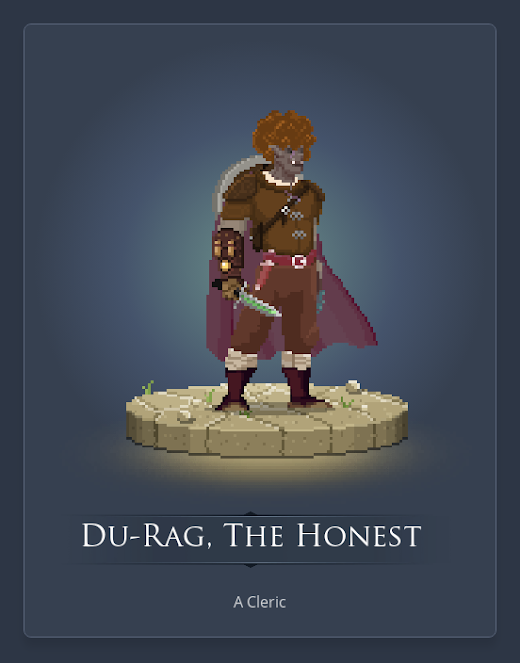
Each participant is getting an individual session zero, which will involve character creation and an agreement on option rules. They are also getting pixel art of their PC, using the ReRoll app. Each will also get a set of dice, which is especially handy for those who are playing for the first time.
Lorenzo is a human bard, run by Tacoma Defiance Head Coach Wade Webber. He’s as handy with his lute as he is with a dagger or rapier. Sometimes he’ll bang a drum or play a recorder, but mostly he likes the strings to accompany his songs and poetry. Snapdragon is likely to be the charismatic face of the party.
Du-Rag, The Honest, is run by Defy professional wrestler and Destiny City Comics owner Ethan HD. Du-Rag is a half-orc cleric, who is as comfortable in the streets as he is in the pulpit. His friends? He’ll heal them. The Honest will usually try words first, but those that stay enemies face the dagger, or the power of his god.
Rest of the Party
Over the next week the rest of our adventuring party is being filled out. When those are done we’ll share the character art for them. There’s already a tortle warlock, a half-orc barbarian joining the cause. The group is banding together to defend a lumber town, with a port, a gritty city of unpaved streets with a good bar and neighbors who gather together in defiance of the odds against them.
Again, DDD:253 Invasion of the Trees is part of YachtCon: Back to School. All proceeds from every class go to the Autism Center at Seattle Children’s Hospital.
One of the most popular questions I get is “How do I start to play D&D?” In the Before Times I would invite people to join in my World of the Everflow campaign with fully half of the more than a dozen participants in that game being new to Dungeons & Dragons. Now, with the explosion of digital and remote play I tend to guide people towards the Adventurer’s League. The robust program from Wizards of the Coast just had a major shift.
As someone who builds most of their characters via DnDBeyond the looser rules help. There was not a simple toggle to limit to the PHB+1 rule on/off, so to make an AL character I had to think through which book a spell, background, feat, race, subclass all showed up in. The digital era makes the +1 rule a touch obsolete. A character built on Beyond or any VTT will have all of its abilities publicly facing the DM.