Category: Playing D&D

Custom Backgrounds, classes, advice and more about Dungeons & Dragons

  • Remarkable Drudge – work hard, play hard with this new Fantastic & Empowered Background v 2

    Remarkable Drudge – work hard, play hard with this new Fantastic & Empowered Background v 2

    Backgrounds offer so much space to establish who you character was before they entered the stress and conflict of adventuring life. The combination of skill selection, tools, languages, equipment, and personality are a story unto themselves. Jim the Fighter and Nancy the Fighter are similar because of what they do now, but they are also different because of what they did then. Jim was a Noble, raised among the upper class — prim and proper. Nancy was an Urchin, raised on the streets she could sneak among crowds to avoid fights, usually.

    And unlike classes, there’s still a lot of uncovered ground. Many tales of what your hero was aren’t encapsulated in the current official backgrounds. The common laborer – the fence builder, the ditch digger, the lumber mover, the stevedore, the longshoreman – is currently ignored.

    Photo by Filip Marcus Adam on Pexels.com

    In trying to fill that niche, while also playing with the idea that utility cantrips are valid parts of a Background, the Remarkable Drudge comes to life. This implementation differs from the earlier version of Seven Backgrounds for Games in the World of the Everflow in one primary way. In the past, the power level of a 1st level character was such that cantrips were folded into the feature. To keep the Drudge and the other Fantastical Backgrounds appropriate to generic D&D worlds the decision is made to replace a single skill and a single tool/language with one cantrip. An evaluation of various Feats available in the Player’s Handbook, Xanathar’s Guide to Everything, and Tasha’s Cauldron of Everything shows the value of a cantrip is slightly more than a skill, but not much more than a skill.

    Let’s meet the Remarkable Drudge.

    Remarkable Drudge

    You are a laborer, often ignored and yet the reason why the community runs as smoothly as it does. You may work the docks, the stockyards, the lumberyards, or lay the planks to improve the dirt roads into wooden streets. Your hard work is the foundation of civilization. But, you’ve also learned, or been born with, a simple spell to make your work a bit easier. The small spell provides utility for you and your coworkers. It may be a hand that can bring you the necessary tool from a distance, the ability to change the shape of earth or water, a way to shout instructions to someone across the field, or a way to light a fire. No matter what your little spells gain you a bit more respect and value than others in your line of work.

    Skill Proficiencies: Athletics
    Tool Proficiencies: Pick One: Carpenter’s Tools, Farmer’s Tools, Mason’s Tools, Vehicles (Land or Water)
    Languages: None
    Cantrips: Pick One: Shape Water, Mold Earth, Mage Hand, Prestidigitation, Druidcraft, Thaumaturgy
    Equipment: Traveler’s clothes, wineskin or jar of mead, mallet, shovel, block & tackle, 2 gp, 5 sp

    Feature: This Will Work

    Over the years you’ve learned that anything can be a hammer, or a shovel, or well, what you need. When you don’t have the tool or mundane item designed for the job you are usually able to find something else that will work for it – maybe it’s a rock, a brick, a busted up board, or something from someone else’s pack. An imperfect tool is better than no tool at all.

    Suggested Characteristics

    Drudges are hard workers and celebrate their completed projects with gusto. Frequently working in teams they are warm to those who work hard and cold to those who do not.

    For now, use the Personality Traits, Ideals, Bonds, and Flaws of the Folk Hero.

    Custom Backgrounds for 5th edition Dungeons & Dragons


    Farmer’s Tools

    Cost: 5 gp | Weight: 7 lbs

    Proficiency with farmer’s tools means that you are familiar with the operations of a farm, orchard, vineyard, or other cropland. You are knowledgeable in the typical crops within an area, to include when to plant and harvest them. You also know their market value in most lands.

    A sledgehammer rests on green grass with fallen leaves scattered around it. The hammer is well worn from use.

    Components: Farmer’s Tools include a hand trowel, a bag of seeds, a hand rake, a mallet, shears, a bucket, and 10 feet of rope. When near a homestead they would be able to easily borrow a hoe or other full size implements.

    Animal Handling: Familiar working in tandem with animals you are able to gain the cooperation from domesticated animals and can give common commands in languages you know.

    Nature: You are able to identify the plants and fungus that are consumed as food, often knowing what cultures would typically raise those crops.

    Survival: In the wilds you are generally able to locate some produce that provide a minimum level of nourishment.

    Forecast: Your understanding of weather patterns is such that you are able to predict the weather for the next few hours. You can sense if there will be a natural change in temperature, wind, precipitation, etc when you have a view of the sky.

    Farmer’s Tools

    ActivityDC
    Identify culture/race raising common crops10
    Give domesticated animal a simple command15
    Weather forecast for the next few hours15
    Identify culture/race raising rare crops20

    Farmer’s Tools are designed to use the tools guidance in Xanathar’s Guide to Everything.

  • Meet the cast of DDD:253 – Invasion of the Trees

    Meet the cast of DDD:253 – Invasion of the Trees

    We’re speeding towards my first ever livestream of Dungeons & Dragons. There’s a thrill and excitement to this. Unlike most who jump into livestreaming, my playing group is not a set of people who I’ve done this with before. Only one of the players is part of my regular gaming group (I’ve never DMd for them). The two celebrities are the people I know the best. Many wouldn’t plan to jump into streaming this way, but for me the game came together as a desire to help YachtCon: Back to School generate community while donating to the Autism Center at Seattle Children’s Hospital, to act as an evangelist for D&D, and to add some South Sound/Tacoma Defiance flavor to my life after missing it for so long.

    The paid slots are full, but you can still “audit” the stream — yes, that means you can watch us play a D&D scenario with Defiance Head Coach Wade Webber and professional wrestler Ethan HD. There are other great classes, too. But DDD: 253 is my baby and my challenge, my dragon to tame.

    One of the thrills about creating this game is meeting new players. Each of the participants met with me for a one-on-one session zero. In every single one of these the players didn’t just build a combat oriented “build” but worked on backstory and connections towards the adventure on hand.

    It was thrilling to see this!

    There are several reasons why backstory developed. Fifth edition leans into this with Backgrounds. Every participant knows that their DM is into story creep rather than pure roll play. Plus, it isn’t surprising that those willing to generously donate their time and money to the cause would be those whose passions for the game include social, exploration, and combat encounters.

    It will be up to me to take these characters and get at least a small mention of their pasts into the three-hour tour that is DD:253 – Invasion of the Trees (Sunday March 21 at 7p). All of our characters, from Lorenzo to Du-Rag to the ones you are about to meet, are here to help the small town of Prosperityburg solve a simple problem – why did Castle Highberg stop responding to messages?

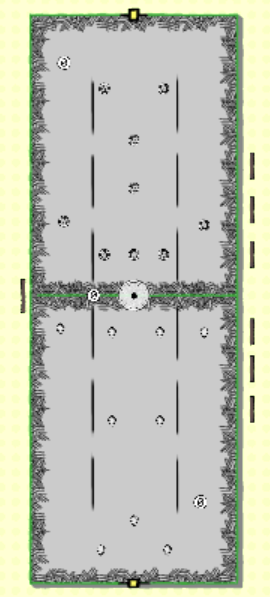
    A map of the Dusk Shores and the Spring Mountains

    On this campaign of discovery Du-Rag and Lorenzo will be joined by a ragtag group of adventurers. The rest of the group is made up of;

    Lennel is a tortle warlock with a spear and dedication to the seas.

    Lennel is a tortle warlock, connected to the sea. He values the connection between the port town and the Dusk Sea, working to build camaraderie between the peoples.

    Ebrius is a tiefling warlock torn between his birth and his heart.

    Ebrius is our second warlock. A tiefling, he works to help the helpless.

    Yelfir is a goliath fighter with a big axe

    Yelfir is a goliath fighter. Born in mountains, she tests her strength and serves the greater good of the community.

    Rezani is an axe-wielding half-orc barbarian.

    Joining Yelfir on the frontline is another axe-wielder. A half-orc barbarian, Rezani shuns armor as he stares down the greatest dangers.

    Quille is a swashbuckling fishperson who stabs with a rapier and then a dagger.

    When not stabbing you with sharp wit Qulile will stab with a rapier and a dagger. The swashbuckling fishfolk knows the run of the streets and remains calm under pressure, right up until the point he runs.

    Together this group of misfits joins Du-Rag (half-orc cleric) and Lorenzo (human bard) serving the city that sits along Badd Bay in the shadow of the Spring Mountains north of the Weald of Aspirations. The defiant land that they call home is threatened. Rising together they will attempt to stop the Invasion of the Trees.

    Join us Sunday night.

  • Inspiration Is Everywhere: Beer Factories and other modern approaches to food

    Inspiration Is Everywhere: Beer Factories and other modern approaches to food

    Many D&D worlds are anachronistic in their approach to the world space. The inn has rooms with bunks for a single person. Clothing and bathing habits also mimic our current world. Reading is common.

    Here’s the thing — the idea that these things are too modern for a “real” approach to world building is wrong. The ancient world through the Renaissance contained modern conveniences, and they didn’t have magic.

    Beer Factories

    No, your average inn or tavern will not have canned tall boys to crush when the adventurers visit. They most certainly would have lower carbonation beers that are mass produced, not just niche ales, lagers, meads, and such. Beer factories were present in ancient Egypt.

    Archaeologists found eight huge units — each is 20 meters (about 65 feet) long and 2.5 meters (about 8 feet) wide. Each unit includes some 40 pottery basins in two rows, which had been used to heat up a mixture of grains and water to produce beer, Waziri said.

    That’s a lot of beer. In Curse of Strahd there’s the embrace of a rather large winery.

    Embrace this. Have a popular beer, wine, liquor, etc within a region. Develop trade routes with it. Maybe your character tried it when their richer friend gifted them a bottle, jar, or cask. Maybe they carry a small vial of their favorite with them to remember home. Were they part of the merchant class that helped ship the goods from town to town?

    There are plenty of ways to add mass produced beverages to your game. Embrace the additional ways that flavor can connect to your world.

    Recipe Books

    Related to beer is that recipe books go back to the dawn of writing. Your brewer or vintner could be producing a recipe from many towns over, not due to word of mouth, but because the recipe is known to the world.

    The foods will be different than the modern era. Eel was a quite popular protein in England, for example.

    Grab Heroes Feast for some modern foods inspired by Dungeons & Dragons, or just follow Dollop of History for pre-WWII foods going back to the early Middle Ages.

    And, of course, the Redwall Feasts bot has foods that work for any indulgent culture.

    Your world can and should include the senses of taste and smell. Street foods and walkups should exist. Develop a vibrant food culture not because it adds verisimilitude, but because it expands the stories you can tell with D&D.

  • Fey-folk enter testing with March Unearthed Arcana; continues floating ASIs

    Fey-folk enter testing with March Unearthed Arcana; continues floating ASIs

    Four Fey-folk are explored in the March 11 Unearthed Arcana drop. This includes the classic Fairy, two animal-folk (rabbit and owl), and a Fey Hobgoblin. While all of these races are connected to the Feywild, they are not called out specifically as being from the Feywild, just connected to it. Only the Fairy is Fey, by creature category. In some ways this makes the other three racial options (the document does not call them out as lineages) like “normal” Elves rather than Eladarin. If this UA gets strong feedback there will be two Hobgoblins in existence, one a martial warrior and the other that creates a unique bond through gift giving.

    Just as in the last Unearthed Arcana there is a sidebar explaining the path forward in regards to Ability Score Increases at character creation. Mostly it is a reminder about the rules in Tasha’s, but it continues the commitment to reduce racism and bioessentialism within Dungeons & Dragons.

    The “Creating Your Character” section provides special character-creation rules for the race options in this article. The races that use these rules can coexist seamlessly with races that use other rules. For example, the race options in the Player’s Handbook have built-in ability score increases, while the races in this article don’t. Race options from both sources can adventure together.
    If you’d like a race that doesn’t appear in this article, such as an elf or a dwarf, to have similar ability score flexibility, the book Tasha’s Cauldron of Everything provides a rule, called Customizing Your Origin, that gives you that flexibility. That book also gives you the option of building your own race, rather than choosing an existing one. That option is called the Custom Lineage. No matter which option you choose for your character—a race in this article, a Player’s Handbook race, a race modified by the Customizing Your Origin rule, or a Custom Lineage—you can adventure with characters who are built with a different option.
    This sidebar builds on the design note in our previous Unearthed Arcana, “Gothic Lineages.”

    UNEARTHED ARCANA 2021 | Folk of the Feywild

    Fairy

    Any fey centered story has to have fairies as playable characters. Fifth edition is finally adding them. They fly, of course. The Fairy joins Aarakocra and Feral Tieflings as able to fly at first level. Owlfolk join that group shortly. These are the only races limited away from some versions of Adventurers League.

    All of the abilities just make sense for what we expect from fairies, but the one that stands out to me as unique and situationally potent is Fey Passage. The ability of a small fey to enter nearly sealed spaces fits so much of the legend and lore surrounding these peoples.

    Hobgoblin of the Feywild

    Whereas the Volo’s version of Hobgoblins focused on every single one of them being at least a light fighter, those Hobgoblins with connections to the Feywild are helpers. Rather than armor or weapon proficiencies, your Hobgoblin gains a leveling version of the Help action. This is much more interesting flavor.

    Hopefully when the Fey Hobgoblin gets dialed into official material the two version appear more like subraces, rather than having similar, but still different abilities. There is language drift between the new Fortune from the Many and the old Saving Face. Also, the older version of the Hobgoblin is just weaker. Three proficiencies is just weaker than Fey Gift and Fey Ancestry.

    Owlfolk

    Another flying creature, of course. The choice to be either medium or small makes sense, as there is variation in size for real owls, as well as the stories upon which the Owlfolk are based. There are two sight based abilities, but neither directly relate to Perception. This UA does insert a third scale of Darkvision. It should likely be changed to either 60′ or 120′ to be inline with other races. 5e is about those kinds of simplicity.

    My favorite ability for Owlfolk is Magic Sight. Adding a ritual spell makes so much sense for a race that is so storied in wisdom and intelligence. It combines well with spellcasters and martial types. Hopefully there are more races that access rituals rather than the now standard 1 per long rest usage of a 1st level spell.

    Rabbitfolk

    Hip, hop and hippity hop. Yes, there will be a Rabbitfolk Bard in my future. There’s some interesting mirroring of Halfling abilities here, which makes sense. The two generally smaller folk both love freedom and large families. Rather than Lucky, the Rabbitfolk get a minor bonus on failed Dexterity saving throws. These similar abilities maintain interest while connecting to their stories.

    Here, the Rabbit Hop is the ability that leaps out. Being able to jump around is key for a rabbit. Getting to use it with no cost is wonderful. The d12 of additional feet is clunky (just as the similar rules regarding Athletics are clunky). For gridded play something like +5′ per proficiency bonus would be simpler. For those playing with Theater of the Mind the difference between 3 feet and 4 feet is meaningless in combat.


    Overall these should be popular. There are entire game systems dedicated to animal folk. Humblewood was extraordinarily popular, because people just enjoy being little floofs of magic and power. Official support for similar folk makes sense.

    Hopefully the feedback helps dial in some changes to the various hobgoblins and other non-core races that have clear subraces but operate as completely separate instances rather than those that share story and abilities.

  • DDD:253 Invasion of Trees – a YachtCon charity adventure

    DDD:253 Invasion of Trees – a YachtCon charity adventure

    Over the past five years I’ve participated in YachtCon — sometimes as talent, sometimes as green room host. In 2019 and 2020, while with Tacoma Defiance I sold off the opportunity to join the broadcast booth for a match. Those 2020 winners are still waiting to do that, as the covid-19 pandemic made that option unsafe.

    Still wanting to give some South Sound flavor to an event that will be entirely virtual I needed to come up with a different idea. Ambition got the best of me, and with Sounder at Heart/Nos Audietis manager Jeremiah Oshan’s approval Dungeons & Dragons & Defiance: Invasion of the Trees was launched. DDD:253 is a charity game with two celebrity guests and five PC spots for people who donated $60 dollars to the Autism Center at Seattle Children’s Hospital. DDD:253 sold out in 24 hours. There’s still plenty of opportunity to join the audience for the live stream of this 3-hour tour of D&D.

    There are also many other opportunities to join in on classes about pizza making, wine tasting (observer only), cocktail shaking, watercolor painting, and so much more. All of them will have twists related to the pro soccer teams in the area, including celeb participants. Just as gaming conventions had to adapt, so did YachtCon. The group of passionate Sounders/Reign/Defiance fans haven’t been to a match together since March 8, 2020. It’s possible that the 2020 YachtCon was the last time we were all together. This year’s event is as much about re-connecting the community as it is raising funds. That’s why you can audit every “class” for free. But, it’s also a way to raise funds. The Nos Audietis/Sounder at Heart/Ride of the Valkyries group has raised over $30,000 dollars in the past five years. Please join us. There’s even kickass soccer gear.

    Character art or for a half-orc cleric and a human bard frame the logo for YachtCon 2021 with the title DDD: 253 Invasion of the Trees.
    Character art by ReRoll

    What is DDD: 253 – Invasion of the Trees?

    This is a short adventure inspired by Tacoma and Tacoma Defiance, set in a small frontier town common in so many fantasy worlds. This port village has a tavern where a local leader needs help. Our adventuring party is going to help the city defend itself from an invasion from the south. Along the way they will meet hazards, possible allies, and of course the enemy(ies?).

    Railroads have been avoided, which means there are nearly a dozen encounters, but in a 3-hour session only a handful will ever be used. Maybe, just maybe, the whole world will see the product after the live adventure, which will be streamed. There will be no VTT, everyone will track their damage, spells, etc with paper sheets in their own homes. Maps and art will be via a shared screen and the experience will be Theater of the Mind, rather than tactical. The model being followed is the Stranger Things x D&D game from early winter rather than highly produced streams like Critical Role.

    Each participant is getting an individual session zero, which will involve character creation and an agreement on option rules. They are also getting pixel art of their PC, using the ReRoll app. Each will also get a set of dice, which is especially handy for those who are playing for the first time.

    Meet Lorenzo Snapdragon

    Lorenzo’s character sheet.

    Lorenzo is a human bard, run by Tacoma Defiance Head Coach Wade Webber. He’s as handy with his lute as he is with a dagger or rapier. Sometimes he’ll bang a drum or play a recorder, but mostly he likes the strings to accompany his songs and poetry. Snapdragon is likely to be the charismatic face of the party.

    Meet Du-Rag, The Honest

    Du-Rag’s character sheet

    Du-Rag, The Honest, is run by Defy professional wrestler and Destiny City Comics owner Ethan HD. Du-Rag is a half-orc cleric, who is as comfortable in the streets as he is in the pulpit. His friends? He’ll heal them. The Honest will usually try words first, but those that stay enemies face the dagger, or the power of his god.

    Rest of the Party

    Over the next week the rest of our adventuring party is being filled out. When those are done we’ll share the character art for them. There’s already a tortle warlock, a half-orc barbarian joining the cause. The group is banding together to defend a lumber town, with a port, a gritty city of unpaved streets with a good bar and neighbors who gather together in defiance of the odds against them.


    Again, DDD:253 Invasion of the Trees is part of YachtCon: Back to School. All proceeds from every class go to the Autism Center at Seattle Children’s Hospital.

  • Adventurer’s League changes expand playing options

    Adventurer’s League changes expand playing options

    One of the most popular questions I get is “How do I start to play D&D?” In the Before Times I would invite people to join in my World of the Everflow campaign with fully half of the more than a dozen participants in that game being new to Dungeons & Dragons. Now, with the explosion of digital and remote play I tend to guide people towards the Adventurer’s League. The robust program from Wizards of the Coast just had a major shift.

    Used as part of Wizards of the Coast Fan Content Policy

    News and other programming is hosted on the Wizards website. The Yawning Portal helps guide people to events, particularly the monthly virtual play sessions, but also online conventions with AL participation.

    The next virtual play weekend registration starts March 2 for play between March 12 and March 14. You can even get a preview of Candlekeep Mysteries during that weekend. The book comes out on March 16. There are dozens of possible games to get involved in — stuff for first time players and things for masters of the game, both.

    Follow Baldman Games and/or D&D Adventurers League for more info

    Not only are all of the updates for D&D AL now on the Wizards website there are also changes as to how AL is played. In most games you will no longer be limited to the Player’s Handbook + 1 book rule. Now, almost any character you can build will be legal. Check out their blog post to see the specific limitations (mostly centered around flying as ThinkDM points out).

    As someone who builds most of their characters via DnDBeyond the looser rules help. There was not a simple toggle to limit to the PHB+1 rule on/off, so to make an AL character I had to think through which book a spell, background, feat, race, subclass all showed up in. The digital era makes the +1 rule a touch obsolete. A character built on Beyond or any VTT will have all of its abilities publicly facing the DM.

    If you haven’t played, and you don’t want to join a game another thing to do is start by observing a stream. D&D’s official Twitch channel hosts shows to watch and their YouTube channel includes quick how-to-play videos.

    You can also sign up to observe my 1st level adventure DDD: 253 Invasion of the Trees as part of YachtCon: Back to School.

  • Inspiration Is Everywhere: Mushrooms

    Inspiration Is Everywhere: Mushrooms

    They can be disgusting. There are times that I’ve called them the rats of the vegetable world — they are not vegetables. In our games we can use mushrooms as food.

    What dungeon bound civilization hasn’t used fields of mushrooms for sustenance? Every time Drow, Dueger, Svirfneblin, and the rest raise shrooms. It’s part of the lore. Bioluminescent fungus and molds can be used for lighting as well.

    These tropes are common in Dungeons & Dragons.

    But you should also use mushrooms to build things. This is happening in the real world, but as bricks. Sure, that works in D&D. It makes a lot of sense for certain cultures.

    Expand on that idea.

    Who lives inside the shrooms like the Smurfs did. Or do your fey hide from the rain underneath a little cap.

    Photo by Visually Us on Pexels.com

    What secret assassin group searches for a specific fungus for their signature poison? What apothecary makes a healing tisane out of mycelium and molds? Which street vendor took the meals of the underdark and turned them into handheld pastries stuffed with minced mushrooms and aged cheese making a name for themselves in the lighted world?

    Everything you experience — eat, read, watch, listen to, encounter — can inspire you to add a little bit to your gameworld or character.

  • How to give your Beasts and Monstrosities reasonable speeds

    How to give your Beasts and Monstrosities reasonable speeds

    You might be able to outrun a Tyrannosaurus Rex, if you’re a peak athlete. Keep note of that. You almost certainly can outmaneuver them. Those are the key takeaways that Wired wants you to have after reading “How to Outrun a Dinosaur.

    There’s a lot more depth in there for a game designer, homebrewer, or storyteller.

    Three years ago the biologist Myriam Hirt, who studies animal movement at the German Centre for Biodiversity Research, asked a seemingly simple question: Why is it that the biggest, most powerful animals—the whales, elephants, and rhinoceroses—are not the fastest, while the smallest—the mice, minnows, and millipedes—are some of the slowest? Is the implication that there is an optimum size for speed?

    The answer, Hirt found, is yes. If you were designing an animal for speed, that animal should weigh approximately 200 pounds. A bit heavier for a swimmer, and a bit lighter for a flyer.

    Wired, How to Outrun a Dinosaur.

    The T Rex has a speed of 50 in Dungeons & Dragons. That’s too fast for the mass of meat with jaws of death. Smaller dinos and lizards should probably have higher speeds. The Ripper Lizard is getting an update as this story is getting written.

    The speed of 50 might make sense if the primary time in D&D that speed is used is to determine distance running. But it is not. Speed most frequently comes up in combats in six-second chunks of time. Beasts and Monstrosities with high speeds should be the ones that accelerate and burst forward — cheetahs, lions, and Deltadromeus. Even the velociraptor should be average-to-athletic human sprint speed-ish.

    That also brings up a key point. A D&D character is supposed to represent, in general, above average athletes. There’s no direct tie-in between Strength, Dexterity, or Constitution and speed. Most races get a 30, some get a 25, rare ones get 35, and even rarer are the few that fly or swim.

    There are three things we should do with the knowledge from that Wired article;

    • Centerline most speeds to better represent reality in non-magical creatures.
    • Add line in the description that addresses distance traveled by unencumbered and encumbered beasts of burden.
    • Create a quick and easy way to avoid getting run down by a dinosaur.

    That last bullet doesn’t take a lot of work. When in a chase scene use opposed Dexterity checks (Acrobatics or Athletics or Sports could apply) when the chaser is within Reach of the chasee. A success would permit an attack/shove/grapple, if the action economy makes sense. If not, let the chasee take half their movement as a reaction as long as they are able to, and do, significantly change direction.

    Any creature that has magical influence on their speed can operate as normal.

  • Excellent online tool for NPC portraits and traits

    Excellent online tool for NPC portraits and traits

    As a big advocate for NPCs built for social and exploration encounters, finding a tool that creates those randomly, with art, is wonderful.

    Christian Oesch’s DM Heroes page throws together a handful of racial/lineage options with descriptions that are not centered on combat. Additionally there are suggestions on how to connect them to each other.

    Veklani Skandalor

    Female Dwarf Cobbler – If it doesn’t kill you…

    Veklani’s suggested traits are;

    Features

    70 years old (young adult)
    4′2″ (128cm)
    Normal voice
    Speaks about themself in 3rd person.

    Traits

    Never changes their facial expression.
    Hates the government.
    Is happy because of a recent dream.

    Story

    Asks the party to help their become a cult leader.
    Wants to kill Erag Ambershard

    Other

    Prays to Dugmaren Brightmantle, god of discovery (CG)


    If you don’t have time to custom craft a handful of minor NPCs just in case, this tool does wonders. It also can be a handy tool to get quick art for your PC, though you’ll need to spend time tuning the various sliders and such. Reroll, Hero Forge and others might be better for that.

    Here’s Thoumas built with ReRoll.

    You can read about the Swarmkeeper of Terriers here.

    Quick art for your characters, whether player or DM controlled, helps with immersion and inspiration. Find those tools that help you and your group enjoy the game most.

    And if you have the funds for custom art, do that! Custom art is wonderful too.

  • Check out Ginny Di’s video about etiquette in online RPGs

    Check out Ginny Di’s video about etiquette in online RPGs

    After many, many months of the covid-19 pandemic more people are playing D&D than ever. Much of this is online. Long-time players and D&D rookies both are discovering the challenges of gaming via video.

    Ginny Di put together a strong 12-minute video that hits on the common challenges and solutions that come up at virtual tables. Even if your virtual table play is going well this is a good reminder. If you haven’t played virtually before the package is an excellent starting point.

    When I watched this it reminded me of one my habits as Awf — I can dominate the channel rather than share the spot light. When I play as Thoumas, the group interplay is different. We split the party frequently, something that is harder to handle on a VTT, in my experience. Coordination requires a bit more care.

    Her best piece of advice, at least for my groups (hi guys), is to use the text chat for out-of-character stuff. That clears space for the DM to manage the game. My second favorite is to schedule a little bit of the time pre & post game to communicate about non-gaming things. Be friendly and social with each other, because being social during the pandemic is hard enough.