In 5th edition D&D I create a lot of rogues. This is a change for me, for in my earlier forays into Dungeons & Dragons, I mostly played clerics, bards and paladins. Part of the appeal of the rogue in 5e, is that it has became the main skill-monkey class. Mostly mundane there are interesting stories to be told via the mastermind, the inquisitive, the scout and the propagandist.
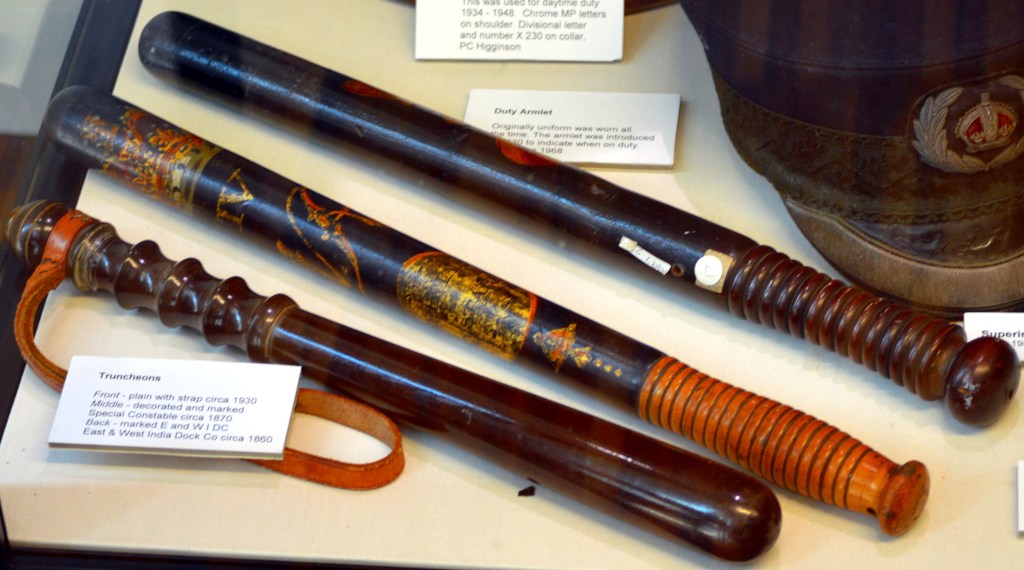
One thing I find lacking for three of those options is the narrative around using a weapon that knocks opponents unconscious. While the rule set allows any weapon that does enough damage to kill to be declared a non-fatal blow, there’s something about an mastermind smacking a thief upside the head with a baton and knocking them out.
Common within the literatures that inspire our game are also tales about short staves that flip about stabbing with the point and smacking with the side — see various interpretations of Sherlock Holmes. My campaign needed one of these because a player in Uprising and Rebellion Campaign Two is a streetsweeper. Their broom handle makes sense as a weapon for them.
The baton is just a refined club so that you can play as Sticks from the Vlad Taltos Saga. The short stave (broom handle) is based on the rapier, the current best weapon for a rogue, but merely bludgeoning and cheap.
There’s nothing game breaking from these additions. There’s no power creep.
There is a whole lot more story. And that’s the whole point to Full Moon Storytelling — story creep.
Dungeons and Dragons is more popular than ever. That is undeniable. The game has grown and become a side channel to the mainstream, with its influence everywhere. But it is about to get a lot more popular. Tens of millions are going to watch Dungeons & Dragons: Honor Among Thieves.
That’s going to attract a lot more neophytes to the game.
From Chris Pine saying every high school should have a D&D club to mainstream local soccer fundraisers like YachtCon playing the game (we’ll do something this year too) the game is spreading faster than ever before. After a season of not-really-D&D Stranger Things dipped back in with the Hellfire Club. Season five, the final will also be D&D themed.
There’s also D&D adjacent properties like Wheel of Time (season 2 of Origins is out in August and season 3 is already happening) and Rings of Power (season 1 in Fall). Witcher keeps going strong. Vox Machina got a season 2 and probably will get a third. List goes on, and on.
There’s no better time for fantasy TV and movies — none.
As experienced players and DM’s it is our responsibility and duty to welcome these new players to the game. One way to do that is through the classic Starter Set, the Stranger Things boxed set, the Essentials Kit, the new Dragons of Stormwreck Isle, Spelljammer Academy, etc, etc.
But you also have your home games with elaborate and thought-out original plots. These games are the most common way to play D&D, a majority do not play in the official worlds. There’s a danger in welcoming people to the game the first time in an original world. Those campaigns can have a lot of custom rules.
When the Lorebook Hunters first started in the World of the Everflow there were more than four pages of custom rules, heavily tweaking the game. Now there are just four sentences of rules not taken from the books – all able to integrate with DnDBeyond, excepting the custom subclasses. Players new to the game can create a character in 30-60 minutes rather than hours.
That helps first-time players pick up the game. There’s plenty of support online for the official rules — blogs, video, podcasts, social media. There’s only your table as a place to learn about custom rules. That can be intimidating. Plus they need to pick up custom lore. Another barrier to play.
Reducing both of those weights helps a first-time player become a perpetual player and eventual Dungeon Master.
Tips for types of rules to add
Optional rules from the Dungeon Master’s Guide — they’re already official, in a book for others to read.
Rules that enable your story — the World of the Everflow has a key question as to why we love pets. It wouldn’t be the same without the bonus feat of Bonded Companion.
Changes that empower cinematic flavor — since many people new to the game will come from watching film give them that vibe.
Tweaks that don’t require technical knowledge — asking a first time player to learn a VTT rather than just video or theater of the mind can reduce their interest.
At the same point, if you have a massive world already, don’t retro those rules. Find ways for your table to welcome new people into your complex lore and ruleset. Use session zeroes frequently, both one-on-one and with the group. Tell a new player why you have those rules. House rules that help tell the communal storytelling are always better than house rules that add complexity, at least for the modern gamer coming at D&D as a storytelling game that empowers group tales of action and adventure.
Most of all, enjoy the new players and their new stories. They’re going to add to your table coming up with ideas and concepts you’ve never seen before. If you are doing it right you’ll have a more diverse group, telling more diverse tales — and you’ll be stronger both in real life and in the game.
This campaign is set seven years after the Lorebook Hunters returned magic to the World of the Everflow. It is set in the Free City of Sheljar, and is centered on clearing portions of the bog-city from the return of undead and tunneling nightmares. Combat and exploration will be heavier than social play at the beginnnig. Every character is united in keeping residents of Sheljar safeand mostly unified in the ideals of Free Shejlar (all thinking peoples have value), but may have differing concepts about how to do so.
The bog-city of Sheljar sits in a lowland below a waterfall. The climate is cool and wet, think the lowlands of the upper Salish, the moors of Scotland with a boggy multi-island brackish lake similar to New Orleans.
Campaign Premise
The party is a group of guards that volunteered and is paid to help the Lorebook Hunters keep the people of Sheljar safe from skeletons, zombies, wights and other undead. Tunneling Nightmares may have returned to isles in the bog-city as well. They will start in the old neighborhood of Jherr as recent migrants have noticed a cavern with odd noises and smells.
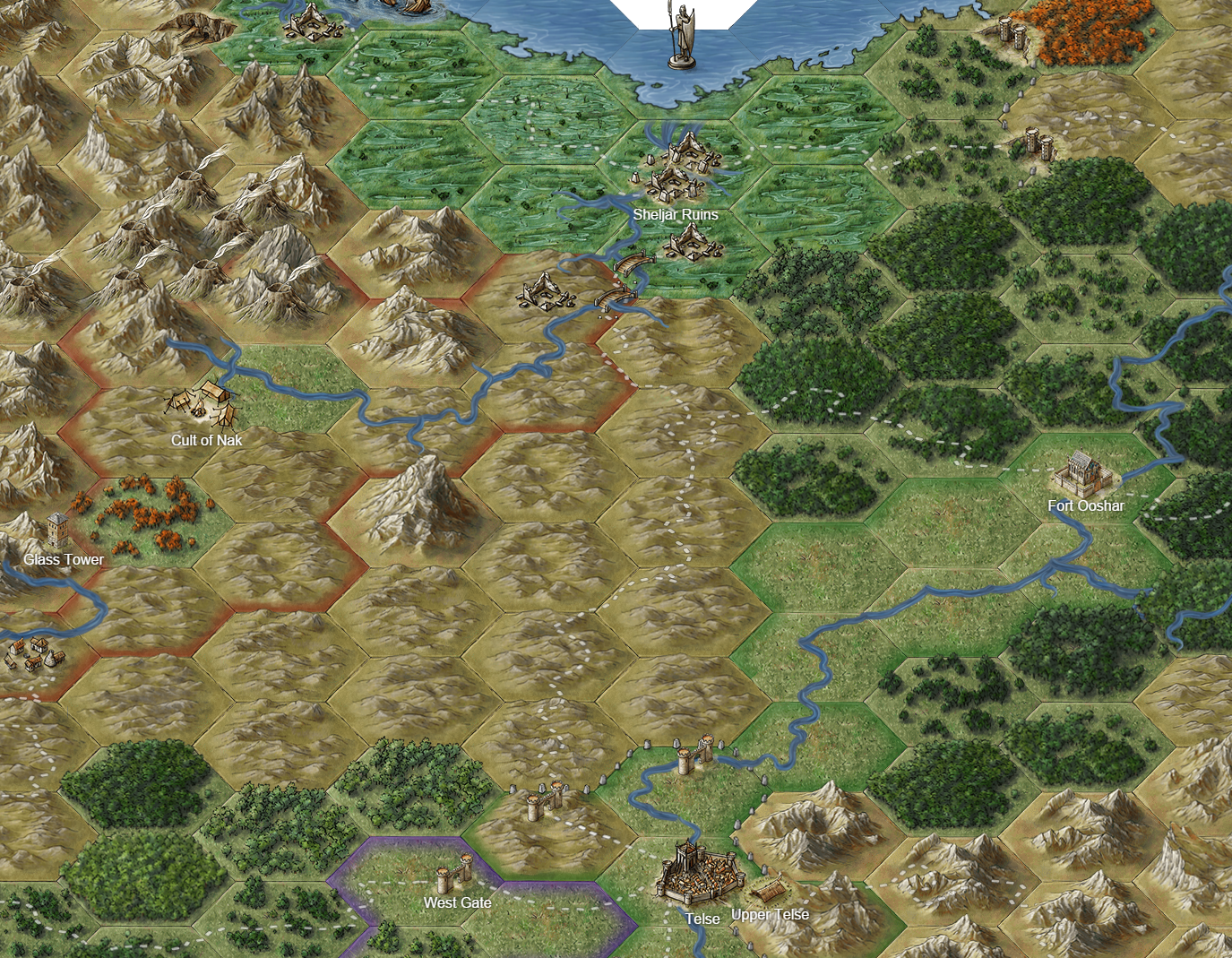
Made using Perilous Shores, this is the neighborhood of Jherr, to the north and east of the core of Sheljar. The southeast corner is less brackish than most of the bog-city, almost an internal fresh water space.
Background
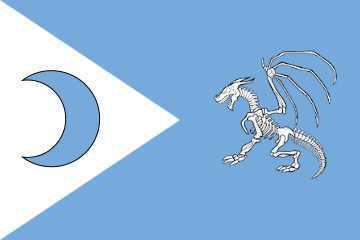
The Flag of the Free City of Sheljar features the moon Feylf in crescent, a white triangle entering a field of the sea and Boo, in his skeletal form.
Once upon a time, the Empire of Sheljar ruled all of the Western Wildes, from the Cliffs of Galinor to Mira to Qin. Then, the Born Generation of magically imbued teens (27 years ago) caused chaos and disruption, upending the old ways. One of the Born Generation, the Necromancer, thought he was doing good, keeping dying peoples and animals with their families, but these horrifying undead monstrosities were often rejected. As he raised more and more, people fled Sheljar, emptying it out, leaving the bog-city nearly abandoned to the Necromancer and his unliving nightmares. A misty stench then started to control the city and more people fled.
It was not until after the eruption of the volcano, the battle of Cortez and Chorl, and the Lorebook Hunters eventually slaying the Necromancer that Sheljar felt free again. Now, six years later the Free City of Sheljar welcomes all thinking peoples. Those that return to their former homes have their property back. Those without homes are granted plots and space with the promise of aid. Few ships dock at Sheljar, but that number increases every month.
Sheljar has several dozen gobkon, a few dozen Ken with no known dragons, but most of its 2,000 generally agrarian peoples are various Kin with their animal companions. The Gendarmes and the Lorebook Hunters are the only standing ‘army.’ Most of the residents are frontier peoples ready to defend their cottages but only have clubs and other utensils as weapons.
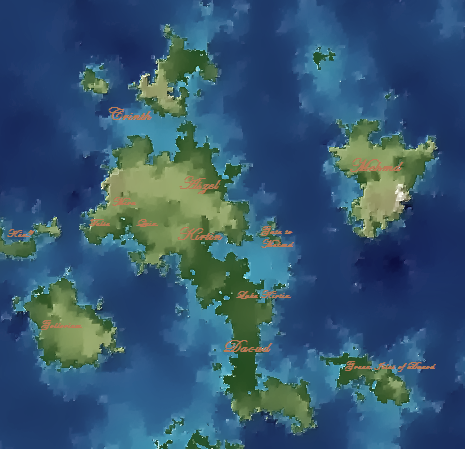
A map of the former Empire of Sheljar, now a series of independent city-states and free towns.
Grand Conflicts
At the start this is a simple island of the week adventure, where the Gendarmes are responsible for discovering and clearing pockets of undead.
Factions
Lorebook Hunters – this is the leadership of Sheljar.
Cult of Nak – these are the remnants of Chrol’s transformations.
Fort Ooshar is under control of the Fox and Crow, a gang that sees opportunity to raid the migrants heading to Sheljar
A death cult has taken over the lands west of Telse.
Rumors
The Folio of Necromancy may be missing. Saffron had held it prior to rising to part of the leadership council.
What is that stench out east? Tunneling Nightmares?
The Volcano of the Glass Tower is glowing.
Facets
Exploring the zero-to-hero tropes, friendship with animals, and who gets to control knowledge.
Sandbox play.
Player agency creates history.
Drop in/drop out, whatever. This is an episodic campaign.
Sessions are 60-90 minutes. Adventures are 1-3 sessions.
Variant Rules
Playable races are Human, Hin(what they call themselves)/Halfling, Goliath/Firbolg, Elf, Dwarf, Gnome (wood only), Goblin, Hobgoblin, Bugbear.
Use point buy or standard array for starting attributes. If you want something random, the redrick roller gives random point buy valid stats.
Start at 1st level because several are new to the game, let’s learn together.
The Gendarmes start with a small sailing boat (Crew:4 for rudder, sails, a repeating heavy crossbow, and a fire sling).
Long rests require 24 hours within sanctuary. This creates a pace of play more similar to novels than video games.
Practicum
Sessions will be on Wednesdays right after work, played over Meet with shared screen used to help set the scene. Theater of the Mind will be the most common form of combat, ideally using cinematic descriptions which will grant Inspiration. There is a campaign on DnDBeyond, used only by the participants rather than open to public.
Rather than a one sheet that’s built for players, and the way the game is played, this is the common knowledge sheet that’s built for characters. The goal is a the level of knowledge that every single member of the adventuring party would have (some exceptions for extreme outsider situations).
Magic is only a generation old in the Lands of the Everflow. Just over one passing of the Dragon (the 4th moon) ago, a born generation came about that all knew minor magics. Just seven years ago the eruption of Cortez broke the barriers of magic. The Lorebook Hunters found the Tome of Divination and the Folio of Necromancy. As magic returned to the world so did dragons, and elves, and goblins with their smog-punk teknology. Magic is real; and the world is not ready for the Born Generation as they age. Some empires fade, others rise, and peoples throughout see the beacon of a Free Sheljar as a new way to govern as the Lands of the Everflow continue to shake under threats for teknology, dragons, and magic.
The Six Kingdoms
Kon
Crinth
Azsel
Mira
Mehmd
Sheljar
The Slope
Fey Isles
Telse
Kirtin
Qin
KotL
Daoud Green Lands
A word map of the six kingdoms
That’s a word-map of the Six Kingdoms with a few of the major cities that have featured in the various campaigns. This gives indications to their relative distance from each other. Since the commoner wouldn’t necessarily have an accurate map, the word-map demonstrates the proximity of the lands to each other.
This map is highly inaccurate, the fanciful dreams of an inauthentic narrator from the Fey Isles.
Azsel
A highly structured society built around small families and packs, the Kingdom of Azsel is mostly hin/halflings and their dog companions that trace their lineage to Az and Sel, the first bondings. Every King and Queen traces their lineage to Az, sometimes clearly and sometimes not. Azselites tend to be hierarchical, loyal, and have a strong sense of superiority because of their founder being the one who enabled bondings.
They are an expansionist society pushing against Crinth in the West and Kirtin in the South. They tend to ignore Mehmd. Messenger dogs keep outlying cities, towns, and forts in touch with the capital.
Crinth Confederation
Not really a singular government, the Crinth Confederation is a loose alliance of the northernmost peoples in the Land of the Everflow. Named after the River Crinth, the Confederation is ‘headquartered’ in Thornewall. Goliaths are most common here, particularly those that roam the plains, forest, and tundra. Crinthians have the strongest connection to nature and their architecture attempts to blend living plants into their homes and buildings. Myths from Crinth talk about a time when the bonded animals were large enough for homesteads to be carried on their backs — turtles, birds, mastiffs, snakes.
Daoud, the Green Lands, and the Emerald Isle
The grandest fleets of the Six Kingdoms come from Daoud. Naval power is so important to this dispersed nation that even the armies are called navies. Daoud’s forces will raid using rivers, and that’s how they’ve captured Kirtin-on-the-Lake, but also why they struggle to advance into the more mountainous territories of Kirtin and Qin. A land of warmth and greenery, Daoud is full of bright colors and loose fabrics. Similar to Mehmd, there is more variety in bonding with monkeys and fish being common enough, including some who carry their bonded fish in special bags and bowls while they travel.
Kirtin-on-the-Lake
Once the winter capital of Kirtin, the city has changed hands several times over the centuries. Currently it is controlled by Daoud. The largest university in the Six Kingdoms predates both Kirtin and Daoud, and may connect to the times before legends.
Kirtin
A land at war to the north and to the south, having lost one capital, the people of Kirtin all serve a summer season in the militia. In recent years this has meant service on the Slope, in the past these defensive posts were scattered throughout the mountain homeland of Kirtin. The former Summer Capital of Kirtin, Kirtin-in-the-Sky is a city of winding spires along a cliff face where it is difficult to tell the difference between natural and person-made. Once the center of learning, Kirtin is now a nation of defense.
The Slope
Coming down from the mountains The Slope is a frontier land not really controlled by Kirtin or Azsel. Both of those kingdoms send forces to the area regularly, usually in a soft-conflict as the villages along the Slope are unconcerned with empire. Many of Kirtin’s national militia serve on the Slope now that the kingdom has mostly given up on retaking the former winter capital, Kirtin-on-the-Lake.
Mehmd
The peoples of Mehmd bond not just with the warm-blooded as the rest of the Six Kingdoms, Mehmd also bonds with lizards and ‘saurs. Oft considered the least of the Six, Mehmd is sometimes considered just a city-state, rather than a kingdom. Water is somewhat scarce as the city sits just beyond the rain shadow from the mountains of Kirtin. Mehmd’s rocky land is crossed with aqueducts and canals taking water to the city.
Gate to the Wastes
Mehmd’s largest city is the only one that the rest of the Six Kingdoms encounter. Gate is open to all, but closes of the lands beyond. It is also the largest city of the Six Kingdoms, but on a tiny amount of land.
Sheljar
A dead kingdom until the Lorebook Hunters established the Free City of Sheljar. Prior to the Born Generation Sheljar was a mighty empire the controlled all of the West and the lands of the Everflow. A trade empire with major cities on its eastern coasts, Sheljar’s exports included the holy waters of the Font of Two Paths, gems and glassware from Bell’an’faire, alcohols from The Ferments, and stones from the various mountains. It is now fractured, with independent city-states throughout its former lands.
As magic started to seep back into the Six Kingdoms Sheljar was dominated by a Necromancer. The marsh-city came home to thousands of undead and a family of monsters known as Tunneling Nightmares who spewed vomit of bones and created sunken tunnels throughout the underbelly of the city.
The Free City is mostly confined to a few isles in the marsh-city. Its main tenant is that all thinking peoples are equal and worthy. They have eliminated most of the undead and all (?) of the Nightmares. They killed the Necromancer.
Telse, Mira, Qin and the other cities near the Everflow and its two rivers.
Telse
The towns of Upper and Lower Telse are dominated by the Orthodox Church of Quar. The main feature is the fountain, pool, and the two rivers that flow forth to both Qin and Mira. Many other faiths also treat the towns for pilgrimage. From the Born Generation to the present day those pilgrims have overwhelmed the town. The Mayor and Bishop rule together, frustratingly looking at the Free City of Sheljar as a threat.
Qin and Mira
The two trade cities didn’t fall to the Necromancer and took in many refugees. Both are ruled by trade societies. In Qin these guilds are centered around the trade routes. In Mira they are centered around the craft or goods created.
Other Lands
Few of the other lands outside of the Six Kingdoms are well known. Two have recently become quite important.
Queen’s Land
From Shejar to the northwest stands a series of island spires and a storm. According to the gobkon beyond that is their own homeland. The matrilineal kingdom is full of smog and caste, with the creation of new technologies being the currency of power.
Fey Isles
This series of islands well beyond the Sea of Gallinor is where the dragons and their friends originate. A land of bewildering magic there are colleges and schools to advance the art of the arcane. Only the Oriq, outcasts, are believed to not be able to channel the mystical into reality.
Races
Kin, the People of Love and Companionship
Nearly all of the kin have bonded companions. While dogs and birds are the most common of these, there are also some lizards, horses, and quite rarely fish. Mechanically this is in essence a Feat.
Goliaths
The giants of the Land of the Everflow, goliaths are most often found on the edges of cities, or out in the wilderness, though they are the most common peoples in the Crinth Confederation. On the Western Wildes, on the Cliffs of Galinor, is a singular tribe of goliaths. They most commonly bond with birds, often using the small creatures to make up for their larger fingers. Not just gentle giants, goliaths are generally warmer to strangers and live in large multifamily groups. Their homes will have open windows across many levels.
Hin, or Halflings
The largers will call them halflings, but the hin are half of nothing. Fond of canines some hin ride their bonds, others have small little herds. Hin are loyal to a fault. They enjoy flavors – cooking, tea, coffee, beer, wine, anything that can entertain their mouth and nose. They are most common in Azsel and the Western Wildes where Sheljar once ruled.
Human
Most common of all peoples, humans run the gamut of sizes, shapes, and bondings. There are humans bonded with horses, canines, avians, and so much more. They are a menagerie. It is common for the offspring of Hin and Goliath, or Hin and Human, or Goliath and Human to all be called human as their characteristics of humans are all across the spectrum of what makes life amazing. They are most common in everywhere but Azsel (Hin) and Crinth (Goliath).
Ken, the People of Knowledge and Magic
These fey peoples have mystical powers, all able to cast magic spells of varying kinds. Mechanically this means that ever Ken starts with a feat that grants magic of some type.
Dragons
They hoard things and/or emotions. While most peoples in the Land of the Everflow think that always means treasure the ale drakes hoard alcohol; black dragons hoard companionship; faerie dragons hoard joy and mirth; red dragons gather rage. All have powerful magic, which leads some of the peoples to swear fealty to the dragons. Most in the Six Kingdoms still think dragons are a story of trouble over the hill, rather trouble right here in the city.
Dwarves
Often the student-warriors and defenders of the colleges, the stout folk are generally evokers and abjurers. Channeling magic into hard violence and shielding others from it. Tending towards dour and serious, when they do unwind they unwind as hard a magic missile. Many keep the various drakes (non-thinking dragon-kin) as pets, but this is not the bond of the Six Kingdoms.
Elves
Changing the real world through their summoning powers and abilities to reshape reality, elves of the Fey Isles are aloof and superior. Looking down on the other humanoids for their “lesser” powers the elves like to present themselves as the equals to dragons (they are not).
Gnomes
The smallest of the fey, gnomes master the arts of emotion. Changing the way peoples feel or what they experience, gnomes are artists. They want to experience all emotions, at once, if they can. At times some from the Six Kingdoms have seen gnomes with smaller dragons and thought they are bonded. They are not. They’re just great friends with faerie, ale, and others of the weaker types. Gnomes are so fascinated by the Bonding that they have learned to speak with the animals.
No Rock Gnomes are part of the Ken. There are rumors among the Ken that Gobkons were once gnomes. This is heretical.
Kon, the People of Teknology and Konstruct
From the Land of Queen and Konstruct, these goblins are more misunderstood by the people of the Everflow than any other. Covered in soot and grime they are teknical marvels capable of building airxips powered by tar trees, clacketing cycles to move themselves, signal towers and so much more bizarre inventions. Coming in three sizes (Goblin, Hobgoblin, Mulgob) some sages from the Six Kingdoms have theorized that they are related to halflings, humans, and goliaths.
Mechanically this means that every character starts with Artificer Initiate and Rock Gnome Tinker.
People of Chorl
The creations of a rogue Scholar, these peoples are centaurs, aarakocra, minotaurs, fauns, and other blends of beast and human. They are outsiders, shunned due to their being the result Chorl’s use of transmutation magics. They are most common in the unsettled lands of the Western Wildes. The Chorl-ites only gather by animal type.
The Moons
Circled by four moons, Aur is roughly the size of Earth. The moons are part a major part of the calendar, and each is centered within different regions.
Feyelf (7 days) – dominant in the Queens Land
Glibbon or Glight (31 days) – dominant in Mehmd, Azsel
Kin (78 days) – dominant in Sheljar, Kirtin, Daoud
Dragon (6220 days) – dominant in Crinth, Fey Isles
The Days
These are the days in the Religion of Quar, the former lands of Sheljar, and Daoud.
Elmsday starts the week and honors Selley (Goddess of Birth, Life and Death) and Belsem (Goddess of the Untamed).
Bell’an’Aur is the second day of the week. It starts with a rejection of that which can’t be tamed and ends with a dinner celebrating Aur. In Kirtin and Crinth this is Feylfday, the day when Feylf is full, shortly after sunset.
Quarsday is the third day. It celebrates Quar (God of Rivers, Mountains)
Day of Glight honors the Lord of Knowledge. In developed lands the afternoons are given to learning.
Torday honors Torq (Goddess of Sea and Storm).
Az and Sel is day six. This honors not a god within the Wildes/Kirtin/Daoud, but the man and dog that legend says discovered the bonding. Nik is also frequently honored on this day. Azsel recognizes Az and Sel as man and dog that were raised to the gods.
Day of Oun is the end of the week. Oun and Obscon are not honored or celebrated, instead the Lords of the End are respected in that all things end. They are often feared.
Religions
Neither the Ken nor the Kon are religious. Within the Land of the Everflow there are four major pantheons each with distinct God-groups. The most influential of these is the Orthodox Church of Quar which centers Quar, the Lord of Life and Rivers. Other gods within the group are Belsem (Goddess Nature, the Wild, the Untames), Torq (Scion of the Seas, Storms), Oun and Obscon (Twins of Ending, Death, Souls, Trickery, Darkness), Selley (Goddess of Life and Bondings) and Glight (Knowledge, Study). There is also a Free Church of Quar, an offshoot that objects to the mercantile power of the Bishop. Both churches are most influential in old Sheljar, Kirtin, and Daoud.
Up in Crinth the most influential pantheon is The Siblings. The god-group are two parents with sextuplets. The Parents are Glight (Light, Knowledge) and Selley (Birth, Moons, Passion). Both have minor roles in the Orthodox Church. The Siblings represent the Hearth, Trickery, Crafts, Beasts, Spirit, and Unity.
Over in Mehmd the God of Unity from The Siblings is worshipped as the sole god, with all others gods being an aspect of Unity.
In Azsel both Az and Sel, the First Bondings, are worshipped as Gods. Though they were a real pairing of hin and mastiff as the source of bonding the two represent the power of companionship, life, war, nature and people all together.
The Everflow
The Font of Two Paths, or the Everflow, is the magical water that emerges from the cliffside above Telse. When captured from the falls or not significantly intermixed the Everflow has healing powers. The Orthodox Church of Quar controls access to the Everflow in nearly every community. The Church uses its control of the Everflow to have a presence in all cities and most towns throughout the Six Kingdoms.
Lorebooks
Every school of magic as well as the hybrid colleges and certain traditions that aren’t usually connected to arcane magic (Druidic, Bards, Tricksters, etc) has a Lorebook hidden somewhere within the Six Kingdoms. The Scholar and their two Students are the only people who know where these books are.
The world knows that the government of the Free City of Sheljar has both the Lorebook of Divination (Scholar Cortez) and Folio of Necromancy (Scholar Rohan, The Necromancer). The other of the two dozen books, once assumed to just be a singular book, are all considered to be part of the reason for the Born Generation and the return to magic (when Cortez caused the eruption at the Glass Tower) to come to the Land of the Everflow.
Source The first three episodes of The Legend of Vox Machina were just released on Amazon Prime Video. The show is based on the first campaign of “Critical Role”; a Dungeons and Dragons live play podcast and twitch stream. So far three episodes have been released; it is difficult to judge whether or not the […]
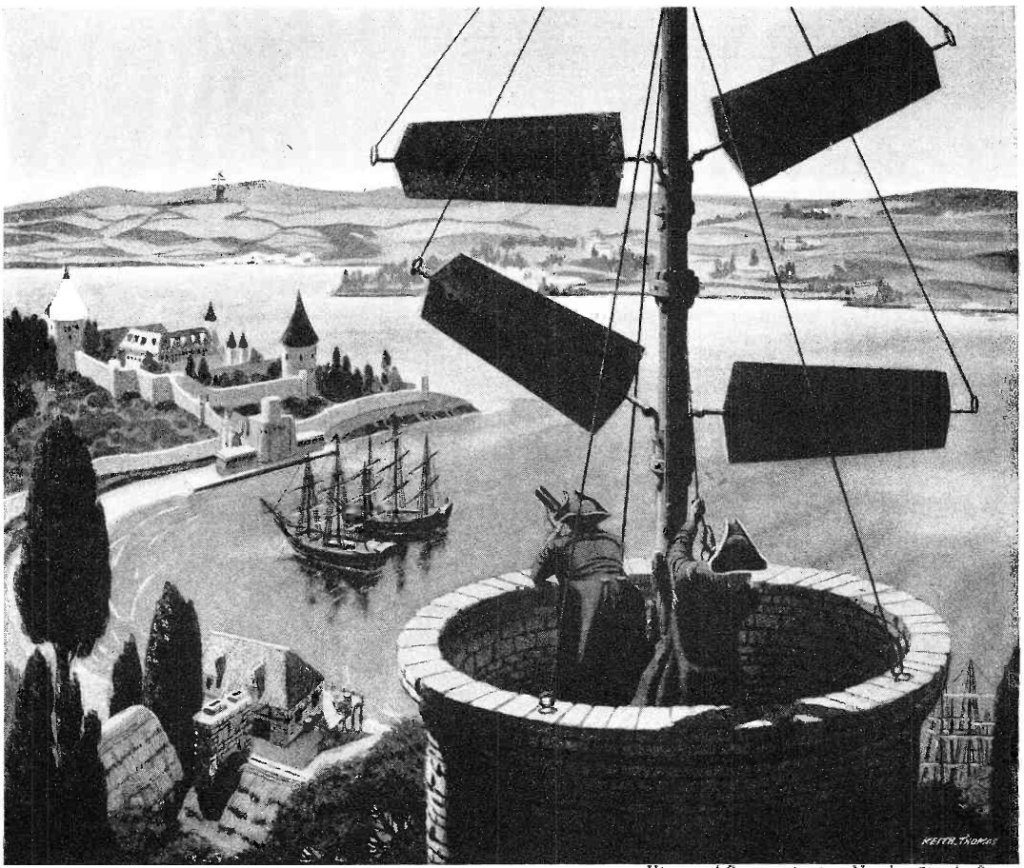
As a horde of humans riding guard drakes crests the Blue Hills, the chappe telegraph operator builds the signal that will reach the Larton Keep now that war has returned to the range. Using whistles, a youngster tells the village miles away that four sheep are lost so they’ll be home late, could his family please have tea ready for when they return.
A thrumming beat injects itself into the air as an owlbear stalks a deer. Knowing the bear is nearing a sacred vale a group of druids and rangers work to separate hunter and prey, for there will be no killing in Frannet’s vale.
Sure, a spell caster might be able to use Message, or two people may have Sending Stone for magical cell phones. But, the Far Talkers converse over a distance of miles, not feet. They speak with many, not one, signaling a warning or just chattering about the weather. Far Talkers and Messengers help societies that stretch over leagues communicate and maintain a culture.
Far Talker
You have the ability to converse over miles, sending messages for a government, faction, or some other organization. In war societies seek your aid to help units communicate. In peace you and other Far Talkers help connect towns and cities, or just keep two distant wizard towers in touch.
Familiar with how the weather impacts your mode of speech you have learned the winds and rains of many lands. Expected to see or hear things at a great distance your senses are strong. You may be an expert at the drums, but you have heard of others who use whistles, tree beating, smoke, flags, or other instruments. No matter what tool is used your messages are simultaneously public and semi-secret.
Skill Proficiencies: Perception, Nature Tool Proficiencies: One musical instrument Languages: One additional, plus the ability to Far Talk in Intelligence bonus languages (minimum 1) Equipment: A symbol of service to a government or large church, a gaming set, a spyglass or musical instrument, traveler’s clothes, a notebook with notation for your type of far talk, 1 day rations, pouch with 2 gold
Feature: Far Talking
Using your chosen tool you can communicate over a distance of 6 miles when outdoors, and twice normal speaking distance when indoors, in a number of languages equal to your Intelligence bonus (minimum 1). Extreme weather may make those long-distance conversations more difficult.
When you meet another practitioner of the Far Talking arts they are always one step friendlier than their companions or social situation would indicate. For example if two scout groups from warring nations met their far talkers would be indifferent while everyone else was hostile. This is true even when the far talkers in question use different languages and tools to talk.
Learning Far Talking
A character without the background can learn Far Talking per the rules to learn a new language. They would then learn one method of Far Talking for a single language.
Some groups of druids, rangers, and their allies might spend time learning Druidic spoken via Whistle Cant. A fleet of pirates could all know Yodeling. Have fun with this.
As always, seek ways that cantrips would enhance these. Those that rely on sound would be amplified by Minor Illusion, Thaumaturgy, and can you imagine Thunder Clap sent through a massive bugle-like device. Those that need light can be made more useful by Prestidigitation, Dancing Lights, Light, and Minor Illusion. A world of magic would have Far Talkers that can speak across many miles.
Personality: Use the Soldier or Folk Hero personality traits for now. When the Background project is done each new Background will have traits, ideals, bonds, and flaws that are unique to the Background.
Design Goals
The Far Talker started out from two different ideas — I wanted to create Whistle Cant as a kind of alt-Druidic and my desire for the Messenger Background. The Messenger became two different Backgrounds. That Messenger will focus on the people who deliver physical messages by walking, running, riding, etc. The Far Talker is the other version. Rather than become Druidic, Whistle Cant became a type of Far Talking, and one of several examples of alt-languages that a Far Talker might specialize in.
Custom Backgrounds for 5th edition Dungeons & Dragons
Using Green-Flame Blade, Booming Blade, and Lightning Lure gives these two subclasses much of the feel they need. Both invoke a feeling of characters who use their weapons while slinging spells. So does the Hexblade, the Battle Smith, some Paladins, and some Rangers.
Unlike when the Hexblade and Battle Smith were added to the game, the Bladesinger and Eldritch Knight didn’t get access to spells like Thunderous Smite or Zephyr Strike or Ensnaring Strike. The Smites all fit the two narratives. The Strikes are just the two previously listed and Steel Wind Strike.
A Dungeon Master that adds these ten spells for their players helps that player play a character who fits the mold as a weapon-caster. Giving a PC a few moments a day, because they take spell slots, when that character emphasizes the vibe of the fiction that inspires their character is great. They aren’t stepping on the toes of the Paladin (who has the Smite feature still) or the Ranger (because Favored Foe and Hunter’s Mark are their combat signatures).
Ten spells and your players will be more like the character they want to be, without the need to be a Hexblade sworn to a odd mystical sword, a Paladin sworn to a cause, or a Ranger protecting civilization from the Wildes.
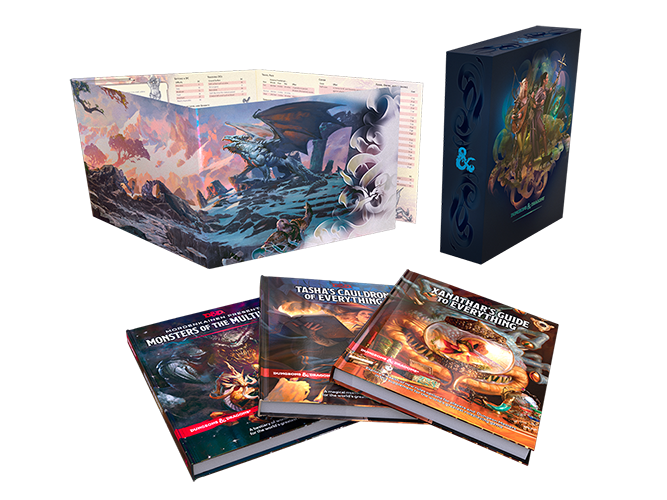
There’s a new official Dungeons & Dragons book coming out on Tuesday, but it’s bundled in with the Rules Expansion Gift Set. Due to all of this that we’re living through [waves hands at world] the Gift Set didn’t come out in time for the peak gift-giving time of year. Instead, it’s an oddly timed late-January product with the only “original” part of it not available until May 17.
As is typical alternate art is available at your local gaming store, which you should support. In Renton you can go to Wizards Keep Games or Shane’s Cards. People on the Eastside should go to Mox Bellevue. Down in Tacoma check Tacoma Games. Those are all places in Greater Puget Sound that I’ve supported and am confident in.
What’s in the Gift Set?
There are three books. Xanathar’s Guide to Everything and Tasha’s Cauldron of Everything are just reprinted with the latest errata. There’s a new(kinda) book called Mordenkainen Presents Monsters of the Multiverse. You’ll also get a DM’s screen with some tables to reduce page flipping when you play in person. Screens can be quite handy.
Additionally there is a fancy slipcase to hold everything and look really good while it sits there.
That kinda sticks out doesn’t it? Monsters of the Multiverse has one new monster. Those that already own Volo’s Guide to Monsters and Mordenkainen’s Tome of Foes will already have every other monster and nearly ever race, but in a different form. The new book has adjustments to the stat blocks to make them a bit more powerful and a bit easier to use. Also, those two earlier books (Volo’s and Tome of Foes) have dramatically more lore. Most of that lore is Forgotten Realms specific. The new book greatly minimizes the lore elements to what is true for a race or monster, typically, throughout the multiverse of D&D play.
Between the three books you’ll get rules for the Artificer class, a couple dozen new subclasses, over 30 new races, gobs of new magic items, many spells, and some new rules for exploration and be social parts of the game.
Reviews of Mordenkainen Presents Monsters of the Multiverse
The person who most needs the Gift Set is someone who is recently deep into the game. For all intents this set is the second core of the game, with rules that help both players and dungeon masters. Those players that only have the Player’s Handbook and want to dramatically expand their options will enjoy the set (talk to your regular DM beforehand just in case they don’t want certain subclasses or rules at the table). A Dungeon Master who wants more monsters, traps, and puzzles will get great use from the Set if all they have are the three core books. Monsters of the Multiverse is particularly helpful for those who homebrew, as the weight of lore won’t interfere as much as Guide to Monsters and Tome of Foes.
Maybe certain collectors will want the new set too. There’s an appeal to that. But, I don’t have that kind of room in my house or wallet. The new art and case are great though. When I have that kind of room this might be the set that finds its way into the background of a video meeting.
Overall the set is the next three books a D&D fanatic should get if they don’t have the four books that make up the Gift Set already. If you already have those books it may not be meant for you. Wait for the three or more other books that will come out in 2022 or keep playing with what you already own.
Typically in Dungeons and Dragons an adventure consists of some easy encounters, some hard encounters, a deadly encounter, and then the final encounter. The way characters level up over a campaign echoes this progression.
Heck, this is even typical in most stories. The heroes may see a deadly monster early, but they don’t fight it until they are more powerful. Or, in the course of a D&D adventuring day, when they’ve used some amount of resources, thereby making the final monster more deadly.
Through a happy little accident of misreading some stat blocks, my last set of sessions inverted this process.
Rather than meet goblins, then hobgoblins, then an ogre climbing that ladder of difficulty, the group started their day with a CR 7.6 encounter, next was a CR 6.25 encounter, and then a CR 3.
That released some opportunities for the players. The happy little accident meant that during that tough encounter they used a bunch of powerful abilities rather than keep them in reserve. During the second encounter they used more.
Then, finally, when they met the “boss” (who was actually the boss of the various Dragon Sworn*) they only had a couple abilities left. That meant it felt deadly, but really wasn’t. They won easily.
* For this I used the Fizban’s Dragon Blessed, Dragon Chosen, and Dragon Speaker
Overall the group was tested, more so than typical in my sessions. Also, they got to use more of their potent features. If I better telegraphed the inversion, like if it was planned, then they would have used even more of their limited powers.
When a player invests in a character having certain abilities they need to be able to use them. This accident utilized more powers in one day then I’ve seen in some time.
Over the years mainstream media has shifted from acting as if Dungeons & Dragons was connected to Satan and murder, to acting as if players were just nerds in basements to be ignored, to being nerds in apartments to be mocked (Big Bang Theory), to superpowered nerds to save the world (Stranger Things), to now just people who like something that other people don’t like (Ghosts) without any judgment of the game.
Seeing this shift, which I’ve lived through every moment of, still amazes me. Yes, there were times when genre shows featured D&D. Stranger Things made sense. The game fit and was featured in the story.
Ghosts did something different. One of the main characters mocked the game, but the way D&D was featured wasn’t a mockery. Instead, Dungeons & Dragons was a way to further establish fellowship between the diverse cast of ghosts and the one living who shares their space and cannot see them. Also, the d20s helped solve the other plot of the episode. Lead writer Joe Wiseman addressed this on Dragon Talk recently.
Every time I encounter the featuring of D&D as normal continues to astound me. Once forced to hide my passion for the game or get the books knocked out of my lap as if real life was a crappy teen comedy, now D&D is popular and mainstream enough that it is on my resume, talked about during job interviews, played in public, and can raise money for charity as celebs play.
Much of the mainstreaming of the game is because many of us nerds that hid in our basements are now of the age that we are in positions of influence. While it is Zoomers and Millenials that are the fuel spreading the game, GenX leadership is normalizing it.
Writers rooms throughout Hollywood played as kids and are playing again, as are the actors, cinematographers, set designers, etc. Video game designers (and all of the support staff) played with pen and paper, then translated that to big screen.
D&D’s tropes are mentioned in genre fiction (Onward!) and regularly trend on social media. There’s not a day that goes by that an Alignment Chart meme doesn’t show up.
Now that we’re mainstream there’s always that worry among us olds that things will change in ways that we don’t understand. But at it’s core D&D has always espoused that a “diverse group is a strong group.” And all of the current changes lean into that trope that started with the Fighting-Man, Magic User, Thief, and Cleric that were also a Dwarf, Elf, Halfling, and Elf.
Leaning into that means more players, more games, more chances to “roll for initiative.” That’s all I want.