The smogpunk land of goblins in the World of the Everflow was set apart from the Kingdom of Sheljar, Crinth, and other areas for a few millennia. Within this separation the goblins and hobgoblins changed from the standard tropes.
In the Everflow they answer to the Queen Mother. Everyone is organized around their family’s history of developing teknology for one of the various guilds. Inventiveness and cleverness are more important than fighting and viciousness.
To emphasize these differences, but still capture traditional goblinoid feelings there should be a some differences in language. This discovery of numerals from the 13th century feels proper for the gobkon of the world.
The Cistercian monks invented a numbering system in the 13th century which meant that any number from 1 to 9999 could be written using a single symbol pic.twitter.com/VRuEx4dkPF
— UCL Department of Mathematics (@MathematicsUCL) February 2, 2021
It works in a printing press, scribbled on paper or carved into wood.
Will it ever see the table? Probably not. Or maybe just one or two numbers in a handout for the players to demonstrate the differences between their lands with the languages of Telse (Common) and the rest of the Six Kingdoms.
If there was a campaign book for the World of the Everflow this could be a tiny sidebar for flavor, not a rule for use.
In my campaigns we use experience points rather than milestone levelling. But, we also spend time in the social and exploration pillars, where the game as designed provides little guidance towards the experience that should be rewarded for success overcoming obstacles beyond traps.
Rewarding the play I want to see, I have given out xp for solved plot points and discoveries. In the past these have been given out at the end of a session without the players knowing ahead of time what their character rewards would be.
I’m going to attempt to pull back that veil, listing out major plots and side quests with xp values. My goal is so that the player characters will be rewarded for developing their stories and the overall campaign.
Major plots
Daoud’s 7th Fleet vs Twilight and Shadow the Black Dragons vs the Mayor with the Blue Dragons vs assembling Kirtinish forces on the east shore – 10,000 xp
Kirtin-on-the-Lake is now torn between two of the Six Kingdoms and the separate appeals of two groups of Ken. Twilight and Shadow seem to thrive on misery, sucking up negative emotions from the war. The Mayor has gifted the Blue dragons significant territory and their co-operation requires unbonding from animal companions.
The 7th Fleet wants to take the city back to Daoud. It is actually a massive cavalry army with horses, riding dogs and warbirds. Kirtin’s forces sit, waiting for the three sides to destroy each other and sweep back into the city as welcomed heroes.
Our heroes haven’t picked a side, because they are all bad. In the past they’ve hoped for trade or normality looking to Sheljar for inspiration.
Our heroes have the Lorebook of Illusions and the Crate of Conjuration. They suspect there is another Lorebook locally and a fourth may be in The Ferments. They know not what power the Lorebooks provide, just that a group called the Scholars control them and the Proctors are a violent segment of Ken who are trying to acquire the various books. The world knows that the Folio of Necromancy and the Lorebook of Divination are in Sheljar.
Defending their books from other Proctors or Scholars is as important as finding more, probably.
Unseat the Mayor – 7,500 xp — COMPLETED
The Mayor has turned his back on Daoud and joined with the Blue Dragons and their Ken allies. Even if the heroes cannot yet sway the four-sided war, the group wants the Mayor eliminated via election, appointment or violence — he just needs to be gone.
Side quests
Where is Wilkie? – 2,500 xp — COMPELETED
One of their allies, Wilkie, former leader of the Dock District Guard fled. With their leader in hiding the Dock District has dissolved back to an ad hoc militia. The group of heroes had trusted Wilkie to defend their district.
Missing Printers – 2,500 xp — COMPLETED
The printing press and gobkon printers’ office burnt down in a dragon strike. No bodies were found. Once in hiding, then public, the Society of Veil and Shadow has again disappeared. Their pro-Sheljar message remains known, but there have been no broadsheets in three passings of Feylf.
Is the new flag of quill and sword related to their absence?
Bounties – 2,500 xp — COMPLETED
Each of the known heroes has a bounty of 2,500 gold on them. This is mostly because the Mayor hates them for the murder of the gnome during his festival. But also because they keep trying to inspire the people toward concepts like freedom and respect.
Character quests
Keldrass wants to repair the bonds broken by the black dragons and help protect the city from the Ken.
Gardar wants to increase the trade with Mehmd, earn respect outside of the caste system there and maybe have his own Goltoppa team.
Seymore wants to teach commoners magic, because even though he doesn’t trust it the people need the power. He’s done a bit of this by spreading Minor Illusion.
Req wants to maintain the independence of the Dock District.
In 5th edition D&D I create a lot of rogues. This is a change for me, for in my earlier forays into Dungeons & Dragons, I mostly played clerics, bards and paladins. Part of the appeal of the rogue in 5e, is that it has became the main skill-monkey class. Mostly mundane there are interesting stories to be told via the mastermind, the inquisitive, the scout and the propagandist.
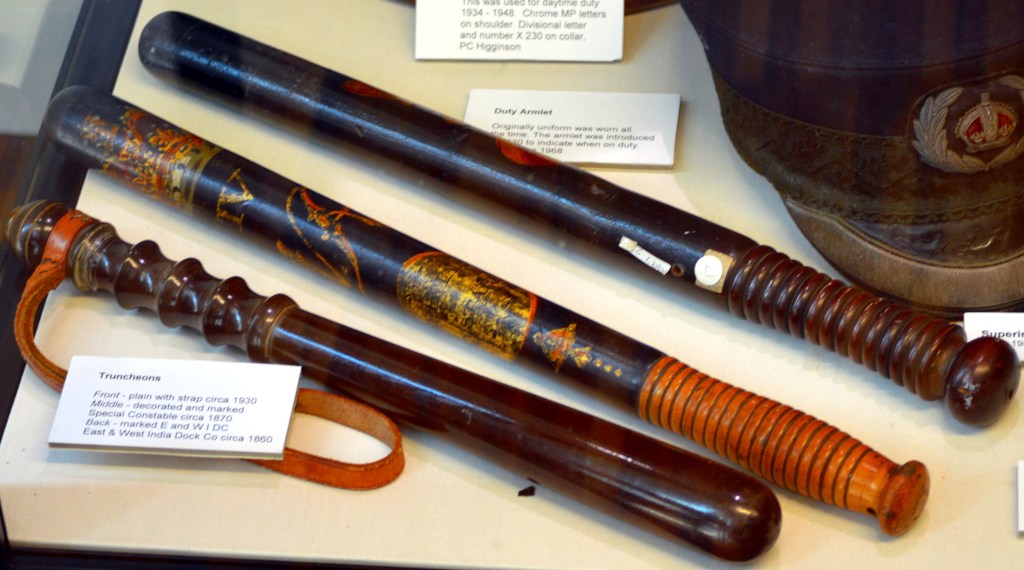
One thing I find lacking for three of those options is the narrative around using a weapon that knocks opponents unconscious. While the rule set allows any weapon that does enough damage to kill to be declared a non-fatal blow, there’s something about an mastermind smacking a thief upside the head with a baton and knocking them out.
Common within the literatures that inspire our game are also tales about short staves that flip about stabbing with the point and smacking with the side — see various interpretations of Sherlock Holmes. My campaign needed one of these because a player in Uprising and Rebellion Campaign Two is a streetsweeper. Their broom handle makes sense as a weapon for them.
The baton is just a refined club so that you can play as Sticks from the Vlad Taltos Saga. The short stave (broom handle) is based on the rapier, the current best weapon for a rogue, but merely bludgeoning and cheap.
There’s nothing game breaking from these additions. There’s no power creep.
There is a whole lot more story. And that’s the whole point to Full Moon Storytelling — story creep.
Dungeons and Dragons is more popular than ever. That is undeniable. The game has grown and become a side channel to the mainstream, with its influence everywhere. But it is about to get a lot more popular. Tens of millions are going to watch Dungeons & Dragons: Honor Among Thieves.
That’s going to attract a lot more neophytes to the game.
From Chris Pine saying every high school should have a D&D club to mainstream local soccer fundraisers like YachtCon playing the game (we’ll do something this year too) the game is spreading faster than ever before. After a season of not-really-D&D Stranger Things dipped back in with the Hellfire Club. Season five, the final will also be D&D themed.
There’s also D&D adjacent properties like Wheel of Time (season 2 of Origins is out in August and season 3 is already happening) and Rings of Power (season 1 in Fall). Witcher keeps going strong. Vox Machina got a season 2 and probably will get a third. List goes on, and on.
There’s no better time for fantasy TV and movies — none.
As experienced players and DM’s it is our responsibility and duty to welcome these new players to the game. One way to do that is through the classic Starter Set, the Stranger Things boxed set, the Essentials Kit, the new Dragons of Stormwreck Isle, Spelljammer Academy, etc, etc.
But you also have your home games with elaborate and thought-out original plots. These games are the most common way to play D&D, a majority do not play in the official worlds. There’s a danger in welcoming people to the game the first time in an original world. Those campaigns can have a lot of custom rules.
When the Lorebook Hunters first started in the World of the Everflow there were more than four pages of custom rules, heavily tweaking the game. Now there are just four sentences of rules not taken from the books – all able to integrate with DnDBeyond, excepting the custom subclasses. Players new to the game can create a character in 30-60 minutes rather than hours.
That helps first-time players pick up the game. There’s plenty of support online for the official rules — blogs, video, podcasts, social media. There’s only your table as a place to learn about custom rules. That can be intimidating. Plus they need to pick up custom lore. Another barrier to play.
Reducing both of those weights helps a first-time player become a perpetual player and eventual Dungeon Master.
Tips for types of rules to add
Optional rules from the Dungeon Master’s Guide — they’re already official, in a book for others to read.
Rules that enable your story — the World of the Everflow has a key question as to why we love pets. It wouldn’t be the same without the bonus feat of Bonded Companion.
Changes that empower cinematic flavor — since many people new to the game will come from watching film give them that vibe.
Tweaks that don’t require technical knowledge — asking a first time player to learn a VTT rather than just video or theater of the mind can reduce their interest.
At the same point, if you have a massive world already, don’t retro those rules. Find ways for your table to welcome new people into your complex lore and ruleset. Use session zeroes frequently, both one-on-one and with the group. Tell a new player why you have those rules. House rules that help tell the communal storytelling are always better than house rules that add complexity, at least for the modern gamer coming at D&D as a storytelling game that empowers group tales of action and adventure.
Most of all, enjoy the new players and their new stories. They’re going to add to your table coming up with ideas and concepts you’ve never seen before. If you are doing it right you’ll have a more diverse group, telling more diverse tales — and you’ll be stronger both in real life and in the game.
This campaign is set seven years after the Lorebook Hunters returned magic to the World of the Everflow. It is set in the Free City of Sheljar, and is centered on clearing portions of the bog-city from the return of undead and tunneling nightmares. Combat and exploration will be heavier than social play at the beginnnig. Every character is united in keeping residents of Sheljar safeand mostly unified in the ideals of Free Shejlar (all thinking peoples have value), but may have differing concepts about how to do so.
The bog-city of Sheljar sits in a lowland below a waterfall. The climate is cool and wet, think the lowlands of the upper Salish, the moors of Scotland with a boggy multi-island brackish lake similar to New Orleans.
Campaign Premise
The party is a group of guards that volunteered and is paid to help the Lorebook Hunters keep the people of Sheljar safe from skeletons, zombies, wights and other undead. Tunneling Nightmares may have returned to isles in the bog-city as well. They will start in the old neighborhood of Jherr as recent migrants have noticed a cavern with odd noises and smells.
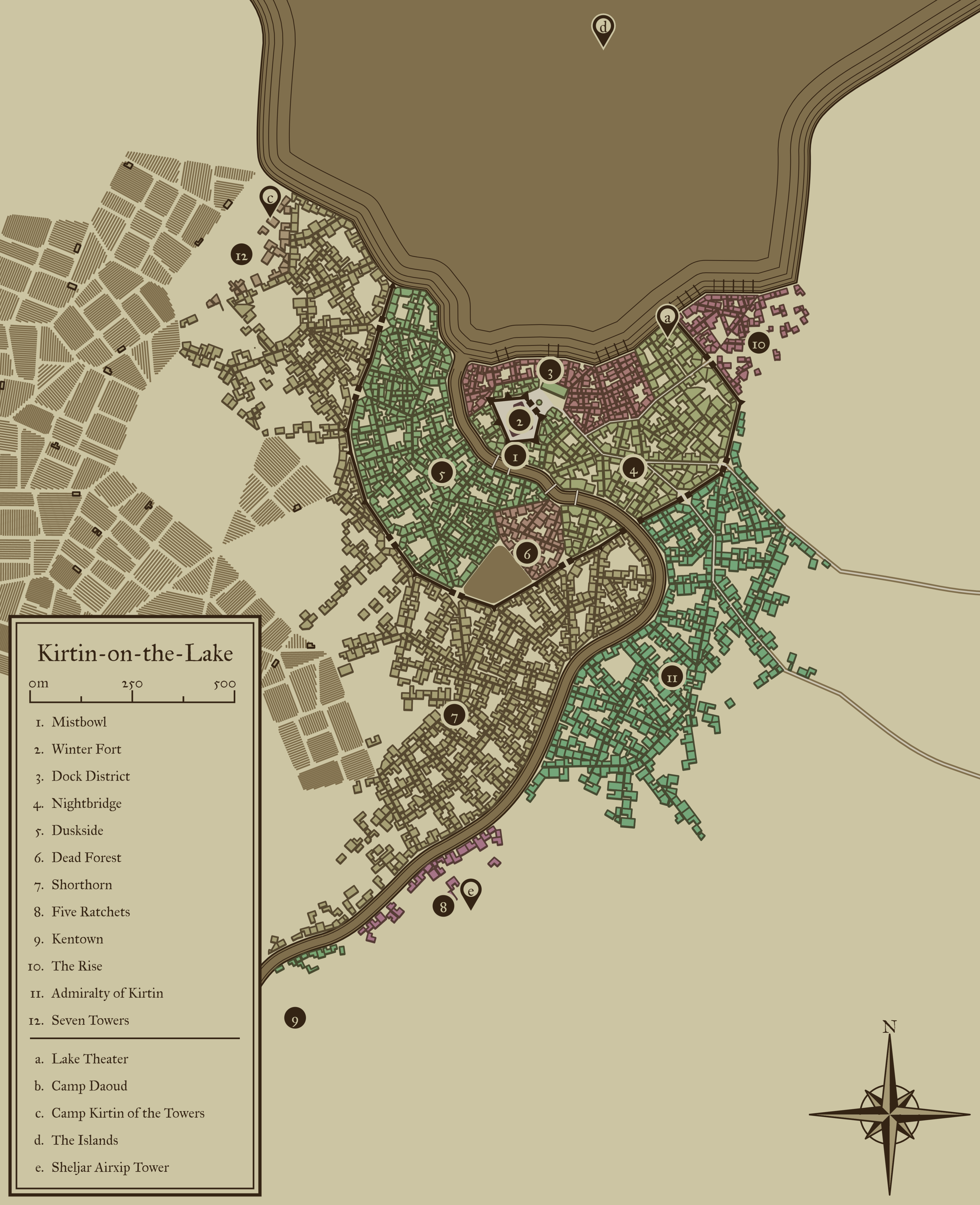
Made using Perilous Shores, this is the neighborhood of Jherr, to the north and east of the core of Sheljar. The southeast corner is less brackish than most of the bog-city, almost an internal fresh water space.
Background
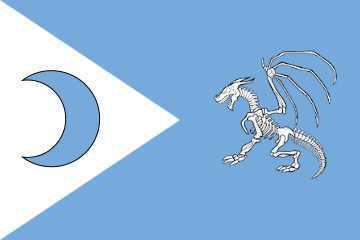
The Flag of the Free City of Sheljar features the moon Feylf in crescent, a white triangle entering a field of the sea and Boo, in his skeletal form.
Once upon a time, the Empire of Sheljar ruled all of the Western Wildes, from the Cliffs of Galinor to Mira to Qin. Then, the Born Generation of magically imbued teens (27 years ago) caused chaos and disruption, upending the old ways. One of the Born Generation, the Necromancer, thought he was doing good, keeping dying peoples and animals with their families, but these horrifying undead monstrosities were often rejected. As he raised more and more, people fled Sheljar, emptying it out, leaving the bog-city nearly abandoned to the Necromancer and his unliving nightmares. A misty stench then started to control the city and more people fled.
It was not until after the eruption of the volcano, the battle of Cortez and Chorl, and the Lorebook Hunters eventually slaying the Necromancer that Sheljar felt free again. Now, six years later the Free City of Sheljar welcomes all thinking peoples. Those that return to their former homes have their property back. Those without homes are granted plots and space with the promise of aid. Few ships dock at Sheljar, but that number increases every month.
Sheljar has several dozen gobkon, a few dozen Ken with no known dragons, but most of its 2,000 generally agrarian peoples are various Kin with their animal companions. The Gendarmes and the Lorebook Hunters are the only standing ‘army.’ Most of the residents are frontier peoples ready to defend their cottages but only have clubs and other utensils as weapons.
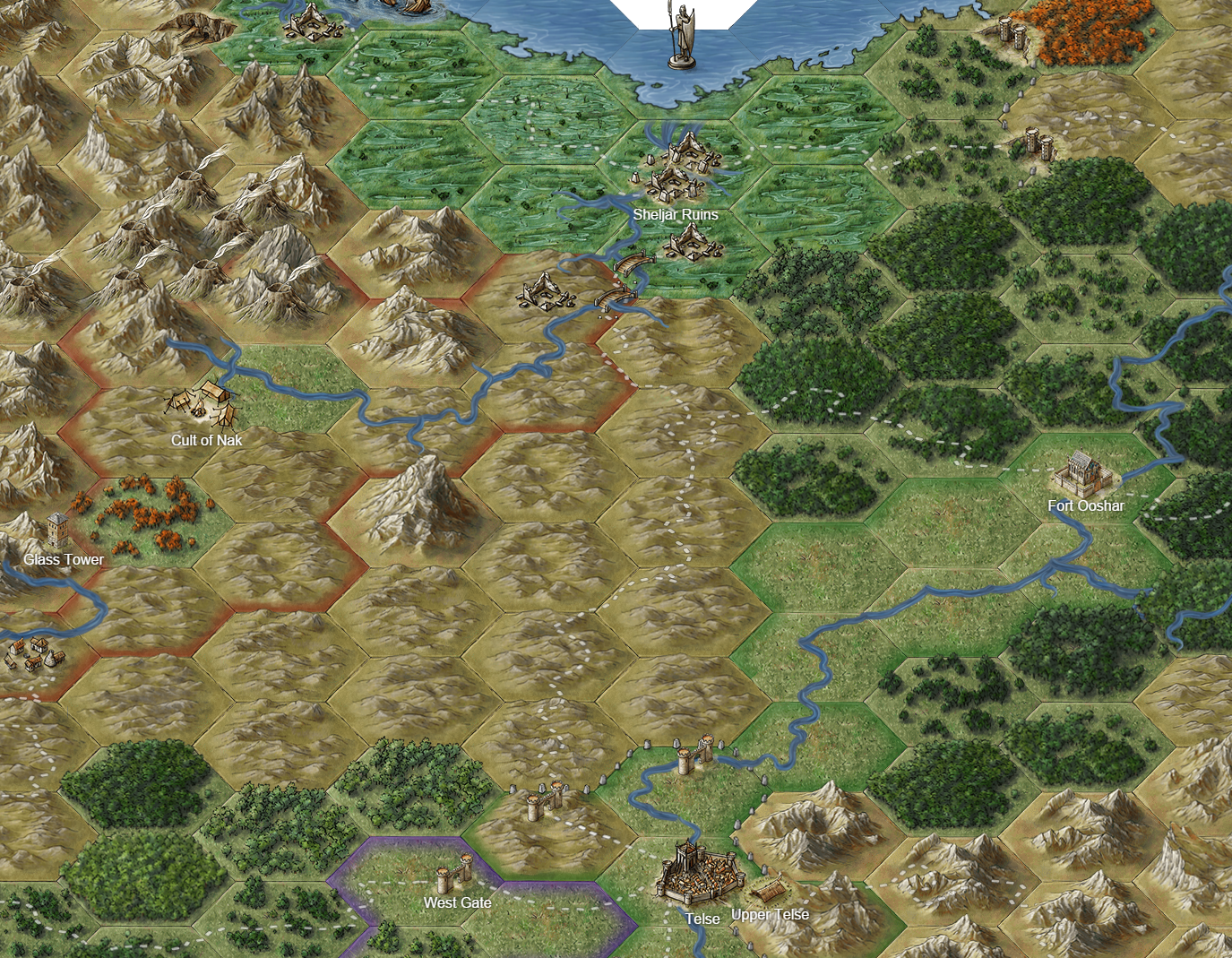
A map of the former Empire of Sheljar, now a series of independent city-states and free towns.
Grand Conflicts
At the start this is a simple island of the week adventure, where the Gendarmes are responsible for discovering and clearing pockets of undead.
Factions
Lorebook Hunters – this is the leadership of Sheljar.
Cult of Nak – these are the remnants of Chrol’s transformations.
Fort Ooshar is under control of the Fox and Crow, a gang that sees opportunity to raid the migrants heading to Sheljar
A death cult has taken over the lands west of Telse.
Rumors
The Folio of Necromancy may be missing. Saffron had held it prior to rising to part of the leadership council.
What is that stench out east? Tunneling Nightmares?
The Volcano of the Glass Tower is glowing.
Facets
Exploring the zero-to-hero tropes, friendship with animals, and who gets to control knowledge.
Sandbox play.
Player agency creates history.
Drop in/drop out, whatever. This is an episodic campaign.
Sessions are 60-90 minutes. Adventures are 1-3 sessions.
Variant Rules
Playable races are Human, Hin(what they call themselves)/Halfling, Goliath/Firbolg, Elf, Dwarf, Gnome (wood only), Goblin, Hobgoblin, Bugbear.
Use point buy or standard array for starting attributes. If you want something random, the redrick roller gives random point buy valid stats.
Start at 1st level because several are new to the game, let’s learn together.
The Gendarmes start with a small sailing boat (Crew:4 for rudder, sails, a repeating heavy crossbow, and a fire sling).
Long rests require 24 hours within sanctuary. This creates a pace of play more similar to novels than video games.
Practicum
Sessions will be on Wednesdays right after work, played over Meet with shared screen used to help set the scene. Theater of the Mind will be the most common form of combat, ideally using cinematic descriptions which will grant Inspiration. There is a campaign on DnDBeyond, used only by the participants rather than open to public.