Tag: Playing D&D

  • Expanding character personality and 11 other things to help you game

    Expanding character personality and 11 other things to help you game

    Roleplaying is more than a stat block. It’s that stat block, plus the personality of a character you assume for however that game lasts. Early in D&D and the hobby’s history that personality would be as simple as the class, race and maybe alignment. That resulted in a pattern where many characters had the same personality.

    As alignment faded, and especially during the surge in actual plays, personalities became vibrant. Original 5e even tried to reward personality using the traits, ideals, bonds, and flaws system plus alignment. It was too much to handle for a few hours a week of fun.

    How can we simplify the personality?

    By using archetypes from fiction — these pull at our souls because they are common. BUT. A character with a singular archetype is also boring, just like the idea that every single lawful good Paladin has the same personality is boring.

    The most recent episode of Scriptnotes went over ways to incorporate archetypes in screenwriting.

    It’s the intersection of two or three archetypes that makes a character interesting. They need positive and flawed attributes, and tension.

    Their archetypes are a version of short-form personality. Ejecting trope-y D&D concepts by force and giving your character simple ways to remember who they are in their soul is easy — especially if you use their card system — which I’m backing.

    Two positive attributes, one flaw; both in a single word — you can remember that. You probably are already playing that way!

    Xabal, my goblin artificer, is quick-witted, kind, and overthinking.

    That’s more interesting than chaotic good.

    I started to listen to Scriptnotes because it helped me be a better DM and rare short fiction writer, not because I think I’ll be in a writer’s room someday. And now they’re both working on D&D TV projects. Craig Mazin is working with HBO on the Baldur’s Gate series while John August is working on the Ravenloft project. Almost every episode mentions D&D.


    Other things to help inspire your game, help you play, or help you design

    Any Human Ever creates short bios based on the history of our world. It can be a start to seeding interesting NPCs.

    Dyson Logos Small Shop Series — now with 14 small shops in a market road of a city, these help me more than dungeons.

    Scipio’s Resources for RPG creators — bookmark this if you ever think you are going to publish for pay. The assembly of resources is excellent.

    British Columbia has a floating island that keeps disappearing. Welcome to spooky season. Floating islands are fascinating enough, but what if it pops in and out of the fey realms regularly? What if it isn’t haunted, but everyone that lives on it thinks that the village on the edge of the lake are the haunters? This could be a fun one-shot.

    You know I have strong thoughts on using cultures rather than languages. Two other bloggers riffed on those concepts over the summer.

    All of us agree that you should use Culture rather than Language at your D&D table. Pick the system that works best at yours — I may run Melestrua’s version in my next campaign.

    Dice are six thousand years older than previously thought, and American. Remember, your D&D tech doesn’t have to mirror Western and Central Europe. It can, but even then, it doesn’t have to mirror a single era.

    I love Adempz idea of using Success Thresholds rather than single-roll DCs. Having ways to expand the mechanical heft of a social or exploration encounter is good! This is a variant on stealing Blades in the Dark clocks, basically.

    M.T. Black fleshed out traveling in a way I need to use at the table. D&D travelling used to be a significant element of the game, but now is frequently ignored. Swift, simple mechanics that amplify story and setting like Black does here are perfect.

    Traipse offers a new way to think about commonality via 1, 10, 100000. Within the World of the Everflow dragons in the Age of Myths were closer to 10, but in the modern era of Uprising and Rebellion they are 100,000 — extremely common, almost like humans. Those are two different levels of danger.

    What links should I include in the next edition of Lore Collage?

    Fediverse Reactions
  • Ritual casting Cantrips in D&D

    Ritual casting Cantrips in D&D

    Worlds with mild or pervasive magic, magic that’s not merely for combat should have more rituals. These rituals would be to represent the fictions around hedge mages, working mages, knacks, folk magic and the like.

    But how do we do this in a world that isn’t just low magic, but nearly no trained magic — by Ritual casting Cantrips.

    Now, that seems counter intuitive. In D&D and the rest of the 5e ecosystem we’re used to seeing cantrips as a less than six second flash of action. The non-combat ones, especially the four most flavorful ones, aren’t powerful.

    That’s exactly why we’re stealing those four and turning them into rituals for the hedge mage, the folk witch, the knacked one.

    Converting to Rituals

    Currently the casting time is one Magic Action or Action for Druidcraft, Elementalism, Prestidigitation and Thaumaturgy.

    1. Make the ritual last 10 minutes, 1 hour, or 8 hours.
    2. Expand the impact of these spells exponentially.
    3. Give them to commoners.
    4. Do not let the trained casters cast these as rituals as they are less powerful than constantly casting using an Action.
      1. Do let casters have the higher impacts when their combat cantrips get more powerful.

    Druidcraft

    From the 5.2 SRD;

    Whispering to the spirits of nature, you create one
    of the following effects within range.

    Weather Sensor. You create a Tiny, harmless sensory effect that predicts what the weather will be at your location for the next 24 hours. The effect might manifest as a golden orb for clear skies, a cloud for rain, falling snowflakes for snow, and so on. This effect persists for 1 round.

    Bloom. You instantly make a flower blossom, a seed pod open, or a leaf bud bloom.

    Sensory Effect. You create a harmless sensory effect, such as falling leaves, spectral dancing fairies, a gentle breeze, the sound of an animal, or the faint odor of skunk. The effect must fit in a 5-foot Cube.

    Fire Play. You light or snuff out a candle, a torch, or a campfire.

    Adjustments by effect

    • Weather Sensor. 10-minute ritual. The forecast is for the next two days. 1-hour ritual. The forecast is for the next four days. 8-hour ritual. The forecast is for the next eight days.
    • Bloom. 10-minute ritual. You can create two blooms. 1-hour ritual. You can create four blooms. 8-hour ritual. You can create eight blooms. These blooms last as long as the ritual.
    • Sensory Effect and Fire Play. 10-minute ritual. You may create two of those effects in a 10-foot cube. 1-hour ritual. You may create three of those effects in a 20-foot cube. 8-hour ritual. You may create four effects in a 40-foot cube. Sensory Effect and Fire Play can be combined when part of a ritual.

    Elementalism

    The various effects are similar to Sensory Effect and Fire Play, but with minor changes.

    • 10-minute ritual. You may beckon or sculpt two elements. The effect can be within a 10-foot cube or square. Effects that last a minute last two minutes instead.
    • 1-hour ritual. You may beckon or sculpt three elements. The effect can be within a 20-foot cube or square. Effects that last a minute last four minutes instead.
    • 8-hour ritual. You may beckon or sculpt up to four elements. The effect can be within a 40-foot cube or square. Effects that last a minute last 10 minutes instead.
    A thin shape of a house with script Kristin Clark inset

    Full Moon Storytelling is brought to you by Kristin Clark of Keller-Williams Lake Washington
    If you are looking to buy or sell a home in King or Pierce County, Washington support Full Moon Storytelling by supporting Kristin.

    She’s my partner in everything I do.

    Prestidigitation

    This is the most complex of the flavor cantrips.

    Sensory Effect and Fire Play. 10-minute ritual. You may create two of those effects in a 10-foot cube. 1-hour ritual. You may create three of those effects in a 20-foot cube. 8-hour ritual. You may create four effects in a 40-foot cube. Sensory Effect and Fire Play can be combined when part of a ritual.

    Clean or Soil. 10-minute ritual. The size of impacted area increases to 2-cubic feet. 1-hour ritual. The size of the impacted area increases to 4-cubic feet. 8-hour ritual. The size of the impacted area increases to 10-cubic feet or one Large (or smaller) creature.

    Minor Sensation. 10-minute ritual. The size of impacted area increases to 2-cubic feet for two hours. 1-hour ritual. The size of the impacted area increases to 4-cubic feet for four hours. 8-hour ritual. The size of the impacted area increases to 10-cubic feet or one Large (or smaller) creature for eight hours.

    Magic Mark. 10-minute ritual. The mark lasts two hours. 1-hour ritual. The mark lasts four hours. 8-hour ritual. The mark lasts a day.

    Minor Creation. 10-minute ritual. The item or image lasts for a minute. 1-hour ritual. The item or image lasts for ten minutes. 8-hour ritual. The item or image lasts for 1 hour.

    Thaumaturgy

    Altered Eyes. Booming Voice. Fire Play. Tremors. 10-minute ritual. The effect lasts for 2 minutes. 1-hour ritual. The item or image lasts for ten minutes. 8-hour ritual. The item or image lasts for 1 hour.

    Invisible Hand. 10-minute ritual. You can influence two doors. 1-hour ritual. You can influence four doors. 8-hour ritual. You can influence 16 doors at once.

    Phantom Sound. 10-minute ritual. You can create two sounds. 1-hour ritual. You can create four sounds. 8-hour ritual. You can create 16 sounds at once.

    This work includes material from the System Reference Document 5.2.1 (“SRD 5.2.1”) by Wizards of the Coast LLC, available at https://www.dndbeyond.com/srd. The SRD 5.2.1 is licensed under the Creative Commons Attribution 4.0 International License, available at https://creativecommons.org/licenses/by/4.0/

    In the Lands of the Everflow

    Before The Born Generation and the return of magic the rare, mild magicks of the world were the Bonding, the clandestine Scholars, and extremely rare ritual casters who could only cast these four Cantrips and Rituals as per Black Flag’s Ritualist Talent (page 81). Even the Scholars could only cast using rituals during the three thousands years without magic, but those rituals were casting normal spells at that length of time and then holding concentration on them until they were needed.

    Fediverse Reactions
  • Cabbies and ferien – people moving backgrounds for 5e/5.5 D&D and Black Flag

    Cabbies and ferien – people moving backgrounds for 5e/5.5 D&D and Black Flag

    Paths and ways in a fantasy world are not just occupied with masses of people walking with a few nobles on horseback. They are also clogged with carriages and carts delivering goods. In my own world one NPC used two giant turkeys to pull his coffee delivery cart. The players enjoyed the presence of this NPC so much they kept bringing him back up.

    The cabbie or ferien are taxis for a world where there are dragons and very expensive teleport circles.

    Cabbie

    You help carry people and goods between neighborhoods and distances. Working in urban areas either on the land or water you know the paths between places and the peoples who inhabit them.

    The cabbie may pull their own cart, use a pony or even have experience with a two-horse carriage. Often they have a stool to help their clientele into their car. Also willing to talk, even when the occupant isn’t interested, the cabbie can learn the happenings of a region or distract that occupant in such a way that they are susceptible to crimes.

    Cabbie (5e / 2014)

    Skill Proficiencies: Insight, Deception or Persuasion
    Tool Proficiencies: Vehicles (pick one of land or water)
    Languages: One additional language, often from a culture that is nearby the home of the character
    Equipment: Cart, carriage, rowboat, gondola, sailboat (pick one), a lantern with 3 flasks of oil, traveler’s clothes, a trinket, 2 days rations, pouch with 25 silver

    Feature: Talk too much

    You are a skilled conversationalist that frequently goes on and on. These long talks are often consuming and distracting. Some cabbies and feriens may have allies who use that speech as a distraction to pick pockets or similar events.

    Additionally, you pick up the streets, rivers or flyways of a new city quickly almost never getting lost in natural urban areas.

    Personality

    Use the Folk Hero and Fisher for guidance.

    Alternate: Ferien

    First, let’s get this out of the way. There’s no simple gender neutral word for ferryman. Similar to Anagod on World Anvil, I appreciate the older English word ferien. As you expect the cabbie knows the streets of a city or the ways between villages, the ferien works the waterways of a land — rivers, canals, lakes and shores.

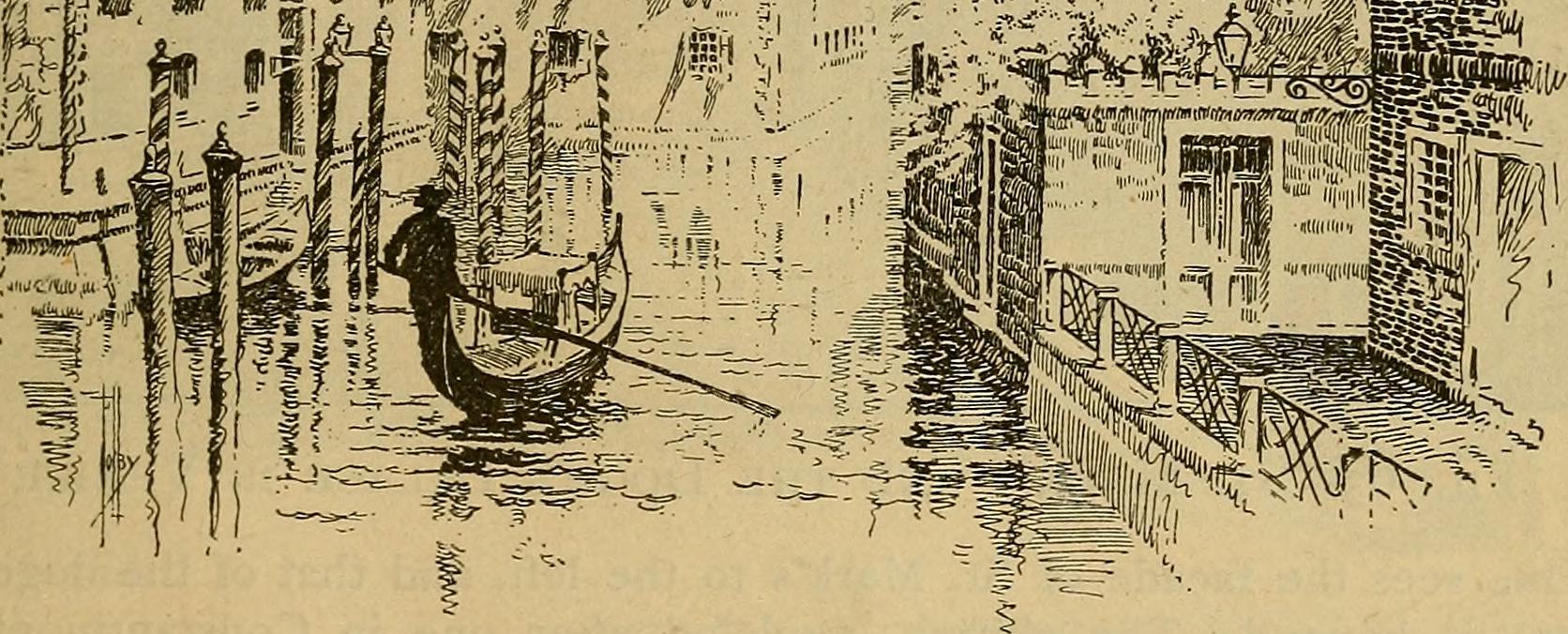
    Image from page 270 of Medieval and modern times; an introduction to the history of western Europe form the dissolution of the Roman empire to the present time (1919)
    A scene in Venice – public domain

    It’s pretty simple to make the Ferien version. Choose Vehicles (water) and then pick a rowboat, canoe, gondola or tiny sailboat for the vehicle. Nothing else needs to change.

    Cabbie (5.5e / 2024)

    Ability scores: Charisma, Strength, Wisdom
    Feat: Talk Too Much
    Skill Proficiencies: Insight, Deception or Persuasion
    Tool Proficiency: Navigator’s Tools (2024 depreciated Vehicles)
    Equipment: Cart, carriage, rowboat, gondola, sailboat (pick one), a lantern with 3 flasks of oil, traveler’s clothes, a trinket, 2 days rations, pouch with 25 silver or 20 gold.

    Origin Feat: Talk Too Much

    Shoulder talking. When talking to creature with which you share a language (or culture) you are able to distract a non-hostile creature. An ally attempting use Sleight of Hand, Stealth, or Deception against that creature has advantage in the current minute.

    Paths and landmarks. After spending an hour in a bar, market, restaurant or other third place in a new non-magical urban area you are unable to get lost.

    Cabbie (Black Flag)

    Skill Proficiencies: Insight, Deception or Persuasion
    Additional Proficiencies: Vehicle (land, water to be a ferrien)
    Equipment: Cart, carriage, rowboat, gondola, sailboat (pick one), a lantern with 3 flasks of oil, traveler’s clothes, a trinket, 2 days rations, pouch with 25 silver or 20 gold.

    Talent

    You are familiar with the conversations and flow of urban places, used to finding your way through new cities and old while talking to people across social class, faiths or ancestries. Pick one of the following;

    1. Polyglot
    2. Trade Skills
    3. Aware

    Design Goals

    Watching Shadow & Bone, or the Lion, the Witch and the Wardrobe, you see that those who manage transportation are part of fantasy stories. Whether the carriage driver or the polemaster in a gondola, these characters deserve the opportunity to be heroes.

    Maybe because I’ve been focused on the bog-city of Sheljar for Dungeon 23 I thought it was time to share this background publicly. The bog-city, or an island city, must have peoples who are dedicated to navigating the waters.

    This post was originally written for 5e in January 2023 and updated for 5.5e and Black Flag in July 2026.

    Custom Backgrounds for 5th edition Dungeons & Dragons

  • Turning 5e Background Features into 5.5e Feats

    Turning 5e Background Features into 5.5e Feats

    Much of the flavor of the 2014 version of 5e Dungeons & Dragons backgrounds was within their features. These mild mechanics usually made some element of either the social or exploration pillars of the game.

    They’re gone, replacing both story and the two minor pillars with a Feat in 2024 D&D. It’s a shame.

    Many of my own custom backgrounds sit dormant, because the story was a key part of why they existed. And adding power through a Feat that offers more combat utility is silly.

    There’s a solution. The example comes from the Realms books. The Feats there ooze flavor in ways the Player’s Handbook does not.

    How can I do that at scale for the 20+ backgrounds I’ve created?

    Borrow from themes

    Find the origin feats (or talents) that are most similar to the desire and calibrate from there. Skilled, Musician and Crafter are the ones in the 5.5 Player’s Handbook I’ll lean towards. Black Flag expands the calibration in similar ways to the Realms books. Psychanist, Ritualist, Athletic, Polyglot, Scrutinous, and Trade Skills will be referenced as well. Having a bank of ten feats and talents to calibrate against should help.

    Walkthrough

    Let’s start with the clothier/weaver, which by design leans into tropes around various fictional cults that use threads to see futures.

    The original feature with mild mechanics.

    Feature: As the Wheel Wills

    You have a certain comfort and understanding that you aren’t always in control. You have advantage on saves against fear, charm and other enchantments after the first round in these conditions.

    Additionally, you are able to find and protect secrets. When using Insight or Sleight of Hand to keep or discover secrets you do so with double proficiency.

    Making it modern

    From mild mechanics to direct mechanics is a first step. The second is to calibrate versus similar feats and talents. As the Wheel Wills feels like more of a social feat with hints at magic, but not spell craft. Ritualist, Musician and Athletic have some of the heft I’ll use.

    As the Wheel Wills for 5.5e

    Due to your understanding of the wheel you have advantage on saving throws against fear and charm after being under the condition for one round. (This is somewhat similar to Athletic)

    Also, your experiences understanding that weaving is a physical representation of the connections between peoples you have expertise with one of Insight or Sleight of Hand. (Removing the more situational impact from the previous version).

    Another example – Cabbie/Ferien

    The Cabbie is an attempt to capture some Shadow & Bone, Narnia, Bridgerton, Gilded Age vibes.

    Feature: Talk too much

    You are a skilled conversationalist that frequently goes on and on. These long talks are often consuming and distracting. Some cabbies and feriens may have allies who use that speech as a distraction to pick pockets or similar events.

    Additionally, you pick up the streets, rivers or flyways of a new city quickly almost never getting lost in natural urban areas.

    Let’s convert that

    Origin Feat: Talk Too Much

    When talking to creature with which you share a language (or culture) you are able to distract a non-hostile creature. An ally attempting use Sleight of Hand, Stealth, or Deception against that creature has advantage in the current minute.

    Additionally after spending an hour in a bar, market, restaurant or other third place in a new non-magical urban area you are unable to get lost.

    Moving forward

    For some reason, unlocking this process within my mind is fuel to move forward with the backgrounds that are necessary to move forward with Uprising & Rebellion into the 5.5 era.

    Converting 20 was overwhelming until these thoughts. Plus, with the idea that an Origin Feat can be a General Feat with the addition of an attribute bonus that helps advance the three pillars I’m most interested in — Social, Exploration, Scheming. Because a few of these backgrounds and their newly associated Feats will unlock crafting, business management or militia actions.

    Fediverse Reactions
  • Using word-maps for quick reference during your games

    Using word-maps for quick reference during your games

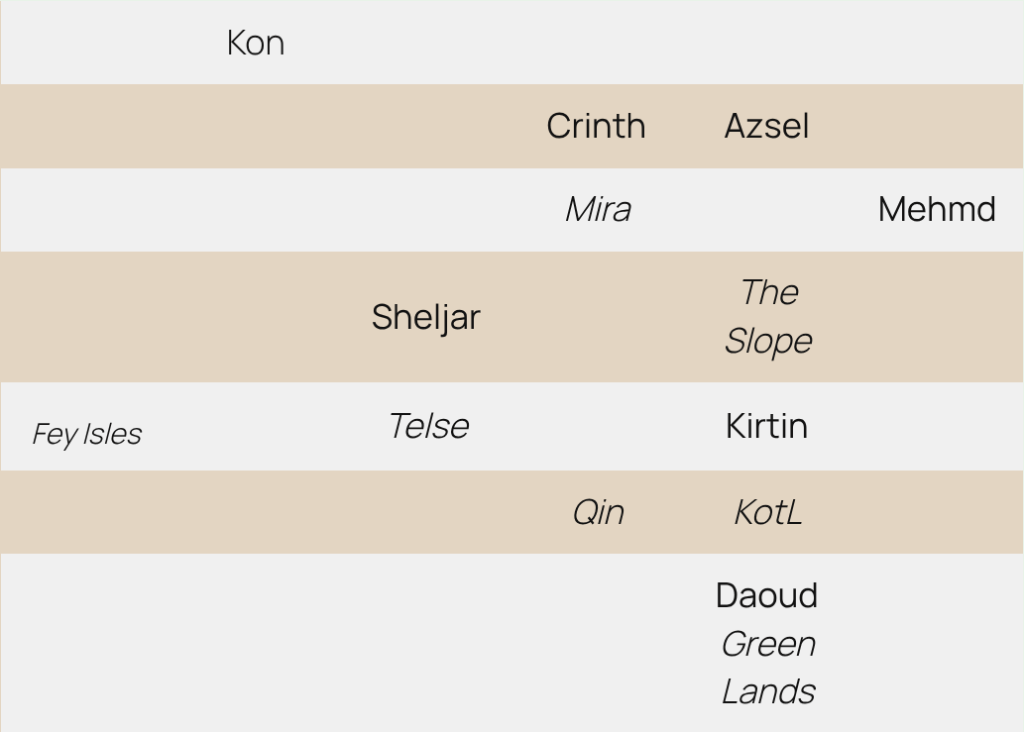
    You don’t have to be a map maker to make adequate maps for gaming. A map can be as simple as showing the relative relationship between distance and location of the important elements. Even putting a few words on a page can be a map.

    Take the word map of the Six Kingdoms. It shows the relative locations and rough distances between the various kingdoms, their major cities and the other lands that interact in the World of the Everflow.

    Word maps can also represent a homestead, village or neighborhoods of a city.

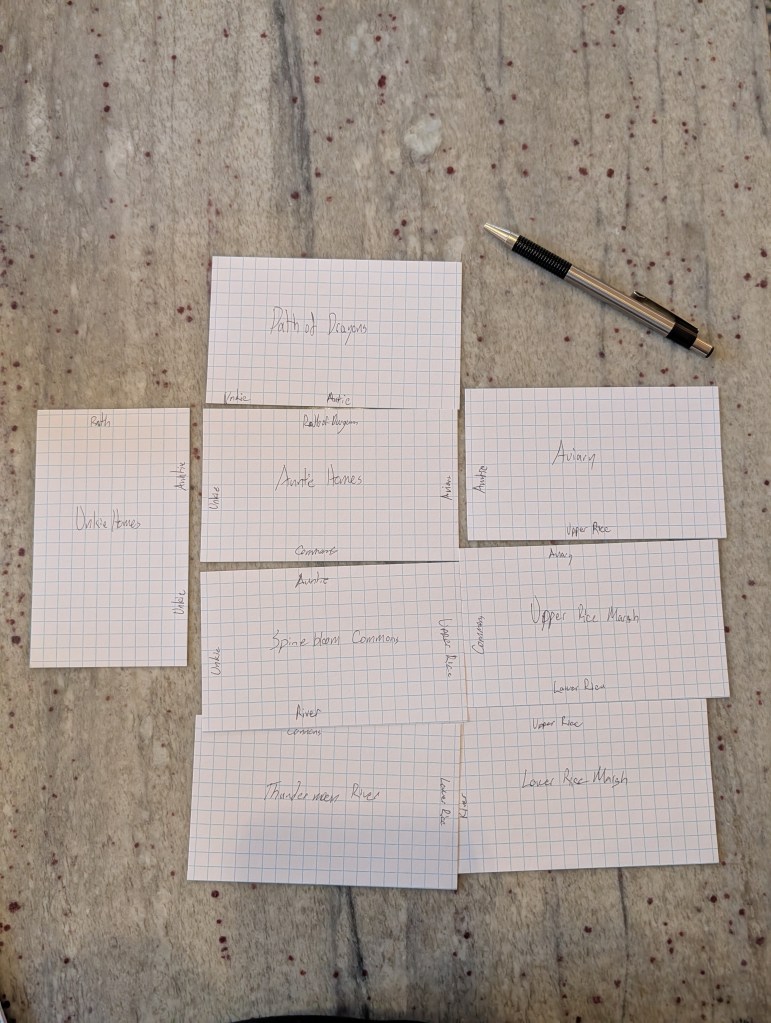
    The image shows a group of seven index cards laid out on a speckled stone surface. Each card features a grid pattern and contains handwritten text in pencil. On the top left, there is a small vertical card with "Path" and "Divide" written along its edges. Adjacent to it on the right is a horizontal card labeled "Path of Dreams" with "Prairie" and "Auntie Houses" along the sides. Below are three more cards: the left card reads "Prairie" and "Auntie Houses," the middle card reads "Spine Bloom Common," and the right card says "Upper Rice Marsh." The bottom row features two horizontal cards, one labeled "Thunder Maker River" and the other, "Lower Rice Marsh." A pen with a black grip lies horizontally above the cards to the right.

    Any player can take a quick glance and know what each location is and what they connect to within the compound. More thorough descriptions in a blog post and in the character’s notes, but these quick notecards reminds us of Spinebloom Farms at the table.

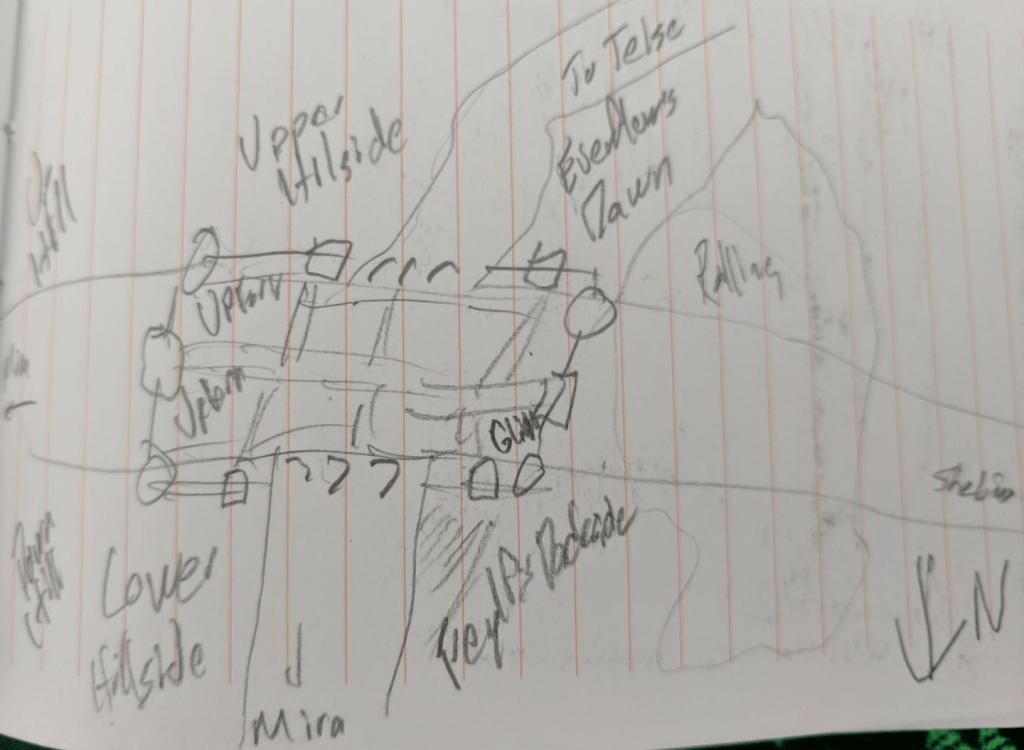
    The image is a hand-drawn sketch on lined notebook paper, depicting a rough map layout with various labeled areas and arrows indicating movement or direction. The map is oriented with "Up Hill" on the left and features several labeled sections, including "Upper Hillside," "Lower Hillside," and "Rolling." There are geometric shapes, such as squares and circles, possibly indicating buildings or points of interest, with some labeled "Upper," "GLAV," and "Verde Breezde." Lines and arrows point toward different labeled areas like "To Telee" and "Esedelens Tavern."

    Fort Ooshar is a bridge-town that turned into a fortress when Sheljar fell to the Necromancer. This quick sketch lays out the neighborhoods of the bridge-town, the gates, the fields and the nearby hills.

    Yes, a better mapmaker would be better. My favorites are Deven Rue and Dyson Logos. I support both via Patreon and use their works in my games.

    But sometimes I want something that is unique to my world. That leaves me with my lack of art. I then build a word map.

    Keys to making a quick word map.

    1. Decide on the central space
    2. Build outward using relative distance to represent a unit of time
    3. Include evocative names, especially when in tight focus
    4. If building a dungeon, point crawl or town having connective tissue — this can be a road, river, or other path
    5. Leave yourself space to build details and add discoveries

    Doing this as a player

    Old school D&D involved at least one player making highly detailed maps. But a word map may be all that’s necessary to prevent your party from getting lost. Using a room-and-halls word map by the player helps represent how the characters think.

    In essence you are channeling the concept of ‘turn left after the big red barn, go over Herringbone Bridge, take the third path’ into a simplistic drawing.

    These are quick, simple and can be done on a 3-by-5 card or as a sketch in something as simple as Paint, Slides, Canva or even in a Spreadsheet (the Six Kingdoms started as a spreadsheet).

    One of the special powers of the word map is that they’re quick. You don’t need to search for anything. It’s a sketch that can be done in a few seconds.

    Whether as a player or a DM this tool can help you understand your fantasy world better than without a map at all.

    Fediverse Reactions