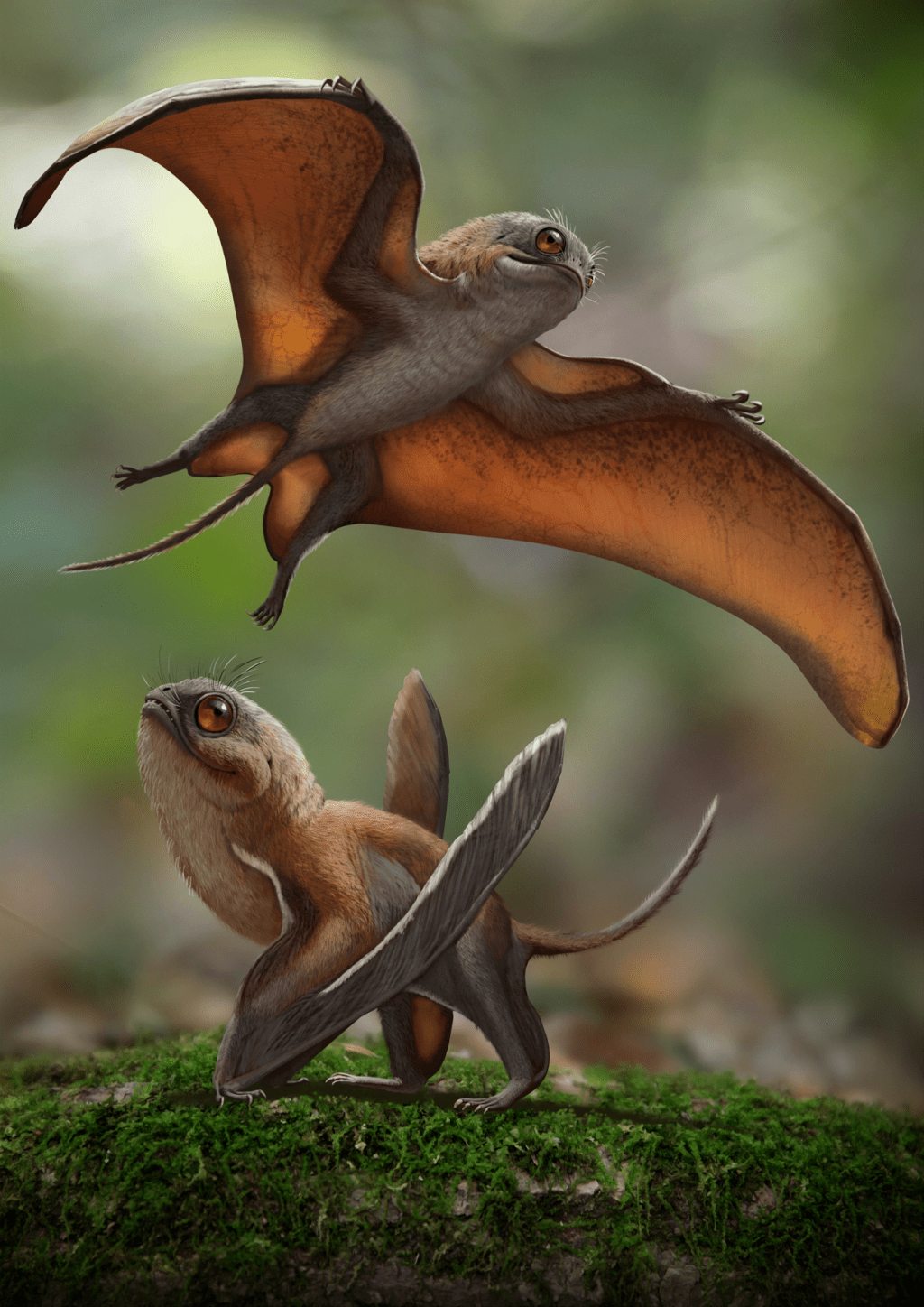
Who didn’t grow up loving dinosaurs? The massive ones were essentially real-life kaiju, and they populate so much Dungeons & Dragons lore. But prehistory also has smaller dinosaurs. These too belong in your D&D games. They make perfect low-level scene setting creatures — even more special they offer player characters new choices for Familiars and Animal Companions.
For stats, use a common bird – the Owl makes the most sense. But Ravens with their mimicry may make sense for you character. A talking tiny ‘saur that flits and floats about to help your wizard? Perfect!
The fact is that the world of inspiration for other beasties to be your best friend. From small carnivores like the Taien Sahul to the Sinomacrops Bondei your companions do not need to be confined to what is in the basic rules.
Dragons of Wales has wonderful art that fits many micro-dragons and ‘saurs.
There’s so much out there. Your world is a fantasy with imps and elves. Your companions can be beasts that are unreal, but power appropriate. Some may even have minor magical powers, slightly shifting their “natural” abilities because if your characters are imbued with magic, shouldn’t their animal companions also be blessed with fantastic abilities?
This set of rules was shared with me by one of my fellow players in Arise & Descend. When they aren’t playing in our near-weekly game they also DM. Recently they noticed a gap in rules for naval warfare. Unlike Ghosts of Saltmarsh, this rule set is for when the party are on other vessels in a fleet or when the story may demand that the group zoom out from the single ship to a small conflict between two fleets.
Dave, not me, my friend, asked if I would share these for feedback. I have edited for copy, but have not playtested these rules.
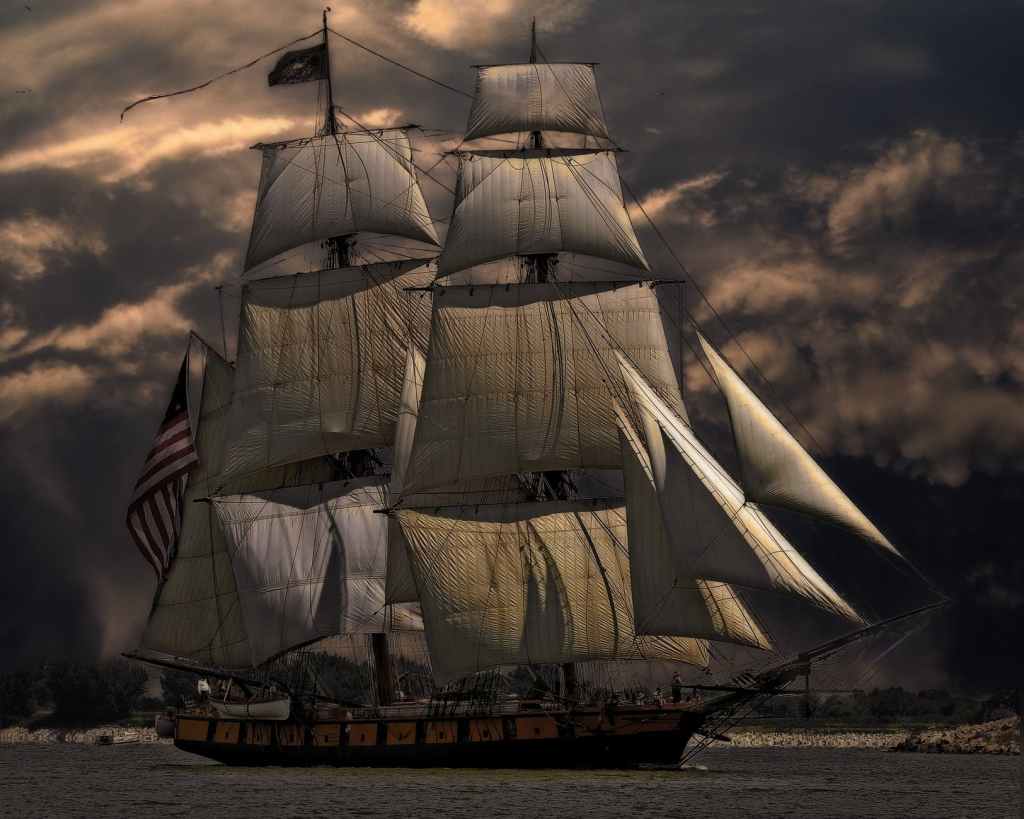
Tall ships on the sea are a great setting for a D&D campaign. The romance of the high seas has driven stories for centuries, and finding adventure there can spice up any campaign.
I have a homebrew campaign running, and in it my players have gotten themselves involved in a civil war on an island nation. Of course, any war like this is going to involve some pretty intense naval battles that I wanted my players to take part in.
However, when I looked into rules and systems for running naval battles, there wasn’t anything that really worked for what I wanted. There is some really fun stuff in the Unearthed Arcana “Of Ships and Sea,” which was refined for the Ghosts of Saltmarsh adventure. Those are great if you’re running a full on naval campaign, with all sorts of rules for maintaining a crew and a ship over long periods of time.
What I couldn’t find, though, is something for a major set piece battle to conclude my players current story arc. So I’ve come up with some rules and a system for running a naval battle that I think could be useful to other DMs looking to change up their player’s experience.
One quick note at the top: This system assumes your PCs will be on the ships, and that the players themselves will make decisions for those ships. Story-wise, this creates a bit of a problem. Either your players are in command of the ships they’re on or your players are controlling an NPC instead of their own character. If you’re like me, and you’ve always wondered why Han Solo was given the rank of General when he’s done nothing to qualify for that rank, the former is a bit hard to swallow. But some players won’t like the way the immersion is broken for the latter. It’s a small wrinkle, but it’s still there, and you might want to address it with your players.
Preparation and Ship Stat Blocks
Rather than playing as a character, each player will take over a ship. Each ship will have a stat block which will include Strength, Dexterity, and Constitution scores. Wisdom, Intelligence, and Charisma scores will all be zero. Ships are also immune to most effects, because they’re… ya know… ships. They are vulnerable to fire attacks.
Strength will relate to the amount of damage each attack can cause. The modifiers for various attacks will be based on this score. You add some flavor to this by giving a bonus to a STR score to a ship with a veteren crew, or a penalty to a ship with lots of novice or pressed sailors who aren’t as motivated.
Dexterity will relate to ship movement and speed. A ship’s base speed is 300 feet, adjusted for 50 feet per Dex modifier. For example: A ship with a 14 Dexterity (+2) should have 400 feet of movement. Ships get -3 to their Dexterity score for each size above large.
Constitution works similarly, but will relate to ship AC and hull HP. The base hull HP is 100, adjusted by 10 HP per Con modifier. For example: A ship with a 16 Constitution should have 130 HP. Ships should get +3 to their Constitution for each size above large.
On top of hull HP, each ship will have a number of crew members. Max crew number should be equal to the length of the ship. A large ship (100 feet long) will have a max crew of 100, whereas a gargantuan ship (200 feet long) will have a max crew of 200.
Max crew is in relation to the number of actions a ship can take. A ship can carry more than its max crew, but cannot take anymore actions because of it. For example, if a ship with a max crew of 100 gains 30 more crew after sinking another ship, putting it’s total at 130, it still can only take four actions.
Ships get one action per 25 crew members per turn, rounded down. For example, a ship with 100 crew members gets four actions per turn. But as they lose crew members, they lose the manpower to do as much. So once they go below 100 crew members, they only get 3 actions. A ship with 25 or fewer crew members cannot attack. They can only change course, make repairs, or tend the wounded.
Note: When building your stat blocks, make sure to pay attention to how each ship is balanced. Perhaps a flagship of the fleet has 200 crew members, meaning it gets eight actions. But such a large ship is ungainly and probably has half the movement of a smaller ship. You might even consider saying changing course on a ship that size takes two actions.
The ship’s actions are as follows
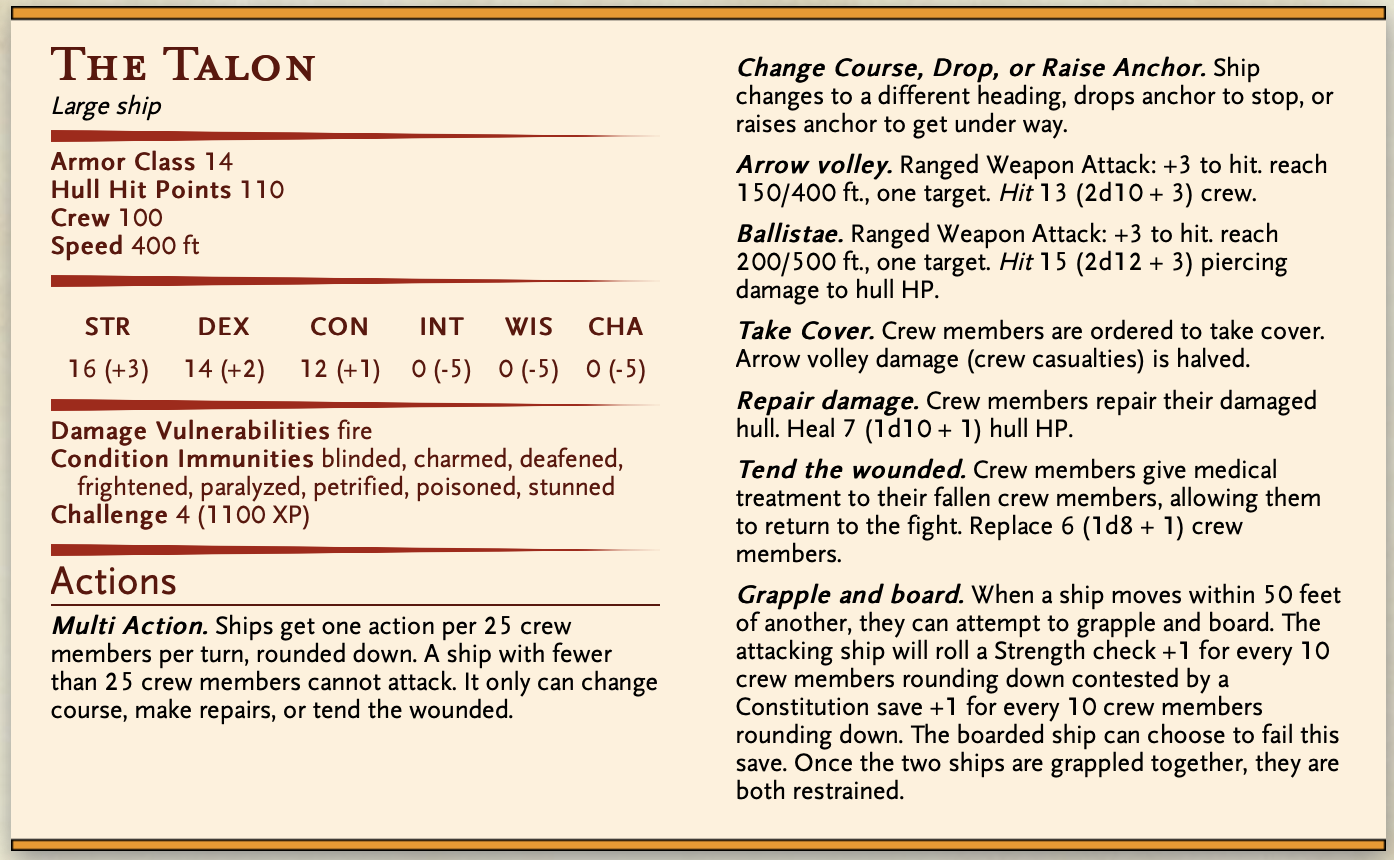
Change Course, Drop, or Raise Anchor: Ship changes to a different heading, drops anchor to stop, or raises anchor to get under way.
Arrow volley – Ranged Weapon Attack: + STR to hit. reach 150/400 ft., one target. Hit 2d10 + STR crew.
Ballistae – Ranged Weapon Attack: + STR to hit. reach 200/500 ft., one target. Hit 2d12 + STR piercing damage to hull HP.
Take Cover – Crew members are ordered to take cover. Arrow volley damage (crew casualties) is halved.
Repair damage – Crew members repair their damaged hull. Heal 1d10 + CON hull HP.
Tend the wounded – Crew members give medical treatment to their fallen crew members, allowing them to return to the fight. Replace 1d8 + CON crew.
Grapple and board – When a ship moves within 50 feet of another, they can attempt to grapple and board. The attacking ship will roll a Strength check +1 for every 10 crew members rounding down contested by a Constitution save +1 for every 10 crew members rounding down. The boarded ship can choose to fail this save. Once the two ships are grappled together, they are both restrained.
After including all the actions, a ship’s stat block should look like this
When a ship’s hull HP drops to zero, the ship sinks. Any ship that enters the space in which a ship sank may pick up the remaining crew members. All crew members will be rescued. If an ally of the sunk ship moves into the space they add all the crew members to their current crew. If an enemy ship moves into that space they add half the crew members to their crew.
This is because sailors don’t want to drown and know that if they try to fight the ship rescuing them, they will be left behind. Half the surviving crew members will join the fight in the new ship because they’re either pressed or sailors for hire therefore sailing for one ship or another is all the same to them. The other half will willingly go below decks as prisoners as that’s preferable to drowning.
Setting up Battle
The battlemap for these engagements should be a grid on primarily open sea, though some islands or a coastline can certainly add some tactical flavor. One square on the grid should equal 50 feet. Since ships are large and slow-moving objects in a large area, each round is equivalent to about 6 minutes. Ships will be sized to 50 foot squares.
Medium = 50 feet long (a large yacht)
Large = 100 feet long (a sloop or a brig)
Huge = 150 feet long (galleon or a schooner)
Gargantuan = 200+ feet long (frigate or Ship of the Line)
Movement
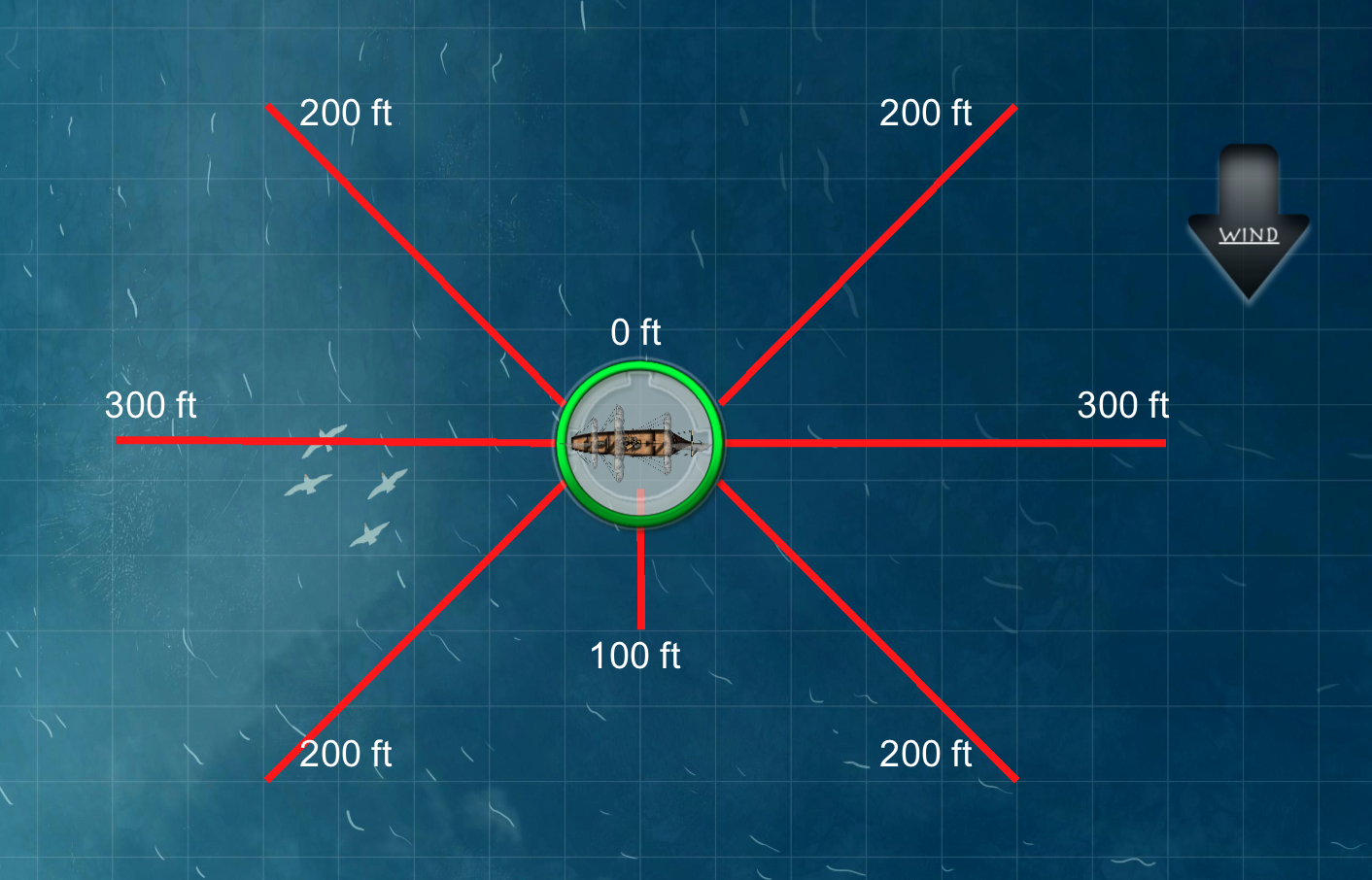
When it comes to sailing ships, the wind is an important factor. A token should be placed on the map to indicate the direction of the wind. A ship may not sail directly into the wind, but can sail at a 45 degree angle towards the wind. Ships sail fastest going perpendicular to the wind, so when they head 90 degrees from the wind, they have full movement. Sailing away from the wind is the slowest, so ships headed the same direction as the wind have one-third speed, rounded to the nearest 50 feet. Quartering the wind (45 degree angle in any direction towards or away from the wind) will give ships two-thirds speed rounded to the nearest 50 feet.
In practice, it should look as follows. The diagram below is for a ship with 300 ft of movement:
It takes one action to change course or drop anchor to stop, but if no action is taken to correct course, the ship will spend it’s full available movement each turn continuing in the same direction.
If a ship’s movement will lead it to hit another ship or some other obstacle, it must use one of its actions to change course or stop.
A ship cannot attack through an allied ship’s space, but must move to a space with a clear shot at its target if it wants to take an attack action.
Boarding Rules
Of course, no high seas adventure would be complete without the chance to board another ship. As an action, a ship within 50 feet of another can take the Grapple and Board actions. If that action is successful, the two ships are tied together and restrained. While two ships are grappled and restrained, they attack each other. Each ship gets one action for each 25 crew members rounding down per round. They can attack or retreat and break free.
Attack: +1 for each 10 crew members rounding down. Damage 1d10+1 for each 10 crew members rounding down.
Retreat: Strength check +1 for every 10 crew members rounding down contested by a Constitution save +1 for every 10 crew members rounding down. The enemy ship can choose to fail this save.
Once one ship has less than half crew, the rest of the crew will surrender. If a ship already is down to half a crew, it will surrender as soon as it is grappled. The winning ship has two options:
Bring captured crew aboard their own ship, adding half of the surviving crew of the captured ship to their crew member total (and taking the other half prisoner), and scuttling the captured ship.
Add half the surviving crew of the captured ship to the crew member total (taking the other half prisoner) then split the new crew total evenly to take command of both ships.
If your entire party is on a single ship, or if more than one of your player’s ships grapple on to a single enemy, you might want to replace this grapple roll with a full encounter and ship-based battlemap.
Adding Your Player’s Traits
Most of these ships will be pretty similar in capabilities. But you can add some variation to these fights by giving bonuses based on your players’ character classes and traits. Story-wise, your player’s heroes will have spent some time with the crew members of their ship teaching them some new skills and talents, which gives those crews certain advantages in battle.
For example, in my campaign, I have four PCs, a Barbarian, a Paladin, a Ranger, and a Wizard. For my final battle, I will have them all on separate ships (which each player will control), and give the following bonuses:
Barbarian: He’s great at close quarters combat so his ship will have advantage on his Grapple and Board Strength check and +5 to his boarding attack.
Paladin: She’s a healer and a tank so her ship will be resistant to Arrow Volley (she loses half the crew members per volley, down to a quarter with the Take Cover action), and she has a +5 to her Tend Wounded action.
Ranger: She’s a classic ranged fighter so her ship will have no range disadvantage for her Arrow Volley or Ballistae actions, and get a +5 to her Arrow Volley damage.
Wizard: He loves to cast Expeditious Retreat on himself and keep moving in battle so his ship will have an extra 150 feet of movement, and he can add fire damage to his Ballistae action.
You should add your own bonuses based on the personality and favorite tactics of your characters.
Final Notes
Another big change you could add to this is adding cannons, assuming you’re playing with the Firearms rules. Since I don’t use them in my campaign, I didn’t think too hard on how they would work. But that doesn’t mean you couldn’t adapt this for Firearms rules.
An optional rule you might use is to add changes to the wind direction. If you want to use this, choose a random interval (or roll for one) such as 3 rounds or 15 minutes (real time), and roll either a d4 or d8 to choose a random change in wind direction.
And finally, this is all pretty complicated, and might be a bit much to throw at a party in one session. I would advise bringing these concepts slowly. For example, put your players on a single ship that you control, and give them each one of the ship’s actions to use as they see fit. Then you can slowly bring in concepts like wind direction, movement, or boarding one at a time, so that by the time your players reach their climactic battle, they are comfortable with all these rules and the tools at their disposal.
Hopefully this can give you a framework to build an epic and memorable naval battle to your campaign. If you have any thoughts or suggestions for improvements to this, I’d love to hear them.
Backgrounds offer so much space to establish who you character was before they entered the stress and conflict of adventuring life. The combination of skill selection, tools, languages, equipment, and personality are a story unto themselves. Jim the Fighter and Nancy the Fighter are similar because of what they do now, but they are also different because of what they did then. Jim was a Noble, raised among the upper class — prim and proper. Nancy was an Urchin, raised on the streets she could sneak among crowds to avoid fights, usually.
And unlike classes, there’s still a lot of uncovered ground. Many tales of what your hero was aren’t encapsulated in the current official backgrounds. The common laborer – the fence builder, the ditch digger, the lumber mover, the stevedore, the longshoreman – is currently ignored.
In trying to fill that niche, while also playing with the idea that utility cantrips are valid parts of a Background, the Remarkable Drudge comes to life. This implementation differs from the earlier version of Seven Backgrounds for Games in the World of the Everflow in one primary way. In the past, the power level of a 1st level character was such that cantrips were folded into the feature. To keep the Drudge and the other Fantastical Backgrounds appropriate to generic D&D worlds the decision is made to replace a single skill and a single tool/language with one cantrip. An evaluation of various Feats available in the Player’s Handbook, Xanathar’s Guide to Everything, and Tasha’s Cauldron of Everything shows the value of a cantrip is slightly more than a skill, but not much more than a skill.
Let’s meet the Remarkable Drudge.
Remarkable Drudge
You are a laborer, often ignored and yet the reason why the community runs as smoothly as it does. You may work the docks, the stockyards, the lumberyards, or lay the planks to improve the dirt roads into wooden streets. Your hard work is the foundation of civilization. But, you’ve also learned, or been born with, a simple spell to make your work a bit easier. The small spell provides utility for you and your coworkers. It may be a hand that can bring you the necessary tool from a distance, the ability to change the shape of earth or water, a way to shout instructions to someone across the field, or a way to light a fire. No matter what your little spells gain you a bit more respect and value than others in your line of work.
Over the years you’ve learned that anything can be a hammer, or a shovel, or well, what you need. When you don’t have the tool or mundane item designed for the job you are usually able to find something else that will work for it – maybe it’s a rock, a brick, a busted up board, or something from someone else’s pack. An imperfect tool is better than no tool at all.
Suggested Characteristics
Drudges are hard workers and celebrate their completed projects with gusto. Frequently working in teams they are warm to those who work hard and cold to those who do not.
For now, use the Personality Traits, Ideals, Bonds, and Flaws of the Folk Hero.
Custom Backgrounds for 5th edition Dungeons & Dragons
Proficiency with farmer’s tools means that you are familiar with the operations of a farm, orchard, vineyard, or other cropland. You are knowledgeable in the typical crops within an area, to include when to plant and harvest them. You also know their market value in most lands.
Components: Farmer’s Tools include a hand trowel, a bag of seeds, a hand rake, a mallet, shears, a bucket, and 10 feet of rope. When near a homestead they would be able to easily borrow a hoe or other full size implements.
Animal Handling: Familiar working in tandem with animals you are able to gain the cooperation from domesticated animals and can give common commands in languages you know.
Nature: You are able to identify the plants and fungus that are consumed as food, often knowing what cultures would typically raise those crops.
Survival: In the wilds you are generally able to locate some produce that provide a minimum level of nourishment.
Forecast: Your understanding of weather patterns is such that you are able to predict the weather for the next few hours. You can sense if there will be a natural change in temperature, wind, precipitation, etc when you have a view of the sky.
Farmer’s Tools
Activity
DC
Identify culture/race raising common crops
10
Give domesticated animal a simple command
15
Weather forecast for the next few hours
15
Identify culture/race raising rare crops
20
Farmer’s Tools are designed to use the tools guidance in Xanathar’s Guide to Everything.
It comes with just a single question. What if? What if I started a new blog? What if we talked about fantasy fiction? What if the stories told coincided with a role-playing game? What if I set myself back two decades and cracked open Dungeons & Dragons again?
Every storyteller needs their tools – a good mug, a notebook (or netbook), a satchel for tokens and memories and a block of cheese maybe some sausage, and a trusty sword.
What if the themes were strong adult subject matter that made for gritty tales of life, death and heroism? What if magic was real? And the gods could talk, but then they stopped?
What if the continents were small, the peoples plentiful and not all human? What if humans didn’t believe in magic because it had disappeared in the only continent they know? How about making it so they are defined more by their cultures than by their phenotype?
Have they stopped believing in themselves, in their gods? Do they see good and evil? How?
Is there slavery? Why? Is there nobility? Can someone be both?
These questions and the cascade of answers start to form more questions. It’s a nearly infinite series of responses. World building, particularly the creation of a world that breathes, is hard. Crafting a world-space that can withstand episodic gaming is harder.
Take chunks at a time. That’s what Full Moon Storytelling will be. Small chunks of content for use in a campaign setting, built around a custom set of rules adapted from 5th edition D&D, but with accompanying tales. If the setting says “The Necromancer is just someone trying to be good” there will be a story that explains how that happened.
As The Worthing Saga took a novella and broke out portions into branch stories, Full Moon Storytelling takes a campaign setting, rule set and crafts micro-fiction, short stories, plotless narrations and episodic adventures within the World of the Everflow.
Maybe that’s where we start, not with a character, but with a story about a fountain that flows from a cliff and diverts along two paths – the Font of Two Paths, the Two-Headed Spring, Pool of Life, Lake of Wonder. The Everflow influences the western peninsula of Kin, is clearly unnatural and …
This is Full Moon Storytelling. It’s a way to share writing, writing process and to think aloud, while words spring forth from tiny digits. Things will happen live, in front of you. Process will be as important as output. Creation is play. Come, join me at this fire under a full moon with clear sky as we look up through trees staring towards the open world of wonder, knowing that behind those trees at your back is whatever reality you can imagine.
You might be able to outrun a Tyrannosaurus Rex, if you’re a peak athlete. Keep note of that. You almost certainly can outmaneuver them. Those are the key takeaways that Wired wants you to have after reading “How to Outrun a Dinosaur.“
There’s a lot more depth in there for a game designer, homebrewer, or storyteller.
Three years ago the biologist Myriam Hirt, who studies animal movement at the German Centre for Biodiversity Research, asked a seemingly simple question: Why is it that the biggest, most powerful animals—the whales, elephants, and rhinoceroses—are not the fastest, while the smallest—the mice, minnows, and millipedes—are some of the slowest? Is the implication that there is an optimum size for speed?
The answer, Hirt found, is yes. If you were designing an animal for speed, that animal should weigh approximately 200 pounds. A bit heavier for a swimmer, and a bit lighter for a flyer.
The speed of 50 might make sense if the primary time in D&D that speed is used is to determine distance running. But it is not. Speed most frequently comes up in combats in six-second chunks of time. Beasts and Monstrosities with high speeds should be the ones that accelerate and burst forward — cheetahs, lions, and Deltadromeus. Even the velociraptor should be average-to-athletic human sprint speed-ish.
That also brings up a key point. A D&D character is supposed to represent, in general, above average athletes. There’s no direct tie-in between Strength, Dexterity, or Constitution and speed. Most races get a 30, some get a 25, rare ones get 35, and even rarer are the few that fly or swim.
There are three things we should do with the knowledge from that Wired article;
Centerline most speeds to better represent reality in non-magical creatures.
Add line in the description that addresses distance traveled by unencumbered and encumbered beasts of burden.
Create a quick and easy way to avoid getting run down by a dinosaur.
That last bullet doesn’t take a lot of work. When in a chase scene use opposed Dexterity checks (Acrobatics or Athletics or Sports could apply) when the chaser is within Reach of the chasee. A success would permit an attack/shove/grapple, if the action economy makes sense. If not, let the chasee take half their movement as a reaction as long as they are able to, and do, significantly change direction.
Any creature that has magical influence on their speed can operate as normal.
Out in the lands of Mehmd mammals and avians are rare. Many of the ecological and domestic niches are instead filled by lizards, amphibians and dinosaur-like creatures. The Taien Sahul are small saurs based on the Velociraptor by Sam Stockdale at ENWorld.
In Mehmd they tend to roam the wilderness, though certain tribes of Unkempt in the South and the Isles use them as companions. When free they roam in packs of 9 or so (3d6). Their Pounce needs quite a distance in order to be used, but when the commit they tend to rush prey quickly. Taien Sahul can survive in deserts, having advantage on CON checks to deal with dehydration.
Taien Sahul – the ripper lizard Small beast, unaligned
Armor Class 13 (natural) Hit Points 3 (1d6) Speed 45 ft., climb 10 ft.
STR 7 (–2) DEX 15 (+2) CON 10 (+0) INT 3 (–4) WIS 14 (+2) CHA 7 (–2)
Skills Perception +4, Stealth +4 Senses passive Perception 14 Languages — Challenge: ½ CR 50 xp
Keen Sight: The raptor has advantage on sight-based Perception (WIS) checks. Pounce: If the raptor moves at least 30 feet straight toward a target and then hits with a claw attack on the same turn, that target must succeed on a DC 10 Strength saving throw or be knocked prone. If a target is prone, the raptor can make one bite attack against it as a bonus action. Pack Tactics: The raptor has advantage on an attack roll against a target if at least one of the raptor’s allies is within 5 feet of the target and isn’t incapacitated.
ACTIONS Multiattack: The raptor makes two melee attacks, usually using both claws unless they’ve pounced. Bite:Melee Weapon Attack: +4 to hit, reach 5 ft., one target. Hit: 1d4+2 piercing damage. Claws:Melee Weapon Attack: +4 to hit, reach 5 ft., one target. Hit: 1d4+2 slashing damage.
There’s a doc open on my computer almost every day. I’m crafting an original D&D adventure for a charity game come spring time. For that adventure I’m researching various tree-monsters. These are common in the fiction which is inspired by and that inspired Dungeons & Dragons. There’s Treants/Ents from Lord of the Rings and the Flying Forest and Sentient Trees of The Magicians.
Within the game there are Awakened Shrubs and Awakened Trees in the Basic Rules. Kobold Press introduces us to a Dragonleaf Tree, in Tome of Beasts for 5e.
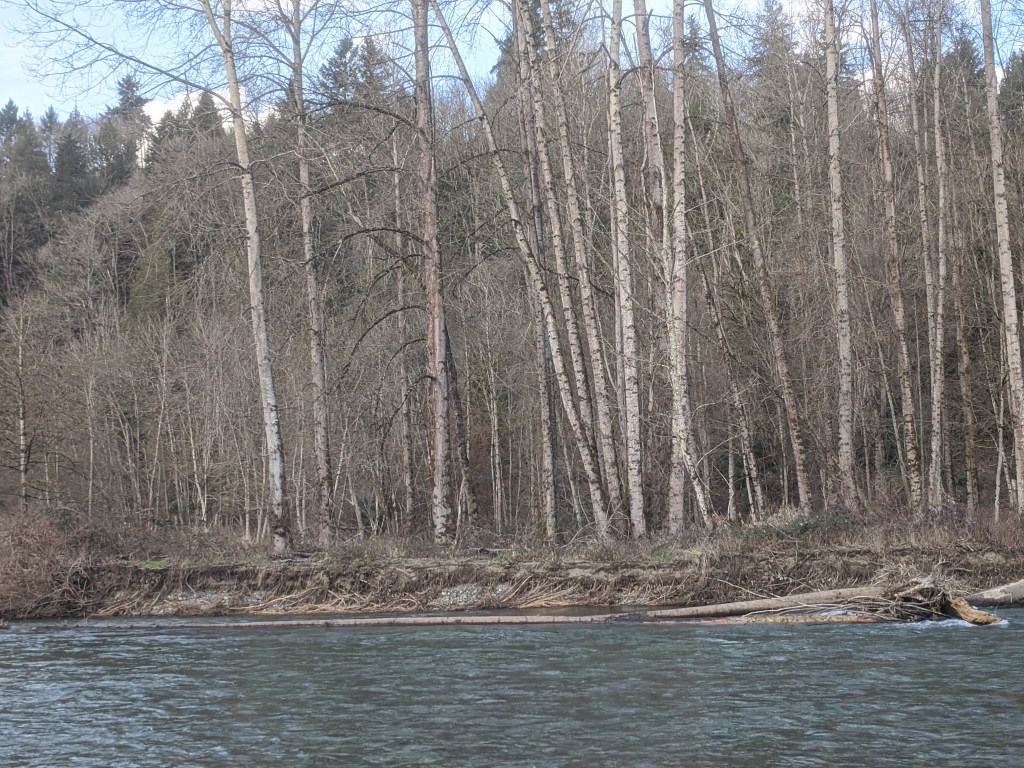
But trees can help us with more than just monsters. They can inspire creative decisions. Look at this stand across the river.
There’s some scarring from disease, or something, several dozen feet up. Take a closer look at that.
Put your “not in the real world” hat on. What if that scaring was from a massive beast? What if the Giant Elk of this realm were so huge that their antlers (looking it up, yes elk have antlers) rubbed off that bark that’s a full 30 feet or so above the river.
What happens when a herd of them walk the river during logging season with their massive legs crushing through or between the barges? Or are these Elk the friends of your woodland dwelling elves, gnomes, goblins, or other races? Are they ridden like elephants?
The answers are up to you.
Trees are also our mighty connection to history.
Did you know the Mountaineer Tree on Five Mile Drive is about as old as William Shakespeare? He was born in 1564, that's over 450 years ago! pic.twitter.com/4vnpx0JH2z
Tolkien recognized that. The age of trees is why the Ents knew so much and also why they’d become peaceful and rooted. When you see so much life pass before you are the little lives so precious?
In the World of the Everflow, the Dragonleaf Trees are ancient, from the era before legends, when Dragons and the other Ken were part of the world of Kin. But they are also dying. A breed that is honored while also being forgotten. They do not seed. They do not spread. There are only twenty or so of these ancient trees left, with almost all of them in the Tree District of Qin.
When a tree is a millennia old what does that signal in your world? Are they like the trees of Solace in Krynn, with homes and workplaces scattered within the branches? Or is it a single tree from the time before time the sits alone in a desert, with roots that stretch hundreds of feet down and branches in the sky that reach to the clouds, a trade post surrounding this tree so big that it creates its own climate?
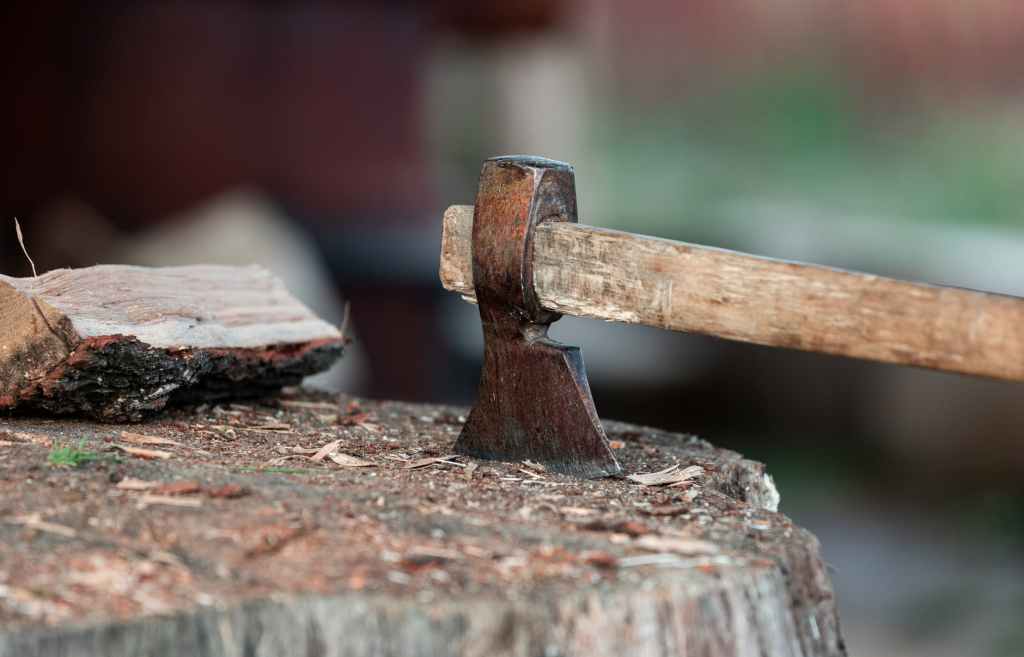
Every journey you take. Every book you read. Every show or movie you watch. Every song you here. Every social media post you scan.
They’re all inspiration for your world, your character, your dreams. Share them with your table.
In general I’m fascinated with Tier 1 play. But there’s another trope that I enjoy — the old-timer who retreated from the life of adventure and war, but who for some reason gets called back into it. They’ve done their best to avoid violence. Instead violence seeks them out. The Fighter: Conscript (final name TBD) has seen things. Things no one else should see.
When they get the call to return to their former life they are no longer concerned with having the best weapon and the best armor. Their wits and experience taught them that any tool can be used for any job.
Design Goals
With this subclass the desire was to build a character who attempted to retire from their life of violence. They still know how to fight, they just stopped. Then, for whatever the cause, they re-entered the realm of warfare. Most often this transition occurs when they are on their farm, in their tavern, working their forge.
They use the weapons at hand and the armor of peasants, and yet fight like the mightiest warriors. The build should support the use of simple weapons and lesser armors with Strength being the primary stat.
Fighter: Conscript
You are a light fighter who once served as a conscript in a standing army or militia. While there you learned the horrors of war. You also learned how to survive. You fought with what was available. Then, the war ended.
Now, you attempt to forget your past. Your neighbors may look at you as a hero or a villain. That depends on your behavior and their opinion of the forces for which you fought. You go about your days, an expert smith, carpenter, vintner, or other artisan.
Recently you’ve felt the call. You are duty bound to pick up your sickle, spear, gambeson, and those well-worn boots again. Your people need help, and you are called to serve.
Tough as Nails
Starting at third level you may choose to use your Strength bonus to Armor Class rather than Dexterity when wearing any light armor or medium armor.
Plowshares into Swords
At third level you gain the following abilities as a reflection of your life after service.
You are proficient in improvised weapons.
When using simple or and improvised weapons you gain +1 to damage on a successful attack.
You gain proficiency in an Artisan’s Tool. If you are already proficient in an Artisan’s Tool you may instead choose to have expertise in that Tool.
When recovering spent ammunition you recover all of it, rather than half.
Wise Beyond Years
At seventh level you gain proficiency in Insight and Intimidation. If you already have one or both of these skills you may take any Wisdom skill instead.
Heart of the Lion
At tenth level you are noted for refusal to give up the fight. You have advantage on saving throws that would impose the following conditions: Charmed, Exhaustion, Frightened, or Stunned.
Rally from Defeat
At 15th level you inspire your teammates. When an ally within 30 feet fails a saving throw that causes damage you may use a reaction to grant them temporary hit points equal to your Fighter level + your Wisdom bonus and they may reroll the saving throw. They must accept the second result. Your ally must be able to hear you. This ability may be used proficiency bonus number of times per long rest.
Bones of Steel
At 18th level your Armor Class is adjusted by both your Strength and your Dexterity Bonus. This bonus is not subjected to a limit based on the armor. When you take damage you may use a reaction to spend a Hit Die to recover Hit Points as if you were taking a short rest.
Animal companions are a tradition in Dungeons & Dragons. The Ranger with a hunting dog; the halfling riding a wolfhound; the dogs guarding the entry to the castle — all have status as tropes. In the standard rules the “Mastiff” represents all of these.
But not every dog is a mass of muscle, teeth, and bark.
Other dogs exist in any fantasy world. These doggos deserve game-love, too. Inspired by Ambrose, the ranger in the game where my dwarven axe-wizard Awf slings spells and swings a battle axe like some kind of D&D version of John Casey, the Herding Dog leapt into existence.
The desire with the Herding Dog was to not have an increase in power for a medium canine, but represent how shepherds, collies, sheepdogs, and other AKC Herding Group members are different from the working group types that the Mastiff embraces.
There’s a small dip in strength, constitution, and damage with the most significant boosts being adding Animal Handling (to embrace the ability to make the herd go places) and Pack Tactics (to represent that herding dogs often work in groups).
The minor changes give this dog a different identity, stay at the same power level, and give Ambrose a friend that isn’t purely a means to biting enemies. We’re using the Herding Dog in our campaign. Let me know if you decide to add it to your own.
Terriers and Retrievers are on my list of potential design additions.