Tag: Dungeons and Dragons

  • Unearthed Arcana expands playable dragons – lacks playable dungeons

    Unearthed Arcana expands playable dragons – lacks playable dungeons

    The latest drop of Unearthed Arcana is another exploration of Draconic options – this time lineages, feats, and spells. Previously the Dungeons & Dragons team explored a Monk: Way of the Ascendant Dragon and a Ranger: Drakewarden.

    The UA also reminds readers that everyone gets a floating +2&+1 or three floating +1 with two languages (Common and one other being recommended).

    This review of UA will include bolded statements of what I like, what I would change, and what I dislike but can’t think of how to fix.

    Dragonborn

    Fifth edition D&D already has two sets of Dragonborn, one in the Player’s Handbook and another in Explorer’s Guide to Wildemount, the Critical Role book. Soon, there will be even more Draconic races, as the new set splits Dragonborn into the subsets – chromatic, metallic, gem. This Unearthed Arcana is also an expansion of Kobold options, as they were previously released in Volo’s Guide to Monsters.

    For all three there is a small boost in power for the breath weapon. This was needed. The PHB Dragonborn breath weapon wasn’t able to be used enough for it to serve a purpose. Having it be an attack replacement grants some great options for martial players after tier 1 play. Rather than 1 bonus action per rest (short or long) the UA version gets proficiency bonus number of uses per long rest. This is true for all three of the new subraces. They also increase damage from 2d6 with tier scaling to 2d8 with tier scaling. I like this.

    Chromatic

    Their breath weapon is a line, which is a switch for green and red dragonborn.

    At third level they gain the ability to be immune to the energy connected to their draconic origin. This ten minutes at once ability can help ahead of a combat encounter, but is also quite handy for some exploration challenges. It’s a fun little bit of story creep too. I like this.

    Metallic

    Their breath weapon is a cone, which is a switch for brass, bronze, and copper.

    Their third level boost is a secondary breath weapon that they can use once per long rest. There is a choice of two effects – a push and or kind of knock-out gas that incapacitates targets. These are both fine.

    Gem

    Previously gem dragonborn weren’t a thing, and as someone who didn’t get into gem dragons, this section is a lot of new ground. The various gems connect to new damage types (force, radiant, psychic, thunder, necrotic). As all gem dragons are connected to psionics these dragonborn gain the ability to telepathically communicate with a single creature within 30′, as long as they share a language. I like this cool boost.

    At third level they get this weird ability to fly by being surrounded by spectral gems. I don’t like this.

    Kobolds

    The kobolds in Volo’s have two negatives – their strength is reduced and they have sunlight sensitivity. The new draconic versions of kobolds suffer from neither of these.

    But the new kobolds also don’t get Grovel, Cower, and Beg (ok), nor do they get Pack Tactics (boo).

    The draconic versions get to choose between three abilities.

    • Advantage on saves versus fear. I like this.
    • A sorcerer cantrip. I like this because it connects them to the Volo’s monster kobold sorcerer.
    • An unarmed strike with the tail. I would change this strike to be finesse, so that dex builds could benefit.

    They also can roar. I don’t like this.

    I would rather the playable kobolds lean into the variant kobolds like dragonshields, winged, and inventors. Further connections between kobold culture and playable kobolds would be wonderful.

    Feats

    The new feats are about granting non-dragonborn a small lean into the powers and abilities of various dragons. This part is cool, but because they are each a different feat that means your character could take each feat once picking up a bit of chromatic, gem, and metallic. I don’t like this.

    Spells

    There are seven new spells that range from level 2 to 7. Four of them are named spells, with three carrying iconic names from the Forgotten Realms and one from Dragonlance. All are available to sorcerers and wizards, with a few being open to other casters.

    Draconic Transformation is a way to be nearly a dragon.

    Fizban’s Platinum Shield is a potent protective spell.

    Flame Stride is a movement boost that burns people as you pass them.

    Icingdeath’s Frost is a cone blast that covers the target in an ice shell.

    Nathair’s Mischief is a cube (yuck) that is rather fey in its behavior.

    Raulothim’s Psychic Lance is a piercing blast that has an interesting known name twist.

    Summon Draconic Spirit follows the new summons from Tasha’s Cauldron of Everything, and is a dragon.

    I like the story behind the spells and hope that Awf can add the Icingdeath’s Frost and Flame Stride to his known spell list. A Bladesinger running through traffic with flaming feat is a great image.

    Overall there’s a lot of flavor in these, but similar to the Fey UA, there is a clear need to fold the earlier releases and this next book together. There are competing versions of Orc, Hobgoblin, Dragonborn, and Kobold now. These would make more sense as subraces in a book, or digital version, that is consolidated with all the changes, shifts, and combinations.

  • Lore Collage: Virtual Play is this weekend

    Lore Collage: Virtual Play is this weekend

    There’s a ton of cool animals in the real world that should be your companion or familiar. Dogs, cats, and owls are tiring. Instead go with tiny little ‘saurs that look like flying porgs.

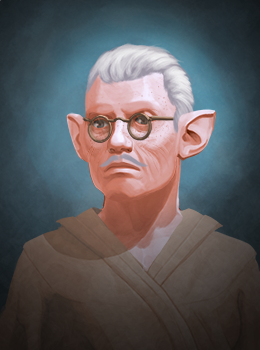
    Embrace NPCs that have bad vision. Orne Willowrush is ready for your campaign. He’s a dude that’s bad at fishing, but likes it. Wearing glasses Willowrush crafts fine barrels and can be found buying his friends beverages.

    Official D&D Product Releases and Reviews

    D&D Virtual Weekend This Weekend

    This weekend’s Virtual Play includes games in Portuguese, but stay tuned as there are often options in Spanish with some other languages also featured. As a reminder these are paid events. The DMs are the primary recipient of those funds. Dragon+ has more about Virtual Play.

    Dungeons & Dragons Movie News

    Paramount is delaying the D&D movie by a year-and-a-half. This is almost certainly due to the continuation of the Covid-19 pandemic and how crowded the big-budget movie release schedule will be in 2022. The wide slate of TV shows has no announced delays. Derek Kolstad’s project is the only one with an announced showrunner at this time.

    Regé-Jean Page was nearly in an upcoming Superman project. One of the hottest (in demand) actors in Hollywood these days Page will be in the D&D movie. He won’t be in that Superman project, because some idiot seemed to think that Superman can’t be related to a Black man.d

    He’s also a popular pick as the next James Bond. Dude is in demand. He’s in D&D.

    eOne is also launching a gob of reality programming, none are D&D, yet.

    Van Richten’s Guide to Ravenloft Previews

    The latest Lore You Should Know is all about one of the reworked Domains of Dread.

    Third-Party Products

    Venture Maidens is the latest podcast to release their world as a sourcebook. Their DM is also the head of the book project, and that bodes quite well for the quality of the product. Celeste Conowitch has credits with Wizards of the Coast, Kobold Press, and is now with 2C Gaming. The Kickstarter is up through May 10.

    Solasta is nearly a ‘finished’ product. The D&D OGL video game is leaving early access. Solasta is more focused on the 5e D&D rules than the official games.

    Tribality reviews the upcoming character and scenery art generator Neverending. Finding a tool that you can use, that helps non-artists changes your table atmosphere. Toss those creators some money, because they earned it.

    Advice for Dungeons & Dragons Payers and DMs

    Every week Alphastream and Shawn Merwin go deeper and deeper into what Tasha’s Cauldron of Everything empowers players to do. Their podcast might be the only digital enterprise still talking about the dramatic story and rules expansion from last fall.

    Want to add the themes from Phillip K. Dick’s stories to your games? Screen Rant guides you through mashing up sci-fi with your fantasy.

    Game Rant goes over how to use Feats in 5th edition. For me, in my world, I enjoy granting Feats at first level. But I drop the power-gamey ones from the list of options. There is a lot of story creep available in 80% of Feats.

    Playing D&D in Civic Spaces During the Pandemic

    Whereas most libraries are hosting games to play, at the Topeka Library the focus is on teaching people how to play the game. They have a monthly series that focuses on specific aspects of play. Up next is Character and Combat.

    The Johnston Public Library, in upstate New York, is reopening to the public, and continuing virtual D&D for teens in two age groups.

    Saratoga Springs Public Library, in Florida, is hosting virtual D&D.

    Dungeons & Dragons is Mainstream Now

    D&D character art can be more than a hobby these days. | Fan art feature: Leilani Perriera and D&D – Savannah College of Art and Design Connector

    The ability to become a hero, no matter what holds you back in real life, is part of the powerful call of roleplaying. | Dungeons and Dragons Helps Me Live Without Duchenne for a Moment – Muscular Dystrophy News

    Other Geek Stuff

    If you missed Coyote & Crow’s Kickstarter, they have a late backer option now.

    We live in the future – and in the future there are lightsabers that work.

    Polygon’s board game shopping guide is a great reminder that Summer should involve games with friends on a deck or patio.

    The City of Dragons is celebrating the birth of Erasmus. Downtown Renton, the home of Wizards of the Coast, is celebrating hatchday on April 17.

    Shadow and Bone is the latest fantasy series to get a TV deal. Go behind the scenes in this story that discusses how the books were translated to screen.

    Washington State is flooded with RPG designers, don’t ignore the talent in the board game side of our hobby.

    The best board games of 2021, according to American designers.

    As Always, Maps

    Add fjords and mountains carved by gods to your game.

    This map has an old school styling to it. I want to move to this town.

  • Orne Willowrush – an NPC for your adventuring needs

    Orne Willowrush – an NPC for your adventuring needs

    Opening up an NPC creation series with a character I should have made ages ago – one with glasses. If you don’t know me, I’m basically finger-blind. Without glasses or contacts I am unable to count how many fingers you would be holding up if you are more than a couple feet away from me. And yet, I never have played a character or NPC with glasses. I actively avoided it.

    After reading Deven Rue’s recent post about embracing characters with vision impairment or blindness I decided that needed to change.

    Heading over to DM Heroes, I hit the random button until it turned up a character with glasses. Then, it was about creating a character with an interesting background who was not a quest giver. Because as Rue says, “Make us non-quest related. Just people in your world. Living. Existing.”

    Meet Orne Willowrush

    This image shows the bust of an older male halfling with somewhat receding grey hair that is swept back. He wears glasses and has a thin mustache. His clothing looks like it could be a rough robe or shawl shirt. It is light brown.
    Created using DM Heroes one of my favorite NPC art tools

    First up is a Simple Index Card Version of an NPC. These are designed so with just a few words you can know who an NPC is from a basic description of appearance, to some basic motivations. In Willowrush’s case he’s a former soldier who once fought for the realm, but now works as a cooper. In my deep belief that everyone in your D&D world should have a hobby he is a fisher. He is not skilled in fishing though. He just enjoys doing the calmness of fishing with his friends. He can get dreamy about his past, but also doesn’t like to talk about it. Orne recently lost his beaver – Tryn. He’s just newly bonded with an otter – Orla.

    Orne’s best friend is a librarian named Incirion Vadu, a goblin. You can often find them at the river together, ignoring work. Incirion knows Mending, and will often have an extra pair of glasses for Orne.

    Orne Willowrush

    Dexterity, Strength +1Stout Halfling, Conscript Fighter (3)
    Constitution, Charisma -1Cooper | Woodworking Tools, Fisher’s Tools
    Padded Armor, Common Clothes, Glasses, OtterWinestar, Lemplet Place
    Staff, adzeWants to relive past glories
    Modest lifestyle, and will buy you a glass of wineDaydreamer, Reticent, Recently lost his beaver companion
    An otter peers out from a small cave.
    Photo by David Frazer on Pexels.com

    If you want him built as a fully playable character I’ve added him to my DnDBeyond Community Characters campaign. Orne on Beyond is a Scout rather than a Conscript, so as to not introduce new rules.

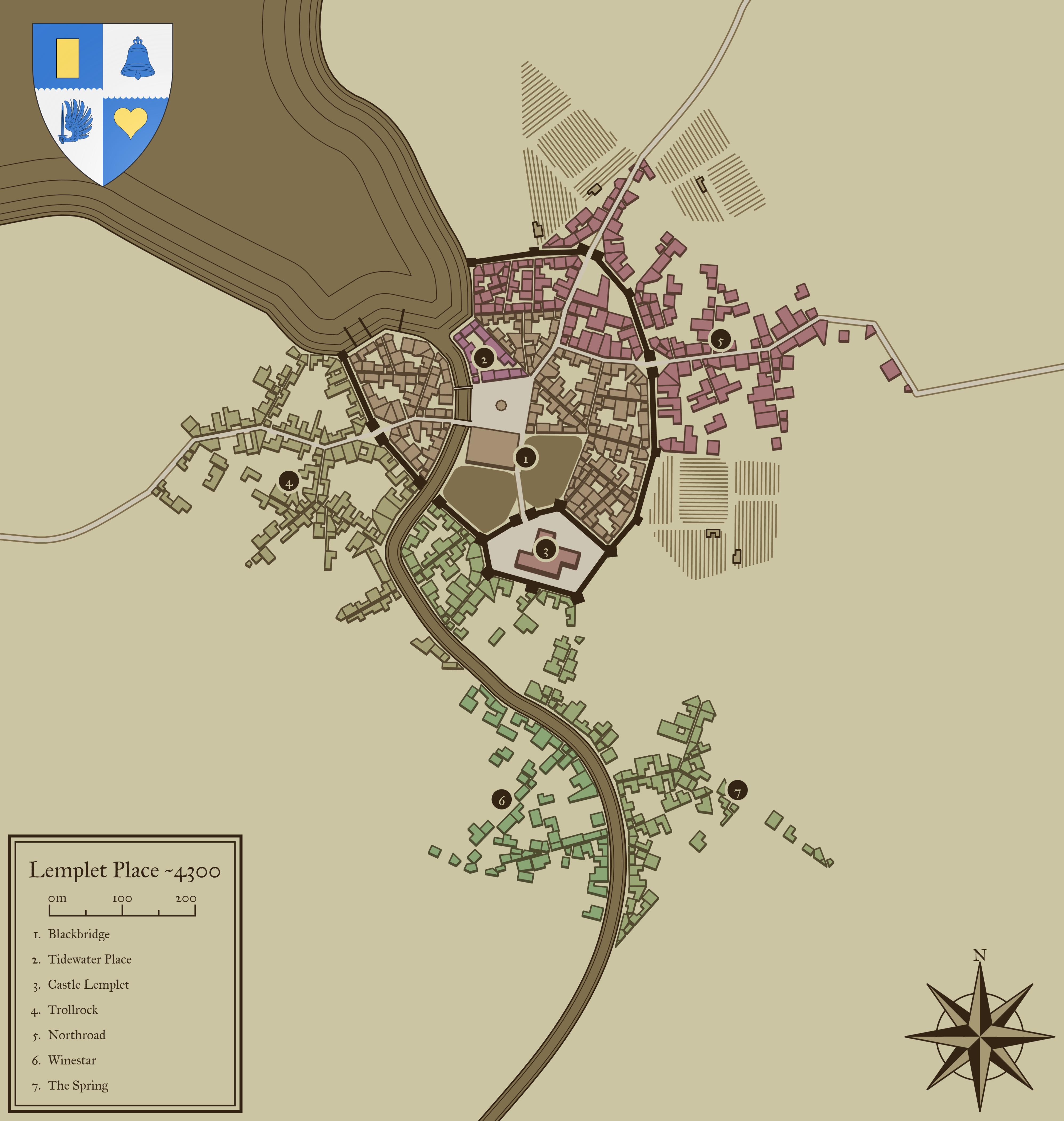
    Winestar, Lemplet Place

    A map of Lemplet Place, a fictitious town. The river runs from south to north into a bay. There are seven neighborhoods with three being inside or somewhat inside the walls. Main roads leave to the east, the west, and the northwest. There is a castle, a green, and a large temple.
    Built using the Medieval Fantasy City Generator

    Winestar is a neighborhood built along the rolling ridge of the Lemplet River. It’s a mix of farmsteads with a few crafts to support their needs. Most of the good produced enter the walled part of the city via barge or float. The Spring, across the river, is up on a cliffside, and is generally more wealthy than Winestar, especially those parts that are next to the castle walls. Within Winestar you will, of course, find many small vintners, with most of the homes at least having a passing hobby of wine creation. In general, Winestar produces luxury goods whereas Northroad is sustenance farming.

    Lemplet Place is a city of about 4,300 people.

    1. Blackbridge – known for the eponymous bridge, the downtown of Lemplet Place
    2. Tidewater Place – the slums, used to flood with high tide
    3. Castle Lemplet – originally built as a exterior castle, the city has grown around it
    4. Trollrock – the northern block surrounds a huge rock hill with a cave inside, no trolls though
    5. Northroad – sustenance farming
    6. Winestar – grapevines, orchards
    7. The Spring – for the wealthy that moved out of the city

    How will you use Orne Willowrush in your campaign?

    Fediverse Reactions
  • Lore Collage: D&D Virtual Weekend signups this week

    Lore Collage: D&D Virtual Weekend signups this week

    Before we get into the gossip around Page, Adventurer’s League, great D&D podcasts, and a video game where you can play D&D inside the game, I’m going to remind you that travel distances in D&D should be about time, not distance. Use leagues, use daylong journeys, and add to the immersive and simplified feel of 5th edition.

    If you need to run a naval skirmish with 2-6 ships on each side, here’s a rule set for you.

    Official D&D Product Releases and Reviews

    D&D Virtual Weekend Signups Start This Week

    On Virtual Weekends you can play in Adventurer’s League, or in custom worlds from professional DMs.

    Sign ups are live Tuesday. The event runs from April 16 to April 18.

    Dungeons & Dragons Movie News

    With Regé-Jean Page leaving Bridgerton, maybe for good, the Hollywood gossip and news services are all over where you can catch him next – in Dungeons & Dragons.

    • Variety
    • Insider
    • Like, it was everywhere. Snagging a rising star like that will get eOne and Paramount much attention.

    Candlekeep Mysteries Reviews

    Games Radar’s deep dive into the mini-adventure compilation.

    Music to accompany the Caponic Being adventure.

    Third-Party Products

    Heroes’ Feast continues to surprise and delight book reviewers around the world, to include my hometown paper, the Seattle Times.

    D&D Podcasts Besides Critical Role

    Almost everyone knows about Critical Role, but there’s many other Actual Plays and edited performances that deserve your earholes.

    Tech Radar has a Top 8. I love Not Another D&D Podcast which they have 5th. NADDPod also gets a plug at Pop.Inquirer.

    The Adventure Zone is running into issues of popularity – how big can your family be?

    Advice for Dungeons & Dragons Payers and DMs

    Think DM is correct. As designed the Haversack is an underperforming magic item.

    Deven Rue, a mapmaker you should be following already, has advice on how to create authentic characters that are blind or visually impaired.

    POC Gamer goes behind the curtain on how to design a short adventure.

    Playing D&D in Civic Spaces During the Pandemic

    Over in Tarrytown, New Jersey, a youth organization launched to keep kids creative during the covid-19 pandemic. They are, of course, using D&D as one of those paths.

    The Northland Public Library in Pittsburg is hosting a D&D game based around a sheep getting loose. A stellar start to a campaign that I’m going to borrow.

    The Klamath Oregon library system is up to three teen D&D sessions a week now.

    Over in Maryland, the Calvert County Library is the rare library running D&D for adults.

    All Ada public libraries in Idaho are hosting D&D these days.

    Dungeons & Dragons is Mainstream Now

    Local multiplayer video games, that’s ones where you are on the same couch using the same console and screen, are increasing popular during the pandemic. Like Dungeons & Dragons (mentioned in story) these games give you social interaction when it’s difficult. | It Takes Two proves that couch co-op games are back for good – Wired

    Stranger Things isn’t the only fiction world where D&D is featured. There’s a new book out where the D&D group is the star. | Book Talk: Cleveland author writes novel about LGBTQ role-playing club – Akron Beacon Journal

    You turn on your video game, take over that character, and then meet another character. You then start to play D&D with them?!?! Yeah, that’s meta, but it’s happening. | I Can’t Wait To Play Dungeons And Dragons With Steph Again In Life Is Strange: True Colors – The Gamer

    Financial advisors are bullish on Hasbro these days. The April 27th earnings call is of interest to them, primarily because of Wizards of the Coast. | 3 Reasons Hasbro Stock Is a Buy – The Motley Fool

    Other Geek Stuff

    The latest issue of Strange Horizons is Palestinian sci-fi, which combines two of my biggest passions in the world. If there was a story about soccer it would hit my trifecta.

    Russian TV made Lord of the Rings before Peter Jackson did. It’s a trip. Re-watch the Jackson version in theaters when it’s safe. That experience is worth reliving.

    Just because you don’t have a Rogue doesn’t mean that you can’t do what rogues do.

    New York City Comicon is going to allow people in attendance in October. They will also have virtual events.

    As Always, Maps

    Need a city or dungeon on the spur of the moment? Use your favorite shopping mall.

    How would your PCs solve the problem of a boat blocking the main shipping canal in your world?

  • Naval Skirmishes and Battles for 5e D&D

    Naval Skirmishes and Battles for 5e D&D

    This set of rules was shared with me by one of my fellow players in Arise & Descend. When they aren’t playing in our near-weekly game they also DM. Recently they noticed a gap in rules for naval warfare. Unlike Ghosts of Saltmarsh, this rule set is for when the party are on other vessels in a fleet or when the story may demand that the group zoom out from the single ship to a small conflict between two fleets.

    Dave, not me, my friend, asked if I would share these for feedback. I have edited for copy, but have not playtested these rules.


    On Ships and Naval Battles

    A Naval System for 5th edition Dungeons & Dragons

    By Dave

    Tall ships on the sea are a great setting for a D&D campaign. The romance of the high seas has driven stories for centuries, and finding adventure there can spice up any campaign.

    I have a homebrew campaign running, and in it my players have gotten themselves involved in a civil war on an island nation. Of course, any war like this is going to involve some pretty intense naval battles that I wanted my players to take part in.

    However, when I looked into rules and systems for running naval battles, there wasn’t anything that really worked for what I wanted. There is some really fun stuff in the Unearthed Arcana “Of Ships and Sea,” which was refined for the Ghosts of Saltmarsh adventure. Those are great if you’re running a full on naval campaign, with all sorts of rules for maintaining a crew and a ship over long periods of time. 

    What I couldn’t find, though, is something for a major set piece battle to conclude my players current story arc. So I’ve come up with some rules and a system for running a naval battle that I think could be useful to other DMs looking to change up their player’s experience.

    One quick note at the top: This system assumes your PCs will be on the ships, and that the players themselves will make decisions for those ships. Story-wise, this creates a bit of a problem. Either your players are in command of the ships they’re on or your players are controlling an NPC instead of their own character. If you’re like me, and you’ve always wondered why Han Solo was given the rank of General when he’s done nothing to qualify for that rank, the former is a bit hard to swallow. But some players won’t like the way the immersion is broken for the latter. It’s a small wrinkle, but it’s still there, and you might want to address it with your players.

    Preparation and Ship Stat Blocks

    Rather than playing as a character, each player will take over a ship. Each ship will have a stat block which will include Strength, Dexterity, and Constitution scores. Wisdom, Intelligence, and Charisma scores will all be zero. Ships are also immune to most effects, because they’re… ya know… ships. They are vulnerable to fire attacks. 

    Strength will relate to the amount of damage each attack can cause. The modifiers for various attacks will be based on this score. You add some flavor to this by giving a bonus to a STR score to a ship with a veteren crew, or a penalty to a ship with lots of novice or pressed sailors who aren’t as motivated.

    Dexterity will relate to ship movement and speed. A ship’s base speed is 300 feet, adjusted for 50 feet per Dex modifier. For example: A ship with a 14 Dexterity (+2) should have 400 feet of movement. Ships get -3 to their Dexterity score for each size above large.

    Constitution works similarly, but will relate to ship AC and hull HP. The base hull HP is 100, adjusted by 10 HP per Con modifier. For example: A ship with a 16 Constitution should have 130 HP. Ships should get +3 to their Constitution for each size above large.

    On top of hull HP, each ship will have a number of crew members. Max crew number should be equal to the length of the ship. A large ship (100 feet long) will have a max crew of 100, whereas a gargantuan ship (200 feet long) will have a max crew of 200.

    Max crew is in relation to the number of actions a ship can take.  A ship can carry more than its max crew, but cannot take anymore actions because of it.  For example, if a ship with a max crew of 100 gains 30 more crew after sinking another ship, putting it’s total at 130, it still can only take four actions.   

    Ships get one action per 25 crew members per turn, rounded down. For example, a ship with 100 crew members gets four actions per turn. But as they lose crew members, they lose the manpower to do as much. So once they go below 100 crew members, they only get 3 actions. A ship with 25 or fewer crew members cannot attack. They can only change course, make repairs, or tend the wounded.  

    • Note: When building your stat blocks, make sure to pay attention to how each ship is balanced. Perhaps a flagship of the fleet has 200 crew members, meaning it gets eight actions. But such a large ship is ungainly and probably has half the movement of a smaller ship. You might even consider saying changing course on a ship that size takes two actions.

    The ship’s actions are as follows

    • Change Course, Drop, or Raise Anchor:  Ship changes to a different heading, drops anchor to stop, or raises anchor to get under way. 
    • Arrow volley – Ranged Weapon Attack: + STR to hit. reach 150/400 ft., one target. Hit 2d10 + STR crew. 
    • Ballistae – Ranged Weapon Attack: + STR to hit. reach 200/500 ft., one target. Hit 2d12 + STR piercing damage to hull HP.
    • Take Cover – Crew members are ordered to take cover. Arrow volley damage (crew casualties) is halved.
    • Repair damage – Crew members repair their damaged hull. Heal 1d10 + CON hull HP.
    • Tend the wounded – Crew members give medical treatment to their fallen crew members, allowing them to return to the fight. Replace 1d8 + CON crew.
    • Grapple and board – When a ship moves within 50 feet of another, they can attempt to grapple and board. The attacking ship will roll a Strength check +1 for every 10 crew members rounding down contested by a Constitution save +1 for every 10 crew members rounding down. The boarded ship can choose to fail this save. Once the two ships are grappled together, they are both restrained.

    After including all the actions, a ship’s stat block should look like this

    When a ship’s hull HP drops to zero, the ship sinks. Any ship that enters the space in which a ship sank may pick up the remaining crew members. All crew members will be rescued. If an ally of the sunk ship moves into the space they add all the crew members to their current crew. If an enemy ship moves into that space they add half the crew members to their crew. 

    This is because sailors don’t want to drown and know that if they try to fight the ship rescuing them, they will be left behind. Half the surviving crew members will join the fight in the new ship because they’re either pressed or sailors for hire therefore sailing for one ship or another is all the same to them. The other half will willingly go below decks as prisoners as that’s preferable to drowning.


    Setting up Battle

    The battlemap for these engagements should be a grid on primarily open sea, though some islands or a coastline can certainly add some tactical flavor. One square on the grid should equal 50 feet. Since ships are large and slow-moving objects in a large area, each round is equivalent to about 6 minutes. Ships will be sized to 50 foot squares.

    • Medium = 50 feet long (a large yacht)
    • Large = 100 feet long (a sloop or a brig)
    • Huge = 150 feet long (galleon or a schooner)
    • Gargantuan = 200+ feet long (frigate or Ship of the Line)

    Movement

    When it comes to sailing ships, the wind is an important factor. A token should be placed on the map to indicate the direction of the wind. A ship may not sail directly into the wind, but can sail at a 45 degree angle towards the wind. Ships sail fastest going perpendicular to the wind, so when they head 90 degrees from the wind, they have full movement. Sailing away from the wind is the slowest, so ships headed the same direction as the wind have one-third speed, rounded to the nearest 50 feet. Quartering the wind (45 degree angle in any direction towards or away from the wind) will give ships two-thirds speed rounded to the nearest 50 feet.

    In practice, it should look as follows. The diagram below is for a ship with 300 ft of movement:

    It takes one action to change course or drop anchor to stop, but if no action is taken to correct course, the ship will spend it’s full available movement each turn continuing in the same direction.

    If a ship’s movement will lead it to hit another ship or some other obstacle, it must use one of its actions to change course or stop.

    A ship cannot attack through an allied ship’s space, but must move to a space with a clear shot at its target if it wants to take an attack action.

    Boarding Rules

    Of course, no high seas adventure would be complete without the chance to board another ship. As an action, a ship within 50 feet of another can take the Grapple and Board actions. If that action is successful, the two ships are tied together and restrained. While two ships are grappled and restrained, they attack each other. Each ship gets one action for each 25 crew members rounding down per round.  They can attack or retreat and break free. 

    • Attack: +1 for each 10 crew members rounding down. Damage 1d10+1 for each 10 crew members rounding down.
    • Retreat: Strength check +1 for every 10 crew members rounding down contested by a Constitution save +1 for every 10 crew members rounding down. The enemy ship can choose to fail this save.

    Once one ship has less than half crew, the rest of the crew will surrender. If a ship already is down to half a crew, it will surrender as soon as it is grappled. The winning ship has two options:

    • Bring captured crew aboard their own ship, adding half of the surviving crew of the captured ship to their crew member total (and taking the other half prisoner), and scuttling the captured ship.
    • Add half the surviving crew of the captured ship to the crew member total (taking the other half prisoner) then split the new crew total evenly to take command of both ships.

    If your entire party is on a single ship, or if more than one of your player’s ships grapple on to a single enemy, you might want to replace this grapple roll with a full encounter and ship-based battlemap.

    Adding Your Player’s Traits

    Most of these ships will be pretty similar in capabilities. But you can add some variation to these fights by giving bonuses based on your players’ character classes and traits. Story-wise, your player’s heroes will have spent some time with the crew members of their ship teaching them some new skills and talents, which gives those crews certain advantages in battle.

    For example, in my campaign, I have four PCs, a Barbarian, a Paladin, a Ranger, and a Wizard. For my final battle, I will have them all on separate ships (which each player will control), and give the following bonuses:

    • Barbarian: He’s great at close quarters combat so his ship will have advantage on his Grapple and Board Strength check and +5 to his boarding attack.
    • Paladin: She’s a healer and a tank so her ship will be resistant to Arrow Volley (she loses half the crew members per volley, down to a quarter with the Take Cover action), and she has a +5 to her Tend Wounded action.
    • Ranger: She’s a classic ranged fighter so her ship will have no range disadvantage for her Arrow Volley or Ballistae actions, and get a +5 to her Arrow Volley damage.
    • Wizard: He loves to cast Expeditious Retreat on himself and keep moving in battle so his ship will have an extra 150 feet of movement, and he can add fire damage to his Ballistae action.

    You should add your own bonuses based on the personality and favorite tactics of your characters. 

    Final Notes

    Another big change you could add to this is adding cannons, assuming you’re playing with the Firearms rules. Since I don’t use them in my campaign, I didn’t think too hard on how they would work. But that doesn’t mean you couldn’t adapt this for Firearms rules.

    An optional rule you might use is to add changes to the wind direction.  If you want to use this, choose a random interval (or roll for one) such as 3 rounds or 15 minutes (real time), and roll either a d4 or d8 to choose a random change in wind direction.

    And finally, this is all pretty complicated, and might be a bit much to throw at a party in one session. I would advise bringing these concepts slowly. For example, put your players on a single ship that you control, and give them each one of the ship’s actions to use as they see fit. Then you can slowly bring in concepts like wind direction, movement, or boarding one at a time, so that by the time your players reach their climactic battle, they are comfortable with all these rules and the tools at their disposal.

    Hopefully this can give you a framework to build an epic and memorable naval battle to your campaign. If you have any thoughts or suggestions for improvements to this, I’d love to hear them.