One of the absolute amazing powers of Dungeons & Dragons is the ability to tell stories that you couldn’t tell by yourself. Whether you play at a table of 2, or 4, or 8 there will be ideas brought forth that surprise you. Communal storytelling by the DM and players creates options and opportunities that a single author would miss or gloss over.
The additional experiences and diversity of the group interact to create tales of wonder. This is a large part of why I enjoy D&D. Through the power of social media there is an opportunity to mimic this by using polls to guide the character creation process.
Asking others to help build a character gets you out of potential ruts and tropes, or embeds those tropes even further into your future PC or NPC. In the end of the process you come up with a character that is amalgam of not just your own experiences, but of the near infinite stories available via social media.
The full creation process can be viewed in the Twitter thread.
Tatiana started with “this character uses a sling.” While everything built off that, rather than build through the explicit creation system as outlined in the Player’s Handbook, instead the prompts were chosen in a more narrative fashion.
The various choices informed attribute distribution, race, class, background, spells, and skills. Riverhopper was built in order to create an Adventurer’s League character in case someone wanted to jump onto the Yawning Portal and just play.
Using personality seeds for the choices meant that we have a prankster who left their hometown looking for stories to tell (Bard) and gold to acquire (Criminal). You can find her in alehouses taking out some pocket cheese as she plans her next bit of mischief.
She’s not great remembering names, even though she’ll always remember you – just be something not a name. She keeps a small notebook and quill with her, constantly taking notes in a delicate hand in code that most do not know.
In combat Tatiana is likely to use Heroism and Bardic Inspiration to help her allies as she lurks back slinging stones at the enemy. Prone to rash decisions, Riverhopper will use a trick of the mind or hand to get herself out of trouble. The loveable Halfling is best in a support and face role.
Everyone needs a good pick-me-up. The studious wizard, the pickpocket, the noble, and the farmer all can take advantage of the boost of energy whether the beans are from far-off mountains or nearby hills. Adventurers aren’t on standard sleep schedules so the not-quite-magical bean roaster and brewer is quite helpful in the wildes, caverns, dungeons, and seas of any world.
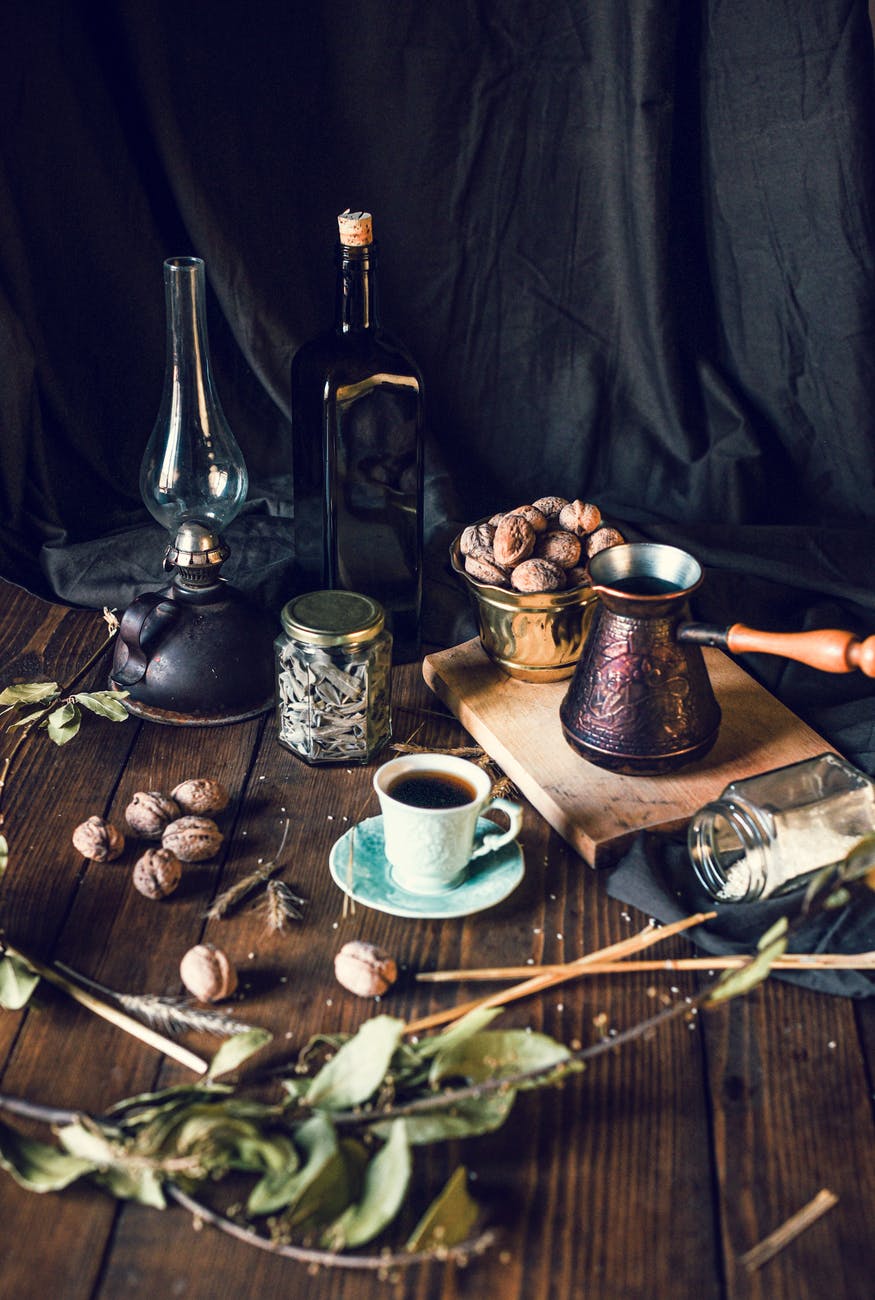
Components: Coffee gear includes a pound of beans, 2 small spoons, 2 small cups, mortar & pestle or small hand grinder, an ibrik or small moka pot, a small rotisserie or pan roaster (can be powered by fire or certain cantrips), spices and sugar.
Those cantrips that could power the two styles of roasters are: Control Flames, Create Bonfire, Druidcraft, Fire Bolt, Prestidigitation, and Produce Flame.
In most D&D worlds a pound of green coffee should be priced around 3 gp and available similar to how cloves are in your worldspace.
Insight: As someone that is in tune with the life of a cafe, coffeehouse, or court you can read the emotions and even pick up rumors spreading through the crowd.
Example: As the party enters a bar or coffeehouse there is a buzz of conversation. Volgat Emberstone recognizes the conversations, listening in on the chatter around him. The player tells the DM that they are attempting to learn if Crylia the Goblin has been in the area.Per Xanathar’s Guide, as this Insight check is aided by the Tool, the player rolls with Advantage if they are proficient in both Insight and Coffee Gear, using the higher modifier of the two. If they are only proficient in only one of the two, they would use just the higher modifier rolling a single d20.
Nature: Familiar with the origins of the glorious bean, you have learned about various locales where coffee is grown.
Example: Marching through Windy Heaven Ridge, Umog sees some wild coffee. The player is wondering if this area is where they might find the tail feather of the Peryton that the Archmage of Cryssalis Valley hired them to bring to him.
Remove Exhaustion: During a Short Rest you can roast and prepare a unique beverage for a single humanoid that drinks water. This special beverage can remove one level of Exhaustion, up to level 3 (going from 3 to 2, or 2 to 1, or 1 to no longer exhausted).
Animal companions are a tradition in Dungeons & Dragons. The Ranger with a hunting dog; the halfling riding a wolfhound; the dogs guarding the entry to the castle — all have status as tropes. In the standard rules the “Mastiff” represents all of these.
But not every dog is a mass of muscle, teeth, and bark.
Other dogs exist in any fantasy world. These doggos deserve game-love, too. Inspired by Ambrose, the ranger in the game where my dwarven axe-wizard Awf slings spells and swings a battle axe like some kind of D&D version of John Casey, the Herding Dog leapt into existence.
The desire with the Herding Dog was to not have an increase in power for a medium canine, but represent how shepherds, collies, sheepdogs, and other AKC Herding Group members are different from the working group types that the Mastiff embraces.
There’s a small dip in strength, constitution, and damage with the most significant boosts being adding Animal Handling (to embrace the ability to make the herd go places) and Pack Tactics (to represent that herding dogs often work in groups).
The minor changes give this dog a different identity, stay at the same power level, and give Ambrose a friend that isn’t purely a means to biting enemies. We’re using the Herding Dog in our campaign. Let me know if you decide to add it to your own.
Terriers and Retrievers are on my list of potential design additions.
In creating Awf there were a few goals. As one of the more experienced players in the party I wanted to have at least a secondary stat be Intelligence. With the party being four to six PCs, there was room for at least one multi-role character. There’s a fighter, a rogue, a ranger, a cleric in the regular group.
That meant that I could fill a few roles – this dwarf axe-wizard is a solid secondary front-line warrior and secondary spellcaster.
As someone who generally tries to avoid the more typical tropes with my PCs, Awf let me explore a few things that 5th edition empowers that weren’t possible when I was originally playing in 1st and 2nd edition of AD&D. He’s a Dwarf Wizard who uses a Battleaxe, fairly well.
The desire to explore a new subclass was approved by my DM. The Bladesinger made sense for a frontline warrior/spellcaster. But, Dwarves aren’t supposed to be one.
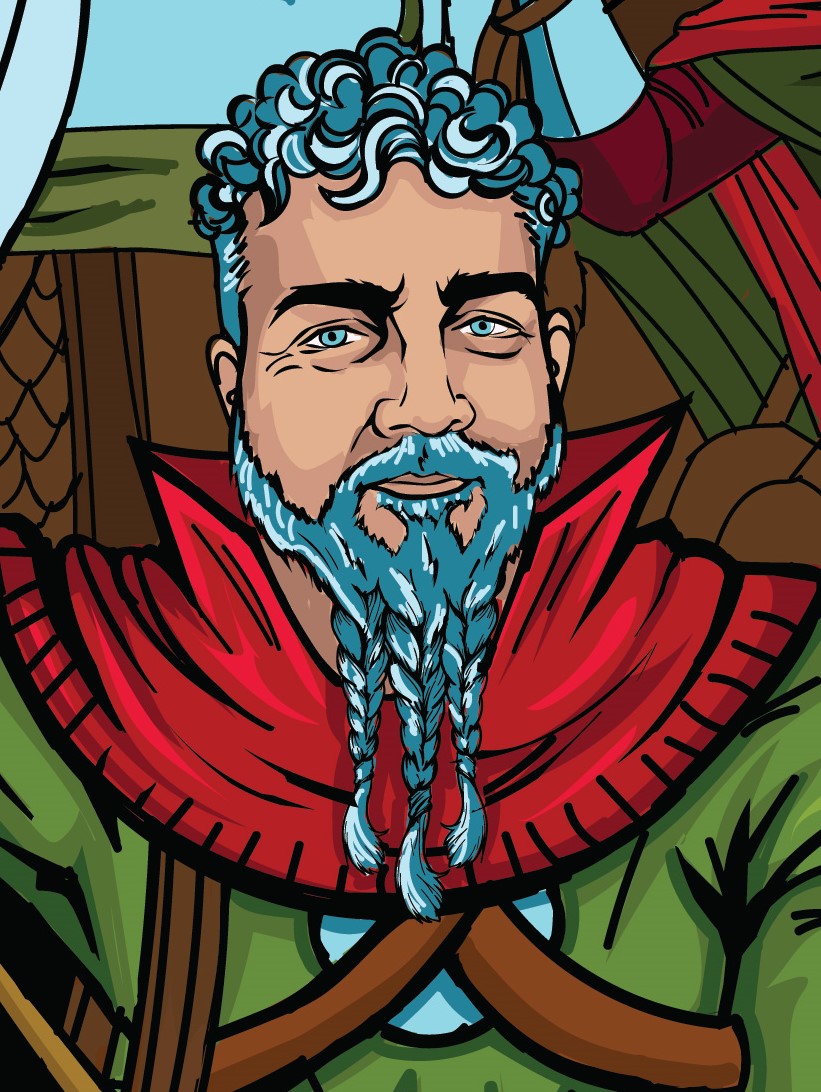
Courtesy of Delaney Saul for my birthday
That meant exploring his backstory. Awf has started to talk about that in his backstory in the game, so now it makes sense to share a bit of it.
His hometown suffered a goblin attack. At the time he was a righteous adolescent who believed in the power of his family and village. Unfortunately his homestead was destroyed by goblins. He will never forgive this act.
Fortunately the Order of the Shooting Star, mostly Elven Bladesingers, saved the town through a flanking operation. Awf’s family survived. But he lost respect. They weren’t powerful enough; they weren’t strong enough.
So when the Shooting Stars left, he followed. There was strength in their magic. He followed them for more than ten years. The orphan-by-choice was a hanger-on. He shadowed the lessons of the Eagle Song, as they used axes in their maneuvers, but small axes, for they were not dwarves.
By day Awf Hornjaw was an annoying outcast who offered just enough service to be useful. By night, Awf Hornjaw studied the ways of the Loragwyn clan’s magic.
Being 3’11” and 211 pounds, he didn’t fit in the Knightly Order. He was too fat, too slow, too Dwarf.
But Awf worked. The insulting nickname “Fat Goose” became his calling card. His axe took on the name Oie Cendrée. He learned and succeeded.
Eventually the Loragwyns and the Shooting Stars accepted Awf. His noble desire to sacrifice anything to help others fit their ideals. His skill with adapting Oie Cendrée to the ways of the Song were intriguing.
As Awf left the Shooting Stars they awarded him their name. Awf Hornjaw et Loragwyn is a man with two last names, two identities, and one goal – to find the goblin clan that threatened his family and show them that the Fat Goose is ready to sing the song of violence and ring the gong of death.
My backgrounds project continues to expand, adding in many medieval/Renaissance professions that fit in the apocrypha of D&D and related fantasy worlds. At this point there are nearly three dozen frameworks down. None of them demand a magical world.
But, this is D&D, and in all (?) of the official, product-supported worlds of 5th edition magic is not something that is only held by leveled PCs and NPCs. If you visit a shrine in Forgotten Realms there is a great chance that one of the Acolytes there knows Thaumaturgy. The number of Guild Artisans (tailor) in Eberron that know Mending is almost certainly larger than the number that do not.
In these worlds there should be tales of those who became heroes after their less-than-mundane lives. The fantastic is part of the D&D experience – both in heroic journeys and in everyday life.
Exploring what cantrips make sense leads me to listing those cantrips that are not designed for warfare – essentially ignoring damage cantrips, but there are a few that make sense. Let’s take a look at the DnDBeyond list of cantrips and pare it down to just things that commoners would possibly know.
Cantrips for Fantastic Living
Control Flames – Yes, it can do damage, but its primary purpose is about starting and putting out fires. I’ll explore a Firefighter.
Create Bonfire – Similar to above.
Dancing Lights – This also has combat roles, but imagine the ability of a theater designer to take advantage of Dancing Lights in ways that amplify that experience. The name does not leap to mind, but a variant entertainer using light is needed.
Druidcraft – The most obvious way this works is to help a Farmer, Rancher, Herder, etc. On the other hand, imagine a Weather Forecaster.
Gust – Sailing across the sea and stuck? Find your empowered crew who can create a tiny wind.
Light – The uses are nearly infinite. The Lamplighter will be both apocryphal and fantastical.
Mage Hand – Thieves and Wizards alike enjoy this one, but so would construction workers. Why bother with a ladder when you have Mage Hand?
Magic Stone – While this is a combat cantrip it feels proper for certain wilderness Backgrounds to have access to it. An Herbalist hunting for a rare shroom may need to defend themselves, for example.
Mending – Tailors and Tinkers around the world would be thrilled.
Message – This would be useful for the Pamphleteer, the Town Crier, the Spy, the City Watch, and many more.
Minor Illusion – Another cantrip that would suit Entertainers.
Mold Earth – Masons and Farmers could both find uses for this cantrip.
Prestidigitation – A Realmsean Dry Cleaner could profit off of making the bloodied heroes, and criminals, presentable. Similar to Light and Druidcraft the Backgrounds that could take advantage of this are nearly infinite.
Produce Flame – A third in the fire series.
Shape Water – Immediately upon reading this one I thought about construction of aqueducts and water wheels.
Spare the Dying – In gameplay this may be one of the weakest cantrips. In the rough and tumble alleys of Baldur’s Gate it keeps the citizenry alive – Medic and maybe for the Barber as well.
Thaumaturgy – Acolytes and Sages should probably already know this one. The organized faiths of the world would have plenty of priests and others able to shout above the masses. This also has great application for a Town Crier, Herald, and Soldier.
Several more attacking cantrips have possible secondary uses. These are ignored because not every D&D world need be one of violence for the commoner.
Next Steps
In some cases adding these minor spells to existing Backgrounds makes sense. That would involve a slight change to the current rule set. We know that a cantrip is considered roughly equal to a skill or language based on the Feats Linguist, Prodigy, and Skilled. The product will address that.
But knowing these cantrips also means an exploration of how certain roles in the medieval/Renaissance apocrypha of D&D change because of magic. A Lamplighter (a custom background in development) with Light should be behaviorally different than one still using flint, steel, and oil.
If we are to be heroes, we must act with in the faith of ourselves, our gods, and those that look to us for hope. This band of becoming-friends is strong willed and capable.
We are willing to risk, a bit brash (that may be my fault). Those that oppose us are able to surrender. We will not kill them if they do. There are things we will not tolerate. Those enemies do not live long.
Together we will free this town and rescue our patron. What happens on the way will happen.
Spoilers for the D&D Starter Set adventure Lost Mines of Phandelver follow. Our adventures started with an ambush by goblins, then a rescue of Sildar in the goblin caves. From there we cleaned up the southern part of town prior to attack the Red Brands at their manor house.
Have you met my friends? Maybe I should introduce them.
Krakom is another dwarf. A fierce fighter who will stand shoulder-to-shoulder with me Krakom is sometimes confused by my behavior. While I prefer a big axe, Krakom has mastered the use of a massive hammer — bang-bang.
Norran might be an elf. I’m uncertain. He can slip through a crowd, or into the dark, and disappear for a bit. An arrow will fly free from where Norran might be and pierce the heart of our enemies. Most often he’s the scout.
Ambrose is my orc-ish friend. Deft with a hurled spear and willing to enter a fight with two weapons when hand-to-hand combat ensues Ambrose likes to use an axe, which I appreciate.
Rowan has faith. She’s more than a believer. Tymora works through her. The human helps keep us alive, which is appreciated, of course. Rowan is also a wonder at sussing out information from people who aren’t trying to destroy us. She’s trusted. Hopefully we can all be trusted soon.
Sorry, I got distracted. You were asking about the manor house. Yes, we raided it. Yes, at daylight. We needed to sleep. No, we weren’t concerned with them being warned by the near dozen of deaths and surrenders from the previous day.
[mutters under breath: coward]
No, not you.
Anyway. We went to the manor. Shortly after entering we dispatched three more Red Brands, found some rations, and a bit of coin. The one we didn’t kill indicated that the GlassStaff would be down a hall.
While my friends discussed the ‘proper action’ I opened the door to that hall. We knew what to do. Let’s do it.
Behind that door was a powerful stench of rotting flesh. Someone vomited. No, it wasn’t me [it was me].
A disgusting monstrosity was beyond the doors. It had one large eye in the center of its head and a massive maw. The hands were large with nails that may as well been claws.
We destroyed it because talking wasn’t working. It wanted to eat the flesh of peoples. There is no saving those types.
You want to know what happens next? Fill my mug. I’m out of Elverquisst. Fill the mug. I’ll have more tales when you return.
Rescuing Sildar with finding Gundran left the group feeling somewhat successful, but there is worry. We know just enough to start tracking down where our patron is being held. First, we must complete the hired mission – delivering the goods to Phandalin.
Getting paid is good for morale. As our coffers fill we learn that this poor frontier town has little in the way of a constabulary, and rather large department of Protection Racket.
The group decides that before we rescue Gundran we will help this town live without fear. Time to clean the streets!
One things I’ve realized about Phandolin, as opposed to my home village or the woods where I earned the name Fat Goose, is that everyone is caught up in some kind of tragedy or ill business. Between the Red Brands/Cloaks terrorizing the town, the goblins able to raid with impunity, some kind of haunted house, and a set of mines which a dwarven community is trying to bring back this frontier town needs heroes.
That’s what we are. The Loragwyn family taught me that. People in need deserve help, even if you fail while you try.
At Barthen’s Provisions we were paid for the work we’d completed. Unfortunately Sildar demanded his oxen back. I’d grown comfortable with the dumb beasts. Mayhap, I’ll purchase them from him in the future.
While most of us were concentrating on getting paid for an unplanned return of merchandize, Rowan, the Priestess of Lady Tymora, visited a shrine. In the eve, after a few battles she shares what occurred at that shrine.
“You wouldn’t believe how it warmed my heart to find shrine to the Lady Tymora in this little village. It made me feel like the Lady’s luck will be following me wherever I go. And the cleric who cares for the shrine, Garael… I can’t wait for all of you to meet her. She’s in need of our help, but I expect she’s going to be a great help to us as well.”
We learn that there is a coster that is responsible for the rest of the goods we rescued from the goblin caves. There should be a bit of money in returning those goods.
Money is good, but solving problems is better. I’ve always felt that addressing confrontation straight on is best. The Red Brands have a particular bar that they enjoy.
We visit it. Or we try to visit it. A handful step out to confront us.
“What are you doing here?”
I respond, “We’re here to clean up town.” I cast a basic spell to clean up the poor, dirty bastard’s disgusting cloak.
My generosity is ignored. Those idiots. It takes a bit for us to clean up the south end of town and this stupid bar. We leave behind four dead bodies, a handful of smarties that surrender.
Those that surrender let us know of more dangers at the manor house – bugbears, undead, more red brands, a couple of wizards. This is probably beyond our capabilities.
I toss a gold towards the barkeep. His inn is a mess after our conflict. While my companions interrogate, I clean. This town needs help. We help.
We take the dead to the edge of town to serve as a warning, their red cloaks hanging over their bodies as a symbol towards those who would terrorize good peoples.
The living we leave with Sildar overnight. In the morn we are to raid the manor house.
Life is only worth living if you are to help others. The people of Phandalin will live free, or our band will perish.
Over the past couple of weeks I’ve started working towards a bundle of dozens of backgrounds for use in 5th edition Dungeons & Dragons. The basic version of these would be to fill out the space of time before you became a hero — so toss that Folk Hero in the trash.
The goal is to keep the core of these with the 2 skills and 2 language/tools of the base system, while having handful that may go beyond the base ruleset. Each would have a description, the gained skill set, equipment, the feature (maybe an alternate) as well as the including the personality traits, ideals, bonds, and flaws.
Backgrounds, when fully explored, give power to the social and exploration pillars of play. With them we discover that point of time “Before We Were Heroes.” There will also be need for at least one more language and a few more tools.
My goal, is to put this forward as a product on the DMs Guild, eventually. If my dreams come to fruition that I would partner with an experienced editor. I have an artist and designer in mind at this point. Depending on the editor, I may need a cultural consultant or two.
The list grows daily. At this point a few have full descriptions and associated personalities, while others are a title with the skills associated with the Background. Here is a list, in order of inspiration, that is far from complete.
Farmer
Minder
Barber
Crier/Herald
Pamphleteer
Lamplighter
Clerk
Hunter/Trapper
Third-Born
The Gambler
Lantan Mechanik
Barista
Tea Master
Bartender
Tax Collector
Oracle
Caravanserai
Tinker
Messenger
Teacher
Perfumery
Talking Drummer
Herbalist
Brute Squad
Logger
Eventually these will be organized — likely by urban and rural. A few more magical and mystical backgrounds will be added. Those will likely include tropes that can only exist in a world of fantasy.
For now, my focus is on what the heroes of our times did, before they became legends.
All of these backgrounds vary from the system as outlined in the Player’s Handbook (2 skills and 2 languages/kits/games/instruments/tools). They are slightly more powerful, but also have limitations in regards to origin kingdom and maybe negative features. The bonuses include an extra non-damaging cantrip, a bit more equipment, a single weapon or companion points. A DM running a game outside of the World of Everflow should take caution in adding these to their campaign, but they may be needed flavors within their world.
The backgrounds are: Street Mage, Glight’s Monitor, Keeper of Everflow, Tinker, Farmer/Rancher, Messenger Service, Villien
This post was updated on 5/24/2020
Street Mage
Performing on the streets earned you a few coin, and the feeling that you are constantly hunted by those that wish to limit magic. You’ve found a way to take the new magic and use it to entertain the common man. You can be a hustler, an entertain, and some even call you a charlatan, but you know that magic is real and there is potential for so much more to Kin than a few animals and stodgy rituals.
In most of the West street mages are welcomed in the ghettos while watched by the Guard when they visit good neighborhoods. In Qin they are often found dead in alleys, unless they are part of the Ashen Scarves.
Skill Proficiencies: Performance, Sleight of Hand Tool Proficiencies: None Languages: Two languages Equipment: Gaming set, Fine clothes, 3 shells or similar, belt pouch containing 15 gold
Feature: Prestidigitation and Wanted
Word of your powerful magic (it’s not necessarily powerful) has spread. You heard you were being hunted and now know you cannot stay in one town too long as word will get out that you have learned to control magic. There are many who distrust magic, as the Awakening and magic lead to the fall of Sheljar and other cities around Kin.
These itinerant teachers visit small villages on the Day of Glight. They encourage reading, study and a knowledge. In all villages they are a welcome distraction from day-to-day life. The Day of Glight ensures that everyone has a bit of an education in how the Kingdoms came to be and what the various faiths are. But none can explain the Awakening and these magics that are now real, rather than legend.
Glight has the second most followers in the West. These teachers are common throughout Kin, even in Azsel.
Skill Proficiencies: History, Religion, Arcana Tool Proficiencies: None Languages: One of your choice Equipment: Folding chalkboard, chalk, common clothes, history book, belt pouch with 10 gold
Feature: Pupil in power
A former student of yours is now in a place of influence. During your traveling and teaching you taught hundreds. One of those is now in a position that can help guide you towards finding the answer to a question or the merchant that sells the rare, but needed equipment.
Characteristics: Sage
Keeper of the Everflow
Prerequisite: Must be a follower of Quar.
The Church of Quar and Bishop Ollium lead the largest faith in the West, Kirtin and Daoud. Due to the Everflow’s powers Quarites are popular in the other Kingdoms as well. The Keeper of the Everflow is part merchant, part cleric. They heal and serve the people, for a price. You serve this powerful Church spreading the word and maintaining its influence in all the Kingdoms.
Shrines and churches to Quar dot the landscape throughout Kin. The Church’s historical control of the Font of the Everflow and Lake of Two Paths empowers them to limit all other faiths’ potency.
Skill Proficiencies: Religion, Persuasion Tool Proficiencies: Calligrapher’s Supplies Languages: One of your choice Equipment: One vial of the Everflow, 5 sticks of incense, vestments, common clothes, belt pouch with 5 gold
Feature: Gift of Quar and First Aid (Spare the Dying if played outside of the World of the Everflow)
When you visit a temple of Quar you can ask the ruling deacon to give the gift of the Everflow. If they have the resources and find your needs worthy you will get one vial.
At non-Quarian temples you can still make this request but the chances of success are minimal. Most faiths will make an exchange for a lower price than typically asked.
Characteristics: Acolyte
Tinker
Tinker’s travel between farmsteads, hamlets and villages that lack most smiths. They use both natural and magical means to repair metal goods. In the evening they share news or stories from history and legend. You don’t have a home, and have long left your family. Now, wandering the world you discover new tales and new ways to fix the problems that keep people from doing the things they love.
They are particularly common in the less organized West as well as areas under sway of the Crinthian Confederation.
Skill Proficiencies: Performance Tool Proficiencies: Tinker’s Tools Languages: Two of your choice Equipment: donkey/mule/pony, Tinker’s Kit, 1 pound each tin, copper, iron, pack saddle, traveler’s clothes, pouch with 5 gold
Feature: Job Seeker and Mending
Whether fixing small metal objects or telling tales in the local inn, you find a way to survive at a modest level. This can be through a mix of both activities or just one. If fixing objects all of a morning or afternoon of most days is occupied. If at an inn every evening and some afternoons are occupied.
Characteristics: Folk Hero
Farmer/Rancher
You raise crops or animals for food. At some point your property, or that of your neighbors needed defense. Some of your friends and family were unable to survive the raid from the bandits, but you did. That’s when you discovered there’s more to life that a cock-a-doodle-do at dawn, milking goals, shearing sheep, weeding, swinging a scythe. Your people need protection. You are their hope of a simple, safe life.
Many farmsteads and ranches in Telse lose family members to quests, adventures and those that are searching for better lives. In Kirtin every man or woman must serve, some do not come back from service. Daoud, Azsel, Mehmd and Crinth all have portions of the populace that start as mere serfs and become greater.
Skill Proficiencies: Animal Handling or Athletics, Nature Tool Proficiencies: Farmer’s Tools, Vehicles (Land or Water) Languages: None Equipment: Farmer’s Tools, common clothes, a beast of burden (mule, donkey, dog, flightless bird), lantern, flask of oil, week’s rations, pouch with 1 gold and 17 silver.
Feature: Druidcraft and Foraging
In occupied lands you know how to take just enough food to live without most farmers/ranchers noticing, unless you do so for more than 2 days.
Characteristics: Folk Hero
Messenger
Prerequisite: Your bonded companion(s) must be a messenger bird/dog or a riding horse. You gain an extra companion point.
Messengers work throughout Kin and the Lands of the Everflow. Their birds, dogs and horses carry news, treaties, love letters and more between the cities and towns that remain in the post-Awakening world.
Skill Proficiencies: Animal Handling Tool Proficiencies: None Languages: Any three Languages Equipment: Common clothes, map case, ink, quill, 5 pieces of paper, pouch with 15 gold
Feature: Service Connections Past messages have been sent to two major cities as well as two small towns in the past. Your bonds know how to get to these places, to your home and to yourself.
Characteristics: Folk Hero
Villein
When a youth comes of age they or their family visit the local Villein. While some, particularly Crinthians, do not use a service, many Kin find their first companion through the services of those who know animals as well as any.
Most Villeins deal with mammals, though some in Daoud have experience with fish. Those in Mehmd deal with saurs and lizards.
Skill Proficiencies: Animal Handling (Expertise), Nature Tool Proficiencies: None Languages: None Equipment: 50 gp worth of non-bonded animals, common clothes, pouch with 5 gold
Feature: Domesticating beasts
You are able to calm the semi-wild beasts and prepare them for a bonding session. You also have two additional companion points but must have more than one companion.
Characteristics: Guild Artisan, your art is raising animals.
After being ambushed along the trail we learned of a cave from which these goblins raid the civilized folk along the merchant’s road. Within those caverns may just be Gundran and Sildar.
So we headed out, an attempt to rescue the men responsible for paying us. We mount this rescue operation out of self-interest, revenge, whatever motivates the individual. We aren’t yet a band of brothers (and sister – Rowan), but this is developing.
Spoilers for the D&D Starter Set adventure Lost Mines of Phandelver follow.
Repelling the ambush wasn’t hard. My golden flame axe swung powerfully. The bell of death rung hard. These companions fight well. We are noble, and let one poor gobbo live. He told us where to go.
It meant a hike, and we left the poor oxen and the burdened cart behind. But Sildar was to the north in the woods, up a stream through the woods, and into a goblin-cave.
Outside the cave an outpost tried to ambush us. The wood elf, Norran, took quick care of those. I think Ambrose and Rowan joined that attack, as they have some effectiveness at range while Krakomand I, honorable dwarves, guarded the rear.
Yeah, we’re also slow and not good with “stealth.”
Two goblins dead before I could swing my axe.
That meant the group was a bit inverted when we entered the caverns. Those faster members of the group rushed past a group of guard-wolves.
The wolves could have been a problem, as they were trying to escape their chains and the uproar meant we would lose all surprise. They died, a couple with burns and blade.
Krakom and I had to rush to catch the group. The “eating room” created an urgency from the group. In our haste the conflict spread throughout a handful of rooms. The fight was came from all angles and there was much confusing with the screams of pain from goblin and peoples.
I, me, stopped one pathetic goblin from flooding the caves. I, me, also took a significant blow to the head from some kind of super-goblin. The wretched soul dropped me quickly. I woke a dozen minutes later.
Ambrose, the ranger, told me of throwing a spear near through one on a bridge. I’m intrigued by spears now. I will not be able to sing with them, but they seem useful. The toothy one can teach me much.
The stories of the battle are glorious. My friends took out 25 gobbos, a few wolves, and that one thing that smacked me on the head.
Dear reader, this is where we learn that good Awf is not necessarily a reliable narrator.
Rowan, by luck of her goddess, or through shear will takes out that jerk that dropped me. What a blessed soul Rowan is.
Norran and Ambrose rescue Sildar.
With Sildar, in a room I never saw, was a dark soul. Zardos is quiet. Withdrawn from us, the man offers much power. The others saw him in action, and vouch for his usefulness. His eyes carry knowledge.
There was a lot of hauling of goods from cave to ox-cart and then the trudge back. Each of us had to make multiple trips. I may hate the goblins more for that then anything else. But when we traverse back towards the caves Krakom teaches me a game that shield dwarves play – golf(?) he calls it. Basically, the goal is to hit a round object (like a goblin head) as far as you can. There are rules, but we just do the long distance smacking, because it’s fun. We have to stop when Krakom sends a head out into an area we haven’t scouted.
On the journey to Phandalin Sildar tells us about Gundren’s brothers, the goal to re-open a mine, that Klarg’s goblins are working to support someone(?) called the Black Spider.
Thankfully Phandalin offers a short respite. There we can rest again, sell the goods we have, buy some rations and whatnot, and learn from some dude named Iarno Albrek, a friend of Sildar who is also a member of the Lord’s Alliance.
I’ve worked with the Lord’s Alliance in the past, as they and the Order of the Shooting Star oft work together. With the Alliance’s goals matching ours, for now, it not only makes sense to help them, it is right and just to work together.
For now, I’ll bring some joy to the children of Phandalin and whatever their local wines and ales are. Because I’ve got coin in my pocket – we earned our pay delivering the goods that Gundren hired us to bring to the city.
We also have more goods to try to sell. And clues to discover, and honestly a town to improve. These people are down. Let’s get them up, again.