Rather than a one sheet that’s built for players, and the way the game is played, this is the common knowledge sheet that’s built for characters. The goal is a the level of knowledge that every single member of the adventuring party would have (some exceptions for extreme outsider situations).
Magic is only a generation old in the Lands of the Everflow. Just over one passing of the Dragon (the 4th moon) ago, a born generation came about that all knew minor magics. Just seven years ago the eruption of Cortez broke the barriers of magic. The Lorebook Hunters found the Tome of Divination and the Folio of Necromancy. As magic returned to the world so did dragons, and elves, and goblins with their smog-punk teknology. Magic is real; and the world is not ready for the Born Generation as they age. Some empires fade, others rise, and peoples throughout see the beacon of a Free Sheljar as a new way to govern as the Lands of the Everflow continue to shake under threats for teknology, dragons, and magic.
The Six Kingdoms
| Kon | |||||
| Crinth | Azsel | ||||
| Mira | Mehmd | ||||
| Sheljar | The Slope | ||||
| Fey Isles | Telse | Kirtin | |||
| Qin | KotL | ||||
| Daoud Green Lands | |||||
That’s a word-map of the Six Kingdoms with a few of the major cities that have featured in the various campaigns. This gives indications to their relative distance from each other. Since the commoner wouldn’t necessarily have an accurate map, the word-map demonstrates the proximity of the lands to each other.
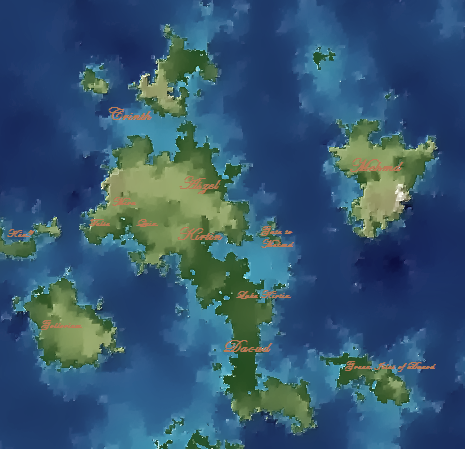
Azsel
A highly structured society built around small families and packs, the Kingdom of Azsel is mostly hin/halflings and their dog companions that trace their lineage to Az and Sel, the first bondings. Every King and Queen traces their lineage to Az, sometimes clearly and sometimes not. Azselites tend to be hierarchical, loyal, and have a strong sense of superiority because of their founder being the one who enabled bondings.
They are an expansionist society pushing against Crinth in the West and Kirtin in the South. They tend to ignore Mehmd. Messenger dogs keep outlying cities, towns, and forts in touch with the capital.
Crinth Confederation
Not really a singular government, the Crinth Confederation is a loose alliance of the northernmost peoples in the Land of the Everflow. Named after the River Crinth, the Confederation is ‘headquartered’ in Thornewall. Goliaths are most common here, particularly those that roam the plains, forest, and tundra. Crinthians have the strongest connection to nature and their architecture attempts to blend living plants into their homes and buildings. Myths from Crinth talk about a time when the bonded animals were large enough for homesteads to be carried on their backs — turtles, birds, mastiffs, snakes.
Daoud, the Green Lands, and the Emerald Isle
The grandest fleets of the Six Kingdoms come from Daoud. Naval power is so important to this dispersed nation that even the armies are called navies. Daoud’s forces will raid using rivers, and that’s how they’ve captured Kirtin-on-the-Lake, but also why they struggle to advance into the more mountainous territories of Kirtin and Qin. A land of warmth and greenery, Daoud is full of bright colors and loose fabrics. Similar to Mehmd, there is more variety in bonding with monkeys and fish being common enough, including some who carry their bonded fish in special bags and bowls while they travel.
Kirtin-on-the-Lake
Once the winter capital of Kirtin, the city has changed hands several times over the centuries. Currently it is controlled by Daoud. The largest university in the Six Kingdoms predates both Kirtin and Daoud, and may connect to the times before legends.
Kirtin
A land at war to the north and to the south, having lost one capital, the people of Kirtin all serve a summer season in the militia. In recent years this has meant service on the Slope, in the past these defensive posts were scattered throughout the mountain homeland of Kirtin. The former Summer Capital of Kirtin, Kirtin-in-the-Sky is a city of winding spires along a cliff face where it is difficult to tell the difference between natural and person-made. Once the center of learning, Kirtin is now a nation of defense.
The Slope
Coming down from the mountains The Slope is a frontier land not really controlled by Kirtin or Azsel. Both of those kingdoms send forces to the area regularly, usually in a soft-conflict as the villages along the Slope are unconcerned with empire. Many of Kirtin’s national militia serve on the Slope now that the kingdom has mostly given up on retaking the former winter capital, Kirtin-on-the-Lake.
Mehmd
The peoples of Mehmd bond not just with the warm-blooded as the rest of the Six Kingdoms, Mehmd also bonds with lizards and ‘saurs. Oft considered the least of the Six, Mehmd is sometimes considered just a city-state, rather than a kingdom. Water is somewhat scarce as the city sits just beyond the rain shadow from the mountains of Kirtin. Mehmd’s rocky land is crossed with aqueducts and canals taking water to the city.
Gate to the Wastes
Mehmd’s largest city is the only one that the rest of the Six Kingdoms encounter. Gate is open to all, but closes of the lands beyond. It is also the largest city of the Six Kingdoms, but on a tiny amount of land.
Sheljar
A dead kingdom until the Lorebook Hunters established the Free City of Sheljar. Prior to the Born Generation Sheljar was a mighty empire the controlled all of the West and the lands of the Everflow. A trade empire with major cities on its eastern coasts, Sheljar’s exports included the holy waters of the Font of Two Paths, gems and glassware from Bell’an’faire, alcohols from The Ferments, and stones from the various mountains. It is now fractured, with independent city-states throughout its former lands.
As magic started to seep back into the Six Kingdoms Sheljar was dominated by a Necromancer. The marsh-city came home to thousands of undead and a family of monsters known as Tunneling Nightmares who spewed vomit of bones and created sunken tunnels throughout the underbelly of the city.
The Free City is mostly confined to a few isles in the marsh-city. Its main tenant is that all thinking peoples are equal and worthy. They have eliminated most of the undead and all (?) of the Nightmares. They killed the Necromancer.

Telse
The towns of Upper and Lower Telse are dominated by the Orthodox Church of Quar. The main feature is the fountain, pool, and the two rivers that flow forth to both Qin and Mira. Many other faiths also treat the towns for pilgrimage. From the Born Generation to the present day those pilgrims have overwhelmed the town. The Mayor and Bishop rule together, frustratingly looking at the Free City of Sheljar as a threat.
Qin and Mira
The two trade cities didn’t fall to the Necromancer and took in many refugees. Both are ruled by trade societies. In Qin these guilds are centered around the trade routes. In Mira they are centered around the craft or goods created.
Other Lands
Few of the other lands outside of the Six Kingdoms are well known. Two have recently become quite important.
Queen’s Land
From Shejar to the northwest stands a series of island spires and a storm. According to the gobkon beyond that is their own homeland. The matrilineal kingdom is full of smog and caste, with the creation of new technologies being the currency of power.
Fey Isles
This series of islands well beyond the Sea of Gallinor is where the dragons and their friends originate. A land of bewildering magic there are colleges and schools to advance the art of the arcane. Only the Oriq, outcasts, are believed to not be able to channel the mystical into reality.
Races
Kin, the People of Love and Companionship
Nearly all of the kin have bonded companions. While dogs and birds are the most common of these, there are also some lizards, horses, and quite rarely fish.
Mechanically this is in essence a Feat.
Goliaths
The giants of the Land of the Everflow, goliaths are most often found on the edges of cities, or out in the wilderness, though they are the most common peoples in the Crinth Confederation. On the Western Wildes, on the Cliffs of Galinor, is a singular tribe of goliaths. They most commonly bond with birds, often using the small creatures to make up for their larger fingers. Not just gentle giants, goliaths are generally warmer to strangers and live in large multifamily groups. Their homes will have open windows across many levels.
Hin, or Halflings
The largers will call them halflings, but the hin are half of nothing. Fond of canines some hin ride their bonds, others have small little herds. Hin are loyal to a fault. They enjoy flavors – cooking, tea, coffee, beer, wine, anything that can entertain their mouth and nose. They are most common in Azsel and the Western Wildes where Sheljar once ruled.
Human
Most common of all peoples, humans run the gamut of sizes, shapes, and bondings. There are humans bonded with horses, canines, avians, and so much more. They are a menagerie. It is common for the offspring of Hin and Goliath, or Hin and Human, or Goliath and Human to all be called human as their characteristics of humans are all across the spectrum of what makes life amazing. They are most common in everywhere but Azsel (Hin) and Crinth (Goliath).
Ken, the People of Knowledge and Magic
These fey peoples have mystical powers, all able to cast magic spells of varying kinds.
Mechanically this means that ever Ken starts with a feat that grants magic of some type.
Dragons
They hoard things and/or emotions. While most peoples in the Land of the Everflow think that always means treasure the ale drakes hoard alcohol; black dragons hoard companionship; faerie dragons hoard joy and mirth; red dragons gather rage. All have powerful magic, which leads some of the peoples to swear fealty to the dragons. Most in the Six Kingdoms still think dragons are a story of trouble over the hill, rather trouble right here in the city.
Dwarves
Often the student-warriors and defenders of the colleges, the stout folk are generally evokers and abjurers. Channeling magic into hard violence and shielding others from it. Tending towards dour and serious, when they do unwind they unwind as hard a magic missile. Many keep the various drakes (non-thinking dragon-kin) as pets, but this is not the bond of the Six Kingdoms.
Elves
Changing the real world through their summoning powers and abilities to reshape reality, elves of the Fey Isles are aloof and superior. Looking down on the other humanoids for their “lesser” powers the elves like to present themselves as the equals to dragons (they are not).
Gnomes
The smallest of the fey, gnomes master the arts of emotion. Changing the way peoples feel or what they experience, gnomes are artists. They want to experience all emotions, at once, if they can. At times some from the Six Kingdoms have seen gnomes with smaller dragons and thought they are bonded. They are not. They’re just great friends with faerie, ale, and others of the weaker types. Gnomes are so fascinated by the Bonding that they have learned to speak with the animals.
No Rock Gnomes are part of the Ken. There are rumors among the Ken that Gobkons were once gnomes. This is heretical.
Kon, the People of Teknology and Konstruct
From the Land of Queen and Konstruct, these goblins are more misunderstood by the people of the Everflow than any other. Covered in soot and grime they are teknical marvels capable of building airxips powered by tar trees, clacketing cycles to move themselves, signal towers and so much more bizarre inventions. Coming in three sizes (Goblin, Hobgoblin, Mulgob) some sages from the Six Kingdoms have theorized that they are related to halflings, humans, and goliaths.
Mechanically this means that every character starts with Artificer Initiate and Rock Gnome Tinker.
People of Chorl
The creations of a rogue Scholar, these peoples are centaurs, aarakocra, minotaurs, fauns, and other blends of beast and human. They are outsiders, shunned due to their being the result Chorl’s use of transmutation magics. They are most common in the unsettled lands of the Western Wildes. The Chorl-ites only gather by animal type.
The Moons
Circled by four moons, Aur is roughly the size of Earth. The moons are part a major part of the calendar, and each is centered within different regions.
Feyelf (7 days) – dominant in the Queens Land
Glibbon or Glight (31 days) – dominant in Mehmd, Azsel
Kin (78 days) – dominant in Sheljar, Kirtin, Daoud
Dragon (6220 days) – dominant in Crinth, Fey Isles
The Days
These are the days in the Religion of Quar, the former lands of Sheljar, and Daoud.
- Elmsday starts the week and honors Selley (Goddess of Birth, Life and Death) and Belsem (Goddess of the Untamed).
- Bell’an’Aur is the second day of the week. It starts with a rejection of that which can’t be tamed and ends with a dinner celebrating Aur. In Kirtin and Crinth this is Feylfday, the day when Feylf is full, shortly after sunset.
- Quarsday is the third day. It celebrates Quar (God of Rivers, Mountains)
- Day of Glight honors the Lord of Knowledge. In developed lands the afternoons are given to learning.
- Torday honors Torq (Goddess of Sea and Storm).
- Az and Sel is day six. This honors not a god within the Wildes/Kirtin/Daoud, but the man and dog that legend says discovered the bonding. Nik is also frequently honored on this day. Azsel recognizes Az and Sel as man and dog that were raised to the gods.
- Day of Oun is the end of the week. Oun and Obscon are not honored or celebrated, instead the Lords of the End are respected in that all things end. They are often feared.
Religions
Neither the Ken nor the Kon are religious. Within the Land of the Everflow there are four major pantheons each with distinct God-groups. The most influential of these is the Orthodox Church of Quar which centers Quar, the Lord of Life and Rivers. Other gods within the group are Belsem (Goddess Nature, the Wild, the Untames), Torq (Scion of the Seas, Storms), Oun and Obscon (Twins of Ending, Death, Souls, Trickery, Darkness), Selley (Goddess of Life and Bondings) and Glight (Knowledge, Study). There is also a Free Church of Quar, an offshoot that objects to the mercantile power of the Bishop. Both churches are most influential in old Sheljar, Kirtin, and Daoud.
Up in Crinth the most influential pantheon is The Siblings. The god-group are two parents with sextuplets. The Parents are Glight (Light, Knowledge) and Selley (Birth, Moons, Passion). Both have minor roles in the Orthodox Church. The Siblings represent the Hearth, Trickery, Crafts, Beasts, Spirit, and Unity.
Over in Mehmd the God of Unity from The Siblings is worshipped as the sole god, with all others gods being an aspect of Unity.
In Azsel both Az and Sel, the First Bondings, are worshipped as Gods. Though they were a real pairing of hin and mastiff as the source of bonding the two represent the power of companionship, life, war, nature and people all together.
The Everflow
The Font of Two Paths, or the Everflow, is the magical water that emerges from the cliffside above Telse. When captured from the falls or not significantly intermixed the Everflow has healing powers. The Orthodox Church of Quar controls access to the Everflow in nearly every community. The Church uses its control of the Everflow to have a presence in all cities and most towns throughout the Six Kingdoms.
Lorebooks
Every school of magic as well as the hybrid colleges and certain traditions that aren’t usually connected to arcane magic (Druidic, Bards, Tricksters, etc) has a Lorebook hidden somewhere within the Six Kingdoms. The Scholar and their two Students are the only people who know where these books are.
The world knows that the government of the Free City of Sheljar has both the Lorebook of Divination (Scholar Cortez) and Folio of Necromancy (Scholar Rohan, The Necromancer). The other of the two dozen books, once assumed to just be a singular book, are all considered to be part of the reason for the Born Generation and the return to magic (when Cortez caused the eruption at the Glass Tower) to come to the Land of the Everflow.