• Who is the new D&D Rules Expansion Gift Set for?

    Who is the new D&D Rules Expansion Gift Set for?

    There’s a new official Dungeons & Dragons book coming out on Tuesday, but it’s bundled in with the Rules Expansion Gift Set. Due to all of this that we’re living through [waves hands at world] the Gift Set didn’t come out in time for the peak gift-giving time of year. Instead, it’s an oddly timed late-January product with the only “original” part of it not available until May 17.

    Image from Wizards of the Coast

    As is typical alternate art is available at your local gaming store, which you should support. In Renton you can go to Wizards Keep Games or Shane’s Cards. People on the Eastside should go to Mox Bellevue. Down in Tacoma check Tacoma Games. Those are all places in Greater Puget Sound that I’ve supported and am confident in.

    What’s in the Gift Set?

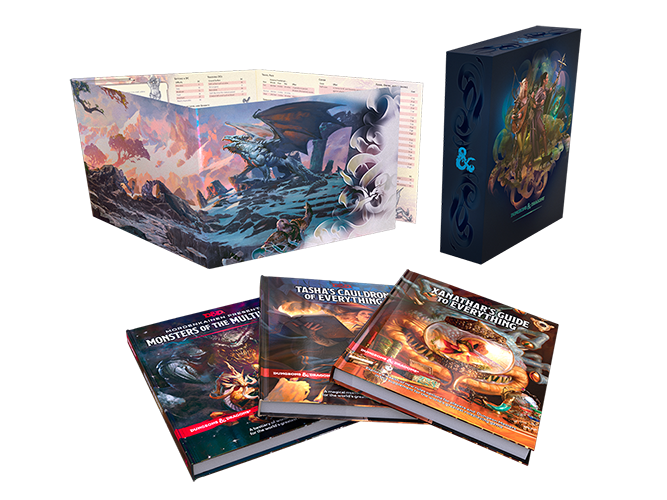
    There are three books. Xanathar’s Guide to Everything and Tasha’s Cauldron of Everything are just reprinted with the latest errata. There’s a new(kinda) book called Mordenkainen Presents Monsters of the Multiverse. You’ll also get a DM’s screen with some tables to reduce page flipping when you play in person. Screens can be quite handy.

    Additionally there is a fancy slipcase to hold everything and look really good while it sits there.

    That kinda sticks out doesn’t it? Monsters of the Multiverse has one new monster. Those that already own Volo’s Guide to Monsters and Mordenkainen’s Tome of Foes will already have every other monster and nearly ever race, but in a different form. The new book has adjustments to the stat blocks to make them a bit more powerful and a bit easier to use. Also, those two earlier books (Volo’s and Tome of Foes) have dramatically more lore. Most of that lore is Forgotten Realms specific. The new book greatly minimizes the lore elements to what is true for a race or monster, typically, throughout the multiverse of D&D play.

    Between the three books you’ll get rules for the Artificer class, a couple dozen new subclasses, over 30 new races, gobs of new magic items, many spells, and some new rules for exploration and be social parts of the game.

    Reviews of Mordenkainen Presents Monsters of the Multiverse

    So who is the new product for?

    The person who most needs the Gift Set is someone who is recently deep into the game. For all intents this set is the second core of the game, with rules that help both players and dungeon masters. Those players that only have the Player’s Handbook and want to dramatically expand their options will enjoy the set (talk to your regular DM beforehand just in case they don’t want certain subclasses or rules at the table). A Dungeon Master who wants more monsters, traps, and puzzles will get great use from the Set if all they have are the three core books. Monsters of the Multiverse is particularly helpful for those who homebrew, as the weight of lore won’t interfere as much as Guide to Monsters and Tome of Foes.

    Maybe certain collectors will want the new set too. There’s an appeal to that. But, I don’t have that kind of room in my house or wallet. The new art and case are great though. When I have that kind of room this might be the set that finds its way into the background of a video meeting.

    Overall the set is the next three books a D&D fanatic should get if they don’t have the four books that make up the Gift Set already. If you already have those books it may not be meant for you. Wait for the three or more other books that will come out in 2022 or keep playing with what you already own.

  • Try inverting your D&D encounters’ difficulty

    Try inverting your D&D encounters’ difficulty

    Typically in Dungeons and Dragons an adventure consists of some easy encounters, some hard encounters, a deadly encounter, and then the final encounter. The way characters level up over a campaign echoes this progression.

    Heck, this is even typical in most stories. The heroes may see a deadly monster early, but they don’t fight it until they are more powerful. Or, in the course of a D&D adventuring day, when they’ve used some amount of resources, thereby making the final monster more deadly.

    Through a happy little accident of misreading some stat blocks, my last set of sessions inverted this process.

    Rather than meet goblins, then hobgoblins, then an ogre climbing that ladder of difficulty, the group started their day with a CR 7.6 encounter, next was a CR 6.25 encounter, and then a CR 3.

    That released some opportunities for the players. The happy little accident meant that during that tough encounter they used a bunch of powerful abilities rather than keep them in reserve. During the second encounter they used more.

    Then, finally, when they met the “boss” (who was actually the boss of the various Dragon Sworn*) they only had a couple abilities left. That meant it felt deadly, but really wasn’t. They won easily.

    * For this I used the Fizban’s Dragon Blessed, Dragon Chosen, and Dragon Speaker

    Overall the group was tested, more so than typical in my sessions. Also, they got to use more of their potent features. If I better telegraphed the inversion, like if it was planned, then they would have used even more of their limited powers.

    When a player invests in a character having certain abilities they need to be able to use them. This accident utilized more powers in one day then I’ve seen in some time.

    Now they’ll try to rest.

  • My Best of 2021

    My Best of 2021

    In 2021 I rejoined the community that taught me how to write, that taught me how to believe, and that taught me how to be a better person every day. I started writing about soccer again, mostly about Tacoma Defiance, but also about the Seattle Sounders and OL Reign. Putting the polish back into my words gave me hope in a year when I needed it more than ever.

    The past year was also the year that established my voice around D&D. More people read Full Moon Storytelling in 2021 than they did in every other year of its existence, combined. To throw yourself into a new endeavor is hard. To do it during a reboot and a pandemic has been a struggle. The journey has been worth it because the people who enjoy my writings about Dungeons & Dragons are the type of people who always have more stories to tell and who know — deep and fundamentally — that a diverse group is a strong group.

    These are my favorite writings of 2021, only originals, no updates. Just the best of what was new this past year.

    Seattle Sounders

    Throughout the pandemic the Sounders continued to open new mini-pitches. These small, all-weather soccer fields help ensure that all youth have access to play. Brad Evans and the RAVE Foundation opened pitches in Renton, Tacoma, and Yakima in 2021.

    Covering matches gives me the platform to do more than just write about soccer — it gives me the opportunity to write about feelings. After the Sounders “lost” to Real Salt Lake I embraced the Wheel of Time.

    Tacoma Defiance

    More for myself than anyone else, I reviewed the Day that Sports Stopped. This gave me an opportunity to reconnect with Justin Dhillon and to think about just how much life changed from March 10, 2020 to the present day.

    Centerback Taylor Mueller retired from soccer at the end of the 2021 USL Championship season. Mueller ends as one of the legends of the league, playing more than 20,000 minutes in career where he showed that there’s more to American soccer than MLS.

    OL Reign

    While Cheney Stadium is no longer home for OL Reign, it was where they ruled. Powered by their success in Tacoma, Reign are moving back to Seattle.

    Dungeons & Dragons

    The Black Dice Society burst on the scene, sharing a horror setting sharing new ways to do communal storytelling via livestreams. They do a wonderful job at creating the disquiet of the Domains of Dread and the use of cutscenes to Strahd and others makes them a must watch.

    As my skills in art aren’t good. But, I get past that through NPC art and various map makers.

    Backgrounds, of course, have been very popular the two most well received were the Tinker and the Farmer. Friends are playing the Caravanserai and the Lamplighter (which also works as a Streetsweeper). Within the edition Backgrounds offer a mechanical space that embraces a character’s state of being beyond just being a killer and sometime explorer. Your D&D character should have hobbies.

    Custom Backgrounds for 5th edition Dungeons & Dragons

    For some reason, people rather enjoy the relaunch of my campaign, particularly the way that the Allies and Adversaries are presented.

    ShantyTok was fun for a bit. This story reminded that if you’re trying to ride the wave of a meme do so immediately, or do it because you love the themes of the meme and don’t care about going viral. Me? I love pirates and tall ships.

    Flavor

    When Will Bruin made a beer, who better to write about t than the former professional coffee taster and beer salesman? The Georgetown Brewing-Will Bruin collab was an easy drinking IPA.

    Podcast and Livestreams

    As part of YachtCon, I was the Dungeon Master for a D&D livestream that raised a few hundred dollars for the Red Box program at the Seattle Children’s Hospital Autism Center. That adventure was themed around the South Sound with numerous references to Tacoma, Defiance, and Reign.

    You can also find me as a regular on the Sounder at Heart podcast.

  • The Normalization of D&D in Media

    The Normalization of D&D in Media

    Over the years mainstream media has shifted from acting as if Dungeons & Dragons was connected to Satan and murder, to acting as if players were just nerds in basements to be ignored, to being nerds in apartments to be mocked (Big Bang Theory), to superpowered nerds to save the world (Stranger Things), to now just people who like something that other people don’t like (Ghosts) without any judgment of the game.

    The D&D episode of CBS’ Ghosts will re-air as part of the Ghosts marathon on December 23rd.

    Seeing this shift, which I’ve lived through every moment of, still amazes me. Yes, there were times when genre shows featured D&D. Stranger Things made sense. The game fit and was featured in the story.

    The current status of the game is different. This isn’t some niche hobby anymore. Active football players play; Jack Black plays; there’s a regular show on cable TV that is D&D.

    Ghosts did something different. One of the main characters mocked the game, but the way D&D was featured wasn’t a mockery. Instead, Dungeons & Dragons was a way to further establish fellowship between the diverse cast of ghosts and the one living who shares their space and cannot see them. Also, the d20s helped solve the other plot of the episode. Lead writer Joe Wiseman addressed this on Dragon Talk recently.

    Every time I encounter the featuring of D&D as normal continues to astound me. Once forced to hide my passion for the game or get the books knocked out of my lap as if real life was a crappy teen comedy, now D&D is popular and mainstream enough that it is on my resume, talked about during job interviews, played in public, and can raise money for charity as celebs play.

    Much of the mainstreaming of the game is because many of us nerds that hid in our basements are now of the age that we are in positions of influence. While it is Zoomers and Millenials that are the fuel spreading the game, GenX leadership is normalizing it.

    Writers rooms throughout Hollywood played as kids and are playing again, as are the actors, cinematographers, set designers, etc. Video game designers (and all of the support staff) played with pen and paper, then translated that to big screen.

    D&D’s tropes are mentioned in genre fiction (Onward!) and regularly trend on social media. There’s not a day that goes by that an Alignment Chart meme doesn’t show up.

    Now that we’re mainstream there’s always that worry among us olds that things will change in ways that we don’t understand. But at it’s core D&D has always espoused that a “diverse group is a strong group.” And all of the current changes lean into that trope that started with the Fighting-Man, Magic User, Thief, and Cleric that were also a Dwarf, Elf, Halfling, and Elf.

    Leaning into that means more players, more games, more chances to “roll for initiative.” That’s all I want.

  • Narrative character creation in 5th edition

    Narrative character creation in 5th edition

    Story is modern roleplay gaming. But, character creation per the Player’s Handbook is mechanical. It doesn’t have to be. It can follow a narrative; this is how.

    The character creation order changes a little bit with this method. Now it’s almost as if your character is going through childhood and adolescence while you and the DM (ideally together) go through this process. Kind of like filming a documentary, together you discover the journey from birth to hero. Take notes and get the feeling of the story that created the personality that will exist at the table later. If the player talks about history or backstory that doesn’t yet exist in your world, they are there creating it with you. This empowers the player to help with worldbuilding and creates bonds between the character and the past.

    I’ve done this with two players so far. The following has the steps of process and a practical example.

    Tell me about your parents

    This is the first lead. The DM is trying to figure out a bit about the homeland and race of the parents. They don’t need to be known (orphans are common in our base literature), but at the least get a few words describing origin country and race. Write those down. Get their given name now. Maybe their adventuring name is different, but when they are born, they are named.

    My first player said his parents were a merchant family from Southern Kirtin. They’d lost their lands when Daoud took over. They are halflings that abhor Azsel.

    Race: Halfling

    Are you strong, intelligent, wise, a leader, nimble, healthy?

    As the DM I generated a random point buy array and asked for the player to describe their character traits that they exhibited as a youth. Were they the type that led groups or shy? Did they throw rocks, or work in the mill? Maybe they were sick, or never got sick when others were? Some people read a lot, or read people. Distribute the six scores based on the answers given.

    This player said that they were a bit of a leader playing with the kids, generally healthy, tended to know and understand people. They were a bit weak (halflings in Everflow have minuses to strength).

    STR: 7 | DEX: 16 | CON: 14 | INT: 11 | WIS: 14 | CHA: 14

    Your parents did what? Did you follow in footsteps?

    The answers to these questions determine Background, and help guide you towards Class. They aren’t the answer to class, but do influence it. A lot of personality gets built out here. The Personality Trait, Ideal, Bond, and Flaw should be apparent from this conversation. If it isn’t offered, the DM can probe a bit more.

    In our example the character was raised by a merchant family that wanted to do everything right, that as a family wanted to regain their lost market in Kirtin-on-the-Lake and as the youngest of the trade family he’d been swindled once or twice, so he’s a bit suspicious of that.

    Background: Merchant with skills in Appraiser’s Tools because he doesn’t trust and Vehicle’s (Land) because he was the youngest son.

    What makes you special?

    Ask about the time that the character discovered that they aren’t common, but instead began to know that they are a hero. Have them describe it. Did they fight with arms, pick up a bow? Maybe they stole something? There should be indications towards class here. The experience may be a bit like a tree where the branches are melee or magic. After that the split might be sneaky (Rogue), hefty (Fighter, Barbarian), ranged (Fighter, Rogue, Ranger) or divine (Cleric, Druid), arcane (Wizard), discovered (Sorcerer), pledged (Warlock, Paladin). Are they principled (Monks, Paladins, Clerics)? This is likely the longest conversation you have during narrative character creation. Throw them some experience for wonderful ideas that surprise and entertain you.

    But during this section you’ll come away with their Class, their options like Fighting Styles, or Faith, or Wizard school, etc.

    Our example character was someone who had a caravan raided. He wasn’t a fighter, and didn’t know magic, instead he helped. He distracted the opponents, or warned his guards. Throughout the fight he was helpful. After the fight he repaired the cart, and returned the goods.

    Class: Uncommoner (this is a homebrew that may be public soon)

    Altogether it isn’t a major shift. Maybe some tables already do similar. For me it created a process shift from “this is what I am” to “this is how I came to be.” That adds some depth.

  • Errata for December 2021 mostly focused on helping your character be yours

    Errata for December 2021 mostly focused on helping your character be yours

    The semi-regular blog by the D&D team at Wizards of the Coast released today is from Jeremy Crawford, folding in Sage Advice and Errata updates.

    Four rules answers are shared, all about spells. The biggest impact on my games would be the clarification that spell attacks are not spells. This means Counterspell and similar are not effective against the consolidated stat blocks for monsters in the latest and upcoming releases. Also, Silvery Barbs is ineffective against Legendary Resistance, which shouldn’t be a surprise. The other two questions seemed to have obvious answers, but the clarification helps.

    There is a significant change to Drow, and that connects to most of the player-facing Errata updates.

    This new text replaces a description that confused the culture of Menzoberranzan—a city in the grip of Lolth’s cult in the Forgotten Realms—with drow themselves. The new text more accurately describes the place of drow in the D&D multiverse and correctly situates them among the other branches of the elf family, each of which was shaped by an environment in the earliest days of the multiverse: forests (wood elves), places of ancient magic on the Material Plane (high elves), oceans (sea elves), the Feywild (eladrin), the Shadowfell (shadar-kai), and the Underdark (drow). Drow are united by an ancestral connection to the Underdark, not by worship of Lolth—a god some of them have never heard of.

    Sage Advice December 2021

    Within the nine books that have Errata updates that theme is extended.

    The Player’s Handbook sees 15 of 22 new changes being related to Alignment. The most common change is “The “Alignment” section has been removed.” No longer are characters going to be directed towards certain behaviors. They are, instead, the heroes and anti-heroes of the story — unique and special.

    “The “Alignment” section has been removed.”

    Volo’s Guide to Monsters and Sword Coast Adventurer’s Guide (which is not only still in print, but still getting updates!) have similar changes to their PC-facing content. Volo’s also notes that Volo himself is an unreliable narrator with almost all of his experiences being confined to the Forgotten Realms.

    “The lore in this chapter represents the perspective of Volo and is mostly limited to the Forgotten Realms. In the Realms and elsewhere in the D&D multiverse, reality is more varied than the idiosyncratic views presented here. DM, use the material that inspires you and leave the rest.”

    Volo’s Guide to Monsters Errata

    SCAG has some changes to the Sun Soul Monk and the Swashbuckler that bring them in line with these subclass’s appearances in other books.

    Overall the Errata focuses on the concept that only canon that matters is what’s at your table, and that your character is yours. All nine books with Errata in the last year are linked at the Sage Advice update.

  • Why DMs Are Banning Silvery Barbs

    Why DMs Are Banning Silvery Barbs

    Due to Silvery Barbs (1st lev) being dramatically better than Fortune’s Favor and slightly better than Shield, I will also be banning it at my table.

    thinkdm's avatarThinkDM

    Silvery Barbs was an Unearthed Arcana subclass feature that was playtested for the Strixhaven setting. After class-variable subclasses were abandoned, the feature was converted to a level 1 enchantment spell for bards, sorcerers, and wizards. This spell is published in D&D’s new book, Strixhaven: A Curriculum of Chaos.

    Spell Mechanics

    The spell works like this:

    As a reaction, you can force a reroll (take lower) on an attack, check, or save.

    Then, you hand out a bonus inspiration that can be used for 1 minute.

    Reroll Mechanic

    The core mechanic is not based on disadvantage. It’s a forced reroll after the fact. That’s not only better for conserving spell slots and action economy, it allows Silvery Barbs to be stacked with disadvantage from other sources, and other strong reroll mechanics like the Lucky feat.

    Casting Time

    Reaction spells immediately throw up a red flag for power creep. There aren’t…

    View original post 1,156 more words

  • Deck of Many Gifts: A Holiday Shopping Guide

    Deck of Many Gifts: A Holiday Shopping Guide

    Not everyone is an expert on D&D, but thanks to the pandemic, nearly everyone knows someone who has taken up the hobby within the past year. If you are looking for ideas, this collection should help you find the perfect gift for the new Dungeons & Dragons fan in your life. Or, it’s a great way to share ideas with your family and friends that need to support your hobby during the holidays.

    The following collections of gifts are sorted by the style of D&D fan you are shopping for. None of the links, except one, has an affiliation with myself or Full Moon Storytelling. For the most part the links are not to Amazon, but to direct purchasing, or in some cases, King’s Books in Tacoma, an indie that needs support. For digital gaming only DnDBeyond is linked, but check what digital service your gamer uses to see how to best aid them in playing.

    Don’t critically fail. Shop from this gift guide instead.

    The Pandemic Casual

    Over the past 9 months many people took up the game to help create social interactions via digital spaces in a time when doing so in real life would help spread the disease. They may only be using the free version of the Basic Rules. Give them an upgrade.

    If they’re only playing a single campaign or so, they don’t need subscription on DnDBeyond. But it can be handy to grab the Player’s Handbook, Xanathar’s Guide to Everything, or Tasha’s Cauldron of Everything. These can expand your options as they level up or play their second and third character. If they use Roll20 or Fantasy Grounds go for those manuals on those systems.

    When they convert from digital play get a nice set of dice that inspires them and a written notebook for that analog pen & paper experience – my favorite entry level is from Field Notes. At the higher end, the Adventurer’s Kit from Arcana Note is stunning.

    The Digital Addict

    Others are now addicts, gaming a half-dozen times a week or more. These people need more expansive tools, and art.

    The Hero Tier on DnDBeyond is of great value if your giftee is constantly talking about their next character build rather than their current. The Sourcebook Bundle provides the maximum number of options in the 5th edition rule set.

    An expert at DMing on Roll20 or Fantasy Grounds will love Newbie DM’s Spell Templates. Support a map maker on Patreon – 2-Minute Tabletop, Dyson Logos, and Deven Rue are my favorites – so that they have great maps to help them game.

    The Beginner

    There is no better time for a family to start playing D&D together. For those with little to no experience in playing analog role-playing games start with the D&D Essentials Kit (currently less than $10). For those just a bit too young to start playing, The Young Adventurer’s Collection from Jim Zub, Stacy King, and Andrew Wheeler will give them the experiences of the multiverse through original art and writing. There’s also Adventure Begins, a basic board-meets-roleplaying game.

    The Collector

    They probably have all the gaming stuff already. You need to find them with something related to the game that they don’t have. There are high end options galore, including Beedle & Grimm’s assortment of adventures.

    Heroes’ Feast is a cookbook inspired by D&D. How ’bout a dice box with a caddypult? Or a prop map for their wall? Finally, rather than something inspired by D&D, why not give them Appendix N, the materials that inspired the game?

    The Actor

    Some role-players take a deep dive into their role. They create elaborate backstories, dress as their character, and only want to spin the tales from their singular deep build. You can aid them in this endeavor.

    Head over to HeroForge to create a custom version of their character. They even offer full color now. Now, find the perfect pairing of fancy dice, like the all wood from Artisan Dice (or poo, or bone?).

    They also likely need a prop or two. Maybe a sword, or sextant, or a spyglass. Match their passion with fun trinkets and maybe even a custom dice bag from Tea & Tails so they get in character as soon as they sit at the table.

    Creator of Worlds

    For some of your friends, the rulebooks are only part of the game. They aren’t interested in Faerûn, Krynn, Athas, Eberron, Oerth, or other pre-created realms. They are the Dungeon Master. They create their own places for heroic tales. They need other tools.

    For guidance in world creation, there is nothing better than the Kobold Guide to Worldbuilding. For those that need more monsters, the Tome of Beasts 2 expands the monsters in the world. As someone who gets a thrill from creating new villages and cities, Spectacular Settlements from Nord Games is amazing. Finally, the Monsters Know What They Are Doing, no DM should assume those beasties and what-not are dumb.

    Lifestyle

    Those that live the D&D lifestyle will love the Lambert House D&D shirts, Found Familiar coffee, and Friday Afternoon Tea.

    What if you’re Dave?

    If you’re me you’ll enjoy everything listed above, as well as things on my wishlist.

  • Four ways to use Oleg Dolya’s new Neighborhood maps

    Four ways to use Oleg Dolya’s new Neighborhood maps

    There are certain DMs (me) who aren’t good at drawing and or mapping. For us, a few dollars a month towards various map makers helps us create our worlds. Even if you don’t commission specific works, the services of Dyson Logos (my favorite dungeons), Two Minute Tabletop (my favorite battlemaps), Deven Rue (my favorite regional maps), and Watabou (my favorite procedural maps) can add depth to your gaming sessions — even when you don’t use miniatures.

    Oleg Dolya, the person behind Watabou, just released neighborhoods.

    This is vital for me. Uprising & Rebellion takes place in large city. Having maps of districts and neighborhoods within that is important for the game. Being able to create one on the fly as my players head off script is vital. Players will always go off script. Just because you think they’re going to have a battle in the Docks doesn’t mean they won’t visit North Shore, the Ward of Mighty Trees, the University or Silk Row.

    Created using Watabou

    Will I have two or three of these printed out just for the flavor of the next neighborhood over? Yes.

    Here are three other ways you can use the Neighborhood maps.

    1. Stitch together an assembly of several of them to create a city. The unnatural gaps make perfect sense as mountains, lakes, rivers, etc. A whole city at this level of detail would be interesting. Make certain to use the same color set for each.
    2. Some of the generations for the neighborhood map make sense as compact villages. Yes, Dolya has a village creator, but those don’t have wells, fountains, and ponds in them. The neighborhoods can.
    3. The map can be an underground cavern in the Dwarven city trope. First shift the colors using the ‘0’ key to one that has some darkness to it. Pretend that the trees are mushrooms, and that the streets are the passageways and tunnels to the rest of the world. Bone Wharf is now a Mountain Dwarf city.
    Created using Watabou

    The key to using a procedural map is that you aren’t going to get exactly what you want, or even close to what you want. You are going to get a usable map, fast. Let the oddities of the creation guide you towards creating the people and the space. That long road running from lower-left to upper-right on Silk Row? That’s obviously the Silk Row itself. The fountain is where the various traders and merchants gather to discus their deals. The light smattering of trees are for the very richest of households, those that raise silkworms in the climate that isn’t proper for them. There are some roads that run parallel to the Silk Row, those are for supporting businesses, not the wealthy traders. The non-enclosed squares like the large one up-and-right are areas that are pack animal friendly. You are the DM (or when you use as a player to describe a hometown the creator). Let the algorithm take you to answers you could never find on your own.

    What else do you see in Silk Row? Why is the dwarven city called Bone Wharf? What makes Bone Wharf unique?

  • The Hunter should be among your D&D Backgrounds

    The Hunter should be among your D&D Backgrounds

    Myth, legend and story energize Dungeons & Dragons. The game, especially in its 5th edition circles back and amplifies itself. So many of the tales which helped create the game are those of the zero who becomes a hero. A small town X becomes greater than life, saving kingdoms and worlds.

    These zeroes have so many professions. In 5th edition these preheroic roles are captured in Backgrounds. The game does a decent job of offering several. But some are missing — like the Hunter. A Hunter may be chasing a stag and stumble upon a sleeping woman. Or they set traps for furs, travelling to the city later.

    Currently you could use an Outlander or a Folk Hero. But you aren’t a hero yet. That’s going to happen at the table. The Outlander ignores many of the stories of a hunter who is part of the community from which the tale starts. That’s why you need a Hunter. So here it is.

    Photo by Vincent M.A. Janssen on Pexels.com

    Hunter

    Whether for your lone homestead or for a large city you hunt for your people’s food. You may do this with a bow, or a sling, or traps. You do this swiftly and effectively, honoring the prey for what they provide your family, friends, and neighbors. You may be a pseudo-noble authorized to hunt on the Queen’s lands or a trapper out in the wilds.

    Some hunters are expert trackers, others can stalk their prey for miles, while others still use snares. A hunter may focus on specific beasts, or not. No matter their preferred protein when they are on the trail they are completely dedicated to success.

    Skill Proficiencies: Survival, Stealth
    Tool Proficiencies: Leatherworker’s or Woodcarver’s Tools
    Languages: None
    Equipment: A non-magical ranged (w/ 10 pieces of ammunition) or 3 thrown weapons or 2 hunting traps, traveler’s clothes, waterskin, knife, whetstone

    Feature: Provider

    During a long rest you are able to find enough food for yourself and your proficiency bonus number of people for a day. You can do so and still gain the benefits of a rest, but still must sleep or trance as appropriate to your race or lineage. Additionally, you have twice your proficiency bonus for your Stealth or Survival skill gained from this Background when in natural surroundings. This bonus does not stack with Expertise or similar rules at any time.

    You are not proficient with the weapons that are starting equipment.

    For personality use the Folk Hero or Outlander, for now. When the Before We Were Heroes project is available for purchase every Background will have their own traits, ideals, bonds, and flaws.

    The Hunter can also be played as a Trapper without any changes beyond the name. Just choose the hunting traps for your equipment.

    Hunter Design Goals

    As usual this design started with the massive hole in the Dungeons & Dragons Player’s Handbook not having many mundane backgrounds and trying to shoehorn them into the Folk Hero. But being a hero is what playing the game is about, not the story in your past.

    With the Hunter I wanted to explore a way to grant Expertise, under a different name, to any character at 1st level. But, this is as pricey as the cantrip granted by the Drudge. There must be a cost. That cost isn’t just dropping a single skill, but dropping a skill and one language/tool/etc. That didn’t seem to be enough though. So, the rule is that a Hunter must choose one of two skills and cannot have the other at 1st level. Our mundane hunter is either good at tracking/trapping or good at sneaking — not both.

    The inspiration has to start with Artemis, Orion, and the Huntsman. But there are more, so many more. Missing this trope is glaring. Crockett, Boone, Ishi, and others can guide you to your own character.


    Other Custom Backgrounds