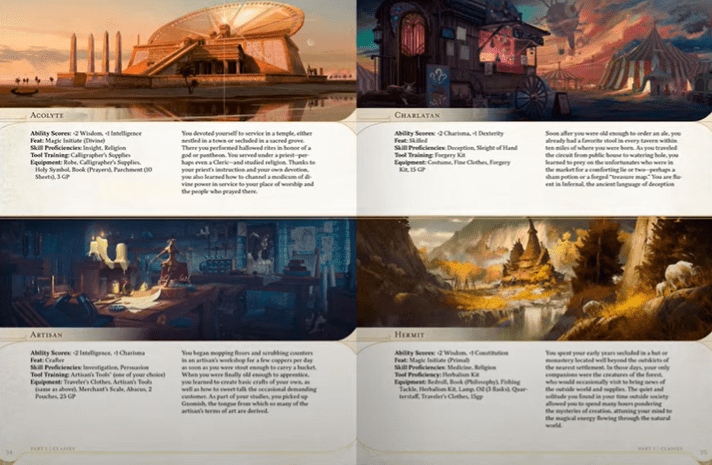
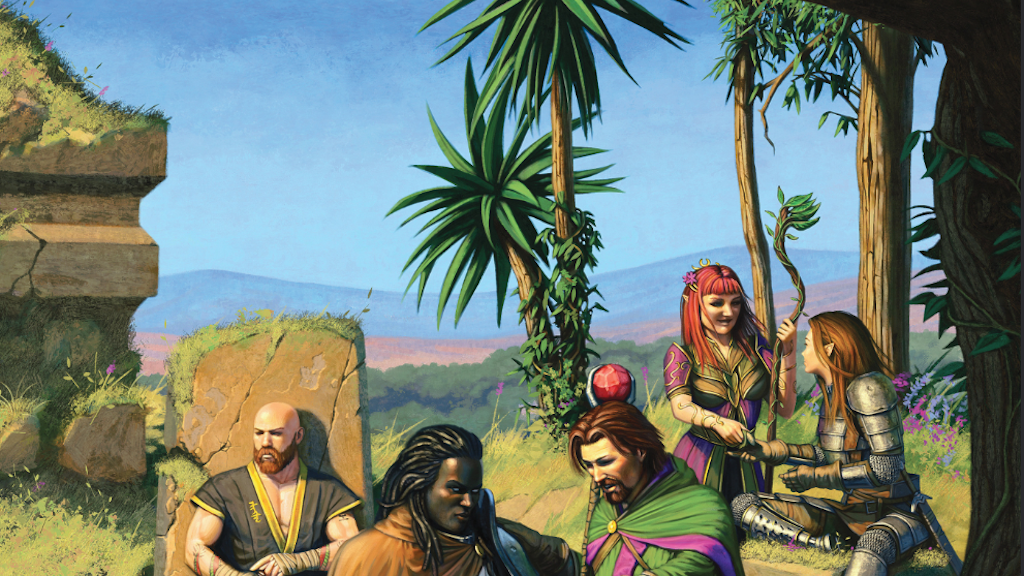
As part of the Worlds to-go! The Elysians Kickstarter I pitched PJ the idea of adding sports inspired by this magical world that is a conjunction of city-states, godly wilderness and island-hopping villagers. The microsetting we’re going for has some ancient Greek and Roman inspiration, flexing into similar tropes taken by the Percy Jackson series, a dash of Narnia without the chivalry and because I’m me dashes of magic in all things.
It leans into narrative as mechanics. The concept here is to describe the action your are taking using your specialty (an advanced 5e rule), skill and attribute in unique ways.
Normally I ignore individual sports as they can typically be done with a one roll roll-off. But Elysia had to have something inspired by the original multi-national sporting competition. So I added the Pentiad.
As the peoples are emulating the gods (a fun bit of lore I enjoy) there’s no such thing as cheating. Borrowing from The Magicians, I leaned into the concept that the gods have minds beyond people’s minds. Emulating the minds of gods meant no cheating. There’s no cheating! Do whatever you want for victory — that’s what the gods would do. Pursue victory using spells or even attacks. Just don’t kill people.
Throwing Stars is based off an ancient Roman juggling competition, adding in a dash of mysticism around the creation of constellations and turning it into a team event. Combat juggling is a modern thing that should be captured in this lore too. Throwing Stars takes combat juggling with magic and then instead of awarding points on surviving, awarding points on the artistry of the creation — a divine act.
When Throwing Stars what object or magic will you create to impress the gods?
You can check out Sports on the Fields of Elysia for free for a few days. It’s a proof of concept, not a final rule set. If the Kickstarter continues on its strong path you may seen the final version of the rules, along with two other team sports.
Try out the rules for sports. Tell us what you think.
Working with PJ over at Homebrew & Hacking, I’m helping put together a set of backgrounds and other elements for a micro-setting for use in the 5e D&D variant Level Up. Our project is tightly focused on a culture of temples, philosophers, oracles and city-states — Worlds to-go! The Elysians.
One of the reasons I chose a Level Up project rather than traditional 5e Dungeons & Dragons is that Level Up puts a large emphasis on Backgrounds and Cultures. Things like NPC connections, mementos and even advancement in that pre-heroic profession are featured in a Level Up Background. That fits how I want to tell stories using D&D.
I also listen to PJ’s podcast quite a bit, which I guess PJ just found out.
For the project some of my previous Backgrounds will be adapted, but there are also new ones that help fill the micro-setting of the Elysians.
Head over toKickstarterand click on “Notify Me On Launch” to see the project when it is live. The team PJ is putting together will provide you with some simple tools to help expand your D&D stories and maybe even tell the future.
There’s a blue super moon tonight, which feels like the perfect time to reveal “What we do on the sidelines FC.” This team is inspired by What we do in the Shadows, a fine vampire production.
Full Moon Storytelling was kind of the perfect fit for the front of shirt sponsor.
The orange is the keeper kit. I may need to talk to the corrupt league commissioner for one of those. When the season is done, I’ll be getting the “Strahd #83” jersey and maybe one of the other sub jerseys too.
If you want one of the pirate themed sub jerseys from Spring ’23 reach out to me. I do not need three, but will be keeping the Dread Pirate Roberts #6 (Wesley was #4 btw) top.
As I said last time I say again, maybe one of the players on the soccer team I sponsor will play Dungeons & Dragons for the first time because of this. Maybe not. That’s not the point. The point is my friends needed a tiny bit of help and I could help — so I did.
tl;dr – I’ve become a horse-race style observer of the D&D movie because I see the numbers as a proxy for acceptance of a hobby that remains just on the edge of pop culture.
It is inarguable that the D&D movie didn’t turn a profit at the box office. It was pulled from theaters after earning ~208 million dollars. Production costs were reported to be ~$150 million, some of that budget was higher due to filming during the early stages of the pandemic and across four nations (Iceland, Ireland, England and the U.S.A). Those costs were supposedly split evenly between Paramount and Hasbro, but Hasbro only held distribution rites in the U.K. and Canada due to their ownership of eOne at the time.
Paramount reported in Q1 that they spent at most $62 million on advertising the movie (that number is bundled with another film). Hasbro never revealed their ad spend, but did take a $25 million impairment due to the film not hitting theater expectations.
It is a highly rated film. And some would consider those box office numbers a failure or a flop. I have spent way too much time in certain corners of the internet arguing how it wasn’t flop or failure.
But my evidence isn’t raw dollar numbers. So why do I argue?
Part of it is because I’m a marketer that loves D&D. One piece of guidance I use is the massive increase in search around the movie.
Red is D&D the game. Blue is D&D the movie. The first blue spike is when the movie’s name was released. The second blue spike is the Super Bowl ad. The third is the release buildup. All are echoed more strongly in the game’s search results.
Search results don’t directly connect to purchasing. They are merely an indicator. But that indicator is strong, very strong. No other event in modern D&D has the spike creation that Honor Among Thieves did.
Also, a ton of people are still watching D&D: Honor Among Thieves. It’s been available in the United States via Paramount+ for more than three months. From its release week on streaming it has been a top ten movie every week.
D&D: Honor Among Thieves was #9 heading into this weekend.
Just prior to the current weekend it finally released in the U.K. and Ireland. It is number one on Paramount+ in both markets. When it was released in Canada on Netflix, it was number two for most of the first week. It releases on Amazon Prime globally on August 25.
It ranks when bigger box offices successes don’t.
Some streaming isn’t captured. For example, I just watched it on Alaska Airlines. It was the third listed movie in the New Movies section, again ahead of much more popular films.
For 35 days it was number one or two on iTunes. In the 110 days it has been available there are only seven days it is not in the top 10.
On Google Play it had a 44 day run at #1. Once on general release it has never dropped below 7th.
On Amazon it wasn’t quite as popular, but the D&D movie was still strong.
On less popular services it still did well, on Rakuten it just leapt to number one last week, for example.
How does a movie that fell a bit, but not a lot, short of financial success metrics (pre-March 2020 people would use a doubling of production+marketing, now the 1.5 is more common) do this well in the modern environment?
How did D&D: The Brand (not the game) have a 74% increase in revenue when the movie was a failure? Probably because of licensed goods. There are a lot of them. I bought the Healing Potion mints for example.
Why do I argue with people about this?
Again, I’m a marketer.
But I’m also a nerd who had his D&D books knocked out of his hands walking the halls of high school. I had a parent think that the game was the path to Satan. The moral outrage and general jocks v. nerds aspect of my relationship to the game came up a lot when I was interviewed for “Hero’s Feast: Finding Community through Dungeons and Dragons.”
I’m lucky enough to see, and help, my other main hobby grow in popularity. Soccer in America is mainstream. It’s popular enough in the Seattle area that a hobby website can go independent and fully employ at least one person.
And yes, there are similar successes in D&D. Critical Role is the largest of those. They aren’t alone. These are still often niche cases, and not an indicator of mainstream acceptance, as much as there can be a mainstream in a world where every hobby and interest has its own channel.
Honor Among Thieves was an opening for something like the mainstreaming of comics. It may not have gotten there. It might have. There’s still a D&D TV show in the works, as part Hasbro Entertainment and in cooperation with Paramount.
Paramount and Hasbro also keep expanding where D&D: Honor Among Thieves is available. That’s uncommon with niche properties. The Peripheral was just cancelled. Willow was cancelled. It’s easy to cancel shows and movies that aren’t massively popular.
Streaming continues to sort itself out. Paramount was late to the game. They are moving ahead of older streaming platforms because of their original movies and their deep catalog of TV.
And I guess that means D&D: Honor Among Thieves judgement as a financial success is a lot more like a campaign than a one-shot. There was no overnight hit, just a consistent leveling up and growth over the past six months as the fans of the game keep watching, keep showing others the movie and keep powering the growth of D&D to heights that us 1980s basement dwellers thought was just a dream.
Depending on sourcing (I’ll use Berlitz) that’s now languages one, four, five, twelve and Italian (outside of the top twenty) that have a free, open version of Dungeons & Dragons available to them.
I wouldn’t be surprised if Japanese is added soon, as WotC took over the Japanese release of D&D a couple years ago.
Chinese, Portuguese, Arabic and Dutch were the next most popular languages for Dungeons & Dragons: Honor Among Thieves that have not yet had an SRD released for them.