Category: Playing D&D

  • Neither darkness, nor snow, nor wyverns – the Message must be delivered

    Neither darkness, nor snow, nor wyverns – the Message must be delivered

    Worlds of points of light in a wilderness, or fallen empires, or warring kingdoms, or with merchant guilds that control trade need ways for far-ranging communities to stay in touch. In the real world this meant messenger pigeons, in the Potterverse they used owls, in Game of Thrones there were crows and ravens to communicate. Other fictions use dogs, or just a hearty human that trudges through awful conditions to keep the ties of society together — The Postman by David Brin, or the Pony Express in reality.

    Your Dungeons & Dragons worlds also need these messengers. They make sense and fit the fiction so well. A Messenger in D&D also doesn’t need to be confined to the animals of the real world. A Ravnica or Eberron game might use a tiny ornithopter. Fastieths fit in Eberron and parts of the Six Kingdoms. Spiders or bats fit in Ravenloft. There’s a flavor of messenger companion for every world.

    Photo by Jimmy Chan on Pexels.com

    Messenger

    You are the connection between disparate homesteads, towns, or cities. Conveying the messages and scrolls between the communities rapidly without magic you bring news, warning, and joy to peoples who often struggle to keep in touch or that would take weeks to travel and deliver the message themselves. Often welcomed in strange towns, a messenger sometimes wears an official uniform of a ruling power and at others is a freelancer working without direction from above. You and your messenger companion are a symbol of civilization even in the furthest outposts.

    Skill Proficiencies: Animal Handling, Nature
    Tool Proficiencies: None
    Languages: Two Languages
    Equipment: One animal messenger companion, travelers clothes, a scroll case with a dozen pages, a quill, an ink pot, a whistle or bell or other command device, a pouch with 5 gp

    Choose an animal that is your messenger’s companion and conveyance, and discuss with the DM how the companion will fit into the adventure. These come in four primary groups, and a few examples are provided. Don’t feel limited to the specific animals listed, but use them for guidance regarding their abilities, if, gods forbid, they enter combat.

    • Small land animals — cats, dogs, iguanas, otters, monkeys, not-quite-giant spiders
    • Medium land animals — axe beaks, ponies, fastieths, antelopes
    • Small flying animals — pigeons, crows, ravens, owls, bats
    • Fantastic animals — enchanted paper airplanes, clockwork machines, not-quite-giant dragonflys, flying snakes, stirges, not-quite-giant wasps

    Feature: Rivers and Roads

    Your messenger companion begins the game with a network of three destinations and the ability to find its way back to you where you sent it from. When delivering a message to a known destination on the network it travels at a fast pace and does so with no penalty to a stealth check (your messenger companion add your proficiency bonus and your Wisdom bonus to their stealth at all times). If you plan to move from your location when you send a message you can instruct your messenger companion to deliver the message and then go to a different destination. You and your messenger companions have a number of network destinations of proficiency bonus +1. If your companion perishes you must train a new one. This takes several weeks of downtime.

    Natural weather has less impact on your own travels. Survival and/or Constitution checks made due to harsh natural weather are made with advantage.

    Traits, Ideals, Bonds, Flaws: At this time use the Sage, Outlander, or Folk Hero for inspiration.

    Messenger Design Goals

    Starting with the idea that greyhounds would be perfect canine versions of messenger pigeons, this background just kept growing and growing in its scope. Eventually I spun out the Far Talker as a similar but different role in the world.

    One of the difficulties was coming up with the dual features. I wanted cover the US Postal Service’s unofficial motto which actually dates back to 500-449 B.C.E.

    Neither snow nor rain nor heat nor gloom of night stays these couriers from the swift completion of
    their appointed rounds.

    Emulating those words was vital, but needed to not be game breaking.

    The non-magically empowered companion couldn’t be built out of Find Familiar, which was considered. My world’s bonded companions are meant to be non-magical. While the phrasing of the ability is a bit long, it’s mostly an ability that adds flavor. The messenger companion is not going to change a D&D party’s combat power.


    Other Custom Backgrounds

  • Dragonlance appears in Unearthed Arcana

    Dragonlance appears in Unearthed Arcana

    The tea leaves seemed to indicate that Wizards of the Coast would be going back to Dragonlance. Once one of the strongest lines of fantasy novels, Dragonlance encapsulates stories of absent but powerful gods; mighty romantic heroes; that good and evil can work together; that it is always right to help those you love. Krynn was the first world upon which I ran campaigns. I own the Atlas of Krynn still. I owned the recipe book at some time. The first six books were as much a part of my youth as Lord of the Rings and Wheel of Time.

    For someone with this background, and who had stepped away from D&D for 20 years, seeing Heroes of Krynn be released as the latest Unearthed Arcana set of a nostalgia bomb. As a rather religious child, the allegory within Weis & Hickman’s books was something that was empowering. The tales they told were ones my even more religious mother could accept. Dragonlance was a path past the Satanic Panic.

    I’m ready for the land of naval Minotaur, Irda, Kender, and so many dragons. The UA only gave us one of those.

    Kender

    “These short-statured beings have a knack for producing the right tools in every situation.”

    What I like

    I love kender, just like I love halflings. Played kender in both a Dragonlance and a Spelljammer campaign back in my youth. All the flavor from history I like (I know many hated them). The modern take which says that their items aren’t stolen is good.

    Taunt is great. Bravery is good.

    What I don’t like

    There’s no need to make the Aces ability magical. Just say it happens. Let the lore of the campaign decide the how. Also, the options within the Aces are a complex layer of dice rolls and limited lists. ThinkingDM breaks out exactly which items you can find in your pocket.

    Will I use it in play?

    Absolutely. I’d allow them in my home campaign right now.


    Lunar Magic Sorcerer

    “You, or someone from your lineage, has been exposed to the concentrated magic of the moon (or moons) of your world, imbuing you with lunar magic. Perhaps your ancestor was involved in a druidic ritual involving an eclipse, or maybe a mystical fragment of a moon crashed near you. However you came to have your magic, your connection to the moon is obvious when you cast sorcerer spells.”

    What I like

    They got rid of calendar tracking, which is great. Most people don’t want to bother with tracking moon cycles. The payoff isn’t there for a majority of tables. Maybe if you have a table like my first one there’s one player who wants you to build a calendar and track that stuff.

    Adding spells to every Sorcerer subclass just makes sense. Please errata that into every Sorc.

    The flexibility to change what lunar phase you are attached to means you can be a different type of lower-case mage every day, and later whenever you want.

    What I don’t like

    There’s enough to keep track of when switching between lunar phases that most players will probably just settle on one phase, similar to how Eladrin are used in play. All the power of being able to switch isn’t useful if you don’t do it.

    Will I use it in play?

    Allowed immediately. My world has four moons, and it just makes sense for them to be connected to powers.


    Knight of Solamnia

    “You have trained to be a valorous warrior known as a Knight of Solamnia. Strict rules guide your every action, and you work to uphold them as you strive to defend the weak and oppose all forms of evil. Your honor is as important to you as your life.”

    What I like

    If you read Full Moon Storytelling regularly, you know I love backgrounds with more “oomph.” I love backgrounds in general.

    What makes the Knight of Solamnia more interesting than the standard knight is that it gets trinkets and it gets a feat.

    What I don’t like

    There are only suggested traits. This ignores the mechanical weight of backgrounds. The should get the entire TIBF system.

    Will I use it in play?

    Probably not. In my youth I was a bit of a religious zealot and knight fan, and would have played this constantly.

    I’m going to put the four feats related to this background here, because they’ll almost certainly be taken as a set.

    Squire Solamnia

    Your training in the ways of the Knights of Solamnia

    What I like

    Martial Training is better than two current feats that are rather weak. Then again, most character concepts that would take this feat don’t need any Martial Training.

    Encouraging Rally is a nice buff similar to warlord concepts, the Purple Dragon Knight, probably some bards. It’s nice side benefit.

    What I don’t like

    Defensive Rider is unlikely to come up in most games.

    The single use per day of Encouraging Rally is weak, but that’s to be expected since this feat is already about a feat-and-a-half.

    Will I use it in play?

    This will be allowed at my table immediately. No one should ever take Weapon Master or any of the armor feats except Heavy Armor Master (which I would just make Armor Master and allow the benefit of damage reduction to any level of armor worn).

    Knight of the Crown

    “You are a Knight of Solamnia aligned with the Order of the Crown, a group that extols the virtues of cooperation, loyalty, and obedience. You excel in group combat.”

    What I like

    Tactical Teamwork is another warlord-esque ability, which is great to see.

    The “feat chain” makes sense. You have to be a squire before you are a knight and locking this into level 4+ makes sense.

    What I don’t like

    Getting to use Tactical Teamwork only twice a day at fourth level is disappointing.

    Will I use it in play?

    Probably not. Reaction based advantage for close combat won’t come up enough for me.

    Knight of the Sword

    “You are a Knight of Solamnia aligned with the Order of the Sword, a group devoted to heroism and courage. Bravery steels your spirit.”

    What I like

    The extra saving throw proficiency granted by Disciplined Spirit is great.

    What I don’t like

    Tying Hit Dice into Willpower doesn’t feel right. Yes, hit dice are your own willpower, but is the strength of my will going to help a friend? I guess that fits many narratives, but I’m not sold.

    Will I use it in play?

    A moderate chance, especially if I play a Fighter that starts at higher level, because I would probably mimic the traditional Solamnia path of Squire, Crown, Sword, Rose.

    Knight of the Rose

    “You are a Knight of Solamnia aligned with the Order of the Rose, a group known for leadership, justice, and wisdom.”

    What I like

    Bolstering Rally is similar to Inspiring Leader, with a few more limits on how many times you can use it, but a likely larger amount of temporary hit points gained.

    What I don’t like

    Connecting Bolstering Rally to Constitution.

    Will I use it in play?

    Yep. Absolutely. This is great for so many characters I enjoy playing.


    Mage of High Sorcery

    “Your talent for magic came to the attention of the Mages of High Sorcery, an organization of spellcasters that study magic and prevent its misuse. You’ve trained among the Mages, but whether or not you’ll face the dangerous tests required to become a true member of the group remains to be determined.”

    What I like

    I said this earlier and I’ll say it again. If you read Full Moon Storytelling regularly, you know I love backgrounds with more “oomph.” I love backgrounds in general.

    Also, since you’ll get a tiny bit of casting from taking the background, I think I could play a failed Initiate with any class.

    What I don’t like

    There are only suggested traits. This ignores the mechanical weight of backgrounds. The should get the entire TIBF system.

    Will I use it in play?

    All fey peoples in my world start with the ability to cast spells, and it would make a lot of sense for them to use this background.

    This background starts a feat chain, like the Solamnia background does. They are with the one you gain upon getting the feat and then the three options you may take later.

    Initiate of High Sorcery

    “You’ve received training from magic-users affiliated with the Mages of High Sorcery.”

    What I like

    The attachment to one of the moons of Krynn is rather flavorful.

    What I don’t like

    1 cantrip and 1 spell is less powerful than the Solamnia version of the beginner feat. That’s probably fine if the character is already a spellcaster, since they are a bit more powerful than martials.

    Will I use it in play?

    Yep, though I would suggest just taking Magic Initiate instead.

    Adept of the Black Robes

    “Your ambition and loyalty to the Order of the Black Robes has been recognized.”

    What I like

    Throwing your own essence into your damage spells via Life Channel is the type of story creep I love. I’d usually just use odd number of HD because the rounding up statement.

    The 20 spells you can select when you gain this feat.

    What I don’t like

    Ambitious Magic ties back to the ability score increase from Initiate of High Sorcery, which might mean you have two different spell casting stats.

    Will I use it in play?

    Yes. It’s dark and nasty, and a way to channel your own life force into killing things.

    Adept of the Red Robes

    “Your pursuit of truth and dedication to maintaining the balance between all things has been recognized by the Order of the Red Robes.”

    What I like

    Magical Balance is kind of a like a minor divination type benefit. It’s fine.

    The 30 spells you can gain from this feat.

    What I don’t like

    Insightful Magic ties back to the ability score increase from Initiate of High Sorcery, which might mean you have two different spell casting stats.

    Will I use it in play?

    Didn’t like Red Robes in the 80s and I don’t like them now.

    Adept of the White Robes

    “Your oath to use magic to make the world a better place has been recognized by the Order of the White Robes.”

    What I like

    Protective Ward is almost exactly what the Abjurer from the PHB gets, but now you can get it as a cleric, bard, druid, paladin. That’s great.

    The 17 spells you can select with this feat.

    What I don’t like

    Protective Magic ties back to the ability score increase from Initiate of High Sorcery, which might mean you have two different spell casting stats.

    Will I use it in play?

    I want to use it yesterday. This would have been great with Awf.


    Divinely Favored

    “A god has chosen you to carry a spark of their divine power.”

    What I like

    In Dragonlance alignment matters. Connecting the spells gained to your alignment is perfect for this setting.

    What I don’t like

    This is weaker than Magic Initiate and the only reason to take it is to get Divine Communications later.

    Will I use it in play?

    No.

    Divine Communications

    “Your connection to your god deepens”

    What I like

    Augury and Commune are potent story devices when used well. Taking this feat is a clarion call to your DM that you two will be regularly talking to gods.

    What I don’t like

    This makes Linguist useless (it already was).

    It’s easy to lose track of 1d4 long rests for two different spells. Your abilities will recharge on different days.

    Will I use it in play?

    I think this should be allowed without Divine Favored, and will be at my table.

  • Exploration in Dungeons and Dragons 5th edition

    Exploration in Dungeons and Dragons 5th edition

    This is a wonderful overview of approaches towards the Exploration Pillar of D&D. Mostly, I lean towards Progress Clocks, with a dash of Point Crawl.

    GM Raakam's avatarGM Workshop


    Hexcrawls, pointcrawls and other options for exploration in D&D


    D&D 5e boasts three pillars of gameplay. Combat, Roleplay and Exploration. We’re going to offer some ideas on how to run Exploration for your games.

    Narration

    If the area is not threatening or if there is nothing of consequence, it’s perfectly fine to tell your players “this area is safe. The roads are maintained by the Queen’s guards, merchants travel these roads in caravans as well as the occasional vendors and inns you’ll encounter along the way. Is there something you want to do on your way to so and so?”
    You can introduce some merchants, any npcs that might relay plot points (Oh, you’re heading to the swam of fondue? I heard that there’s a big mean dragon there!), or perhaps the players would want to roleplay some moments when they’re setting up the campfire for the night. Unless there’s…

    View original post 907 more words

  • Far Talkers – Converse over miles with this D&D Background

    Far Talkers – Converse over miles with this D&D Background

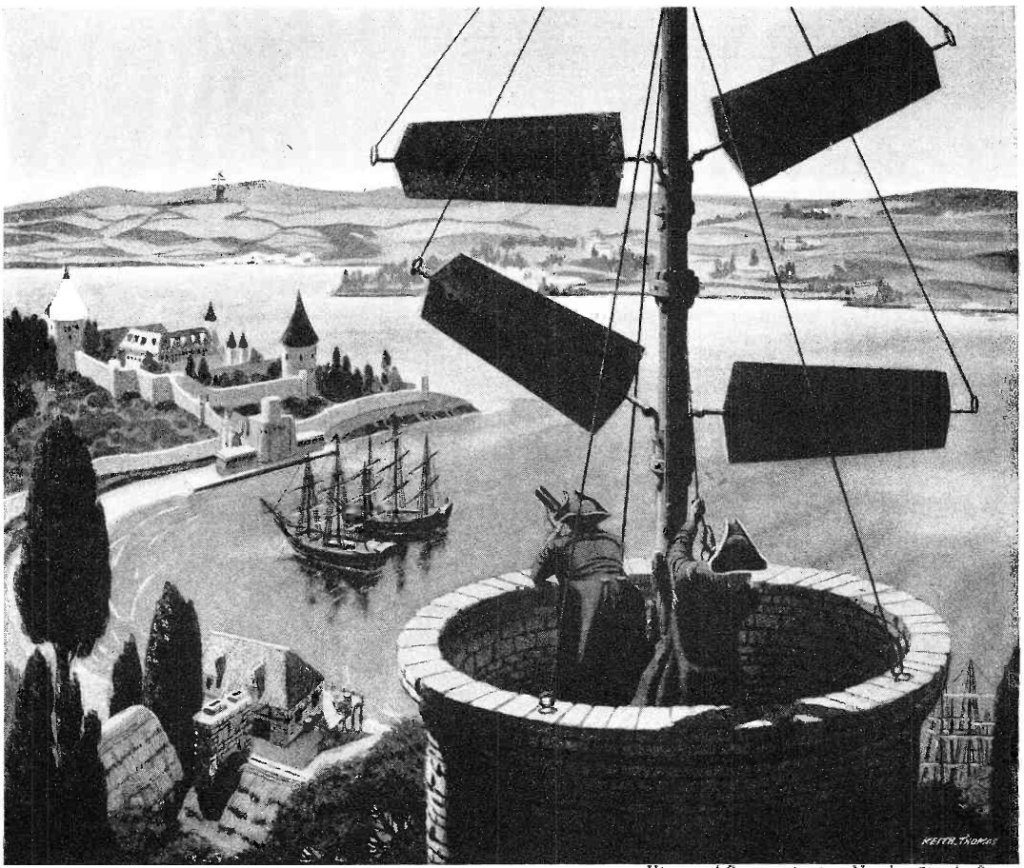
    As a horde of humans riding guard drakes crests the Blue Hills, the chappe telegraph operator builds the signal that will reach the Larton Keep now that war has returned to the range. Using whistles, a youngster tells the village miles away that four sheep are lost so they’ll be home late, could his family please have tea ready for when they return.

    A thrumming beat injects itself into the air as an owlbear stalks a deer. Knowing the bear is nearing a sacred vale a group of druids and rangers work to separate hunter and prey, for there will be no killing in Frannet’s vale.

    The drawing is signed “Keith Thomas” in lower right corner – Retrieved June 11, 2014 from Radio News magazine, Ziff-Davis Publishing Co., Inc., New York, Vol. 32, No. 5, November 1944, p. 71 archived on http://www.americanradiohistory.com/, Public Domain, https://commons.wikimedia.org/w/index.php?curid=39352497

    Sure, a spell caster might be able to use Message, or two people may have Sending Stone for magical cell phones. But, the Far Talkers converse over a distance of miles, not feet. They speak with many, not one, signaling a warning or just chattering about the weather. Far Talkers and Messengers help societies that stretch over leagues communicate and maintain a culture.

    Far Talker

    You have the ability to converse over miles, sending messages for a government, faction, or some other organization. In war societies seek your aid to help units communicate. In peace you and other Far Talkers help connect towns and cities, or just keep two distant wizard towers in touch.

    Familiar with how the weather impacts your mode of speech you have learned the winds and rains of many lands. Expected to see or hear things at a great distance your senses are strong. You may be an expert at the drums, but you have heard of others who use whistles, tree beating, smoke, flags, or other instruments. No matter what tool is used your messages are simultaneously public and semi-secret.

    Skill Proficiencies: Perception, Nature
    Tool Proficiencies: One musical instrument
    Languages: One additional, plus the ability to Far Talk in Intelligence bonus languages (minimum 1)
    Equipment: A symbol of service to a government or large church, a gaming set, a spyglass or musical instrument, traveler’s clothes, a notebook with notation for your type of far talk, 1 day rations, pouch with 2 gold

    Feature: Far Talking

    Using your chosen tool you can communicate over a distance of 6 miles when outdoors, and twice normal speaking distance when indoors, in a number of languages equal to your Intelligence bonus (minimum 1). Extreme weather may make those long-distance conversations more difficult.

    When you meet another practitioner of the Far Talking arts they are always one step friendlier than their companions or social situation would indicate. For example if two scout groups from warring nations met their far talkers would be indifferent while everyone else was hostile. This is true even when the far talkers in question use different languages and tools to talk.

    Learning Far Talking

    A character without the background can learn Far Talking per the rules to learn a new language. They would then learn one method of Far Talking for a single language.

    Some groups of druids, rangers, and their allies might spend time learning Druidic spoken via Whistle Cant. A fleet of pirates could all know Yodeling. Have fun with this.

    Types of Far Talkers

    Roll on the table below or pick your favorite

    1. Whistle Cant
    2. Talking Drums
    3. Smoke Signals
    4. Signal Flags
    5. Tree Drumming
    6. Yodeling/Throat Singing
    7. Bugle
    8. Optical Telegraph

    As always, seek ways that cantrips would enhance these. Those that rely on sound would be amplified by Minor Illusion, Thaumaturgy, and can you imagine Thunder Clap sent through a massive bugle-like device. Those that need light can be made more useful by Prestidigitation, Dancing Lights, Light, and Minor Illusion. A world of magic would have Far Talkers that can speak across many miles.

    Personality: Use the Soldier or Folk Hero personality traits for now. When the Background project is done each new Background will have traits, ideals, bonds, and flaws that are unique to the Background.

    Design Goals

    The Far Talker started out from two different ideas — I wanted to create Whistle Cant as a kind of alt-Druidic and my desire for the Messenger Background. The Messenger became two different Backgrounds. That Messenger will focus on the people who deliver physical messages by walking, running, riding, etc. The Far Talker is the other version. Rather than become Druidic, Whistle Cant became a type of Far Talking, and one of several examples of alt-languages that a Far Talker might specialize in.

    Custom Backgrounds for 5th edition Dungeons & Dragons

  • Bladesingers and Eldritch Knights should have Smite and Strike spells

    Bladesingers and Eldritch Knights should have Smite and Strike spells

    Using Green-Flame Blade, Booming Blade, and Lightning Lure gives these two subclasses much of the feel they need. Both invoke a feeling of characters who use their weapons while slinging spells. So does the Hexblade, the Battle Smith, some Paladins, and some Rangers.

    Unlike when the Hexblade and Battle Smith were added to the game, the Bladesinger and Eldritch Knight didn’t get access to spells like Thunderous Smite or Zephyr Strike or Ensnaring Strike. The Smites all fit the two narratives. The Strikes are just the two previously listed and Steel Wind Strike.

    Photo by Anastasia Lashkevich on Pexels.com

    A Dungeon Master that adds these ten spells for their players helps that player play a character who fits the mold as a weapon-caster. Giving a PC a few moments a day, because they take spell slots, when that character emphasizes the vibe of the fiction that inspires their character is great. They aren’t stepping on the toes of the Paladin (who has the Smite feature still) or the Ranger (because Favored Foe and Hunter’s Mark are their combat signatures).

    Ten spells and your players will be more like the character they want to be, without the need to be a Hexblade sworn to a odd mystical sword, a Paladin sworn to a cause, or a Ranger protecting civilization from the Wildes.

  • Who is the new D&D Rules Expansion Gift Set for?

    Who is the new D&D Rules Expansion Gift Set for?

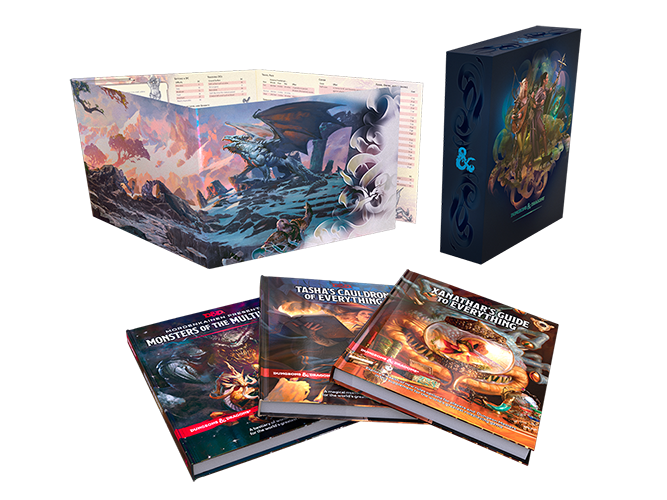
    There’s a new official Dungeons & Dragons book coming out on Tuesday, but it’s bundled in with the Rules Expansion Gift Set. Due to all of this that we’re living through [waves hands at world] the Gift Set didn’t come out in time for the peak gift-giving time of year. Instead, it’s an oddly timed late-January product with the only “original” part of it not available until May 17.

    Image from Wizards of the Coast

    As is typical alternate art is available at your local gaming store, which you should support. In Renton you can go to Wizards Keep Games or Shane’s Cards. People on the Eastside should go to Mox Bellevue. Down in Tacoma check Tacoma Games. Those are all places in Greater Puget Sound that I’ve supported and am confident in.

    What’s in the Gift Set?

    There are three books. Xanathar’s Guide to Everything and Tasha’s Cauldron of Everything are just reprinted with the latest errata. There’s a new(kinda) book called Mordenkainen Presents Monsters of the Multiverse. You’ll also get a DM’s screen with some tables to reduce page flipping when you play in person. Screens can be quite handy.

    Additionally there is a fancy slipcase to hold everything and look really good while it sits there.

    That kinda sticks out doesn’t it? Monsters of the Multiverse has one new monster. Those that already own Volo’s Guide to Monsters and Mordenkainen’s Tome of Foes will already have every other monster and nearly ever race, but in a different form. The new book has adjustments to the stat blocks to make them a bit more powerful and a bit easier to use. Also, those two earlier books (Volo’s and Tome of Foes) have dramatically more lore. Most of that lore is Forgotten Realms specific. The new book greatly minimizes the lore elements to what is true for a race or monster, typically, throughout the multiverse of D&D play.

    Between the three books you’ll get rules for the Artificer class, a couple dozen new subclasses, over 30 new races, gobs of new magic items, many spells, and some new rules for exploration and be social parts of the game.

    Reviews of Mordenkainen Presents Monsters of the Multiverse

    So who is the new product for?

    The person who most needs the Gift Set is someone who is recently deep into the game. For all intents this set is the second core of the game, with rules that help both players and dungeon masters. Those players that only have the Player’s Handbook and want to dramatically expand their options will enjoy the set (talk to your regular DM beforehand just in case they don’t want certain subclasses or rules at the table). A Dungeon Master who wants more monsters, traps, and puzzles will get great use from the Set if all they have are the three core books. Monsters of the Multiverse is particularly helpful for those who homebrew, as the weight of lore won’t interfere as much as Guide to Monsters and Tome of Foes.

    Maybe certain collectors will want the new set too. There’s an appeal to that. But, I don’t have that kind of room in my house or wallet. The new art and case are great though. When I have that kind of room this might be the set that finds its way into the background of a video meeting.

    Overall the set is the next three books a D&D fanatic should get if they don’t have the four books that make up the Gift Set already. If you already have those books it may not be meant for you. Wait for the three or more other books that will come out in 2022 or keep playing with what you already own.

  • Try inverting your D&D encounters’ difficulty

    Try inverting your D&D encounters’ difficulty

    Typically in Dungeons and Dragons an adventure consists of some easy encounters, some hard encounters, a deadly encounter, and then the final encounter. The way characters level up over a campaign echoes this progression.

    Heck, this is even typical in most stories. The heroes may see a deadly monster early, but they don’t fight it until they are more powerful. Or, in the course of a D&D adventuring day, when they’ve used some amount of resources, thereby making the final monster more deadly.

    Through a happy little accident of misreading some stat blocks, my last set of sessions inverted this process.

    Rather than meet goblins, then hobgoblins, then an ogre climbing that ladder of difficulty, the group started their day with a CR 7.6 encounter, next was a CR 6.25 encounter, and then a CR 3.

    That released some opportunities for the players. The happy little accident meant that during that tough encounter they used a bunch of powerful abilities rather than keep them in reserve. During the second encounter they used more.

    Then, finally, when they met the “boss” (who was actually the boss of the various Dragon Sworn*) they only had a couple abilities left. That meant it felt deadly, but really wasn’t. They won easily.

    * For this I used the Fizban’s Dragon Blessed, Dragon Chosen, and Dragon Speaker

    Overall the group was tested, more so than typical in my sessions. Also, they got to use more of their potent features. If I better telegraphed the inversion, like if it was planned, then they would have used even more of their limited powers.

    When a player invests in a character having certain abilities they need to be able to use them. This accident utilized more powers in one day then I’ve seen in some time.

    Now they’ll try to rest.

  • The Normalization of D&D in Media

    The Normalization of D&D in Media

    Over the years mainstream media has shifted from acting as if Dungeons & Dragons was connected to Satan and murder, to acting as if players were just nerds in basements to be ignored, to being nerds in apartments to be mocked (Big Bang Theory), to superpowered nerds to save the world (Stranger Things), to now just people who like something that other people don’t like (Ghosts) without any judgment of the game.

    The D&D episode of CBS’ Ghosts will re-air as part of the Ghosts marathon on December 23rd.

    Seeing this shift, which I’ve lived through every moment of, still amazes me. Yes, there were times when genre shows featured D&D. Stranger Things made sense. The game fit and was featured in the story.

    The current status of the game is different. This isn’t some niche hobby anymore. Active football players play; Jack Black plays; there’s a regular show on cable TV that is D&D.

    Ghosts did something different. One of the main characters mocked the game, but the way D&D was featured wasn’t a mockery. Instead, Dungeons & Dragons was a way to further establish fellowship between the diverse cast of ghosts and the one living who shares their space and cannot see them. Also, the d20s helped solve the other plot of the episode. Lead writer Joe Wiseman addressed this on Dragon Talk recently.

    Every time I encounter the featuring of D&D as normal continues to astound me. Once forced to hide my passion for the game or get the books knocked out of my lap as if real life was a crappy teen comedy, now D&D is popular and mainstream enough that it is on my resume, talked about during job interviews, played in public, and can raise money for charity as celebs play.

    Much of the mainstreaming of the game is because many of us nerds that hid in our basements are now of the age that we are in positions of influence. While it is Zoomers and Millenials that are the fuel spreading the game, GenX leadership is normalizing it.

    Writers rooms throughout Hollywood played as kids and are playing again, as are the actors, cinematographers, set designers, etc. Video game designers (and all of the support staff) played with pen and paper, then translated that to big screen.

    D&D’s tropes are mentioned in genre fiction (Onward!) and regularly trend on social media. There’s not a day that goes by that an Alignment Chart meme doesn’t show up.

    Now that we’re mainstream there’s always that worry among us olds that things will change in ways that we don’t understand. But at it’s core D&D has always espoused that a “diverse group is a strong group.” And all of the current changes lean into that trope that started with the Fighting-Man, Magic User, Thief, and Cleric that were also a Dwarf, Elf, Halfling, and Elf.

    Leaning into that means more players, more games, more chances to “roll for initiative.” That’s all I want.

  • Narrative character creation in 5th edition

    Narrative character creation in 5th edition

    Story is modern roleplay gaming. But, character creation per the Player’s Handbook is mechanical. It doesn’t have to be. It can follow a narrative; this is how.

    The character creation order changes a little bit with this method. Now it’s almost as if your character is going through childhood and adolescence while you and the DM (ideally together) go through this process. Kind of like filming a documentary, together you discover the journey from birth to hero. Take notes and get the feeling of the story that created the personality that will exist at the table later. If the player talks about history or backstory that doesn’t yet exist in your world, they are there creating it with you. This empowers the player to help with worldbuilding and creates bonds between the character and the past.

    I’ve done this with two players so far. The following has the steps of process and a practical example.

    Tell me about your parents

    This is the first lead. The DM is trying to figure out a bit about the homeland and race of the parents. They don’t need to be known (orphans are common in our base literature), but at the least get a few words describing origin country and race. Write those down. Get their given name now. Maybe their adventuring name is different, but when they are born, they are named.

    My first player said his parents were a merchant family from Southern Kirtin. They’d lost their lands when Daoud took over. They are halflings that abhor Azsel.

    Race: Halfling

    Are you strong, intelligent, wise, a leader, nimble, healthy?

    As the DM I generated a random point buy array and asked for the player to describe their character traits that they exhibited as a youth. Were they the type that led groups or shy? Did they throw rocks, or work in the mill? Maybe they were sick, or never got sick when others were? Some people read a lot, or read people. Distribute the six scores based on the answers given.

    This player said that they were a bit of a leader playing with the kids, generally healthy, tended to know and understand people. They were a bit weak (halflings in Everflow have minuses to strength).

    STR: 7 | DEX: 16 | CON: 14 | INT: 11 | WIS: 14 | CHA: 14

    Your parents did what? Did you follow in footsteps?

    The answers to these questions determine Background, and help guide you towards Class. They aren’t the answer to class, but do influence it. A lot of personality gets built out here. The Personality Trait, Ideal, Bond, and Flaw should be apparent from this conversation. If it isn’t offered, the DM can probe a bit more.

    In our example the character was raised by a merchant family that wanted to do everything right, that as a family wanted to regain their lost market in Kirtin-on-the-Lake and as the youngest of the trade family he’d been swindled once or twice, so he’s a bit suspicious of that.

    Background: Merchant with skills in Appraiser’s Tools because he doesn’t trust and Vehicle’s (Land) because he was the youngest son.

    What makes you special?

    Ask about the time that the character discovered that they aren’t common, but instead began to know that they are a hero. Have them describe it. Did they fight with arms, pick up a bow? Maybe they stole something? There should be indications towards class here. The experience may be a bit like a tree where the branches are melee or magic. After that the split might be sneaky (Rogue), hefty (Fighter, Barbarian), ranged (Fighter, Rogue, Ranger) or divine (Cleric, Druid), arcane (Wizard), discovered (Sorcerer), pledged (Warlock, Paladin). Are they principled (Monks, Paladins, Clerics)? This is likely the longest conversation you have during narrative character creation. Throw them some experience for wonderful ideas that surprise and entertain you.

    But during this section you’ll come away with their Class, their options like Fighting Styles, or Faith, or Wizard school, etc.

    Our example character was someone who had a caravan raided. He wasn’t a fighter, and didn’t know magic, instead he helped. He distracted the opponents, or warned his guards. Throughout the fight he was helpful. After the fight he repaired the cart, and returned the goods.

    Class: Uncommoner (this is a homebrew that may be public soon)

    Altogether it isn’t a major shift. Maybe some tables already do similar. For me it created a process shift from “this is what I am” to “this is how I came to be.” That adds some depth.

  • Errata for December 2021 mostly focused on helping your character be yours

    Errata for December 2021 mostly focused on helping your character be yours

    The semi-regular blog by the D&D team at Wizards of the Coast released today is from Jeremy Crawford, folding in Sage Advice and Errata updates.

    Four rules answers are shared, all about spells. The biggest impact on my games would be the clarification that spell attacks are not spells. This means Counterspell and similar are not effective against the consolidated stat blocks for monsters in the latest and upcoming releases. Also, Silvery Barbs is ineffective against Legendary Resistance, which shouldn’t be a surprise. The other two questions seemed to have obvious answers, but the clarification helps.

    There is a significant change to Drow, and that connects to most of the player-facing Errata updates.

    This new text replaces a description that confused the culture of Menzoberranzan—a city in the grip of Lolth’s cult in the Forgotten Realms—with drow themselves. The new text more accurately describes the place of drow in the D&D multiverse and correctly situates them among the other branches of the elf family, each of which was shaped by an environment in the earliest days of the multiverse: forests (wood elves), places of ancient magic on the Material Plane (high elves), oceans (sea elves), the Feywild (eladrin), the Shadowfell (shadar-kai), and the Underdark (drow). Drow are united by an ancestral connection to the Underdark, not by worship of Lolth—a god some of them have never heard of.

    Sage Advice December 2021

    Within the nine books that have Errata updates that theme is extended.

    The Player’s Handbook sees 15 of 22 new changes being related to Alignment. The most common change is “The “Alignment” section has been removed.” No longer are characters going to be directed towards certain behaviors. They are, instead, the heroes and anti-heroes of the story — unique and special.

    “The “Alignment” section has been removed.”

    Volo’s Guide to Monsters and Sword Coast Adventurer’s Guide (which is not only still in print, but still getting updates!) have similar changes to their PC-facing content. Volo’s also notes that Volo himself is an unreliable narrator with almost all of his experiences being confined to the Forgotten Realms.

    “The lore in this chapter represents the perspective of Volo and is mostly limited to the Forgotten Realms. In the Realms and elsewhere in the D&D multiverse, reality is more varied than the idiosyncratic views presented here. DM, use the material that inspires you and leave the rest.”

    Volo’s Guide to Monsters Errata

    SCAG has some changes to the Sun Soul Monk and the Swashbuckler that bring them in line with these subclass’s appearances in other books.

    Overall the Errata focuses on the concept that only canon that matters is what’s at your table, and that your character is yours. All nine books with Errata in the last year are linked at the Sage Advice update.