Category: Playing D&D

  • Adding Culture to your game: A new tool

    Adding Culture to your game: A new tool

    Languages in most Dungeons & Dragons settings are rather rudimentary. There’s the pidgin-trade tongue of Common (and sometimes Undercommon). From there, the typical known languages are based on races and the planes.

    A character might know Common, Elvish, and Primordial for example.

    This is bland, unnecessary, and lacks verisimilitude (people don’t either know or not know a language).

    Get rid of languages.

    They rarely come up at the table. For most tables, languages are simply “You can communicate” or “You must use gestures.” Few encounters are successes and failures based on the 3-7 languages a character knows.

    Instead replace them with Culture: NAME.

    This then replaces Intelligence (History). This small tweak aids deeper connections between certain character classes and backgrounds with the world in which they are played.

    What do you gain from adding Culture?

    Especially in games with heavier social and exploration pillars you have a better idea of what your character knows. Rather than have a wood elf raised as an urchin on the streets of Waterdeep be capable of talking to every single elf in the world, as if language is hard-coded in the soul, it is instead a learned thing.

    Said wood elf would instead know Common and the Culture of the Sword Coast, able to communicate with the peoples in and around Waterdeep, as well as knowing the traditions of the various peoples, their symbols, their stories.

    The characters are deeper, with more connections to the world in which they play. A Fighter-Sage would be intimately familiar with many nations and cultures, rather than just a few and whatever the DM determines is known through a d20. A character that has studied the Dalelands would know the holidays, conflicts, and ways to communicate that are common in the the Moon Sea and the Inner Sea.

    At its simplest with Culture, you know more.

    What do you lose by removing Languages and History?

    Not much.

    The characters will still be able to communicate as always. There may be a perceived penalty for a few backgrounds, but there is a fix for that.

    There is additional bookkeeping. You will have to use a custom language on DnDBeyond.com, for example. You do this by clicking on Languages on the character sheet on the website (the app may be different). Then click add proficiency. Then select custom language. Add the culture you choose. If you skip language selection during the creation process you’ll now have a listing of Common plus the Cultures your character experienced and/or studied.

    How does adding Culture work when building a Player Character?

    While building your character in the standard order (Race, Class, Background) take note of every language learned. Each of these are replaced with adding a culture for each language.

    When you would take History you would now have the option to take another proficiency or take a culture.

    Additionally, I would encourage most tables to use a PC’s Intelligence modifier to add (or subtract) from known cultures. This is mostly because Intelligence is undervalued within the game.

    Example: A High Elf, Fighter, Sage would begin knowing as many as 8 cultures known. This would represent their studious familiarity with many peoples.

    How do you use Culture?

    Use Culture like you would use History, but apply it like a tool. Most often it would connect with Intelligence, but there are times when your proficiency in a culture would apply to a check based off of Wisdom (if a character isn’t proficient in Insight their awareness of the opponent’s culture might help them) or Charisma would apply.

    Knowing a culture of a peoples with which you are interacting is particularly helpful in social encounters. A character familiar with a particular empire should be able to take advantage of that knowledge at the table!

    Are you familiar with the Dalelands? Then you would recognize their heraldry, for example. Hidden societies, or subsets of a culture may require a check (DC: 15) to see if you have studied or are aware of that aspect.

    Practical Examples of Cultures in D&D

    Within the World of the Everflow, a rather narrow setting, the following cultures would be available;

    • Western Wildes
      • Ancient Sheljar
      • Ancient Gallinor
    • Kirtin
    • Daoud
    • Crinth Confederacy
    • Azsel
    • Mehmd
    • Gobkon Union
    • Dragonken
    • Church of Quar (yes, this is cross-national group with influence throughout the continent of Kin)
      • There are other faiths and cults that may be appropriate
    • The Scholars and Proctors of Grace

    In a more explored and developed setting such as the Forgotten Realms I would recommend using the super-national regions such as, but not limited to the Sword Coast or the Dalelands or Chult. If you are a member of a Faction, assume that you know their Culture too. The list of political groups, religions, factions, and other strong cultural groups within the Forgotten Realms would fill an entire wiki.

    If you are playing in Eberron: Rising from the Last War the various nations of Khorvaire would all be appropriate Cultures as would most of the religions.

    Tables that use other setting would have to assess that setting. Do not make the cultures too narrow, nor too broad (then you just have the language problem, but different).

    Fediverse Reactions
  • Goodbye Alignment. Hello short-form personality.

    Goodbye Alignment. Hello short-form personality.

    Alignment is tired, boring and essentially meaningless in 5th edition Dungeons & Dragons.

    Many playing the modern game trying to replace it with personality. Wizards of the Coast tried to take major steps towards personality play with their Traits, Ideals, Bonds and Flaws system attached to backgrounds. That system uses five sentences of 5-25 words to describe the personality of the character. Alignment also exists.

    Then, if the DM and/or the other players remember your TIBF and you play to it you might get advantage via Inspiration.

    It’s a bulky system that requires memorizing a lot of detail that aren’t necessarily relevant to how your character is played. The Acolyte is in the SRD 5.1 CC BY. Here’s a sample of TIBF for a lawful good Acolyte.

    I see omens in every event and action. The gods try to speak to us, we just need to listen.
    I quote (or misquote) sacred texts and proverbs in almost every situation.
    Faith. I trust that my deity will guide my actions. I have faith that if I work hard, things will go well. (Lawful)
    I would die to recover an ancient relic of my faith that was lost long ago.
    I am suspicious of strangers and expect the worst of them.

    That’s 82 words plus two for lawful good. But really, it’s just a few. You don’t need that much detail.

    Just like when you fill out that your character has brown or brown-green eyes you know there is more detail to the eyes than just that word or two. You can do this for your personality.

    That Acolyte?

    Faithful, Suspicious, Orderly, Erudite.

    Replace the entire TIBF system with those four words. Can you memorize a few words that describe how the other characters in the party act? Absolutely! Your mind was already taking the shortcuts on the way to do so.

    Then award inspiration when the character is played along their personality.

    You could build your short-form personality using the official background information already provided. That’s a great start. But you could also use a list of personality traits. Here’s 638!

    A character modelled off a favorite movie or TV or comic or book or video game or etc character could use their traits too.

    • Margot from The Magicians — sexy, strong willed, crass, loyal
    • Wesley from The Princess Bride — dedicated, adaptable, loving
    • Tasselhoff from the original Dragonlance – friendly, curious, brave, aloof
    • Moiraine from early Wheel of Time – determined, withdrawn, studious
    • Lan from early Wheel of Time – lawful, loyal, commanding
    • Awf, my PC in Lost Mines – persistent, exuberant, fearless

    The intent with short-form personality is to reduce memorization, reward roleplaying and continue the de-emphasization of alignment in D&D.

    Be generous with the Inspiration you award. Play up the personality. Just make it simpler than a system that might require 100 words when you only need three to five.

    Fediverse Reactions
  • Adapting Genoan revolutionary lunches to fantasy third places

    Adapting Genoan revolutionary lunches to fantasy third places

    During the Age of Revolutions the leaders who wanted liberalization and democracy in Genoa had no idea how to govern. They were a bit idealistic. They struggled to get the various classes of this significant mercantile kingdom to get along.

    This all comes up in a recent Nerd Farmer podcast featuring Nathan Perl-Rosenthal. And it’s going to inspire a new third-place tradition in my Dungeons & Dragons world.

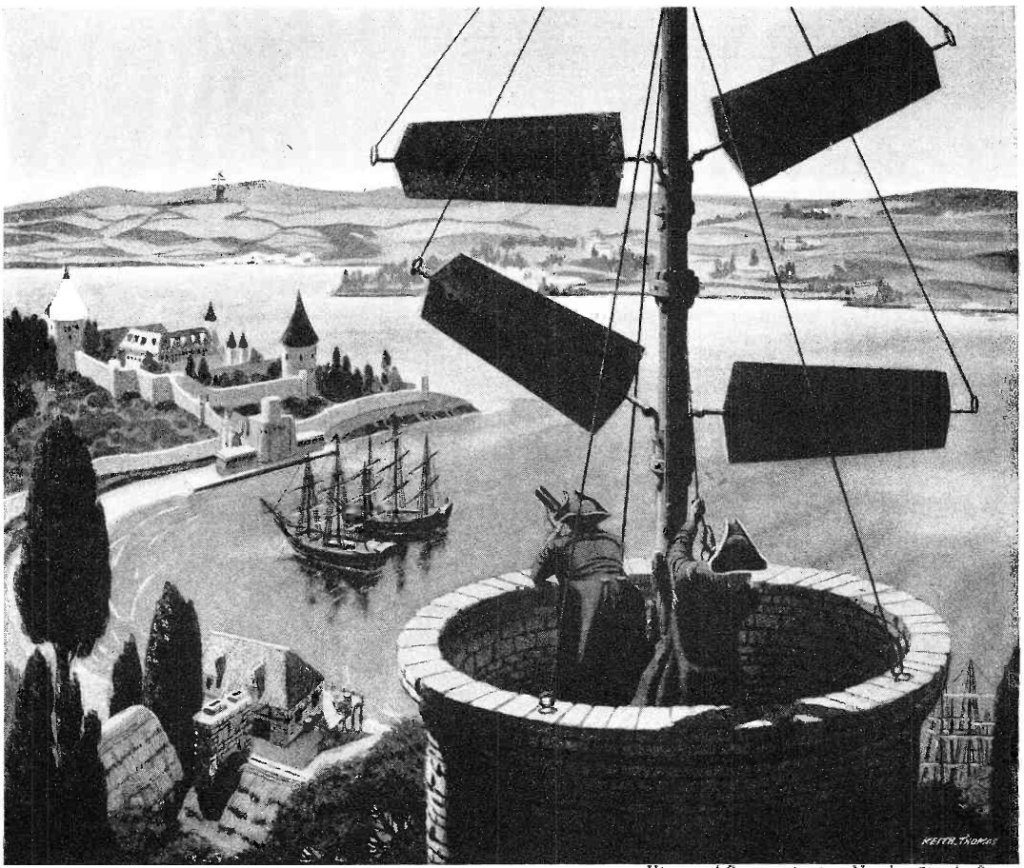
    By Aldan-2 – {{[1]}}{{[2]}}, CC BY-SA 4.0

    One of the ways the Genoan revolutionaries tried to create cross-class conversations was by mandating public lunches be held on the streets before festivals. These lunches would be funded by the elites, had limitations on the number of courses and were intended to inspire conversation before the entire group proceeded together towards a town square for fest time.

    This attempt at a third place being a space in time rather than a physical building intrigues me. That porch was only a third place during the luncheon, roughly every two weeks. It didn’t work.

    This is a fantasy blog, mostly about a fantasy world where dragons and magic are real. Let’s make the Genoa public luncheons real.

    My world has a naval empire, which makes this easy. But it is rather hierarchical and centered on the influence of the navy as sailor-citizens with power and influence. It is expansionist. Daoud won the war with Kirtin twice, and just lost their hold on Kirtin-on-the-Lake, the winter capital of Kirtin.

    Douad’s fleets sail the seas trading goods, conquering territory and bring their wealth back to the homeland.

    Daoud is the southern nation and controls the Green Isles in the Southeast.

    This is where the lunchtime third places come in!

    These now-wealthy sailors, officers and captains are required, by the Admiralty of the Land, upon returning to port to share their wealth and throw a party in the neighborhood from which they came.

    They lunch and fest together, with the Admiralty and Royalty surprising random porches with visits.

    This now ingrained tradition started because when the first ships came back with massive wealth they were seen as a threat to the non-sailing gentry. So that leadership in a form of taxation started the luncheon program. This kept the peasants that didn’t sail happy with the leadership and that joy spread.

    These lunches are simple fare — three courses, one which must always be from the land the ship just visited. There’s always a flatbread, that was originally simple but is now treated as a complex way to serve a fourth course that is not in violation of the edict. There is wine and coffee, tea and liquor.

    There is joy.

    Then there’s the party, always in sight of the harbor with the ships lit and glowing at mast and crossbeam. There are flags and fireworks (the best ships travel with Sparklers). These parties are on a time limit. They start within two sunrises of the ship’s return. They end the next morning.

    And everyone participates. The paupers, urchins and sweeps know that when a ship returns they will eat well for at least a day, often two. The displays of wealth are ostentatious and the people are happy. These aren’t circuses, nor taxes. It’s Daoudian Luncheon — one of the two third places in the culture. The ships are the other third place.

    Fediverse Reactions
  • Kobold Press Eonics offer time loop fun to D&D

    Kobold Press Eonics offer time loop fun to D&D

    I’m one of those passive backers for most projects. For Tales of the Valiant I sent Kickstarter my money to send Kobold Press and then I waited. I did this because I have enough of their products that I know I will use them. Many of their dragon variants are part of my world right now.

    That also means I get fun surprises for their intermittent reveals, like the Eonics.

    This new lineage (their current term for race) is a bunch of time travellers who lost their ways on the time stream, now existing your D&D/Black Flag/5e world without the ability to get back to their normal time.

    They do still have minor time travelling abilities. That’s where things get fun. Their core abilities are about possibly knowing the past, their expectation that things are going to go wrong and a skin that’s been scarred by time streams. Those combine to have fun uses as monks, rogues, bards and maybe even an off-brand barbarian.

    In Black Flag (Kobold Press’s SRD) and Tales of the Valiant characters are born into a lineage and grow via a heritage. Heritages are similar in power to 5e (2014) subraces, but are open to any species/race/lineage.

    The eonic-themed heritages immediately become part of my world. This is time-hoppy funness.

    Time-lost Drifter

    Those raised as drifters have a special belt and some exhaustion based mechanics with a future-self time echo. Plus, they are hard to kill. Their body comes disconnected from time.

    Inheritor of the Future

    The inheritors get a super-advantage Help action and a powerful time warping staff.

    Mirror Worlder

    These peoples can see alternate realities and grab things from them. This is a classic trope in fantasy that hasn’t been embraced much in 5e, until now.

    The Eonics and all of their heritages fit in the World of the Everflow as the peoples from the future who went back to when the gods shunted off magic from the World. They would be 3,000 years in the future from the current games, popping into a world that they helped break and create at the same time.

    With these and the Tales of the Valiant goblins I’m very excited to bring more variety to my table.

  • Children of Chorl

    Children of Chorl

    The first Scholar to be discovered was the Necromancer. His works were hard to ignore, as the undead he mistakenly raised thinking he was helping the peoples of Fort Ooshar and Sheljar broke the empire. That built a distrust for newly released magic.

    Sheljar, Telse, Mira, Qin and the other cities near the Everflow and its two rivers.

    This is likely why Chorl attempted to hide. Not only was his work in Transformation often done involuntarily, Chorl wanted to conquer. His goal was to fill the gaps from the Fall of Sheljar, taking over the Western Wildes via his hybrid peoples. For Chorl, in all his evils, was creating new peoples, a combination of humanity and their companions.

    Some chose to be combined, these peoples frequently became his lieutenants and sergeants. Many fled. The breaking of his camps and the deaths of Chorl and his Student Anderson created an opportunity to escape.

    Now, the Children of Chorl exist in mixed pockets of freedom almost always outside of the major towns and cities. They may want vengeance hating Scholars and magic; they may want freedom; they may want to be respected. They are all hybrids in the World of the Everflow.


    Mechanics for the Children of Chorl

    To play a Child of Chorl in the World of the Everflow select a hybrid species/race. There’s a long list of them available in DnD Beyond now, thanks to Wizards of the Coast adding the Humblewood setting.

    Though none of the core species for 2014 or 2024 D&D are Children of Chorl the current list from official products includes;

    Aarakocra, centaur, harengon, kenku, lizardfolk, minotaur, satyr, shifter, tabaxi, tortle, giff, hadozee, owlin, leonin, loxodon, locathah, or grung.

    Players at my table can also use those from Humblewood;

    Cervan, corvum, gallus, hedge, jerbeen, luma, mapach, raptor, strig or vulpin.

    Then select a feat or bonded companion. Though all Children of Chorl were a goliath, halfling or human combined with a bonded companion, that doesn’t mean that they didn’t have more than one companion.

    Decide what the character was before they were melded. They should generally be someone from the West. They can be someone who volunteered or not, that’s up to you.

    Their background and class represent what they were before. How they present to the world now is similar to the X-Men.