Category: Playing D&D

Custom Backgrounds, classes, advice and more about Dungeons & Dragons

  • Making it easier to DM

    Making it easier to DM

    Being a Dungeon Master is intimidating. At it’s biggest level it can seem like you are supposed to run an entire world, know all the rules to the game, spotlight every player-character equally and help everyone have fun.

    There are many ways to make it simpler than that;

    • Focus only on the world with which the PCs interact
    • Skip rules that aren’t meaningful at the time
    • Rotate the spotlight as appropriate to the table
    • Get feedback from players in order to improve

    There are other ways too. I’m a big fan of the Lazy GM series.

    2024 Dungeons & Dragons helps make it easier in their Dungeon Masters Guide by incorporating some, but not all of SlyFlourish’s ideas. One notable thing is the tracking sheets — theirs and different from his, but that’s fine. Not everything needs to be the same.

    The Game Expectations tracking sheet features space for the DM's name, player names, theme, flavor, sensitive elements and more

    The layout of the new book is much better for new DMs. It also has excellent examples on how to spiral out from the characters while building a world, using Greyhawks as an example. There are micro adventures, which may not give enough information, but they do show that one doesn’t need a lot of notes to run a session. My sessions are usually a single notecard for example.

    Overall the ’24 DMG is a good to great book for Dungeon Masters early in their experience. It’s also handy that those tracking sheets are all available for free!

    But, (sorry WotC), there is a flaw in how easy it is to be a DM in this modern era.

    Those wonderful tracking sheets aren’t really part of DnDBeyond.com

    They exist, but without integration.

    What could make it easier to DM in the DnD Beyond era?

    When you Create a Campaign on Beyond it should start with that Game Expectations sheet. The notes should be replaced with the Campaign Journal.

    These are wonderful tools, and they are completely unsupported.

    Adding the sheets or similar fields to the campaign page would help a DM as they introduce the players to the game-to-be. They’d all be able to see what the story is about.

    Right now those pre-session one-sheets and the like need to be shared on the web, via email, Discord, at the table, or other tools rather than in the platform that Wizards of the Coast owns. It’s a silly gap in integration.

    Make it easier to share variant rules and setting information

    Currently, Beyond lets you share all of your books or none of your books. But that doesn’t help for a specific campaign.

    Currently, Beyond lets you share books in a deeper layer of content sharing, but doesn’t let you pick and choose rules (like attributes, extra feats, no feats, encumbrance)

    The above was updated at 8:57 pm on Nov 27, 2024

    My current Age of Myths campaign would make sense to permit Strixhaven, Theros and Dragonlance rules. It’s absurd for it to include the Illrigger, Ravenloft, or Lord of the Rings (TM).

    Imagine how much easier it would be for a DM and the table to say “these are the rules we are using for this campaign” and then toggle those rules and books either on our off.

    Currently that’s a player-by-player decision within the character creator.

    But what type of encumbrance a table is using isn’t a player-by-player decision. That’s a table decision. The appropriate setting and adventure rules aren’t most or none, but a delicate basis that sets the tone for the next several months or years of hanging out with your friends.

    Wizards of the Coast and the D&D team can make it even easier for DMs by changing some architecture of their semi-walled garden in such a way that they already believe works, because it’s in their brand new book.

    Fediverse Reactions
  • Inspiration is everywhere: Floating islands

    Inspiration is everywhere: Floating islands

    Creating memorable scenes and adventures is easier when fantastic elements are included. Many of these fantastic elements can simply be things from the real world, but amplified or expanded. In this case we’ll walk through the concept of floating islands and make those even more mythical.

    First off, yes, floating islands are real. In Lake Chippewa one is large enough it has to be pushed by motor boats so it doesn’t damage bridges.

    A floating island that drifts about on a lake or sea is already pretty fantastic. How can we up the fantasy to make it more memorable in D&D when the players are getting together every few weeks?

    This example is going to be for Sheljar, the bog-city once ruled by an intending-to-be-good necromancer, but could apply anywhere. Sheljar is a city of 100s of islands.

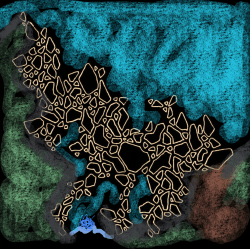
    Simple map of 100s of islands in a sea with a large waterfall in the south and mountains to the south and south east.

    What if a few of those islands floated like the bog-island of Chippewa?

    Rather than be moved by motorboat, they were moved by water elementals during the Age of Myths. The largest of these, Reylerel, at the time was the home of a power school of mages that integrated water, animals that live in and along water, and the peoples.

    As the Age was crashing they attempted to flee the city. The school wanted to isolate itself from the riots, to hide the dolphins, elementals, beaver and ducks that worked together to help the Kin survive. Reylerel went adrift, into the Sea of Sheljar.

    Now, thousands of years later the Free City of Sheljar is no longer ruled by the Necromancer. It is regrowing, discovering some of its influence from the Age of Myths. This bog-city isn’t a city of fog and depression, but a city of hope and humanity integrating gobkon teknology, love of animals and the lost magics.

    The leadership knows this is possible. Myth said it happened before, and drifting towards them is the Floating Island of Reylerel. At sea it moves with the swells and storms. The towers and buildings are rundown. Someone is going to need to go to Reylerel and find a way to prevent it from crashing into the docks.

    And that’s how you take a small trending topic on the internet and turn it into an adventure.

    Fediverse Reactions
  • Sharing your world: The power of co-DMing in the same space

    Sharing your world: The power of co-DMing in the same space

    This is a story about The Dragon.

    Which is a moon, not a big dragon. I don’t know why I called the biggest and slowest moon “The Dragon.” It was probably in honor of The Wheel of Time, one of my foundational fictions in the world. But the name never really came up in play.

    The 21-year cycle did come up. That generational marker (key for many goliaths and the Crinth Confederation) marked a cycle from the Born Generation to the present era.

    But, by expanding play in the world to a second DM The Dragon also finally became a point of clear fiction. It’s named that because during the Age of Myths that’s when the leading dragons on the Council retreated from society — Draakenmoten.

    That’s about to come up in the campaign I’m playing within my own world.

    Playing in the world I’ve invented has expanded the stories in ways I never expected. While I’ve included player concepts in world development in the past, including DM concepts in the world requires trust and grants wonderful opportunities for story-threads to be pulled into new places.

    Other things added to my world through sharing the experience;

    • Evil fungal druids that dabble in necromancy
    • Dragon Council, a ruling body of dragons and their magical allies who control the continent in a federal system.
    • Les Remoden Eisha, the intelligence and security branch of the Council.
    • Necromancy as the forbidden school of magic.
    • Elemental airships. Unlike the era where I DM, magic is common enough that it powers the airships, unlike the clackety, smog xips of the goblins.

    Those first four elements seem to be growing into the major division that leads to the sundering of the world, separating the continent with the Everflow on it from all the magical spaces in the rest of the planet. Those councils and forbidden magicks could grow into the dragon-founded schools with their abusive Proctors, supplicant Scholars and limited magic in a world that has merely love for companionship, healing waters and hope.

    Tips for Sharing a World

    First, have the creator DM and non-creating DM talk about history and key elements. Discuss where the foundational elements of the world are necessary in each campaign. Unlike Uprising & Rebellion (and the other ‘modern’ campaigns set in the World of the Everflow) the current campaign doesn’t have a foundational element about animals as life companions for example.

    Understand that things that happen in history don’t have to be understood in the future. Did Xabal discover tar-trees? Maybe someone else claims that 3,000 years later. Unless the details are vital to a plot point minor differences in the way myth-legend-history are known aren’t important. They can even both be true!

    Second, play and act with trust. Going back to point one, the details don’t matter if they don’t matter. Does the now co-DM get the name of a city wrong? That doesn’t matter. Keep playing at the table. Don’t even bother to correct it. Many cities in the real world have multiple names. That’s the way worlds work.

    Borrow heavily from each other. This is part communication, but also because you’re seeing each set of stories (every table is a set of stories that is some combination of the total number of people playing and their interactions) from different angles.

    Is there a new nugget dropped that you want to be permanently part of the tale? Take note in heavy ink and add it to your own version of the world document. Just like when a player adds something new to the world let the co-DM do the same thing.

    Be a player — you aren’t the DM, so don’t be a co-DM at the table, unless asked. The only time to speak up about some out-of-character element related to previous campaigns or lore is when the DM asks. Then you answer.

    Bonus points if you can work that into something that your character would know/do/say. I didn’t do this most recently, but wish I had. The current DM asked me what Sheljar, the bog-city, was like in the Age of Myths. I gave an encyclopedic answer rather than the answer Xabal would give.

    It’s been so much fun opening the world to more tales set within. We’ve added fantastic spaces, myths and histories that wouldn’t have existed if the World of the Everflow was merely my setting with nearly two dozen players. Adding a second DM to the world has changed the story dynamics in an exponential rather than additive fashion.

    My hope is that after this Age of Myths campaign we return to the modern era with new tales too.

  • Expanding the types of Halflings in your world

    Expanding the types of Halflings in your world

    No other early-era playable species/race in D&D history has been shoehorned into a singular type as the Halfling. Originally called Hobbits, because that’s what they were, Gygax decided to avoid a legal battle and renamed them as Halflings.

    But for nearly thirty years these small people were either the peoples who lived in homely burrows (Stouts) or peoples who lived in Buckland (Tallefellows). There were also hairfoots, which let’s be honest the three types of D&D Halfling perfectly mirrored Tolkien’s varieties of Hobbit.

    In 2024 Dungeons & Dragons, Wizards of the Coast says there are more varieties, mentioning Eberron’s street-gang house and Dark Sun’s roving cannibals. And that’s it.

    Halfling communities come in all varieties. For every sequestered shire tucked away in an unspoiled part of the world, there’s a crime syndicate like the Boromar Clan in the Eberron setting or a territorial mob of halflings like those in the Dark Sun setting.

    No longer are the differences in Halfling types subraces as earlier versions of the game. But the “all varieties” are conventional hobbits, gangsters and cannibals.

    This need not be all varieties of the small folk

    Caravans

    In Rings of Power we meet two varieties of Halflings. The first are the Harfeet, who travel in communal covered wagons travelling with the seasons over a wide land. These peoples hide quickly (a Halfling born trait) and sing proudly of their history. Though not ‘Shire-y’ they are clearly the popular Hobbit/Halfling of fantasy tropes. Caravan Halflings have been embraced by D&D in the past, fitting them in your world is easy.

    Desert cliffs

    A painting of a scene from Rings of Power showing small people living in an arid cliff and valley town with water chutes and small farms.
    Stoors from the Rings of Power (Fandom | CC BY SA)

    Season 2 introduces the Stoors, who live in cliffside holes in an arid land. You can see some Halfing behavior in the structure of the settlement. Again, they are quite communal, which I don’t like associating with a species because that feels cultural, not born, but this is part of the Halfling trope still. What makes these Stoors inspiring for small folk in my world is that they seem to embrace the divine luck of Halflings. Those aqueducts and microfarms carved into cliff sides seems to require bravery, nimbleness and luck. Children scampering through that space would fall constantly without the luck of the gods.

    There are other ways that you can embrace the born traits of Halflings and build some societies, captured in their homes.

    Coop homes

    Photo of a full enclosed wooden home, sized for chickens.
    Chicken coops sold at American feed stores (Dave Clark)

    In visiting various farm and feed stores you can find fancy chicken coops. These will frequently have multiple levels, many doors and windows. Sometimes they have a small fence in material similar to the walls or roof.

    These have made me think of Halflings for some time, not just because they are made for tiny creatures. The various nooks and crannies are places to hide. Similar to modern micro-housing, a cluster of these coop-style Halfling homes would take up very little space in a fantasy city too. A cluster would touch on the communal aspect that Halflings will never escape, because their connection to Tolkien is so strong (even in Eberron and Dark Sun).

    Or one with a run extension could be a connection to terriers, cats, or other small domestic animals that live with these Halflings as companions. A design with space underneath is sensible for raising mushrooms or other foods.

    What other home types make sense for Halflings?

    Rafts and waterways

    A species of brave nimble peoples living on the waters in a mix of canals, creeks and lakes makes a lot of sense. Their small size lends itself well to working in the sails and ropes of the big people too. Narrow paths of docks and ladders would require a nimble and lucky peoples too. This also works at sea, with Halflings living in the rigging of multi-mast ships.

    Bridges

    Yes, I love this trope. My own Fort Ooshar uses it. Small folk are perfect for settling in the upper levels of a bridge-city. They also make sense in the undercarriage. The ability to slip into and out of the various rope elevators is perfect for the narrative. Halflings in this environment can be similar to the Eberron gangs or they can be families who take up the small spaces that humanity (all the medium thinking peoples) ignores.

    Tree houses

    Yes, yes, yes — this trope is heavily associated with Elves. It need not be. Halflings make a lot of sense as a tree people. They are small and light, which means they can live in a much larger variety of tree and not just the not-Redwoods. Put them in birch, or larches, or cedar. Maybe they live in briars with offices in the local oak. Being just a couple dozen pounds is a massive advantage for Halfling tree people. Their divine bravery and luck are also a great fit.

    Spire lands

    Imagine a land of natural spires with Stoor-like homes, but even more exaggeration of height with tiny bridges of rope connecting the neighborhoods. Humans would hate such a place, but a Halfling would run full speed along a rope bridge connecting two towering rocks.

    tl;dr

    Halflings can be more than just Hobbits. Your fantasy version of the small folk should embrace their born traits – brave, nimble, lucky, stealthy. Don’t assign culture due to their species, but the places where they live and how that influences them.

    Your city Halflings could be gangsters, your caravan Halflings could be communal, your bridge Halflings could be a hidden undercurrent, your burrow Halflings could be a coven.

    Embrace more options in your fantasy world so you can tell a wider variety of fantastical tales.

    Fediverse Reactions
  • Reblogging: I’ll be adding NPC ritualists to my world

    In this post Jared talks about how rules support fiction with the examples being from Tales of the Valiant’s rituals system.

    The magic of this is you don’t even have to use Tales of the Valiant as your base system to add this to your 5e world. The ritual system is essentially 5e D&D neutral.

    Take Divine Ritualists as described. They look like, and are mechanically supported like, miracle workers at a temple. The Primordial Ritualists are like less powerful Tom Bombadils.

    Thank you Jared Rascher for the inspiration.