Tag: RPG

  • Embracing the Mechanics of Backgrounds

    Embracing the Mechanics of Backgrounds

    As Wizards of the Coast makes changes to how race & lineage impact character creation there is some pushback towards removing Ability Score Increases from race and having that instead be a floating adjustment. There are many proposed adjustments and several games or third-party products include adjustments to this part of the system, to varying degrees.

    Ancestry & Culture and Level Up are the two that I’ve been most intrigued with to this point. My home game just uses floating ASI for simplicity’s sake. Another movement tries to connect the ASI to Backgrounds. One such proposal on reddit suggests this because;

    The backgrounds we have in basic 5e are fairly lackluster. Here’s some tools and a little feature. It’s kinda meh. You can almost skip them in character creation.
    What I’d like to see are dozens of backgrounds that provide: tools, languages, equipment, more substantial features, as well as appropriate ASIs. They could provide so many more variations with every published book as well as allow for plenty of homebrew.

    There are a few reasons this suggestion would not work at my table, and isn’t recommended.

    • You can already suggest that your Floating ASI connects to your character’s Background. As well as writing your character’s story as if the Floating ASI connects to your racial/species/lineage origin, or to Class, or whatever element you want. This empowers players to tell the widest variety of tales possible.
    • Assumptions about weak/strong, or unintelligent/smart people in specific roles aren’t as bad as those connected to race, but they’re still not great. Being a weak Farmer is a good story, whether or not the character is a Remarkable Drudge.
    • Backgrounds already do a lot of mechanical work. Embrace those mechanics. Their design tells your table so much about who you are and why you do the things you do. The Background rules do not need to change. They need to be used.
    Photo by Canan YAu015eAR on Pexels.com

    Mechanics of Backgrounds

    To review every Background in Dungeons & Dragons 5th edition as written includes two skills (roughly 1/4 to 1/2 of the skills your character begins with), two languages/tools/games/instruments/kits (closer to half of the beginning amount), and a social or exploration themed feature. A removal of Backgrounds further reduces the social and exploration pillars bringing the game back to its wargaming roots, which ignores current desires of most gamers.

    This change also ignores the Traits, Ideal, Bond, and Flaw system. These few short sentences are guidance towards personality, more so than the archaic use of Alignment. They tell you about the who of your character. They are not a complete personality, but a snapshot. This system also adds mechanics to roleplay. When a character plays their Traits, Ideal, Bond, and/or Flaw they are granted an Inspiration Die. This d20 is consumed when a player wants to grant their character advantage (a handy house rule is that players can grant each other an Inspiration Die based on roleplay too). Having advantage is powerful. The math shifts.

    Together there are ten mechanics attached to Backgrounds. TEN.

    Plus those mechanics attach themselves to something else that race and calls do not — the story of what you did Before. Your zero to hero journey is fundamentally intertwined with Backgrounds.

    Backgrounds Empower Story

    What were you before you picked up a sword or spell to fight a bandit? How did that upbringing and background inform who you are becoming? Real world ‘adventurers’ are not the same, even if they are from the same ethnic group and took the same adventuring job. A studious nerd from the ‘burbs who became a linguist with the Special Forces has a different story from the hunter from rough rural lands who became a linguist with the Special Forces.

    Tools aren’t ‘meh.’ They are powerful ways to talk about what your character is outside of combat. Tools are one of the best ways to explain your character’s hobbies. And your character must have a hobby. People in the times that inspire our game had hobbies. Tools are also ways to tell cultural stories about a region. The existence of an expert coffee roaster or athlete carries worldbuilding implications. Knowing more languages than typical speaks to a character’s education (either by book or by street or by silk road)

    Those social and exploration features are some of the only ways that a Fighter will have social and exploration mechanics. The class is so blank slate that without Backgrounds that hole is massive. They also augment the ways that the rest of the Classes interact with those pillars of the game.

    Backgrounds help D&D players differentiate their characters by adding another layer of story from Before as they begin to tell the story of Now.

    Custom Backgrounds for 5th edition Dungeons & Dragons

  • Uprising & Rebellion Campaign Two: One Sheet

    Uprising & Rebellion Campaign Two: One Sheet

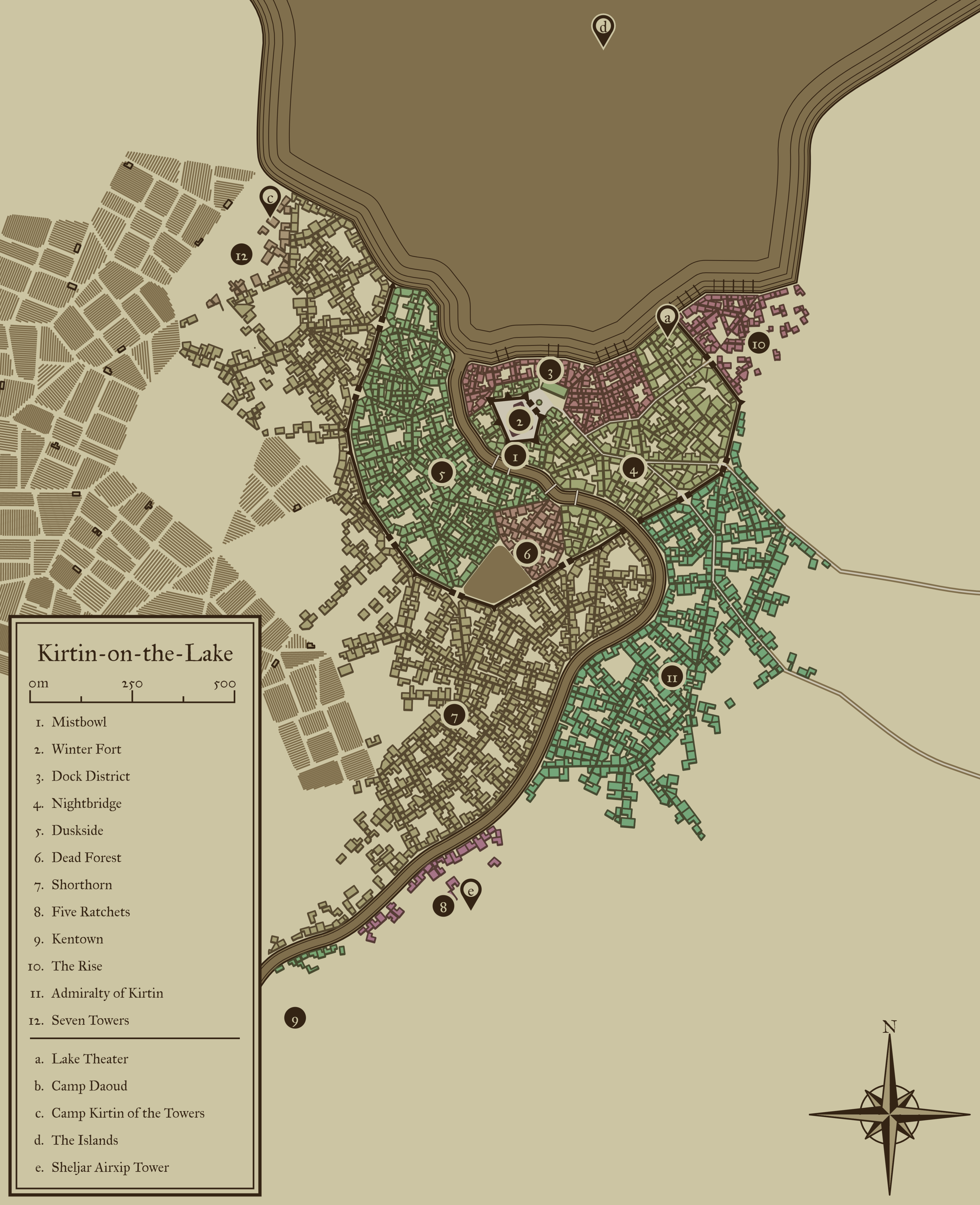
    This campaign is set six years after the Lorebook Hunters returned magic to the World of the Everflow. It is set in Kirtin-on-the-Lake, and is centered on political intrigue with social and exploration pillars being as important as combat. Every player is united in rebellion against the corrupt Mayor, but may have differing ideas about how the various factions can help Kirtin-on-the-Lake be free.

    Made using the Medieval Fantasy City Generator.

    Campaign Premise

    You are common people living in and around Kirtin-on-the-Lake who are inspired to free the city from under the rule of Daoud. You may want it to once again be part of Kirtin, or you may want to copy the Free City of Sheljar. The City Guard, a unit of Daoud’s military, and even Dragons, who see Kirtin-on-the-Lake as their ancestral home, stand in your way.

    Background

    Kirtin-on-the-Lake was once the winter capital of Kirtin. Taken over by Daoud in the generational wars it is a city of borders even before the Awakening and the discoveries of the Lorebook of Divination and the Folio of Necromancy. Now, the Ken and their Dragons are trying to capture what they claim are their ancestral homeland. Daoud and Kirtin remain at war over the city.

    There is also a general uprising of peoples inspired by the Free City of Sheljar. The Mayor has managed to consolidate power by playing the various factions off against each other; this hasn’t helped the common people beyond allowing them peace.

    Made using Perilous Shores

    Grand Conflicts

    The Proctors of Grace and their other allies want to control access to magic. Certain Dragons also want to repopulate Kirtin-on-the-Lake as the Ward of Mighty Trees is the ancestral home of certain types of Dragons (at least a Red as that first DragonTree has regrown).

    Daoud will not allow their winnings (Kirtin-on-the-Lake and the Slope) to leave their control after centuries. The rebellion has taken control of the Dock District. What will they free next? While the mayor may be willing to have the rebels help repel the Proctors, he serves at the whim of an empire that refuses to recognize Kirtin-on-the-Lake as anything but its own territory.

    Factions

    • Mayor and City Guard, generally aligned with Daoud, he is willing to look the other way and cede districts to other invaders for a price.
    • Daoud, the conquering empire of the south. Normally a naval power in the World of the Everflow, their long conflict over Kirtin-on-the-Lake is their largest land holding.
    • Kirtin, the mountain kingdom has been at war with Daoud and Azsel for so long that all of its peoples serve in the military.
    • Proctors of Grace and the Ken, lead by Dragons the various fey peoples are experts at magic and claim that Kirtin-on-the-Lake’s Ward of Mighty trees is their homeland. They also want to put the power of magic under their control and only their control.
    • Society of Veil and Shadows, these rebels are inspired by the Free City of Sheljar and its empowerment of all thinking peoples. Whether Kin, Ken, or Kon the people deserve equality of treatment and opportunity.

    Rumors

    • There are half-animal/half-people roaming the Western Wildes.
    • Out in the Ferments forms of life based on the elements are driving out the Kin there.
    • Headquartered Church of Quar has lost control of the Everflow (the source of all healing potions).
    • Peace has come between the Kingdoms of the North as the Crinth Confederation and Azsel are more concerned with the Kon and the Ken.
    • The Dragons seek the Robe of the Magi.
    • The Tome of Abjuration and its Proctor may be in the city or surrounding area.

    Facets

    • Exploring the zero-to-hero tropes, rebellion, and who gets to control knowledge.
    • Sandbox play.
    • Player agency creates history.
    • Drop in/drop out, whatever.
    • Sessions are 2-3 hours. Adventures are 1-3 sessions.

    Variant Rules

    • Playable races are Human, Hin/Halfling, Goliath/Firbolg, Elf, Dwarf, Gnome (wood only), Goblin, Hobgoblin, Bugbear.
      • Only the Kon (goblinoids may be Artificers.
      • Kin start with a Bonded Companion
      • Ken start with a Feat that grants a 1st level spell such as Magic Initiate.
      • Kon start with Tek
    • There are a few custom subclasses available (Way of Frayed Knot, Society of Veil and Shadows, Conscript, Propagandist, Liberator, Circle of Sewers).
    • There are several custom backgrounds and tools available. We will use cultures, not languages.
    • Use point buy or standard array for starting attributes. If you want something random, the redrick roller gives random point buy valid stats.
    • Start at 3rd level, because power is cool.
    • Long rests require 24 hours within sanctuary. This creates a pace of play more similar to novels than video games.

    Practicum

    Sessions will be on Sunday afternoons and evenings, floating times based on the Puget Sound pro soccer schedule. Characters must be created prior to dropping in. The table will be on an outdoor patio at one of a few locations in South King County.

    Email, private message, or text for more details.

  • Feat: Bonded Companion

    Feat: Bonded Companion

    Salvy

    Animal Companions, or Bonded Companions, or a key element of life in Kin. The Kin are the people of friendship, loyalty of loving those around them. This extends towards their non-humanoid companions as well. Where an elf might group in a land where spells are used to do mundane things, in Kin when a goliath needs a bit of string to finish sewing they send their swallow off to do it, or their heron to fish. Halflings have dogs that pull, push, fetch, hunt, fish, carry, and many other tasks. Human bonds with goats, rams, dogs, birds and horses are quite common. Bonds of Kin are a very essence of life. Almost everyone has one.

    This ruleset needs to do a few things.

    • Scale like cantrips, attacks and proficiency. The companion is expected to live alongside their friend for some time.
    • Build in a reason that having a Bond die is bad for the PC
    • Not destroy the action economy
    • As a bonus, can it be simplified for usage in gaming outside the World of Everflow?

    Feat: Bonded Companion

    Prerequisite: Wisdom of 13 or higher. Kin and Rangers ignore this prerequisite.
    This feat can be taken more than once.

    Two dogs on gravel

    You have an intense bond with a beast. These beasts cannot have a higher Intelligence than the character. In certain worlds the bonded companion can be a monstrosity. At this point I considered just granting access to the Bonded Companion system in a similar manner as to how Magic Initiate works, but instead built it within the Feat. The rule could be built by making Bonded Companion a Class Feature and Feat, but I digress. Taking the feat gives you Companion Points. You also gain companion points in the following manners;

    • Rangers at 1st, 3rd, 5th, 11th, and 17th levels
    • Druids at 1st and 5th level.
    • Clerics with the Nature domain at 1st level.
    • Your Wisdom modifier

    Those points can be spent on a single companion or multiple companions. A character can bond with a number of Companions equal to their Wisdom modifier +1 (minimum 1). Each new companion takes a number of weeks to establish a bond as their cost in companion points. This can be done as downtime, or could be a solo adventure. A character may only spend new points when they take the feat or if they are a Ranger or Druid at their higher levels that earn Companion Points.

    The following chart lists various Companions and their Companion Point cost.

    OneTwoThreeFiveSevenTen
    Herd dogSled DogWarhound *Giant Eagle *&Rhino &Mammoth *&
    RetrieverMastiff *Axebeak *&BisonElephant *Wyvern *&
    TerrierBloodoundOstrich &Bear *&Dire Wolf *&Roc *&
    Sentry DogGuard dog *Elk &Lion *&Owlbear *& 
    SprinterRavenPanther *&Worg *&Griffon *& 
    HeronEagle *&Bear Cub *&Hippogriff *&Pegasus *& 
    PigeonFalcon *Wolf *&Peryton *&  
    SparrowParrotTiger *&Awakened Tree &  
    Pony/MuleDraft HorseWarhorse *   
    FoxRiding HorseApe &   
    Goat/SheepMonkey    
    Awakened Shrub &Cow    

    Legend: The ‘&’ is used to indicate an animal companion that can only be paired with a Ranger, Druid or Nature Cleric. They are normally wild. The ‘*’ is used to indicate animals that can enter combat on command.

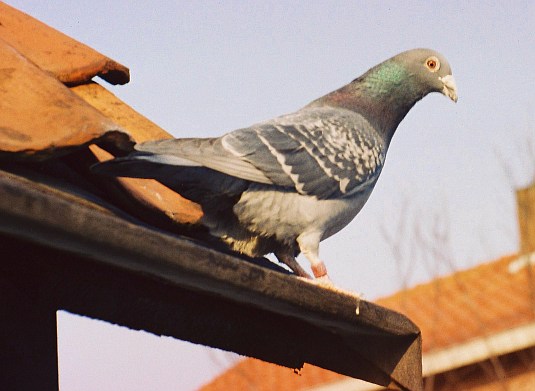
    "Postduif". Licensed under Public Domain via Wikimedia Commons - https://commons.wikimedia.org/wiki/File:Postduif.jpg#/media/File:Postduif.jpg
    “Postduif” – Licensed under Public Domain via Wikimedia Commons

    As a Bonus Action the Bonder can command their animal. These commands are Attack, Dash, Disengage, Dodge, or Help. An animal without a * can only attack if the Bonder passes a Wisdom (Animal Handling) DC: 20 check. The Companion will continue that action until the combat is complete or another Bonus Action is used (ie they will Attack the directed target until that target is no longer participating in the combat). Some Companions have other actions that can be taken (A Retriever can Fetch as an action). Check with your DM for these other actions.

    When separated a Bonder and Companion that are on the same plane know the direction and rough travel time between them.

    If someone tries to control a Companion it is an opposed Animal Handling check for the Bonder and whatever skill or spell is appropriate for the attempt to control the Companion. The duration of the control is per the appropriate spell or skill.

    If a Companion dies the Bonder takes half their Companion’s hit points in psychic damage. If they make a Wisdom save (DC: 15) they then take one quarter of their Companion’s hit points in psychic damage.

    Variant Rule in Kin: At first level and below halflings usually bond with canines and goliaths usually bond with avians. All Kin start with an additional Companion Point.

  • Creating a new world

    Creating a new world

    It comes with just a single question. What if? What if I started a new blog? What if we talked about fantasy fiction? What if the stories told coincided with a role-playing game? What if I set myself back two decades and cracked open Dungeons & Dragons again?

    bard-dave
    Every storyteller needs their tools – a good mug, a notebook (or netbook), a satchel for tokens and memories and a block of cheese maybe some sausage, and a trusty sword.

    What if the themes were strong adult subject matter that made for gritty tales of life, death and heroism? What if magic was real? And the gods could talk, but then they stopped?

    What if the continents were small, the peoples plentiful and not all human? What if humans didn’t believe in magic because it had disappeared in the only continent they know? How about making it so they are defined more by their cultures than by their phenotype?

    Have they stopped believing in themselves, in their gods? Do they see good and evil? How?

    Is there slavery? Why? Is there nobility? Can someone be both?

    These questions and the cascade of answers start to form more questions. It’s a nearly infinite series of responses. World building, particularly the creation of a world that breathes, is hard. Crafting a world-space that can withstand episodic gaming is harder.

    Take chunks at a time. That’s what Full Moon Storytelling will be. Small chunks of content for use in a campaign setting, built around a custom set of rules adapted from 5th edition D&D, but with accompanying tales. If the setting says “The Necromancer is just someone trying to be good” there will be a story that explains how that happened.

    As The Worthing Saga took a novella and broke out portions into branch stories, Full Moon Storytelling takes a campaign setting, rule set and crafts micro-fiction, short stories, plotless narrations and episodic adventures within the World of the Everflow.

    Maybe that’s where we start, not with a character, but with a story about a fountain that flows from a cliff and diverts along two paths – the Font of Two Paths, the Two-Headed Spring, Pool of Life, Lake of Wonder. The Everflow influences the western peninsula of Kin, is clearly unnatural and …

    This is Full Moon Storytelling. It’s a way to share writing, writing process and to think aloud, while words spring forth from tiny digits. Things will happen live, in front of you. Process will be as important as output. Creation is play. Come, join me at this fire under a full moon with clear sky as we look up through trees staring towards the open world of wonder, knowing that behind those trees at your back is whatever reality you can imagine.

    Fediverse Reactions
  • Check out Ginny Di’s video about etiquette in online RPGs

    Check out Ginny Di’s video about etiquette in online RPGs

    After many, many months of the covid-19 pandemic more people are playing D&D than ever. Much of this is online. Long-time players and D&D rookies both are discovering the challenges of gaming via video.

    Ginny Di put together a strong 12-minute video that hits on the common challenges and solutions that come up at virtual tables. Even if your virtual table play is going well this is a good reminder. If you haven’t played virtually before the package is an excellent starting point.

    When I watched this it reminded me of one my habits as Awf — I can dominate the channel rather than share the spot light. When I play as Thoumas, the group interplay is different. We split the party frequently, something that is harder to handle on a VTT, in my experience. Coordination requires a bit more care.

    Her best piece of advice, at least for my groups (hi guys), is to use the text chat for out-of-character stuff. That clears space for the DM to manage the game. My second favorite is to schedule a little bit of the time pre & post game to communicate about non-gaming things. Be friendly and social with each other, because being social during the pandemic is hard enough.