Tag: DnD

  • Goltoppa, a Mehmdian sport in the World of the Everflow

    Goltoppa, a Mehmdian sport in the World of the Everflow

    Fantasy sports can be a fun way to add depth and cultural to a campaign world. One of my players in Uprising & Rebellion is playing a character from Mehmd and invented the sport of Goltoppa. He adapted some of the cultural touchpoints from the hidden empire, placing them into the common state of the game and has asked for it to be featured in a session soon. The character in question is not a Goltoppa player or coach.


    Goltoppa

    by JayDubTheGamer

    Playing Surface:

    A goltoppa field created using Dungeon Scrawl

    The game is played on an open, flat, dirt field, generally free of rocks & debris, that is 360 feet  long by 144 feet wide. The field is split lengthwise down the entirety of the center into 72 feet wide halves, and crosswise at 120 feet intervals. These six resulting areas are marked off with white paint borders. Particularly enterprising/wealthy teams have been known to pay to have the sections magicked to different colors. Straddling the centerline at each end of the playing field is a netted goal, 9 feet wide by 3 feet tall. One narrow end of the field is to be facing North, indicating the “head” of the field. Three referees patrol the playing surface to control the action during the run of play.

    Players:

    Goltoppa is played by two opposing teams, consisting of 9 starting players on each side. Teams are permitted to ‘dress’ 3 bench players for each contest, to be subbed into the game in the event of injury. Players may not be subbed into the game for strategic reasons or in the event of a player’s expulsion from the contest. A player’s uniform shall consist of a sleeveless tunic, belted at the waist & extending to mid-thigh, in the primary color of one of the six teams currently representing the league’s six social strata: Noble (violet), Military (red), Religious (white), Artisan (gold), Farmer/Fisher (green), Merchant (blue). Note that players are recruited to represent these strata, and need not be members of them. Additionally, players shall wear sandals that wrap up around their calves, with linen padding over their shins. Each team dresses one Left & Right “Slasher,” designated by a black sash that goes diagonally from either left or right shoulder to opposing hip, with the shoulder covered indicating which side of the field they may patrol. Players may wear short pants as well.

    Play:

     The game is played in two 36 minute halves. At the start of the game, a coin toss determines initial possession, which begins via kicking a ball onto the field from a position to the left of the goal which the possessing team is defending. The ball is traditionally made from a treated cow’s stomach filled with air, or a leather ball of approximately the same size . There are no goalies; all players may attempt to kick the ball toward or away from the goal, or to a teammate. Additionally, each team’s Slashers are allowed to catch the ball on the fly in their hands and run with it to the border of whichever section of the field they currently occupy, at which point they must kick the ball themselves unless trying to place the ball in the opposing goal. A Slasher with possession of the ball may be leg tackled by the opposing team. A successful leg tackle means the Slasher must kick the ball to a teammate (only) from the spot of the tackle. Tackling with one’s arms, striking a Slasher above the waist, or attempting to strip the ball from a Slasher’s hands by a player other than an opposing Slasher is not allowed. A ball that goes out of the field of play results in a change of possession, with the new possessing team kicking the ball into the field of play from the sideline spot where the referees determine the ball crossed out of the field.

    Scoring:

    A score happens whenever the ball is put into the net during the run of play, A ball kicked into the net scores 2 points; a ball placed into the net by hand scores 5 points.

    Penalties:

    Rough Play: Arm tackles; deliberate leg tackles of a non-Slasher; headbutts; intentional hands to the face or back of an opponent – Offending player off the field for 3 minutes.

    Stripping: An attempt to pull the ball from the hands of a Slasher by a non-Slasher – Offending player off the field for 3 minutes.

    Catching: Non-Slasher making deliberate contact with his hands to the ball, especially with an effort to control the ball – Offending player off the field for 2 minutes.

    Scooping: Slasher attempting to pick the ball up off the field, rather than catching it on the fly. This includes a ball that bounces before being caught – Offending player off the field for 1 minute.

    Offsides: Slasher maintaining possession of the ball beyond the area of the field where he caught it, or crossing from his designated half of the field – Change of possession from the spot; no kick to inbound the ball needed.

    Belligerence: Fighting; intentional physical contact/intimidation toward a referee – Offending player ejected.


    Playing Goltoppa at the table

    There will be a series of contested checks to determine scoring. These will use the Tool Sports: Goltoppa and have a few skills that can connect to them.

    My first thought is a way to generate scoring similar to what is described by JayDubTheGamer would be to have five contested checks by half. That’s a lot of rolling, but provides some variety of results and capability of multiple players participating.

    Winning a check by 1-5 results in two points. Winning a check by more than 5 results in 5 points. Winning a check by more than 10 results in seven points and winning by 15 or more is good for nine points.

    Losing a check by less than 5 results in two points for your own team. Any natural 1 means that you have given up a five-pointer or have committed a foul, rolling their next challenge at Disadvantage. Any natural 20 means that you have scored a five-pointer.

    This should generate scores that look a bit like early 20th century American football or current rugby.

    Applying skills

    Acrobatics and Athletics will be the most used skills, most frequently connecting to Dexterity and Strength. It would also make sense for someone in a coaching position to use Intelligence with one of those and for a character playing the captain to use Charisma.

    I would allow up to one role to use Deception in order to get away with a foul. That team would have Advantage on the next check, but if they lose that roll their next roll would be at Disadvantage.

    An example:

    Violet teamBlue teamScore
    137Violet 5: Blue 0
    1620 (natural)Violet 2: Blue 7
    915Violet 0: Blue 5
    1212Violet 2: Blue 2
    415Violet 0: Blue 7
    1st half9 points21 points
    29Violet 0: Blue 5
    20 (natural)7Violet 12: Blue 0
    1411Violet 2: Blue 2
    186Violet 7: Blue 0
    39Violet 0: Blue 5
    2nd half21 points12 points
    FINAL30 points33 points

    Yes, that’s ten rolls for a non-combat encounter. Which feels like a bit, but the descriptions are at most two sentences, show the shifts in momentum, and feel like watching a sport when including those descriptions especially around the nat 20s.

    We’ll see how it runs at the table.

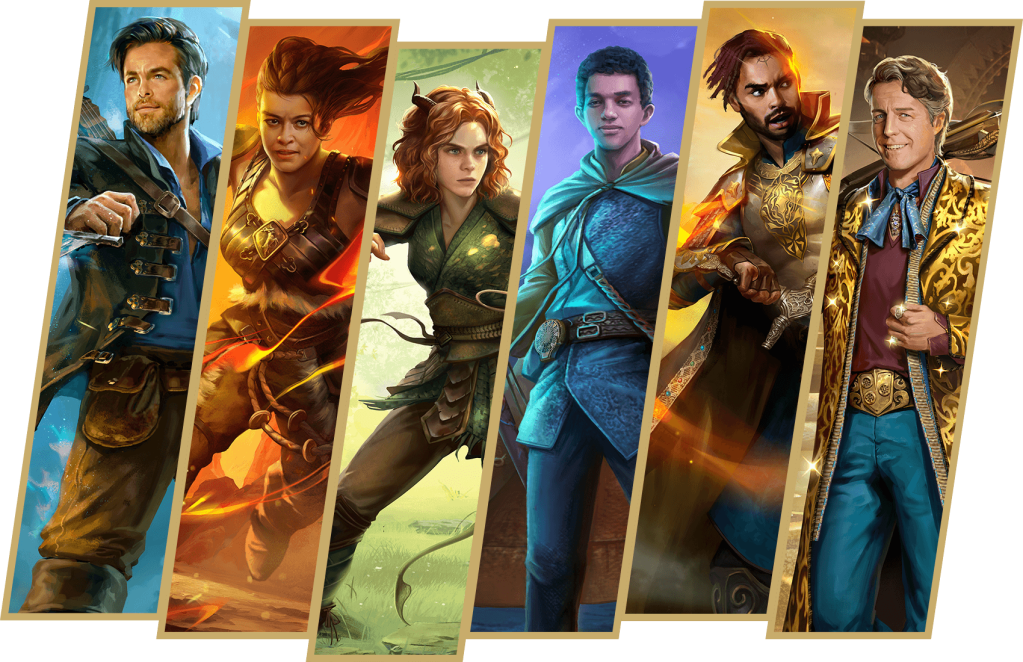
  • Honor Among Thieves trailer shows more of the party dynamic

    Honor Among Thieves trailer shows more of the party dynamic

    Coming out in just over two months Dungeons & Dragons: Honor Among Thieves is about to get another wave of hype. Today was the release of trailer two. In it we see more of the soon-to-be-famous rather than infamous adventuring party supporting each other while also taking shots at each other. It’s a typical dynamic in the game.

    Some day we’ll find out more about Rodriguez’ youth D&D game, but not today.

    One of D&D’s consistent themes is found family.

    “This film is about found family,” Daley said. “Despite obvious differences, what keeps them together is this desire to fix something that’s much bigger than themselves. And then, what ultimately keeps them together is this newfound affinity that they end up having for one another.”

    From IGN

    When characters, or real people, undergo the stresses of surviving dragon attacks they bond in ways that go far beyond friendship. If Honor Among Thieves can pull that off, and the trailers lean that way (as do the actors’ histories in other movies) it will justify me seeing it three or so times on opening weekend March 31, 2023.

    From Ars Technica we learn that Critical Role performers are part of the movie.

    Cast members from the D&D web series Critical Role (which spawned the animated series The Legend of Vox Machina)will also make cameo appearances.

    From Ars Technica

    The movie continues to look good, unlike any other D&D movie in the past.

    D&D TV show picked up by Paramount+

    The Rawson Marshall Thurber written and produced TV show was picked up. It’s not connected to the movie, but exists within the same universe.

    There’s been no update on the Derek Kolstad show in some time, but he’s busy with John Wick Infinity.

  • Integrating social narrative into combat – legendary points connected to a dragon’s hoard

    Integrating social narrative into combat – legendary points connected to a dragon’s hoard

    In the World of the Everflow all dragons have hoards. At this point of Uprising and Rebellion the group has met those that hoard books (paper dragons), jewels and fine art (jaculus), animal companions (black dragons) and strife (blue dragons).

    Heading towards the final faceoff with the great wyrm blue dragon there’s a desire to connect the size of the hoard in that Wyrm’s sphere of influence to its power – subsequently allowing actions by the players to reduce the hoard.

    This will be done by combining the Legendary Resistance and Legendary Action pools. Legendary Resistance will still be a use and lose item while Legendary Actions will be regained at the start of the dragon’s next turn. A pool of physical objects will symbolize the size of the pool. This will represent the intelligence the group learns about the Wyrm.

    A blue-green dragon atop a mossy rock leers over a large d20. Behind it is a river
    The Wyrm watches the d20 rolls

    The Blue Wyrm currently resides in the mayor’s palace, having thrived off the strife caused by the rebellion and the Mayor’s corruption. But the heroes have shown that their rebellion is built on hope, a less stratified society and a city capable of trade again. Now just three dragons stand in the way of freedom, possibly.

    Things the characters could do to reduce strife;

    • Healing, feeding Kirtin-on-the-Lake’s residents
    • Freeing animal companions bound to Shadow and Darkness, the two black dragons
    • Increasing trade of desired goods within the war torn city
    • Establishing a popular governance path after the Mayor’s abdication
    • Reducing the size of the 7th Fleet encampment outside of the city
    • Teaching utility cantrips

    I’m certain the party will surprise me with other ideas.

    Things that can increase strife;

    • War with the 7th Fleet
    • Teaching more attack cantrips
    • The Mayor reclaiming the seat of government
    • Open battle in the streets

    They will again surprise me with ideas that create a less peaceful city.

    The Wyrm is going to start with five legendary points in the penultimate session for this story arc. The session will be split between the plan to pick the territory of battle (palace, tunnel, cave) and preparations that could include reducing the Wyrm’s power.

    This tweak to the standard rules should connect a social session to the grand combat ending the Wyrm’s arc.

  • Cabbies and ferien – people moving backgrounds for 5e D&D

    Cabbies and ferien – people moving backgrounds for 5e D&D

    Paths and ways in a fantasy world are not just occupied with masses of people walking with a few nobles on horseback. They are also clogged with carriages and carts delivering goods. In my own world one NPC used two giant turkeys to pull his coffee delivery cart. The players enjoyed the presence of this NPC so much they kept bringing him back up.

    The cabbie or ferien are taxis for a world where there are dragons and very expensive teleport circles.

    Cabbie

    You help carry people and goods between neighborhoods and distances. Working in urban areas either on the land or water you know the paths between places and the peoples who inhabit them.

    The cabbie may pull their own cart, use a pony or even have experience with a two-horse carriage. Often they have a stool to help their clientele into their car. Also willing to talk, even when the occupant isn’t interested, the cabbie can learn the happenings of a region or distract that occupant in such a way that they are susceptible to crimes.

    Skill Proficiencies: Insight, Deception or Persuasion
    Tool Proficiencies: Vehicles (pick one of land or water)
    Languages: One additional language, often from a culture that is nearby the home of the character
    Equipment: Cart, carriage, rowboat, gondola, sailboat (pick one), a lantern with 3 flasks of oil, traveler’s clothes, a trinket, 2 days rations, pouch with 25 silver

    Feature: Talk too much

    You are a skilled conversationalist that frequently goes on and on. These long talks are often consuming and distracting. Some cabbies and feriens may have allies who use that speech as a distraction to pick pockets or similar events.

    Additionally, you pick up the streets, rivers or flyways of a new city quickly almost never getting lost in natural urban areas.

    Personality

    Use the Folk Hero and Fisher for guidance.

    Alternate: Ferien

    First, let’s get this out of the way. There’s no simple gender neutral word for ferryman. Similar to Anagod on World Anvil, I appreciate the older English word ferien. As you expect the cabbie knows the streets of a city or the ways between villages, the ferien works the waterways of a land — rivers, canals, lakes and shores.

    Image from page 270 of Medieval and modern times; an introduction to the history of western Europe form the dissolution of the Roman empire to the present time (1919)
    A scene in Venice – public domain

    It’s pretty simple to make the Ferien version. Choose Vehicles (water) and then pick a rowboat, canoe, gondola or tiny sailboat for the vehicle. Nothing else needs to change.

    Design Goals

    Watching Shadow & Bone, or the Lion, the Witch and the Wardrobe, you see that those who manage transportation are part of fantasy stories. Whether the carriage driver or the polemaster in a gondola, these characters deserve the opportunity to be heroes.

    Maybe because I’ve been focused on the bog-city of Sheljar for Dungeon 23 I thought it was time to share this background publicly. The bog-city, or an island city, must have peoples who are dedicated to navigating the waters.

    Custom Backgrounds for 5th edition Dungeons & Dragons

  • Office Space | Dungeon 23

    Office Space | Dungeon 23

    Tucked in the back corner of the underground portion of the Temple of the Lords of the End is an office space. The last dual head clergy were two halfings, so the office has two halfing-sized desks with chairs. The chamber is packed with bookshelves, cabinets, decorative wall coverings and, like the main chamber has some damage from a Tunneling Nightmare.

    There are also a couple secret doors.

    1 – This secret door (DC 15) is to a small safe that contains gems and ingots. The interior is free from dust and it looks as if one ingot is new (DC 10, History or Culture(Sheljar).

    2 – One of the bookcases has a book-handle secret door system. It can be found with a DC 20 check. Behind that case is access to the alcove to one of Sheljar’s former ruling families, one that dedicated itself to Oun and Obscon rather than Quar. That chamber no longer has any remains.

    From Dungeon Scrawl

    We’re nearly done with the Temple of the Lords of the End. These two gods have a five chamber space that will be covered over three total entries. At this point there have been no monsters, but several hints that the Tunneling Nightmares, supposedly gone for several years, are active once again.

    Also, the remains that should be around are not.

    Maybe the death cult and the Necromancer were working together.

    I’m doing Lore 24, an attempt to write small lore elements daily in the year 2024. Each element will be something that’s come up in play or will come up in play within my homebrew World of the Everflow — there will be actionable threads for PCs to grab onto and advance the story.

  • Catacombs of the Lords of the End | Dungeon 23

    Catacombs of the Lords of the End | Dungeon 23

    After the intrepid explorers find the formerly sealed secret door they descend down into a small chamber using a ladder. That chamber is connected to a catacomb with 36 remaining alcoves for remains, four small doors to private burial chambers and a double door.

    The walls weep. Now somewhat below the waterline of the bog-city of Sheljar there is a heavy amount of moisture, plus the southwest corner is open to the brackish waters of the area. Outside of the open pool are a large pile of bones. It is clear that the opening is natural, not manmade.

    Created using Dungeon Scrawl.

    Possible learnings

    Intelligence checks attempting to understand what could make such a large opening could use Nature, History, Culture (Sheljar) to understand that damage was done by a Tunneling Nightmare (DC 15).

    Intelligence checks attempting to understand the alcoves and small doors could use Religion, Culture (Sheljar) to understand that the small doors are for former leadership of Sheljar (DC 10).

    Inspecting the bones using Survival or Perception would find that they are recent to the area, not covered in dust (DC 10) and there are now 4 skeletons attacking the group.

    Complications

    If 50% of the group takes enough damage to fall unconscious making death saves the roar of a Tunneling Nightmare echoes, partially muffled by the water.

    I’m doing Lore 24, an attempt to write small lore elements daily in the year 2024. Each element will be something that’s come up in play or will come up in play within my homebrew World of the Everflow — there will be actionable threads for PCs to grab onto and advance the story.

  • Winning LEGO Ideas D&D project is miniature adventure

    Winning LEGO Ideas D&D project is miniature adventure

    Of course I voted in the LEGO Idea x Dungeons & Dragons event. Back in high school I used LEGO’s castle and pirate sets while playing D&D. When LEGO announced the contest the one I liked best brought back those memories. But it also brought back memories of stereotypical D&D. And it won.

    From the original entry, where you can see the cave with the Beholder and a diverse D&D party.

    Let’s work from left to right, bottom to top.

    That may be a house, but it’s probably an inn or tavern. “You meet in a tavern” is a D&D trope.

    Next is a bit of wilderness adventure. There’s a stream and a tree. Because you have to travel to the castle.

    Inside that castle is also a cave system, with a Beholder. Beholders are giant floating eyeballs with extra eyeballs that shoot magic spells at you. They are one of the classic monsters in the game.

    Of course there’s also a traditional castle. That castle’s tower is wrapped up by a dragon. Finally we have the dragon of Dungeons & Dragons. The party is split, of course, because despite the axiom to not split the party they frequently do split. One is climbing the exterior of the tower while another walks along the halls of the castle.

    The six minifigs make a great party. Again from left to right, they look like a half-orc rapier wielding fighter/rogue, a Black human wizard or sorcerer, a likely elven bard, maybe a fire genasi barbarian, a tiefling paladin, and a rogue or ranger.

    That’s pretty good variety of role, of identity and of mini-figs.

    I cannot wait to get this. It will be great on my desk for me to look at or on the shelf behind me so that people on video calls can see it.

  • Temple of Oun and Obscon, the Lords of the End | Dungeon 23

    Temple of Oun and Obscon, the Lords of the End | Dungeon 23

    After the quick, safe ride on the sky-cable, you arrive at the top of a small tower. On the isle with the City Center this temple was abandoned when all of Sheljar turned their backs upon Oun and Obscon. These twin gods of death, endings, and darkness were rejected when the dead started to walk the earth again.

    The gondola stops atop the pillar shape of the temple, in a haphazard wooden frame, with large hole knocked out of the roof.

    Map by Dyson Logos, released as part of his commercially available project.

    This narrow temple is cramped for hobgoblins, mulgoblins, goliath and large animals. These tight turns in the cold stone pass quickly as most try to exit the dark temple to dark powers as fast as they can. Though the Necromancer had nothing to do with Oun and Obscon the stench of death is too strong.

    On the ground floor a search can result in finding the sealed secret door with an Intelligence check (DC 18). Intelligence, Culture (Sheljar), Religion are proficiencies that may apply if the characters act in ways that would connect them.

    That secret door is sealed tight with iron bands. A Strength check (DC 20) can break through. Athletics and certain tools will help open it. Magic could be used as well.

    If there is a desire to see how long that secret door has been sealed those that succeeded on the various checks would know that the seal is 25 years old, just as the Necromancer was coming to power. Is there a connection? Why not open the door and find out?

    Learn more about the Faiths of the Six Kingdoms here.

    I’m doing Lore 24, an attempt to write small lore elements daily in the year 2024. Each element will be something that’s come up in play or will come up in play within my homebrew World of the Everflow — there will be actionable threads for PCs to grab onto and advance the story.

  • First Sky-cable of Sheljar

    First Sky-cable of Sheljar

    When the goblins and the Lorebook Hunters decided to make Sheljar into a Free City, where all thinking peoples were respectedm there was a vast, several mile separation between the suburbs and caves that the goblins discovered and the former City Center with its library, temples, city hall and palace.

    The First Sky-cable was constructed to connect these places without worry about bridges, or Tunneling Nightmares, or frightening island of zombies. Now it is the most travelled sky-cable. The gondola rides high, so high that its towers peak above the frequent fogs.

    So high the weather is different.

    Photo by Constantin on Pexels.com. Gondola image for example. It doesn’t look exactly like this.

    As the players ride this sky-cable gondola they are in their first “hallway.” This path is dangerous. They are in a space where weather is different. There are creatures that may threaten them. This fastest route to the City Center may not be the shortcut they expected.

    Hazards

    Roll 2d4 about halfway through the journey in the sky.

    2. Uninvited guest — There is someone aboard the gondola with the party. The illusioned elf works for the Proctors of Grace. It casts Detect Magic while Invisible. If it detect magic it attacks. Use the stat block for the Evoker Wizard if the party is in Tier 2. If they are only Tier 1 use the Evil Mage.

    3. Frayed cable — The character with the highest Passive Investigation notices the cable is frayed. The group will need to discover a way to get the gondola to the next tower 100′ away or fix the cable. Tinker’s Tools, Vehicles (air), Vehicles (water) offer some solutions. The DC should be 15. If no one succeeds in fixing the cable and it does break there are rudimentary parachutes that reduce the falling damage to one half on a successful Dexterity save of 10. They are 60′ in the air.

    4. High winds — The gondola shakes violently. Each character should make a Strength saving throw (DC 13) or take 2d6 HP of damage and fall prone. Those that save take half damage and suffer no other effects. This is frightening but should have little impact on their ability to travel.

    5. Freezing rain — Though it was a moderate day beneath the fogs there is freezing rain up in the sky. Each character suffers 3d6 damage. A successful constitution saving throw (DC 10) results in half damage.

    6. Isle of horrors — With a Wisdom Check of 10 the party makes out a small island in the bog-city that seems to be overtaken by skeletons with a leader on a skeletal boar. This island is not hosting a tower.

    7. What’s that? — 0ff in the distance, at the statue there is a large, white winged creature. An Intelligence Check, DC 20, recognizes it as a white dragon. Ken would role with advantage. Skills that could apply are Culture (Ken), Arcana. A player could convince the DM of other skills being applicable. The dragon does not attack. It lurks, watching.

    8. Sabotage — The group notices the tower they just passed being attacked by group (party size +1) of zombies. If half of the zombies are destroyed the others retreat. The characters start 90′ from the zombies. They are able to stop or reverse the gondola. If the zombies are able to do 65 hit points of damage to the tower (AC 12) the tower falls.

    If they complete the trip they stop at the bell tower of a semi-abandoned temple in the City Center.

    Our intrepid heroes have discovered the the Free City of Sheljar isn’t a place of safety. Sheljar may be a dreamy government of respect for all, it is also a place of undeath, dragons and technology too fragile to survive with not enough people in the city to maintain it.

    I’ll admit these DCs and language probably don’t match the standard D&D style. Today’s Dungeon 23 exercise came up against a my go-to-bed soon deadline.

    I’m doing Lore 24, an attempt to write small lore elements daily in the year 2024. Each element will be something that’s come up in play or will come up in play within my homebrew World of the Everflow — there will be actionable threads for PCs to grab onto and advance the story.

  • Chupmolea Transit Center of Sheljar

    Chupmolea Transit Center of Sheljar

    When the Queen’s Fleet discovered Sheljar they landed in the NW suburbs where the cliffs become hills. There’s a cave system that they originally used to hide their aixips. Now, after the elimination of the Necromancer and the Tunneling Nightmares, their little neighborhood among the hills is a densely populated, for the Free City of Sheljar, space that is a transit hub by sea and sky. Each of the guilds are represented in the many dozen gobkons that have settled in the space.

    The main space where all peoples of the Everflow interact with these goblins, hobgoblins, and mulgobs is the Chupmolea Transit Center of Sheljar. It has space for seafaring vessels, multiple sky gondolla cables and a spire for airxips to dock as well.

    Chupmolea Transit Center of Sheljar

    Made with Canva’s Text to Image. The prompt was a “Leonardo da Vinci inspired transit center with airships, cable car gondollas and greasy smoke stacks.”
    The cable system scene connects the transit center to the Grand Entry of Sheljar.

    Paths

    1. A cable car gondola to the Grand Entry to the Free City of Sheljar.
    2. A harbor with regular small ferry service to the City Center.
    3. A cable car gondola to the City Center.
    4. Exit to the Chupmolea Square, the main plaza in the goblin suburb. There are hills to the Western Wildes beyond the plaza.
    5. A high, arcing bridge to a tiny island now occupied by a dwarven family.
    6. Swyns café.

    Peoples

    Chupmolea – Grand Mistress of cables, she rode with the Queen’s Fleet as part of a minor house. Her quick thought to connect the bog-city via sky-cable gondola earned her two flags. On her left shoulder are now five flags, two from her house and three she earned. She has a hook-spear used to guide gondolas to their spaces.

    Swyn – a mulgoblin that discovered the power of coffee. Their café is a center of gossip and a primary spot for non-goblins to meet goblins. Swyn is always in an oilcloth apron (effective as leather armor), has random burn scars from roasting coffee, and carries a small, for them, cup of coffee.

    Blerxa and Patha – two goblins of different guilds, these sisters are arguing over maintaining a connection to the Queen. Blerxa has many more flags on her left shoulder, nearly running out of space. Patha has a single flag for self and one for house.

    Umikdrael Honorfeet – one of the dwarves from the nearby isle. He seems a bit lost and flustered by all the damn noise. He is constantly glancing at his notebook and then at the skyline. There is a lantern drake sitting on his hat.

    Peculiars

    The air reeks of burning tar from tar trees. There are fresh trees in the hills. But here in the city they are burned to power numerous teknikal devices.

    A constant clamor of mekiniks hammers in the background and foreground. There are grinding gears, ratchets, pneumatics and other systems that cause this neighborhood always loud.

    Unfortunately the brackish waters of the bog-city in this area are covered with a thin film of soot and tar.

    I’m doing Lore 24, an attempt to write small lore elements daily in the year 2024. Each element will be something that’s come up in play or will come up in play within my homebrew World of the Everflow — there will be actionable threads for PCs to grab onto and advance the story.