All of the campaigns that have taken place win the World of the Everflow have focused on tracking down the various Lorebooks, with each group having other side quests, generally towards making the world for the common peoples of the Lands of the Six Kingdoms.
They’ve run counter to the Proctors, an evil faction that is trying to control knowledge of magic, and rogue Scholars who are spreading knowledge of magic in order to control people. Necromancy and Transformation are the ones most counter to traditional D&D goodness.
The only other super-natural organization is the Orthodox Church of Quar. The Quarites control access to the Everflow and a massive merchant endeavor with their churches also working as trade posts and shops for what are in game terms healing potions.
This world has no equal to the Factions of tradition D&D, or the Knights of the Round Table, or Templars or other super-national knightly orders. No one has wanted to be in one.
But if a player wanted to play a character with these kinds of ideals and/or oaths, we’d talk about how it would fit. Knowing my player base the inspiration would be the Free City of Sheljar, the egalitarian re-founding of Sheljar after the early campaigns purged the Necromancer, his agents of undeath and the Tunneling Nightmares (they’ll be the subject of a future Lore 24).
Based off the players and characters that founded the Free City such an idealistic organization would look similar to the Harpers, with a dash of de oppresso liber and a side of asymmetric organization.
Determination for all peoples Kin, Ken, Kon and any who think.
Share knowledge, so all in the world may live better lives.
Defend those that cannot defend themselves and their companions
Judge behavior, not the companion, the nationality or the faith
Recognize successes at spreading the word of a Free Shejar and Free Everflow
Like the oaths of D&D paladins, these ideals within the oath are aspirational. They aren’t to be perscriptive.
A player wanting to be part of this order wouldn’t necessarily pledge to sergeant or knight. They wouldn’t need to swear fealty to the current Mayor of Sheljar (Samul). The order would rise because the oath is a bit viral — it’s one that encourages heroic actions and fulfilling quests.
A band could be one halfling and her dog, or an entire airxip of goblins, or an adventuring party, or three elves visiting the Everflow that abandon their fey pacts, or a group of Mehmdians, or a village near Telse, or a tribe in Crinth. A band inspired by the ideals of Free Sheljar aren’t sworn to them, in fact the current governance of Kirtin-on-the-Lake is inspired by Sheljar, but free from them.
That’s the knightly order I would make if I were to make a knightly order.
Within the World of the Everflow magic is relatively new, well besides the Everflow’s healing power and ability to flow in two directions and the powerful bond between beast and Kin. In the current Proctors of Song and Book magic returned ~27 years ago. First that was via the Born Generation when over a period of a year every child of Kin came of age knowing a single cantrip. About 7 years ago the Lorebook of Divination was found and over the following years, magic started to spread with the realization that there were 17 or so Lorebooks scattered across the lands.
The current campaign takes place in Sas Rurulit, where the Proctors are attempting to collect two Lorebooks. But the ingenious groups that control the Lorebooks down in this land broke them up. The Lorebook of the Book are people who cast directly from books and scrolls.
These peoples are manifesting magic at various colleges. The college of metallurgy used every fire and electricity spell to forge metals. The college of hydrology was water and air spells, with a bit of illusion. The Proctors (PCs) have essentially destroyed these two schools ability to function by either capturing or damaging the master books there.
In the last session they visited a public park that is also the School of Herbimancy.
Unlike traditional D&D approaches to herbs, the School of Herbimancy isn’t about ingesting herbs in some fashion to gain magical effects. Instead, the plants themselves are the magic.
For example, the paths in the park were softly lit at night via the glowing flowers of a particular plant (a version of Dancing Lights). Maybe the smell of burning needles from a deciduous tree heals (Healing Spirit). Fallen branches from a tree are a magical staff (Shillelagh). Within Sas Rurulit, this school’s magic is artifice meets druid — the plants are simultaneously technology and magical.
The group failed a series of checks, one with a natural 1, so they don’t know the professor in charge of the school. Instead, they got the name of the banker financing the project. A way to turn a nat 1 into a meaningful failure!
They also didn’t quite figure out that the seed room may be the equal of a scroll room or library at the other schools they’ve raided (some read this site and it would be a natural conclusion for the characters to reach after fleeing the fires they set to cover their raid).
I’m doing Lore 24, an attempt to write small lore elements daily in the year 2024. Each element will be something that’s come up in play or will come up in play within my homebrew World of the Everflow — there will be actionable threads for PCs to grab onto and advance the story.
Fantasy sports can be a fun way to add depth and cultural to a campaign world. One of my players in Uprising & Rebellion is playing a character from Mehmd and invented the sport of Goltoppa. He adapted some of the cultural touchpoints from the hidden empire, placing them into the common state of the game and has asked for it to be featured in a session soon. The character in question is not a Goltoppa player or coach.
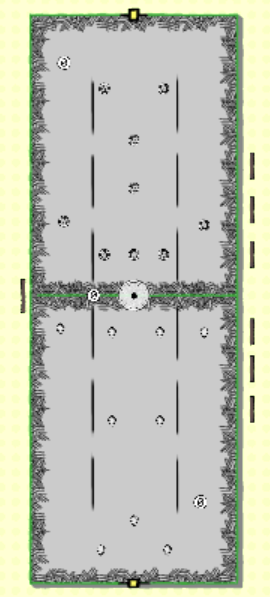
The game is played on an open, flat, dirt field, generally free of rocks & debris, that is 360 feet long by 144 feet wide. The field is split lengthwise down the entirety of the center into 72 feet wide halves, and crosswise at 120 feet intervals. These six resulting areas are marked off with white paint borders. Particularly enterprising/wealthy teams have been known to pay to have the sections magicked to different colors. Straddling the centerline at each end of the playing field is a netted goal, 9 feet wide by 3 feet tall. One narrow end of the field is to be facing North, indicating the “head” of the field. Three referees patrol the playing surface to control the action during the run of play.
Players:
Goltoppa is played by two opposing teams, consisting of 9 starting players on each side. Teams are permitted to ‘dress’ 3 bench players for each contest, to be subbed into the game in the event of injury. Players may not be subbed into the game for strategic reasons or in the event of a player’s expulsion from the contest. A player’s uniform shall consist of a sleeveless tunic, belted at the waist & extending to mid-thigh, in the primary color of one of the six teams currently representing the league’s six social strata: Noble (violet), Military (red), Religious (white), Artisan (gold), Farmer/Fisher (green), Merchant (blue). Note that players are recruited to represent these strata, and need not be members of them. Additionally, players shall wear sandals that wrap up around their calves, with linen padding over their shins. Each team dresses one Left & Right “Slasher,” designated by a black sash that goes diagonally from either left or right shoulder to opposing hip, with the shoulder covered indicating which side of the field they may patrol. Players may wear short pants as well.
Play:
The game is played in two 36 minute halves. At the start of the game, a coin toss determines initial possession, which begins via kicking a ball onto the field from a position to the left of the goal which the possessing team is defending. The ball is traditionally made from a treated cow’s stomach filled with air, or a leather ball of approximately the same size . There are no goalies; all players may attempt to kick the ball toward or away from the goal, or to a teammate. Additionally, each team’s Slashers are allowed to catch the ball on the fly in their hands and run with it to the border of whichever section of the field they currently occupy, at which point they must kick the ball themselves unless trying to place the ball in the opposing goal. A Slasher with possession of the ball may be leg tackled by the opposing team. A successful leg tackle means the Slasher must kick the ball to a teammate (only) from the spot of the tackle. Tackling with one’s arms, striking a Slasher above the waist, or attempting to strip the ball from a Slasher’s hands by a player other than an opposing Slasher is not allowed. A ball that goes out of the field of play results in a change of possession, with the new possessing team kicking the ball into the field of play from the sideline spot where the referees determine the ball crossed out of the field.
Scoring:
A score happens whenever the ball is put into the net during the run of play, A ball kicked into the net scores 2 points; a ball placed into the net by hand scores 5 points.
Penalties:
Rough Play: Arm tackles; deliberate leg tackles of a non-Slasher; headbutts; intentional hands to the face or back of an opponent – Offending player off the field for 3 minutes.
Stripping: An attempt to pull the ball from the hands of a Slasher by a non-Slasher – Offending player off the field for 3 minutes.
Catching: Non-Slasher making deliberate contact with his hands to the ball, especially with an effort to control the ball – Offending player off the field for 2 minutes.
Scooping: Slasher attempting to pick the ball up off the field, rather than catching it on the fly. This includes a ball that bounces before being caught – Offending player off the field for 1 minute.
Offsides: Slasher maintaining possession of the ball beyond the area of the field where he caught it, or crossing from his designated half of the field – Change of possession from the spot; no kick to inbound the ball needed.
Belligerence: Fighting; intentional physical contact/intimidation toward a referee – Offending player ejected.
Playing Goltoppa at the table
There will be a series of contested checks to determine scoring. These will use the Tool Sports: Goltoppa and have a few skills that can connect to them.
My first thought is a way to generate scoring similar to what is described by JayDubTheGamer would be to have five contested checks by half. That’s a lot of rolling, but provides some variety of results and capability of multiple players participating.
Winning a check by 1-5 results in two points. Winning a check by more than 5 results in 5 points. Winning a check by more than 10 results in seven points and winning by 15 or more is good for nine points.
Losing a check by less than 5 results in two points for your own team. Any natural 1 means that you have given up a five-pointer or have committed a foul, rolling their next challenge at Disadvantage. Any natural 20 means that you have scored a five-pointer.
This should generate scores that look a bit like early 20th century American football or current rugby.
Applying skills
Acrobatics and Athletics will be the most used skills, most frequently connecting to Dexterity and Strength. It would also make sense for someone in a coaching position to use Intelligence with one of those and for a character playing the captain to use Charisma.
I would allow up to one role to use Deception in order to get away with a foul. That team would have Advantage on the next check, but if they lose that roll their next roll would be at Disadvantage.
An example:
Violet team
Blue team
Score
13
7
Violet 5: Blue 0
16
20 (natural)
Violet 2: Blue 7
9
15
Violet 0: Blue 5
12
12
Violet 2: Blue 2
4
15
Violet 0: Blue 7
1st half
9 points
21 points
2
9
Violet 0: Blue 5
20 (natural)
7
Violet 12: Blue 0
14
11
Violet 2: Blue 2
18
6
Violet 7: Blue 0
3
9
Violet 0: Blue 5
2nd half
21 points
12 points
FINAL
30 points
33 points
Yes, that’s ten rolls for a non-combat encounter. Which feels like a bit, but the descriptions are at most two sentences, show the shifts in momentum, and feel like watching a sport when including those descriptions especially around the nat 20s.
The timeline of the World of the Everflow is getting harder for me to track. There have been six campaigns with some overlap in both reality and at the table. In order for me to keep better track of events and so that the players and their characters have a better idea of events in the past prior to the campaign I started to build a timeline.
The desire is that these are basically small phrases containing history, not a book of common knowledge to study. I’ll be adding to this as the players remind me of events, create things from their own history or ask questions.
Red Oak burns, allowing red dragons to be born; Uprising & Rebellion 1; 7th Fleet of Daoud encamps to the south of Kirtin-on-the-Lake
Five years ago
Dragons and the Ken fly to Kirtin-on-the-Lake; Sheljar is freed from Necromancy and the Tunneling Nightmares; some Scholars (Diviner, Necromancer) are made public; Kin can learn magic
Six years ago
Goblin Queen’s Fleet lands near Sheljar; Discovery of the Lorebook of Divination; Children of Chorl created; Eruption of Dakan Thaeeb; Lorebook Hunters start their search
Twenty-seven years ago
Sheljar falls to the Necromancer
Twenty-eight years ago
Born Generation
Seventy years ago
Crinth Confederation re-structures to stop expansion of Azsel
One hundred and twenty-two years ago
Kirtin loses Kirtin-on-the-Lake again
Two hundred and twenty-four years ago
Kirtin retakes Kirtin-on-the-Lake
Four hundred and sixty-four years ago
Daoud takes Kirtin-on-the-Lake
Seventeen hundred years ago
Az and Sel establish the Bond, rising to godhood; other bondings besides dogs are discovered; the Goliath nation of Galinor disappears
Two thousand years ago
Church of Quar controls the Everflow and the Font of Two paths, becoming a continent wide faith; Mehmd closes off the empire with foreigners only allowed at Gate
Millenia ago
Quar and the gods create Habergeon, the Everflow and separate the Lands of the Six Kingdoms from the world of magic
In my campaigns we use experience points rather than milestone levelling. But, we also spend time in the social and exploration pillars, where the game as designed provides little guidance towards the experience that should be rewarded for success overcoming obstacles beyond traps.
Rewarding the play I want to see, I have given out xp for solved plot points and discoveries. In the past these have been given out at the end of a session without the players knowing ahead of time what their character rewards would be.
I’m going to attempt to pull back that veil, listing out major plots and side quests with xp values. My goal is so that the player characters will be rewarded for developing their stories and the overall campaign.
Major plots
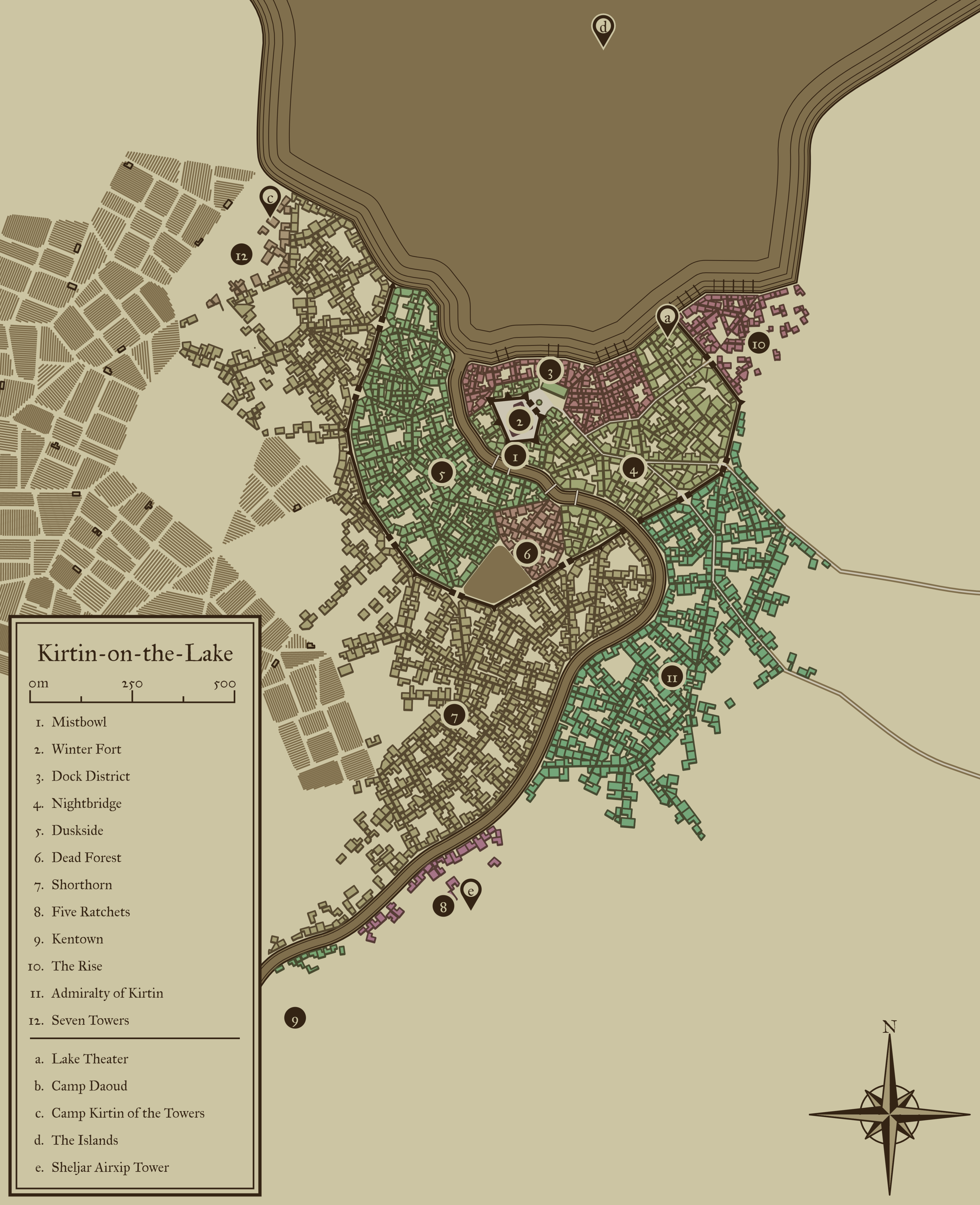
Daoud’s 7th Fleet vs Twilight and Shadow the Black Dragons vs the Mayor with the Blue Dragons vs assembling Kirtinish forces on the east shore – 10,000 xp
Kirtin-on-the-Lake is now torn between two of the Six Kingdoms and the separate appeals of two groups of Ken. Twilight and Shadow seem to thrive on misery, sucking up negative emotions from the war. The Mayor has gifted the Blue dragons significant territory and their co-operation requires unbonding from animal companions.
The 7th Fleet wants to take the city back to Daoud. It is actually a massive cavalry army with horses, riding dogs and warbirds. Kirtin’s forces sit, waiting for the three sides to destroy each other and sweep back into the city as welcomed heroes.
Our heroes haven’t picked a side, because they are all bad. In the past they’ve hoped for trade or normality looking to Sheljar for inspiration.
Our heroes have the Lorebook of Illusions and the Crate of Conjuration. They suspect there is another Lorebook locally and a fourth may be in The Ferments. They know not what power the Lorebooks provide, just that a group called the Scholars control them and the Proctors are a violent segment of Ken who are trying to acquire the various books. The world knows that the Folio of Necromancy and the Lorebook of Divination are in Sheljar.
Defending their books from other Proctors or Scholars is as important as finding more, probably.
Unseat the Mayor – 7,500 xp — COMPLETED
The Mayor has turned his back on Daoud and joined with the Blue Dragons and their Ken allies. Even if the heroes cannot yet sway the four-sided war, the group wants the Mayor eliminated via election, appointment or violence — he just needs to be gone.
Side quests
Where is Wilkie? – 2,500 xp — COMPELETED
One of their allies, Wilkie, former leader of the Dock District Guard fled. With their leader in hiding the Dock District has dissolved back to an ad hoc militia. The group of heroes had trusted Wilkie to defend their district.
Missing Printers – 2,500 xp — COMPLETED
The printing press and gobkon printers’ office burnt down in a dragon strike. No bodies were found. Once in hiding, then public, the Society of Veil and Shadow has again disappeared. Their pro-Sheljar message remains known, but there have been no broadsheets in three passings of Feylf.
Is the new flag of quill and sword related to their absence?
Bounties – 2,500 xp — COMPLETED
Each of the known heroes has a bounty of 2,500 gold on them. This is mostly because the Mayor hates them for the murder of the gnome during his festival. But also because they keep trying to inspire the people toward concepts like freedom and respect.
Character quests
Keldrass wants to repair the bonds broken by the black dragons and help protect the city from the Ken.
Gardar wants to increase the trade with Mehmd, earn respect outside of the caste system there and maybe have his own Goltoppa team.
Seymore wants to teach commoners magic, because even though he doesn’t trust it the people need the power. He’s done a bit of this by spreading Minor Illusion.
Req wants to maintain the independence of the Dock District.