Category: Playing D&D

  • Coffee Gear – a 5e D&D Tool

    Coffee Gear – a 5e D&D Tool

    Everyone needs a good pick-me-up. The studious wizard, the pickpocket, the noble, and the farmer all can take advantage of the boost of energy whether the beans are from far-off mountains or nearby hills. Adventurers aren’t on standard sleep schedules so the not-quite-magical bean roaster and brewer is quite helpful in the wildes, caverns, dungeons, and seas of any world.

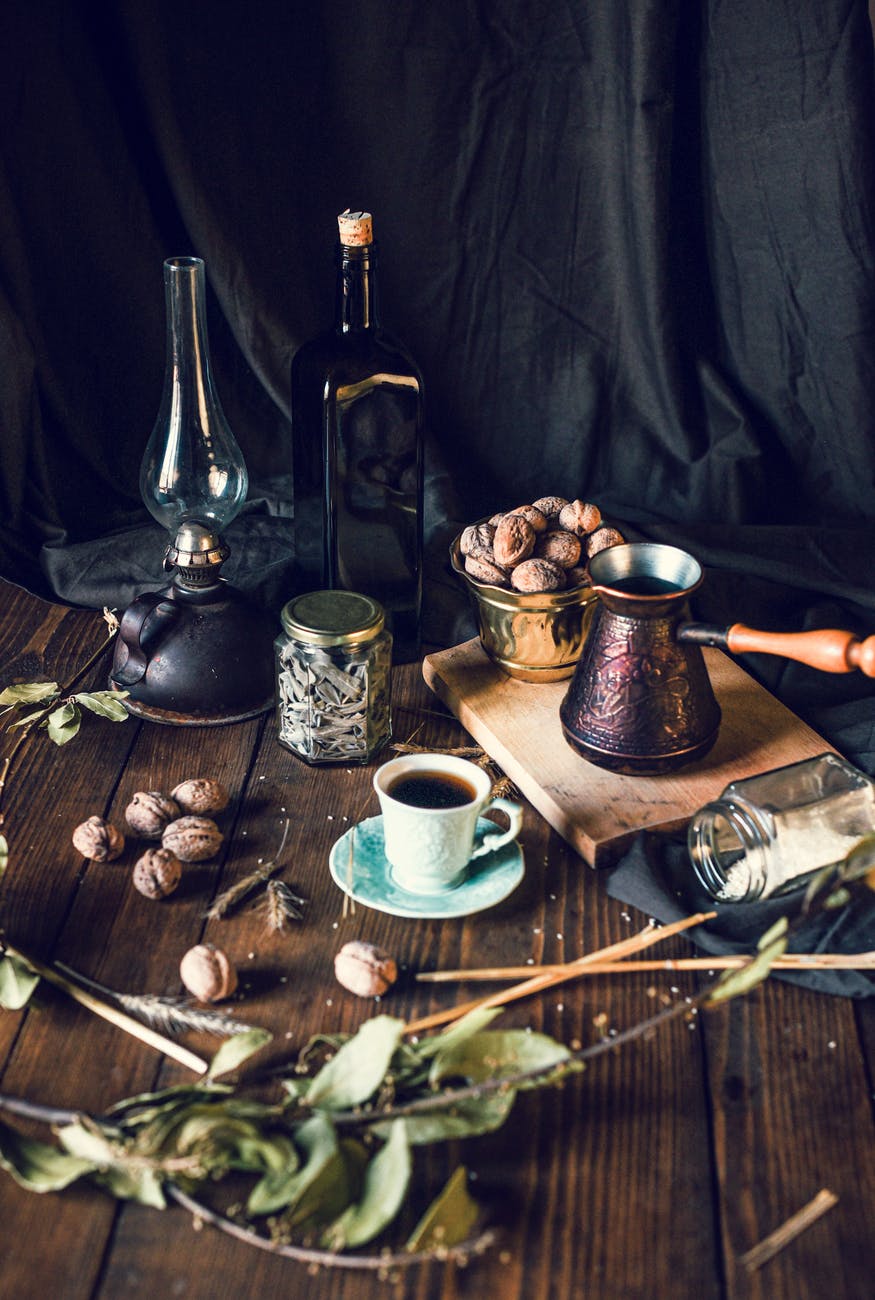
    Components: Coffee gear includes a pound of beans, 2 small spoons, 2 small cups, mortar & pestle or small hand grinder, an ibrik or small moka pot, a small rotisserie or pan roaster (can be powered by fire or certain cantrips), spices and sugar.

    Those cantrips that could power the two styles of roasters are: Control Flames, Create Bonfire, Druidcraft, Fire Bolt, Prestidigitation, and Produce Flame.

    In most D&D worlds a pound of green coffee should be priced around 3 gp and available similar to how cloves are in your worldspace.
    Photo by Svetlana Ponomareva on Pexels.com

    Insight: As someone that is in tune with the life of a cafe, coffeehouse, or court you can read the emotions and even pick up rumors spreading through the crowd.

    Example: As the party enters a bar or coffeehouse there is a buzz of conversation. Volgat Emberstone recognizes the conversations, listening in on the chatter around him. The player tells the DM that they are attempting to learn if Crylia the Goblin has been in the area. Per Xanathar’s Guide, as this Insight check is aided by the Tool, the player rolls with Advantage if they are proficient in both Insight and Coffee Gear, using the higher modifier of the two. If they are only proficient in only one of the two, they would use just the higher modifier rolling a single d20.

    Nature: Familiar with the origins of the glorious bean, you have learned about various locales where coffee is grown.

    Example: Marching through Windy Heaven Ridge, Umog sees some wild coffee. The player is wondering if this area is where they might find the tail feather of the Peryton that the Archmage of Cryssalis Valley hired them to bring to him.

    Remove Exhaustion: During a Short Rest you can roast and prepare a unique beverage for a single humanoid that drinks water. This special beverage can remove one level of Exhaustion, up to level 3 (going from 3 to 2, or 2 to 1, or 1 to no longer exhausted).

    Coffee Gear

    ActivityDC
    Roast Coffee (takes 1 hour)10
    Prepare Typical Beverage (takes 10 minutes)10
    Understand The Hills, Mountains Where Beans Grow15
    Discern Emotions, Learn Rumors In Coffeehouse15
    Remove Exhaustion20
    Photo by Tom Swinnen on Pexels.com
  • Add a Herding Dog to your D&D Game

    Add a Herding Dog to your D&D Game

    Animal companions are a tradition in Dungeons & Dragons. The Ranger with a hunting dog; the halfling riding a wolfhound; the dogs guarding the entry to the castle — all have status as tropes. In the standard rules the “Mastiff” represents all of these.

    But not every dog is a mass of muscle, teeth, and bark.

    Belgian Shepherd by Fouquier ॐ declared public domain at https://flic.kr/p/2i12JQq

    Other dogs exist in any fantasy world. These doggos deserve game-love, too. Inspired by Ambrose, the ranger in the game where my dwarven axe-wizard Awf slings spells and swings a battle axe like some kind of D&D version of John Casey, the Herding Dog leapt into existence.

    The desire with the Herding Dog was to not have an increase in power for a medium canine, but represent how shepherds, collies, sheepdogs, and other AKC Herding Group members are different from the working group types that the Mastiff embraces.

    There’s a small dip in strength, constitution, and damage with the most significant boosts being adding Animal Handling (to embrace the ability to make the herd go places) and Pack Tactics (to represent that herding dogs often work in groups).

    The minor changes give this dog a different identity, stay at the same power level, and give Ambrose a friend that isn’t purely a means to biting enemies. We’re using the Herding Dog in our campaign. Let me know if you decide to add it to your own.

    Terriers and Retrievers are on my list of potential design additions.

  • Awf Hornjaw et Loragwyn

    Awf Hornjaw et Loragwyn

    In creating Awf there were a few goals. As one of the more experienced players in the party I wanted to have at least a secondary stat be Intelligence. With the party being four to six PCs, there was room for at least one multi-role character. There’s a fighter, a rogue, a ranger, a cleric in the regular group.

    That meant that I could fill a few roles – this dwarf axe-wizard is a solid secondary front-line warrior and secondary spellcaster.

    He’s clearly not optimized.

    As someone who generally tries to avoid the more typical tropes with my PCs, Awf let me explore a few things that 5th edition empowers that weren’t possible when I was originally playing in 1st and 2nd edition of AD&D. He’s a Dwarf Wizard who uses a Battleaxe, fairly well.

    The desire to explore a new subclass was approved by my DM. The Bladesinger made sense for a frontline warrior/spellcaster. But, Dwarves aren’t supposed to be one.

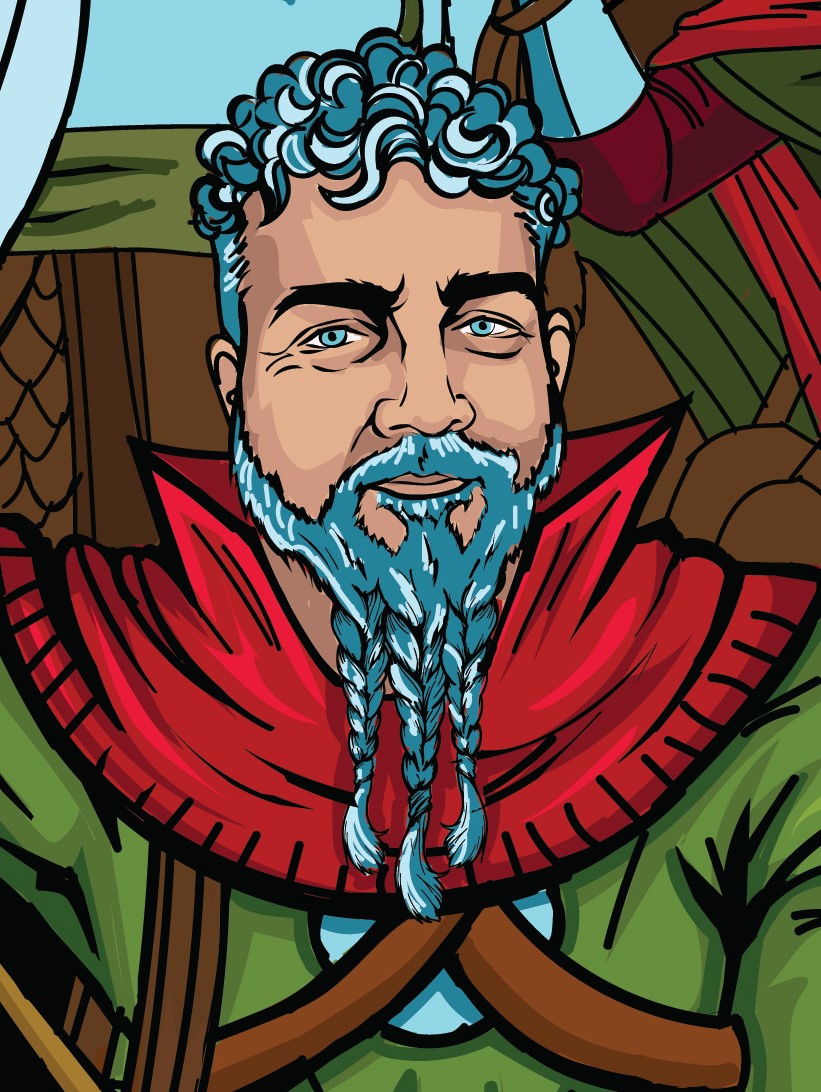
    Courtesy of Delaney Saul for my birthday

    That meant exploring his backstory. Awf has started to talk about that in his backstory in the game, so now it makes sense to share a bit of it.

    His hometown suffered a goblin attack. At the time he was a righteous adolescent who believed in the power of his family and village. Unfortunately his homestead was destroyed by goblins. He will never forgive this act.

    Fortunately the Order of the Shooting Star, mostly Elven Bladesingers, saved the town through a flanking operation. Awf’s family survived. But he lost respect. They weren’t powerful enough; they weren’t strong enough.

    So when the Shooting Stars left, he followed. There was strength in their magic. He followed them for more than ten years. The orphan-by-choice was a hanger-on. He shadowed the lessons of the Eagle Song, as they used axes in their maneuvers, but small axes, for they were not dwarves.

    By day Awf Hornjaw was an annoying outcast who offered just enough service to be useful. By night, Awf Hornjaw studied the ways of the Loragwyn clan’s magic.

    Being 3’11” and 211 pounds, he didn’t fit in the Knightly Order. He was too fat, too slow, too Dwarf.

    But Awf worked. The insulting nickname “Fat Goose” became his calling card. His axe took on the name Oie Cendrée. He learned and succeeded.

    Eventually the Loragwyns and the Shooting Stars accepted Awf. His noble desire to sacrifice anything to help others fit their ideals. His skill with adapting Oie Cendrée to the ways of the Song were intriguing.

    As Awf left the Shooting Stars they awarded him their name. Awf Hornjaw et Loragwyn is a man with two last names, two identities, and one goal – to find the goblin clan that threatened his family and show them that the Fat Goose is ready to sing the song of violence and ring the gong of death.

  • Cantrips and Backgrounds Are a Perfect Match

    Cantrips and Backgrounds Are a Perfect Match

    My backgrounds project continues to expand, adding in many medieval/Renaissance professions that fit in the apocrypha of D&D and related fantasy worlds. At this point there are nearly three dozen frameworks down. None of them demand a magical world.

    But, this is D&D, and in all (?) of the official, product-supported worlds of 5th edition magic is not something that is only held by leveled PCs and NPCs. If you visit a shrine in Forgotten Realms there is a great chance that one of the Acolytes there knows Thaumaturgy. The number of Guild Artisans (tailor) in Eberron that know Mending is almost certainly larger than the number that do not.

    In these worlds there should be tales of those who became heroes after their less-than-mundane lives. The fantastic is part of the D&D experience – both in heroic journeys and in everyday life.

    Exploring what cantrips make sense leads me to listing those cantrips that are not designed for warfare – essentially ignoring damage cantrips, but there are a few that make sense. Let’s take a look at the DnDBeyond list of cantrips and pare it down to just things that commoners would possibly know.

    Cantrips for Fantastic Living

    • Control Flames – Yes, it can do damage, but its primary purpose is about starting and putting out fires. I’ll explore a Firefighter.
    • Create Bonfire – Similar to above.
    • Dancing Lights – This also has combat roles, but imagine the ability of a theater designer to take advantage of Dancing Lights in ways that amplify that experience. The name does not leap to mind, but a variant entertainer using light is needed.
    • Druidcraft – The most obvious way this works is to help a Farmer, Rancher, Herder, etc. On the other hand, imagine a Weather Forecaster.
    • Gust – Sailing across the sea and stuck? Find your empowered crew who can create a tiny wind.
    • Light – The uses are nearly infinite. The Lamplighter will be both apocryphal and fantastical.
    • Mage Hand – Thieves and Wizards alike enjoy this one, but so would construction workers. Why bother with a ladder when you have Mage Hand?
    • Magic Stone – While this is a combat cantrip it feels proper for certain wilderness Backgrounds to have access to it. An Herbalist hunting for a rare shroom may need to defend themselves, for example.
    • Mending – Tailors and Tinkers around the world would be thrilled.
    • Message – This would be useful for the Pamphleteer, the Town Crier, the Spy, the City Watch, and many more.
    • Minor Illusion – Another cantrip that would suit Entertainers.
    • Mold Earth – Masons and Farmers could both find uses for this cantrip.
    • Prestidigitation – A Realmsean Dry Cleaner could profit off of making the bloodied heroes, and criminals, presentable. Similar to Light and Druidcraft the Backgrounds that could take advantage of this are nearly infinite.
    • Produce Flame – A third in the fire series.
    • Shape Water – Immediately upon reading this one I thought about construction of aqueducts and water wheels.
    • Spare the Dying – In gameplay this may be one of the weakest cantrips. In the rough and tumble alleys of Baldur’s Gate it keeps the citizenry alive – Medic and maybe for the Barber as well.
    • Thaumaturgy – Acolytes and Sages should probably already know this one. The organized faiths of the world would have plenty of priests and others able to shout above the masses. This also has great application for a Town Crier, Herald, and Soldier.

    Several more attacking cantrips have possible secondary uses. These are ignored because not every D&D world need be one of violence for the commoner.

    Next Steps

    In some cases adding these minor spells to existing Backgrounds makes sense. That would involve a slight change to the current rule set. We know that a cantrip is considered roughly equal to a skill or language based on the Feats Linguist, Prodigy, and Skilled. The product will address that.

    But knowing these cantrips also means an exploration of how certain roles in the medieval/Renaissance apocrypha of D&D change because of magic. A Lamplighter (a custom background in development) with Light should be behaviorally different than one still using flint, steel, and oil.

    Both will exist. You will be in charge of how your world borrows the ideas to come in Before We Were Heroes (tentative title).

    Your world should be apocryphal and fantastic.

  • Arise & Descend: Entering the Manor House

    Arise & Descend: Entering the Manor House

    If we are to be heroes, we must act with in the faith of ourselves, our gods, and those that look to us for hope. This band of becoming-friends is strong willed and capable.

    We are willing to risk, a bit brash (that may be my fault). Those that oppose us are able to surrender. We will not kill them if they do. There are things we will not tolerate. Those enemies do not live long.

    Together we will free this town and rescue our patron. What happens on the way will happen.

    Spoilers for the D&D Starter Set adventure Lost Mines of Phandelver follow.
    Our adventures started with an ambush by goblins, then a rescue of Sildar in the goblin caves. From there we cleaned up the southern part of town prior to attack the Red Brands at their manor house.

    Have you met my friends? Maybe I should introduce them.

    Krakom is another dwarf. A fierce fighter who will stand shoulder-to-shoulder with me Krakom is sometimes confused by my behavior. While I prefer a big axe, Krakom has mastered the use of a massive hammer — bang-bang.

    Norran might be an elf. I’m uncertain. He can slip through a crowd, or into the dark, and disappear for a bit. An arrow will fly free from where Norran might be and pierce the heart of our enemies. Most often he’s the scout.

    Ambrose is my orc-ish friend. Deft with a hurled spear and willing to enter a fight with two weapons when hand-to-hand combat ensues Ambrose likes to use an axe, which I appreciate.

    Rowan has faith. She’s more than a believer. Tymora works through her. The human helps keep us alive, which is appreciated, of course. Rowan is also a wonder at sussing out information from people who aren’t trying to destroy us. She’s trusted. Hopefully we can all be trusted soon.

    Sorry, I got distracted. You were asking about the manor house. Yes, we raided it. Yes, at daylight. We needed to sleep. No, we weren’t concerned with them being warned by the near dozen of deaths and surrenders from the previous day.

    [mutters under breath: coward]

    No, not you.

    Anyway. We went to the manor. Shortly after entering we dispatched three more Red Brands, found some rations, and a bit of coin. The one we didn’t kill indicated that the GlassStaff would be down a hall.

    While my friends discussed the ‘proper action’ I opened the door to that hall. We knew what to do. Let’s do it.

    Behind that door was a powerful stench of rotting flesh. Someone vomited. No, it wasn’t me [it was me].

    A disgusting monstrosity was beyond the doors. It had one large eye in the center of its head and a massive maw. The hands were large with nails that may as well been claws.

    We destroyed it because talking wasn’t working. It wanted to eat the flesh of peoples. There is no saving those types.

    You want to know what happens next? Fill my mug. I’m out of Elverquisst. Fill the mug. I’ll have more tales when you return.