Tag: RPG

  • Lore Collage: Bringing the blogosphere I wanted back

    Lore Collage: Bringing the blogosphere I wanted back

    Likely inspired by this interview over at Flipboard, I decided to bring back Lore Collage. This is a weekly look at things I read/watched/etc. The focus will be on building and playing in a mid to high fantasy world using 5th edition D&D and related rulesets.

    Reading

    Beyond the Gates: Where Dungeons & Dragons Meets Sacred Community(Roll 4 Joy) Once upon a time I was active in a church youth group and also actively played D&D. I wouldn’t have dared crossed those interests. I’m happy this group now feels comfortable to do so.

    Avoid Removing Player Agency (SlyFlourish) This is the money quote “Players want to do stuff. They want to use the tools their characters have to interact with the world.” The article is a good reminder that the lack of agency should be used intentionally and rarely.

    Kickstarter’s New Head Of Games Asher McClennahan Discusses His Vision (Forbes) 80% of tabletop games on Kickstarter deliver.

    Southern resident orcas pick up, use kelp in newly discovered behavior (Seattle Times) The real, natural world continues to find new ways to influence my world. Inspired by this story I want to work some weird play/symbology with the various beasts in the world.

    New Monster – Dreadful Tree (Sea of Stars RPG) My Sunday campaign, where I play the smog-goblin Xabal, keeps running into various blights. We can always use more blights. Recently Sea of Stars also wrote about adding weaknesses to monsters to add in their story.

    How Dungeons & Dragons: Dragon Delves is breaking all fantasy art rules (Creative Bloq) Now-released Dragon Delves artist Andre Kolb and writer Justice Arman talk to Creative Bloq about a new approach to official D&D art in an adventure book.

    Design Diary with Richard Green, one of the authors of Labyrinth Worldbook (Kobold Press) Green writes about the setting expansion — the Labyrinth Worldbook, which was cooperatively created for Tales of the Valiant. Even if you don’t play ToV/Black Flag, everything in the book can be used to create a new multiverse for your own world.

    Watching

    While the era of peak high fantasy may be fading away, you can still dip back into low to mid fantasy via shows like Merlin or Cursed. These lower magic shows do a great job of establishing a world where magic is special, powerful and intimidating. They also provide a slice of life for the zero-to-not-yet-hero portion of play.

    Creating

    For my upcoming Ferments-set nearly-zero prep game I put together an encounters table. The intent is to include things that aren’t only combat and that fit the tale of the setting.

    There’s everything from fire tornadoes to loose goats, from steam golems to calm skies after a storm.

    ‘Wine lets secrets out’ – the Vintner, a 5e D&D Background (Full Moon Storytelling) To update to 2024 D&D or Black Flag;

    5e24

    Pick one of the following Feats. They are listed in order of commonality;

    1. Skilled
    2. Musician
    3. Magic Initiate (Druid)
    4. Tavern Brawler
    5. Healer

    Then assign ability score bonuses to Wisdom, Charisma or Intelligence.

    Black Flag

    Pick one of the following Talents. They are listed in order of commonality;

    1. Polyglot
    2. Trade skills
    3. Scrutinous
    4. Ritualist (Primordial)
    5. Athletic
  • Your favorite fantasy TV series was cancelled, now what? RPGs

    Your favorite fantasy TV series was cancelled, now what? RPGs

    A few years ago it was the heyday of big, high fantasy TV series. Yes, the grit of Game of Thrones and Witcher were still popular, but there were also a selection of shows with a higher level of magic, higher level of heroism and a set of characters who you wanted to win. It was the era of peak fantasy TV.

    Slowly but surely these faded away.

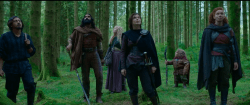
    Several people in fantasy medieval garb in a dark forest.
    Screenshot of Willow on Disney+

    Some series got a reasonable run — The Magicians reached a conclusion. Some series were cut quite short — Willow, ended with more story to tell.

    Universes were announced to be expanding. Shadow & Bone went from having the Six of Crows spinoff announced to the entire project dying.

    There was big money in fantasy for a bit. These weren’t Brit TV specials like Merlin or modern attempts at low budget like Xena.

    The biggest money of them all is still around. Rings of Power, the prequel-ish endeavor by Prime Video churns along at price points that are normally saved for theater or Andor.

    The wheel weaves as the wheel wills, always turning.

    Sometimes the wheel destroys the things you enjoy, like Wheel of Time — especially the last half of season 2 and all of season 3 with strong reviews and great fan appreciation. While there was enormous pushback against the changes made to adapt to the shorter run time of a book plus a bit per season, as well as pushback against the attempts to be less coded and more openly diverse, the series was generally well received. It was generally profitable.

    It’s gone.

    The story won’t finish (except in the books, which will always be around). Yes, there’s a petition to Save Wheel of Time. I hope it succeeds. Brandon Sanderson seems to suggest it should, but will not.

    Petitions and book reading are passive.

    Don’t be passive — adapt those stories to an RPG

    Playing games in those worlds is active participation in the fandom, and helps build out that word of mouth.

    You don’t need to have an authorized book in order to play. Any fantasy series, movie, video game, book, comic, etc can show up at your table.

    You can instead borrow the themes, cultures, characters and put them in your world. Sure, you could play pure within the world created by Robert Jordan or Lev Grossman or Jonathan Kasdan.

    The power of roleplaying games is that the tale is yours, no one can take it from you. The rules can be simple enough to fit on a business card or so complex it fills bookshelves.

    A selection of 5e D&D books from Wizards of the Coast, Kobold Press and others.

    What happens to Jade, Kit and Elora?

    That’s up to you.

    What happens to Mat, Perrin, Elayne, Min and the rest?

    That’s up to you.

    Take the themes, tropes and world of that story that a committee decided was no longer worth being told and tell it yourself.

    That’s why I fell in love with D&D and RPGs in the 80s.

    The unfinished trilogy, or maybe not

    Back in my youth my bookshelves were covered with science fiction, fantasy and encyclopedias. Words on a page were meant to be consumed by me, like a black hole consumes a galaxy.

    I’d shop at a used bookstore, looking for a new series to start. Except sometimes I’d never find book 2, let alone the inevitable trilogy. Sometimes I would start with book 3!

    One of my favorite tales, and I say this as someone who had pets but didn’t really discover the love of pets until my 30s, was a story about a fading order of knights who rode giant tigers. The hero wasn’t really part of the order. His family was and he had that extremely large cat. In this dying world they journeyed, starting as outsiders and immediately recognized as legendary. But they were just a dude and a great cat.

    They didn’t want to be heroes. It was so compelling, this story of man and beast who wanted to be normal while the world needed them to be great.

    I never found book 2.

    But I had already discovered Dungeons & Dragons. A character paralleling that tale was created. We roamed the worlds that Erik and Justin and Chis and Abel and Hayes and Jacob and Colin and Andrew and others created.

    We finished that tale.

    Wheel of Time is over, unless it isn’t

    The series explored slightly different things from the books. One of those was how tales are told. There’s a suggestion from the meta of the series that within a world where there are endless retellings of tales and history.

    What changes, and what stays the same is part of that story.

    Your RPG could lean into that by playing similar characters at different levels, at different times with a power to oncer per month to have a past power show up, maybe ramping faster as time goes by.

    Another possible exploration from the Wheel of Times series and books is how power corrupts. The nature of saidin is that man with power lose control of themselves — mentally, emotionally, physically.

    Want to toss a saidin power into your D&D?

    Maybe your Rand-ish character is a Warlock that has to roll on the Wild Magic table every time they cast a spell.

    Of course, one of the most potent tales from the books that is amplified in the series is that women are not side characters. They are as important to the story, and powerfully so, as anyone else.

    You don’t need special rules for this. The modern versions of D&D encourage this.

    From Willow there is a connection in the series to the tales from the movie (history is a massive throughput in Wheel of Time as well).

    To see this at your table means connecting a current adventure or campaign to one that ended a decade, a century, a millennia, an age ago.

    A D&D campaign that builds off of former campaigns is a structure that generally needs some continuity of players, but can also be done through one-sheets, common knowledge pages and a regular re-telling of special moments.

    This could happen around the campfire, on the steps of a temple, inside a tavern or any place where the PCs meet NPCs.

    Find what’s important from these tales and make them your own

    It’s rough to lose a special story.

    You have your memory. You have your hope.

    You have a game to help you continue the legends that are important to you. You don’t need Rafe or Sera or Kasdan.

    You need dice, paper and a table of friends.

    Fediverse Reactions
  • The Ferments: A campaign one sheet

    The Ferments: A campaign one sheet

    The Ferments are a rough land of geysers, lava flows, fast glaciers, waterfalls, hot springs, tornadoes, earthquakes — the raw power of the world. From this land the best alcohols of the Six Kingdoms come. The peoples of the Ferments are dispersed, spread over the many miles with four main towns. They generally live in defensible homesteads interacting when they need goods or during festivals.

    Campaign Premise

    Our eventual heroes start out as the primary defender of a homestead. They know how to contact other homesteads for help when needed, but mostly they are on their own hoping to remain safe from a world where dragons came real, magic became powerful and kaiju returned.

    Grand Conflicts

    Elementals burst from the land, stronger than before and with a hungry intelligence that threatens the land. Outsiders fleeing the wars of Six Kingdoms come for safe harbor. Dragons and their Ken continue to search for more scholars.

    Photo of a hot spring and geyser with a foreground of rough reds, the pool of water and a cliff in the background
    Photo by Laura Paredis on Pexels.com

    Each homestead has a book, collection of scrolls or other devices that helps them control an element (earth, air, fire, water) or paraelemental (smoke, magma, dust, ice, steam, mud, etc). These start out with each PC knowing Elementalism, limited by their choice of element. Each was passed down since the time of Gallinor, before the time of dragons.

    Factions

    Every player will create either an ally or adversary family besides their own. They may also have a connection to one of the families (not all families share blood-ties) of other characters.

    Adversaries

    Allies

    Rumors

    This section will fill over time.

    Animated gif of a blue-green wyvern overlooking a river
    • Kaiju roam as in the time of Gallinor — some even are ridden. Word is they come from the Kirtin-in-the-Sky and the Cliffs of Gallinor.

    Facets

    • Exploring the zero-to-hero tropes, friendship with animals, and who gets to control knowledge.
    • Defending your people.
    • Inverted West Marches.
      • Enemy generally comes to you. Though you may sallly in order to obtain resources.
      • Episodic – attend when you can.
    • Sessions are 3 hours, with each story completed in one session.
      • Characters will level up every 3 sessions.
    • Recaps will be posted to Full Moon Storytelling.

    Variant Rules

    • Wizards of the Coast’s 2024 D&D is the baseline
      • Monsters may come from Black Flag, A5E, 5.1 and 5.2 products.
      • Player options must be consistent within the ruleset (i.e. if you play a Mechanist all options should be from Tales of the Valiant for that character).
      • There is a campaign set up on DnD Beyond. Email me to get an invite.
      • Start at 1st level.
      • Use point buy or standard array for starting attributes. If you want something random, the redrick roller gives random point-buy-valid stats.
    • Playable races are Human, Hin(what they call themselves)/Halfling, or Goliath.
    • There are several custom backgrounds and tools available. We will use cultures, not languages. Common is the Western Wildes. Other cultures are;
    • Heroic Inspiration will exist as a shared dice pool that is a maximum of 2+ the number of PCs that day.
      • In addition to the normal ways to award Heroic Inspiration it will be awarded for playing to Short Form Personality.
    • Each PC manages a Homestead (Bastion from 5e 2024) that starts with no Special Buildings.
    • Each session will offer the opportunity for a short rest. Long rests are between sessions.

    Practicum

    Sessions are on Sundays from 1-4 when my main campaign isn’t being played. We’ll meet at Logan Brewing, usually. I’m willing to do duet play outside of that timeline as well.

    Each character should be built in a session zero discussing their personality, homestead, allies/adversaries and key abilities.

    Fediverse Reactions
  • How players should prepare before their next TTRPG session

    How players should prepare before their next TTRPG session

    There’s a lot of guidance on how to be a better DM. There’s some guidance on the player-side of the table. The most prolific of the player-side guidance is about character builds.

    Instead of focusing on the character or DM, we’re going to focus on the player. What can a player do to prep for their next session? How can they help their group move at a pace that matches the genre of the game?

    While the examples provided relate to Dungeons & Dragons, the fundamentals apply to most roleplaying games. You should be able to prepare in less than 30 minutes. These tips may be basic, but they’re steps I take every time I’m a player in my current era and come from my experiences in my bifurcated RPG time (early 80s to mid-90s, 2014 to present).

    Review your character’s motivations

    Others may push you to look at your powers first, but to me what makes a pen-and-paper RPG (even if it is D&D played on a VTT) special is that you get to act as the character would act. You aren’t constrained by anything but the willingness to be a coherent character.

    To do so you should spend a few minutes thinking about your character. That could mean checking what their alignment is, what their personality is, what their goals are, how their family motivates them, etc. Don’t have them act slovenly if they’ve been cleanly in the past. Don’t have them be a chaos agent if they are orderly.

    Do talk about how their brother inspired their quest. Do put forth that they are searching for their best friend. Do have them be motivated by riches and treasure.

    Reviewing motivations means putting on that character’s face for a couple of minutes.

    Review your character’s abilities

    Character sheets can be complex. D&D PC sheets can be two-plus pages with spells and feats and features and weapons and masteries and riders — this list can go on. But for most characters you have a primary attack, a secondary attack, a way to interact in social encounters and a way to explore (or other pillars for other games).

    Focus your attention on the main things your character does because they are good at them. At the table that’s what you’ll do. Spending a minute or two reviewing the rules for the things you do should speed up play as you won’t be looking up the rules live. This is especially important if the character has recently leveled up, acquired a magic item, or added a new feature.

    Also remember what your character shouldn’t do because they are bad at it. You may want to hint at that during play. Maybe you are a Barbarian who shouldn’t be doing ranged attacks, bring that up when the group wants to snipe at distance.

    Plan to use an ability or feature you haven’t in several sessions

    When you’re looking at your sheet maybe you’ll notice something that your character hasn’t done in a few sessions. Find a way to do that in the session you are prepping for!

    Xabal, my goblin Artificer, started using a spell called Caustic Brew regularly. They hadn’t used it in enough sessions that I forgot I had it. This week I committed to bringing it back to the forefront. Xabal blasted an automaton with it and later used it to break open a gate.

    Review the party’s names, excellences and weaknesses

    In real life most of us don’t forget our friends and coworkers. In a game like D&D, where some of us only play once a month, it’s easy to do so. As a player that’s understandable. It’s not for the characters.

    Our recent session continued an invasion of a mob warehouse. Xabal wouldn’t forget the other character’s in the party, what they are good at and what they’d need help with.

    The only way to ensure that you, the player, don’t forget the other characters in the group is to take a moment to review their names, their skills, and what they are doing adventuring with your character.

    Remember the adventure and campaign goals

    You don’t have to be a deep notetaker for this one.

    Take the time to think about why the group is on this quest. What does success look like? What does failure look like?

    Why is Xabal’s group invading a mob warehouse? Because they were sent there by an organization of mages from the ruling powers who think this mob may be connected with cultish activities that are attempting to overthrow the order in the world.

    By knowing what the group’s goals are you may avoid going on that weird side quest or shopping trip or winding up with a 4-hour session in a tavern — you might not avoid it though! That’s the power of playing as real people. Sometimes we don’t do the smart thing or the right thing. We still should be ready to do the proper thing and know why we aren’t


    These are my four steps to getting ready to be a player in a D&D session. What do you do to prepare to play?

    Fediverse Reactions
  • Your players aren’t supposed to die

    Your players aren’t supposed to die

    A couple weeks ago one of my players passed away. Not his character, the actual player. This isn’t supposed to happen. My group is GenX with a couple of Millennials.

    John White left us too early. His D&D experiences were strongly in 3rd edition, though like myself had played for as long as he could remember. And even though he mostly played in an edition that encouraged optimization, it was his adoption of the story-centric campaign that we’ll all remember.

    I remember playing with a friend who was never waiting for his turn to do something, but was engrossed in the act of telling a story together. I remember a collaborator who expanded the world that we played in by fully being in it. I remember characters whose backstories and internal lives were fully fleshed out, who incorporated elements of the world that even its creator hadn’t thought of and who interwove the stories of other players’ characters into their own with a generosity and care that is rare in any circumstance.
    — another player at our table

    He’s played with this group since it was founded during the pandemic, playing on the patio of a brewery that was roughly a midpoint for a group that is spread through King and Pierce County — Logan Brewing.

    We’re going to celebrate John by playing D&D together in public — we’d like you to join us. Or you can watch. The event is March 16 from 1-4 pm PT at Logan Brewing.

    Please fill out this form so we can be prepared with characters and the necessary number of DMs

    John’s characters were:

    • Habergeon, the world’s first, and possibly only, warforged, Habergeon was crafted during the fall of a previous age back when magic was plentiful and those who are now gods walked the world as mortals.
    • Gardar, a Mehmdoan, this one-time cooper and weaponsmith lost his first animal companion to tragedy, fled his former master and now seeks to rid the influence of the Dragons and their allies.
    • Tsirdan, an elven Scribe Wizard who worked with the Dragons to control the spread of magic in Douad.
    • And Artok, our commander Dragonborn Paladin in his final campaign. Artok, like John, was noble and heroic, short on words but those few words were always potent.

    John was unlike anyone I’ve ever met, his way of thinking and explaining things was in such detail that I could tell his mind was always working in overdrive
    — another of our players.

    The first time I met John was when I was co-hosting a Sounders podcast at our local German pub.

    The first time I played D&D with John was when I was featured in the Renton History Museum exhibit on Creating Community with D&D. A letter to the editor at the time shouted that the museum shouldn’t support Satan, as if it was the 80s again.

    John’s response was to suggest to me that we should play in public so that people could see this game for what it is. He and I were joined by his wife and sister-in-law. We played in a public park.

    Though my modern D&D games had frequently been in public it was mostly at geeky places like game cafes.

    It was perfect that our post-pandemic campaigns were in a very public brewery. Many times we played a stranger would ask us what we were doing while current and former players would always recognize the game and ask about the campaign.

    Playing in public exposed more people to the game John loved.

    John enjoyed porters and though he was short on words he was always present.

    And that’s why we’re doing one session of a 4th level one-shot on Sunday March 16, from 1-4 pm. People who know John and those who want to experience the game are welcome. Again, please fill out this form so we can get an idea for how many DMs we need.

    Fediverse Reactions