Tag: monsters

  • Lore collage: Inspirations, disasters and conventions

    Lore collage: Inspirations, disasters and conventions

    The irregular column where I share links to the things that inspire me is back!

    Today, I’m writing while a third atmospheric river in a week passes over my home state. It offered a new twist, a levee break near where I go shopping and attend Sounders practices. The repair seems to be going well and the flooding there is only bad enough to wet parking lots. Up in the North Sound things are not simple, nor easy. Their recovery is going to take a long time. The communities up there will learn on each other and those of us that can help, because it’s bad.

    Working in a field adjacent to disaster prep I’ve given some talks about how RPGs can help people learn what to do in crisis through short games that are D&D adjacent (ability+skill/class, d20). Next month I’m giving a different but similar talk at OrcaCon in SeaTac.

    Attendees can find it in their schedule as: Special Event: RPGs as Natural Disaster Prep Tools.

    Hurricanes, Earthquakes, Volcanoes! Learn how to prepare using TTRPGs. Themed around community, and helpful for memory retention, these small, educational TTRPG games can help a community prepare for the natural hazards that are impacting them more than ever.

    There’s obviously going to be an example about floods, bomb cyclones and atmospheric rivers too. If you are in the South Sound come to OrcaCon. I’d love to meet you.


    A Collection of Unmitigated Pedantry takes a deep dive, in series, into the lives of peasants. The hard work of the pre-Industrial Age by those nameless families who make up the majority of those humans who have ever lived is modeled and described.

    Much of it runs counter to my previously cited works about the amount of leisure time available that should inspire characters to have hobbies.

    There is almost no dedicated leisure time during the day. There is a regularity to the cycle, a monotony – each day more or less like the one before it and the one after – one imagines it was comforting to some peasants and deeply constricting to others, shaped by the continuing demands of peasant labor (itself structured by the heavy extraction regime they operate under, which consumes the leisure time they might otherwise have).

    But your characters should still have hobbies — even if they are peasants.

    1. Modern D&D is mostly in a near industrial format that allows for specialization.
    2. Wide magic definitely enables specialization and light.
    3. It’s more fun to have.
    4. ACOUP also points out that days may not have breaks, but weeks likely do and there are fest periods annually.

    In any case, for those long days in the fields or the long hours of spinning thread while keeping one eye on the large pot and the other on the tiny tot, our peasants would be looking forward to the next festival, the next feast day, the next major event…


    But also, games are common, everywhere.

    Ancient Maya game board with unique mosaic design discovered in Guatemala

    This board is different than previous finds in that it was built in to the floor in a mosaic rather than on benches or tables. It was large and meant to be permanent.

    People like to play games.


    Sometimes people play games to avoid thinking about the Apocolypse.

    When You Say, “Thermonuclear War,” I Think You Mean “the Call to Adventure”! The Twilight: 2000 Tabletop Role-Playing Game and the Postapocalyptic World’s Imaginary Spaces

    Or to learn about how to behave during natural disasters.


    A few months ago this beat wound up in my reader. I still haven’t used it in a game, but need to do that soon.
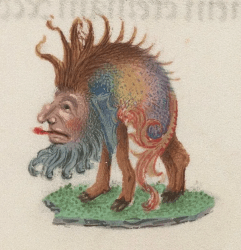

    Now, normally I love to add more dragons to a fantasy world — I prefer Dragons of Wales for my non-traditional dragon art.

    What if you wanted an armadillo looking thing with a humanish face smoking something?

    The history of oddities that aren’t natural beasts is vast and open to your use. Public Domain Review shared a selection of them recently.


    Does your fantasy world include smog-punk goblins, artificers, or take place in Eberron?

    You may need Gadgets From A Parallel World by Pantograph.

    A tube amp wireless router? A binary code typewriter with only a zero and one? A record player that can play 4 records – vocals, guitar, base and drum – at the same time? These are all gadgets that almost seem like they could exist, but of course they don’t.

    The binary typewriter is going into my world right now.


    Work passed 300 disaster relief and humanitarian aid NGOs supported for free. I’m proud to work at a place that lives its values and helps humanity. Factal produces free resources for the public too.

  • Reblogging: Monsters of the Multiverse Humanoids, Part 1 — The Monsters Know What They’re Doing

    Keith Ammann’s The Monsters Know What They’re Doing is a great book (and blog) that converts that statistics for a D&D monster to the types of tactics that monster would use in combat. With the recent release of Mordenkainen Presents: Monsters of the Multiverse Keith look how humanoids from Volo’s and the first Mord’s to see how the tactics would change. I’m looking forward to running the duergar with these new stats from Monsters of the Multiverse and guidance from Keith.

    I’m going to look at the significant changes to monsters in Monsters of the Multiverse in the order they appear in MOAR! Monsters Know What They’re Doing… 3,398 more words

    Monsters of the Multiverse Humanoids, Part 1 — The Monsters Know What They’re Doing
  • How to give your Beasts and Monstrosities reasonable speeds

    How to give your Beasts and Monstrosities reasonable speeds

    You might be able to outrun a Tyrannosaurus Rex, if you’re a peak athlete. Keep note of that. You almost certainly can outmaneuver them. Those are the key takeaways that Wired wants you to have after reading “How to Outrun a Dinosaur.

    There’s a lot more depth in there for a game designer, homebrewer, or storyteller.

    Three years ago the biologist Myriam Hirt, who studies animal movement at the German Centre for Biodiversity Research, asked a seemingly simple question: Why is it that the biggest, most powerful animals—the whales, elephants, and rhinoceroses—are not the fastest, while the smallest—the mice, minnows, and millipedes—are some of the slowest? Is the implication that there is an optimum size for speed?

    The answer, Hirt found, is yes. If you were designing an animal for speed, that animal should weigh approximately 200 pounds. A bit heavier for a swimmer, and a bit lighter for a flyer.

    Wired, How to Outrun a Dinosaur.

    The T Rex has a speed of 50 in Dungeons & Dragons. That’s too fast for the mass of meat with jaws of death. Smaller dinos and lizards should probably have higher speeds. The Ripper Lizard is getting an update as this story is getting written.

    The speed of 50 might make sense if the primary time in D&D that speed is used is to determine distance running. But it is not. Speed most frequently comes up in combats in six-second chunks of time. Beasts and Monstrosities with high speeds should be the ones that accelerate and burst forward — cheetahs, lions, and Deltadromeus. Even the velociraptor should be average-to-athletic human sprint speed-ish.

    That also brings up a key point. A D&D character is supposed to represent, in general, above average athletes. There’s no direct tie-in between Strength, Dexterity, or Constitution and speed. Most races get a 30, some get a 25, rare ones get 35, and even rarer are the few that fly or swim.

    There are three things we should do with the knowledge from that Wired article;

    • Centerline most speeds to better represent reality in non-magical creatures.
    • Add line in the description that addresses distance traveled by unencumbered and encumbered beasts of burden.
    • Create a quick and easy way to avoid getting run down by a dinosaur.

    That last bullet doesn’t take a lot of work. When in a chase scene use opposed Dexterity checks (Acrobatics or Athletics or Sports could apply) when the chaser is within Reach of the chasee. A success would permit an attack/shove/grapple, if the action economy makes sense. If not, let the chasee take half their movement as a reaction as long as they are able to, and do, significantly change direction.

    Any creature that has magical influence on their speed can operate as normal.

  • Taien Sahul – the ripper lizard

    Taien Sahul – the ripper lizard

    Out in the lands of Mehmd mammals and avians are rare. Many of the ecological and domestic niches are instead filled by lizards, amphibians and dinosaur-like creatures. The Taien Sahul are small saurs based on the Velociraptor by Sam Stockdale at ENWorld.

    In Mehmd they tend to roam the wilderness, though certain tribes of Unkempt in the South and the Isles use them as companions. When free they roam in packs of 9 or so (3d6). Their Pounce needs quite a distance in order to be used, but when the commit they tend to rush prey quickly. Taien Sahul can survive in deserts, having advantage on CON checks to deal with dehydration.

    Photo by Innermost Limits on Pexels.com

    Taien Sahul – the ripper lizard
    Small beast, unaligned

    Armor Class 13 (natural)
    Hit Points 3 (1d6)
    Speed 45 ft., climb 10 ft.

    STR 7 (–2)
    DEX 15 (+2)
    CON 10 (+0)
    INT 3 (–4)
    WIS 14 (+2)
    CHA 7 (–2)

    Skills Perception +4, Stealth +4
    Senses passive Perception 14
    Languages —
    Challenge: ½ CR 50 xp

    Keen Sight: The raptor has advantage on sight-based Perception (WIS) checks.
    Pounce: If the raptor moves at least 30 feet straight toward a target and then hits with a claw attack on the same turn, that target must succeed on a DC 10 Strength saving throw or be knocked prone. If a target is prone, the raptor can make one bite attack against it as a bonus action.
    Pack Tactics: The raptor has advantage on an attack roll against a target if at least one of the raptor’s allies is within 5 feet of the target and isn’t incapacitated.

    ACTIONS
    Multiattack: The raptor makes two melee attacks, usually using both claws unless they’ve pounced.
    Bite: Melee Weapon Attack: +4 to hit, reach 5 ft., one target. Hit: 1d4+2 piercing damage.
    Claws: Melee Weapon Attack: +4 to hit, reach 5 ft., one target. Hit: 1d4+2 slashing damage.

  • Inspiration Is Everywhere: Trees

    Inspiration Is Everywhere: Trees

    There’s a doc open on my computer almost every day. I’m crafting an original D&D adventure for a charity game come spring time. For that adventure I’m researching various tree-monsters. These are common in the fiction which is inspired by and that inspired Dungeons & Dragons. There’s Treants/Ents from Lord of the Rings and the Flying Forest and Sentient Trees of The Magicians.

    Within the game there are Awakened Shrubs and Awakened Trees in the Basic Rules. Kobold Press introduces us to a Dragonleaf Tree, in Tome of Beasts for 5e.

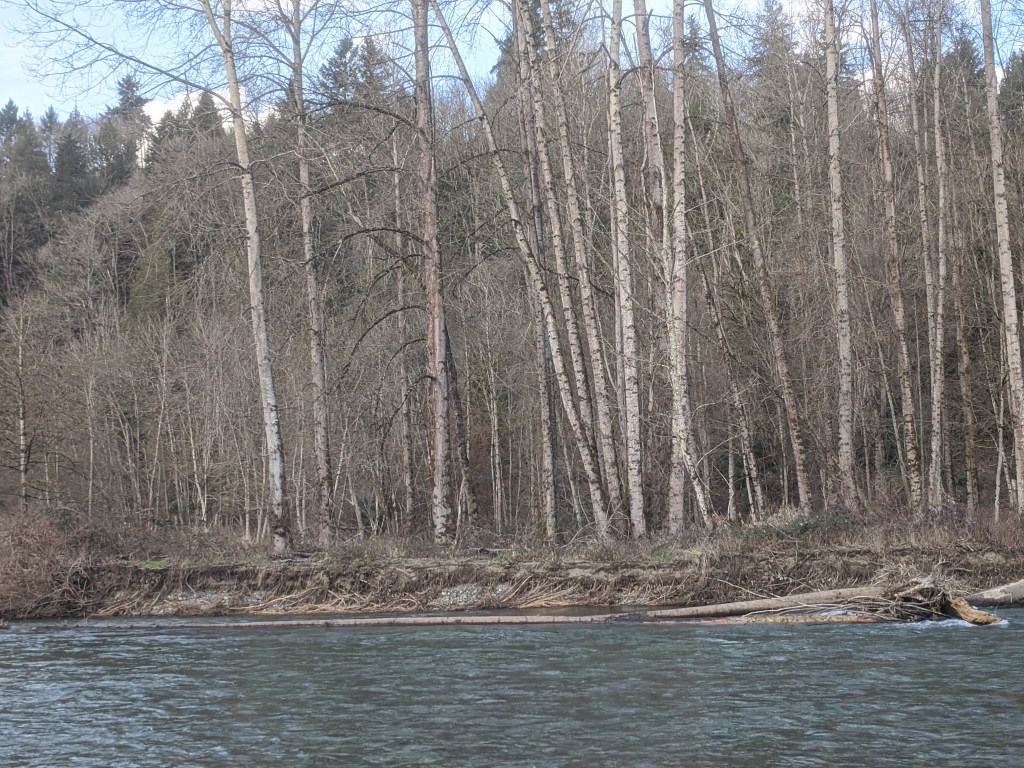
    But trees can help us with more than just monsters. They can inspire creative decisions. Look at this stand across the river.

    There’s some scarring from disease, or something, several dozen feet up. Take a closer look at that.

    Put your “not in the real world” hat on. What if that scaring was from a massive beast? What if the Giant Elk of this realm were so huge that their antlers (looking it up, yes elk have antlers) rubbed off that bark that’s a full 30 feet or so above the river.

    What happens when a herd of them walk the river during logging season with their massive legs crushing through or between the barges? Or are these Elk the friends of your woodland dwelling elves, gnomes, goblins, or other races? Are they ridden like elephants?

    The answers are up to you.

    Trees are also our mighty connection to history.

    Tolkien recognized that. The age of trees is why the Ents knew so much and also why they’d become peaceful and rooted. When you see so much life pass before you are the little lives so precious?

    In the World of the Everflow, the Dragonleaf Trees are ancient, from the era before legends, when Dragons and the other Ken were part of the world of Kin. But they are also dying. A breed that is honored while also being forgotten. They do not seed. They do not spread. There are only twenty or so of these ancient trees left, with almost all of them in the Tree District of Qin.

    When a tree is a millennia old what does that signal in your world? Are they like the trees of Solace in Krynn, with homes and workplaces scattered within the branches? Or is it a single tree from the time before time the sits alone in a desert, with roots that stretch hundreds of feet down and branches in the sky that reach to the clouds, a trade post surrounding this tree so big that it creates its own climate?

    Every journey you take. Every book you read. Every show or movie you watch. Every song you here. Every social media post you scan.

    They’re all inspiration for your world, your character, your dreams. Share them with your table.