Tag: dragons

  • Lore collage: Inspirations, disasters and conventions

    Lore collage: Inspirations, disasters and conventions

    The irregular column where I share links to the things that inspire me is back!

    Today, I’m writing while a third atmospheric river in a week passes over my home state. It offered a new twist, a levee break near where I go shopping and attend Sounders practices. The repair seems to be going well and the flooding there is only bad enough to wet parking lots. Up in the North Sound things are not simple, nor easy. Their recovery is going to take a long time. The communities up there will learn on each other and those of us that can help, because it’s bad.

    Working in a field adjacent to disaster prep I’ve given some talks about how RPGs can help people learn what to do in crisis through short games that are D&D adjacent (ability+skill/class, d20). Next month I’m giving a different but similar talk at OrcaCon in SeaTac.

    Attendees can find it in their schedule as: Special Event: RPGs as Natural Disaster Prep Tools.

    Hurricanes, Earthquakes, Volcanoes! Learn how to prepare using TTRPGs. Themed around community, and helpful for memory retention, these small, educational TTRPG games can help a community prepare for the natural hazards that are impacting them more than ever.

    There’s obviously going to be an example about floods, bomb cyclones and atmospheric rivers too. If you are in the South Sound come to OrcaCon. I’d love to meet you.


    A Collection of Unmitigated Pedantry takes a deep dive, in series, into the lives of peasants. The hard work of the pre-Industrial Age by those nameless families who make up the majority of those humans who have ever lived is modeled and described.

    Much of it runs counter to my previously cited works about the amount of leisure time available that should inspire characters to have hobbies.

    There is almost no dedicated leisure time during the day. There is a regularity to the cycle, a monotony – each day more or less like the one before it and the one after – one imagines it was comforting to some peasants and deeply constricting to others, shaped by the continuing demands of peasant labor (itself structured by the heavy extraction regime they operate under, which consumes the leisure time they might otherwise have).

    But your characters should still have hobbies — even if they are peasants.

    1. Modern D&D is mostly in a near industrial format that allows for specialization.
    2. Wide magic definitely enables specialization and light.
    3. It’s more fun to have.
    4. ACOUP also points out that days may not have breaks, but weeks likely do and there are fest periods annually.

    In any case, for those long days in the fields or the long hours of spinning thread while keeping one eye on the large pot and the other on the tiny tot, our peasants would be looking forward to the next festival, the next feast day, the next major event…


    But also, games are common, everywhere.

    Ancient Maya game board with unique mosaic design discovered in Guatemala

    This board is different than previous finds in that it was built in to the floor in a mosaic rather than on benches or tables. It was large and meant to be permanent.

    People like to play games.


    Sometimes people play games to avoid thinking about the Apocolypse.

    When You Say, “Thermonuclear War,” I Think You Mean “the Call to Adventure”! The Twilight: 2000 Tabletop Role-Playing Game and the Postapocalyptic World’s Imaginary Spaces

    Or to learn about how to behave during natural disasters.


    A few months ago this beat wound up in my reader. I still haven’t used it in a game, but need to do that soon.

    Now, normally I love to add more dragons to a fantasy world — I prefer Dragons of Wales for my non-traditional dragon art.

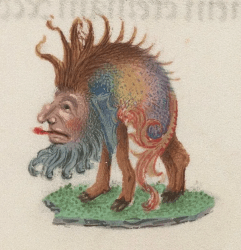
    What if you wanted an armadillo looking thing with a humanish face smoking something?

    The history of oddities that aren’t natural beasts is vast and open to your use. Public Domain Review shared a selection of them recently.


    Does your fantasy world include smog-punk goblins, artificers, or take place in Eberron?

    You may need Gadgets From A Parallel World by Pantograph.

    A tube amp wireless router? A binary code typewriter with only a zero and one? A record player that can play 4 records – vocals, guitar, base and drum – at the same time? These are all gadgets that almost seem like they could exist, but of course they don’t.

    The binary typewriter is going into my world right now.


    Work passed 300 disaster relief and humanitarian aid NGOs supported for free. I’m proud to work at a place that lives its values and helps humanity. Factal produces free resources for the public too.

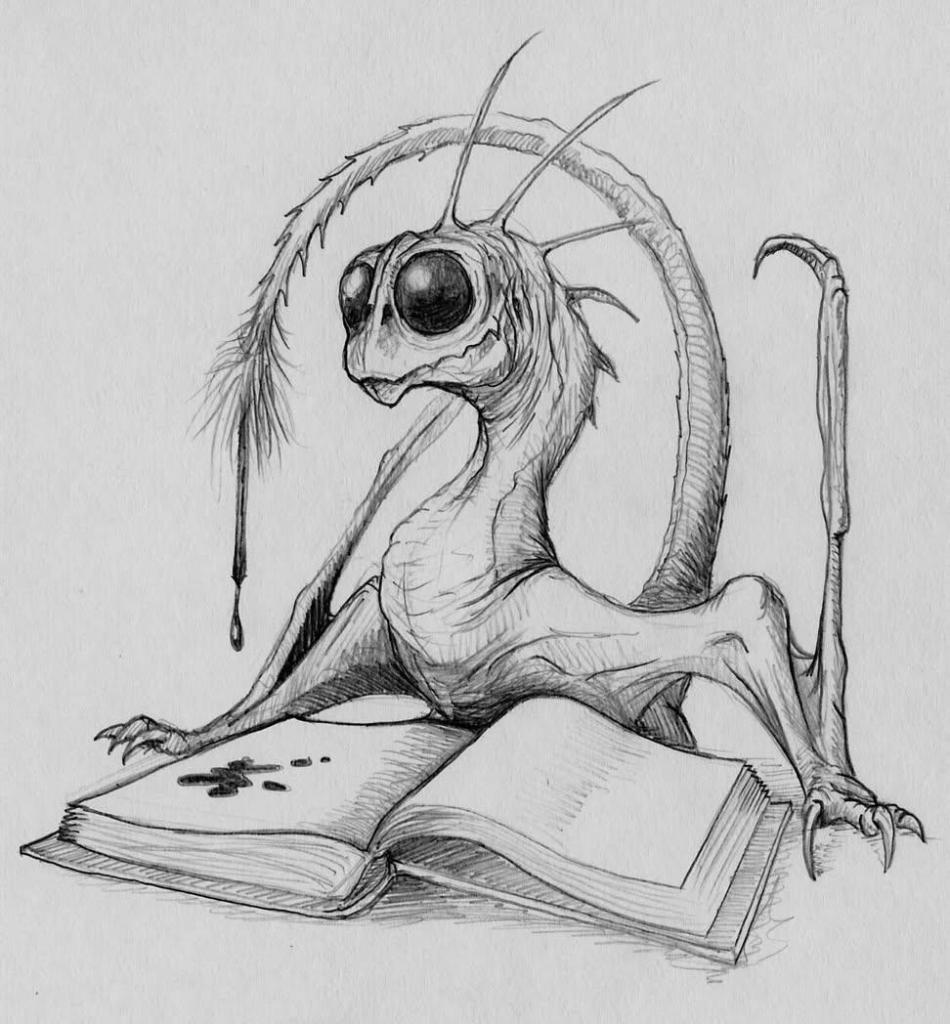
  • Inkling Dragon

    Inkling Dragon

    Inkling Dragons are thought to be related to pseudodragons, but where the pseudodragon is a wilderness lover the inkling dragon is generally an urban drake that enjoys being surrounded by books, scrolls and pamphlets.

    Generally the size of a large rat or small cat inkling dragons can be mistaken for an immature jaculus drake. As all dragonkin hoard something, an inkling dragon is consumed with the pursuit of knowledge and writing, similar to paper drakes.

    An inkling dragon without a companion can be found in libraries, universities, bardic colleges and wherever records are kept. Some are creatives writing fiction and song. Others are historians, tracking the world through the written word. At least one inkling dragon is known to only write in mathematics. This inkling dragon, Aymon, is a friend of transmuters, tax collectors and merchants often working as a clerk or calculator.

    The Inkling Dragon was created as part of a limited commission in the upcoming book Dragons of the Dwindling by Dragons of Wales (Andy Frazer).
    Follow Dragons of Wales on Instagram, Threads and Mastodon. Support Dragons of Wales on Patreon.

    Inkling Dragon companions

    Frequently inkling dragons and writers bond over their love of the written word. Sought after by many wizards and writers, an inkling dragon chooses their companion as much as their companion chooses them — the tiny dragon has to find the work engaging and relevant to their own writing.

    1. Wizard
    2. Bard
    3. Propagandist
    4. Novelist
    5. Poet
    6. Merchant
    7. Tax collector
    8. Cleric
    9. Clerk
    10. Noble

    This work includes material taken from the Black Flag Reference Document 1.0 (“BFRD 1.0”) by Kobold Press and available at Black Flag Roleplaying

    Pencil sketch of a tiny dragon resting on a book. The pointy tail arches over the back with drips of ichor coming out of a feathered tip. The arms seem to be vestigial wings with opposing fingers capable of handling obects
    Art by Dragons of Wales in the forthcoming book Dragons of the Dwindling

    Inkling Dragon stat block

    Inkling Dragon (CR 1/4)
    Tiny Dragon

    Armor Class 14 (natural armor, small size)
    Hit Points 8
    Speed 10 ft., fly 30 ft.
    Perception 11 Stealth 12
    Resistant none | charmed
    Senses darkvision 30 ft., keensense 10 ft.
    Languages Common and four other languages (or cultures)

    STRDEXCONINTWISCHA
    -3+2-1+4+1+1

    Heightened Senses. The inkling dragon’s Perception is 20 when perceiving by sight. Ability checks for Perception using sight use Intelligence.

    Magic Resistance. The inkling dragon has advantage on saves against spells and other magical effects.

    Limited Telepathy. The inkling dragon can magically communicate simple ideas, emotions, and images telepathically with any creature within 30 feet of it that can understand a language it knows.

    Copying a Spell into the Book. When an inkling dragon or its companion finds an Arcane spell of 1st circle* or higher, the inkling dragon can add it to a spellbook if it is of a spell circle the companion can prepare and if they can make time to decipher and copy it. For each circle of the spell, the process takes 1 hour with no gp costs. Once the inkling dragon spends this time, the companions can prepare the spell just like their other Arcane spells. Copying a spell from a scroll into a spellbook doesn’t consume or destroy the scroll. Non-magical writing is written four times as fast when compared to humans. The inkling dragon produces ink from its tail as long as it isn’t at level two exhaustion or higher.
    * Black Flag uses circle as D&D uses spell level.

    Ritualist. An inkling dragon with its own book can be a Ritualist, per the Black Flag Talent. The spell source is Arcane. Intelligence is their spellcasting ability. The inkling dragon knows one 1st circle ritual (typically Identify). If the inkling dragon is a companion to a spellcaster it can learn rituals at the same circle and source as their spellcasting companion.

    1st circle Arcane rituals

    • Alarm
    • Create Familiar (these can only be common beasts)
    • Identify
    • Illusory Script
    • Unseen Servant

    ACTIONS

    Sting. Melee Weapon Attack: +4 to hit, reach 5 ft., one
    creature. Hit: 4 (1d4 + 2) piercing damage and the target must succeed on a DC 11 DEX save or be poisoned for 10 minutes. If the creature fails the save by 5 or more, it is stained by ink per Ink Stain below. This staining does not count against the number of uses per day.

    Ink Stain (1/short rest). On a successful sting the inkling dragon can mystic mark (Ranger) one creature. While a creature is marked (including for the attack that triggered the mark), the inkling dragon and allies deal an extra 1d4 damage to it (of the same damage type as the weapon) each time you successfully hit it with a weapon attack. A marked creature can use an Action to remove the Ink Stain. An inkling dragon that is a familiar or companion to a character may use this ability proficiency bonus (of that character) times per day rather than once per short rest.

    Fediverse Reactions
  • Integrating social narrative into combat – legendary points connected to a dragon’s hoard

    Integrating social narrative into combat – legendary points connected to a dragon’s hoard

    In the World of the Everflow all dragons have hoards. At this point of Uprising and Rebellion the group has met those that hoard books (paper dragons), jewels and fine art (jaculus), animal companions (black dragons) and strife (blue dragons).

    Heading towards the final faceoff with the great wyrm blue dragon there’s a desire to connect the size of the hoard in that Wyrm’s sphere of influence to its power – subsequently allowing actions by the players to reduce the hoard.

    This will be done by combining the Legendary Resistance and Legendary Action pools. Legendary Resistance will still be a use and lose item while Legendary Actions will be regained at the start of the dragon’s next turn. A pool of physical objects will symbolize the size of the pool. This will represent the intelligence the group learns about the Wyrm.

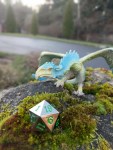
    A blue-green dragon atop a mossy rock leers over a large d20. Behind it is a river
    The Wyrm watches the d20 rolls

    The Blue Wyrm currently resides in the mayor’s palace, having thrived off the strife caused by the rebellion and the Mayor’s corruption. But the heroes have shown that their rebellion is built on hope, a less stratified society and a city capable of trade again. Now just three dragons stand in the way of freedom, possibly.

    Things the characters could do to reduce strife;

    • Healing, feeding Kirtin-on-the-Lake’s residents
    • Freeing animal companions bound to Shadow and Darkness, the two black dragons
    • Increasing trade of desired goods within the war torn city
    • Establishing a popular governance path after the Mayor’s abdication
    • Reducing the size of the 7th Fleet encampment outside of the city
    • Teaching utility cantrips

    I’m certain the party will surprise me with other ideas.

    Things that can increase strife;

    • War with the 7th Fleet
    • Teaching more attack cantrips
    • The Mayor reclaiming the seat of government
    • Open battle in the streets

    They will again surprise me with ideas that create a less peaceful city.

    The Wyrm is going to start with five legendary points in the penultimate session for this story arc. The session will be split between the plan to pick the territory of battle (palace, tunnel, cave) and preparations that could include reducing the Wyrm’s power.

    This tweak to the standard rules should connect a social session to the grand combat ending the Wyrm’s arc.

  • “Mom, where do dragonborn come from?”

    “Mom, where do dragonborn come from?”

    That’s a question I didn’t have an answer for. A player wanted to be a dragonborn, but they don’t exist in the world as I built it. That’s not always a great reason to not allow a race.

    When you build a limited world players either need to buy-in completely or you can work together to figure out how the character fits.

    When a player asked to be a warforged he came up with an incredible backstory. They were the only warforged, built by those that became gods. Wakened for unknown reasons (we knew it was because of the rediscovery of the powers that those who created them used) the warforged is an outsider who knows that the myths of the founding are reality, that idyllic times of the past can be recreated using the same tools that the past used.

    This also made sense because the player wasn’t familiar with the world as it is. Instead they created what it was and together the player and character learned the current reality.

    When I was approached about a player being a dragonborn I wasn’t ready. We worked the character in with no backstory, knowing that at some point it will come up again.

    Then DnDBeyond presented the following idea;

    The Rise of Dragonborn and Kobolds

    As the Dungeon Master, you can craft unique origins for draconic folk like dragonborn and kobolds. You could decide that the burst of magical energy released by a dragon’s death could lead to the spontaneous emergence of these people in nearby areas. Just as mysteriously as a dragon egg could appear, a dragonborn infant could be found napping among resting sheep. In such a case, would the party be responsible for ensuring the child’s safety? And what will they do or say if the child has been imbued with some of the dead dragon’s memories? Such an ill-fate could lead the child to grow up to resent the party and even become a villain themselves.

    What Happens When a Dragon Dies in D&D?

    Now, my brain started flowing.

    The dragonborn PC would be the ‘child’ of the first dragon the party had slain. They would be the embodiment of some part of the dead black dragon, with others born of the slaying being all of the evil parts. Some would even be able to bond and break bonds of animals. Black dragons hoarding bondings, making them incredibly hated in the World of the Everflow.

    The player took this up, learning about his characters birthing through play. The group has encountered a few other dragonborn, always black.

    This also gives the group something to think about — they’re about to fight up to three more dragons. What will that mean for the future dragonkin? Will they be mostly evil as the first dragonkin?

    Lessons for any DM

    • When a player approaches to play something unallowed in your world try to discover a lore path towards yes
    • Is it just the mechanics they want? Re-lore the banned item into something that makes sense
    • Use this opportunity to build a world together, rather than have it be only the DM’s world
    • Every thing you read is prep for your next session

  • Unearthed Arcana expands playable dragons – lacks playable dungeons

    Unearthed Arcana expands playable dragons – lacks playable dungeons

    The latest drop of Unearthed Arcana is another exploration of Draconic options – this time lineages, feats, and spells. Previously the Dungeons & Dragons team explored a Monk: Way of the Ascendant Dragon and a Ranger: Drakewarden.

    The UA also reminds readers that everyone gets a floating +2&+1 or three floating +1 with two languages (Common and one other being recommended).

    This review of UA will include bolded statements of what I like, what I would change, and what I dislike but can’t think of how to fix.

    Dragonborn

    Fifth edition D&D already has two sets of Dragonborn, one in the Player’s Handbook and another in Explorer’s Guide to Wildemount, the Critical Role book. Soon, there will be even more Draconic races, as the new set splits Dragonborn into the subsets – chromatic, metallic, gem. This Unearthed Arcana is also an expansion of Kobold options, as they were previously released in Volo’s Guide to Monsters.

    For all three there is a small boost in power for the breath weapon. This was needed. The PHB Dragonborn breath weapon wasn’t able to be used enough for it to serve a purpose. Having it be an attack replacement grants some great options for martial players after tier 1 play. Rather than 1 bonus action per rest (short or long) the UA version gets proficiency bonus number of uses per long rest. This is true for all three of the new subraces. They also increase damage from 2d6 with tier scaling to 2d8 with tier scaling. I like this.

    Chromatic

    Their breath weapon is a line, which is a switch for green and red dragonborn.

    At third level they gain the ability to be immune to the energy connected to their draconic origin. This ten minutes at once ability can help ahead of a combat encounter, but is also quite handy for some exploration challenges. It’s a fun little bit of story creep too. I like this.

    Metallic

    Their breath weapon is a cone, which is a switch for brass, bronze, and copper.

    Their third level boost is a secondary breath weapon that they can use once per long rest. There is a choice of two effects – a push and or kind of knock-out gas that incapacitates targets. These are both fine.

    Gem

    Previously gem dragonborn weren’t a thing, and as someone who didn’t get into gem dragons, this section is a lot of new ground. The various gems connect to new damage types (force, radiant, psychic, thunder, necrotic). As all gem dragons are connected to psionics these dragonborn gain the ability to telepathically communicate with a single creature within 30′, as long as they share a language. I like this cool boost.

    At third level they get this weird ability to fly by being surrounded by spectral gems. I don’t like this.

    Kobolds

    The kobolds in Volo’s have two negatives – their strength is reduced and they have sunlight sensitivity. The new draconic versions of kobolds suffer from neither of these.

    But the new kobolds also don’t get Grovel, Cower, and Beg (ok), nor do they get Pack Tactics (boo).

    The draconic versions get to choose between three abilities.

    • Advantage on saves versus fear. I like this.
    • A sorcerer cantrip. I like this because it connects them to the Volo’s monster kobold sorcerer.
    • An unarmed strike with the tail. I would change this strike to be finesse, so that dex builds could benefit.

    They also can roar. I don’t like this.

    I would rather the playable kobolds lean into the variant kobolds like dragonshields, winged, and inventors. Further connections between kobold culture and playable kobolds would be wonderful.

    Feats

    The new feats are about granting non-dragonborn a small lean into the powers and abilities of various dragons. This part is cool, but because they are each a different feat that means your character could take each feat once picking up a bit of chromatic, gem, and metallic. I don’t like this.

    Spells

    There are seven new spells that range from level 2 to 7. Four of them are named spells, with three carrying iconic names from the Forgotten Realms and one from Dragonlance. All are available to sorcerers and wizards, with a few being open to other casters.

    Draconic Transformation is a way to be nearly a dragon.

    Fizban’s Platinum Shield is a potent protective spell.

    Flame Stride is a movement boost that burns people as you pass them.

    Icingdeath’s Frost is a cone blast that covers the target in an ice shell.

    Nathair’s Mischief is a cube (yuck) that is rather fey in its behavior.

    Raulothim’s Psychic Lance is a piercing blast that has an interesting known name twist.

    Summon Draconic Spirit follows the new summons from Tasha’s Cauldron of Everything, and is a dragon.

    I like the story behind the spells and hope that Awf can add the Icingdeath’s Frost and Flame Stride to his known spell list. A Bladesinger running through traffic with flaming feat is a great image.

    Overall there’s a lot of flavor in these, but similar to the Fey UA, there is a clear need to fold the earlier releases and this next book together. There are competing versions of Orc, Hobgoblin, Dragonborn, and Kobold now. These would make more sense as subraces in a book, or digital version, that is consolidated with all the changes, shifts, and combinations.

  • Here There Be Dragons

    Here There Be Dragons

    In most fantasy worlds dragons are hoarders of treasure. In some they are (also?) destroyers of worlds. There are worlds where dragons founded existence. On Krynn the chromatic and metallic dragons battle each other sometimes interfering in the lives of Man.

    In establishing the World of the Everflow I wanted a slightly different take upon how dragons (as well as other dragonkin) exist within the World.

    Dragons are part of the People of Ken. They are knowers of things, especially of magic. They, and all of the Ken, control access to magic of all kinds. For millennia of millennia they prevented the People of Kin (companionship and love) from knowing magic. Through the Scholars and the Proctors of Grace the Dragons and their followers (Elves, Dwarves, Gnomes) kept their thumb on magic, eliminating all but love and the healing power of the Everflow.

    Rather than piles of gold, a dragon’s home back on Ken (the continent) is full of scrolls, books, and tomes. The long lives of all Ken mean that their minds are full of mighty spells well beyond the standards of Dungeons & Dragons.

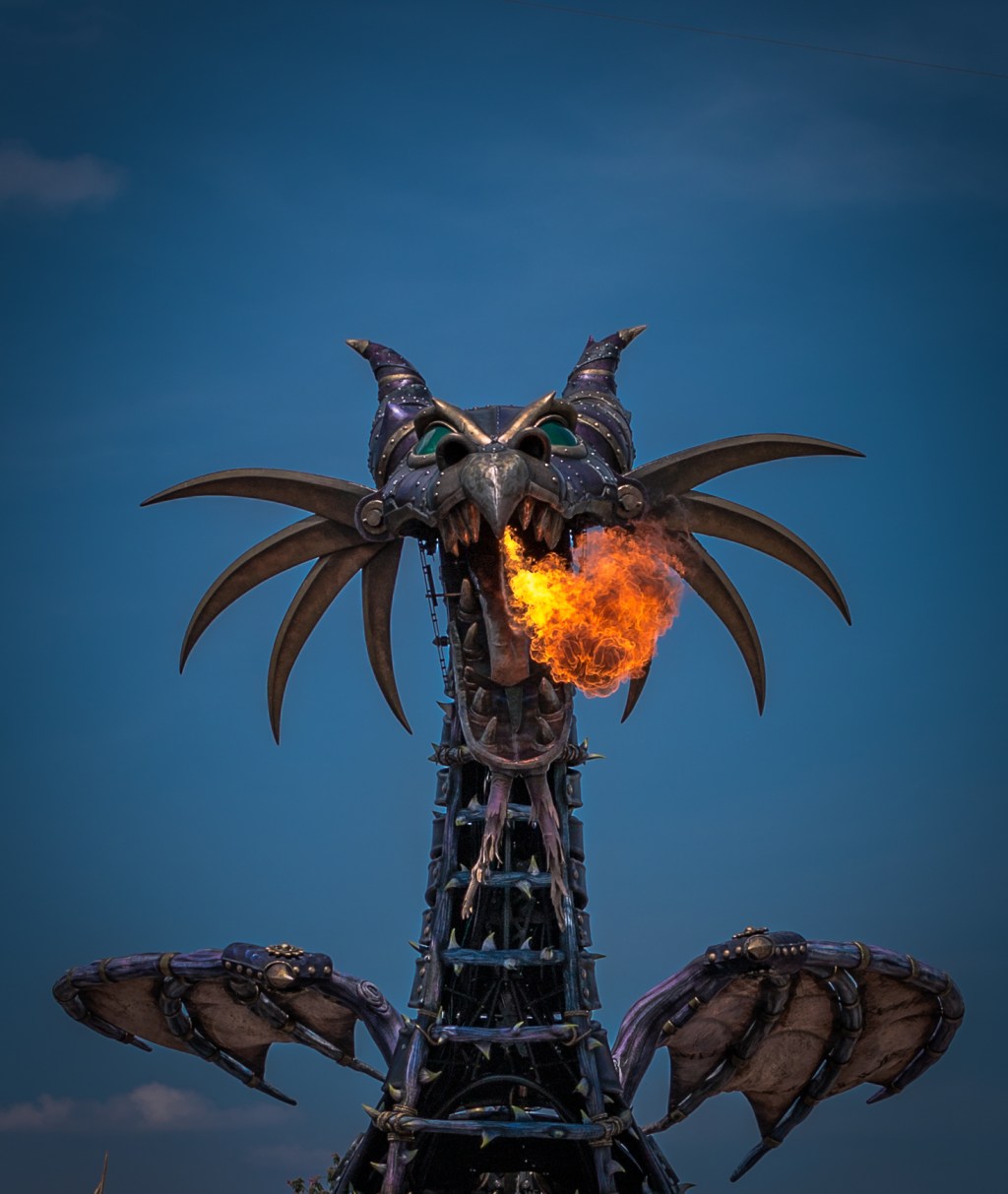
    Dragon breath by Nicklas Lundqvist (CC BY-SA 2.0)
    Dragon breath by Nicklas Lundqvist (CC BY-SA 2.0)

    Their immense powers are legendary, the same way that our modern world views dragons — a story so fictional it is not even legend. Statues and tales about dragons are created for artistic reasons.

    Within the current campaign the dragons are returning to Kirtin-on-the-Lake seeking an ancestral homeland in the Ward of Mighty Trees. These trees are essential to the Dragons life in ways that the group has yet to discover.

    Those Dragons, from the Ale Dragon Brewst Griselle to a mighty Red waiting on the southern plains of Kalst’s Field, are now quite real. Some fit in well. Brewst is small enough to fit inside buildings. He drinks and cavorts. His study of brewing, distilling, and vintning is familiar to the Kin. Yes, he’s different, but there is also familiarity.

    Other drakes do not cause fear, initially. They remind most in Kirtin and Daoud about the lizards of Mehmd, a Kin-ish kingdom that bonds with lizards more frequently than mammals.

    KOMODO DRAGON by NAPARAZZI (CC BY-SA 2.0)
    KOMODO DRAGON by NAPARAZZI (CC BY-SA 2.0)

    But, when those drakes fought they taught fear. Their breath of fire, or poisoned stingers, killed in ways that nature should not. The drakes are not as intelligent as a person. Unlike Brewst they do not speak. They consume. Negotiation is not possible.

    Brewst, and his companion gnome Oolia, are talkers. They also use the power of illusion and charm to work their way towards their goals. The governor and the group do not know these goals. They only know that the influence of the two continues to grow.

    They worked as advanced scouts for the Proctors of Grace. Their goals could be called fey-like as all of the magical Ken work in ways that are not familiar to Kin (Goliaths, Halflings, Humans). The plans of Ken take centuries or even millenia.

    When life lasts at least a few hundred years the approach to the world is incomprehensible to races that live to 100 at most.

    Now, our heroes have to discover how these plans impact life in Kirtin-on-the-Lake, and the two kingdoms. This process of discovery could be deadly, it will be challenging. In the end, life in Kirtin and Daoud will change. Our heroes will determine how much it changes and how the Dragons will be included, punished, or rewarded.