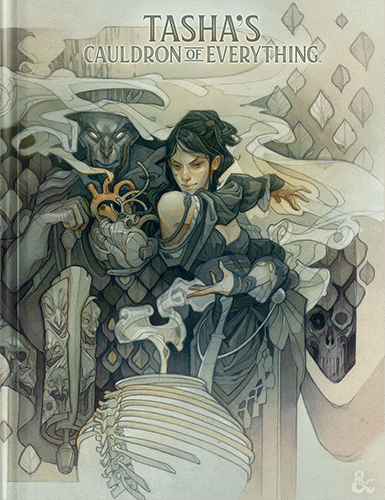
• 7 Things I Love in Tasha’s Cauldron of Everything

    7 Things I Love in Tasha’s Cauldron of Everything

    Tasha’s Cauldon of Everything is packed with new mechanics to add to the game. The expansion of racial options, which reduces but doesn’t eliminate the bioessentialism in D&D, and the new class options was the focus of most of the attention of previews. Now that the book is in the hands of the masses there a few other things that deserve your eyeballs, your character sheet, and your campaign.

    Wizards provides this handy list about how to get your handses [in voco Gollum] on the book, but we strongly recommend supporting your local gaming store. The main digital play tools all have Tasha’s at this time and are in various stages of integration for what is a massive update and reworking of character creation.

    Lean Into Personalization

    While every player-facing book in 5th edition talks about creating your character’s identity through minor reskinning of features, none go as heavy into this as Tasha’s. There aren’t just lists. Through the ample use of sidebars and even art, the designers make it clear that your character is yours, and how that character presents itself is up to you.

    The art with the chicken-shaped Magic Missiles is the most clear demonstration of this concept.

    I’m leaning into this with a Swarmkeeper Ranger whose swarm is a bunch of terriers. They can nip the opponent’s heals, overwhelm them and force them to move, pull me to safety, and even fetch my spent ammunition after the fight.

    Make the world yours, that’s what Tasha would do.

    Battle Master Builds

    The Fighter’s two non-magical subclasses from the Player’s Handbook can lack the identifying traits that connect them to fantasy literature in ways that every other subclass does. Tasha’s helps solve this by providing some sample builds for the Battle Master.

    Each example includes the fighting styles, maneuvers, and feats that help create a cohesive identity rather than have a character that is merely a collection of mechanics.

    With a sampling of those mechanics and about 50 words your Battle Master transforms into a representation of the legendary heroes of yore, that is uniquely yours.

    Session Zero

    Many, many, many blogs, vids, podcasts and articles over the decades have focused on Session Zero. Nowhere has the concept been laid out as clearly in a book produced by the maker of the game.

    Adding this guide to what will almost certainly be the 4th best selling book in the arsenal of official products will help so many people who want to try the game. New players and new DMs will have a foundation upon which to establish their own social contract.

    Sidekicks

    Puppy! Wait, no warrior-wolf.

    Scheduling play sessions during a global pandemic are a different struggle than they were in the Before Times. Getting a group together, using the same technology. In games with only 1 or 2 PCs having a sidekick can help solve the issues of game balance and limit the chances of a total party kill. They also fit the stories we try to tell.

    Here, again, the creators used art to provide examples of the variety of sidekicks that can be created through the three “classes.”

    The Expert shows up as a tortle scout/navigator, a winged kobold with some kind of charm, and a kenku historian/sage. The three versions of the Spellcaster are a bullywug wizard, a goblin mage (love that pink dress), and a tabaxi oracle with a pack of extra large scrolls. For the Warrior the art is of an aasimar with a sword & shield, a wolf, and a firbolg chef ready to smash someone with a cast iron pan.

    Class Icons
    Each of the 13 core classes (Artificer is in two books, it’s core now in my mind) has a icon that represents them. These small images are not new (they’re in the Player’s Handbook), they are just more obvious in their presentation within Tasha’s Cauldron of Everything.

    They’re a clean look that I hope to see on merch at some point. Many third-party D&D inspired jewelers and apparel companies use class iconography. There is no reason why Wizards shouldn’t embrace this as well.

    Parleying

    People have been homebrewing versions of this for years, but including it in such a common book is important. D&D is, at its core, a combat game. But it doesn’t have to be and more rules to demonstrate that are good.

    Hints, Allegations, Rumors of What’s to Come

    Hidden within Tasha’s in character conversations and the rules sidebars are a plethora of hints about the future of the game. All attempts to figure out what these mean will be futile fun. Search them all and you too can shout “[setting name] confirmed.”

    What are you looking forward to using from Tasha’s?

  • The Defiant of 2020

    The Defiant of 2020

    The pandemic was rough for Tacoma Defiance. Players in the USL bubble couldn’t practice with the Seattle Sounders. Players in the MLS bubble couldn’t play for Defiance, unless loaned for the entirety of the season – Alfonso Ocampo-Chavez and Ethan Dobbeleare were, eventually.

    Defiance also lost a few home games as the Seattle Mariners used Cheney Stadium for their alternate training site. Still, the squad toughed it out. In fact, they came out of the restart 2-0-1, looking like just maybe things could be magical.

    Eventually the losses of 7 players to the First Team, and the transfer of Jesse Daley (The Defiant 2019) to Brisbane Roar, over the past two seasons caught up to Tacoma, who finished third in the group.

    Without their best who stood out as The Defiant of 2020, that player who best represents the spirit of Tacoma and Defiance more than anyone to wear the crest? [insert drumroll]

    Ray Serrano

    In 2020, this bizarre year, Ray Serrano turned into a goal dangerous threat. At 17 he had 3 goals scored on the season, tied for second on the squad with Chino Perez and Danny Robles.

    Ray Serrano, number 80, is in the center of the photo. Sacramento player, number 8, is entering a slide tackle and failing to win the ball. Serrano is stepping over the outstretched foot..
    Photo courtesy of Charis Wilson – Sounders FC/Tacoma Defiance

    His first goal of the year cemented a come-from-behind draw to take points against Sacramento Republic in Sac. That was the first time for Defiance to take down the giants and future MLS side.

    Over the season he developed a more aggressive approach to his game. Slicing his way through defenses he looked to become a goal-dangerous winger, not just a flair player. The assertive and artistic style is perfect for someone wearing the Black Ink and Green of Tacoma.

    Starting the year as the youngest player on the roster Ray Serrano built himself up from infrequent sub into regular starter. Six of his first seven appearances were as a sub. By the end of the year Ray had a stretch with five starts in a row, including three times going a full 90 in a year where the usage of five subs meant that was a quite rare event for attacking players. Serrano’s hard work in practice is emblematic of what Tacoma expects from its people.

    Last year after winning the Development Academy Western Conference Best XI he said that he wanted to win it again. Ray didn’t get that opportunity, because in the year he turned 18 he played too frequently on the professional side.

    Whenever 2021 starts, Serrano looks certain to be a regular with Tacoma. He will be just 18 and have 989 competitive minutes under his belt.

    Honorable Mentions

    Other considerations were for Alec Diaz, who lead the squad in scoring with six goals and Sam Rogers whose value was demonstrated through his absence as he worked on transferring to a team in Spain. They were the Attacking Player of 2020 and the Defensive Player of 2020 respectively.

    The Defiant by matchday polling

    • Diaz 3
    • Rogers 2.5
    • Serrano 2
    • Cissoko 1
    • Daley 1
    • Dhillon 1
    • Dobbeleare 1
    • Gonzalez 1
    • Herrera 1
    • Klenofsky 1
    • Fernandez .5
    • Ocampo-Chavez .5
    • Reynolds .5

    Danny Robles and Taylor Mueller didn’t win The Defiant for a specific match, but they were frequently finalists for the award.

    Robles showed flexibility that he can be a strong 8 as well as a dynamic 10. Mueller’s defense and leadership were vital in a season so frequently damaged by matches rescheduled due to the pandemic and wildfires.

  • Uprising & Rebellion in a Magic Setting

    Uprising & Rebellion in a Magic Setting

    Oppressive governments are a staple of genre fiction. From Robin Hood to the Vlad Taltos series, from Thay to any place ruled by a Sorcerer-King in Athas – the tales of tyranny that must be overcome are common.

    An uprising is nearly impossible against these powers though. They have access to magics and personnel that make hiding difficult. Identifying who is in rebellion within a society that has the fantastic equivalent of an NSA, CIA, KGB, etc at the surface level seems easy. Yet, in our modern world with facial recognition and AI-infused communication monitoring there are still those who rise up against injustice.

    The following are how you make certain that a rebellion that starts like this

    Photo by Rene Asmussen on Pexels.com

    doesn’t end up like this?

    Photo by Pixabay on Pexels.com

    Baseline D&D

    There are some tools to help the Dungeons & Dragons themed revolt within the standard rules.

    Illusion Spells

    Everything starts here, really. From something as simple as Disguise Self to the potent Seeming and Mislead the usages are obvious. They must still be stated and reviewed, lest we overlook the obvious.

    Enchantment Spells

    These go hand-in-hand with Illusion. Getting past the guard who recognizes you is key. Having a huge crowd be under Sympathy can turn the entire tide of the movement.

    Rogues and Bards

    These two classes are natural fits for revolution. A College of Whispers Bard can sneak into a castle or manor and learn the secrets of the realm. A College of Glamour will work the nobles The College of Lore will know the History of the peoples, helping define and refine the message of the group, as can Eloquence. The Colleges of Swords and Valor fight among a crowd quite well.

    Every Rogue fits. Every. They’re probably the baseline for your rebellion. Assassins, Tricksters, Masterminds, Inquisitives, Thieves, Swashbucklers, Scouts – the list of rogues involved in uprising reads like a casting call for Hunger Games or Divergent.

    All Classes Can Fit

    • Artificers can build the defenses needed.
    • Barbarians are those enraged by injustice.
    • Clerics are more than the needed healers, but the ministers pushing for the rights of their flock.
    • Fighters can be the thug guarding a raid, or the armored noble who joins the cause.
    • Monks need not be confined to the outsider from another land, but the brethren who know the ancient ways of the nation.
    • Paladins who take their oath to the betterment of the commoner over the ruling class join your uprising.
    • Sorcerers exist in uprising literature often as the targets of a realm that do not like those born to authority.
    • Warlocks may join their pact to gain powers to help their peoples.
    • Wizards are masters of the spells most important to helping the revolution.
    • Druids and Rangers probably take the most work to have them fit the story, but difficulties are not impossibilities.
    by Hartwig HKD (CC BY-ND 2.0) https://flic.kr/p/aDwaAx

    Filling in Gaps via Homebrew

    There are gaps within the common D&D classes, and these won’t be filled by Tasha’s Cauldron of Everything. The literature and other fictions around resistance feature some tropes that are currently difficult to build in the base rules.

    Each of the following subclasses is a work in progress. Some are more finished than others.

    Society of Veil and Shadow: Rogue

    The Society of Veil and Shadows are a group of rogues dedicated to obscuring and protecting their guild from spies — both arcane and mundane. While able to contribute to the uprising’s success via sneak attacks and other clandestine abilities their true power is their ability to cast a few spells, most of which help keep the rebellion secret.

    Society of Veil and Shadow

    Way of the Frayed Knot: Monk

    The Way of the Frayed Knot is a Monk subclass that attempts to feature some Western fantasy tropes. The most common of these is Friar Tuck from Robin Hood, but there are other studious, religious types that fought alongside rogues and pirates.

    Way of the Frayed Knot

    The Way of Mercy in Tasha’s may be close enough that my own version gets retired.

    Conscript: Fighter

    An old-timer who retreated from the life of adventure and war, but who for some reason gets called back into it. They’ve done their best to avoid violence. Instead violence seeks them out. The Fighter: Conscript (final name TBD) has seen things. Things no one else should see.

    When they get the call to return to their former life they are no longer concerned with having the best weapon and the best armor. Their wits and experience taught them that any tool can be used for any job.

    Conscript

    Propagandist: Rogue

    You rose from the underbelly of empire to demand a better life for all. Your pamphlets and speeches can inspire hope, or fear. Whether from the soapbox or via pamphlet your proclamations turn the tides of rebellion.

    Propagandist

    Still to Come – Circle of Sewers: Druid

    They come from the urchins and gangs, getting to know the vermin of civilization. Simultaneously they serve the people and the animals that run the streets of a city. Able to help feed and heal those in need, the Sewers Druid is equally at home within a gang of thieves as they are a swarm of rats.

    How would you run a D&D campaign that focuses on rebelling against a power much mightier than the player-characters? What tools would you use to rise against The White Witch, or The Union, or the Burgue?

    Fediverse reactions
  • Lore Collage: 22 Links to Click

    Lore Collage: 22 Links to Click

    Welcome to Lore Collage, a weekly look at things going on around Dungeons & Dragons, fiction related to D&D, and a few other things within RPG and fantasy that you should grab for your next character or campaign. This list is curated with the goal to make certain that readers will not miss major announcement because they aren’t online at all times, as well as to expose them to unique and/or interesting projects that deserve amplification.

    Add Mechanical Wolves to Your Campaign

    Your next town of gnomes and/or artificers should copy Takikawa, Japan. They defended themselves from bear attacks by installing mechanical wolves — that are way too creepy. It’s a new twist on warforged, and frankly your home table needs this. Whatever natural plague is impacting your urban areas in D&D can be defended by completely bizarre things, not just walls and towers.

    Official D&D Announcements

    This weekend is the first ever Virtual Weekend of play for Adventurers League. There’s trial size and standard adventures still available. Creators and DMs will have the option to expand beyond prepared content. That will increase the variety of stories available to players in ways that past AL and convention play did not.

    Sage Advice got a massive update in preparation for release of Tasha’s Cauldron of Everything. Awf will be impacted by this, as Bladesingers took a low-level nerf and a high-level buff.

    Learn more about Tasha through Ginny D’s cosplay or the Lore You Should Know in DragonTalk.

    Famous People Play D&D – Star Trek: Discovery, Vince Vaughn, Andrew Ervin

    Star Trek: Discovery’s cast plays together using DnD Beyond and Zoom. No fancy VTT, just a camera pointed at a map and Theater of the Mind.

    Andrew Ervin credits playing D&D for informing his ability to create worlds.

    At this point it will start being news when someone in Hollywood doesn’t play.

    Chase Scenes Are Classics in Genre, but Hard to Run – Merric Solves That

    Dyson Logos Latest Town

    Every few days Dyson Logos comes up with a new map, including the lore around it. If you’re running behind your session prep or just need a one-off dropping these into your campaign are simple and easy.

    Not D&D – Creators to Back

    Swordsfall continues to expand on the lore for their Afro-hope-punk future RPG. The latest drop is a massive graphic novel.

    I’m a sucker for rebellion stories. I just watched the BBC Robin Hood from 2006, love Thomas Paine, and have a few subclass concepts I’m working through for my own campaign. Backing Flames of Freedom made too much sense. Their Kickstarter is done, but you can still order via Backerkit. Watch the amazing blend of rebellion, dark magick, and the power of all the peoples of the grimm alt-history of Boston on their Twitch channel.

    Ribbons

    Ali’s latest twitter thread on djinn focuses on the djinn of plagues.

    Destiny City Comics is going to give youth the gift of comics.

    Tor’s gift guide is based on your family’s personalities.

    D&D is so ubiquitous that it is used in elections stories now.

  • Community Character – Tatiana Riverhopper

    Community Character – Tatiana Riverhopper

    One of the absolute amazing powers of Dungeons & Dragons is the ability to tell stories that you couldn’t tell by yourself. Whether you play at a table of 2, or 4, or 8 there will be ideas brought forth that surprise you. Communal storytelling by the DM and players creates options and opportunities that a single author would miss or gloss over.

    The additional experiences and diversity of the group interact to create tales of wonder. This is a large part of why I enjoy D&D. Through the power of social media there is an opportunity to mimic this by using polls to guide the character creation process.

    Asking others to help build a character gets you out of potential ruts and tropes, or embeds those tropes even further into your future PC or NPC. In the end of the process you come up with a character that is amalgam of not just your own experiences, but of the near infinite stories available via social media.

    Tatiana Riverhopper

    The full creation process can be viewed in the Twitter thread.

    Tatiana started with “this character uses a sling.” While everything built off that, rather than build through the explicit creation system as outlined in the Player’s Handbook, instead the prompts were chosen in a more narrative fashion.

    The various choices informed attribute distribution, race, class, background, spells, and skills. Riverhopper was built in order to create an Adventurer’s League character in case someone wanted to jump onto the Yawning Portal and just play.

    Using personality seeds for the choices meant that we have a prankster who left their hometown looking for stories to tell (Bard) and gold to acquire (Criminal). You can find her in alehouses taking out some pocket cheese as she plans her next bit of mischief.

    She’s not great remembering names, even though she’ll always remember you – just be something not a name. She keeps a small notebook and quill with her, constantly taking notes in a delicate hand in code that most do not know.

    In combat Tatiana is likely to use Heroism and Bardic Inspiration to help her allies as she lurks back slinging stones at the enemy. Prone to rash decisions, Riverhopper will use a trick of the mind or hand to get herself out of trouble. The loveable Halfling is best in a support and face role.

A thin shape of a house with script Kristin Clark inset

Full Moon Storytelling is brought to you by Kristin Clark of Keller-Williams Lake Washington
If you are looking to buy or sell a home in King or Pierce County, Washington support Full Moon Storytelling by supporting Kristin.
Here’s a wonderful 3-bed townhome in the Totem Lake area you should consider.
She’s my partner in everything I do.