• Gendarmes of Sheljar Campaign: One Sheet

    Gendarmes of Sheljar Campaign: One Sheet

    This campaign is set seven years after the Lorebook Hunters returned magic to the World of the Everflow. It is set in the Free City of Sheljar, and is centered on clearing portions of the bog-city from the return of undead and tunneling nightmares. Combat and exploration will be heavier than social play at the beginnnig. Every character is united in keeping residents of Sheljar safe and mostly unified in the ideals of Free Shejlar (all thinking peoples have value), but may have differing concepts about how to do so.

    The bog-city of Sheljar sits in a lowland below a waterfall. The climate is cool and wet, think the lowlands of the upper Salish, the moors of Scotland with a boggy multi-island brackish lake similar to New Orleans.

    Campaign Premise

    The party is a group of guards that volunteered and is paid to help the Lorebook Hunters keep the people of Sheljar safe from skeletons, zombies, wights and other undead. Tunneling Nightmares may have returned to isles in the bog-city as well. They will start in the old neighborhood of Jherr as recent migrants have noticed a cavern with odd noises and smells.

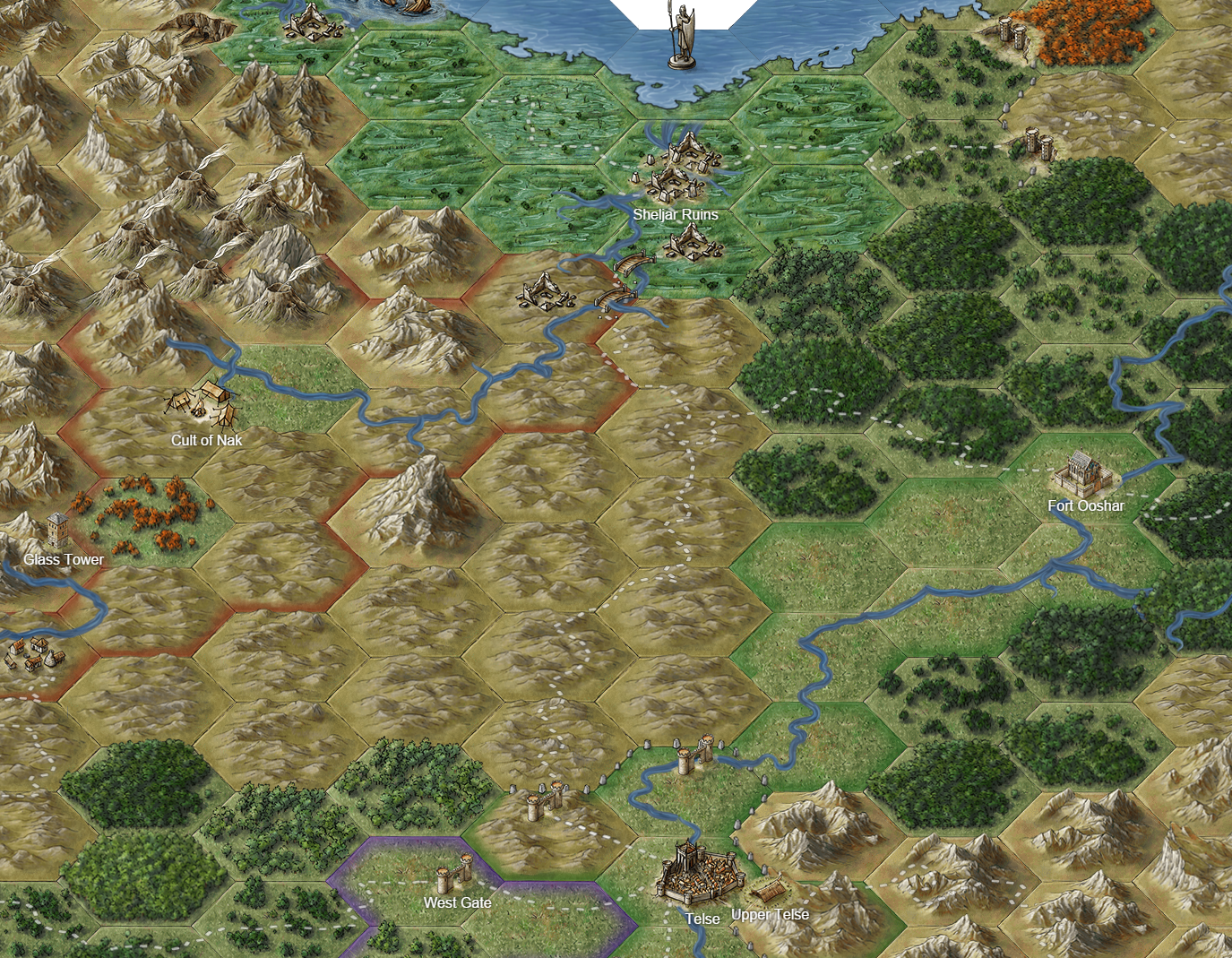
    Made using Perilous Shores, this is the neighborhood of Jherr, to the north and east of the core of Sheljar. The southeast corner is less brackish than most of the bog-city, almost an internal fresh water space.

    Background

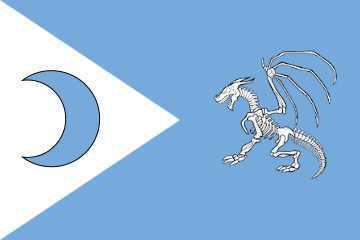
    The Flag of the Free City of Sheljar features the moon Feylf in crescent, a white triangle entering a field of the sea and Boo, in his skeletal form.

    Once upon a time, the Empire of Sheljar ruled all of the Western Wildes, from the Cliffs of Galinor to Mira to Qin. Then, the Born Generation of magically imbued teens (27 years ago) caused chaos and disruption, upending the old ways. One of the Born Generation, the Necromancer, thought he was doing good, keeping dying peoples and animals with their families, but these horrifying undead monstrosities were often rejected. As he raised more and more, people fled Sheljar, emptying it out, leaving the bog-city nearly abandoned to the Necromancer and his unliving nightmares. A misty stench then started to control the city and more people fled.

    It was not until after the eruption of the volcano, the battle of Cortez and Chorl, and the Lorebook Hunters eventually slaying the Necromancer that Sheljar felt free again. Now, six years later the Free City of Sheljar welcomes all thinking peoples. Those that return to their former homes have their property back. Those without homes are granted plots and space with the promise of aid. Few ships dock at Sheljar, but that number increases every month.

    Sheljar has several dozen gobkon, a few dozen Ken with no known dragons, but most of its 2,000 generally agrarian peoples are various Kin with their animal companions. The Gendarmes and the Lorebook Hunters are the only standing ‘army.’ Most of the residents are frontier peoples ready to defend their cottages but only have clubs and other utensils as weapons.

    A map of the former Empire of Sheljar, now a series of independent city-states and free towns.

    Grand Conflicts

    At the start this is a simple island of the week adventure, where the Gendarmes are responsible for discovering and clearing pockets of undead.

    Factions

    • Lorebook Hunters – this is the leadership of Sheljar.
    • Cult of Nak – these are the remnants of Chrol’s transformations.
    • Fort Ooshar is under control of the Fox and Crow, a gang that sees opportunity to raid the migrants heading to Sheljar
    • A death cult has taken over the lands west of Telse.

    Rumors

    • The Folio of Necromancy may be missing. Saffron had held it prior to rising to part of the leadership council.
    • What is that stench out east? Tunneling Nightmares?
    • The Volcano of the Glass Tower is glowing.

    Facets

    • Exploring the zero-to-hero tropes, friendship with animals, and who gets to control knowledge.
    • Sandbox play.
    • Player agency creates history.
    • Drop in/drop out, whatever. This is an episodic campaign.
    • Sessions are 60-90 minutes. Adventures are 1-3 sessions.

    Variant Rules

    • Playable races are Human, Hin(what they call themselves)/Halfling, Goliath/Firbolg, Elf, Dwarf, Gnome (wood only), Goblin, Hobgoblin, Bugbear.
      • Only the Kon (goblinoids) may be Artificers.
      • Kin start with a Bonded Companion.
      • Ken start with a Feat that grants a 1st level spell such as Magic Initiate.
      • Kon start with Tek.
    • There are a few custom subclasses available (Way of Frayed Knot, Society of Veil and Shadows, Conscript, Propagandist, Circle of Sewers).
    • There are several custom backgrounds and tools available. We will use cultures, not languages.
    • Use point buy or standard array for starting attributes. If you want something random, the redrick roller gives random point buy valid stats.
    • Start at 1st level because several are new to the game, let’s learn together.
    • The Gendarmes start with a small sailing boat (Crew:4 for rudder, sails, a repeating heavy crossbow, and a fire sling).
    • Long rests require 24 hours within sanctuary. This creates a pace of play more similar to novels than video games.

    Practicum

    Sessions will be on Wednesdays right after work, played over Meet with shared screen used to help set the scene. Theater of the Mind will be the most common form of combat, ideally using cinematic descriptions which will grant Inspiration. There is a campaign on DnDBeyond, used only by the participants rather than open to public.

    Every character is assumed to have Common Knowledge in the Six Kingdoms.

  • Inkling as a Warlock familiar

    Inkling as a Warlock familiar

    The Strixhaven mascots make great familiars, but they’re a bit weak compared to the other options available after 1st level. The imp is clearly the power-play. It’s a CR 1 monster, not the 1/4 and 1/2. And while that’s not a significant problem, it’s one that can be fixed. What would you need to do to make the Inkling Mascot a more permanent companion/familiar?

    Recently other companions are designed around un-fluffed stat blocks. The Primeval Druid has a beast, but all description is up to the to the player and DM. One of the players in the Uprising & Rebellion campaign is a multiclass Warlock-Rogue, who just leveled up in Warlock and took Pact of the Chain for the slightly boosted familiar.

    Combining the player’s desire with recent history means I’ll be making a few adjustments to Nerinmil’s familiar.

    First, the quick part. A bunch of stuff is going to get that character’s Proficiency Bonus (Stealth, to hit, a bonus Armor Class, uses of Ink Spray per Long Rest). We’re also going to add Perception as a proficient skill, because the player has mostly been a ranged attacker and spy who wants to enhance their current role via the familiar.

    Because the player really liked the imp, I’ll be granting the ooze-y Improved Inkling resistance to bludgeoning, piercing, and slashing damage. Also, because of that spy role desire, I’m adding in a Reaction: Ichorous Form – When an opponent makes an opportunity attack the Improved Inkling may take use its reaction to flow around the attempted attack if it has perceived the attacker. That opponent than has disadvantage on its attack role.

    We’ll also be boosting its mental attributes to Int: 10, Wis: 12, Cha: 10 and dropping the Strength to a 6.

    Spot hanging out in his bottle (photo by Jill Burrow on Pexels.com)

    Armor Class 16
    Hit Points 18
    Speed 10 ft., fly 45 ft. (hover)
    Initiative +3

    STR: 6 (-3) | DEX: 16 (+3) CON: 14 (+2) | INT: 10 (-) | WIS: 12 (+1) | CHA: 10 (+0)

    Skills: Stealth +6, Perception +4 (passive 14)

    Resistances: Bludgeoning, piercing, slashing from non-magical weapons

    Immunities: Psychic, Blinded, Charmed, Deafened, Exhaustion, Prone

    Blot at +6 for 1d4+3 psychic

    Ink Splot is now 3/Long Rest at DC 13

    Reaction: Ichorous Form – When an opponent makes an opportunity attack the Improved Inkling may take use its reaction to flow around the attempted attack if it has perceived the attacker. That opponent than has disadvantage on its attack role.

    This was a quick and dirty reskin and improvement based on conversations with the player. It works for the world, where the founder dragons from Strixhaven are part of the Ken’s power center. It works for the character, because his rogue class will eventually be a Propagandist. Using a amorphous ink thing to pick up rumors to put in the broadsheet is perfect.

    tl;dr – reskin official creatures to make them appropriate for your world.

  • Reblogging: Monsters of the Multiverse Humanoids, Part 1 — The Monsters Know What They’re Doing

    Keith Ammann’s The Monsters Know What They’re Doing is a great book (and blog) that converts that statistics for a D&D monster to the types of tactics that monster would use in combat. With the recent release of Mordenkainen Presents: Monsters of the Multiverse Keith look how humanoids from Volo’s and the first Mord’s to see how the tactics would change. I’m looking forward to running the duergar with these new stats from Monsters of the Multiverse and guidance from Keith.

    I’m going to look at the significant changes to monsters in Monsters of the Multiverse in the order they appear in MOAR! Monsters Know What They’re Doing… 3,398 more words

    Monsters of the Multiverse Humanoids, Part 1 — The Monsters Know What They’re Doing
  • They might be giants, a new Unearthed Arcana

    They might be giants, a new Unearthed Arcana

    A big, hefty Unearthed Arcana was released in late May. Giant Options hints at a something massive — the book could be a Giant version of Fizban’s, the First World’s war between giantkin and dragons, or a new set of player options with this just being the first of a series.

    Some of these will be immediately available to players in my campaign. Others need more work before I would allow them. Overall they are strong and I’m encouraged by more flavorful Feats being added to the game.

    Archetypes/Subclasses

    Barbarian: Path of the Giant

    “Barbarians who walk the Path of the Giant draw strength from the primal forces that are the Giants and their elemental ilk. Their rages surge with elemental power and cause these barbarians to grow in size, transforming them into avatars of primordial might.”

    What I like:

    The Giant Power cantrip makes perfect sense. Connecting rages to growing in size and throwing things is excellent. Elemental Cleaver is basically Thor’s ability, so that will be very popular. Adding a ruleset for the fastball special fits this concept, but I’m hoping to see more mooks used as ranged weapons than friends.

    What I don’t like:

    Unless a campaign uses culture rather than language, learning the language of Giant just because you turn into one makes no sense.

    Will I use it in play:

    Yes. Every mechanic fits the build except for the odd way D&D embraces languages.


    Druid: Circle of the Primeval

    “The Circle of the Primeval teaches that, though the land may change over time, it never truly forgets. By tapping into the timeworn memory of the earth, these druids summon and bond with the spirit of a primeval behemoth — a hulking creature that once ruled the ancient world alongside the giants.”

    What I like:

    While there are other abilities, the main reason you want to play this Druid is for the Primeval Companion. Similar to the new Beast Master Ranger beasts, the Primeval Companion has very light flavor. Want it to be an ankylosaurs or wooly mammoth or a velociraptor? You can. It just starts a bit small than those first two were, but that’s easy to call an adolescent. It’s nice that it can avoid your overflowing blasts, because your dino-companion is probably in the fray while your druid is back a layer. Scourge of the Ancients comes on in the late game, giving 1st level spells purpose.

    What I don’t like:

    Nothing.

    Will I use it in play:

    These fit Mehmd, in my home campaign, very well.


    Wizard: Runecaster

    “Runecrafter wizards enhance their spellcasting through the ancient power of runes. Though the tradition originated with the giant rune casters of old, runecraft magic has expanded to encompass countless languages and practitioners across different worlds.”

    What I like:

    Like most of the non-school Wizards, the Runecaster feels more powerful, especially so in a campaign that ignores material components and spell inscribing costs. The runes themselves have interesting riders when combined with spells — cast a magic missile and boost the health of ally with a Life Rune for example.

    Overall the narrative of the runes is strong and fills a hole in the game.

    What I don’t like:

    Rune Maven is a complicated recovery mechanic. Thankfully Think DM broke down how it works.

    There’s also a disconnect between the narrative and the mechanics. The runes are being cast in less than 6 seconds, but when you think of a runemaster those runes should take time.

    Will I use it in play:

    I’m undecided. It is a bit complicated above level 9. I also must get over my frustration about crafting a rune taking a time


    FEATS

    A few of the feats are meant to be taken at first level, the kind of powers a character might be born with or that inspires them to go out adventuring. Others are clearly too powerful for 1st level and so are gated at 4th or 8th level, which makes sense unless the character is a fighter who gets their second feat at 6th level. These 4th and 8th level feats also don’t make narrative sense. Why would the powers of a giant manifest based on adventuring?


    Feats: Rune Carver Apprentice and Rune Carver Adept

    The two rune feats are meant to be taken in a series. Apprentice first and than at 4th level or higher after taking Apprentice a character make take the Adept.

    What I like:

    Unlike the Runecaster Wizard, these runes are inscribed during a long rest – lovely! Unlike other spellcasting feats, the Rune Carver feats offer a high level of versatility. There are 19 different spells that one may have available. Just one at the Apprentice level and from two to six as an Adept.

    What I don’t like:

    The Apprentice assumes that versatility is more significant than a cantrip and ASI or two cantrips, which every other 1st level spell granting Feat has. My solution would be to add one of the general cantrips as a choice or even more broadly, every cantrip tagged with Utility on DnDBeyond.

    Will I use it in play?

    Absolutely. I love these. I have no idea where they fit in my world, but they belong.


    Feats: Elemental Touched; Outsized Might

    These are the other two feats that don’t have level requirements. Both could connect a character to the primordial or the Giants. One thing that latter-stage D&D does is strongly connect the Giants to elements, but not in the same ways as dragons.

    What I like:

    The spell-like abilities granted by Elemental Touched are perfectly flavored, like Top Chef finale quality flavor.

    Outsized Might is excellent for grapplers and other martial artists. It is also story-full. Imagine a Stout Halfling that carries more than strong Humans. That’s great as a rare ability granted by a Feat.

    What I don’t like:

    The versatility of Elemental Touched removes strong flavor potential. Being touched by every element is part of what went wrong with the Four Elements Monk and it continues to be poor story here.

    Outsized Might overlaps heavily with a few races (Orc, Bugbear, Centaur, Firbolg, Goliath, Loxodon), which isn’t as fun. There’s no practical way for Powerful Build to stack. While the Feat is still useful, there may need to be a way to make up for that.

    Will I use it in play?

    Elemental Touched may be tweaked to connect to a specific element while granting an additional use.

    Outsized Might isn’t great, but I’d allow it.


    4th Level Feats: Fury of the Frost Giant; Keenness of the Stone Giant; Vigor of the Hill Giant

    The three lower power common giants are bundled together and locked in as something a character would take just before they enter tier 2 play. This makes some sense as there are more and more ways to have a Feat at 1st level (my campaign allows a Feat for every 1st level character).

    What I like:

    Keenness of the Stone Giant has a strong connection to their lore as wizened leaders who tend to be less into the violence of other giants.

    Vigor of the Hill Giant is perfect — 100% perfect. The lore of the Hill Giant is wrapped in mechanics that directly connect the character to the big, dumb oafs that use trees as clubs and use hills as pillows.

    What I don’t like:

    Frost giants make you afraid, more than other giants? I don’t get the narrative justification.

    Will I use them in play?

    If a player asked, probably. But I’d have to come up with a story for Keenness and Fury. The core D&D assumptions about Giants aren’t present in my world. I would allow Vigor right out of the box.


    8th Level Feats: Ember of the Fire Giant; Guile of the Cloud Giant; Soul of the Storm Giant

    These big hefty feats are overly delayed for Fighters. They’re powerful, probably the most powerful Feats of 5e and unchained. You don’t have to start with Outsized Might to somehow develop a connection to Giants. Maybe you should. Maybe these should be three-feat chains that include Elemental Touched and Outsized Might.

    What I like:

    The flavor of Ember of the Fire Giant is well done.

    Misty Form from the Cloud Giant is very powerful, a non-concentration casting of blur is encounter changing. It also fits the narrative.

    What I don’t like:

    An attack at 8th level does more damage than Ember of the Fire Giants does, and while there’s an area of effect it isn’t big enough to mitigate the reduction in damage. I might throw on one of the fire cantrips to increase versatility.

    A soft caution on adding a lot of divination to the game must be given. It’s one of the thought spells that can dramatically change the genre of play.

    The Storm Giant grants a defensive bonus, which feels unusual for a giant. How hard can it be to hit a 40′ tall human-like representation of a thunderstorm? But, it’s a great ability. So much so that I wanted to list this as a like, even though my narrative first thoughts are that I don’t like it.

    Will I use it in play:

    I like these, all of them. Even the weak Fire Giant ability is a lot of fun.

    Overall many of the Feats add 5′ and 10′ ranged abilities. These ranges are very tactical and hard to do in Theater of the Mind. I’ve come to thinking that TotM works better with abilities that are 5/15/30 rather than 5/10/20/30.

  • Tea Master – a new Background for D&D

    Tea Master – a new Background for D&D

    Tea, tisanes, rooibos, herbal concoctions and other similar hot drinks are staples in many cultures of the real world and fit so many Dungeons & Dragons cultures as well. The sub-culture around ceremony and expertise makes sense as a Background in 5th edition.

    Why would a Tea Master go adventuring? They could be searching for a new supply; have run out of their own supply; know that there is a threat to the trade routes they depend upon; heard from the nobility of a need for the government; have a loyal customer that needs aid. A Tea Master like many service types develops a relationship with the people they serve. Those connections are easy to leverage into relationships that help power story — plus they have tea.

    Photo by Ylanite Koppens on Pexels.com

    Tea Master

    You are a server of fine teas. Maybe you worked in a tea shop, or were a tea merchant, or were the tea master for a noble estate. You prepare teas and small bites of food for the thinking peoples in the area. This can be as simple as a cuppa or an elaborate ritual.

    You may be an expert in particular types of tea (powders, fermented, naturals, or combination). These teas and tisanes may come from your local community or come from other lands far from your origin. Regardless, you start with 24 servings of your favorite tea or tisane (tisane=herbal tea). When creating your tea master consider the peoples you served tea to in the past, consider who taught you the ceremony(ies) you know. Use these flavor decisions to embrace your role as a Tea Master.

    Skill Proficiencies: History and Insight. If you are using cultures rather than languages, then replace history as per those rules.
    Tool Proficiencies: None
    Languages: Two languages
    Equipment: Alms box with 25 silver, bell or whistle or hand drum, tea set for 6 including tea for 4 ceremonies for 6 (10 pounds and 25 gp value), fine clothes, waterskin

    Feature: Tea Ceremony

    Performing a 1 hour ritualistic ceremony you serve tea often with small plates of food, but that is not required. The ceremony is patient and calming, shifting NPC attitude from hostile to indifferent or indifferent to friendly, if the NPC can be convinced to partake in the full ceremony. PCs partaking in a tea ceremony can use Hit Dice to heal as if the time was spent on a Short Rest.

    Personality Traits that make sense for the Tea Master could be from the Acolyte, the Guild Artisan, the Hermit, or the Sage. Mix and match these as necessary.

    Photo by Pavel Danilyuk on Pexels.com

    Design Goals

    There are a few reasons I wanted to make the Tea Master. During my time in the Middle East I experienced a couple versions of tea ceremonies. These were done as a welcome to a home or to a camp. In my personal life I have also experienced the elaborate high tea that used to be part of the nobility of England. These seemed to fit the social portion of D&D, especially as they stretch back in time to the days which inspire our stories.

    Within fiction there are two tea ceremonies that stand out in my mind — both from The Lion, The Witch, and The Wardrobe. Tumnus uses a tea ceremony to distract and then poison Lucy. The Witch uses a tea ceremony and foods to make Edmund think that she is not a threat. Both examples fit the literature that inspires our game.

    There was also a desire to make the tea ‘rules’ different than coffee ‘rules.’ The two are similar in that they are water with vegetation that often provides stimulation as well as being from locales far from the founding cultures of the game. Both belong in D&D, because they were in Europe in the era that inspired the game AND because D&D is about much more than Europe.

    Another goal was to remove specificity of culture from the tea ceremony. Tea ceremonies do not have the direct lineage that coffee does (coffee houses have a direct lineage to Ottoman cafes). Tea is a more widespread crop with various cultures celebrating the leaf. So make your tea ceremony your own. Celebrate a real culture, create a pastiche, or invent a new one — do it honoring real cultures that you are a member of or that you’ve studied.

    Custom Backgrounds for 5th edition Dungeons & Dragons

A thin shape of a house with script Kristin Clark inset

Full Moon Storytelling is brought to you by Kristin Clark of Keller-Williams Lake Washington
If you are looking to buy or sell a home in King or Pierce County, Washington support Full Moon Storytelling by supporting Kristin.
Here’s a wonderful 3-bed townhome in the Totem Lake area you should consider.
She’s my partner in everything I do.