Category: World of the Everflow

My homebrew world where tales of animal companionship, forgotten magic, and the question of who controls information are told.

  • Ferments, Session two: Punch chickens, Malk the taker, Lenny the lynx

    Ferments, Session two: Punch chickens, Malk the taker, Lenny the lynx

    The second session of The Ferments campaign, an East March style took place again at West Thundermoon Trading Post.

    Again, the session started with rolling on the random encounter chart. Only one of the encounters happened, as there was a lot of great roleplay between the characters.

    That encounter was with “Chickens with arms and fists” also referred to as “punch chickens.” These larger-than-a-turkey chickens have humanoid arms coming out of their wing joints and are semi intelligent.

    The Ferments reading;

    Session two started with a brief recap of the last session and a reminder of the nature of the East March campaign — problems come to you.

    Then Keesrah spoke to her brother, Caile, about the situation with the open door up to the game trails. That conversation leads to the discovery that the brother is dating one of the goliaths in the rival clan up in the hills. Keesrah leans on the young love bird to keep the doors and gates closed as the brother mocks Keesrah for the fight with the fire snakes.

    Ellis, a guest (another PC) enters the compound seeking materials for their homestead. He’s taken over an abandoned plateau homestead nearby. Those religious zealots left the region nearly 30 years ago during the time of the born generation. With decades of wear on the home, mill and other equipment Ellis will have to work hard to reopen the spring-fed mill and granary.

    Needing smithed goods, Ellis chats with Keesrah’s father, Cay, and the goblin Malk. During those conversations Keesarh and Ellis learn that Malk is not merely a refugee, but has strong goals to learn how to take the magma and steam power from The Ferments to the Queen.

    This learning is specifically called out in the quick recap as a note for all players. As was the brother's love interest.
    One piece of advice I try to follow is to remind players of the clues their characters learn. Our memories of a game are more fallible than our characters' memories of their lives.

    Learned clues

    • Malk (goblin leader) is a taker. They want to take whatever they can from The Ferments that helps the Queen.
    • Keesrah’s brother has a lover up with the Goliath Clan Drudzhar.
    • Ellis homestead was previously abandoned by religious zealots during the Born Generation when magic returned.
    • Someone is creating animal hybrids.

    Those first three clues are from the conversations between the characters and the named NPCs.

    The fourth clue was an interjection because I could tell the table needed some action, plus there were two random encounters rolled and we hadn’t gotten to either.

    Using the open door to the game trail from session one, and the obvious wealth of the trading post as inspiration the punch chickens were the easier of the two random rolls to integrate.

    Punch chickens

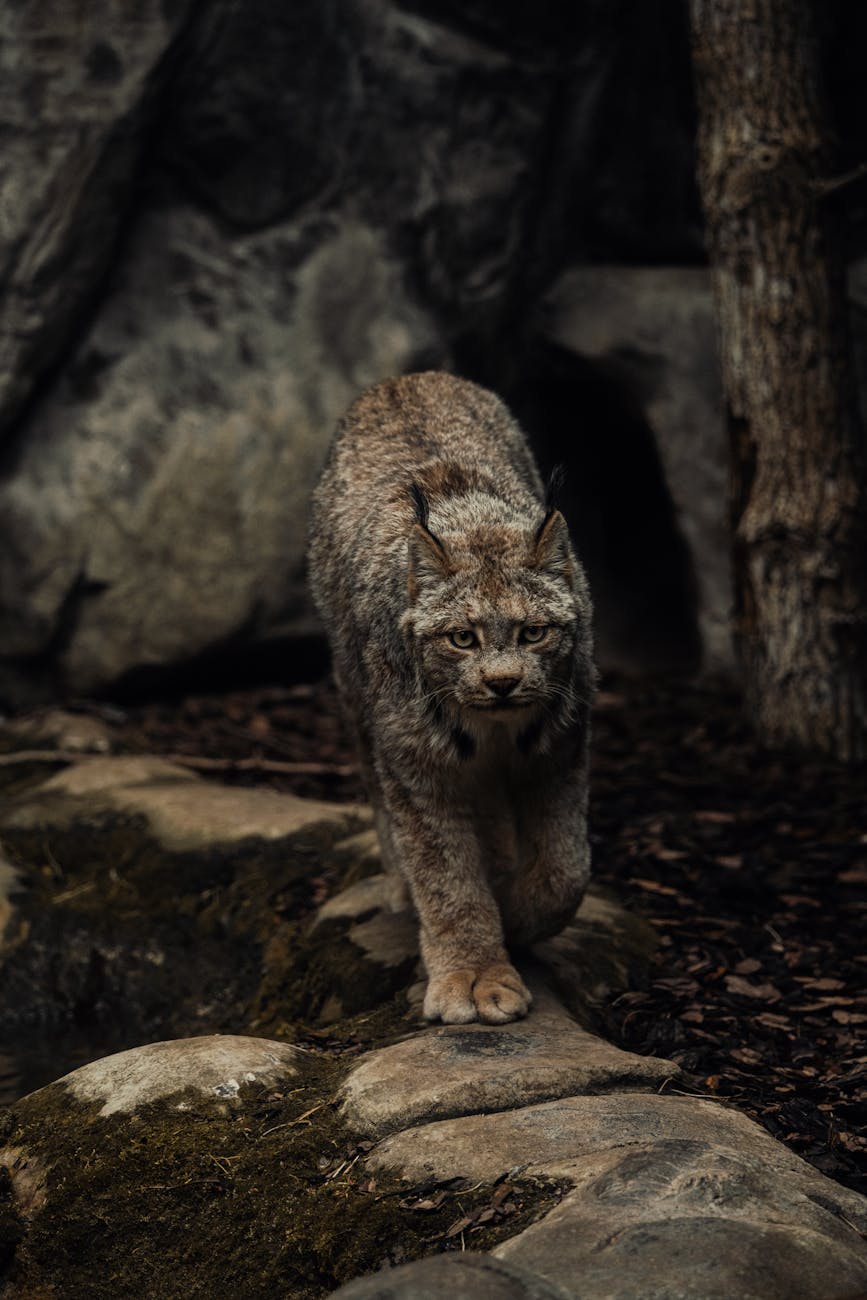
    Three punch chickens are discovered by Ellis’ lynx, Lenny. The lynx flushes them out of one of the merchant booths. Those armed chickens are carrying some goods away, sprinting towards the open door.

    What are punch chickens?

    Statistically they are axe beaks (Black Flag page 371) that punch rather than poke. Their special ability of Evasion turns out to be too significant for 2.5 combatants.

    Deadly encounter

    This is a deadly encounter with two characters and one combatant animal companion. The action economy combined with consistent dodging means both characters are dropped unconscious. The final roll comes down to Ellis’ lynx versus a wounded punch chicken. The lynx lands the fatal blow.

    Keesrah did bar the door preventing a simple escape, so even if they had completely failed there was a narrative success available via the peasants and non-heroic NPCs.

    Keesrah’s mother, Velthuria, helps the group heal.

    During the recovery the group used some social checks to learn that the punch chickens likely originate from a group that myths call the Children of Chorl (an evil transmuter who tried to create various hybrid creatures).

  • Inkling Dragon

    Inkling Dragon

    Inkling Dragons are thought to be related to pseudodragons, but where the pseudodragon is a wilderness lover the inkling dragon is generally an urban drake that enjoys being surrounded by books, scrolls and pamphlets.

    Generally the size of a large rat or small cat inkling dragons can be mistaken for an immature jaculus drake. As all dragonkin hoard something, an inkling dragon is consumed with the pursuit of knowledge and writing, similar to paper drakes.

    An inkling dragon without a companion can be found in libraries, universities, bardic colleges and wherever records are kept. Some are creatives writing fiction and song. Others are historians, tracking the world through the written word. At least one inkling dragon is known to only write in mathematics. This inkling dragon, Aymon, is a friend of transmuters, tax collectors and merchants often working as a clerk or calculator.

    The Inkling Dragon was created as part of a limited commission in the upcoming book Dragons of the Dwindling by Dragons of Wales (Andy Frazer).
    Follow Dragons of Wales on Instagram, Threads and Mastodon. Support Dragons of Wales on Patreon.

    Inkling Dragon companions

    Frequently inkling dragons and writers bond over their love of the written word. Sought after by many wizards and writers, an inkling dragon chooses their companion as much as their companion chooses them — the tiny dragon has to find the work engaging and relevant to their own writing.

    1. Wizard
    2. Bard
    3. Propagandist
    4. Novelist
    5. Poet
    6. Merchant
    7. Tax collector
    8. Cleric
    9. Clerk
    10. Noble

    This work includes material taken from the Black Flag Reference Document 1.0 (“BFRD 1.0”) by Kobold Press and available at Black Flag Roleplaying

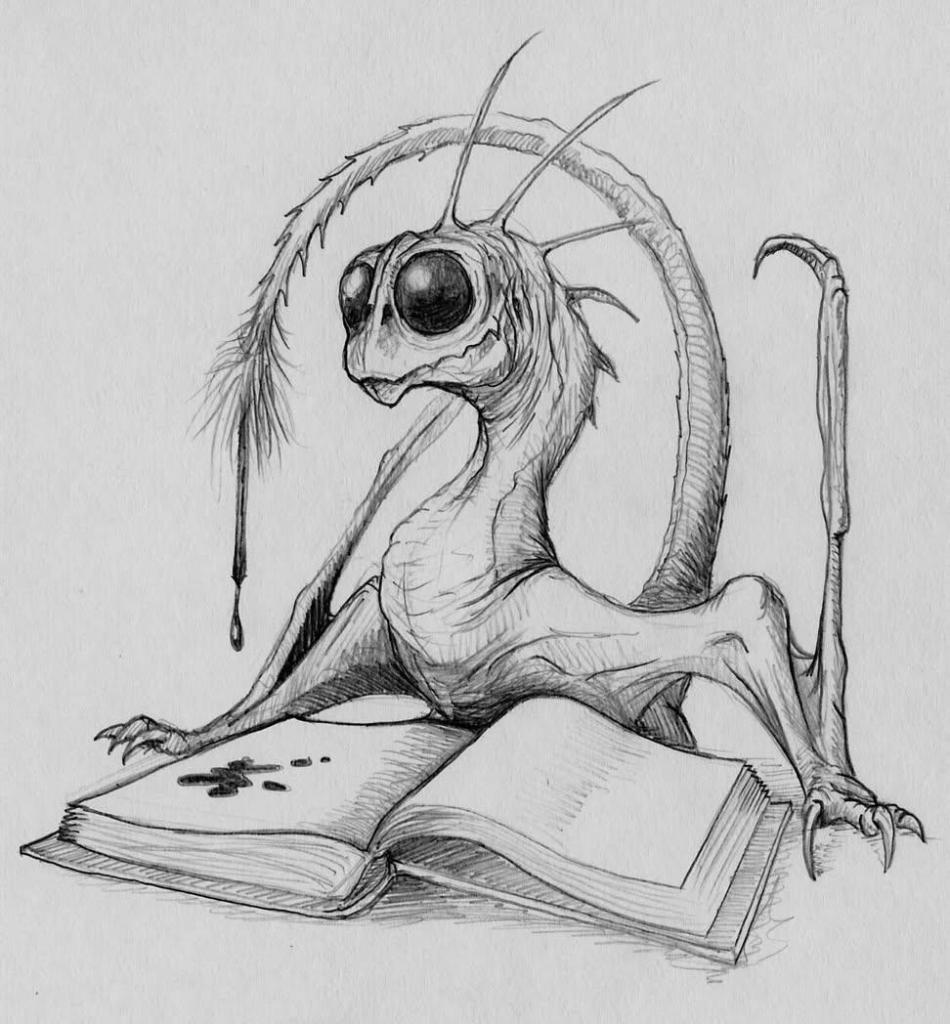
    Pencil sketch of a tiny dragon resting on a book. The pointy tail arches over the back with drips of ichor coming out of a feathered tip. The arms seem to be vestigial wings with opposing fingers capable of handling obects
    Art by Dragons of Wales in the forthcoming book Dragons of the Dwindling

    Inkling Dragon stat block

    Inkling Dragon (CR 1/4)
    Tiny Dragon

    Armor Class 14 (natural armor, small size)
    Hit Points 8
    Speed 10 ft., fly 30 ft.
    Perception 11 Stealth 12
    Resistant none | charmed
    Senses darkvision 30 ft., keensense 10 ft.
    Languages Common and four other languages (or cultures)

    STRDEXCONINTWISCHA
    -3+2-1+4+1+1

    Heightened Senses. The inkling dragon’s Perception is 20 when perceiving by sight. Ability checks for Perception using sight use Intelligence.

    Magic Resistance. The inkling dragon has advantage on saves against spells and other magical effects.

    Limited Telepathy. The inkling dragon can magically communicate simple ideas, emotions, and images telepathically with any creature within 30 feet of it that can understand a language it knows.

    Copying a Spell into the Book. When an inkling dragon or its companion finds an Arcane spell of 1st circle* or higher, the inkling dragon can add it to a spellbook if it is of a spell circle the companion can prepare and if they can make time to decipher and copy it. For each circle of the spell, the process takes 1 hour with no gp costs. Once the inkling dragon spends this time, the companions can prepare the spell just like their other Arcane spells. Copying a spell from a scroll into a spellbook doesn’t consume or destroy the scroll. Non-magical writing is written four times as fast when compared to humans. The inkling dragon produces ink from its tail as long as it isn’t at level two exhaustion or higher.
    * Black Flag uses circle as D&D uses spell level.

    Ritualist. An inkling dragon with its own book can be a Ritualist, per the Black Flag Talent. The spell source is Arcane. Intelligence is their spellcasting ability. The inkling dragon knows one 1st circle ritual (typically Identify). If the inkling dragon is a companion to a spellcaster it can learn rituals at the same circle and source as their spellcasting companion.

    1st circle Arcane rituals

    • Alarm
    • Create Familiar (these can only be common beasts)
    • Identify
    • Illusory Script
    • Unseen Servant

    ACTIONS

    Sting. Melee Weapon Attack: +4 to hit, reach 5 ft., one
    creature. Hit: 4 (1d4 + 2) piercing damage and the target must succeed on a DC 11 DEX save or be poisoned for 10 minutes. If the creature fails the save by 5 or more, it is stained by ink per Ink Stain below. This staining does not count against the number of uses per day.

    Ink Stain (1/short rest). On a successful sting the inkling dragon can mystic mark (Ranger) one creature. While a creature is marked (including for the attack that triggered the mark), the inkling dragon and allies deal an extra 1d4 damage to it (of the same damage type as the weapon) each time you successfully hit it with a weapon attack. A marked creature can use an Action to remove the Ink Stain. An inkling dragon that is a familiar or companion to a character may use this ability proficiency bonus (of that character) times per day rather than once per short rest.

    Fediverse Reactions
  • Ferments, Session one: Smog buggy and fire snakes

    Ferments, Session one: Smog buggy and fire snakes

    The East marched on West Thundermoon Trading Post.

    Wrapping up a typical day, Keesrah noticed a thick, acrid cloud coming from the east. At the same time a not-unusual goliath walked up the packed dirt road from the south.

    The goliath, Guarase Spinebloom, reached the gates of the wooden palisade enclosure a few minutes before the smog buggy. Keesrah starts closing the doors.

    The smog buggy encounter was one of three random encounters rolled by the three players taking part in today's session.

    In a thick accent, the boss of the smog buggy, a goblin with driver and second passenger, demands/requests entry to escape “fire snakes.”

    Keesrah messages her mother. This takes nearly a minute because it is the spell. She opens the gate and lets the rancid smoke engulfed clackety buggy into the trading post.

    Mere feet behind them are fire snakes.

    This was not a euphemism. They are snakes, made of fire.

    Fire snakes were also rolled on the random encounter chart.

    The fight is swift with another Trading Post visitor, a halfling with six tiny terrier companions, Luke with a silent and non-appearing q in his name. Luke is a cleric and joins in the defense. He was picking up farm implements from Keesrah’s father, a smith whose forge burns over an open lava seam.

    Luke, Keesrah and Guarase try to defend these goblins. They have difficulty conversing with the goblins. Though the goblins know common (Telsian as we’re using cultures not languages)the two dialects known aren’t similar between the Ferments-born and the Essians (goblin born).

    A unique use of Create Water by Luke reduces the fire snake effectiveness for a round, while also limiting the spread of fire in the walls.

    During the fight the fire snakes kill one of the goblin minions and damage everyone, as well as a bit of the palisade. It’s a win, but with a hefty loss.

    A mistake the DM, me, made was having four fire snakes. Standard fire snakes have too many hit points for three 1st level characters, even with their allies.
    As soon as I realized the error I dropped them to 13 or 14 HP. That meant the fight was very difficult, but not a campaign ender.

    A morale roll means that the smog buggy driver will likely never leave the trading post again. Their best friend is gone, burnt. Malk, the goblin boss needs to repair their buggy, which is also crispy, and find a crew and find the resources to use as fuel. The goblins normally use tar trees, but outside of Essia those are extremely rare.

    Malk and Keesrah’s father talk about the possibility of using lava to fuel the smog buggy.

    After a bit of rest, and setting up a guard by Keesrah’s family the group tries to recover. They talk a bit.

    Looking around the Post they notice the overflight of dozens of hunting birds. The Maltunyn family rivals up in the hills almost always bond with birds. At a heightened alert, the group of Luke, Guarase and Keesrah notice that one of the smaller doors out to the game trails is open. Keesrah’s younger brother is gone.

    The overflight was the third random encounter rolled.

    Key learnings (SlyFlourish would call these secrets).

    • Goblins are searching The Ferments for a resource that can fuel their smog-tek.
    • Fire snakes are now aggressive, rather than passive. They will chase outsiders in the area.
    • Keesrah’s brother snuck out at night. That raised an alert from the adversarial clan nearby.
    • Community helps community. No matter the challenge and the danger.

    This was the first session of The Ferments, an East Marches Campaign set in the World of the Everflow.

    It is an experiment in using random encounters, defensible places, and a West Marches style to talk about community, control of knowledge and love of pets.

    Fediverse Reactions
  • Xabal’s Workshop

    Xabal’s Workshop

    In our Age of Myths campaign the party acquired a keep. Though the party is many days travel by airship away from the keep, their former leader Artok (originally played by John) now runs the keep.

    Each of us gets a Special Feature for what is now our group Bastion. At this time Artok has a Sanctuary. We’ll want to get him a Barracks and Armory soon, because we aren’t around to defend the Bastion very often.

    Xabal Gaitee Quarter-Flagged Optigraph Balaneer nox Free Tink and non-Commissioned Officer of the Sadijh (on leave in absence), my goblin artillerist artificer, established a Workshop. He’s also interested in the Arcane Study, but first a workshop.

    Xabal and Crag took over the two store rooms in the keep. Xabal’s is on the left.

    The image depicts a hand-drawn map on graph paper. It outlines a fortified area, possibly a castle or fort, surrounded by a flowing body of water indicated by blue wavy lines, and red hatching marks representing elevation or terrain. The map includes labeled structures such as a "Keep" located centrally and surrounded by various buildings including "Stone barracks," "Stables wooden," and "Stores." There is an "Archery range" and a circular "Melee Practice" area. Paths and roads are sketched in black, with dotted lines representing different routes. Additional topographical features include a "Waterfall from mtns above into valley" on the right side of the map and a path labeled "Cart Path to main road." The map is oriented vertically, with features labeled throughout in a combination of print and cursive handwriting.
    Xabal took over the left most of the stores.

    What I like about the concept of Bastions/Strongholds/etc is that it gives players the opportunity for some ‘lonely fun.’ With a chill weekend at home I spent time thinking about D&D, but not actually playing the game.

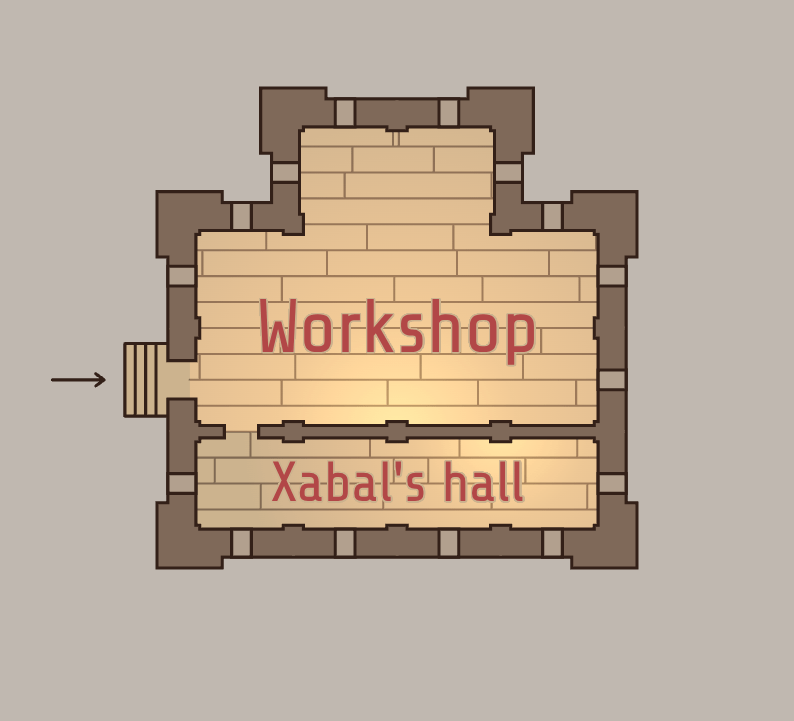
    The image is a top-down view of a rectangular room layout with beige and brown tones, resembling a floor plan. The main space is labeled "Workshop," situated at the top center. Below it, the space is divided by a thick line and labeled "Xabal's hall." The flooring appears to be composed of rectangular tiles laid in a brick pattern. The room is surrounded by a darker brown border, representing walls, with protruding sections at the corners, suggesting architectural features. On the left side, a small protruding area features parallel lines indicating steps leading up, with an arrow pointing to the right.
    Xabal’s workshop interior floorplan created using watabou’s Dwellings Generator

    Using watabou’s Dwellings creator I found something as close as possible to the space on the DM’s map of the keep. Then I added a bit of lore around the minor change (there’s an aviary so it isn’t a pure rectangle).

    And then I discovered the steps and main door should be on the right rather than left. That error will go down as a function of Xabal’s quite-distracted memory and the difficulty of communicating over long distances

    One thing that Xabal trusted Artok to do was hire three artisans to help in the workshop. He hasn’t yet met them, but Flasfur and Chofs started working already.

    Hirelings

    Below the three current hirelings are described including their “stats” for social encounters and their short-form personalities.

    Flasfur Wreltor with Blackbirds

    Photo by Siegfried Poepperl on Pexels.com

    A goliath with a flock of blackbirds that stay in the newly added aviary. He’s a cobbler and leather worker. The blackbirds help Flasfur with fine work required of those professions.

    Nearly eight feet tall, Flasfur was the one said he wouldn’t join the workshop without a small improvement, the aviary for his small flock of blackbirds.

    He’s from a small town in the hills between Mihrstone, Sheljar and Artok’s Keep.

    Strength, constitutionGoliath (2014)
    Negative dexterityCobbler, leatherworker
    Investigative
    Heavy leather apronSheljar
    Small awl (dagger)large aviary for the birds
    Modest lifestyleOpen, respectful, fatalistic, absent minded

    Chofs Chupmolea badged al-Chems

    The image depicts a minimalist, stylized drawing of a small castle-like building with a light brown background. The structure is rectangular with a crenellated parapet along the top. It features two arched windows on either side of a central arched door. The roof is angular and tiled, with a warm tan color. Two lantern-style lamps flank the door. The building is surrounded by sparse grass, adding to the scene's simplicity and rustic charm.
    Exterior drawing of Xabal’s Workshop in Artok’s Keep created using watabou’s Dwellings Generator.

    A goblin who is insistent in studying the corruption. She’s a jeweler and glassblower.

    Chofs recently travelled through the area scouting out a new source of gems not from her hometown. From Bel’an’faire in the south of Sheljar lands, she works with jewels and glass to create art and rarely implements of war.

    She also does etching and some other things that border on chemistry or alchemy.

    Dexterity, IntelligenceGoblin
    Negative charisma, strength, constitutionJeweler and fine arts, perceptive
    Lightweight, close fitting dressesBel’an’faire
    Caltrops to aid her escapeUse the corruption to power art
    Modest lifestyleBrilliant, excitable, religious

    Bolnis Abica nox Qawaha

    Where Chofs is a common goblin in their structured society Bolnis is a wanderer similar to Xabal. She’s potter and tinker who travelled through the land with simple coffee gear.

    Bolnis doesn’t like tea, but has some with her. Most of her time is in the hills and coast between Sheljar and Mira, if people insist on discovering where she’s from it’s Ooshar. She considers her hometown a backwater.

    There’s a chance that Bolnis invents fancy coffee gear, but right now it’s simple. Her passion is to discover new ways to use tek to create new foods, tisanes, poultices, and more.

    Intelligence, CharismaGoblin
    Negative strength, constitutionPotter, tinker, coffee gear
    Insight
    Lightweight travelling pantsOoshar
    Mug (club)An espresso machine
    Comfortable lifestyle, though paid at modestGenerous, meticulous, sensual

    I’m already thinking about how Xabal will interact with these hirelings and what knives they give the DM. Chofs offers someone that could be corrupted through those who study it. Bolnis clearly has twice the income of the others. How is she getting that money? Flasfur’s blackbirds could distract him from running the shop.

  • The Ferments: A campaign one sheet

    The Ferments: A campaign one sheet

    The Ferments are a rough land of geysers, lava flows, fast glaciers, waterfalls, hot springs, tornadoes, earthquakes — the raw power of the world. From this land the best alcohols of the Six Kingdoms come. The peoples of the Ferments are dispersed, spread over the many miles with four main towns. They generally live in defensible homesteads interacting when they need goods or during festivals.

    Campaign Premise

    Our eventual heroes start out as the primary defender of a homestead. They know how to contact other homesteads for help when needed, but mostly they are on their own hoping to remain safe from a world where dragons came real, magic became powerful and kaiju returned.

    Grand Conflicts

    Elementals burst from the land, stronger than before and with a hungry intelligence that threatens the land. Outsiders fleeing the wars of Six Kingdoms come for safe harbor. Dragons and their Ken continue to search for more scholars.

    Photo of a hot spring and geyser with a foreground of rough reds, the pool of water and a cliff in the background
    Photo by Laura Paredis on Pexels.com

    Each homestead has a book, collection of scrolls or other devices that helps them control an element (earth, air, fire, water) or paraelemental (smoke, magma, dust, ice, steam, mud, etc). These start out with each PC knowing Elementalism, limited by their choice of element. Each was passed down since the time of Gallinor, before the time of dragons.

    Factions

    Every player will create either an ally or adversary family besides their own. They may also have a connection to one of the families (not all families share blood-ties) of other characters.

    Adversaries

    Allies

    Rumors

    This section will fill over time.

    Animated gif of a blue-green wyvern overlooking a river
    • Kaiju roam as in the time of Gallinor — some even are ridden. Word is they come from the Kirtin-in-the-Sky and the Cliffs of Gallinor.

    Facets

    • Exploring the zero-to-hero tropes, friendship with animals, and who gets to control knowledge.
    • Defending your people.
    • Inverted West Marches.
      • Enemy generally comes to you. Though you may sallly in order to obtain resources.
      • Episodic – attend when you can.
    • Sessions are 3 hours, with each story completed in one session.
      • Characters will level up every 3 sessions.
    • Recaps will be posted to Full Moon Storytelling.

    Variant Rules

    • Wizards of the Coast’s 2024 D&D is the baseline
      • Monsters may come from Black Flag, A5E, 5.1 and 5.2 products.
      • Player options must be consistent within the ruleset (i.e. if you play a Mechanist all options should be from Tales of the Valiant for that character).
      • There is a campaign set up on DnD Beyond. Email me to get an invite.
      • Start at 1st level.
      • Use point buy or standard array for starting attributes. If you want something random, the redrick roller gives random point-buy-valid stats.
    • Playable races are Human, Hin(what they call themselves)/Halfling, or Goliath.
    • There are several custom backgrounds and tools available. We will use cultures, not languages. Common is the Western Wildes. Other cultures are;
    • Heroic Inspiration will exist as a shared dice pool that is a maximum of 2+ the number of PCs that day.
      • In addition to the normal ways to award Heroic Inspiration it will be awarded for playing to Short Form Personality.
    • Each PC manages a Homestead (Bastion from 5e 2024) that starts with no Special Buildings.
    • Each session will offer the opportunity for a short rest. Long rests are between sessions.

    Practicum

    Sessions are on Sundays from 1-4 when my main campaign isn’t being played. We’ll meet at Logan Brewing, usually. I’m willing to do duet play outside of that timeline as well.

    Each character should be built in a session zero discussing their personality, homestead, allies/adversaries and key abilities.

    Fediverse Reactions