Category: Playing D&D

Custom Backgrounds, classes, advice and more about Dungeons & Dragons

  • Rogue: Propagandist – a literary revolutionary

    Rogue: Propagandist – a literary revolutionary

    This archetype has been banging around my head for some time. The ability of words to inspire rebellion, to move nations, and to inspire people to be better is quite clear. Dungeons & Dragons kind of wraps this into the College of Whispers Bard, but that’s quite supernatural. The Rogue: Propagandist is mundane, based in historic examples such as Thomas Paine and Benjamin Franklin, as well as in certain versions of Assassin’s Creed.

    The design intent is to empower more play in urban and/or political campaigns. This attempt, which is essentially version 1.5, uses new mechanic for the rogue, one that demonstrates that people who publicly advocate for rebellion are often known, but still effective. The Propagandist most powerful abilities are powered by their Sneak Attack dice. This seemed to fit better than making them weak Bards in an Arcane Trickster variant like the Society of Veil and Shadows.

    Most of the lore description is removed from this pre-publication draft in order to focus on the mechanics, which are complex and new. The Swarm of Commoners and the Printing Press tool are just shells of what they will be in the future as well.

    Rogue: Propagandist

    Rebel and Pamphleteer

    You rose from the underbelly of empire to demand a better life for all. Your pamphlets and speeches can inspire hope, or fear. Whether from the soapbox or via playbill your proclamations turn the tides of rebellion or keep a government in power.

    Propagandist Features

    LevelAbility
    3rdWordsmith, Rabble Rousing
    9thProclamations
    13thGrand Voice
    17thMaster Essayist

    Wordsmith

    When you choose this archetype at 3rd level you gain proficiency with the Printing Press and a skill from the following list — History, Investigation, Insight, Deception, Persuasion, and/or Performance.

    In addition you learn one language of your choice.

    At 6th level you may choose the Printing Press for your expertise option.

    Rabble Rousing

    Your words inspire rebellion. You are able to summon a Swarm of Commoners. These commoners are allied with your cause, but are not willing to die for it. You spend an active Sneak Attack die for each use of this ability per short rest. The number of dice used determine how many Swarms you summon. Rabble Rousing takes a minimum 10 minutes to activate via speech, pamphlet, or other communication. The Swarm is summoned at a time and location where some commoners could be expected. The Swarm of Commoners has advantage on saves versus fear and are considered under the effects of the Charmed condition.

    Proclamations

    To issue a Proclamation you spend at least ten minutes creating a pamphlet, playbill, speech, cartoon, etc. These Proclamations grant bonuses to those who experience their call. Those bonuses are equal to the number of Sneak Attack dice spent at the time of proclamation (Proclamation Bonus). The Proclamations’ influence extends to a number of subjects determined by the proficiency bonus + ability score modifier in the skill or tool used to deliver the proclamation. The proclamation can be delivered via speech (Persuasion, Deception, Performance), pamphlet (Printing Press), or cartoon (Calligrapher’s Tools, Painter’s Tools). A tool would use Intelligence (i.e. a 9th level Propagandist with an INT of 14 issuing a Proclamation of Safe Haven via a pamphlet would grant 6 readers the benefits of Safe Haven).

    Proclamations that require a save do so against a DC determined by 8 + Proficiency and Intelligence Bonus.

    List of Proclamations

    • Unrest – A number of Swarm of Commoners determined by the spent Sneak Attack dice gain a Proclamation Bonus of temporary HPs and gain the same bonus to damage rolls. These Swarms will attack on the Propagandist’s initiative roll minus 10. The Proclamation inspires a rebellion.
    • Rally – Subjects regain hit points in the number of the spent Sneak Attack dice plus a Proclamation Bonus (ie. 2d6+6) as these Proclamations rebuild the morale of wounded forces.
    • Urgency – Subjects gain a Proclamation Bonus to their next initiative roll. Subjects are eager to join the fight.
    • Power – Subjects gain a Proclamation Bonus to their damage rolls during their next combat. Those attentive to the Proclamation recognize that they are powerful.
    • Warning – Subjects fall under the Frightened condition if they fail a Wisdom Save versus your Proclamation DC. They are wary of the forces working against them, afraid of any Swarm of Commoners and/or the Propagandist. They are overcome with this fear for one hour.
    • Safe Haven – Subjects are able to gain the benefits of a short rest via the calming words of the Proclamation.

    Grand Voice

    Beginning at 13th level your words can invigorate your allies. You can use a Reaction to have an ally reroll a failed Intelligence, Wisdom, or Charisma saving throw. You have a proficiency bonus number of uses of this ability per long rest.

    At 17th level you may also remove one level of Exhaustion via your Grand Voice, as long as the level of Exhaustion is not level 5 or 6. You may only remove one level of Exhaustion per ally in this manner.

    Master Essayist

    The strength of your words lasts. At 17th level any of your Proclamations (except Safe Haven) issued using a Printing Press grant their benefits/disadvantages until the target takes a short rest.


    Swarm of Commoners

    Huge, Neutral

    • Armor Class 10
    • Hit Points 21 (6d6)
    • Speed 20
    STRDEXCONINTWISCHA
    10 (0)10 (0)10 (0)10 (0)10 (0)10 (0)
    • Saving Throws
    • Damage Resistances Bludgeoning, Piercing, Slashing
    • Condition Immunities 
    • Senses Passive Perception 10
    • Languages Common (or 1 language of a peoples)
    • Challenge Rating

    Swarm. The swarm can occupy another creature’s space and vice versa. The swarm can move through any opening large enough for a Medium commoner. The swarm can’t regain hit points or gain temporary hit points except via Proclamations.

    Actions

    Club. Melee weapon attack: +4 to hit, Reach 5 ft., one target. Hit: 6 (3d4) bludgeoning damage. This attack assumes multiple commoners are attacking as one.

    The Swarm of Commoners can be adjusted if made up of a single humanoid race. Usually their weapons are clubs, but in some cases they may all use a specific simple weapon.

    Any ally of the Propagandist, or the Propagandist themselves, that attacks from within the Swarm of Commoners has advantage on their attacks. They may also use the Swarm for half-cover, attempt a Stealth/Deception check as a bonus action. Upon a success the individual within the Swarm of Commoners is considered invisible.


    Printing Press (tool)

    These are the necessary tools to create pamphlets, books, and playbills. The press itself is too large for adventuring, but you would still have ink, a sheaf of paper, scissors, a few letter blocks and one or two signet blocks.


    Thoughts?

  • Whistle of Az and Sel for the Blog Carnival

    Whistle of Az and Sel for the Blog Carnival

    Within the World of the Everflow every thinking peoples from the Land of Kin bonds with an animal. The most common of these are dogs (especially among halflings), birds (especially among goliaths), and horses (especially among humans). These beasts are family, inseparable companion, and essentially an extension of that person. They share personality and aid each other throughout their shared lives.

    This intimate companionship started after magic left the world. Now, the norm, bonding started with Az, his dog Sel, and a three-hole pipe. Together they created more and more and more and more and more bondings. Eventually this drove Az mad, for the thoughts of 100s of beasts were in his head. What was to be a blessing from one of the gods, turned into a curse for young Az. As he aged, the nation of Azsel formed around Az and Sel. Their whistle becoming the symbol of the nation, it was once under guard as a holy relic. Over the millennia the whistle disappeared. The power of bondings spread beyond what the Whistle started. Companionship is now so common that few consider it magical.

    Many also think legend of Az and Sel is merely a story, not real. But the Whistle of Az and Sel is in fact real, and dangerous, for the curse will drive you as mad. If any have found the Whistle in the current era they are not making that discovery public.

    This is my latest entry for the Blog Carnival.

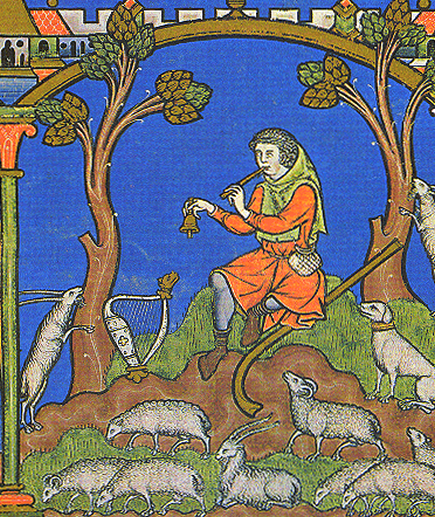
    David, as a young man, playing pipe and bell as he watches his sheep in the pasture. – The Morgan Bible, Folio 25

    Whistle of Az and Sel

    Wondrous Item, artifact, cursed (requires attunement)

    When playing the Whistle of Az and Sel the user can cast the following spells at will, without expending a charge and as a bonus action. These require no spell components nor concentration if that is normally required.

    • Animal Friendship
    • Beast Bond
    • Speak with Animals
    • Animal Messenger
    • Locate Animals
    • Summon Beast
    • Conjure Animals
    • Dominate Beast
    • Commune with Nature
    • Druid Grove

    This power comes with a cost. That cost varies by user.

    When one attunes with the Whistle of Az and Sel they experience two minor and one major detrimental properties. They also suffer from one long-term madness upon attuning and indefinite madness for as long as they are attuned (see DMG page 260). This cursed item requires a quest from a god or powerful magic to be unattuned.

  • Meet Amadin the Barker, including a new 5e D&D Background

    Meet Amadin the Barker, including a new 5e D&D Background

    From the Greatest Showman, to Newsies, to the nameless town criers belting out “Hear ye, Hear ye” the fiction that inspires our gaming has included symbols of governments, news guilds, carnivals, circuses, and religious orders in the streets are regularly part of the scenery. Some of these people would be dragged into heroic adventures.

    Amadin the Barker is one of these. Originally a barker for a travelling carnival, this fey hobgoblin fits within the normal world because of the cover of the carnival. Their uncommon lineage belongs among the strongmen who aren’t strong, the acrobatic performers, the owlbear trainers, and the oracles without magic.

    Created through a series of polls and prompts on Twitter, Amadin the Barker is discovered to be a Blessed Warrior Paladin of Redemption. They are generally peaceful, able to help their circus make money, prevent serious loss of live, and work to redeem themselves.

    Peace. Innocence. Patience. Wisdom.

    They swear upon these values. Sure, they are a warrior when needed. Those needs are rare. Amadin’s greatest tool is their booming voice and their desire to help the peoples who took them in when they were a stranger.

    laaaadeees and geenntleemeeen, step right up and see the most amazing art show in the world by Robert Couse-Baker (CC BY 2.0)

    Amadin the Barker

    Constitution +3Fey Hobgoblin, Paladin of Redemption (3)
    Strength -1Carnival Barker | Into crochet, not good at it
    Fine Clothes, rarely a Chain ShirtGhesh Province
    StaffSincere, Confident
    Comfortable, penny pincherAshamed, Judgmental
    This uses the Index Card version of NPCs for Social and Exploration Encounters

    If you want the full PC version of this community character Amadin is over at DnDBeyond, as are all of the community characters built via polls and interactions on my twitter account.

    Amadin is an example of a carnival barker, town crier, or herald. This new Background is part of my ever-percolating project Before We Were Heroes. Unlike the Remarkable Drudge, there is no cantrip or new tool for the Crier.

    Crier/Herald/Barker

    Skill Proficiencies: History, Persuasion
    Tool Proficiencies: None
    Languages: Two of your choice
    Equipment: A noisy instrument (bell, gong, horn, drum), fine clothes (a Barker should have a costume), common clothes, scroll case, 3 sheets of parchment, quill, jar of ink, 15 gp

    FeatureYou Will Hear Me

    When in a crowd, or during a heated discussion, your words always break through the background noise. When you shout out, or clap, or ring the bell, etc., the attention of the multitudes shifts to the Crier/Herald/Barker who can make an appeal to them. Your pronouncements carry the weight and heft of your organization.

    Barker Design choices

    Skills: Persuasion was obvious. That’s where this background had to start. Their whole role in society is to convince people to do things. The other choice came down to Insight or History. Insight made sense because reading a crowd may be necessary, but History fits the idea that the symbol of an area’s governance or a news guild or a traveler would have this level of knowledge. If a campaign is using Culture rather than Language, drop History for Insight.

    Tools: One of the spaces I’m exploring is giving various Backgrounds tools that they possess that they aren’t necessarily proficient in – in this case a musical instrument. The Crier may use a gong to gain attention. They don’t need to know how to perform a musical piece.

    Languages: With two more slots and the modern cosmopolitan nature of default D&D granting two languages makes sense.

    Equipment: The non-proficient instrument is a little note that some Criers need an assist before they gain attention of the masses. Most backgrounds do not include two sets of clothes. In the case of the Crier/Herald they should have fine clothes for official duties and look common when not. For a Barker replace the fine clothing with a costume, if you’d like.

    Feature: First off, yes, I modified the Sounder at Heart motto for this one. You Will Hear Me captures the feel of a person standing in the crowd and demanding attention. A character could use this as a distraction, or a rallying cry, or maybe as a way to start a charity drive. As always, the feature fits into social and exploration moments more so than combat.

    For personality attributes use Folk Hero, Scholar, Noble, or others that fit. The finished product, whenever it is done will include unique characteristics for all 40 or so Backgrounds.

    Custom Backgrounds for 5th edition Dungeons & Dragons

  • Wizards of the Coast brought the D&D blog back and it’s conversation fuel

    Wizards of the Coast brought the D&D blog back and it’s conversation fuel

    I love blogging. It’s been a huge part of my identity and part of my profession from 2008 to the present day (with the largest exception being the first few months of pandemic furlough). D&D blogging is in an interesting space – most of the conversation is happening on reddit, via video, or sectioned off into various closed systems like Patreon. And most of those conversations are about the happenings at a specific table, not the broader game.

    With Wizards of the Coast bringing back the official Dungeons & Dragons blog that may shift, even if just a bit. There’s so much fuel for longer conversations that do not translate well to modern social.

    This first blog entry in the resurrected kingdom of D&D blogging is from Ray Winninger, and the focus is on the D&D Studio and what it does. tl;dr – it is in charge of the tabletop game, and works with other versions of D&D to make certain that they maintain the flavor and notes that make D&D D&D.

    But, hidden within each of the section are a bunch of interesting notes about the structure of the team, how they design products, and what they are working on.

    Product Pitches

    These are all from internal submissions. No outside personnel participate. Those projects that move forward get a Product Lead. The current Leads are Jeremy Crawford, Amanda Hamon, Chris Perkins, Wes Schneider, and James Wyatt. From their past works within 5e we know what types of primary products most of those work on, and by the end of the year we’ll have an example for each.

    • Crawford – rules expansions
    • Perkins – adventures
    • Schneider – horror
    • Wyatt – world building
    • Hamon – an upcoming product not yet announced. Her experience with Kobold Press could mean magic or setting while her experience with Paizo could mean space fantasy. Or it could be something different. The conversation fuel is great.

    By design, we develop almost twice as many products as we publish. Developing more projects than needed allows us to pick and choose based on how those projects progress; it’s a strategy we use to boost the odds of bringing only the very best concepts to market.

    From the blog

    Within those glassed-in halls of south Renton are a couple dozen near-finished projects that sit in dark dungeons guarded by dragons.

    Five Major Releases in 2021

    • Candlekeep Mysteries is already out. I’m avoiding most of the adventures because I expect to play in a few one shots. Still, I own the book because I wanted to support the new creators.
    • Van Richten’s Guide to Ravenloft is coming out in mid May, just in time for my birthday. As someone who doesn’t know the Domains of Dread beyond Barovia, I’ve started to expand my knowledge through The Black Dice Society.
    • Unannounced summer adventure with Perkins as lead.
    • Unannounced Wyatt lead project that is a Winninger pitch.
    • Unannounced Hamon pitch and project, her first on the team.

    A book project takes 12+ months to go from pitch to release. They’re also working on developing more leads. The growth of the game spurred by 5e and supercharged by the pandemic is leading to a higher output of product than the early years of 5e indicated would happen.


    With this first entry being from the head of the D&D Studio there’s a lot of high level information. Since, by nature, a blog is throughput from the passions and mind of an author to their audience, each entry will be a reflection of the primary author, carved and shaped by their editor.

    Not only will the official blog provide inspiration for further conversation among fans, it is another route to learning about the people behind the game. For those of us that are readers it is a piece that helps us use a second screen while other things are on the primary one (whereas video streams tend to need to be the primary screen).

    What’s up next? We can only guess and talk about our theories.

  • Unearthed Arcana expands playable dragons – lacks playable dungeons

    Unearthed Arcana expands playable dragons – lacks playable dungeons

    The latest drop of Unearthed Arcana is another exploration of Draconic options – this time lineages, feats, and spells. Previously the Dungeons & Dragons team explored a Monk: Way of the Ascendant Dragon and a Ranger: Drakewarden.

    The UA also reminds readers that everyone gets a floating +2&+1 or three floating +1 with two languages (Common and one other being recommended).

    This review of UA will include bolded statements of what I like, what I would change, and what I dislike but can’t think of how to fix.

    Dragonborn

    Fifth edition D&D already has two sets of Dragonborn, one in the Player’s Handbook and another in Explorer’s Guide to Wildemount, the Critical Role book. Soon, there will be even more Draconic races, as the new set splits Dragonborn into the subsets – chromatic, metallic, gem. This Unearthed Arcana is also an expansion of Kobold options, as they were previously released in Volo’s Guide to Monsters.

    For all three there is a small boost in power for the breath weapon. This was needed. The PHB Dragonborn breath weapon wasn’t able to be used enough for it to serve a purpose. Having it be an attack replacement grants some great options for martial players after tier 1 play. Rather than 1 bonus action per rest (short or long) the UA version gets proficiency bonus number of uses per long rest. This is true for all three of the new subraces. They also increase damage from 2d6 with tier scaling to 2d8 with tier scaling. I like this.

    Chromatic

    Their breath weapon is a line, which is a switch for green and red dragonborn.

    At third level they gain the ability to be immune to the energy connected to their draconic origin. This ten minutes at once ability can help ahead of a combat encounter, but is also quite handy for some exploration challenges. It’s a fun little bit of story creep too. I like this.

    Metallic

    Their breath weapon is a cone, which is a switch for brass, bronze, and copper.

    Their third level boost is a secondary breath weapon that they can use once per long rest. There is a choice of two effects – a push and or kind of knock-out gas that incapacitates targets. These are both fine.

    Gem

    Previously gem dragonborn weren’t a thing, and as someone who didn’t get into gem dragons, this section is a lot of new ground. The various gems connect to new damage types (force, radiant, psychic, thunder, necrotic). As all gem dragons are connected to psionics these dragonborn gain the ability to telepathically communicate with a single creature within 30′, as long as they share a language. I like this cool boost.

    At third level they get this weird ability to fly by being surrounded by spectral gems. I don’t like this.

    Kobolds

    The kobolds in Volo’s have two negatives – their strength is reduced and they have sunlight sensitivity. The new draconic versions of kobolds suffer from neither of these.

    But the new kobolds also don’t get Grovel, Cower, and Beg (ok), nor do they get Pack Tactics (boo).

    The draconic versions get to choose between three abilities.

    • Advantage on saves versus fear. I like this.
    • A sorcerer cantrip. I like this because it connects them to the Volo’s monster kobold sorcerer.
    • An unarmed strike with the tail. I would change this strike to be finesse, so that dex builds could benefit.

    They also can roar. I don’t like this.

    I would rather the playable kobolds lean into the variant kobolds like dragonshields, winged, and inventors. Further connections between kobold culture and playable kobolds would be wonderful.

    Feats

    The new feats are about granting non-dragonborn a small lean into the powers and abilities of various dragons. This part is cool, but because they are each a different feat that means your character could take each feat once picking up a bit of chromatic, gem, and metallic. I don’t like this.

    Spells

    There are seven new spells that range from level 2 to 7. Four of them are named spells, with three carrying iconic names from the Forgotten Realms and one from Dragonlance. All are available to sorcerers and wizards, with a few being open to other casters.

    Draconic Transformation is a way to be nearly a dragon.

    Fizban’s Platinum Shield is a potent protective spell.

    Flame Stride is a movement boost that burns people as you pass them.

    Icingdeath’s Frost is a cone blast that covers the target in an ice shell.

    Nathair’s Mischief is a cube (yuck) that is rather fey in its behavior.

    Raulothim’s Psychic Lance is a piercing blast that has an interesting known name twist.

    Summon Draconic Spirit follows the new summons from Tasha’s Cauldron of Everything, and is a dragon.

    I like the story behind the spells and hope that Awf can add the Icingdeath’s Frost and Flame Stride to his known spell list. A Bladesinger running through traffic with flaming feat is a great image.

    Overall there’s a lot of flavor in these, but similar to the Fey UA, there is a clear need to fold the earlier releases and this next book together. There are competing versions of Orc, Hobgoblin, Dragonborn, and Kobold now. These would make more sense as subraces in a book, or digital version, that is consolidated with all the changes, shifts, and combinations.