Category: Playing D&D

  • Picking the Fall release 5e products best for you

    Picking the Fall release 5e products best for you

    Somewhat overshadowed by the release of several high-fantasy systems not based in 5e D&D is that Wizards of the Coast has two starter sets, a two-book/three-pdf Forgotten Realms set, and Eberron expansion coming out from September through the holidays.

    Additionally, other 5e systems inspired by D&D are also cranking right now.

    There’s a plethora of choice, right as genre TV’s most D&D related property is coming back — Stranger Things season 5 releases Thanksgiving, Christmas and New Year’s in the U.S. Several of the early monsters based on Dungeons & Dragons are making a comeback.

    Your normie (non-RPG) friends may be interested in the game again thanks to the combination of product releases, the Mighty Nein release, Stranger Things and the general zeitgeist around being big heroes with power in a world where that feels missing.

    What game or books are the right system for them right now?

    If you read Full Moon Storytelling it is likely that you are a DM/GM. It’s also likely that you lean towards 5e D&D. That will be the focus, with a small discussion of the other systems capturing attention (million dollar+ Kickstarters and the like).

    Are you the GM/DM?

    Go with what you like best, what fits your world, and be welcoming. Cut back on house rules and homebrew, at first, as the people who are new to the game can be overwhelmed with normal rule sets that can stretch to 1,000 pages.

    Fold the new invitees into your world by asking them what they enjoy about high fantasy roleplaying. Finding out what your table’s Appendix N always helps, but it is the most helpful knowing what someone new (or returning from long ago) to the hobby wants.

    If they want something simple, but familiar like the D&D of the 80s, but modern there are a few routes. Sticking with 2014 5e one can still get the older starter sets from Target or Amazon. Dragons of Strormwreck Isle is under $16 at Target online, and some physical stores may have it. Check with your local gaming store to see if they are offloading old product.

    You can also intro them to 2014 via Kobold Press Tales of the Valiant Starter Set. It is under $14 at the time of publishing. The primary differences between Wizards of the Coast 2014 D&D and Tales of the Valiant lies in Tales having character creation that separates nature and nurture, luck replacing inspiration and the insertion of unique abilities on every monster.
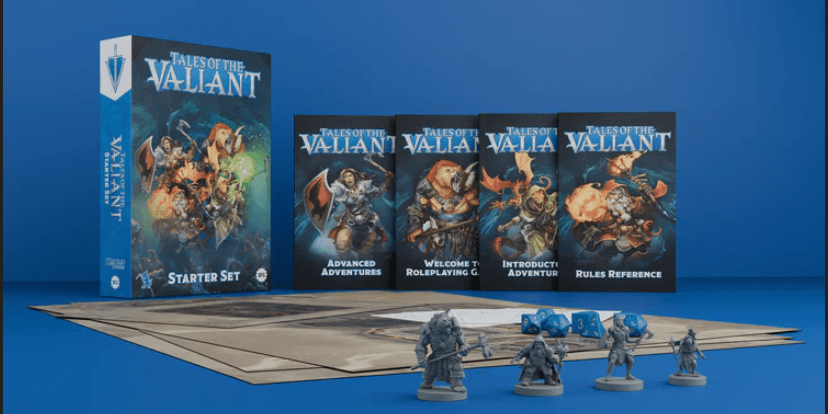
    Merchandising photo of Kobold Press Tales of the Valiant showing four minis, a set of dice, several maps, three adventures and a set of rules.

    I’d recommend Tales of the Valiant over 2014 D&D because of those changes, even if it doesn’t have the branding your friends expect. It also comes with minis! If Stormwreck Isle is 5.1 5e, ToV is probably 5.3.

    Stranger Things: Welcome to the Hellfire Club
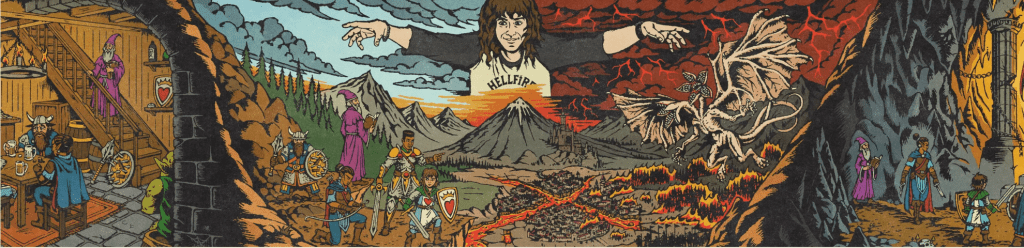
    A cartoon drawing from DnDBeyond that shows Eddie Munson looking over a medieval fantasy world of action and adventure, including a demagorgan.

    Maybe your friends didn’t get into D&D from Stranger Things season 1, or 2, or 3, or 4. Or maybe they did, but didn’t have the time, energy or mental space to play the game.

    Welcome to the Hellfire Club uses Wizards of the Coast’s modern take on starter sets — lots of tokens, handouts, cards and a written approach that blurs the line between board game and roleplaying game.

    modern take on starter sets — lots of tokens, handouts, cards

    The presentation includes a look that borrows from 80s nostalgia as expected. The four adventure books include trade dress that would make Gary Gygax and TSR proud.

    This is the second starter set built out of Stranger Things by Wizards of the Coast. Both lean heavily into using the voice of the character from the show that was the featured DM, lean into the mythology of the TV show with its ‘not quite D&D monsters, but monsters that middle/high schoolers would think are D&D monsters.’

    The first Stranger Things set was rather linear in nature, which fit the times and works fairly well for people newer to roleplaying. Welcome to the Hellfire Club uses 2024 5e D&D rules.

    D&D Starter Set: Heroes of the Borderlands

    Similar to Stranger Things pulling out 80s nostalgia to pull people into its world, Wizards of the Coast uses Dungeons & Dragons most popular adventure from the foundational period to inspire its new general purpose Starter Set.

    Keep on the Borderlands is now Heroes of the Borderlands, with three adventures. Using 2024 5e D&D’s rules, card-based character creation, tokens and maps, the intent of Heroes is to again bridge that gap between board game night and RPG night.

    Because it is 2024’s rules rather than 1974s, the set is massive. Those three little folios that could fit in a small lunchbox are gone. Instead Heroes has more than 400 cards and tokens, a quick start, a set of rules, and three adventures.

    The game of D&D is simultaneously more complex and more approachable than it was in the 70s and 80s. Being a more pervasive part of the culture is part of that. Also the decades of exposure to computer RPGs changes how one approaches teaching the game.

    Forgotten Realms expansions

    A massive two-book, three-digital book expansion coming with the brilliant marketing around “The Realms will know your name” these books aren’t necessarily great for first timers to tabletop roleplaying, unless…

    You know people who were heavy into the lore of Baldur’s Gate 3 and/or D&D: Honor Among Thieves and/or the once dominant fantasy novels set in the Realms. Those legends exist within the expansion, but the point of D&D and RPGs in general is to tell your story.

    Only dive into this if you are being joined by people who absolutely love those non-tabletop versions of the Forgotten Realms. These expansions include 50 micro-adventures that fit an on-the-fly DM rather well (similar to those in the 2024 DMG).

    Those playing with your classic group you need little guidance. If you are using the 2024 D&D rules, or at a table that permits a broad swath of 5e rules, the expansion is handy if you want to borrow factions, subclasses, new species and nuggets of lore to insert into your homebrew.

    In total the Realms expansions add about 30% more character creation options while dramatically expanding the story through the lore expansions.

    Eberron: Forge of the Artificer

    High fantasy doesn’t have to take place in a world that’s pseudo medieval/Renaissance and Euro coded.

    It can also include pervasive magic, spread widely among the populace in a world that echoes tropes related to early Industrialization with great Houses, lightning rails, elemental airships and a ‘war to end all wars.’

    That’s Eberron.

    Forge of the Artificer is a lightweight updated to the setting originally invented by Keith Baker.

    Due to a product failure on the physical book, it is being entirely reprinted with digital and print now out 9 December, 2025.

    Don’t get Forge of the Artificer unless you already have Rising from the Last War or you really want to have the magitech Artificers at your table or you are a completionist. I’ll be getting it for the first two reasons. I’m currently playing a goblin Artificer.

    The Artificer in Forge is updated for 2024 with a brand new subclass as well. From what was in the Unearthed Arcana developing this coming version of the Artificer it looks to have the quality of life improvements I would expect.

    Other RPGs

    LevelUp

    LevelUp is built on the 5.1 5e chassis, but advances it. This does make it a more complex version of high fantasy role playing. Some of the greatest improvements come from expanding the social and exploration pillars. This helps tell a wider variety of stories. Like every offshoot of D&D from the 5e era it separates nature and nurture.

    There’s now a Starter Set available. Yes, it has tokens and multiple adventure, because that’s what modern starter sets do. EN Publishing’s Starter Set is an excellent way to try on a different version of the game you already know.

    Cosmere RPG

    If you enjoy Brandon Sanderson’s writing you might enjoy the Cosmere RPG. It is not based on 5e. It is the highest earning RPG kickstarter of all time.

    Cosmere is beautiful, complex and the most extensive lore heavy game upon release likely ever.

    Draw Steel

    While not the level of Kickstarter success of Cosmere, Draw Steel was still a massive earner. The design team from MCDM is mostly people who produced wonderful 5e products, but are now releasing a system that emphasizes combat (tactical, heroic, cinematic) even more than D&D. The rules are crafted so that the feeling of conflicts is a reminder of watching a movie or TV show’s fight scenes.

    Daggerheart

    If Draw Steel is inspired by D&D, but wanting to be more combat, Daggerheart is inspired by D&D, but wanting to empower more story. Like Draw Steel and Cosmere, Daggerheart is a wholly new system. Most simply defined there is a Hope/Fear mechanic attached to the double-dice roll of players. Additionally it covers more ground about how to communally create the worlds and social interaction. Coming from Critical Role’s Darrington Press Daggerheart is designed to showcase the types of stories Critical Role excelled at.

    Similar to Cosmere and D&D there is a wealth of media associated with it already — with more coming from the media arm of what was once a D&D actual play, but is now a multimedia company.


    There are plenty of other games too — listing them all is foolhardy. Pathfinder and Starfinder, Legend of the Ring, Warhammer, Shadowdark and the list could go on.

    But the zeitgeist right now seems to be focused on 2024 D&D versus a few upstarts with million dollar or more crowdfunding campaigns all coming out in the second half of 2025.

    No matter what you choose — play more games.

    Fediverse Reactions
  • Black Flag is in the Creative Commons, now what? Backgrounds!

    Black Flag is in the Creative Commons, now what? Backgrounds!

    Over the past decade the 5th edition of Dungeons & Dragons grew three main offshoots from its original 2014 release by Wizards of the Coast. These three trunks are all now in the Creative Commons thanks to Kobold Press’s announcement this week.

    A5e is the Systems Reference Document for LevelUp, from EN Publishing. This branch of 5e places much greater emphasis on social and exploration, while also being a more complex combat engine. It’s “advanced” 5e.

    2024 D&D by Wizards of the Coast (the 5.2.1 SRD) is an evolution of the most popular version of the game in history. It adds minor layers of complexity, and removes most bioessentialism.

    Now, Black Flag, the SRD for Tales of the Valiant is also in the Commons under the CC BY 4.0. The primary changes within Black Flag are replacing Inspiration with Luck, adding Dread and similar to A5e uses both nature and nurture to define an upbringing.

    All three modern offshoots add a unique element to every monster. Rather than have merely have bigger numbers, monsters do something different — a Commoner in Black Flag has Angry Mob, while in A5e Commoners have a Stone (they can also be a Group) and in 5.2.1 they have Training.

    What can a DM/GM/designer do with all four in the same license?

    1. I am not a lawyer. Nor am I your lawyer. Use an actual lawyer if you have questions and are publishing for money.
    2. Read all relevant SRDs as well as their related FAQs.
    3. Find the place you want fiddle with and become an expert at that before you try to be an expert at everything.
    4. At your home table, borrow liberally from every system. If you don’t find yourself handing out 2014 Inspiration and don’t like 2024 D&D’s mechanical implementation, use Luck from Black Flag. Use everyone’s monsters — they’re balanced enough for the elastic system that is 5e — your players will have fun interacting with different commoners doing different things.

    Maybe you’re thinking “that’s nice advice Dave, but what are you going to do?”

    Backgrounds!

    Full Moon Storytelling’s most popular types of stories are various Backgrounds. The ones on this site focus on empowering a wider variety of tales within our 5e games, while leaning into short-form personality, a spread of Feats/Talents for each and sometimes a cantrip.

    Each of the main trunks of 5e do something different from the 2014 version of the game. That’s good! Your table can use a Background from any of the modern versions and there will be no balance issues. That means dozens of more origin stories for your heroes.

    For myself it means my eternal project becomes a simple project. A few dozen new Backgrounds with methodology to fit in all four trunks of 5e.

    Custom Backgrounds for 5th edition Dungeons & Dragons

    Photo by Canan YAu015eAR on Pexels.com

    The Tinker

    This week the Tinker is my most popular Background. Tuning it for each version of 5e doesn’t take much.

    2014 5e by WotC

    It’s already released, but the key point is the feature “I Can Fix It.” The feature helps in exploration situations, mostly, as it means the Tinker will usually have a way to MacGyver there way through a problem even if they don’t have the proper supplies.

    2024 5e by WotC

    If you leave Ability Score Improvements within the Background rather than have them float the Tinker would choose between Dexterity, Intelligence and Charisma.

    Origin Feats

    Choose one;

    • Crafter
    • Magic Initiate (Wizard)
    • Skilled
    • Tavern Brawler
    • and from Tasha’s Artificer Initiate

    Black Flag from Kobold Press

    Choose a Talent

    • Far Traveler
    • Polyglot
    • Trade Skills
    • Scrutinous
    • Ritualist (Arcane)

    A5e from EN Publishing

    ASI – Tinkers typically grant a +1 in Dexterity

    Connections – Tinkers might know a caravanserai, an innkeeper, a ferien, a smith, a group of bandits, a sergeant from a warring nation, a local farmer, a maker of fine meed, a faerie that’s a cheesemonger.

    Memento – Tinker memento options could include a letter from home, a chapbook of poetry, a metal they’ve never been able to bend or smelt, a strap of leather from their first failed project, the stein from their favorite inn, or a book of cantrips though they don’t know any.

    Adventures and Advancement – A Tinker who repaired a notable authority’s broken item may be granted a writ of access granting the Tinker expertise on Persuasion rolls.

    Feature – same as the original on Full Moon Storytelling.

    Now, these examples are quick looks at a future project that will include the score of Backgrounds already on the site, plus the four Everflow specific Backgrounds that didn’t get their own entry. And more as my reading expands.

    With four versions of 5e available in the Creative Commons (CC BY 4.0) how will you create for your table?

    Fediverse Reactions
  • Your favorite fantasy TV series was cancelled, now what? RPGs

    Your favorite fantasy TV series was cancelled, now what? RPGs

    A few years ago it was the heyday of big, high fantasy TV series. Yes, the grit of Game of Thrones and Witcher were still popular, but there were also a selection of shows with a higher level of magic, higher level of heroism and a set of characters who you wanted to win. It was the era of peak fantasy TV.

    Slowly but surely these faded away.

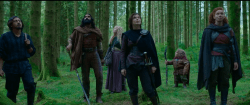
    Several people in fantasy medieval garb in a dark forest.
    Screenshot of Willow on Disney+

    Some series got a reasonable run — The Magicians reached a conclusion. Some series were cut quite short — Willow, ended with more story to tell.

    Universes were announced to be expanding. Shadow & Bone went from having the Six of Crows spinoff announced to the entire project dying.

    There was big money in fantasy for a bit. These weren’t Brit TV specials like Merlin or modern attempts at low budget like Xena.

    The biggest money of them all is still around. Rings of Power, the prequel-ish endeavor by Prime Video churns along at price points that are normally saved for theater or Andor.

    The wheel weaves as the wheel wills, always turning.

    Sometimes the wheel destroys the things you enjoy, like Wheel of Time — especially the last half of season 2 and all of season 3 with strong reviews and great fan appreciation. While there was enormous pushback against the changes made to adapt to the shorter run time of a book plus a bit per season, as well as pushback against the attempts to be less coded and more openly diverse, the series was generally well received. It was generally profitable.

    It’s gone.

    The story won’t finish (except in the books, which will always be around). Yes, there’s a petition to Save Wheel of Time. I hope it succeeds. Brandon Sanderson seems to suggest it should, but will not.

    Petitions and book reading are passive.

    Don’t be passive — adapt those stories to an RPG

    Playing games in those worlds is active participation in the fandom, and helps build out that word of mouth.

    You don’t need to have an authorized book in order to play. Any fantasy series, movie, video game, book, comic, etc can show up at your table.

    You can instead borrow the themes, cultures, characters and put them in your world. Sure, you could play pure within the world created by Robert Jordan or Lev Grossman or Jonathan Kasdan.

    The power of roleplaying games is that the tale is yours, no one can take it from you. The rules can be simple enough to fit on a business card or so complex it fills bookshelves.

    A selection of 5e D&D books from Wizards of the Coast, Kobold Press and others.

    What happens to Jade, Kit and Elora?

    That’s up to you.

    What happens to Mat, Perrin, Elayne, Min and the rest?

    That’s up to you.

    Take the themes, tropes and world of that story that a committee decided was no longer worth being told and tell it yourself.

    That’s why I fell in love with D&D and RPGs in the 80s.

    The unfinished trilogy, or maybe not

    Back in my youth my bookshelves were covered with science fiction, fantasy and encyclopedias. Words on a page were meant to be consumed by me, like a black hole consumes a galaxy.

    I’d shop at a used bookstore, looking for a new series to start. Except sometimes I’d never find book 2, let alone the inevitable trilogy. Sometimes I would start with book 3!

    One of my favorite tales, and I say this as someone who had pets but didn’t really discover the love of pets until my 30s, was a story about a fading order of knights who rode giant tigers. The hero wasn’t really part of the order. His family was and he had that extremely large cat. In this dying world they journeyed, starting as outsiders and immediately recognized as legendary. But they were just a dude and a great cat.

    They didn’t want to be heroes. It was so compelling, this story of man and beast who wanted to be normal while the world needed them to be great.

    I never found book 2.

    But I had already discovered Dungeons & Dragons. A character paralleling that tale was created. We roamed the worlds that Erik and Justin and Chis and Abel and Hayes and Jacob and Colin and Andrew and others created.

    We finished that tale.

    Wheel of Time is over, unless it isn’t

    The series explored slightly different things from the books. One of those was how tales are told. There’s a suggestion from the meta of the series that within a world where there are endless retellings of tales and history.

    What changes, and what stays the same is part of that story.

    Your RPG could lean into that by playing similar characters at different levels, at different times with a power to oncer per month to have a past power show up, maybe ramping faster as time goes by.

    Another possible exploration from the Wheel of Times series and books is how power corrupts. The nature of saidin is that man with power lose control of themselves — mentally, emotionally, physically.

    Want to toss a saidin power into your D&D?

    Maybe your Rand-ish character is a Warlock that has to roll on the Wild Magic table every time they cast a spell.

    Of course, one of the most potent tales from the books that is amplified in the series is that women are not side characters. They are as important to the story, and powerfully so, as anyone else.

    You don’t need special rules for this. The modern versions of D&D encourage this.

    From Willow there is a connection in the series to the tales from the movie (history is a massive throughput in Wheel of Time as well).

    To see this at your table means connecting a current adventure or campaign to one that ended a decade, a century, a millennia, an age ago.

    A D&D campaign that builds off of former campaigns is a structure that generally needs some continuity of players, but can also be done through one-sheets, common knowledge pages and a regular re-telling of special moments.

    This could happen around the campfire, on the steps of a temple, inside a tavern or any place where the PCs meet NPCs.

    Find what’s important from these tales and make them your own

    It’s rough to lose a special story.

    You have your memory. You have your hope.

    You have a game to help you continue the legends that are important to you. You don’t need Rafe or Sera or Kasdan.

    You need dice, paper and a table of friends.

    Fediverse Reactions
  • Xabal’s Workshop

    Xabal’s Workshop

    In our Age of Myths campaign the party acquired a keep. Though the party is many days travel by airship away from the keep, their former leader Artok (originally played by John) now runs the keep.

    Each of us gets a Special Feature for what is now our group Bastion. At this time Artok has a Sanctuary. We’ll want to get him a Barracks and Armory soon, because we aren’t around to defend the Bastion very often.

    Xabal Gaitee Quarter-Flagged Optigraph Balaneer nox Free Tink and non-Commissioned Officer of the Sadijh (on leave in absence), my goblin artillerist artificer, established a Workshop. He’s also interested in the Arcane Study, but first a workshop.

    Xabal and Crag took over the two store rooms in the keep. Xabal’s is on the left.

    The image depicts a hand-drawn map on graph paper. It outlines a fortified area, possibly a castle or fort, surrounded by a flowing body of water indicated by blue wavy lines, and red hatching marks representing elevation or terrain. The map includes labeled structures such as a "Keep" located centrally and surrounded by various buildings including "Stone barracks," "Stables wooden," and "Stores." There is an "Archery range" and a circular "Melee Practice" area. Paths and roads are sketched in black, with dotted lines representing different routes. Additional topographical features include a "Waterfall from mtns above into valley" on the right side of the map and a path labeled "Cart Path to main road." The map is oriented vertically, with features labeled throughout in a combination of print and cursive handwriting.
    Xabal took over the left most of the stores.

    What I like about the concept of Bastions/Strongholds/etc is that it gives players the opportunity for some ‘lonely fun.’ With a chill weekend at home I spent time thinking about D&D, but not actually playing the game.

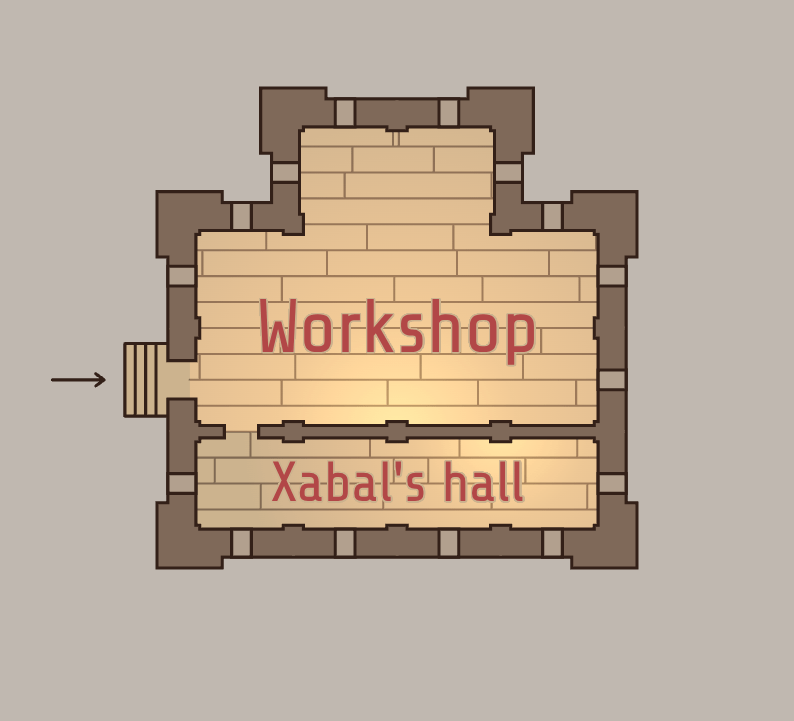
    The image is a top-down view of a rectangular room layout with beige and brown tones, resembling a floor plan. The main space is labeled "Workshop," situated at the top center. Below it, the space is divided by a thick line and labeled "Xabal's hall." The flooring appears to be composed of rectangular tiles laid in a brick pattern. The room is surrounded by a darker brown border, representing walls, with protruding sections at the corners, suggesting architectural features. On the left side, a small protruding area features parallel lines indicating steps leading up, with an arrow pointing to the right.
    Xabal’s workshop interior floorplan created using watabou’s Dwellings Generator

    Using watabou’s Dwellings creator I found something as close as possible to the space on the DM’s map of the keep. Then I added a bit of lore around the minor change (there’s an aviary so it isn’t a pure rectangle).

    And then I discovered the steps and main door should be on the right rather than left. That error will go down as a function of Xabal’s quite-distracted memory and the difficulty of communicating over long distances

    One thing that Xabal trusted Artok to do was hire three artisans to help in the workshop. He hasn’t yet met them, but Flasfur and Chofs started working already.

    Hirelings

    Below the three current hirelings are described including their “stats” for social encounters and their short-form personalities.

    Flasfur Wreltor with Blackbirds

    Photo by Siegfried Poepperl on Pexels.com

    A goliath with a flock of blackbirds that stay in the newly added aviary. He’s a cobbler and leather worker. The blackbirds help Flasfur with fine work required of those professions.

    Nearly eight feet tall, Flasfur was the one said he wouldn’t join the workshop without a small improvement, the aviary for his small flock of blackbirds.

    He’s from a small town in the hills between Mihrstone, Sheljar and Artok’s Keep.

    Strength, constitutionGoliath (2014)
    Negative dexterityCobbler, leatherworker
    Investigative
    Heavy leather apronSheljar
    Small awl (dagger)large aviary for the birds
    Modest lifestyleOpen, respectful, fatalistic, absent minded

    Chofs Chupmolea badged al-Chems

    The image depicts a minimalist, stylized drawing of a small castle-like building with a light brown background. The structure is rectangular with a crenellated parapet along the top. It features two arched windows on either side of a central arched door. The roof is angular and tiled, with a warm tan color. Two lantern-style lamps flank the door. The building is surrounded by sparse grass, adding to the scene's simplicity and rustic charm.
    Exterior drawing of Xabal’s Workshop in Artok’s Keep created using watabou’s Dwellings Generator.

    A goblin who is insistent in studying the corruption. She’s a jeweler and glassblower.

    Chofs recently travelled through the area scouting out a new source of gems not from her hometown. From Bel’an’faire in the south of Sheljar lands, she works with jewels and glass to create art and rarely implements of war.

    She also does etching and some other things that border on chemistry or alchemy.

    Dexterity, IntelligenceGoblin
    Negative charisma, strength, constitutionJeweler and fine arts, perceptive
    Lightweight, close fitting dressesBel’an’faire
    Caltrops to aid her escapeUse the corruption to power art
    Modest lifestyleBrilliant, excitable, religious

    Bolnis Abica nox Qawaha

    Where Chofs is a common goblin in their structured society Bolnis is a wanderer similar to Xabal. She’s potter and tinker who travelled through the land with simple coffee gear.

    Bolnis doesn’t like tea, but has some with her. Most of her time is in the hills and coast between Sheljar and Mira, if people insist on discovering where she’s from it’s Ooshar. She considers her hometown a backwater.

    There’s a chance that Bolnis invents fancy coffee gear, but right now it’s simple. Her passion is to discover new ways to use tek to create new foods, tisanes, poultices, and more.

    Intelligence, CharismaGoblin
    Negative strength, constitutionPotter, tinker, coffee gear
    Insight
    Lightweight travelling pantsOoshar
    Mug (club)An espresso machine
    Comfortable lifestyle, though paid at modestGenerous, meticulous, sensual

    I’m already thinking about how Xabal will interact with these hirelings and what knives they give the DM. Chofs offers someone that could be corrupted through those who study it. Bolnis clearly has twice the income of the others. How is she getting that money? Flasfur’s blackbirds could distract him from running the shop.

  • The Ferments: A campaign one sheet

    The Ferments: A campaign one sheet

    The Ferments are a rough land of geysers, lava flows, fast glaciers, waterfalls, hot springs, tornadoes, earthquakes — the raw power of the world. From this land the best alcohols of the Six Kingdoms come. The peoples of the Ferments are dispersed, spread over the many miles with four main towns. They generally live in defensible homesteads interacting when they need goods or during festivals.

    Campaign Premise

    Our eventual heroes start out as the primary defender of a homestead. They know how to contact other homesteads for help when needed, but mostly they are on their own hoping to remain safe from a world where dragons came real, magic became powerful and kaiju returned.

    Grand Conflicts

    Elementals burst from the land, stronger than before and with a hungry intelligence that threatens the land. Outsiders fleeing the wars of Six Kingdoms come for safe harbor. Dragons and their Ken continue to search for more scholars.

    Photo of a hot spring and geyser with a foreground of rough reds, the pool of water and a cliff in the background
    Photo by Laura Paredis on Pexels.com

    Each homestead has a book, collection of scrolls or other devices that helps them control an element (earth, air, fire, water) or paraelemental (smoke, magma, dust, ice, steam, mud, etc). These start out with each PC knowing Elementalism, limited by their choice of element. Each was passed down since the time of Gallinor, before the time of dragons.

    Factions

    Every player will create either an ally or adversary family besides their own. They may also have a connection to one of the families (not all families share blood-ties) of other characters.

    Adversaries

    Allies

    Rumors

    This section will fill over time.

    Animated gif of a blue-green wyvern overlooking a river
    • Kaiju roam as in the time of Gallinor — some even are ridden. Word is they come from the Kirtin-in-the-Sky and the Cliffs of Gallinor.

    Facets

    • Exploring the zero-to-hero tropes, friendship with animals, and who gets to control knowledge.
    • Defending your people.
    • Inverted West Marches.
      • Enemy generally comes to you. Though you may sallly in order to obtain resources.
      • Episodic – attend when you can.
    • Sessions are 3 hours, with each story completed in one session.
      • Characters will level up every 3 sessions.
    • Recaps will be posted to Full Moon Storytelling.

    Variant Rules

    • Wizards of the Coast’s 2024 D&D is the baseline
      • Monsters may come from Black Flag, A5E, 5.1 and 5.2 products.
      • Player options must be consistent within the ruleset (i.e. if you play a Mechanist all options should be from Tales of the Valiant for that character).
      • There is a campaign set up on DnD Beyond. Email me to get an invite.
      • Start at 1st level.
      • Use point buy or standard array for starting attributes. If you want something random, the redrick roller gives random point-buy-valid stats.
    • Playable races are Human, Hin(what they call themselves)/Halfling, or Goliath.
    • There are several custom backgrounds and tools available. We will use cultures, not languages. Common is the Western Wildes. Other cultures are;
    • Heroic Inspiration will exist as a shared dice pool that is a maximum of 2+ the number of PCs that day.
      • In addition to the normal ways to award Heroic Inspiration it will be awarded for playing to Short Form Personality.
    • Each PC manages a Homestead (Bastion from 5e 2024) that starts with no Special Buildings.
    • Each session will offer the opportunity for a short rest. Long rests are between sessions.

    Practicum

    Sessions are on Sundays from 1-4 when my main campaign isn’t being played. We’ll meet at Logan Brewing, usually. I’m willing to do duet play outside of that timeline as well.

    Each character should be built in a session zero discussing their personality, homestead, allies/adversaries and key abilities.

    Fediverse Reactions
  • Militia actions for 5e systems

    Militia actions for 5e systems

    Sometimes in D&D and similar games you need to empower the players to manage groups of allies supporting the narrative, without precise actions by individuals. When running a rebellion, skirmish or base defense you can use militia actions representing the training a character conducted with a group of commoners.

    1. On every PC’s turn they now have a Militia Action. This is independent of their character’s actions and reflect the training that the character put into the small unit (think squad sized) during downtime.
    2. In initiative the Militia Action happens after all player actions and the actions of that character’s companions (familiars, pets, constructs, etc)
    3. A militia is a Swarm of Commoners (AC: 10, HD: 6, PB: 0, all abilities are 10, a Swarm may have a tool proficiency or skill for flavor). Every time it is attacked it makes a Wisdom ability check against the damage dealt. It gains a bonus from the controlling character’s Charisma (Persuasion). Each failure removes a Hit Die. When it drops below 3 HD it loses one of its damage dice. Do not track damage.
      Suggestion: Use a d6 to track the HD of a Swarm of Commoners.
    4. Pick one of the following actions
      • Ranged attack – this attack is rolled with an Attack Bonus of + controlling character’s Charisma+PB (and whichever ability they use to command). Range is 30/60 to represent inaccurate and improvised weapons. Damage is 2d4.
      • Melee attack – this attack is rolled with an Attack Bonus of + controlling character’s Charisma+PB (and whichever ability they use to command). Reach is 10′ to represent pitchforks, spears, and other implements. Damage is 2d6.
      • Funnel – the swarm moves 20′ and creates an 10×10 area of difficult terrain. If the terrain is already difficult it now costs twice that movement. After that the terrain becomes impassable except through magical means.
      • Rally – the militia energizes an ally, enabling it to expand an Hit Die. If the ally is another militia it regains a Hit Die.
      • Pester – if an opponent is in reach of the militia the unit can distract it so that the next attack against the opponent is at Advantage.
      • Move and/or Hide – the militia unit can move 20′ and then if cover is available it can make its defensive check at advantage.
      • Activate terrain, traps, spell craft or siege weapons – If a siege weapon is nearby a Swarm of Commoners has as many Utilize Actions as it does damage dice. It can also activate Magic Items, Rituals or Terrain as allowed by the scenario and dungeon master.
    5. A player may choose to use a second Bonus Action (if they have one) to make another Militia Action.

    A character may only command one Swarm of Commoners unless they are a Propagandist or Inspiring Leader (PB number of Swarms).

    This is a refined approach on the earlier Introducing Militia Actions to support base defense in urban rebellion play.

    Fediverse Reactions
  • How players should prepare before their next TTRPG session

    How players should prepare before their next TTRPG session

    There’s a lot of guidance on how to be a better DM. There’s some guidance on the player-side of the table. The most prolific of the player-side guidance is about character builds.

    Instead of focusing on the character or DM, we’re going to focus on the player. What can a player do to prep for their next session? How can they help their group move at a pace that matches the genre of the game?

    While the examples provided relate to Dungeons & Dragons, the fundamentals apply to most roleplaying games. You should be able to prepare in less than 30 minutes. These tips may be basic, but they’re steps I take every time I’m a player in my current era and come from my experiences in my bifurcated RPG time (early 80s to mid-90s, 2014 to present).

    Review your character’s motivations

    Others may push you to look at your powers first, but to me what makes a pen-and-paper RPG (even if it is D&D played on a VTT) special is that you get to act as the character would act. You aren’t constrained by anything but the willingness to be a coherent character.

    To do so you should spend a few minutes thinking about your character. That could mean checking what their alignment is, what their personality is, what their goals are, how their family motivates them, etc. Don’t have them act slovenly if they’ve been cleanly in the past. Don’t have them be a chaos agent if they are orderly.

    Do talk about how their brother inspired their quest. Do put forth that they are searching for their best friend. Do have them be motivated by riches and treasure.

    Reviewing motivations means putting on that character’s face for a couple of minutes.

    Review your character’s abilities

    Character sheets can be complex. D&D PC sheets can be two-plus pages with spells and feats and features and weapons and masteries and riders — this list can go on. But for most characters you have a primary attack, a secondary attack, a way to interact in social encounters and a way to explore (or other pillars for other games).

    Focus your attention on the main things your character does because they are good at them. At the table that’s what you’ll do. Spending a minute or two reviewing the rules for the things you do should speed up play as you won’t be looking up the rules live. This is especially important if the character has recently leveled up, acquired a magic item, or added a new feature.

    Also remember what your character shouldn’t do because they are bad at it. You may want to hint at that during play. Maybe you are a Barbarian who shouldn’t be doing ranged attacks, bring that up when the group wants to snipe at distance.

    Plan to use an ability or feature you haven’t in several sessions

    When you’re looking at your sheet maybe you’ll notice something that your character hasn’t done in a few sessions. Find a way to do that in the session you are prepping for!

    Xabal, my goblin Artificer, started using a spell called Caustic Brew regularly. They hadn’t used it in enough sessions that I forgot I had it. This week I committed to bringing it back to the forefront. Xabal blasted an automaton with it and later used it to break open a gate.

    Review the party’s names, excellences and weaknesses

    In real life most of us don’t forget our friends and coworkers. In a game like D&D, where some of us only play once a month, it’s easy to do so. As a player that’s understandable. It’s not for the characters.

    Our recent session continued an invasion of a mob warehouse. Xabal wouldn’t forget the other character’s in the party, what they are good at and what they’d need help with.

    The only way to ensure that you, the player, don’t forget the other characters in the group is to take a moment to review their names, their skills, and what they are doing adventuring with your character.

    Remember the adventure and campaign goals

    You don’t have to be a deep notetaker for this one.

    Take the time to think about why the group is on this quest. What does success look like? What does failure look like?

    Why is Xabal’s group invading a mob warehouse? Because they were sent there by an organization of mages from the ruling powers who think this mob may be connected with cultish activities that are attempting to overthrow the order in the world.

    By knowing what the group’s goals are you may avoid going on that weird side quest or shopping trip or winding up with a 4-hour session in a tavern — you might not avoid it though! That’s the power of playing as real people. Sometimes we don’t do the smart thing or the right thing. We still should be ready to do the proper thing and know why we aren’t


    These are my four steps to getting ready to be a player in a D&D session. What do you do to prepare to play?

    Fediverse Reactions
  • Your players aren’t supposed to die

    Your players aren’t supposed to die

    A couple weeks ago one of my players passed away. Not his character, the actual player. This isn’t supposed to happen. My group is GenX with a couple of Millennials.

    John White left us too early. His D&D experiences were strongly in 3rd edition, though like myself had played for as long as he could remember. And even though he mostly played in an edition that encouraged optimization, it was his adoption of the story-centric campaign that we’ll all remember.

    I remember playing with a friend who was never waiting for his turn to do something, but was engrossed in the act of telling a story together. I remember a collaborator who expanded the world that we played in by fully being in it. I remember characters whose backstories and internal lives were fully fleshed out, who incorporated elements of the world that even its creator hadn’t thought of and who interwove the stories of other players’ characters into their own with a generosity and care that is rare in any circumstance.
    — another player at our table

    He’s played with this group since it was founded during the pandemic, playing on the patio of a brewery that was roughly a midpoint for a group that is spread through King and Pierce County — Logan Brewing.

    We’re going to celebrate John by playing D&D together in public — we’d like you to join us. Or you can watch. The event is March 16 from 1-4 pm PT at Logan Brewing.

    Please fill out this form so we can be prepared with characters and the necessary number of DMs

    John’s characters were:

    • Habergeon, the world’s first, and possibly only, warforged, Habergeon was crafted during the fall of a previous age back when magic was plentiful and those who are now gods walked the world as mortals.
    • Gardar, a Mehmdoan, this one-time cooper and weaponsmith lost his first animal companion to tragedy, fled his former master and now seeks to rid the influence of the Dragons and their allies.
    • Tsirdan, an elven Scribe Wizard who worked with the Dragons to control the spread of magic in Douad.
    • And Artok, our commander Dragonborn Paladin in his final campaign. Artok, like John, was noble and heroic, short on words but those few words were always potent.

    John was unlike anyone I’ve ever met, his way of thinking and explaining things was in such detail that I could tell his mind was always working in overdrive
    — another of our players.

    The first time I met John was when I was co-hosting a Sounders podcast at our local German pub.

    The first time I played D&D with John was when I was featured in the Renton History Museum exhibit on Creating Community with D&D. A letter to the editor at the time shouted that the museum shouldn’t support Satan, as if it was the 80s again.

    John’s response was to suggest to me that we should play in public so that people could see this game for what it is. He and I were joined by his wife and sister-in-law. We played in a public park.

    Though my modern D&D games had frequently been in public it was mostly at geeky places like game cafes.

    It was perfect that our post-pandemic campaigns were in a very public brewery. Many times we played a stranger would ask us what we were doing while current and former players would always recognize the game and ask about the campaign.

    Playing in public exposed more people to the game John loved.

    John enjoyed porters and though he was short on words he was always present.

    And that’s why we’re doing one session of a 4th level one-shot on Sunday March 16, from 1-4 pm. People who know John and those who want to experience the game are welcome. Again, please fill out this form so we can get an idea for how many DMs we need.

    Fediverse Reactions
  • Integrating pop songs into the five-room dungeon system

    Integrating pop songs into the five-room dungeon system

    You have limited time for gaming. Pulled in so many directions, you need to find ways to reduce prep time and focus the game on action.

    Two innovations help those efforts quite a bit when playing a D&D style game.

    But, you’re still left trying to be creative within those techniques.

    Take the five-room dungeon, the short essay of dungeons. It’s an introduction/guardian, puzzle/social encounter, trick/setback, climax/big bad, and the resolution or plot twist.

    This generally follows the basic plot graph in literature. It’s familiar, fast and can be done in one sitting if you time things well.

    How do you fill that out? What’s the source of creativity?

    Use pop songs!

    No, really, they often follow a similar arc, but have a chorus that echoes the main theme of the song. This idea first sprung to mind with Apollo, by SYML.

    Rather than five-rooms, we’re going to go with seven events because of the chorus. The song provides the creative prompts to fill these out.

    Introduction/Entry — on the steps of a temple the party sees a golden altar being shined, hears talks of other wonders when a dark cloud blots the sky. A raven and a wolf rush to the altar, tossing it aside, fleeing to the countryside.

    Note: after the intro the PCs determine the order of approach.

    Social encounter — Interview the group talking of other wonders and the goals for the faith. Secrets and clues include a song that is unsung and a build up of a military force by the faith.

    Choral echo — Tracking the raven and wolf leads to a moonlit glade with an empty space framed by 7 monoliths.

    Setback — The huntress on wolf back, she rides with bow drawn, ready to fight. If the party sings the unsung song there is an attack. She only appears at night, under a full moon.

    Choral echo — If the party rights the altar themselves and shines it to bright gold they discover a medallion that prevents the poison on the arrows from taking effect on the group (immunity from the poison condition in an emanation of 10′ from the one wearing the medallion).

    Climax — The songmaker arrives when one of the party bends their knee (falling unconscious qualifies, as does voluntary submission)

    Resolution (always last) — When the songmaker and huntress are both defeated a flock of ravens blots out the full moon. The wonders fall and a song echoes at their altars “I am. I was. I will be.”

    Yes, that’s quick and dirty. Tuning that to a party shouldn’t be too difficult. Maps and expanding on the secrets can turn it into a decent short adventure facing off against avatars of gods in any D&D world.

    Sure, that works for Apollo, but what about other songs?

    Quicker and dirtier with Last Great American Dynasty by Taylor Swift.

    Intro — In history there was a party with many attendees scheduled at any outsider’s home. Celebrations are held in town honoring the host and diminishing the current leaders

    Chorus — One of the hosts dies, their partner is blamed in efforts by the current leadership to reduce influence

    Puzzle — How did the person die? Clues include a neighbor’s dog, poor health, a nearby sea, a long drink together prior to the party

    Chorus — The commoners in the community ignore the other surviving families, focusing instead on the surviving partner as both suspect and hero

    Setback — Both partner-hosts haunt the house, interfering with ideas at solutions, causing the group to collect extra clues that may or may not be relevant.

    Climax — PCs discover that the old money in the area is the reason for the death, as they didn’t want the new money to interfere. If the PCs share this with the commoners there is an uprising.

    Resolution — The house remains haunted, after the PCs solve the mystery of the death, though the group can live there undisturbed.

    Did you just use a Taylor Swift song?

    Yes, I did.

    Not every pop song will work

    Just like not every TV show, movie or book is a good inspiration for a D&D adventure or campaign, not every song is.

    But, if you find out at 9 in the morning that you’re DMing in the afternoon you can adapt the five-room dungeon using the chorus to help with theme and secrets.

    Playing the song that inspires you on repeat can help you focus your energy. Sketch out the quick map including notable fantastic elements, make certain your secrets and clues work in a multi-nodal fashion.

    Fill the monsters or opponents that fit the song (ravens, wolves, ghosts). The NPCs are in the song as well (commoners from LGAD or clergy in Apollo).

    Connect a couple events to the characters and/or past adventures.

    The chorus can either be tucked into various other scenes, can be dream sequences, portents, or speeches from various NPCs rather than specific events.

    Have fun gaming

    Fediverse Reactions
  • Capturing the magic of the mundane Utilize action

    Capturing the magic of the mundane Utilize action

    The rules for the 2024 D&D Utilize [Action] are rather simple per the Free Rules and the Player’s Handbook. The magic is hidden in the siege engine blurb in the Dungeon Masters Guide.

    Simply, Utilize lets you use non-magical items that take more than a bare moment to activate.

    You normally interact with an object while doing something else, such as when you draw a sword as part of the Attack action. When an object requires an action for its use, you take the Utilize action.

    Free Rules

    Within the siege equipment rules, you can see the potential for Utilize. There, each engine has a different number of utilizations that it takes — frequently these are things like aim, load, fire. Each engine requires between one and five rounds for a single person to use these massive elements of war.

    What’s the magic in a catapult? Nothing, normally.

    But an enterprising DM will realize that there is an implied crew in siege engines. Full staffed these can be used within a normal combat round.

    Also, and probably more intriguing, is the implication of time pressure.

    Imagine now an opponent using mangonel. It takes two Utilize to load, two to aim and one action to fire. In our example we’ll use a crew of three, which lets the mangonel fire every other round and the crew do some other annoying things.

    Our heroes are on a mission to take out the emplacement of the siege engine.

    The weapon itself has an AC of 15 with 100 HP. It could take a long time to damage it.

    Taking out the crew is easier, of course. And thanks to the number of Utilize [Action] required the DM and PCs know the time it takes to make the mangonel no longer effective at attacking their allies. Each loss of a crew member slows down the enemy and grants your allies time to act in other ways.

    It’s a clock, without a clock.

    You can also use this technique for a chase scene!

    Let’s say your PCs run to the docks, board a sailing vessel and need to get going fast. Maybe it’s a ketch, with a main mast and an aft mast and foresail.

    Quick and speedy let’s say that setting the sails requires two at the aft, one at the foresail and three at the main, plus there are two utilize actions needed to release the lines. Yes, this is highly gamist, but allows a scene to develop.

    That’s an eight segment clock for the party to escape. Maybe they have an artificer with a servant, or a familiar that can help. Maybe the rogue uses Fast Hands. These can speed things up, for sure.

    The group knows, quickly that while under assault they need eight actions in order to be undersail and then the enemy will be behind them.

    No need for fiddly rolls, unless they take a wound or condition that would limit the ability to succeed at these mundane tasks.

    Building ad hoc clocks from the Utilize [Action] can also be done with traps (the number required to disarm or the number before the flooded room no longer offers room for breath).

    Photo by Egor Kamelev on Pexels.com

    Maybe do similar with rituals and the Magic [Action]. Is the group raiding a grove where evil druids are conducting a multi-step ritual to bring the mushrooms to life in order to choke out a local farm?

    Come up with a number of Magic actions that are required for success. Now the two groups both know the timing of success.

    If there are seven druids that need 14 Magic actions to succeed they can choose to all ignore the PCs and perform their magic or some can address the PCs. The solution is up to them and creates an interesting balance of choice.

    No, these aren’t the clocks of Blades in the Dark. They still create a sense of timing and urgency within your game.

    Fediverse Reactions