Category: Lore24

  • Inspiration is everywhere: Floating islands

    Inspiration is everywhere: Floating islands

    Creating memorable scenes and adventures is easier when fantastic elements are included. Many of these fantastic elements can simply be things from the real world, but amplified or expanded. In this case we’ll walk through the concept of floating islands and make those even more mythical.

    First off, yes, floating islands are real. In Lake Chippewa one is large enough it has to be pushed by motor boats so it doesn’t damage bridges.

    A floating island that drifts about on a lake or sea is already pretty fantastic. How can we up the fantasy to make it more memorable in D&D when the players are getting together every few weeks?

    This example is going to be for Sheljar, the bog-city once ruled by an intending-to-be-good necromancer, but could apply anywhere. Sheljar is a city of 100s of islands.
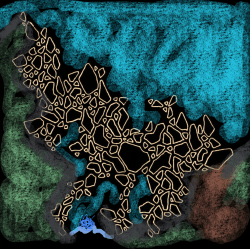
    Simple map of 100s of islands in a sea with a large waterfall in the south and mountains to the south and south east.

    What if a few of those islands floated like the bog-island of Chippewa?

    Rather than be moved by motorboat, they were moved by water elementals during the Age of Myths. The largest of these, Reylerel, at the time was the home of a power school of mages that integrated water, animals that live in and along water, and the peoples.

    As the Age was crashing they attempted to flee the city. The school wanted to isolate itself from the riots, to hide the dolphins, elementals, beaver and ducks that worked together to help the Kin survive. Reylerel went adrift, into the Sea of Sheljar.

    Now, thousands of years later the Free City of Sheljar is no longer ruled by the Necromancer. It is regrowing, discovering some of its influence from the Age of Myths. This bog-city isn’t a city of fog and depression, but a city of hope and humanity integrating gobkon teknology, love of animals and the lost magics.

    The leadership knows this is possible. Myth said it happened before, and drifting towards them is the Floating Island of Reylerel. At sea it moves with the swells and storms. The towers and buildings are rundown. Someone is going to need to go to Reylerel and find a way to prevent it from crashing into the docks.

    And that’s how you take a small trending topic on the internet and turn it into an adventure.

    Fediverse Reactions
  • Children of Chorl

    Children of Chorl

    The first Scholar to be discovered was the Necromancer. His works were hard to ignore, as the undead he mistakenly raised thinking he was helping the peoples of Fort Ooshar and Sheljar broke the empire. That built a distrust for newly released magic.

    Sheljar, Telse, Mira, Qin and the other cities near the Everflow and its two rivers.

    This is likely why Chorl attempted to hide. Not only was his work in Transformation often done involuntarily, Chorl wanted to conquer. His goal was to fill the gaps from the Fall of Sheljar, taking over the Western Wildes via his hybrid peoples. For Chorl, in all his evils, was creating new peoples, a combination of humanity and their companions.

    Some chose to be combined, these peoples frequently became his lieutenants and sergeants. Many fled. The breaking of his camps and the deaths of Chorl and his Student Anderson created an opportunity to escape.

    Now, the Children of Chorl exist in mixed pockets of freedom almost always outside of the major towns and cities. They may want vengeance hating Scholars and magic; they may want freedom; they may want to be respected. They are all hybrids in the World of the Everflow.


    Mechanics for the Children of Chorl

    To play a Child of Chorl in the World of the Everflow select a hybrid species/race. There’s a long list of them available in DnD Beyond now, thanks to Wizards of the Coast adding the Humblewood setting.

    Though none of the core species for 2014 or 2024 D&D are Children of Chorl the current list from official products includes;

    Aarakocra, centaur, harengon, kenku, lizardfolk, minotaur, satyr, shifter, tabaxi, tortle, giff, hadozee, owlin, leonin, loxodon, locathah, or grung.

    Players at my table can also use those from Humblewood;

    Cervan, corvum, gallus, hedge, jerbeen, luma, mapach, raptor, strig or vulpin.

    Then select a feat or bonded companion. Though all Children of Chorl were a goliath, halfling or human combined with a bonded companion, that doesn’t mean that they didn’t have more than one companion.

    Decide what the character was before they were melded. They should generally be someone from the West. They can be someone who volunteered or not, that’s up to you.

    Their background and class represent what they were before. How they present to the world now is similar to the X-Men.

  • Lore 24: Oath of Free Sheljar

    Lore 24: Oath of Free Sheljar

    All of the campaigns that have taken place win the World of the Everflow have focused on tracking down the various Lorebooks, with each group having other side quests, generally towards making the world for the common peoples of the Lands of the Six Kingdoms.

    They’ve run counter to the Proctors, an evil faction that is trying to control knowledge of magic, and rogue Scholars who are spreading knowledge of magic in order to control people. Necromancy and Transformation are the ones most counter to traditional D&D goodness.

    The only other super-natural organization is the Orthodox Church of Quar. The Quarites control access to the Everflow and a massive merchant endeavor with their churches also working as trade posts and shops for what are in game terms healing potions.

    This world has no equal to the Factions of tradition D&D, or the Knights of the Round Table, or Templars or other super-national knightly orders. No one has wanted to be in one.

    But if a player wanted to play a character with these kinds of ideals and/or oaths, we’d talk about how it would fit. Knowing my player base the inspiration would be the Free City of Sheljar, the egalitarian re-founding of Sheljar after the early campaigns purged the Necromancer, his agents of undeath and the Tunneling Nightmares (they’ll be the subject of a future Lore 24).

    Based off the players and characters that founded the Free City such an idealistic organization would look similar to the Harpers, with a dash of de oppresso liber and a side of asymmetric organization.

    • Determination for all peoples Kin, Ken, Kon and any who think.
    • Share knowledge, so all in the world may live better lives.
    • Defend those that cannot defend themselves and their companions
    • Judge behavior, not the companion, the nationality or the faith
    • Recognize successes at spreading the word of a Free Shejar and Free Everflow

    Like the oaths of D&D paladins, these ideals within the oath are aspirational. They aren’t to be perscriptive.

    A player wanting to be part of this order wouldn’t necessarily pledge to sergeant or knight. They wouldn’t need to swear fealty to the current Mayor of Sheljar (Samul). The order would rise because the oath is a bit viral — it’s one that encourages heroic actions and fulfilling quests.

    A band could be one halfling and her dog, or an entire airxip of goblins, or an adventuring party, or three elves visiting the Everflow that abandon their fey pacts, or a group of Mehmdians, or a village near Telse, or a tribe in Crinth. A band inspired by the ideals of Free Sheljar aren’t sworn to them, in fact the current governance of Kirtin-on-the-Lake is inspired by Sheljar, but free from them.

    That’s the knightly order I would make if I were to make a knightly order.

  • Lore 24: Mijdaf, the paddler

    Lore 24: Mijdaf, the paddler

    One of the great parts of Dungeons & Dragons is the impromptu nature of it all. When you’re at the table, especially for a homebrew campaign, things just happen. The participants riff off of each other and a story is created that shouldn’t exist and can never exist again. It is a moment in time. Mijdaf was born in one such moment recently.

    Mijdaf, the paddler

    Mijdaf is an NPC in the current campaign. He started because the group needed transportation up the river from their neighborhood to one on the very edges of urbanity.

    Me: There’s a barge pulled along the ropes on the side of the river.

    The PCs: That seems slow.

    Me: There’s also a paddleboat operated by a goliath.

    The PCs: We take that.

    That’s how a desert goliath living in the largest city of the region started to grow into relevance in the game. But at this point he’s just a ferryman in a boat. Sure, he’s huge and can paddle upriver faster than those humans can pull themselves, but he’s not yet unique.

    PCs: What kind of birds does he have?

    Me: Four seagulls that mostly rest on a branching perch above his head. He asks where your companions are.

    PCs: We’re trying to get a new one for Lauray. Do you know a good breeder?

    As Mijdaf I talk about two options and why he has one that he prefers. It’s one that doesn’t recognize the current government. Mijdaf starts talking about the history of the region that connects to an artisan that they’d met in the previous session.

    They riff off of this, pulling more information from the goliath. It’s interactive at this point. They roll very well. I start playing into Mijdaf being willing to talk, constantly. Soon the PCs figure out that the reason that Mijdaf was available is because no locals will ride in his boat.

    He’s not just a talker — he’s a conspiracy theorist.

    Mijdaf pulls out a slate with tangential connections between various politicians, professors and military leaders. He keeps going.

    At the table this was great. The players with me that day were smiling, nodding and laughing. The total scene may have been 10 minutes. There were some social dice rolls and a lot of me as the DM picking up on table clues to see what the group was enjoying and emphasizing that.

    And then Mijdaf reached the destination, dropping them off. He and they never expected to see each other again.

    A day later in game time the group needs to get back from the nearly rural neighborhood to their home base deep in the port city. They recognize a paddleboat, but don’t see Mijdaf. They steal the boat.

    That’s how Mijdaf, the paddler, went from a simple single scene NPC into a character with purpose, gaming joy, and just possibly a problem for the future.

  • Lore 24: School of Herbimancy

    Lore 24: School of Herbimancy

    Within the World of the Everflow magic is relatively new, well besides the Everflow’s healing power and ability to flow in two directions and the powerful bond between beast and Kin. In the current Proctors of Song and Book magic returned ~27 years ago. First that was via the Born Generation when over a period of a year every child of Kin came of age knowing a single cantrip. About 7 years ago the Lorebook of Divination was found and over the following years, magic started to spread with the realization that there were 17 or so Lorebooks scattered across the lands.

    The current campaign takes place in Sas Rurulit, where the Proctors are attempting to collect two Lorebooks. But the ingenious groups that control the Lorebooks down in this land broke them up. The Lorebook of the Book are people who cast directly from books and scrolls.

    These peoples are manifesting magic at various colleges. The college of metallurgy used every fire and electricity spell to forge metals. The college of hydrology was water and air spells, with a bit of illusion. The Proctors (PCs) have essentially destroyed these two schools ability to function by either capturing or damaging the master books there.

    In the last session they visited a public park that is also the School of Herbimancy.

    Photo by Chris F on Pexels.com

    School of Herbimancy

    Unlike traditional D&D approaches to herbs, the School of Herbimancy isn’t about ingesting herbs in some fashion to gain magical effects. Instead, the plants themselves are the magic.

    For example, the paths in the park were softly lit at night via the glowing flowers of a particular plant (a version of Dancing Lights). Maybe the smell of burning needles from a deciduous tree heals (Healing Spirit). Fallen branches from a tree are a magical staff (Shillelagh). Within Sas Rurulit, this school’s magic is artifice meets druid — the plants are simultaneously technology and magical.

    The group failed a series of checks, one with a natural 1, so they don’t know the professor in charge of the school. Instead, they got the name of the banker financing the project. A way to turn a nat 1 into a meaningful failure!

    They also didn’t quite figure out that the seed room may be the equal of a scroll room or library at the other schools they’ve raided (some read this site and it would be a natural conclusion for the characters to reach after fleeing the fires they set to cover their raid).

    I’m doing Lore 24, an attempt to write small lore elements daily in the year 2024. Each element will be something that’s come up in play or will come up in play within my homebrew World of the Everflow — there will be actionable threads for PCs to grab onto and advance the story.

  • Office Space | Dungeon 23

    Office Space | Dungeon 23

    Tucked in the back corner of the underground portion of the Temple of the Lords of the End is an office space. The last dual head clergy were two halfings, so the office has two halfing-sized desks with chairs. The chamber is packed with bookshelves, cabinets, decorative wall coverings and, like the main chamber has some damage from a Tunneling Nightmare.

    There are also a couple secret doors.

    1 – This secret door (DC 15) is to a small safe that contains gems and ingots. The interior is free from dust and it looks as if one ingot is new (DC 10, History or Culture(Sheljar).

    2 – One of the bookcases has a book-handle secret door system. It can be found with a DC 20 check. Behind that case is access to the alcove to one of Sheljar’s former ruling families, one that dedicated itself to Oun and Obscon rather than Quar. That chamber no longer has any remains.

    From Dungeon Scrawl

    We’re nearly done with the Temple of the Lords of the End. These two gods have a five chamber space that will be covered over three total entries. At this point there have been no monsters, but several hints that the Tunneling Nightmares, supposedly gone for several years, are active once again.

    Also, the remains that should be around are not.

    Maybe the death cult and the Necromancer were working together.

    I’m doing Lore 24, an attempt to write small lore elements daily in the year 2024. Each element will be something that’s come up in play or will come up in play within my homebrew World of the Everflow — there will be actionable threads for PCs to grab onto and advance the story.

  • Catacombs of the Lords of the End | Dungeon 23

    Catacombs of the Lords of the End | Dungeon 23

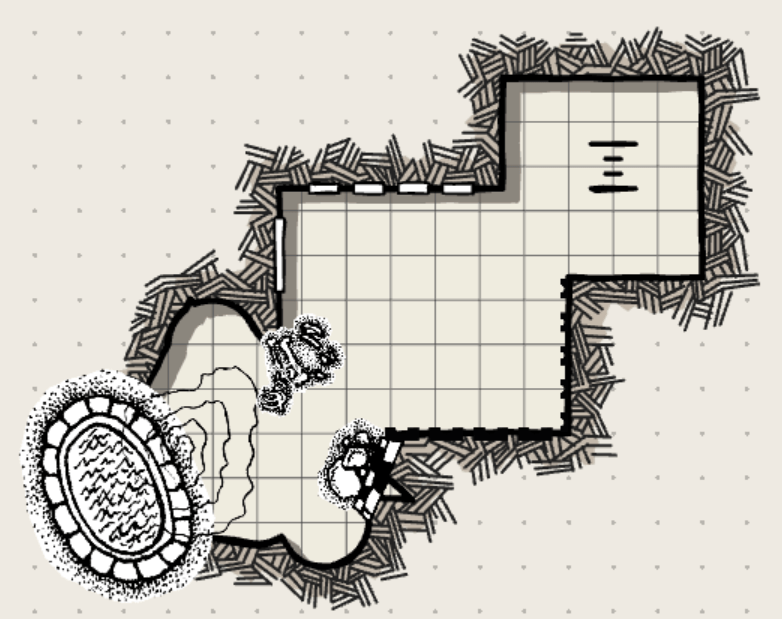
    After the intrepid explorers find the formerly sealed secret door they descend down into a small chamber using a ladder. That chamber is connected to a catacomb with 36 remaining alcoves for remains, four small doors to private burial chambers and a double door.

    The walls weep. Now somewhat below the waterline of the bog-city of Sheljar there is a heavy amount of moisture, plus the southwest corner is open to the brackish waters of the area. Outside of the open pool are a large pile of bones. It is clear that the opening is natural, not manmade.

    Created using Dungeon Scrawl.

    Possible learnings

    Intelligence checks attempting to understand what could make such a large opening could use Nature, History, Culture (Sheljar) to understand that damage was done by a Tunneling Nightmare (DC 15).

    Intelligence checks attempting to understand the alcoves and small doors could use Religion, Culture (Sheljar) to understand that the small doors are for former leadership of Sheljar (DC 10).

    Inspecting the bones using Survival or Perception would find that they are recent to the area, not covered in dust (DC 10) and there are now 4 skeletons attacking the group.

    Complications

    If 50% of the group takes enough damage to fall unconscious making death saves the roar of a Tunneling Nightmare echoes, partially muffled by the water.

    I’m doing Lore 24, an attempt to write small lore elements daily in the year 2024. Each element will be something that’s come up in play or will come up in play within my homebrew World of the Everflow — there will be actionable threads for PCs to grab onto and advance the story.

  • Temple of Oun and Obscon, the Lords of the End | Dungeon 23

    Temple of Oun and Obscon, the Lords of the End | Dungeon 23

    After the quick, safe ride on the sky-cable, you arrive at the top of a small tower. On the isle with the City Center this temple was abandoned when all of Sheljar turned their backs upon Oun and Obscon. These twin gods of death, endings, and darkness were rejected when the dead started to walk the earth again.

    The gondola stops atop the pillar shape of the temple, in a haphazard wooden frame, with large hole knocked out of the roof.

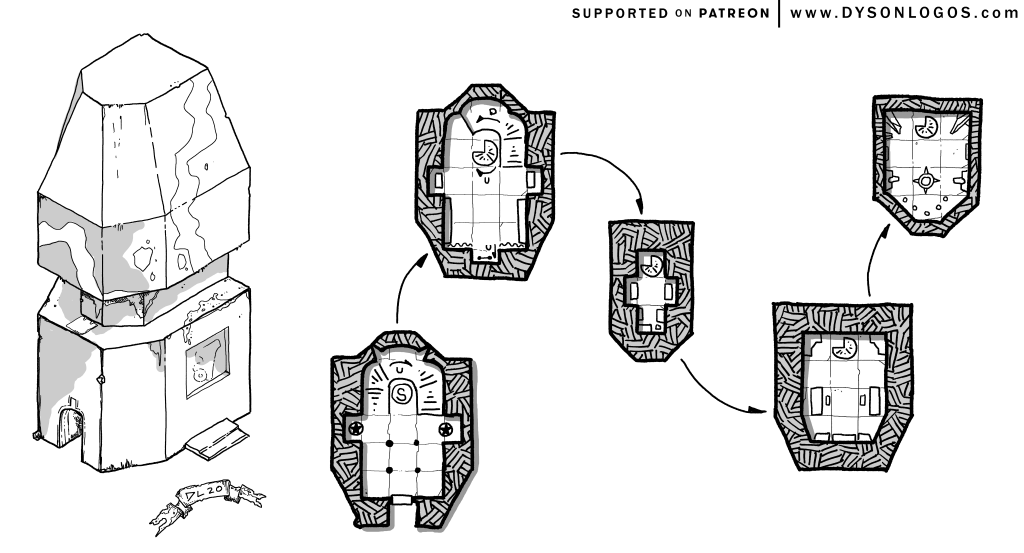
    Map by Dyson Logos, released as part of his commercially available project.

    This narrow temple is cramped for hobgoblins, mulgoblins, goliath and large animals. These tight turns in the cold stone pass quickly as most try to exit the dark temple to dark powers as fast as they can. Though the Necromancer had nothing to do with Oun and Obscon the stench of death is too strong.

    On the ground floor a search can result in finding the sealed secret door with an Intelligence check (DC 18). Intelligence, Culture (Sheljar), Religion are proficiencies that may apply if the characters act in ways that would connect them.

    That secret door is sealed tight with iron bands. A Strength check (DC 20) can break through. Athletics and certain tools will help open it. Magic could be used as well.

    If there is a desire to see how long that secret door has been sealed those that succeeded on the various checks would know that the seal is 25 years old, just as the Necromancer was coming to power. Is there a connection? Why not open the door and find out?

    Learn more about the Faiths of the Six Kingdoms here.

    I’m doing Lore 24, an attempt to write small lore elements daily in the year 2024. Each element will be something that’s come up in play or will come up in play within my homebrew World of the Everflow — there will be actionable threads for PCs to grab onto and advance the story.

  • First Sky-cable of Sheljar

    First Sky-cable of Sheljar

    When the goblins and the Lorebook Hunters decided to make Sheljar into a Free City, where all thinking peoples were respectedm there was a vast, several mile separation between the suburbs and caves that the goblins discovered and the former City Center with its library, temples, city hall and palace.

    The First Sky-cable was constructed to connect these places without worry about bridges, or Tunneling Nightmares, or frightening island of zombies. Now it is the most travelled sky-cable. The gondola rides high, so high that its towers peak above the frequent fogs.

    So high the weather is different.

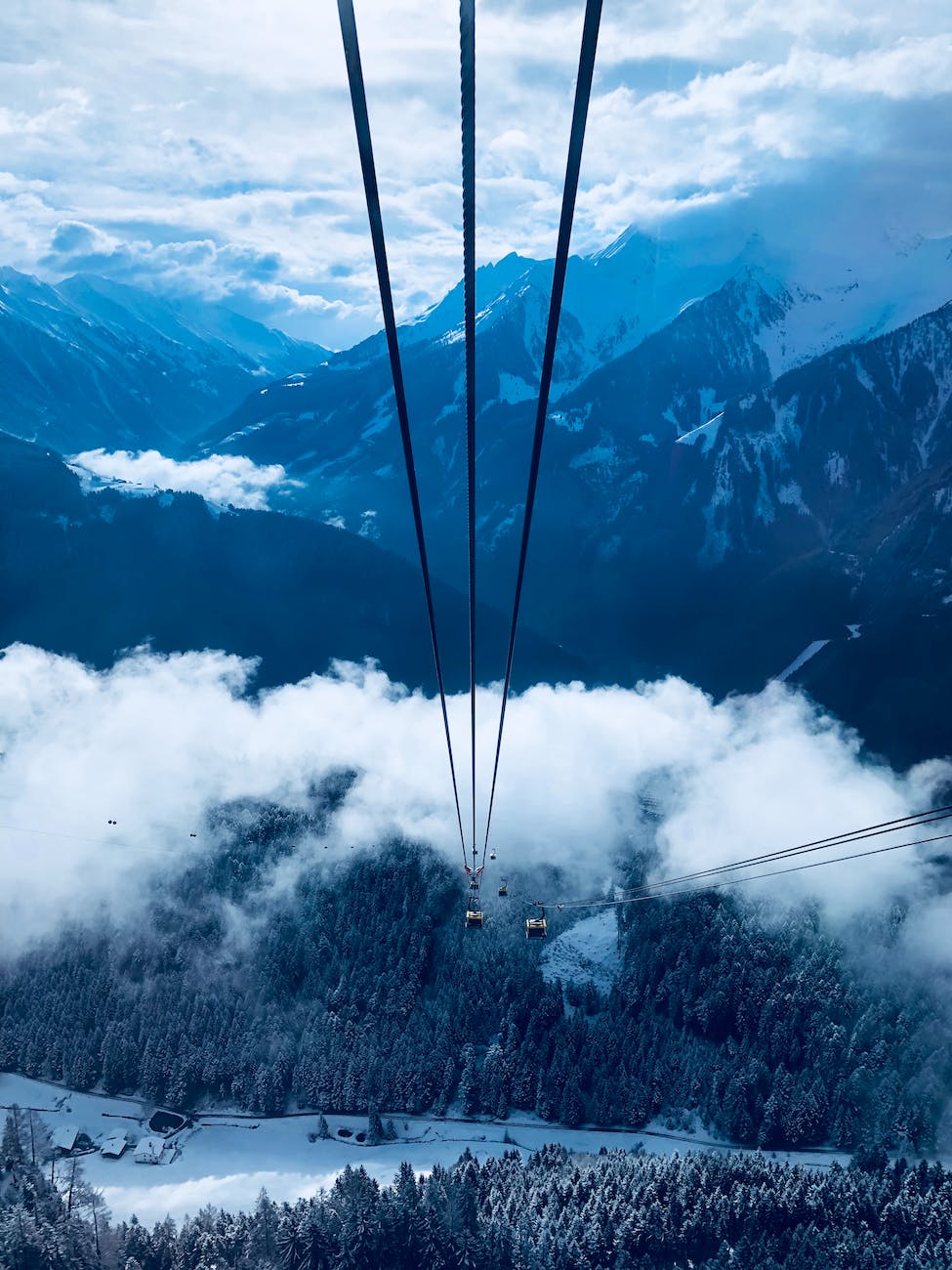
    Photo by Constantin on Pexels.com. Gondola image for example. It doesn’t look exactly like this.

    As the players ride this sky-cable gondola they are in their first “hallway.” This path is dangerous. They are in a space where weather is different. There are creatures that may threaten them. This fastest route to the City Center may not be the shortcut they expected.

    Hazards

    Roll 2d4 about halfway through the journey in the sky.

    2. Uninvited guest — There is someone aboard the gondola with the party. The illusioned elf works for the Proctors of Grace. It casts Detect Magic while Invisible. If it detect magic it attacks. Use the stat block for the Evoker Wizard if the party is in Tier 2. If they are only Tier 1 use the Evil Mage.

    3. Frayed cable — The character with the highest Passive Investigation notices the cable is frayed. The group will need to discover a way to get the gondola to the next tower 100′ away or fix the cable. Tinker’s Tools, Vehicles (air), Vehicles (water) offer some solutions. The DC should be 15. If no one succeeds in fixing the cable and it does break there are rudimentary parachutes that reduce the falling damage to one half on a successful Dexterity save of 10. They are 60′ in the air.

    4. High winds — The gondola shakes violently. Each character should make a Strength saving throw (DC 13) or take 2d6 HP of damage and fall prone. Those that save take half damage and suffer no other effects. This is frightening but should have little impact on their ability to travel.

    5. Freezing rain — Though it was a moderate day beneath the fogs there is freezing rain up in the sky. Each character suffers 3d6 damage. A successful constitution saving throw (DC 10) results in half damage.

    6. Isle of horrors — With a Wisdom Check of 10 the party makes out a small island in the bog-city that seems to be overtaken by skeletons with a leader on a skeletal boar. This island is not hosting a tower.

    7. What’s that? — 0ff in the distance, at the statue there is a large, white winged creature. An Intelligence Check, DC 20, recognizes it as a white dragon. Ken would role with advantage. Skills that could apply are Culture (Ken), Arcana. A player could convince the DM of other skills being applicable. The dragon does not attack. It lurks, watching.

    8. Sabotage — The group notices the tower they just passed being attacked by group (party size +1) of zombies. If half of the zombies are destroyed the others retreat. The characters start 90′ from the zombies. They are able to stop or reverse the gondola. If the zombies are able to do 65 hit points of damage to the tower (AC 12) the tower falls.

    If they complete the trip they stop at the bell tower of a semi-abandoned temple in the City Center.

    Our intrepid heroes have discovered the the Free City of Sheljar isn’t a place of safety. Sheljar may be a dreamy government of respect for all, it is also a place of undeath, dragons and technology too fragile to survive with not enough people in the city to maintain it.

    I’ll admit these DCs and language probably don’t match the standard D&D style. Today’s Dungeon 23 exercise came up against a my go-to-bed soon deadline.

    I’m doing Lore 24, an attempt to write small lore elements daily in the year 2024. Each element will be something that’s come up in play or will come up in play within my homebrew World of the Everflow — there will be actionable threads for PCs to grab onto and advance the story.

  • Chupmolea Transit Center of Sheljar

    Chupmolea Transit Center of Sheljar

    When the Queen’s Fleet discovered Sheljar they landed in the NW suburbs where the cliffs become hills. There’s a cave system that they originally used to hide their aixips. Now, after the elimination of the Necromancer and the Tunneling Nightmares, their little neighborhood among the hills is a densely populated, for the Free City of Sheljar, space that is a transit hub by sea and sky. Each of the guilds are represented in the many dozen gobkons that have settled in the space.

    The main space where all peoples of the Everflow interact with these goblins, hobgoblins, and mulgobs is the Chupmolea Transit Center of Sheljar. It has space for seafaring vessels, multiple sky gondolla cables and a spire for airxips to dock as well.

    Chupmolea Transit Center of Sheljar

    Made with Canva’s Text to Image. The prompt was a “Leonardo da Vinci inspired transit center with airships, cable car gondollas and greasy smoke stacks.”
    The cable system scene connects the transit center to the Grand Entry of Sheljar.

    Paths

    1. A cable car gondola to the Grand Entry to the Free City of Sheljar.
    2. A harbor with regular small ferry service to the City Center.
    3. A cable car gondola to the City Center.
    4. Exit to the Chupmolea Square, the main plaza in the goblin suburb. There are hills to the Western Wildes beyond the plaza.
    5. A high, arcing bridge to a tiny island now occupied by a dwarven family.
    6. Swyns café.

    Peoples

    Chupmolea – Grand Mistress of cables, she rode with the Queen’s Fleet as part of a minor house. Her quick thought to connect the bog-city via sky-cable gondola earned her two flags. On her left shoulder are now five flags, two from her house and three she earned. She has a hook-spear used to guide gondolas to their spaces.

    Swyn – a mulgoblin that discovered the power of coffee. Their café is a center of gossip and a primary spot for non-goblins to meet goblins. Swyn is always in an oilcloth apron (effective as leather armor), has random burn scars from roasting coffee, and carries a small, for them, cup of coffee.

    Blerxa and Patha – two goblins of different guilds, these sisters are arguing over maintaining a connection to the Queen. Blerxa has many more flags on her left shoulder, nearly running out of space. Patha has a single flag for self and one for house.

    Umikdrael Honorfeet – one of the dwarves from the nearby isle. He seems a bit lost and flustered by all the damn noise. He is constantly glancing at his notebook and then at the skyline. There is a lantern drake sitting on his hat.

    Peculiars

    The air reeks of burning tar from tar trees. There are fresh trees in the hills. But here in the city they are burned to power numerous teknikal devices.

    A constant clamor of mekiniks hammers in the background and foreground. There are grinding gears, ratchets, pneumatics and other systems that cause this neighborhood always loud.

    Unfortunately the brackish waters of the bog-city in this area are covered with a thin film of soot and tar.

    I’m doing Lore 24, an attempt to write small lore elements daily in the year 2024. Each element will be something that’s come up in play or will come up in play within my homebrew World of the Everflow — there will be actionable threads for PCs to grab onto and advance the story.