Tag: Playing D&D

  • Queen and Konstruct: A Goblin’s Lyfe

    Queen and Konstruct: A Goblin’s Lyfe

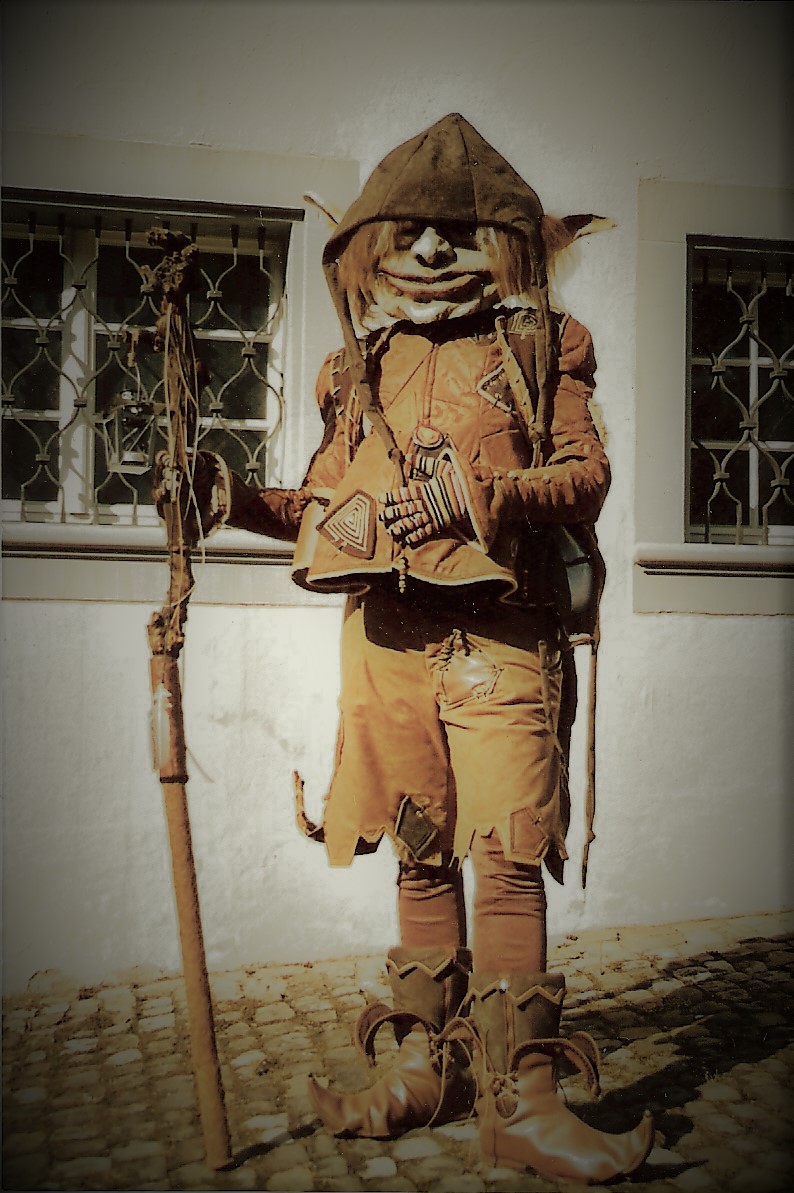
    There are two important things in a goblin’s lyfe. I’m talking about all of us, the gobkon, the hobkon, the mulkon — all of us — our relationship to the Queen and our Guild. This is hard for you humans, with all your divergent nations and cities and faiths and disgusting menagerie animals to understand.

    Goblin
    By creanita design und ausführung by nina saner (CC BY-SA 2.0)

    I’m a printer, part of the Ratxet Guild. My engines run on the power of muls (best!) or whoever else I can hire. The clockwerks give that comforting noise as sheaf and stamp press against each other leaving words behind.

    We’re into gears, mostly. But also some other interesting clockwerks. Frankly, we do better with springs than the Union does. Sure, they’ve the Queens’ Stamp – so we cannot sell to others. In our builds we don’t buy from the Union anymore.

    My first engine was a climbing device. Lean it up against a feral tar-tree and you’ll be able to get to the top on a platform to work that tree with nary your own effort. It was a tough build, because I needed it to be strong enough for a hob. Without a brother there were no hobs to help me. Sis rode atop my shoulders during the entire testing phase.

    At Test it showed a new mechanic for the tar-tree. A Baroness blessed the family via flag and decree. Mother’s standing improved, and the full family took on that glory.

    Now, sister is part of the Airxip Syndicate. They’re relatively new. Taking our bike-props and bladders from the Sisterhood, and the Federation’s tar stacks, the Syndicate built those awesome airxips. I don’t understand her werk. There’s something about steampipes. She’s done well for mother. Her flags came from a Countess, one for her and one for mother. Blerxa left on the First Flight with me.

    I’m Phatha Phioxa Baroness-flagged of the Guild. Sis is Blerxa Phioxa First-Countess Flagged and Many Unfurled of the Syndicate.

    We are what we build and how much the Ladies, may they serve the Queen, reward us for our werks.

    A few more daughters like us and mother could be a Lady. If Blerxa and I hadn’t left for the untamed lands of the Kin Blerx may have earned mother the knighting on her own.

    Our werks are trapped from knowing since we are far from Queen, so I expect mother to have a few more gobkon. Maybe I’ll find out if I go back, not until after I figure out how to use the power of horses in my next werk. They smell, but they are even stronger than mulgobs.

  • Fighter: Conscript, version 1.3

    Fighter: Conscript, version 1.3

    In general I’m fascinated with Tier 1 play. But there’s another trope that I enjoy — the old-timer who retreated from the life of adventure and war, but who for some reason gets called back into it. They’ve done their best to avoid violence. Instead violence seeks them out. The Fighter: Conscript (final name TBD) has seen things. Things no one else should see.

    When they get the call to return to their former life they are no longer concerned with having the best weapon and the best armor. Their wits and experience taught them that any tool can be used for any job.

    Design Goals

    With this subclass the desire was to build a character who attempted to retire from their life of violence. They still know how to fight, they just stopped. Then, for whatever the cause, they re-entered the realm of warfare. Most often this transition occurs when they are on their farm, in their tavern, working their forge.

    They use the weapons at hand and the armor of peasants, and yet fight like the mightiest warriors. The build should support the use of simple weapons and lesser armors with Strength being the primary stat.

    Fighter: Conscript

    You are a light fighter who once served as a conscript in a standing army or militia. While there you learned the horrors of war. You also learned how to survive. You fought with what was available. Then, the war ended.

    Now, you attempt to forget your past. Your neighbors may look at you as a hero or a villain. That depends on your behavior and their opinion of the forces for which you fought. You go about your days, an expert smith, carpenter, vintner, or other artisan.

    Recently you’ve felt the call. You are duty bound to pick up your sickle, spear, gambeson, and those well-worn boots again. Your people need help, and you are called to serve.

    Tough as Nails

    Starting at third level you may choose to use your Strength bonus to Armor Class rather than Dexterity when wearing any light armor or medium armor.

    Plowshares into Swords

    At third level you gain the following abilities as a reflection of your life after service.

    • You are proficient in improvised weapons.
    • When using simple or and improvised weapons you gain +1 to damage on a successful attack.
    • You gain proficiency in an Artisan’s Tool. If you are already proficient in an Artisan’s Tool you may instead choose to have expertise in that Tool.
    • When recovering spent ammunition you recover all of it, rather than half.

    Wise Beyond Years

    At seventh level you gain proficiency in Insight and Intimidation. If you already have one or both of these skills you may take any Wisdom skill instead.

    Heart of the Lion

    At tenth level you are noted for refusal to give up the fight. You have advantage on saving throws that would impose the following conditions: Charmed, Exhaustion, Frightened, or Stunned.

    Rally from Defeat

    At 15th level you inspire your teammates. When an ally within 30 feet fails a saving throw that causes damage you may use a reaction to grant them temporary hit points equal to your Fighter level + your Wisdom bonus and they may reroll the saving throw. They must accept the second result. Your ally must be able to hear you. This ability may be used proficiency bonus number of times per long rest.

    Bones of Steel

    At 18th level your Armor Class is adjusted by both your Strength and your Dexterity Bonus. This bonus is not subjected to a limit based on the armor. When you take damage you may use a reaction to spend a Hit Die to recover Hit Points as if you were taking a short rest.

  • Uprising & Rebellion in a Magic Setting

    Uprising & Rebellion in a Magic Setting

    Oppressive governments are a staple of genre fiction. From Robin Hood to the Vlad Taltos series, from Thay to any place ruled by a Sorcerer-King in Athas – the tales of tyranny that must be overcome are common.

    An uprising is nearly impossible against these powers though. They have access to magics and personnel that make hiding difficult. Identifying who is in rebellion within a society that has the fantastic equivalent of an NSA, CIA, KGB, etc at the surface level seems easy. Yet, in our modern world with facial recognition and AI-infused communication monitoring there are still those who rise up against injustice.

    The following are how you make certain that a rebellion that starts like this

    Photo by Rene Asmussen on Pexels.com

    doesn’t end up like this?

    Photo by Pixabay on Pexels.com

    Baseline D&D

    There are some tools to help the Dungeons & Dragons themed revolt within the standard rules.

    Illusion Spells

    Everything starts here, really. From something as simple as Disguise Self to the potent Seeming and Mislead the usages are obvious. They must still be stated and reviewed, lest we overlook the obvious.

    Enchantment Spells

    These go hand-in-hand with Illusion. Getting past the guard who recognizes you is key. Having a huge crowd be under Sympathy can turn the entire tide of the movement.

    Rogues and Bards

    These two classes are natural fits for revolution. A College of Whispers Bard can sneak into a castle or manor and learn the secrets of the realm. A College of Glamour will work the nobles The College of Lore will know the History of the peoples, helping define and refine the message of the group, as can Eloquence. The Colleges of Swords and Valor fight among a crowd quite well.

    Every Rogue fits. Every. They’re probably the baseline for your rebellion. Assassins, Tricksters, Masterminds, Inquisitives, Thieves, Swashbucklers, Scouts – the list of rogues involved in uprising reads like a casting call for Hunger Games or Divergent.

    All Classes Can Fit

    • Artificers can build the defenses needed.
    • Barbarians are those enraged by injustice.
    • Clerics are more than the needed healers, but the ministers pushing for the rights of their flock.
    • Fighters can be the thug guarding a raid, or the armored noble who joins the cause.
    • Monks need not be confined to the outsider from another land, but the brethren who know the ancient ways of the nation.
    • Paladins who take their oath to the betterment of the commoner over the ruling class join your uprising.
    • Sorcerers exist in uprising literature often as the targets of a realm that do not like those born to authority.
    • Warlocks may join their pact to gain powers to help their peoples.
    • Wizards are masters of the spells most important to helping the revolution.
    • Druids and Rangers probably take the most work to have them fit the story, but difficulties are not impossibilities.
    by Hartwig HKD (CC BY-ND 2.0) https://flic.kr/p/aDwaAx

    Filling in Gaps via Homebrew

    There are gaps within the common D&D classes, and these won’t be filled by Tasha’s Cauldron of Everything. The literature and other fictions around resistance feature some tropes that are currently difficult to build in the base rules.

    Each of the following subclasses is a work in progress. Some are more finished than others.

    Society of Veil and Shadow: Rogue

    The Society of Veil and Shadows are a group of rogues dedicated to obscuring and protecting their guild from spies — both arcane and mundane. While able to contribute to the uprising’s success via sneak attacks and other clandestine abilities their true power is their ability to cast a few spells, most of which help keep the rebellion secret.

    Society of Veil and Shadow

    Way of the Frayed Knot: Monk

    The Way of the Frayed Knot is a Monk subclass that attempts to feature some Western fantasy tropes. The most common of these is Friar Tuck from Robin Hood, but there are other studious, religious types that fought alongside rogues and pirates.

    Way of the Frayed Knot

    The Way of Mercy in Tasha’s may be close enough that my own version gets retired.

    Conscript: Fighter

    An old-timer who retreated from the life of adventure and war, but who for some reason gets called back into it. They’ve done their best to avoid violence. Instead violence seeks them out. The Fighter: Conscript (final name TBD) has seen things. Things no one else should see.

    When they get the call to return to their former life they are no longer concerned with having the best weapon and the best armor. Their wits and experience taught them that any tool can be used for any job.

    Conscript

    Propagandist: Rogue

    You rose from the underbelly of empire to demand a better life for all. Your pamphlets and speeches can inspire hope, or fear. Whether from the soapbox or via pamphlet your proclamations turn the tides of rebellion.

    Propagandist

    Still to Come – Circle of Sewers: Druid

    They come from the urchins and gangs, getting to know the vermin of civilization. Simultaneously they serve the people and the animals that run the streets of a city. Able to help feed and heal those in need, the Sewers Druid is equally at home within a gang of thieves as they are a swarm of rats.

    How would you run a D&D campaign that focuses on rebelling against a power much mightier than the player-characters? What tools would you use to rise against The White Witch, or The Union, or the Burgue?

    Fediverse Reactions
  • Community Character – Tatiana Riverhopper

    Community Character – Tatiana Riverhopper

    One of the absolute amazing powers of Dungeons & Dragons is the ability to tell stories that you couldn’t tell by yourself. Whether you play at a table of 2, or 4, or 8 there will be ideas brought forth that surprise you. Communal storytelling by the DM and players creates options and opportunities that a single author would miss or gloss over.

    The additional experiences and diversity of the group interact to create tales of wonder. This is a large part of why I enjoy D&D. Through the power of social media there is an opportunity to mimic this by using polls to guide the character creation process.

    Asking others to help build a character gets you out of potential ruts and tropes, or embeds those tropes even further into your future PC or NPC. In the end of the process you come up with a character that is amalgam of not just your own experiences, but of the near infinite stories available via social media.

    Tatiana Riverhopper

    The full creation process can be viewed in the Twitter thread.

    Tatiana started with “this character uses a sling.” While everything built off that, rather than build through the explicit creation system as outlined in the Player’s Handbook, instead the prompts were chosen in a more narrative fashion.

    The various choices informed attribute distribution, race, class, background, spells, and skills. Riverhopper was built in order to create an Adventurer’s League character in case someone wanted to jump onto the Yawning Portal and just play.

    Using personality seeds for the choices meant that we have a prankster who left their hometown looking for stories to tell (Bard) and gold to acquire (Criminal). You can find her in alehouses taking out some pocket cheese as she plans her next bit of mischief.

    She’s not great remembering names, even though she’ll always remember you – just be something not a name. She keeps a small notebook and quill with her, constantly taking notes in a delicate hand in code that most do not know.

    In combat Tatiana is likely to use Heroism and Bardic Inspiration to help her allies as she lurks back slinging stones at the enemy. Prone to rash decisions, Riverhopper will use a trick of the mind or hand to get herself out of trouble. The loveable Halfling is best in a support and face role.

  • Coffee Gear – a 5e D&D Tool

    Coffee Gear – a 5e D&D Tool

    Everyone needs a good pick-me-up. The studious wizard, the pickpocket, the noble, and the farmer all can take advantage of the boost of energy whether the beans are from far-off mountains or nearby hills. Adventurers aren’t on standard sleep schedules so the not-quite-magical bean roaster and brewer is quite helpful in the wildes, caverns, dungeons, and seas of any world.

    Components: Coffee gear includes a pound of beans, 2 small spoons, 2 small cups, mortar & pestle or small hand grinder, an ibrik or small moka pot, a small rotisserie or pan roaster (can be powered by fire or certain cantrips), spices and sugar.

    Those cantrips that could power the two styles of roasters are: Control Flames, Create Bonfire, Druidcraft, Fire Bolt, Prestidigitation, and Produce Flame.

    In most D&D worlds a pound of green coffee should be priced around 3 gp and available similar to how cloves are in your worldspace.

    Photo by Svetlana Ponomareva on Pexels.com

    Insight: As someone that is in tune with the life of a cafe, coffeehouse, or court you can read the emotions and even pick up rumors spreading through the crowd.

    Example: As the party enters a bar or coffeehouse there is a buzz of conversation. Volgat Emberstone recognizes the conversations, listening in on the chatter around him. The player tells the DM that they are attempting to learn if Crylia the Goblin has been in the area. Per Xanathar’s Guide, as this Insight check is aided by the Tool, the player rolls with Advantage if they are proficient in both Insight and Coffee Gear, using the higher modifier of the two. If they are only proficient in only one of the two, they would use just the higher modifier rolling a single d20.

    Nature: Familiar with the origins of the glorious bean, you have learned about various locales where coffee is grown.

    Example: Marching through Windy Heaven Ridge, Umog sees some wild coffee. The player is wondering if this area is where they might find the tail feather of the Peryton that the Archmage of Cryssalis Valley hired them to bring to him.

    Remove Exhaustion: During a Short Rest you can roast and prepare a unique beverage for a single humanoid that drinks water. This special beverage can remove one level of Exhaustion, up to level 3 (going from 3 to 2, or 2 to 1, or 1 to no longer exhausted).

    Coffee Gear

    ActivityDC
    Roast Coffee (takes 1 hour)10
    Prepare Typical Beverage (takes 10 minutes)10
    Understand The Hills, Mountains Where Beans Grow15
    Discern Emotions, Learn Rumors In Coffeehouse15
    Remove Exhaustion20
    Photo by Tom Swinnen on Pexels.com