I went and sponsored a soccer team. It’s a pub league team with several friends I met through Sounders soccer. Rather than advertise my soccer blog they all know about already I put the logo for Full Moon Storytelling on their kits. And then I offered to make any of them an Adventurer’s League legal character that represents some of their favorite soccer players and themselves.
A character sheet in Dungeons & Dragons is a story told in short hand.
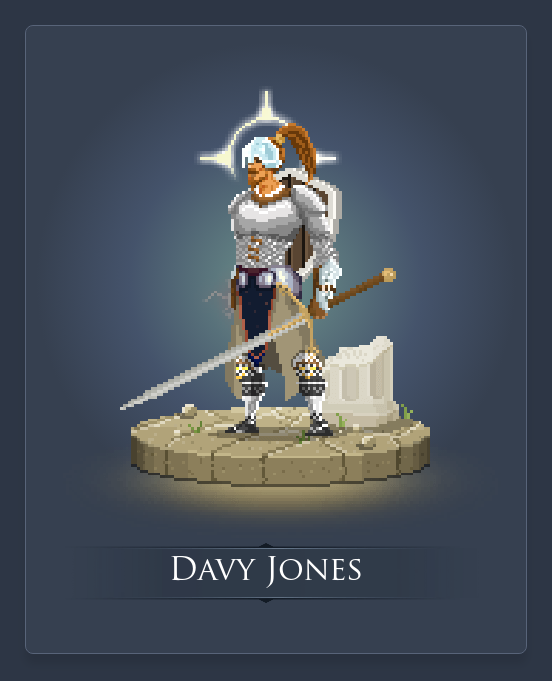
Here’s the story I was trying to tell with Davy Jones — the name on the back of one of the players’ shirts. I didn’t look up the real players to build these. I did use their soccer-name as inspiration.
The soccer players provided in the prompt questions were Fredy Montero, DeAndre Yedlin, Zlatan. In some of the prompts there were references to Jessica Jones and Ljósálfar.
D&D is an imperfect way to represent these things. My attempts here are to capture the vibes of a potent showperson, a striker from distance and a stout defender. An Aasimar is more similar to the light elves of Nordic legend than the current version of D&D, plus that helps add more magic to Davy Jones — Zlatan has to have magic, so does Fredy “Golden God” Montero.
It was Fredy that helped the lean towards Paladin, as well as the Jessica Jones mention. Jones helped the decision towards Oath of Vengeance. Having Compelled Duel was another touch point towards Zlatan.
With DeAndre Yedlin still to be incorporated the Background choice was obvious — Folk Hero. Yedlin was the first MLS Sounder to rise from the Academy, the first to play in the World Cup because of their performance as a Sounder and the first to be sold to Europe. He’s a legend in his home town, and so is Davy Jones.
Each skill, weapon, spell is chosen to emphasize the combination of mystical striker, bewitching technique and the willingness to be a stout defender.
Earlier this week Dungeons & Dragons held a “direct.” These events are about announcing new product. It was a bit odd to see a D&D Direct already, since the full slate of hardback books for D&D is already known. So what did Wizards of the Coast show the fans?
A lot, much of it not related to the game of D&D, but to the brand of D&D.
Hasbro March Monster Madness – new toys and stuffed animals with D&D themes are fine. I’ll probably get one or two (Kristin you didn’t read this)
New Life-Size D&D Figures from Wizkids – I’ll probably get one of these too.
R.A. Salvatore on Drizzt and a Neverwinter Module – The Neverwinter MMO is starting to feel like forever winter. The staying power of the game is impressive
D&D Play Events at Local Game Stores – I like this because FLGS need more support than ever, but also because it helps new people discover the game.
I love adding new people to D&D.
It makes me feel good knowing that this once niche hobby where I was constantly mocked and derided is now popular.
More important than me feeling good is that new players mean new stories.
More players = more stories
I can’t tell you all of my stories, let alone tell you everyone else’s story.
The only route to more stories is more players. By finding new people the original, the mix and the remix at each table is amplified. Playing with the same people all the time is a great way to retell their stories. But the power of life, the power of roleplaying games is story — big, fat, emotionally loaded stories from all the varieties of people in the world.
Story creep is always better than power creep.
That’s why Tasha’s was good. That’s why Radiant Citadel is excellent.
Learning D&D can be hard. There’s no hiding from that. Finding ways to teach new players, especially those not joining a current table is the hardest thing facing any RPG.
This is a brilliant onboarding portal that addresses the most common question I get from the now-hundreds of people who have asked me about Dungeons & Dragons “Where do I start?”
You start at PlayDnD.com. It starts with an intro video.
The Starter Set of course!
But maybe those five characters aren’t right for you. PlayDnD has 11 pregenerated characters. Clicking on those pulls up a fully filled out page on D&D Beyond with a video tour of the character page!
There’s also three adventures, for free!
Lost Mines of Phandelver (which is about to have another sequel, this time in hardback, later this year). This is a mini-campaign
Frozen Sick is a first level adventure
Prisoner 13 is a multi-session adventure set in the prison Revel’s End. Revel’s End is part of the Honor Among Thieves, part of Rime of the Frostmaiden (and co-developed by John Francis Daley who co-wrote and co-directed Honor Among Thieves) and part of Keys from the Golden Vault
The first two can be run by people only semi-familiar with D&D and other fantasy tropes. Prisoner 13 is better for a more familiar DM.
Maybe you need help building a your own character? There’s guide to that.
After that is a bundle to get the Dragons of Strormwreck Isle in both digital and physical at the same time.
There’s a final carousel of clickthroughs that includes ads for D&D Beyond, the D&D Discord, and another item that makes me very happy — help finding your local gaming store.
Play D&D and discover stories of heroism, of diversity, of found family. It just got a lot easier.
Similar to the classic books Choose Your Own Adventure, Before the Storm starts a single character on their path to becoming a hero. It uses two to three options at each path, connects those choices to how the game of Dungeons & Dragons runs, and then rolls a d20 to see if you succeed or not.
There are five different characters, which seem to be the same options as the pre-generated characters for the current Starter Set – Dragons of Stormwreck Isle (at your local game store or DnD Beyond).
Weaving a familiar and simple pick-your-path story with the D&D mechanics is an excellent introduction to what D&D is. People unfamiliar with role-playing games should catch on fairly quickly. The cycle of the D&D process is pretty simple.
Action is described
You make a choice
Does it succeed?
What happens next
That fits a simple computer program easily.
What makes role-playing with a real person so much more interesting is that the stopes for Choice and What Next aren’t confined to pre-programmed options. They’re up to the people at the table, together.
What else makes D&D special is that, unlike Before the Storm, is that it captures that idea that a diverse group is vital to succeeding in life. Everyone has different strengths, different weaknesses. By working together your group is more than the sum of its parts.
Before the Storm is strongly recommended for people who think – I want to play Dungeons & Dragons but don’t know how.
The trope that starts nearly every Dungeons & Dragons campaign is “So, you meet in a tavern.” Which is fitting. For most campaigns start with a diverse group of characters who don’t have strong connections throughout the group. They are a cross-cultural, cross-class, cross-Class, cross-everything group that wouldn’t meet at most places in the medieval-Renaissance-ish fantasy world that is D&D.
But the tavern, via the trope, has become a third place. It’s not home (though it often becomes that). It’s not work (though it often becomes that). It’s the place between. And these places between are frequently where subcultures within a society connect.
Various cultures have had different third places. For modern America it is now the coffeeshop and used to be bowling alleys. In the Ottoman Empire in the classical age had its cafes, where philosophy, music and political debate occurred.
In New England during the American Revolution public houses were the gathering point, for many at that time the first place was a co-located home with work and the second were churches.
The Greeks gathered on the steps of temples. Finns and Russians gather in bathhouses.
Sporting venues have been third places, before they became economically stratified. Travelling carnivals and festivals can be a third place.
No matter the type of third place, it tells you a bit about the culture.
Using third places as a character backstory tool
When creating a PC think about the place where you mingled with peoples unlike you. Where did your dwarf first meet an elf? Where did your farmer first meet a noble? Where did your follower of Lathander meet an unbeliever?
This decision will help tell you about your own history.
It will connect them to a place and associated behaviors that aren’t mechanics, but are fuel for the social pillar. Their own stories about a trip to watch a great debate between philosophers, a visit to the library, or the type of ale they enjoyed at the pub are stories that add more depth to the shared story that is D&D.
Adventurers have the place where they sleep (a cave, a cove, an inn), the place where they work (dungeons), and the places where they spend time meeting strangers with odd quests. Once they start their adventure they have the third place that was cross-cultural communication when they were growing up and now the place between — and that’s up to the whole party of different peoples.
Using third places as a world building tool
Dungeon Masters generally are more active in creating the world. There are a few ways they can use third places in that world.
Collect each players’ third places in your notes. Give them the opportunity to revisit them in new lands.
Start the campaign at the typical third place for the origin culture of the campaign. “So, you meet on the steps of the temple.”
When the group comes to a new land and looks for their comfortable third place (the tavern) demonstrate how that locale is different from their expectation and what the unfamiliar culture would use as their non-stratified place that welcomes outsiders.
Use maps of abandoned third places to show how different the older ages were from the one in which you campaign.
Have an NPC name-drop their favorite third place. This can show how they are familiar to most of the group, or different. Each NPC can have their own place, they should!
Have two third places in the same town share similarities but still be unique beyond their name. Maybe the Rusty Clam is a working pub and the Silver Nail is for the merchant class — and yet the players are welcomed at both.
These are flavor elements, but flavor is story in D&D. And story is what tables build together, usually because Dungeons and Dragons is now our third place.
Fantasy sports can be a fun way to add depth and cultural to a campaign world. One of my players in Uprising & Rebellion is playing a character from Mehmd and invented the sport of Goltoppa. He adapted some of the cultural touchpoints from the hidden empire, placing them into the common state of the game and has asked for it to be featured in a session soon. The character in question is not a Goltoppa player or coach.
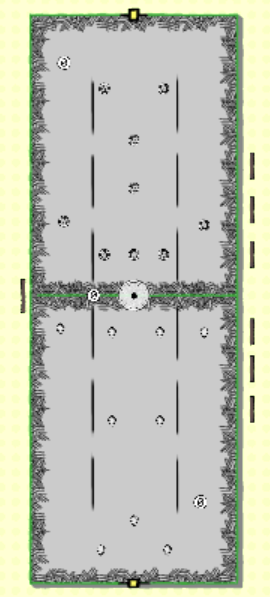
The game is played on an open, flat, dirt field, generally free of rocks & debris, that is 360 feet long by 144 feet wide. The field is split lengthwise down the entirety of the center into 72 feet wide halves, and crosswise at 120 feet intervals. These six resulting areas are marked off with white paint borders. Particularly enterprising/wealthy teams have been known to pay to have the sections magicked to different colors. Straddling the centerline at each end of the playing field is a netted goal, 9 feet wide by 3 feet tall. One narrow end of the field is to be facing North, indicating the “head” of the field. Three referees patrol the playing surface to control the action during the run of play.
Players:
Goltoppa is played by two opposing teams, consisting of 9 starting players on each side. Teams are permitted to ‘dress’ 3 bench players for each contest, to be subbed into the game in the event of injury. Players may not be subbed into the game for strategic reasons or in the event of a player’s expulsion from the contest. A player’s uniform shall consist of a sleeveless tunic, belted at the waist & extending to mid-thigh, in the primary color of one of the six teams currently representing the league’s six social strata: Noble (violet), Military (red), Religious (white), Artisan (gold), Farmer/Fisher (green), Merchant (blue). Note that players are recruited to represent these strata, and need not be members of them. Additionally, players shall wear sandals that wrap up around their calves, with linen padding over their shins. Each team dresses one Left & Right “Slasher,” designated by a black sash that goes diagonally from either left or right shoulder to opposing hip, with the shoulder covered indicating which side of the field they may patrol. Players may wear short pants as well.
Play:
The game is played in two 36 minute halves. At the start of the game, a coin toss determines initial possession, which begins via kicking a ball onto the field from a position to the left of the goal which the possessing team is defending. The ball is traditionally made from a treated cow’s stomach filled with air, or a leather ball of approximately the same size . There are no goalies; all players may attempt to kick the ball toward or away from the goal, or to a teammate. Additionally, each team’s Slashers are allowed to catch the ball on the fly in their hands and run with it to the border of whichever section of the field they currently occupy, at which point they must kick the ball themselves unless trying to place the ball in the opposing goal. A Slasher with possession of the ball may be leg tackled by the opposing team. A successful leg tackle means the Slasher must kick the ball to a teammate (only) from the spot of the tackle. Tackling with one’s arms, striking a Slasher above the waist, or attempting to strip the ball from a Slasher’s hands by a player other than an opposing Slasher is not allowed. A ball that goes out of the field of play results in a change of possession, with the new possessing team kicking the ball into the field of play from the sideline spot where the referees determine the ball crossed out of the field.
Scoring:
A score happens whenever the ball is put into the net during the run of play, A ball kicked into the net scores 2 points; a ball placed into the net by hand scores 5 points.
Penalties:
Rough Play: Arm tackles; deliberate leg tackles of a non-Slasher; headbutts; intentional hands to the face or back of an opponent – Offending player off the field for 3 minutes.
Stripping: An attempt to pull the ball from the hands of a Slasher by a non-Slasher – Offending player off the field for 3 minutes.
Catching: Non-Slasher making deliberate contact with his hands to the ball, especially with an effort to control the ball – Offending player off the field for 2 minutes.
Scooping: Slasher attempting to pick the ball up off the field, rather than catching it on the fly. This includes a ball that bounces before being caught – Offending player off the field for 1 minute.
Offsides: Slasher maintaining possession of the ball beyond the area of the field where he caught it, or crossing from his designated half of the field – Change of possession from the spot; no kick to inbound the ball needed.
Belligerence: Fighting; intentional physical contact/intimidation toward a referee – Offending player ejected.
Playing Goltoppa at the table
There will be a series of contested checks to determine scoring. These will use the Tool Sports: Goltoppa and have a few skills that can connect to them.
My first thought is a way to generate scoring similar to what is described by JayDubTheGamer would be to have five contested checks by half. That’s a lot of rolling, but provides some variety of results and capability of multiple players participating.
Winning a check by 1-5 results in two points. Winning a check by more than 5 results in 5 points. Winning a check by more than 10 results in seven points and winning by 15 or more is good for nine points.
Losing a check by less than 5 results in two points for your own team. Any natural 1 means that you have given up a five-pointer or have committed a foul, rolling their next challenge at Disadvantage. Any natural 20 means that you have scored a five-pointer.
This should generate scores that look a bit like early 20th century American football or current rugby.
Applying skills
Acrobatics and Athletics will be the most used skills, most frequently connecting to Dexterity and Strength. It would also make sense for someone in a coaching position to use Intelligence with one of those and for a character playing the captain to use Charisma.
I would allow up to one role to use Deception in order to get away with a foul. That team would have Advantage on the next check, but if they lose that roll their next roll would be at Disadvantage.
An example:
Violet team
Blue team
Score
13
7
Violet 5: Blue 0
16
20 (natural)
Violet 2: Blue 7
9
15
Violet 0: Blue 5
12
12
Violet 2: Blue 2
4
15
Violet 0: Blue 7
1st half
9 points
21 points
2
9
Violet 0: Blue 5
20 (natural)
7
Violet 12: Blue 0
14
11
Violet 2: Blue 2
18
6
Violet 7: Blue 0
3
9
Violet 0: Blue 5
2nd half
21 points
12 points
FINAL
30 points
33 points
Yes, that’s ten rolls for a non-combat encounter. Which feels like a bit, but the descriptions are at most two sentences, show the shifts in momentum, and feel like watching a sport when including those descriptions especially around the nat 20s.