• Using Feats to expand your setting: Church of Quar

    Using Feats to expand your setting: Church of Quar

    In the new Forgotten Realms books, Strixhaven, 5e Dragonlance and a recent Unearthed Arcana official D&D is using Feat trees/chains. Every published instance so far is a set of two.

    While there are mechanical reasons to have tiered Feats every expression to this point also leans quite heavily into the story elements added. In Strixhaven the feat-taker goes from early student to late in the class. In Dragonlance a squire becomes a knight. In the Realms you are early in a Faction and then a powerful member of it.

    The Feat helps tell the story in ways that a subclass wouldn’t because in all cases the feat has two expressions in Tier 1 available where a subclass gets a single expression. By the end of Tier 2 a subclass gets two expressions while a Feat chain can be up to four. There’s more space for story.

    An initiate becoming an expert is the most common example. The chain (I prefer that to tree as the published versions are two options linked) naturally fit this.

    Let’s explore how a Feat chain could tell a story in my homebrew world by looking at three feats connected to the Church of Quar.

    In the Six Kingdoms of the World of the Everflow the Church of Quar is a hybrid church-healing center-merchant guild. It controls access to the healing waters of the Everflow at the Font of Two Paths in Telse. Their tongue became the common language of the Six Kingdoms because of the strong influence of their healing elixir in a world without magic.

    No faith, no kingdom, no magic school after magic returned to the land has the influence of the Church of Quar. They’re in every town. That does not mean that every town has an Acolyte, a formal role represented by a member of the faith who is becoming a hero.

    The following three feats expand the story of the Church of Quar for heroes (and villains) using the Feat system.


    Acolyte of Quar

    Origin Feat

    You gain the following benefits.

    Cultured. You learn an additional culture (or language).

    Balm of rest. During a Short Rest you create a balm using a Healing Potion that removes one level of exhaustion and grants the creature advantage on a saving throw versus one condition with a save.

    Blessing of the Everflow. When you administer a Healing Potion to a creature they may use a Hit Die to heal as well as gain the benefits from the Healing Potion.


    Minister of Quar

    Feat (prerequisites: Acolyte of Quar, 4th+ level)

    You gain the following benefits.

    +1 to Charisma or Wisdom

    Oratory. You have Advantage when using Influence Action with Indifferent or Friendly peoples with which you share a culture or language (and Hostile creatures who are members of the Church of Quar).

    Lord of Life. You learn the Aid spell and may cast it one time a day without using a spell slot. It becomes a known spell for you.

    Lord of Rivers. You know how to create a Healing Potion (vial of Everflow) with only water and herbs. This lesser potion costs only 5 gp and can be created during a Short Rest. This potion is only half as effective as a standard Healing Potion. Sharing this concept is forbidden.


    Free Minister of Quar

    Feat (prerequisites: Acolyte of Quar, membership in the Reformed Church, 4th+ level)

    You gain the following benefits.

    +1 to Charisma or Constitution

    Rivers and Roads. You learn two cultures or languages and the Religion skill (or another skill if you are already proficient). You have Advantage on Constitution checks brought about by Environmental Effects.

    First Aid: Taking one minute you can grant a Hit Point to a stabilized creature. They are also subjected to Blessings of the Everflow if you have a Healing Potion available.


    Together these dual Feat chains tell the story behind the Orthodox and Reformed Churches of Quar.

    In just the tiniest bits of flavor text you see examples of how two branches of the faith are different, not just in their ability to be heroes, but what is expected from their most ardent believers.

    Where a subclass gains features at 3rd, 6th and 10th level (mostly). Classes have feats at 1st, 4th, 8th, 12th (mostly). By 8th level a member of Quar’s faith could take all three faith feats, going on a journey from being part of a merchant-church to dedicated hedge healer.

    This story doesn’t need to be connected to a class because they aren’t spellcasters. Plus, in the fiction inspiring the game contains people who are faithful without being clerics or druids or paladins.

    Maybe another feat deals with Quars pantheon. After being an Acolyte of Quar the individual is a Devotee to Belsem the Untamed (leaning into animal companionship?) or a Teacher (adherent to Glight becoming an expert at knowing things). These would emphasize branching, which fits the pantheon.

    The other pantheons may start dispersed and then unify (The Siblilngs) or emphasize bonding (Az and Sel) or only be about fellowship (Mehmd’s faith).

    Maybe an aspect of your world is a military organization and feats could be ranks or branches. Does your world lean into magical schools like Strixhaven? A feat chain from underclass, to senior student, to teacher, to dean could work. A setting that anchors the horrors of the environment could use feats as a way to describe various paths to survival (water, shelter, food, community).

    Feats are a discreet, light space that empowers all classes to carry bits of lore that connect to the world mechanically.


    Fediverse reactions
  • Professional failure

    Professional failure

    Professionals fail all the time — in roleplaying games, in elite athletics, in special operations, in life.

    The idea that they shouldn’t miss in a game is built on a foundation of water, not even sand.

    There are still some valid reasons that one wouldn’t roll to hit, but they have nothing to do with professionalism.

    Matt Colville on Mastering Dungeons

    In a recent edition of Mastering Dungeons Matt Colville talked extensively about the business of RPGs. It’s a wonderful listen.

    Something stood out to me though.

    “You’re professionals; you shouldn’t roll to hit.”

    Now, the idea of not rolling to hit is part of Colville’s quite intentional design. I’m certain he’s said it before and will say it again. There are reasons in games to not roll to hit.

    They have nothing to do with the character being a professional.

    Let’s break down the idea of professionals not needing to roll to hit.

    Elite Failure

    Elites fail regularly. They fail when contested. They fail when on their own. Failure at elite levels may not be as common as for us normal people, but it happens.

    This is true for the real, actual elites, not those mere professionals. My personal history is blessed to experience a few elites in fashions that many do not.

    Special operations

    Assigned to 5th Special Forces as a peacetime soldier my Army days were defined by the Quiet Professionals — the Green Berets. Working alongside these masters in warfare I saw failure every single day.

    On the range those trained to be snipers, an uncontested contest in gaming terms, missed. There are reasons for each miss, but missing happened.

    When soldiers, even in highly trained units such as the Special Forces, go to war they miss even more. The human brain does not like to kill things, plus there is chaos all around you. Errors happen. They always will.

    Elite failure isn’t limited to elite warfare.

    High-level sports

    Leaving 5th Group I decided I wanted nothing to do with my high school dreams or hard journalism. I turned to sports. During that era I worked as a producer for the Sonics broadcasting network, baseball’s best postgame show, as an on-air analyst for soccer and founded Sounder at Heart.

    At the field and court level I’ve watched Ichiro, Ken Griffey Jr., Gary Payton, Michael Jordan, Megan Rapinoe, Kasey Keller and many others.

    The list of these Hall of Fame talents failing would be immense.

    But let’s use hard numbers.

    Ichiro is the best contact hitter of the modern era. The ten-time All Star and MVP had a batting average on balls in play forty points higher than his contemporaries, but it was still only .338.

    Jordan’s shooting percentage was just under 50%.

    Now, both of those are contests. What about the best athletes when uncontested? Steph Curry makes only 91% of his free throws.

    It doesn’t matter which sport we consider. Kasey Keller stops 74% of shots he faces. Megan Rapinoe put ~40% of her shots on frame, and scored even fewer of those.

    Failure among the elite is regular and normal. They roll to hit and fail.

    Business

    Pick your favorite business leader and their success rate is higher than average, but whether its Howard Schultz launching a magazine, or Steve Jobs launching NeXT, or Warren Buffet investing in a shoe company, they fail too.

    Gaming reasons to not roll to hit

    So professionals do miss. Elites miss.

    Are there good reasons to not roll to hit? Yes, absolutely, as part of intentional design choices for a style of play that has nothing to do with professionalism of the character

    Hit points vs meat points

    The long standing D&D debate about hit points being more than meat points can be ignored here. Games developing to-hit rolling or direct-to-damage techniques do not need to burden them with Gygax’s decisions.

    Direct-to-damage rolling is excellent when hit points are, as in D&D, a symbol of morale, luck, fortitude, energy and more than merely meat. Since every attempt to physically damage an opponent wears away at those elements you don’t necessarily need to roll to hit. Missing still costs luck, energy, mental health and morale.

    The meat of the opponent can be damaged eventually, even without rolling to hit.

    Speed of play

    Colville did this in MCDM monster design for his 5e books — minions and the like can be hit easily. And then eliminated easily. This speeds up the action at the table and mimics narratives from movies, TV, video games within role playing games. Slicing and dicing through waves of small threats feels great. Having that take only a few moments rather than many minutes is good.

    Additionally in games like Draw Steel, with extensive tactical choices being a goal, eliminating a set of rolling helps speed gameplay up. This is a wise and intentional design choice that amplifies the other intent of bundling morale with meat.

    This supports the designer’s desires for their game — and need not be connected to reality or even lore.

    A wrong justification, with the right idea

    Professionalism in the real-world elite activities includes failure. Even the arts that inspire our gaming include failure. Black Widow misses. Skywalkers miss. Robin Hood misses.

    Designers should embrace failure when missing, because Ichiro, Rapinoe, every special forces soldier, every business leader, every legendary hero misses.

    And when they do design away the miss they should do so with intent that supports their game, no matter what reality and lore suggest. Just as Colville’s done in Draw Steel.

    Fediverse reactions
  • Roleplaying games are stories

    Roleplaying games are stories

    They’re different from novels, short stories, comics, theater, movies, and most other forms of storytelling. That does not remove the tale being told nor the concept of story.

    If anything they are most similar to communal storytelling around a campfire and improv dramas. For the most part roleplaying games are communal events with a group.

    How did I bump into this well-worn debate? Via a recent thread on EN World, the rare bright spot in RPG discourse.

    Let’s talk about “plot”, “story”, and “play to find out.”

    My response there focused mostly on the story and plot aspects, and the power of having more voices (something rare in written fiction, but common in other forms of storytelling).

    There are people who are not good authors, nor good directors, nor good actors who are good roleplayers/gamemasters/etc. By leaning into the ways that community, plot and play-to-find-out work the creation displays, maybe even demands, story emerges.

    This is the Potential of games like D&D.

    Sometimes conventional Western storytelling formats can lean into the things that make the emergent and divergent story that happens in RPGs. This can be magical — because it shows how all story is really a reflection of point of view, or in our hobby — spotlight.

    RPGs-as-story feel messy when considered through a lens of a literature class or mainstream television.

    But, stories are quite messy

    Two people can read the same story, watch the same film, listen to the same podcast and come away with different meanings, see different main plots even.

    A campfire and a full moon

    To me, RPGs are stories in the way that campfire tales are. They involve a lot of wandering, forgotten threads, lack firm outlines and are at their best when the tale is woven through multiple voices providing input.

    Can they be a traditional novel after the campaign? Absolutely! But during the telling of the tale they are similar to writers who don’t edit as they go or a director who over films alternative concepts that aren’t on the script.

    One of the more thrilling things about RPGs is that it is an ensemble cast of both PCs and recurring NPCs. Together they’re important, but the tale and spotlight as to who is most important can easily shift. Use any of them as the point of view to change the story as you understand it. Each can be vital.

    The messiness is the fun part of RPGs as story.

    The messiness is what helps me discover tales I cannot tell on my own. That’s part of the power of the table and broad casts in ensemble stories.

    You think you’ve seen stories like this before, so you can guess what’s going to happen. Who’s important and who isn’t, but that’s because you’re trapped in your POV.
    – later –
    When you file people away as sidekicks you don’t realize their importance to the story, and this story belongs to a lot more people than you think. Where to shelve a book, it’s not a little thing. You’re telling the world what to value. Who to value.

    From The Magicians, Side Effect (S4, E7).

    RPGs are very much like that.

    They remove your assumptions. You don’t know what’s going to happen. The POV constantly shifts and the importance of the broader cast shifts constantly.

    From RPGs-as-Story we learn what and who to value by including others.

  • Protected: RPGs as Natural Disaster Prep

    This content is password-protected. To view it, please enter the password below.

  • The D&D Stranger Things boom is bigger than you think

    The D&D Stranger Things boom is bigger than you think

    This post will not contain spoilers for Season 5 because I haven’t yet watched Season 5 of Stranger Things, though I do know it features more Dungeons & Dragons than Seaons 2-4 combined.

    If you were to go into Target this fall you’d see a massive Stranger Things display somewhere in the store. Part of that display would feature the D&D boxed set Welcome to the Hellfire Club, which is a continuation of Eddie’s D&D campaign. It felt late, because Eddie isn’t part of season 5.

    It was not late.

    Welcome to the Hellfire Club sold out at Target. It sold out on Amazon. A light informal survey of local-to-me stores have it as sold out. The physical boxed set can still be ordered on DnDBeyond.

    Sure, that could be a lack of ambition from Wizards of the Coast by not manufacturing enough of the sets.

    It’s much more likely that the heavy lean back into D&D by Stranger Things Season 5 drove more desire for D&D the game than previous seasons, Critical Role and Baldur’s Gate 3. BG3’s drive of interest into D&D is hard to quantify, but has an extended window over several years.

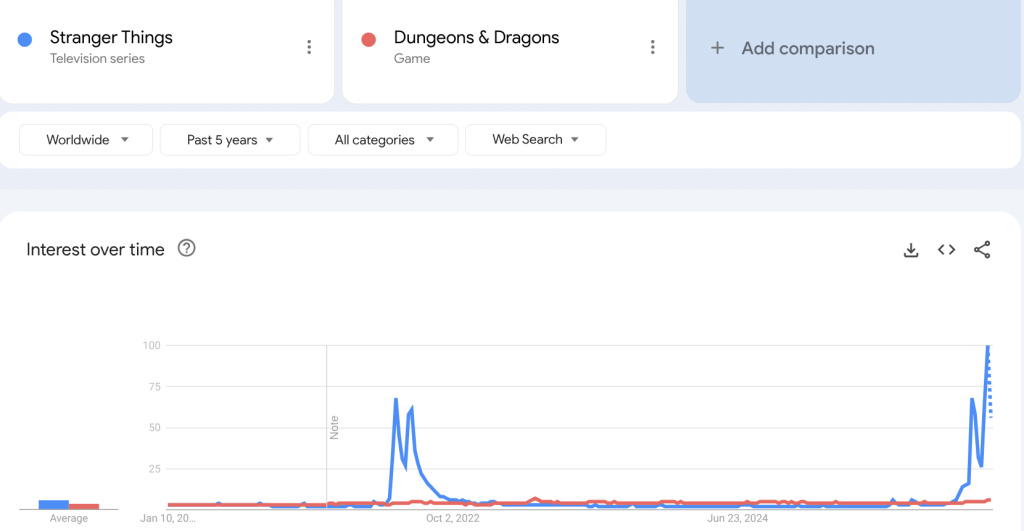
    Google Trends can show you.

    A chart showing the popularity of search for Stranger Things and D&D. The D&D element is tiny. Stranger Things had a big surge in Fall of 2022 and a massive surge in Winter of 2025.

    Search trends for Stranger Things

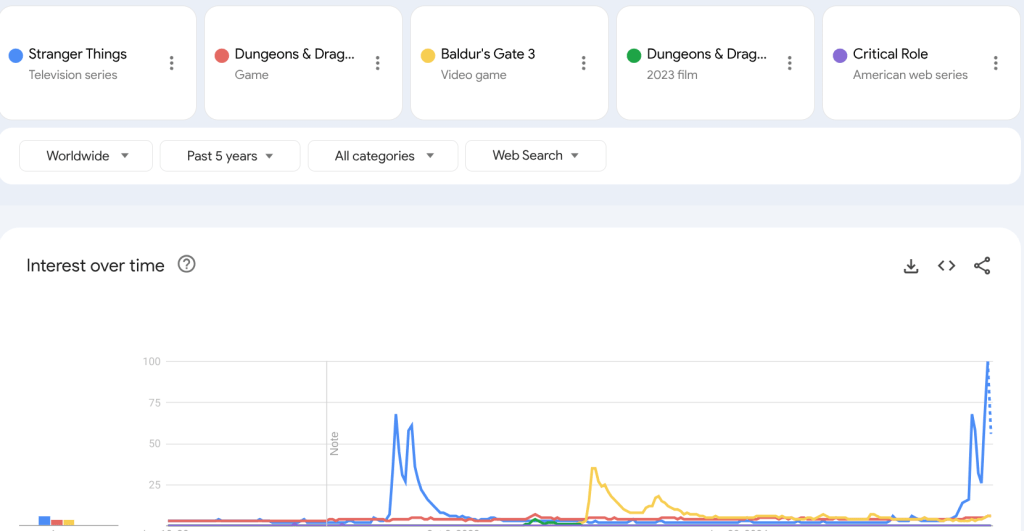
    Here are the four adjacent media and D&D

    Chart showing search trends for Stranger Things, D&D, Baldur's Gate 3, D&D: Honor Among Thieves and Critical Role. The Stranger Things spikes are in Fall of 2022 and Winter 2025. Baldur's Gate 3 spikes in Spring 2023. There are small increases in interest in D&D and Critical Role scattered on the chart.
    Stranger Things is more popular than the others by far.

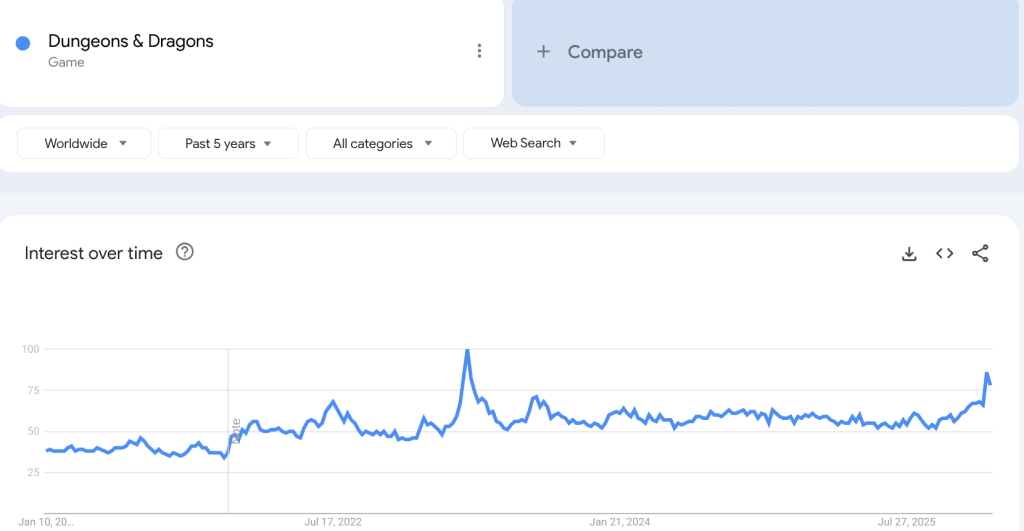
    D&D, the game, had its biggest boom from the movie, but…

    Google trends chart for D&D, the game. It's biggest spike is Spring 2023 when Honor Among Thieves, the D&D movie released. It's next largest spike is from Stranger Things Season 5 and Season 4. BG3 increased it a bit.
    Stranger Things Season 5 nearly matches D&D: Honor Among Thieves

    There’s one major difference — lack of tie-in gaming products.

    Rime of the Frostmaiden contained a single adventure related to the movie. There was a boutique NPC download related to the movie, but nothing like the amazing boxed set Stranger Things got. Baldur’s Gate: Descent into Avernus was barely related to the video game and its release timing was horrible.

    Nothing sold out because of Honor Among Thieves, the best D&D marketing in the history of the game, because D&D wasn’t run as a franchise system with business units failing to talk to each other.

    Both the current starter set and Welcome to the Hellfire Club are selling out.

    What’s that mean for us Dungeon Masters?

    1. Be welcoming to new and returning players.
    2. Reduce house rules when they join you.
    3. Talk about the intent of your table and what type of play you focus on .
    4. Be familiar with the most popular products.
    5. Help teach your current players to DM.
    6. See if local cafes, libraries, schools, pubs, etc need DMs.

    We are responsible for growing this glorious hobby. Thanks to the Creative Commons, various SRDs, the eternal nature of homebrewing and the thousands of other roleplaying games there is always something that’s right for someone.

    Find what’s right for your family, your friends and your community.

    People are interested. It’s up to you to be the reason they stay interested.

    Fediverse reactions
A thin shape of a house with script Kristin Clark inset

Full Moon Storytelling is brought to you by Kristin Clark of Keller-Williams Lake Washington
If you are looking to buy or sell a home in King or Pierce County, Washington support Full Moon Storytelling by supporting Kristin.

She’s my partner in everything I do.