Category: Kin

  • West Thundermoon Trading Post, home the Maltunyns

    West Thundermoon Trading Post, home the Maltunyns

    Traveling the harsh lands of the Ferments? Find everything you need at WEST THUNDERMOON TRADING POST!!! Settled in the foothills of the Thundermoon Mountains a half a day’s ride west of Ourten, WEST THUNDERMOON TRADING POST is the go to location to find all of your hunting and travelling needs.

    Run by the Maltunyn family for generations, they’re knowledge of the local terrain, as well as their selection of only the finest gear will ensure your travels will be safe and comfortable. Or you could pick up some of the finest furs and rations provided by master hunter Velthuria Maltunyn, and her daughter Keesrah. If you need a quick repair, or even an herbal remedy or two, Cay Maltunyn has you covered.

    With the experience of generations, and a deep love of the land and air, the WEST THUNDERMOON TRADING POST is a must for any serious travelers of the Thundermoon Mountains. Visit the WEST THUNDERMOON TRADING POST today!!!

    You can find that brochure throughout the villages and homesteads of the Thundermoon Mountains in The Ferments.

    Keesrah Maltunyn, a human guide and drakewarden ranger with a raven named Crow, is the player character who calls the trading post home.

    The West Thundermoon Trading Post is about two days south by southeast from Orten. The post is on the southerly road towards a desert region. That road runs roughly parallel to the Thundermoon River. In the hills and mountains are a few fishing and hunting families.

    The Location

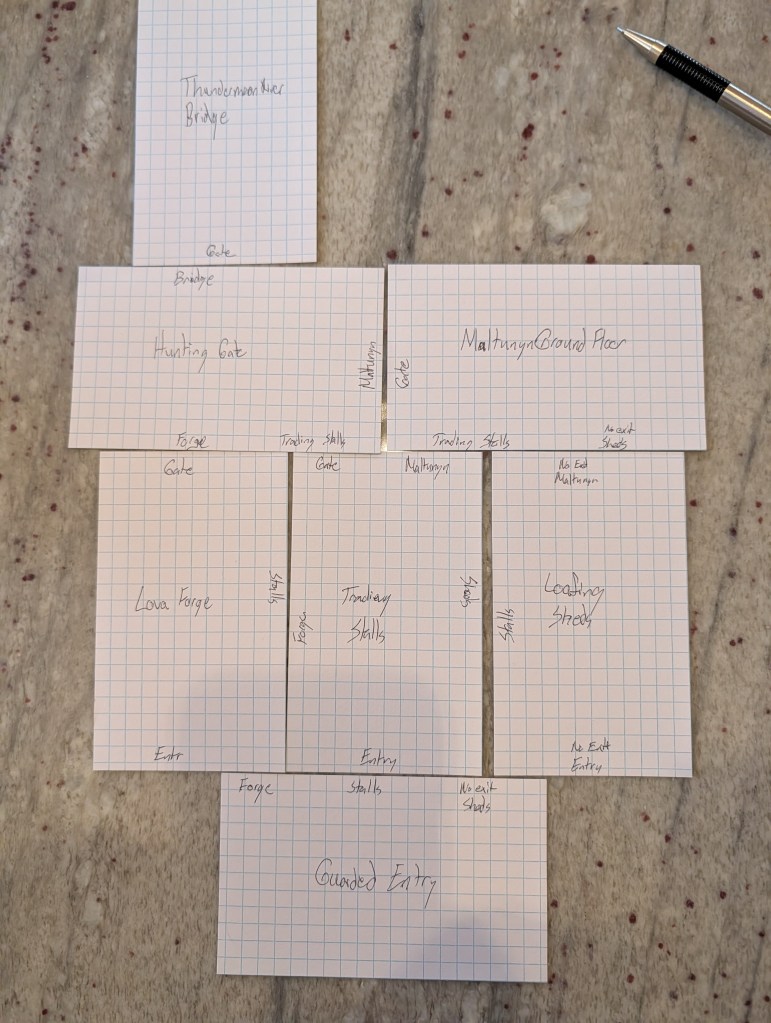
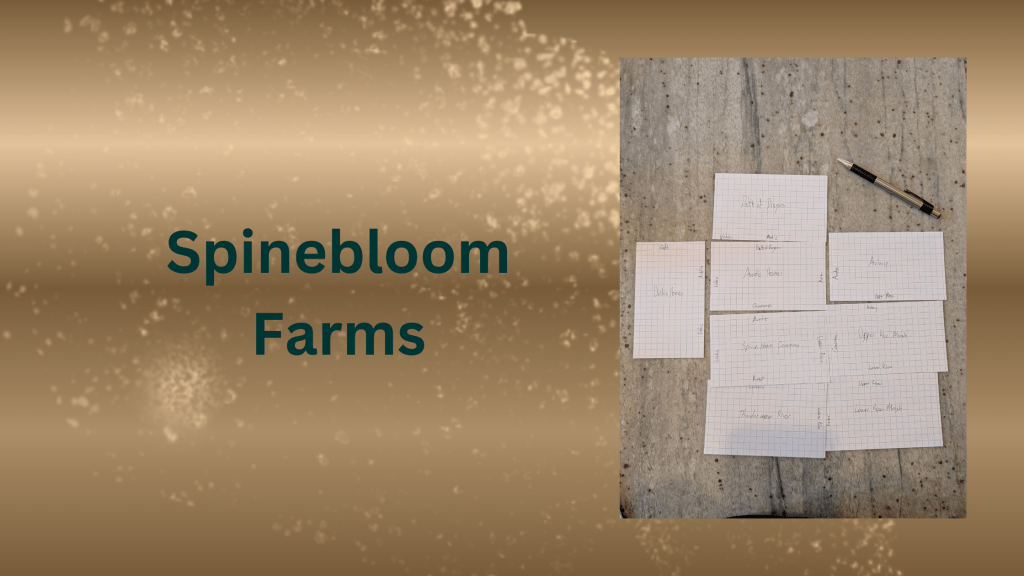
    The image displays a set of seven rectangular index cards arranged on a speckled stone surface. The cards have a grid pattern and are covered with handwritten notes. The cards are arranged in a T-shape with four cards on top and three below. Each card contains various textual labels such as locations and descriptive phrases. In the top row, the central card is labeled "Maltunyn Ground Floor," flanked by cards labeled "Bridge" and "Trading Stalls." The topmost central card features "Thundermoon River Bridge." Other notable labels on the cards include "Hunting Gate," "Lava Forge," "Guarded Entry," and areas denoted as "Stalls" and "Sheds." A pen is positioned at the upper right corner of the image.
    Zonal word map of the Trading Post

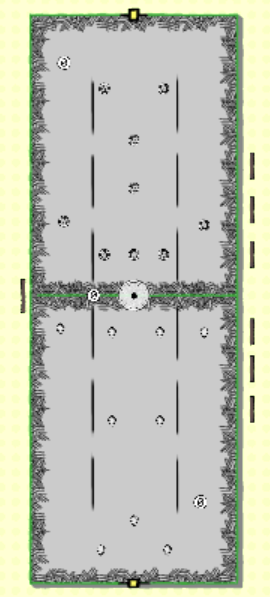
    Guarded entry

    A wooden wall surrounds the Trading Post. The entry is where all merchants and visitors arrive. There are two large doors, which are barred at night. A guard stand rises to the left of the doors, as one exits. It can hold one medium creature and grants them half cover. A ladder provides access.

    • Elemental affinity: None.
    • Hazards: Breaking down the closed door requires a DC: 15 Strength check.
    • Allies: The goblins and family can provide ranged or melee Militia Actions.
    • Max occupancy: Five medium creatures.

    The guarded entry connects to the lava forge, the merchant stalls and the loafing sheds.

    Lava Forge

    A small semi-open air forge where Cay works as a sometime smith. The heat and bellows are from an active fissure where magma surges underneath the trading post. Malk, the goblin captain, now helps out. Malk and Borkin also store their own clutter there, including the smog-buggy.

    • Elemental affinity: Earth, fire, lava
    • Hazards: Those knocked prone who fail their DC by five or more take 1d8 fire damage from the forge. Forced movement can result in the tools of the trade being knocked all over, turning the Lava Forge into difficult terrain. Oh, and beware of a lava flare — who knows when that will happen.
    • Allies: Cay, Malk and Borkin may be present
    • Occupancy: Four medium creatures.

    The lava forge connects to the guarded entry, to the trading stalls and the hunting gate.

    Trading stalls

    One large and two smaller open stalls sit in the large enclosed central space of the post. Various homesteads and outsiders come through with their wares on a seasonal basis. There’s a central fire pit with some large stones and simple benches frequently with a stew pot and hot beverages available.

    • Elemental affinity: Fire, air
    • Hazards: The cook pit can become a fire hazard, doing 1d8 damage to those who fall into it and setting their flammable gear on fire. It provides 10′ of bright light and 10′ of dim light at night.
    • Allies: Neighbors may be present depending on the season. They will almost always limit their help to rallying the Maltunyns.
    • Occupancy: 3 in the large stall, 2 in each small stall and room for 12 more medium creatures.

    The trading stalls connect to every other zone except the hunting gate.

    Loafing sheds

    Like everyone in the Six Kingdoms the Maltunyns have space for beloved animals. These sheds are designed for equines, canines as well as the rare bovine or more exotic companions. There are small cabinets for feed and tack.

    • Elemental affinity: Cold, air
    • Hazards: When occupied the animals could be feisty.
    • Allies: None typically
    • Occupancy: 7 medium creatures.

    The loafing shed connects to the guarded entry, the trading stalls and the Maltunyn home.

    Hunting gate

    Known for the gate that Caile leaves open it’s actually the place where Cay raises herbs. There’s also the gate to the hills where Keesrah and Velthuria hunt. It’s also a lower land, near the river.

    • Elemental affinity: Water, plants
    • Hazards: During heavy rains the mud creates difficult terrain. A rapid freeze after rains can lead to icy conditions.
    • Allies:
    • Occupancy:

    Thundermoon River bridge

    A few weeks ago there was a small wooden bridge over the river. Then the mephit mudslide took it out. Now a ford those that cross must be wary of mud mephits who settled in the area after the slide. Heavy rains may bring them back and upriver there is a threat that the open lava could change the river’s path.

    • Elemental affinity: Mud, water, maybe lava
    • Hazards: During floods the ford is impassable terrain without aids — ropes, other people or animal companions. Mud mephits may strike at random, the little chaos beasties they are.
    • Allies: One of the Maltunyn animal companions are frequently in the area.
    • Occupancy: This is a large space without a limit as it connects to the hills and mountains.

    Thundermoon River bridge connects to the hunting gate.

    Maltunyn home

    A two-story wooden building, the ground floor of the home is mostly accessible to the general public. The main room is a mix of general store with goods on consignment, smithed tools, dried or smoked meats and a few tables with chairs for visitors. This room can be entered from either the hunting gate through a small side door or the main entry connecting to the trading stalls. An outer stair to the second floor reaches the roof of the loafing sheds and a narrow platform along the wall running to the guard stand. There’s a small open kitchen/stove with a root cellar stretching under the homestead wall near the river.

    The second floor is two bedrooms and a small aviary.

    • Elemental affinity: Smoke
    • Hazards: Bar fights are rare, mostly because Cay is a smith and Velthuria is a scout.
    • Allies: If the trading post has visitors one of the family or goblins is always present.
    • Occupancy: 10 medium creatures
    The image is a stylized fantasy map depicting a region with diverse geographical features. The terrain is primarily sandy with scattered trees and mountain ranges. At the top left corner, the title "The Ferments" is displayed, with the region stretching across to the "Thundermoon Range" at the top center. Various areas are marked, including "Fatwoods" and "Palemarsh" to the west, represented with dense forests. "Sands Of Ar" is a large desert area in the center. To the south lies a large body of water labeled "Dark Wassr," depicted in a light blue-green color. Key locations such as "Raven Watch," "Sanctum Of The Black Witch," "Brightshelt," and "Ourten" are marked with symbols like houses or skull icons. A compass rose is placed near the water, aiding orientation. Paths, indicated by dashed lines, connect various locations.
    Created using Perilous Shores

    Allies

    Velthuria is Keesrah’s mother. A human scout with a small dog, she is the primary hunter and runs the operations such as rentals of the three stalls for merchants.

    Cay is Keesrah’s father. A human smith with a miniature pony, he uses a magma powered forge, Cay can craft anything with metals. He also grows herbs.

    Caile is Keesrah’s brother, a human with a small dog. Smitten with one of the Drudzhar Caile sometimes wanders off on his own. Ally, but adversary sometimes.

    Malk is a goblin captain and was saved in session one. A colonialist they are searching for resources for the Queen. They may become an adversary.

    Borkin is a goblin cart driver. They are less colonial and more willing to help the Maltunyns, especially in defense and general labor. Malk is still their boss.

    Henkel family

    River fishers in the ponds and streams of the low Thundermoons the Henkel family are halflings with river dogs. They are indebted to Keesrah after she rescued Taier one of their younger teens.

    Adversaries

    Clan Drudzhar

    A group of goliaths who live higher in the Thundermoon Mountains. Clan Drudzhar and the Maltunyn’s have been arguing, and sometimes openly fighting, over hunting territory in the mountains for years. One of their children is in love with Caile.

    Their home is high in the scrub mountains and was recently near the mud mephit floods. They and the Maltunyns use different styles of traps and will frequently destroy each other’s snares. Birds of prey are their most common companions.

    Elements of mud and lava

    Mud mephits, magmin and lava elementals roam the Thundermoons. These adversaries are manifestations of The Ferments, a land that refuses to be tamed.

    Children of Chorl

    Punch chickens raided a market stall, but quick action by Keesrah and her acquaintance Ellis ended the theft and the punch chickens. The two later learned that the Children of Chorl raided Ourten too. These human-animal hybrids seem to be hiding in the hills or plateau near Pirna Farms, now Ellis Mill.

    Kon colonialists

    While saving the lives of Malk and Borkin pushed off the investigation by the Queen’s goblins into how the resources of The Ferments could replace the tar trees of their homeland. That colonial raid and investigation may expand.

    Downtime and Quests

    Keesrah is researching how to create Serpent Scale Mail armor. She’s learned that the elemental drakes do not leave behind enough resources. The dragonkin raiding Spinebloom Farms do.

    Previously some work was done to reinforce the guarded entry which connects to the road Outsiders arrive along.

  • Ferments, Sessions three & four: Mud mephit slide, wake, fey chwinga

    Ferments, Sessions three & four: Mud mephit slide, wake, fey chwinga

    In session three the focus was on Keesrah. A duet session handled on Discord due to let turnout, session three was a fine example of the intent behind The Ferments campaign — always find a way to play D&D.

    Session four was held at Logan Brewing in Burien, as is typical. Keesrah and Guarese attended.

    What did the other characters do? We’ll use downtime to talk about the use of their homesteads as bastions, Xanathar’s downtime actions and/or improving their defenses for Militia Actions. And, due to player feedback we’re including traps in Militia Actions to embrace the case where a homestead may be solo or light on membership.

    The Ferments reading;

    Session three

    Keesrah heads into the scrub mountains for food to celebrate the visit of the liquor-creating family of halflings from downway. Her mom is on the trip.

    During this trip in horrific weather a mudslide forces a change in path, and eventually she is attacked by mud mephits. It’s a fierce encounter on the edge of failure. But together the two managed to hold off the mephits.

    Later in the trip home they notice a fox, Rennard. Using spellcraft, Keesrah learns that fox is the companion to Taier Henkel. Tier is missing, and presumed dead.

    Keesrah and her mother, Velthuria, need to cross the mudflow to return home. Using some craft, luck and Crow the Raven the two managed to safely cross the mud mephit slide. Keesrah is punched by a mud mephit swimming through the flow.

    After the flow and storm subsides Keesrah and Caile (the brother) head into the hills to talk to the Henkels and then the Drudzhars. One of these conversations goes much better than the other.

    As a sign of fellowship, and because of Caile, Taier’s memorial is to be held at the Trading Post — there’s also easy access to the liquors from the visiting family.

    The celebration goes well, except for the fight between Caile and Keesrah.

    Learned clues

    • Keesrah Maltunyn learned that the Henkel halflings get along with Clan Drudzhar.
    • Caile is friendly with both the Henkel halflings and Drudzhar.
    • Taier Henkel washed away in the mephit mudslide.
    • Keesrah rescued Taier’s fox Rennard.
    • Taier’s body was encased in mud by chwingas claiming he gave them a piece of his soul.
    • Chwingas released Taier when Guarase Spinebloom said he’d find them another bit of soul — maybe his.
    • Ken raiders with an ambush drake made their presence known. One donated its soul.
    • Guarase earned a Charm of Heroism granted by the semi–domesticated fey chwinga that now live in the Spinebloom’s rice marsh.

    Session four

    This was the first session featuring the Spinebloom homestead. It is a series of mostly underground dome structures in a desert environment. Many Spineblooms have some druidic magic and they use this and their traditional growing methods to have the least influence on the environment as possible.

    The same river that goes past the Maltunyn’s flows to the Spineblooms. Since The Ferments are infested with extreme elemental influences the desert and scrub mountains are close than is practical in a typical world.

    Keesrah and Caile travel along that river to try to find Taier’s remains. That journey includes meeting Guarase who helps them search. There is a mud casing hidden in the rice marsh the Spineblooms farm.

    Unfortunately there are also chwingas, little elemental sprites whose morality is not the same as humanity. These chwingas rescued Taier, but kept him cased as a way to protect him during the mephit mudslide.

    In order to get Taier free the chwingas demand another soul. Somewhat confused, Guarase agrees. Then the goliath figures out that they mean his soul.

    During this exchange the non-chwingas notice two advancing elves and an ambush drake. Keesrah sends Caile and Taier home.

    Guarase and Keesrah fend off the elves, while the drake and those elves destroy a third of the rice marsh including many chwingas. When one of the elves is dropped unconscious in the marsh a chwinga captures its soul.

    The elves also damage a Spinebloom home.

    Keesrah and Guarase learn of more threats to The Ferments, more friends that could be made and the challenges to come in a land that threatens their livelihood.

    Fediverse Reactions
  • Ferments, Session one: Smog buggy and fire snakes

    Ferments, Session one: Smog buggy and fire snakes

    The East marched on West Thundermoon Trading Post.

    Wrapping up a typical day, Keesrah noticed a thick, acrid cloud coming from the east. At the same time a not-unusual goliath walked up the packed dirt road from the south.

    The goliath, Guarase Spinebloom, reached the gates of the wooden palisade enclosure a few minutes before the smog buggy. Keesrah starts closing the doors.

    The smog buggy encounter was one of three random encounters rolled by the three players taking part in today's session.

    In a thick accent, the boss of the smog buggy, a goblin with driver and second passenger, demands/requests entry to escape “fire snakes.”

    Keesrah messages her mother. This takes nearly a minute because it is the spell. She opens the gate and lets the rancid smoke engulfed clackety buggy into the trading post.

    Mere feet behind them are fire snakes.

    This was not a euphemism. They are snakes, made of fire.

    Fire snakes were also rolled on the random encounter chart.

    The fight is swift with another Trading Post visitor, a halfling with six tiny terrier companions, Luke with a silent and non-appearing q in his name. Luke is a cleric and joins in the defense. He was picking up farm implements from Keesrah’s father, a smith whose forge burns over an open lava seam.

    Luke, Keesrah and Guarase try to defend these goblins. They have difficulty conversing with the goblins. Though the goblins know common (Telsian as we’re using cultures not languages)the two dialects known aren’t similar between the Ferments-born and the Essians (goblin born).

    A unique use of Create Water by Luke reduces the fire snake effectiveness for a round, while also limiting the spread of fire in the walls.

    During the fight the fire snakes kill one of the goblin minions and damage everyone, as well as a bit of the palisade. It’s a win, but with a hefty loss.

    A mistake the DM, me, made was having four fire snakes. Standard fire snakes have too many hit points for three 1st level characters, even with their allies.
    As soon as I realized the error I dropped them to 13 or 14 HP. That meant the fight was very difficult, but not a campaign ender.

    A morale roll means that the smog buggy driver will likely never leave the trading post again. Their best friend is gone, burnt. Malk, the goblin boss needs to repair their buggy, which is also crispy, and find a crew and find the resources to use as fuel. The goblins normally use tar trees, but outside of Essia those are extremely rare.

    Malk and Keesrah’s father talk about the possibility of using lava to fuel the smog buggy.

    After a bit of rest, and setting up a guard by Keesrah’s family the group tries to recover. They talk a bit.

    Looking around the Post they notice the overflight of dozens of hunting birds. The Maltunyn family rivals up in the hills almost always bond with birds. At a heightened alert, the group of Luke, Guarase and Keesrah notice that one of the smaller doors out to the game trails is open. Keesrah’s younger brother is gone.

    The overflight was the third random encounter rolled.

    Key learnings (SlyFlourish would call these secrets).

    • Goblins are searching The Ferments for a resource that can fuel their smog-tek.
    • Fire snakes are now aggressive, rather than passive. They will chase outsiders in the area.
    • Keesrah’s brother snuck out at night. That raised an alert from the adversarial clan nearby.
    • Community helps community. No matter the challenge and the danger.

    This was the first session of The Ferments, an East Marches Campaign set in the World of the Everflow.

    It is an experiment in using random encounters, defensible places, and a West Marches style to talk about community, control of knowledge and love of pets.

    Fediverse Reactions
  • The Ferments: A campaign one sheet

    The Ferments: A campaign one sheet

    The Ferments are a rough land of geysers, lava flows, fast glaciers, waterfalls, hot springs, tornadoes, earthquakes — the raw power of the world. From this land the best alcohols of the Six Kingdoms come. The peoples of the Ferments are dispersed, spread over the many miles with four main towns. They generally live in defensible homesteads interacting when they need goods or during festivals.

    Campaign Premise

    Our eventual heroes start out as the primary defender of a homestead. They know how to contact other homesteads for help when needed, but mostly they are on their own hoping to remain safe from a world where dragons came real, magic became powerful and kaiju returned.

    Grand Conflicts

    Elementals burst from the land, stronger than before and with a hungry intelligence that threatens the land. Outsiders fleeing the wars of Six Kingdoms come for safe harbor. Dragons and their Ken continue to search for more scholars.

    Photo of a hot spring and geyser with a foreground of rough reds, the pool of water and a cliff in the background
    Photo by Laura Paredis on Pexels.com

    Each homestead has a book, collection of scrolls or other devices that helps them control an element (earth, air, fire, water) or paraelemental (smoke, magma, dust, ice, steam, mud, etc). These start out with each PC knowing Elementalism, limited by their choice of element. Each was passed down since the time of Gallinor, before the time of dragons.

    Factions

    Every player will create either an ally or adversary family besides their own. They may also have a connection to one of the families (not all families share blood-ties) of other characters.

    Adversaries

    Allies

    Rumors

    This section will fill over time.

    Animated gif of a blue-green wyvern overlooking a river
    • Kaiju roam as in the time of Gallinor — some even are ridden. Word is they come from the Kirtin-in-the-Sky and the Cliffs of Gallinor.

    Facets

    • Exploring the zero-to-hero tropes, friendship with animals, and who gets to control knowledge.
    • Defending your people.
    • Inverted West Marches.
      • Enemy generally comes to you. Though you may sallly in order to obtain resources.
      • Episodic – attend when you can.
    • Sessions are 3 hours, with each story completed in one session.
      • Characters will level up every 3 sessions.
    • Recaps will be posted to Full Moon Storytelling.

    Variant Rules

    • Wizards of the Coast’s 2024 D&D is the baseline
      • Monsters may come from Black Flag, A5E, 5.1 and 5.2 products.
      • Player options must be consistent within the ruleset (i.e. if you play a Mechanist all options should be from Tales of the Valiant for that character).
      • There is a campaign set up on DnD Beyond. Email me to get an invite.
      • Start at 1st level.
      • Use point buy or standard array for starting attributes. If you want something random, the redrick roller gives random point-buy-valid stats.
    • Playable races are Human, Hin(what they call themselves)/Halfling, or Goliath.
    • There are several custom backgrounds and tools available. We will use cultures, not languages. Common is the Western Wildes. Other cultures are;
    • Heroic Inspiration will exist as a shared dice pool that is a maximum of 2+ the number of PCs that day.
      • In addition to the normal ways to award Heroic Inspiration it will be awarded for playing to Short Form Personality.
    • Each PC manages a Homestead (Bastion from 5e 2024) that starts with no Special Buildings.
    • Each session will offer the opportunity for a short rest. Long rests are between sessions.

    Practicum

    Sessions are on Sundays from 1-4 when my main campaign isn’t being played. We’ll meet at Logan Brewing, usually. I’m willing to do duet play outside of that timeline as well.

    Each character should be built in a session zero discussing their personality, homestead, allies/adversaries and key abilities.

    Fediverse Reactions
  • Inspiration is everywhere: Floating islands

    Inspiration is everywhere: Floating islands

    Creating memorable scenes and adventures is easier when fantastic elements are included. Many of these fantastic elements can simply be things from the real world, but amplified or expanded. In this case we’ll walk through the concept of floating islands and make those even more mythical.

    First off, yes, floating islands are real. In Lake Chippewa one is large enough it has to be pushed by motor boats so it doesn’t damage bridges.

    A floating island that drifts about on a lake or sea is already pretty fantastic. How can we up the fantasy to make it more memorable in D&D when the players are getting together every few weeks?

    This example is going to be for Sheljar, the bog-city once ruled by an intending-to-be-good necromancer, but could apply anywhere. Sheljar is a city of 100s of islands.

    Simple map of 100s of islands in a sea with a large waterfall in the south and mountains to the south and south east.

    What if a few of those islands floated like the bog-island of Chippewa?

    Rather than be moved by motorboat, they were moved by water elementals during the Age of Myths. The largest of these, Reylerel, at the time was the home of a power school of mages that integrated water, animals that live in and along water, and the peoples.

    As the Age was crashing they attempted to flee the city. The school wanted to isolate itself from the riots, to hide the dolphins, elementals, beaver and ducks that worked together to help the Kin survive. Reylerel went adrift, into the Sea of Sheljar.

    Now, thousands of years later the Free City of Sheljar is no longer ruled by the Necromancer. It is regrowing, discovering some of its influence from the Age of Myths. This bog-city isn’t a city of fog and depression, but a city of hope and humanity integrating gobkon teknology, love of animals and the lost magics.

    The leadership knows this is possible. Myth said it happened before, and drifting towards them is the Floating Island of Reylerel. At sea it moves with the swells and storms. The towers and buildings are rundown. Someone is going to need to go to Reylerel and find a way to prevent it from crashing into the docks.

    And that’s how you take a small trending topic on the internet and turn it into an adventure.

    Fediverse Reactions
  • Adapting Genoan revolutionary lunches to fantasy third places

    Adapting Genoan revolutionary lunches to fantasy third places

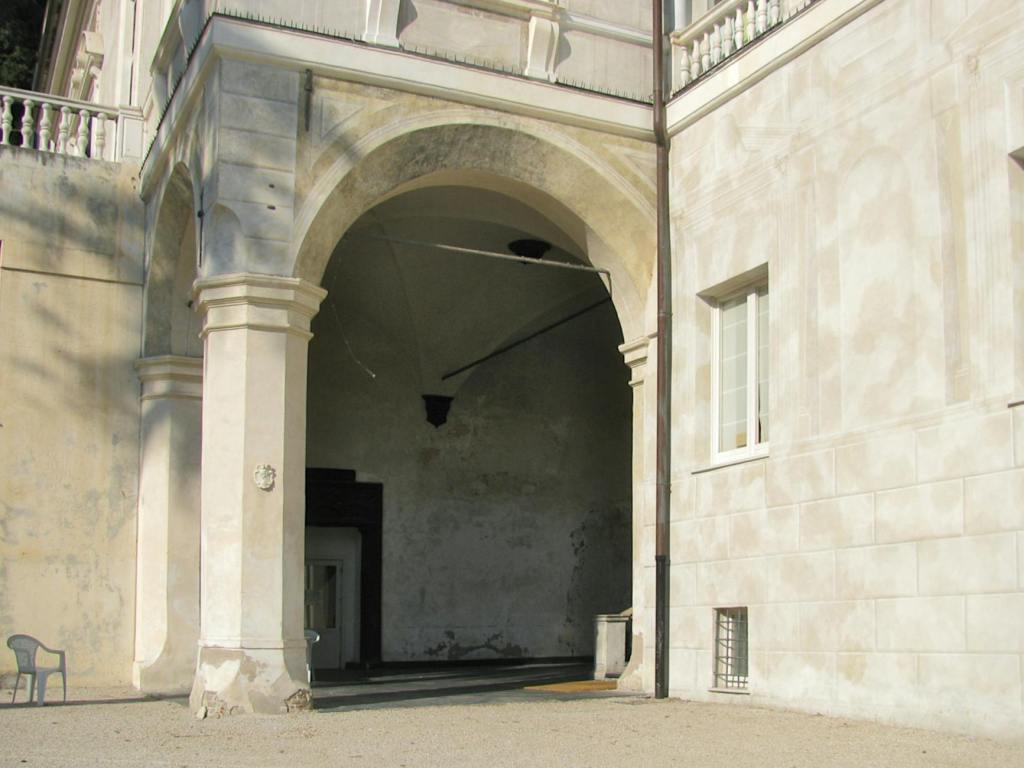
    During the Age of Revolutions the leaders who wanted liberalization and democracy in Genoa had no idea how to govern. They were a bit idealistic. They struggled to get the various classes of this significant mercantile kingdom to get along.

    This all comes up in a recent Nerd Farmer podcast featuring Nathan Perl-Rosenthal. And it’s going to inspire a new third-place tradition in my Dungeons & Dragons world.

    By Aldan-2 – {{[1]}}{{[2]}}, CC BY-SA 4.0

    One of the ways the Genoan revolutionaries tried to create cross-class conversations was by mandating public lunches be held on the streets before festivals. These lunches would be funded by the elites, had limitations on the number of courses and were intended to inspire conversation before the entire group proceeded together towards a town square for fest time.

    This attempt at a third place being a space in time rather than a physical building intrigues me. That porch was only a third place during the luncheon, roughly every two weeks. It didn’t work.

    This is a fantasy blog, mostly about a fantasy world where dragons and magic are real. Let’s make the Genoa public luncheons real.

    My world has a naval empire, which makes this easy. But it is rather hierarchical and centered on the influence of the navy as sailor-citizens with power and influence. It is expansionist. Daoud won the war with Kirtin twice, and just lost their hold on Kirtin-on-the-Lake, the winter capital of Kirtin.

    Douad’s fleets sail the seas trading goods, conquering territory and bring their wealth back to the homeland.

    Daoud is the southern nation and controls the Green Isles in the Southeast.

    This is where the lunchtime third places come in!

    These now-wealthy sailors, officers and captains are required, by the Admiralty of the Land, upon returning to port to share their wealth and throw a party in the neighborhood from which they came.

    They lunch and fest together, with the Admiralty and Royalty surprising random porches with visits.

    This now ingrained tradition started because when the first ships came back with massive wealth they were seen as a threat to the non-sailing gentry. So that leadership in a form of taxation started the luncheon program. This kept the peasants that didn’t sail happy with the leadership and that joy spread.

    These lunches are simple fare — three courses, one which must always be from the land the ship just visited. There’s always a flatbread, that was originally simple but is now treated as a complex way to serve a fourth course that is not in violation of the edict. There is wine and coffee, tea and liquor.

    There is joy.

    Then there’s the party, always in sight of the harbor with the ships lit and glowing at mast and crossbeam. There are flags and fireworks (the best ships travel with Sparklers). These parties are on a time limit. They start within two sunrises of the ship’s return. They end the next morning.

    And everyone participates. The paupers, urchins and sweeps know that when a ship returns they will eat well for at least a day, often two. The displays of wealth are ostentatious and the people are happy. These aren’t circuses, nor taxes. It’s Daoudian Luncheon — one of the two third places in the culture. The ships are the other third place.

    Fediverse Reactions
  • Lore 24: Oath of Free Sheljar

    Lore 24: Oath of Free Sheljar

    All of the campaigns that have taken place win the World of the Everflow have focused on tracking down the various Lorebooks, with each group having other side quests, generally towards making the world for the common peoples of the Lands of the Six Kingdoms.

    They’ve run counter to the Proctors, an evil faction that is trying to control knowledge of magic, and rogue Scholars who are spreading knowledge of magic in order to control people. Necromancy and Transformation are the ones most counter to traditional D&D goodness.

    The only other super-natural organization is the Orthodox Church of Quar. The Quarites control access to the Everflow and a massive merchant endeavor with their churches also working as trade posts and shops for what are in game terms healing potions.

    This world has no equal to the Factions of tradition D&D, or the Knights of the Round Table, or Templars or other super-national knightly orders. No one has wanted to be in one.

    But if a player wanted to play a character with these kinds of ideals and/or oaths, we’d talk about how it would fit. Knowing my player base the inspiration would be the Free City of Sheljar, the egalitarian re-founding of Sheljar after the early campaigns purged the Necromancer, his agents of undeath and the Tunneling Nightmares (they’ll be the subject of a future Lore 24).

    Based off the players and characters that founded the Free City such an idealistic organization would look similar to the Harpers, with a dash of de oppresso liber and a side of asymmetric organization.

    • Determination for all peoples Kin, Ken, Kon and any who think.
    • Share knowledge, so all in the world may live better lives.
    • Defend those that cannot defend themselves and their companions
    • Judge behavior, not the companion, the nationality or the faith
    • Recognize successes at spreading the word of a Free Shejar and Free Everflow

    Like the oaths of D&D paladins, these ideals within the oath are aspirational. They aren’t to be perscriptive.

    A player wanting to be part of this order wouldn’t necessarily pledge to sergeant or knight. They wouldn’t need to swear fealty to the current Mayor of Sheljar (Samul). The order would rise because the oath is a bit viral — it’s one that encourages heroic actions and fulfilling quests.

    A band could be one halfling and her dog, or an entire airxip of goblins, or an adventuring party, or three elves visiting the Everflow that abandon their fey pacts, or a group of Mehmdians, or a village near Telse, or a tribe in Crinth. A band inspired by the ideals of Free Sheljar aren’t sworn to them, in fact the current governance of Kirtin-on-the-Lake is inspired by Sheljar, but free from them.

    That’s the knightly order I would make if I were to make a knightly order.

  • Lore 24: School of Herbimancy

    Lore 24: School of Herbimancy

    Within the World of the Everflow magic is relatively new, well besides the Everflow’s healing power and ability to flow in two directions and the powerful bond between beast and Kin. In the current Proctors of Song and Book magic returned ~27 years ago. First that was via the Born Generation when over a period of a year every child of Kin came of age knowing a single cantrip. About 7 years ago the Lorebook of Divination was found and over the following years, magic started to spread with the realization that there were 17 or so Lorebooks scattered across the lands.

    The current campaign takes place in Sas Rurulit, where the Proctors are attempting to collect two Lorebooks. But the ingenious groups that control the Lorebooks down in this land broke them up. The Lorebook of the Book are people who cast directly from books and scrolls.

    These peoples are manifesting magic at various colleges. The college of metallurgy used every fire and electricity spell to forge metals. The college of hydrology was water and air spells, with a bit of illusion. The Proctors (PCs) have essentially destroyed these two schools ability to function by either capturing or damaging the master books there.

    In the last session they visited a public park that is also the School of Herbimancy.

    Photo by Chris F on Pexels.com

    School of Herbimancy

    Unlike traditional D&D approaches to herbs, the School of Herbimancy isn’t about ingesting herbs in some fashion to gain magical effects. Instead, the plants themselves are the magic.

    For example, the paths in the park were softly lit at night via the glowing flowers of a particular plant (a version of Dancing Lights). Maybe the smell of burning needles from a deciduous tree heals (Healing Spirit). Fallen branches from a tree are a magical staff (Shillelagh). Within Sas Rurulit, this school’s magic is artifice meets druid — the plants are simultaneously technology and magical.

    The group failed a series of checks, one with a natural 1, so they don’t know the professor in charge of the school. Instead, they got the name of the banker financing the project. A way to turn a nat 1 into a meaningful failure!

    They also didn’t quite figure out that the seed room may be the equal of a scroll room or library at the other schools they’ve raided (some read this site and it would be a natural conclusion for the characters to reach after fleeing the fires they set to cover their raid).

    I’m doing Lore 24, an attempt to write small lore elements daily in the year 2024. Each element will be something that’s come up in play or will come up in play within my homebrew World of the Everflow — there will be actionable threads for PCs to grab onto and advance the story.

  • Goltoppa, a Mehmdian sport in the World of the Everflow

    Goltoppa, a Mehmdian sport in the World of the Everflow

    Fantasy sports can be a fun way to add depth and cultural to a campaign world. One of my players in Uprising & Rebellion is playing a character from Mehmd and invented the sport of Goltoppa. He adapted some of the cultural touchpoints from the hidden empire, placing them into the common state of the game and has asked for it to be featured in a session soon. The character in question is not a Goltoppa player or coach.


    Goltoppa

    by JayDubTheGamer

    Playing Surface:

    A goltoppa field created using Dungeon Scrawl

    The game is played on an open, flat, dirt field, generally free of rocks & debris, that is 360 feet  long by 144 feet wide. The field is split lengthwise down the entirety of the center into 72 feet wide halves, and crosswise at 120 feet intervals. These six resulting areas are marked off with white paint borders. Particularly enterprising/wealthy teams have been known to pay to have the sections magicked to different colors. Straddling the centerline at each end of the playing field is a netted goal, 9 feet wide by 3 feet tall. One narrow end of the field is to be facing North, indicating the “head” of the field. Three referees patrol the playing surface to control the action during the run of play.

    Players:

    Goltoppa is played by two opposing teams, consisting of 9 starting players on each side. Teams are permitted to ‘dress’ 3 bench players for each contest, to be subbed into the game in the event of injury. Players may not be subbed into the game for strategic reasons or in the event of a player’s expulsion from the contest. A player’s uniform shall consist of a sleeveless tunic, belted at the waist & extending to mid-thigh, in the primary color of one of the six teams currently representing the league’s six social strata: Noble (violet), Military (red), Religious (white), Artisan (gold), Farmer/Fisher (green), Merchant (blue). Note that players are recruited to represent these strata, and need not be members of them. Additionally, players shall wear sandals that wrap up around their calves, with linen padding over their shins. Each team dresses one Left & Right “Slasher,” designated by a black sash that goes diagonally from either left or right shoulder to opposing hip, with the shoulder covered indicating which side of the field they may patrol. Players may wear short pants as well.

    Play:

     The game is played in two 36 minute halves. At the start of the game, a coin toss determines initial possession, which begins via kicking a ball onto the field from a position to the left of the goal which the possessing team is defending. The ball is traditionally made from a treated cow’s stomach filled with air, or a leather ball of approximately the same size . There are no goalies; all players may attempt to kick the ball toward or away from the goal, or to a teammate. Additionally, each team’s Slashers are allowed to catch the ball on the fly in their hands and run with it to the border of whichever section of the field they currently occupy, at which point they must kick the ball themselves unless trying to place the ball in the opposing goal. A Slasher with possession of the ball may be leg tackled by the opposing team. A successful leg tackle means the Slasher must kick the ball to a teammate (only) from the spot of the tackle. Tackling with one’s arms, striking a Slasher above the waist, or attempting to strip the ball from a Slasher’s hands by a player other than an opposing Slasher is not allowed. A ball that goes out of the field of play results in a change of possession, with the new possessing team kicking the ball into the field of play from the sideline spot where the referees determine the ball crossed out of the field.

    Scoring:

    A score happens whenever the ball is put into the net during the run of play, A ball kicked into the net scores 2 points; a ball placed into the net by hand scores 5 points.

    Penalties:

    Rough Play: Arm tackles; deliberate leg tackles of a non-Slasher; headbutts; intentional hands to the face or back of an opponent – Offending player off the field for 3 minutes.

    Stripping: An attempt to pull the ball from the hands of a Slasher by a non-Slasher – Offending player off the field for 3 minutes.

    Catching: Non-Slasher making deliberate contact with his hands to the ball, especially with an effort to control the ball – Offending player off the field for 2 minutes.

    Scooping: Slasher attempting to pick the ball up off the field, rather than catching it on the fly. This includes a ball that bounces before being caught – Offending player off the field for 1 minute.

    Offsides: Slasher maintaining possession of the ball beyond the area of the field where he caught it, or crossing from his designated half of the field – Change of possession from the spot; no kick to inbound the ball needed.

    Belligerence: Fighting; intentional physical contact/intimidation toward a referee – Offending player ejected.


    Playing Goltoppa at the table

    There will be a series of contested checks to determine scoring. These will use the Tool Sports: Goltoppa and have a few skills that can connect to them.

    My first thought is a way to generate scoring similar to what is described by JayDubTheGamer would be to have five contested checks by half. That’s a lot of rolling, but provides some variety of results and capability of multiple players participating.

    Winning a check by 1-5 results in two points. Winning a check by more than 5 results in 5 points. Winning a check by more than 10 results in seven points and winning by 15 or more is good for nine points.

    Losing a check by less than 5 results in two points for your own team. Any natural 1 means that you have given up a five-pointer or have committed a foul, rolling their next challenge at Disadvantage. Any natural 20 means that you have scored a five-pointer.

    This should generate scores that look a bit like early 20th century American football or current rugby.

    Applying skills

    Acrobatics and Athletics will be the most used skills, most frequently connecting to Dexterity and Strength. It would also make sense for someone in a coaching position to use Intelligence with one of those and for a character playing the captain to use Charisma.

    I would allow up to one role to use Deception in order to get away with a foul. That team would have Advantage on the next check, but if they lose that roll their next roll would be at Disadvantage.

    An example:

    Violet teamBlue teamScore
    137Violet 5: Blue 0
    1620 (natural)Violet 2: Blue 7
    915Violet 0: Blue 5
    1212Violet 2: Blue 2
    415Violet 0: Blue 7
    1st half9 points21 points
    29Violet 0: Blue 5
    20 (natural)7Violet 12: Blue 0
    1411Violet 2: Blue 2
    186Violet 7: Blue 0
    39Violet 0: Blue 5
    2nd half21 points12 points
    FINAL30 points33 points

    Yes, that’s ten rolls for a non-combat encounter. Which feels like a bit, but the descriptions are at most two sentences, show the shifts in momentum, and feel like watching a sport when including those descriptions especially around the nat 20s.

    We’ll see how it runs at the table.

  • Timelines in the World of the Everflow

    Timelines in the World of the Everflow

    The timeline of the World of the Everflow is getting harder for me to track. There have been six campaigns with some overlap in both reality and at the table. In order for me to keep better track of events and so that the players and their characters have a better idea of events in the past prior to the campaign I started to build a timeline.

    The desire is that these are basically small phrases containing history, not a book of common knowledge to study. I’ll be adding to this as the players remind me of events, create things from their own history or ask questions.

    Current day

    Uprising & Rebellion 2 and Gendarmmes of Sheljar

    One year ago

    Red Oak burns, allowing red dragons to be born; Uprising & Rebellion 1; 7th Fleet of Daoud encamps to the south of Kirtin-on-the-Lake

    Five years ago

    Dragons and the Ken fly to Kirtin-on-the-Lake; Sheljar is freed from Necromancy and the Tunneling Nightmares; some Scholars (Diviner, Necromancer) are made public; Kin can learn magic

    Six years ago

    Goblin Queen’s Fleet lands near Sheljar; Discovery of the Lorebook of Divination; Children of Chorl created; Eruption of Dakan Thaeeb; Lorebook Hunters start their search

    Twenty-seven years ago

    Sheljar falls to the Necromancer

    Twenty-eight years ago

    Born Generation

    Seventy years ago

    Crinth Confederation re-structures to stop expansion of Azsel

    One hundred and twenty-two years ago

    Kirtin loses Kirtin-on-the-Lake again

    Two hundred and twenty-four years ago

    Kirtin retakes Kirtin-on-the-Lake

    Four hundred and sixty-four years ago

    Daoud takes Kirtin-on-the-Lake

    Seventeen hundred years ago

    Az and Sel establish the Bond, rising to godhood; other bondings besides dogs are discovered; the Goliath nation of Galinor disappears

    Two thousand years ago

    Church of Quar controls the Everflow and the Font of Two paths, becoming a continent wide faith; Mehmd closes off the empire with foreigners only allowed at Gate

    Millenia ago

    Quar and the gods create Habergeon, the Everflow and separate the Lands of the Six Kingdoms from the world of magic