This post will not contain spoilers for Season 5 because I haven’t yet watched Season 5 of Stranger Things, though I do know it features more Dungeons & Dragons than Seaons 2-4 combined.
If you were to go into Target this fall you’d see a massive Stranger Things display somewhere in the store. Part of that display would feature the D&D boxed set Welcome to the Hellfire Club, which is a continuation of Eddie’s D&D campaign. It felt late, because Eddie isn’t part of season 5.
It was not late.
Welcome to the Hellfire Club sold out at Target. It sold out on Amazon. A light informal survey of local-to-me stores have it as sold out. The physical boxed set can still be ordered on DnDBeyond.
Sure, that could be a lack of ambition from Wizards of the Coast by not manufacturing enough of the sets.
It’s much more likely that the heavy lean back into D&D by Stranger Things Season 5 drove more desire for D&D the game than previous seasons, Critical Role and Baldur’s Gate 3. BG3’s drive of interest into D&D is hard to quantify, but has an extended window over several years.
Google Trends can show you.
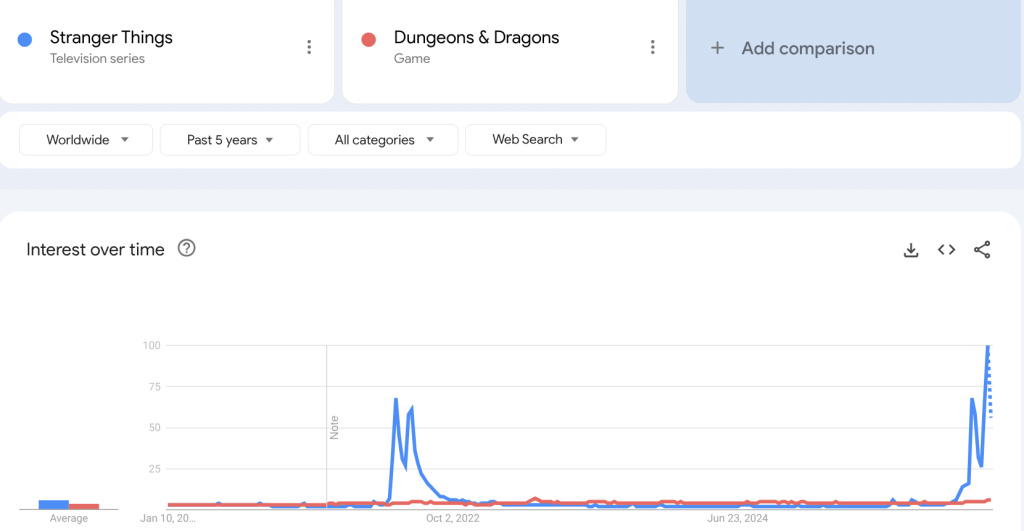
Search trends for Stranger Things
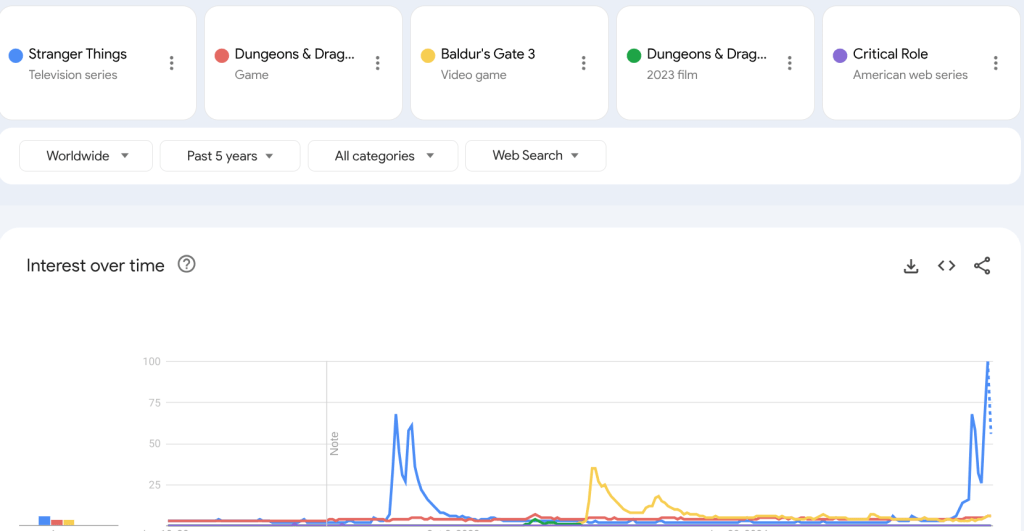
Here are the four adjacent media and D&D
Stranger Things is more popular than the others by far.
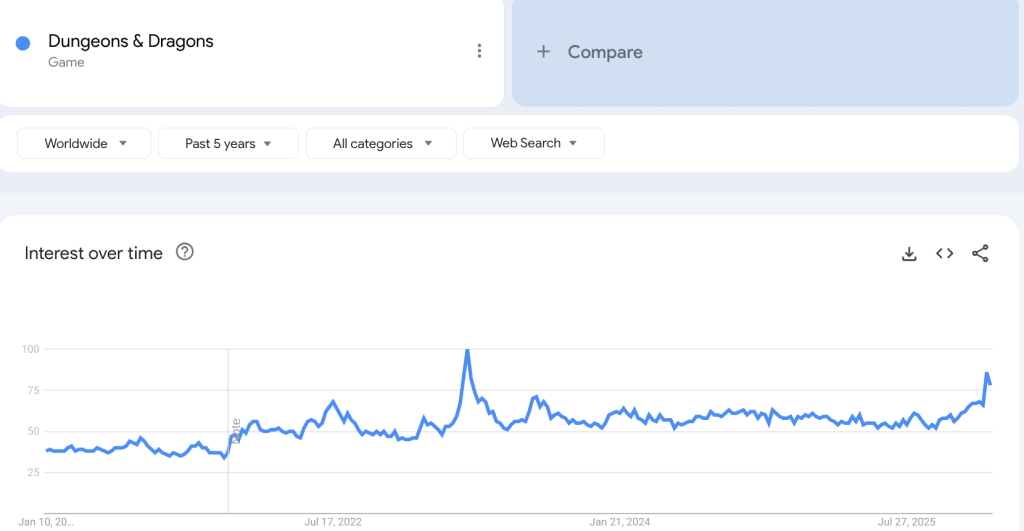
D&D, the game, had its biggest boom from the movie, but…
Stranger Things Season 5 nearly matches D&D: Honor Among Thieves
There’s one major difference — lack of tie-in gaming products.
Rime of the Frostmaiden contained a single adventure related to the movie. There was a boutique NPC download related to the movie, but nothing like the amazing boxed set Stranger Things got. Baldur’s Gate: Descent into Avernus was barely related to the video game and its release timing was horrible.
Nothing sold out because of Honor Among Thieves, the best D&D marketing in the history of the game, because D&D wasn’t run as a franchise system with business units failing to talk to each other.
Both the current starter set and Welcome to the Hellfire Club are selling out.
What’s that mean for us Dungeon Masters?
Be welcoming to new and returning players.
Reduce house rules when they join you.
Talk about the intent of your table and what type of play you focus on .
Be familiar with the most popular products.
Help teach your current players to DM.
See if local cafes, libraries, schools, pubs, etc need DMs.
We are responsible for growing this glorious hobby. Thanks to the Creative Commons, various SRDs, the eternal nature of homebrewing and the thousands of other roleplaying games there is always something that’s right for someone.
Find what’s right for your family, your friends and your community.
People are interested. It’s up to you to be the reason they stay interested.
Somewhat overshadowed by the release of several high-fantasy systems not based in 5e D&D is that Wizards of the Coast has two starter sets, a two-book/three-pdf Forgotten Realms set, and Eberron expansion coming out from September through the holidays.
Additionally, other 5e systems inspired by D&D are also cranking right now.
There’s a plethora of choice, right as genre TV’s most D&D related property is coming back — Stranger Things season 5 releases Thanksgiving, Christmas and New Year’s in the U.S. Several of the early monsters based on Dungeons & Dragons are making a comeback.
Your normie (non-RPG) friends may be interested in the game again thanks to the combination of product releases, the Mighty Nein release, Stranger Things and the general zeitgeist around being big heroes with power in a world where that feels missing.
What game or books are the right system for them right now?
If you read Full Moon Storytelling it is likely that you are a DM/GM. It’s also likely that you lean towards 5e D&D. That will be the focus, with a small discussion of the other systems capturing attention (million dollar+ Kickstarters and the like).
Are you the GM/DM?
Go with what you like best, what fits your world, and be welcoming. Cut back on house rules and homebrew, at first, as the people who are new to the game can be overwhelmed with normal rule sets that can stretch to 1,000 pages.
Fold the new invitees into your world by asking them what they enjoy about high fantasy roleplaying. Finding out what your table’s Appendix N always helps, but it is the most helpful knowing what someone new (or returning from long ago) to the hobby wants.
If they want something simple, but familiar like the D&D of the 80s, but modern there are a few routes. Sticking with 2014 5e one can still get the older starter sets from Target or Amazon. Dragons of Strormwreck Isle is under $16 at Target online, and some physical stores may have it. Check with your local gaming store to see if they are offloading old product.
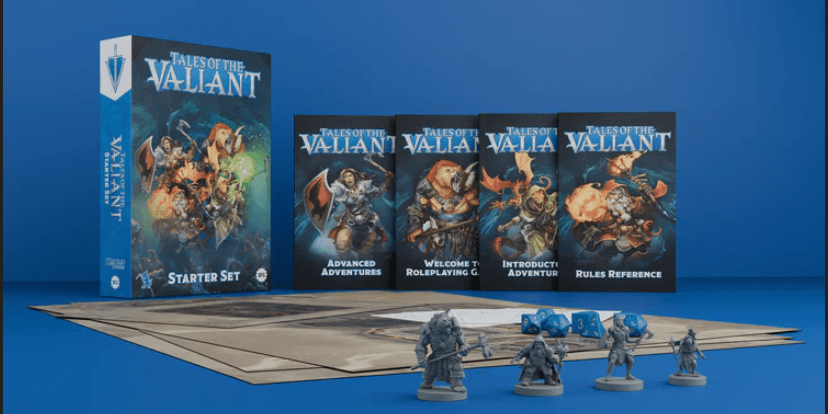
You can also intro them to 2014 via Kobold Press Tales of the Valiant Starter Set. It is under $14 at the time of publishing. The primary differences between Wizards of the Coast 2014 D&D and Tales of the Valiant lies in Tales having character creation that separates nature and nurture, luck replacing inspiration and the insertion of unique abilities on every monster.
I’d recommend Tales of the Valiant over 2014 D&D because of those changes, even if it doesn’t have the branding your friends expect. It also comes with minis! If Stormwreck Isle is 5.1 5e, ToV is probably 5.3.
Stranger Things: Welcome to the Hellfire Club
Maybe your friends didn’t get into D&D from Stranger Things season 1, or 2, or 3, or 4. Or maybe they did, but didn’t have the time, energy or mental space to play the game.
Welcome to the Hellfire Club uses Wizards of the Coast’s modern take on starter sets — lots of tokens, handouts, cards and a written approach that blurs the line between board game and roleplaying game.
modern take on starter sets — lots of tokens, handouts, cards
The presentation includes a look that borrows from 80s nostalgia as expected. The four adventure books include trade dress that would make Gary Gygax and TSR proud.
This is the second starter set built out of Stranger Things by Wizards of the Coast. Both lean heavily into using the voice of the character from the show that was the featured DM, lean into the mythology of the TV show with its ‘not quite D&D monsters, but monsters that middle/high schoolers would think are D&D monsters.’
The first Stranger Things set was rather linear in nature, which fit the times and works fairly well for people newer to roleplaying. Welcome to the Hellfire Club uses 2024 5e D&D rules.
D&D Starter Set: Heroes of the Borderlands
Similar to Stranger Things pulling out 80s nostalgia to pull people into its world, Wizards of the Coast uses Dungeons & Dragons most popular adventure from the foundational period to inspire its new general purpose Starter Set.
Keep on the Borderlands is now Heroes of the Borderlands, with three adventures. Using 2024 5e D&D’s rules, card-based character creation, tokens and maps, the intent of Heroes is to again bridge that gap between board game night and RPG night.
Because it is 2024’s rules rather than 1974s, the set is massive. Those three little folios that could fit in a small lunchbox are gone. Instead Heroes has more than 400 cards and tokens, a quick start, a set of rules, and three adventures.
The game of D&D is simultaneously more complex and more approachable than it was in the 70s and 80s. Being a more pervasive part of the culture is part of that. Also the decades of exposure to computer RPGs changes how one approaches teaching the game.
Forgotten Realms expansions
A massive two-book, three-digital book expansion coming with the brilliant marketing around “The Realms will know your name” these books aren’t necessarily great for first timers to tabletop roleplaying, unless…
You know people who were heavy into the lore of Baldur’s Gate 3 and/or D&D: Honor Among Thieves and/or the once dominant fantasy novels set in the Realms. Those legends exist within the expansion, but the point of D&D and RPGs in general is to tell your story.
Only dive into this if you are being joined by people who absolutely love those non-tabletop versions of the Forgotten Realms. These expansions include 50 micro-adventures that fit an on-the-fly DM rather well (similar to those in the 2024 DMG).
Those playing with your classic group you need little guidance. If you are using the 2024 D&D rules, or at a table that permits a broad swath of 5e rules, the expansion is handy if you want to borrow factions, subclasses, new species and nuggets of lore to insert into your homebrew.
In total the Realms expansions add about 30% more character creation options while dramatically expanding the story through the lore expansions.
Eberron: Forge of the Artificer
High fantasy doesn’t have to take place in a world that’s pseudo medieval/Renaissance and Euro coded.
It can also include pervasive magic, spread widely among the populace in a world that echoes tropes related to early Industrialization with great Houses, lightning rails, elemental airships and a ‘war to end all wars.’
That’s Eberron.
Forge of the Artificer is a lightweight updated to the setting originally invented by Keith Baker.
Don’t get Forge of the Artificer unless you already have Rising from the Last War or you really want to have the magitech Artificers at your table or you are a completionist. I’ll be getting it for the first two reasons. I’m currently playing a goblin Artificer.
The Artificer in Forge is updated for 2024 with a brand new subclass as well. From what was in the Unearthed Arcana developing this coming version of the Artificer it looks to have the quality of life improvements I would expect.
Other RPGs
LevelUp
LevelUp is built on the 5.1 5e chassis, but advances it. This does make it a more complex version of high fantasy role playing. Some of the greatest improvements come from expanding the social and exploration pillars. This helps tell a wider variety of stories. Like every offshoot of D&D from the 5e era it separates nature and nurture.
There’s now a Starter Set available. Yes, it has tokens and multiple adventure, because that’s what modern starter sets do. EN Publishing’s Starter Set is an excellent way to try on a different version of the game you already know.
Cosmere RPG
If you enjoy Brandon Sanderson’s writing you might enjoy the Cosmere RPG. It is not based on 5e. It is the highest earning RPG kickstarter of all time.
Cosmere is beautiful, complex and the most extensive lore heavy game upon release likely ever.
Draw Steel
While not the level of Kickstarter success of Cosmere, Draw Steel was still a massive earner. The design team from MCDM is mostly people who produced wonderful 5e products, but are now releasing a system that emphasizes combat (tactical, heroic, cinematic) even more than D&D. The rules are crafted so that the feeling of conflicts is a reminder of watching a movie or TV show’s fight scenes.
Daggerheart
If Draw Steel is inspired by D&D, but wanting to be more combat, Daggerheart is inspired by D&D, but wanting to empower more story. Like Draw Steel and Cosmere, Daggerheart is a wholly new system. Most simply defined there is a Hope/Fear mechanic attached to the double-dice roll of players. Additionally it covers more ground about how to communally create the worlds and social interaction. Coming from Critical Role’s Darrington Press Daggerheart is designed to showcase the types of stories Critical Role excelled at.
Similar to Cosmere and D&D there is a wealth of media associated with it already — with more coming from the media arm of what was once a D&D actual play, but is now a multimedia company.
There are plenty of other games too — listing them all is foolhardy. Pathfinder and Starfinder, Legend of the Ring, Warhammer, Shadowdark and the list could go on.
But the zeitgeist right now seems to be focused on 2024 D&D versus a few upstarts with million dollar or more crowdfunding campaigns all coming out in the second half of 2025.
The Ferments are a rough land of geysers, lava flows, fast glaciers, waterfalls, hot springs, tornadoes, earthquakes — the raw power of the world. From this land the best alcohols of the Six Kingdoms come. The peoples of the Ferments are dispersed, spread over the many miles with four main towns. They generally live in defensible homesteads interacting when they need goods or during festivals.
Campaign Premise
Our eventual heroes start out as the primary defender of a homestead. They know how to contact other homesteads for help when needed, but mostly they are on their own hoping to remain safe from a world where dragons came real, magic became powerful and kaiju returned.
Grand Conflicts
Elementals burst from the land, stronger than before and with a hungry intelligence that threatens the land. Outsiders fleeing the wars of Six Kingdoms come for safe harbor. Dragons and their Ken continue to search for more scholars.
Each homestead has a book, collection of scrolls or other devices that helps them control an element (earth, air, fire, water) or paraelemental (smoke, magma, dust, ice, steam, mud, etc). These start out with each PC knowing Elementalism, limited by their choice of element. Each was passed down since the time of Gallinor, before the time of dragons.
Factions
Every player will create either an ally or adversary family besides their own. They may also have a connection to one of the families (not all families share blood-ties) of other characters.
Adversaries
Allies
Rumors
This section will fill over time.
Kaiju roam as in the time of Gallinor — some even are ridden. Word is they come from the Kirtin-in-the-Sky and the Cliffs of Gallinor.
Facets
Exploring the zero-to-hero tropes, friendship with animals, and who gets to control knowledge.
Player options must be consistent within the ruleset (i.e. if you play a Mechanist all options should be from Tales of the Valiant for that character).
There is a campaign set up on DnD Beyond. Email me to get an invite.
Start at 1st level.
Use point buy or standard array for starting attributes. If you want something random, the redrick roller gives random point-buy-valid stats.
Each session will offer the opportunity for a short rest. Long rests are between sessions.
Practicum
Sessions are on Sundays from 1-4 when my main campaign isn’t being played. We’ll meet at Logan Brewing, usually. I’m willing to do duet play outside of that timeline as well.
Each character should be built in a session zero discussing their personality, homestead, allies/adversaries and key abilities.
A couple weeks ago one of my players passed away. Not his character, the actual player. This isn’t supposed to happen. My group is GenX with a couple of Millennials.
John White left us too early. His D&D experiences were strongly in 3rd edition, though like myself had played for as long as he could remember. And even though he mostly played in an edition that encouraged optimization, it was his adoption of the story-centric campaign that we’ll all remember.
I remember playing with a friend who was never waiting for his turn to do something, but was engrossed in the act of telling a story together. I remember a collaborator who expanded the world that we played in by fully being in it. I remember characters whose backstories and internal lives were fully fleshed out, who incorporated elements of the world that even its creator hadn’t thought of and who interwove the stories of other players’ characters into their own with a generosity and care that is rare in any circumstance. — another player at our table
He’s played with this group since it was founded during the pandemic, playing on the patio of a brewery that was roughly a midpoint for a group that is spread through King and Pierce County — Logan Brewing.
We’re going to celebrate John by playing D&D together in public — we’d like you to join us. Or you can watch. The event is March 16 from 1-4 pm PT at Logan Brewing.
Habergeon, the world’s first, and possibly only, warforged, Habergeon was crafted during the fall of a previous age back when magic was plentiful and those who are now gods walked the world as mortals.
Gardar, a Mehmdoan, this one-time cooper and weaponsmith lost his first animal companion to tragedy, fled his former master and now seeks to rid the influence of the Dragons and their allies.
Tsirdan, an elven Scribe Wizard who worked with the Dragons to control the spread of magic in Douad.
And Artok, our commander Dragonborn Paladin in his final campaign. Artok, like John, was noble and heroic, short on words but those few words were always potent.
John was unlike anyone I’ve ever met, his way of thinking and explaining things was in such detail that I could tell his mind was always working in overdrive — another of our players.
The first time I met John was when I was co-hosting a Sounders podcast at our local German pub.
The first time I played D&D with John was when I was featured in the Renton History Museum exhibit on Creating Community with D&D. A letter to the editor at the time shouted that the museum shouldn’t support Satan, as if it was the 80s again.
John’s response was to suggest to me that we should play in public so that people could see this game for what it is. He and I were joined by his wife and sister-in-law. We played in a public park.
Though my modern D&D games had frequently been in public it was mostly at geeky places like game cafes.
It was perfect that our post-pandemic campaigns were in a very public brewery. Many times we played a stranger would ask us what we were doing while current and former players would always recognize the game and ask about the campaign.
Playing in public exposed more people to the game John loved.
John enjoyed porters and though he was short on words he was always present.
And that’s why we’re doing one session of a 4th level one-shot on Sunday March 16, from 1-4 pm. People who know John and those who want to experience the game are welcome. Again, please fill out this form so we can get an idea for how many DMs we need.
Creating memorable scenes and adventures is easier when fantastic elements are included. Many of these fantastic elements can simply be things from the real world, but amplified or expanded. In this case we’ll walk through the concept of floating islands and make those even more mythical.
First off, yes, floating islands are real. In Lake Chippewa one is large enough it has to be pushed by motor boats so it doesn’t damage bridges.
A floating island that drifts about on a lake or sea is already pretty fantastic. How can we up the fantasy to make it more memorable in D&D when the players are getting together every few weeks?
This example is going to be for Sheljar, the bog-city once ruled by an intending-to-be-good necromancer, but could apply anywhere. Sheljar is a city of 100s of islands.
What if a few of those islands floated like the bog-island of Chippewa?
Rather than be moved by motorboat, they were moved by water elementals during the Age of Myths. The largest of these, Reylerel, at the time was the home of a power school of mages that integrated water, animals that live in and along water, and the peoples.
As the Age was crashing they attempted to flee the city. The school wanted to isolate itself from the riots, to hide the dolphins, elementals, beaver and ducks that worked together to help the Kin survive. Reylerel went adrift, into the Sea of Sheljar.
Now, thousands of years later the Free City of Sheljar is no longer ruled by the Necromancer. It is regrowing, discovering some of its influence from the Age of Myths. This bog-city isn’t a city of fog and depression, but a city of hope and humanity integrating gobkon teknology, love of animals and the lost magics.
The leadership knows this is possible. Myth said it happened before, and drifting towards them is the Floating Island of Reylerel. At sea it moves with the swells and storms. The towers and buildings are rundown. Someone is going to need to go to Reylerel and find a way to prevent it from crashing into the docks.
And that’s how you take a small trending topic on the internet and turn it into an adventure.
No other early-era playable species/race in D&D history has been shoehorned into a singular type as the Halfling. Originally called Hobbits, because that’s what they were, Gygax decided to avoid a legal battle and renamed them as Halflings.
But for nearly thirty years these small people were either the peoples who lived in homely burrows (Stouts) or peoples who lived in Buckland (Tallefellows). There were also hairfoots, which let’s be honest the three types of D&D Halfling perfectly mirrored Tolkien’s varieties of Hobbit.
Halfling communities come in all varieties. For every sequestered shire tucked away in an unspoiled part of the world, there’s a crime syndicate like the Boromar Clan in the Eberron setting or a territorial mob of halflings like those in the Dark Sun setting.
No longer are the differences in Halfling types subraces as earlier versions of the game. But the “all varieties” are conventional hobbits, gangsters and cannibals.
This need not be all varieties of the small folk
Caravans
In Rings of Power we meet two varieties of Halflings. The first are the Harfeet, who travel in communal covered wagons travelling with the seasons over a wide land. These peoples hide quickly (a Halfling born trait) and sing proudly of their history. Though not ‘Shire-y’ they are clearly the popular Hobbit/Halfling of fantasy tropes. Caravan Halflings have been embraced by D&D in the past, fitting them in your world is easy.
Season 2 introduces the Stoors, who live in cliffside holes in an arid land. You can see some Halfing behavior in the structure of the settlement. Again, they are quite communal, which I don’t like associating with a species because that feels cultural, not born, but this is part of the Halfling trope still. What makes these Stoors inspiring for small folk in my world is that they seem to embrace the divine luck of Halflings. Those aqueducts and microforms carved into cliff sides seems to require bravery, nimbleness and luck. Children scampering through that space would fall constantly without the luck of the gods.
There are other ways that you can embrace the born traits of Halflings and build some societies, captured in their homes.
Coop homes
Chicken coops sold at American feed stores (Dave Clark)
In visiting various farm and feed stores you can find fancy chicken coops. These will frequently have multiple levels, many doors and windows. Sometimes they have a small fence in material similar to the walls or roof.
These have made me think of Halflings for some time, not just because they are made for tiny creatures. The various nooks and crannies are places to hide. Similar to modern micro-housing, a cluster of these coop-style Halfling homes would take up very little space in a fantasy city too. A cluster would touch on the communal aspect that Halflings will never escape, because their connection to Tolkien is so strong (even in Eberron and Dark Sun).
Or one with a run extension could be a connection to terriers, cats, or other small domestic animals that live with these Halflings as companions. A design with space underneath is sensible for raising mushrooms or other foods.
What other home types make sense for Halflings?
Rafts and waterways
A species of brave nimble peoples living on the waters in a mix of canals, creeks and lakes makes a lot of sense. Their small size lends itself well to working in the sails and ropes of the big people too. Narrow paths of docks and ladders would require a nimble and lucky peoples too. This also works at sea, with Halflings living in the rigging of multi-mast ships.
Bridges
Yes, I love this trope. My own Fort Ooshar uses it. Small folk are perfect for settling in the upper levels of a bridge-city. They also make sense in the undercarriage. The ability to slip into and out of the various rope elevators is perfect for the narrative. Halflings in this environment can be similar to the Eberron gangs or they can be families who take up the small spaces that humanity (all the medium thinking peoples) ignores.
Tree houses
Yes, yes, yes — this trope is heavily associated with Elves. It need not be. Halflings make a lot of sense as a tree people. They are small and light, which means they can live in a much larger variety of tree and not just the not-Redwoods. Put them in birch, or larches, or cedar. Maybe they live in briars with offices in the local oak. Being just a couple dozen pounds is a massive advantage for Halfling tree people. Their divine bravery and luck are also a great fit.
Spire lands
Imagine a land of natural spires with Stoor-like homes, but even more exaggeration of height with tiny bridges of rope connecting the neighborhoods. Humans would hate such a place, but a Halfling would run full speed along a rope bridge connecting two towering rocks.
tl;dr
Halflings can be more than just Hobbits. Your fantasy version of the small folk should embrace their born traits – brave, nimble, lucky, stealthy. Don’t assign culture due to their species, but the places where they live and how that influences them.
Your city Halflings could be gangsters, your caravan Halflings could be communal, your bridge Halflings could be a hidden undercurrent, your burrow Halflings could be a coven.
Embrace more options in your fantasy world so you can tell a wider variety of fantastical tales.
Naming characters can be hard. For a DM coming up with names at the spur of the moment can lead to a stoppage in play as their mind struggles to find something appropriate for the NPC that was supposed to be a background character, but your players have thrust that individual into a major role.
For most players, naming a character is a rare event. It is usually the first or last thing that they do. Then, it’s over until the next campaign starts. Still, you want to get the proper name for your character, because you will carry it with you for a long time*.
*strong exceptions for rogues, criminals, urchins, and the like.
As someone who both creates way too many PCs, and once named a formerly non-notable NPC “Anderson” after the car dealer across the street from the restaurant hosting our session I’ve developed a few tricks to naming characters.
Easy Button
Those of you using DnDBeyond.com probably already know this, but the Fantasy Name Generator has well over 100 different naming categories. Click the category and it will spit out ten names. Simple is as simple does. Sometimes you’ll hit those buttons a dozen times to get the one you like.
Xanathar’s Guide to Everything
All the way back in November of 2017 Wizards of the Coast released Xanathar’s Guide to Everything. The book is most well known for being the first official significant expansion of character classes in 5th edition. Those people into optimization ranted against the inclusion of almost 20 pages of names.
Frankly, it was a poor critique.
There are so many more people picking up the game every day, every month, every year. They don’t have the knowledge base that stretches back editions. They may not want unofficial sources for fantasy names.
Xanathar’s includes official lists of fantasy names as well as dozens of real cultures that are often captured within your gaming table. This section is one of the forgotten joys of Xanathar’s Guide to Everything. Cracking the book open to those sections should help inspire your next character’s name.
Use Athletes for Inspiration
After working in sports for nearly 15 years, there should be little surprise that they become part of my gaming paradigm. There’s a reason that Sports as a Tool exists in my worlds.
Sports, particularly Olympic sports and soccer/football, are an excellent way to discover wonderful inspiration for names. Just look at the recent MLS SuperDraft.
Mitch Guitar was drafted. Who doesn’t want to make a Bard called Mith Lyre now?
Sondre Norheim was drafted. Could that be your next dwarf named after a powerful elven king? Yes.
Real people and cultures can inspire your name. Honor those peoples through the name of your character.
To discover new names head to a reference website covering a sport with international play. Click on a league outside of the mainstream, click a team at random, and combine a two-four players’ names. Drop a couple letters, or add a few. Research those players because their lives can help inspire you the same way that reading Tolkien can inspire you.
As a DM, I try to have a small selection of NPCs already made up ahead of a session. These index card sized characters are there because my players will always surprise me. Most of their names have come from various athletes around the world. Some will be consistent within a certain set of cultures, while others recognize that the fantasy worlds in which we play are generally as interconnected as the modern world in which we live.
Your naming conventions should embrace the fact that the peoples travel extensively.








 Full Moon Storytelling