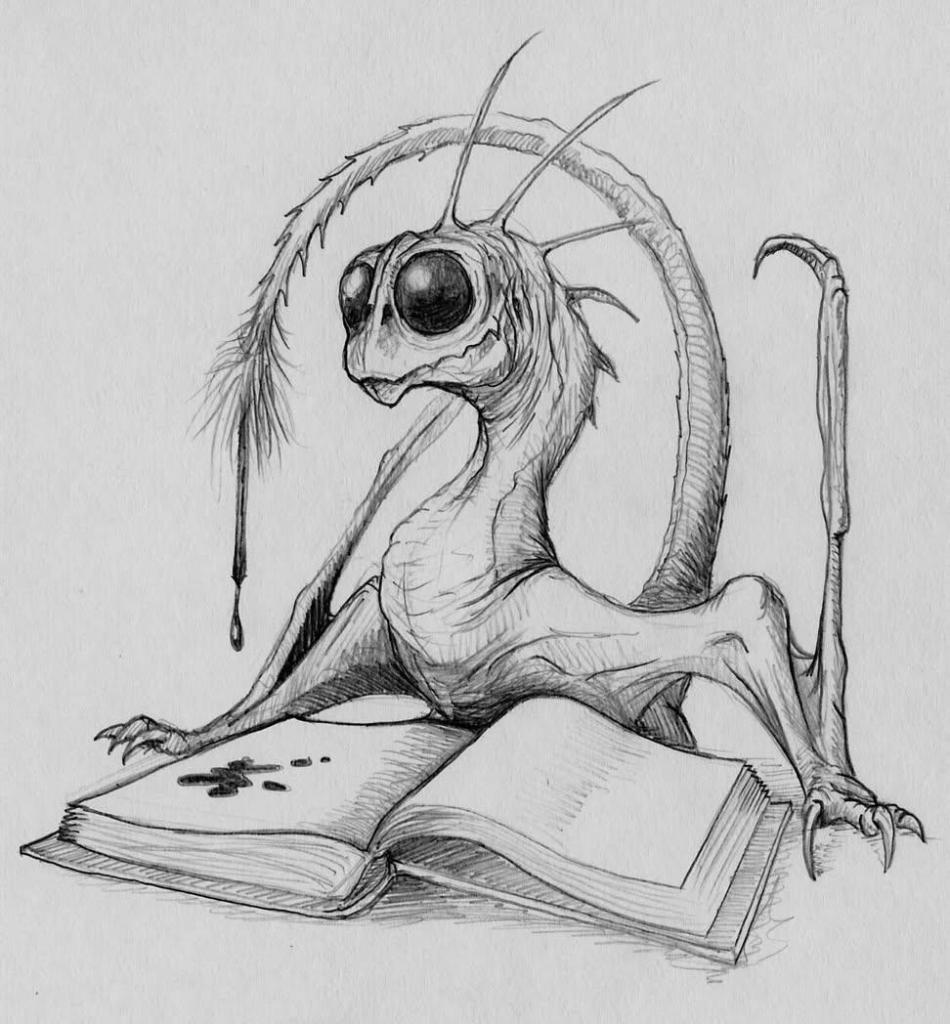
Inkling Dragons are thought to be related to pseudodragons, but where the pseudodragon is a wilderness lover the inkling dragon is generally an urban drake that enjoys being surrounded by books, scrolls and pamphlets.
Generally the size of a large rat or small cat inkling dragons can be mistaken for an immature jaculus drake. As all dragonkin hoard something, an inkling dragon is consumed with the pursuit of knowledge and writing, similar to paper drakes.
An inkling dragon without a companion can be found in libraries, universities, bardic colleges and wherever records are kept. Some are creatives writing fiction and song. Others are historians, tracking the world through the written word. At least one inkling dragon is known to only write in mathematics. This inkling dragon, Aymon, is a friend of transmuters, tax collectors and merchants often working as a clerk or calculator.
The Inkling Dragon was created as part of a limited commission in the upcoming book Dragons of the Dwindling by Dragons of Wales (Andy Frazer). Follow Dragons of Wales on Instagram, Threads and Mastodon. Support Dragons of Wales on Patreon.
Inkling Dragon companions
Frequently inkling dragons and writers bond over their love of the written word. Sought after by many wizards and writers, an inkling dragon chooses their companion as much as their companion chooses them — the tiny dragon has to find the work engaging and relevant to their own writing.
Art by Dragons of Wales in the forthcoming book Dragons of the Dwindling
Inkling Dragon stat block
Inkling Dragon (CR 1/4) Tiny Dragon
Armor Class 14 (natural armor, small size) Hit Points 8 Speed 10 ft., fly 30 ft. Perception 11 Stealth 12 Resistant none | charmed Senses darkvision 30 ft., keensense 10 ft. Languages Common and four other languages (or cultures)
STR
DEX
CON
INT
WIS
CHA
-3
+2
-1
+4
+1
+1
Heightened Senses. The inkling dragon’s Perception is 20 when perceiving by sight. Ability checks for Perception using sight use Intelligence.
Magic Resistance. The inkling dragon has advantage on saves against spells and other magical effects.
Limited Telepathy. The inkling dragon can magically communicate simple ideas, emotions, and images telepathically with any creature within 30 feet of it that can understand a language it knows.
Copying a Spell into the Book. When an inkling dragon or its companion finds an Arcane spell of 1st circle* or higher, the inkling dragon can add it to a spellbook if it is of a spell circle the companion can prepare and if they can make time to decipher and copy it. For each circle of the spell, the process takes 1 hour with no gp costs. Once the inkling dragon spends this time, the companions can prepare the spell just like their other Arcane spells. Copying a spell from a scroll into a spellbook doesn’t consume or destroy the scroll. Non-magical writing is written four times as fast when compared to humans. The inkling dragon produces ink from its tail as long as it isn’t at level two exhaustion or higher. * Black Flag uses circle as D&D uses spell level.
Ritualist. An inkling dragon with its own book can be a Ritualist, per the Black Flag Talent. The spell source is Arcane. Intelligence is their spellcasting ability. The inkling dragon knows one 1st circle ritual (typically Identify). If the inkling dragon is a companion to a spellcaster it can learn rituals at the same circle and source as their spellcasting companion.
1st circle Arcane rituals
Alarm
Create Familiar (these can only be common beasts)
Identify
Illusory Script
Unseen Servant
ACTIONS
Sting. Melee Weapon Attack: +4 to hit, reach 5 ft., one creature. Hit: 4 (1d4 + 2) piercing damage and the target must succeed on a DC 11 DEX save or be poisoned for 10 minutes. If the creature fails the save by 5 or more, it is stained by ink per Ink Stain below. This staining does not count against the number of uses per day.
Ink Stain (1/short rest). On a successful sting the inkling dragon can mystic mark (Ranger) one creature. While a creature is marked (including for the attack that triggered the mark), the inkling dragon and allies deal an extra 1d4 damage to it (of the same damage type as the weapon) each time you successfully hit it with a weapon attack. A marked creature can use an Action to remove the Ink Stain. An inkling dragon that is a familiar or companion to a character may use this ability proficiency bonus (of that character) times per day rather than once per short rest.
Somewhat overshadowed by the release of several high-fantasy systems not based in 5e D&D is that Wizards of the Coast has two starter sets, a two-book/three-pdf Forgotten Realms set, and Eberron expansion coming out from September through the holidays.
Additionally, other 5e systems inspired by D&D are also cranking right now.
There’s a plethora of choice, right as genre TV’s most D&D related property is coming back — Stranger Things season 5 releases Thanksgiving, Christmas and New Year’s in the U.S. Several of the early monsters based on Dungeons & Dragons are making a comeback.
Your normie (non-RPG) friends may be interested in the game again thanks to the combination of product releases, the Mighty Nein release, Stranger Things and the general zeitgeist around being big heroes with power in a world where that feels missing.
What game or books are the right system for them right now?
If you read Full Moon Storytelling it is likely that you are a DM/GM. It’s also likely that you lean towards 5e D&D. That will be the focus, with a small discussion of the other systems capturing attention (million dollar+ Kickstarters and the like).
Are you the GM/DM?
Go with what you like best, what fits your world, and be welcoming. Cut back on house rules and homebrew, at first, as the people who are new to the game can be overwhelmed with normal rule sets that can stretch to 1,000 pages.
Fold the new invitees into your world by asking them what they enjoy about high fantasy roleplaying. Finding out what your table’s Appendix N always helps, but it is the most helpful knowing what someone new (or returning from long ago) to the hobby wants.
If they want something simple, but familiar like the D&D of the 80s, but modern there are a few routes. Sticking with 2014 5e one can still get the older starter sets from Target or Amazon. Dragons of Strormwreck Isle is under $16 at Target online, and some physical stores may have it. Check with your local gaming store to see if they are offloading old product.
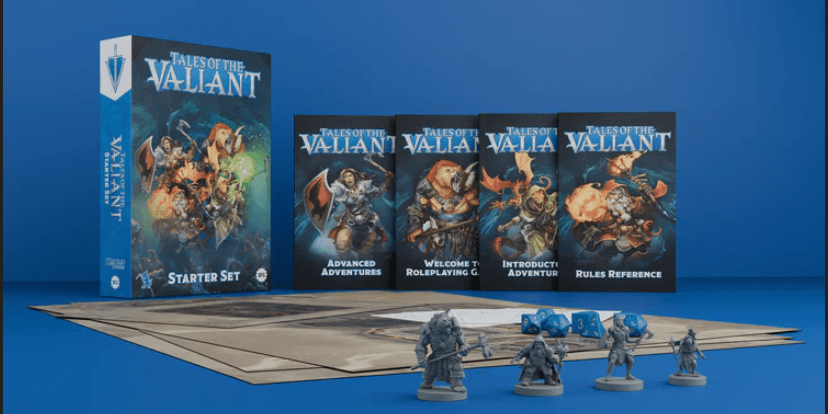
You can also intro them to 2014 via Kobold Press Tales of the Valiant Starter Set. It is under $14 at the time of publishing. The primary differences between Wizards of the Coast 2014 D&D and Tales of the Valiant lies in Tales having character creation that separates nature and nurture, luck replacing inspiration and the insertion of unique abilities on every monster.
I’d recommend Tales of the Valiant over 2014 D&D because of those changes, even if it doesn’t have the branding your friends expect. It also comes with minis! If Stormwreck Isle is 5.1 5e, ToV is probably 5.3.
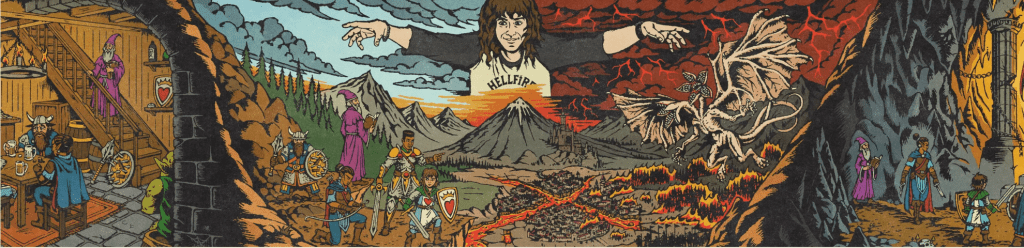
Stranger Things: Welcome to the Hellfire Club
Maybe your friends didn’t get into D&D from Stranger Things season 1, or 2, or 3, or 4. Or maybe they did, but didn’t have the time, energy or mental space to play the game.
Welcome to the Hellfire Club uses Wizards of the Coast’s modern take on starter sets — lots of tokens, handouts, cards and a written approach that blurs the line between board game and roleplaying game.
modern take on starter sets — lots of tokens, handouts, cards
The presentation includes a look that borrows from 80s nostalgia as expected. The four adventure books include trade dress that would make Gary Gygax and TSR proud.
This is the second starter set built out of Stranger Things by Wizards of the Coast. Both lean heavily into using the voice of the character from the show that was the featured DM, lean into the mythology of the TV show with its ‘not quite D&D monsters, but monsters that middle/high schoolers would think are D&D monsters.’
The first Stranger Things set was rather linear in nature, which fit the times and works fairly well for people newer to roleplaying. Welcome to the Hellfire Club uses 2024 5e D&D rules.
D&D Starter Set: Heroes of the Borderlands
Similar to Stranger Things pulling out 80s nostalgia to pull people into its world, Wizards of the Coast uses Dungeons & Dragons most popular adventure from the foundational period to inspire its new general purpose Starter Set.
Keep on the Borderlands is now Heroes of the Borderlands, with three adventures. Using 2024 5e D&D’s rules, card-based character creation, tokens and maps, the intent of Heroes is to again bridge that gap between board game night and RPG night.
Because it is 2024’s rules rather than 1974s, the set is massive. Those three little folios that could fit in a small lunchbox are gone. Instead Heroes has more than 400 cards and tokens, a quick start, a set of rules, and three adventures.
The game of D&D is simultaneously more complex and more approachable than it was in the 70s and 80s. Being a more pervasive part of the culture is part of that. Also the decades of exposure to computer RPGs changes how one approaches teaching the game.
Forgotten Realms expansions
A massive two-book, three-digital book expansion coming with the brilliant marketing around “The Realms will know your name” these books aren’t necessarily great for first timers to tabletop roleplaying, unless…
You know people who were heavy into the lore of Baldur’s Gate 3 and/or D&D: Honor Among Thieves and/or the once dominant fantasy novels set in the Realms. Those legends exist within the expansion, but the point of D&D and RPGs in general is to tell your story.
Only dive into this if you are being joined by people who absolutely love those non-tabletop versions of the Forgotten Realms. These expansions include 50 micro-adventures that fit an on-the-fly DM rather well (similar to those in the 2024 DMG).
Those playing with your classic group you need little guidance. If you are using the 2024 D&D rules, or at a table that permits a broad swath of 5e rules, the expansion is handy if you want to borrow factions, subclasses, new species and nuggets of lore to insert into your homebrew.
In total the Realms expansions add about 30% more character creation options while dramatically expanding the story through the lore expansions.
Eberron: Forge of the Artificer
High fantasy doesn’t have to take place in a world that’s pseudo medieval/Renaissance and Euro coded.
It can also include pervasive magic, spread widely among the populace in a world that echoes tropes related to early Industrialization with great Houses, lightning rails, elemental airships and a ‘war to end all wars.’
That’s Eberron.
Forge of the Artificer is a lightweight updated to the setting originally invented by Keith Baker.
Don’t get Forge of the Artificer unless you already have Rising from the Last War or you really want to have the magitech Artificers at your table or you are a completionist. I’ll be getting it for the first two reasons. I’m currently playing a goblin Artificer.
The Artificer in Forge is updated for 2024 with a brand new subclass as well. From what was in the Unearthed Arcana developing this coming version of the Artificer it looks to have the quality of life improvements I would expect.
Other RPGs
LevelUp
LevelUp is built on the 5.1 5e chassis, but advances it. This does make it a more complex version of high fantasy role playing. Some of the greatest improvements come from expanding the social and exploration pillars. This helps tell a wider variety of stories. Like every offshoot of D&D from the 5e era it separates nature and nurture.
There’s now a Starter Set available. Yes, it has tokens and multiple adventure, because that’s what modern starter sets do. EN Publishing’s Starter Set is an excellent way to try on a different version of the game you already know.
Cosmere RPG
If you enjoy Brandon Sanderson’s writing you might enjoy the Cosmere RPG. It is not based on 5e. It is the highest earning RPG kickstarter of all time.
Cosmere is beautiful, complex and the most extensive lore heavy game upon release likely ever.
Draw Steel
While not the level of Kickstarter success of Cosmere, Draw Steel was still a massive earner. The design team from MCDM is mostly people who produced wonderful 5e products, but are now releasing a system that emphasizes combat (tactical, heroic, cinematic) even more than D&D. The rules are crafted so that the feeling of conflicts is a reminder of watching a movie or TV show’s fight scenes.
Daggerheart
If Draw Steel is inspired by D&D, but wanting to be more combat, Daggerheart is inspired by D&D, but wanting to empower more story. Like Draw Steel and Cosmere, Daggerheart is a wholly new system. Most simply defined there is a Hope/Fear mechanic attached to the double-dice roll of players. Additionally it covers more ground about how to communally create the worlds and social interaction. Coming from Critical Role’s Darrington Press Daggerheart is designed to showcase the types of stories Critical Role excelled at.
Similar to Cosmere and D&D there is a wealth of media associated with it already — with more coming from the media arm of what was once a D&D actual play, but is now a multimedia company.
There are plenty of other games too — listing them all is foolhardy. Pathfinder and Starfinder, Legend of the Ring, Warhammer, Shadowdark and the list could go on.
But the zeitgeist right now seems to be focused on 2024 D&D versus a few upstarts with million dollar or more crowdfunding campaigns all coming out in the second half of 2025.
Over the past decade the 5th edition of Dungeons & Dragons grew three main offshoots from its original 2014 release by Wizards of the Coast. These three trunks are all now in the Creative Commons thanks to Kobold Press’s announcement this week.
A5e is the Systems Reference Document for LevelUp, from EN Publishing. This branch of 5e places much greater emphasis on social and exploration, while also being a more complex combat engine. It’s “advanced” 5e.
2024 D&D by Wizards of the Coast (the 5.2.1 SRD) is an evolution of the most popular version of the game in history. It adds minor layers of complexity, and removes most bioessentialism.
Now, Black Flag, the SRD for Tales of the Valiant is also in the Commons under the CC BY 4.0. The primary changes within Black Flag are replacing Inspiration with Luck, adding Dread and similar to A5e uses both nature and nurture to define an upbringing.
All three modern offshoots add a unique element to every monster. Rather than have merely have bigger numbers, monsters do something different — a Commoner in Black Flag has Angry Mob, while in A5e Commoners have a Stone (they can also be a Group) and in 5.2.1 they have Training.
What can a DM/GM/designer do with all four in the same license?
I am not a lawyer. Nor am I your lawyer. Use an actual lawyer if you have questions and are publishing for money.
Read all relevant SRDs as well as their related FAQs.
Find the place you want fiddle with and become an expert at that before you try to be an expert at everything.
At your home table, borrow liberally from every system. If you don’t find yourself handing out 2014 Inspiration and don’t like 2024 D&D’s mechanical implementation, use Luck from Black Flag. Use everyone’s monsters — they’re balanced enough for the elastic system that is 5e — your players will have fun interacting with different commoners doing different things.
Maybe you’re thinking “that’s nice advice Dave, but what are you going to do?”
Each of the main trunks of 5e do something different from the 2014 version of the game. That’s good! Your table can use a Background from any of the modern versions and there will be no balance issues. That means dozens of more origin stories for your heroes.
For myself it means my eternal project becomes a simple project. A few dozen new Backgrounds with methodology to fit in all four trunks of 5e.
Custom Backgrounds for 5th edition Dungeons & Dragons
This week the Tinker is my most popular Background. Tuning it for each version of 5e doesn’t take much.
2014 5e by WotC
It’s already released, but the key point is the feature “I Can Fix It.” The feature helps in exploration situations, mostly, as it means the Tinker will usually have a way to MacGyver there way through a problem even if they don’t have the proper supplies.
2024 5e by WotC
If you leave Ability Score Improvements within the Background rather than have them float the Tinker would choose between Dexterity, Intelligence and Charisma.
Connections – Tinkers might know a caravanserai, an innkeeper, a ferien, a smith, a group of bandits, a sergeant from a warring nation, a local farmer, a maker of fine meed, a faerie that’s a cheesemonger.
Memento – Tinker memento options could include a letter from home, a chapbook of poetry, a metal they’ve never been able to bend or smelt, a strap of leather from their first failed project, the stein from their favorite inn, or a book of cantrips though they don’t know any.
Adventures and Advancement – A Tinker who repaired a notable authority’s broken item may be granted a writ of access granting the Tinker expertise on Persuasion rolls.
Feature – same as the original on Full Moon Storytelling.
Now, these examples are quick looks at a future project that will include the score of Backgrounds already on the site, plus the four Everflow specific Backgrounds that didn’t get their own entry. And more as my reading expands.
With four versions of 5e available in the Creative Commons (CC BY 4.0) how will you create for your table?
It’s also a space full of unpublished drafts. I wouldn’t want to see what drafts I lost when Sounder at Heart left SB Nation. I can still check what SaH has of mine in drafts, but I don’t dare check that. I recently checked my work drafts and even there I have unpublished drafts. Here there are unpublished drafts.
Anyway, I have to blog.
But also I let things get in the way of publishing. Which is frustrating.
It does mean that I don’t need to shave the yak like my friend, but sometimes, maybe I need a bit of a reset. That’s a part of what Lore Collage is. It compels me to write more. Even if I don’t think my words are worthy — I press publish.
While most of my role-play is centered around 5e and similar systems, I like the Ennies as a way to keep me aware of new systems, creators and aids. The 2025 nominee list includes two products I’ve already used (DungeonScrawl and Hero Forge Kitbashing).
If you live in the Puget Sound and Columbia Basins you don’t need to worry about the tiny earthquake swarms under Tahoma. If you are creating a fantasy world, add earthquake swarms as a natural hazard, make them big. See how the characters react to things they cannot fight. Then make them fight an earthquake swarms.
Making Enemies is the next book from The Monsters Know What They’re Doing creator Keith Amman. The way Keith approaches lore based in the short story of a stat block makes me excited to see what he does when he’s teaching me how to make the stat blocks.
Creating an RPG is hard. It takes either an immense amount of talent or a network of people. It probably takes both. PJ Coffey gets into the details of all the tasks that go into publishing a work. I’ve worked with PJ on two of their projects.
A few weeks ago I spoke at a risk intelligence conference about using role playing games as a teaching aid for non practitioners. My search algorithm is working. Both Rascal News and Military.com put out stories that will be part of my next work presentation on the same subject.
There’s always more to learn about sports, and I’m already trying to figure out how to insert tuj lub into my D&D games — I’m big about that too.
Kobold Press has a deal on shipping right now. I’m looking at the Labyrinth Worldbook. It is full of ideas I can borrow into the World of the Everflow. Which would be funny since as a backer for Tales of the Valiant I pitched the World of the Everflow to be included.
Handily, SlyFlourish has a review up.
Creating
Alignment is too simple. Personality traits, ideals, bonds and flaws is too complex. Use short form personality instead — 2-6 words that describe your character.
Likely inspired by this interview over at Flipboard, I decided to bring back Lore Collage. This is a weekly look at things I read/watched/etc. The focus will be on building and playing in a mid to high fantasy world using 5th edition D&D and related rulesets.
Reading
Beyond the Gates: Where Dungeons & Dragons Meets Sacred Community(Roll 4 Joy) Once upon a time I was active in a church youth group and also actively played D&D. I wouldn’t have dared crossed those interests. I’m happy this group now feels comfortable to do so.
Avoid Removing Player Agency (SlyFlourish) This is the money quote “Players want to do stuff. They want to use the tools their characters have to interact with the world.” The article is a good reminder that the lack of agency should be used intentionally and rarely.
New Monster – Dreadful Tree (Sea of Stars RPG) My Sunday campaign, where I play the smog-goblin Xabal, keeps running into various blights. We can always use more blights. Recently Sea of Stars also wrote about adding weaknesses to monsters to add in their story.
Design Diary with Richard Green, one of the authors of Labyrinth Worldbook (Kobold Press) Green writes about the setting expansion — the Labyrinth Worldbook, which was cooperatively created for Tales of the Valiant. Even if you don’t play ToV/Black Flag, everything in the book can be used to create a new multiverse for your own world.
Watching
While the era of peak high fantasy may be fading away, you can still dip back into low to mid fantasy via shows like Merlin or Cursed. These lower magic shows do a great job of establishing a world where magic is special, powerful and intimidating. They also provide a slice of life for the zero-to-not-yet-hero portion of play.
Creating
For my upcoming Ferments-set nearly-zero prep game I put together an encounters table. The intent is to include things that aren’t only combat and that fit the tale of the setting.
The magic of this is you don’t even have to use Tales of the Valiant as your base system to add this to your 5e world. The ritual system is essentially 5e D&D neutral.
Take Divine Ritualists as described. They look like, and are mechanically supported like, miracle workers at a temple. The Primordial Ritualists are like less powerful Tom Bombadils.
I’m one of those passive backers for most projects. For Tales of the Valiant I sent Kickstarter my money to send Kobold Press and then I waited. I did this because I have enough of their products that I know I will use them. Many of their dragon variants are part of my world right now.
That also means I get fun surprises for their intermittent reveals, like the Eonics.
This new lineage (their current term for race) is a bunch of time travellers who lost their ways on the time stream, now existing your D&D/Black Flag/5e world without the ability to get back to their normal time.
They do still have minor time travelling abilities. That’s where things get fun. Their core abilities are about possibly knowing the past, their expectation that things are going to go wrong and a skin that’s been scarred by time streams. Those combine to have fun uses as monks, rogues, bards and maybe even an off-brand barbarian.
In Black Flag (Kobold Press’s SRD) and Tales of the Valiant characters are born into a lineage and grow via a heritage. Heritages are similar in power to 5e (2014) subraces, but are open to any species/race/lineage.
The eonic-themed heritages immediately become part of my world. This is time-hoppy funness.
Time-lost Drifter
Those raised as drifters have a special belt and some exhaustion based mechanics with a future-self time echo. Plus, they are hard to kill. Their body comes disconnected from time.
Inheritor of the Future
The inheritors get a super-advantage Help action and a powerful time warping staff.
Mirror Worlder
These peoples can see alternate realities and grab things from them. This is a classic trope in fantasy that hasn’t been embraced much in 5e, until now.
The Eonics and all of their heritages fit in the World of the Everflow as the peoples from the future who went back to when the gods shunted off magic from the World. They would be 3,000 years in the future from the current games, popping into a world that they helped break and create at the same time.
With these and the Tales of the Valiant goblins I’m very excited to bring more variety to my table.