Tag: maps

  • Expanding character personality and 11 other things to help you game

    Expanding character personality and 11 other things to help you game

    Roleplaying is more than a stat block. It’s that stat block, plus the personality of a character you assume for however that game lasts. Early in D&D and the hobby’s history that personality would be as simple as the class, race and maybe alignment. That resulted in a pattern where many characters had the same personality.

    As alignment faded, and especially during the surge in actual plays, personalities became vibrant. Original 5e even tried to reward personality using the traits, ideals, bonds, and flaws system plus alignment. It was too much to handle for a few hours a week of fun.

    How can we simplify the personality?

    By using archetypes from fiction — these pull at our souls because they are common. BUT. A character with a singular archetype is also boring, just like the idea that every single lawful good Paladin has the same personality is boring.

    The most recent episode of Scriptnotes went over ways to incorporate archetypes in screenwriting.

    It’s the intersection of two or three archetypes that makes a character interesting. They need positive and flawed attributes, and tension.

    Their archetypes are a version of short-form personality. Ejecting trope-y D&D concepts by force and giving your character simple ways to remember who they are in their soul is easy — especially if you use their card system — which I’m backing.

    Two positive attributes, one flaw; both in a single word — you can remember that. You probably are already playing that way!

    Xabal, my goblin artificer, is quick-witted, kind, and overthinking.

    That’s more interesting than chaotic good.

    I started to listen to Scriptnotes because it helped me be a better DM and rare short fiction writer, not because I think I’ll be in a writer’s room someday. And now they’re both working on D&D TV projects. Craig Mazin is working with HBO on the Baldur’s Gate series while John August is working on the Ravenloft project. Almost every episode mentions D&D.


    Other things to help inspire your game, help you play, or help you design

    Any Human Ever creates short bios based on the history of our world. It can be a start to seeding interesting NPCs.

    Dyson Logos Small Shop Series — now with 14 small shops in a market road of a city, these help me more than dungeons.

    Scipio’s Resources for RPG creators — bookmark this if you ever think you are going to publish for pay. The assembly of resources is excellent.

    British Columbia has a floating island that keeps disappearing. Welcome to spooky season. Floating islands are fascinating enough, but what if it pops in and out of the fey realms regularly? What if it isn’t haunted, but everyone that lives on it thinks that the village on the edge of the lake are the haunters? This could be a fun one-shot.

    You know I have strong thoughts on using cultures rather than languages. Two other bloggers riffed on those concepts over the summer.

    All of us agree that you should use Culture rather than Language at your D&D table. Pick the system that works best at yours — I may run Melestrua’s version in my next campaign.

    Dice are six thousand years older than previously thought, and American. Remember, your D&D tech doesn’t have to mirror Western and Central Europe. It can, but even then, it doesn’t have to mirror a single era.

    I love Adempz idea of using Success Thresholds rather than single-roll DCs. Having ways to expand the mechanical heft of a social or exploration encounter is good! This is a variant on stealing Blades in the Dark clocks, basically.

    M.T. Black fleshed out traveling in a way I need to use at the table. D&D travelling used to be a significant element of the game, but now is frequently ignored. Swift, simple mechanics that amplify story and setting like Black does here are perfect.

    Traipse offers a new way to think about commonality via 1, 10, 100000. Within the World of the Everflow dragons in the Age of Myths were closer to 10, but in the modern era of Uprising and Rebellion they are 100,000 — extremely common, almost like humans. Those are two different levels of danger.

    What links should I include in the next edition of Lore Collage?

    Fediverse Reactions
  • Using word-maps for quick reference during your games

    Using word-maps for quick reference during your games

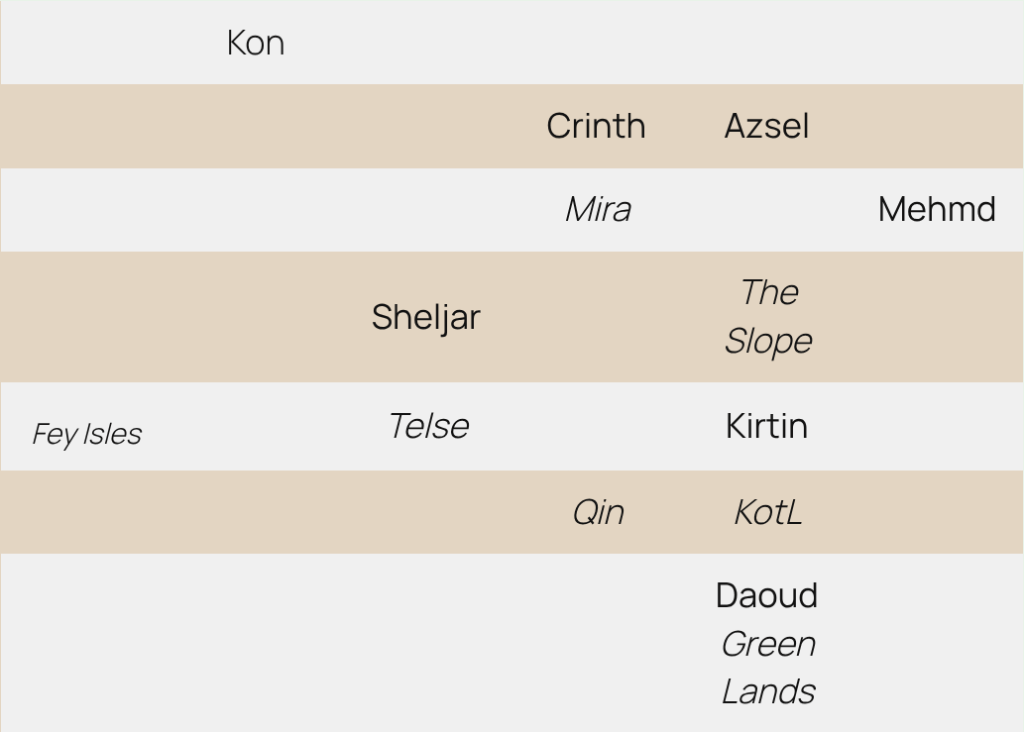
    You don’t have to be a map maker to make adequate maps for gaming. A map can be as simple as showing the relative relationship between distance and location of the important elements. Even putting a few words on a page can be a map.

    Take the word map of the Six Kingdoms. It shows the relative locations and rough distances between the various kingdoms, their major cities and the other lands that interact in the World of the Everflow.

    Word maps can also represent a homestead, village or neighborhoods of a city.

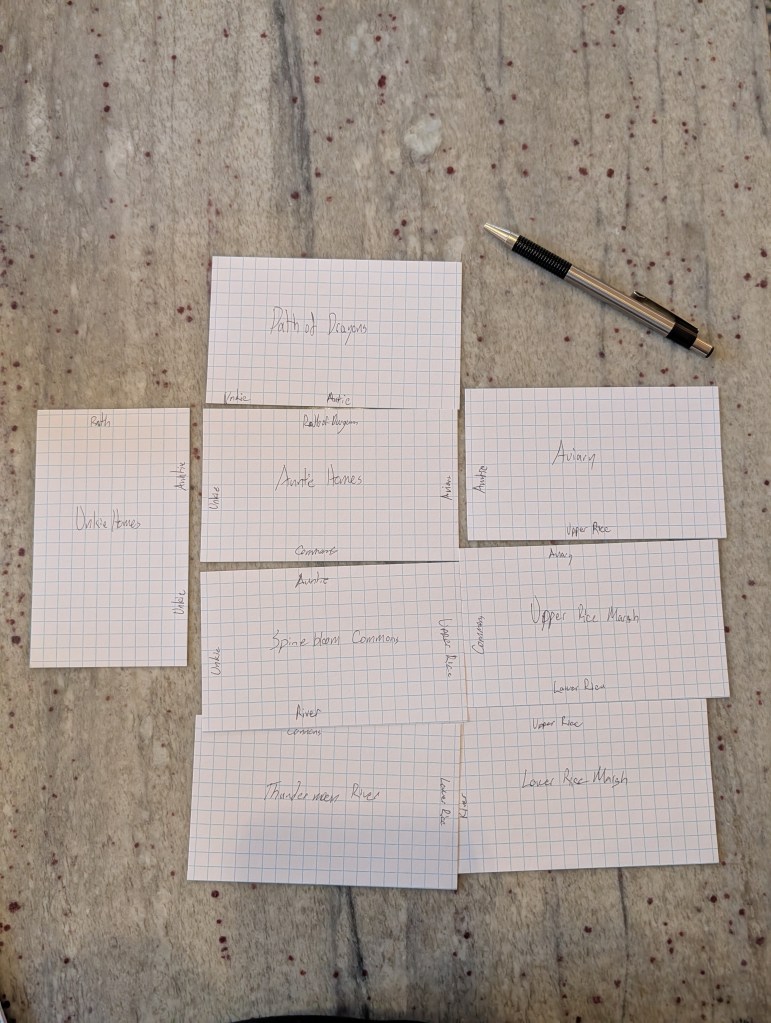
    The image shows a group of seven index cards laid out on a speckled stone surface. Each card features a grid pattern and contains handwritten text in pencil. On the top left, there is a small vertical card with "Path" and "Divide" written along its edges. Adjacent to it on the right is a horizontal card labeled "Path of Dreams" with "Prairie" and "Auntie Houses" along the sides. Below are three more cards: the left card reads "Prairie" and "Auntie Houses," the middle card reads "Spine Bloom Common," and the right card says "Upper Rice Marsh." The bottom row features two horizontal cards, one labeled "Thunder Maker River" and the other, "Lower Rice Marsh." A pen with a black grip lies horizontally above the cards to the right.

    Any player can take a quick glance and know what each location is and what they connect to within the compound. More thorough descriptions in a blog post and in the character’s notes, but these quick notecards reminds us of Spinebloom Farms at the table.

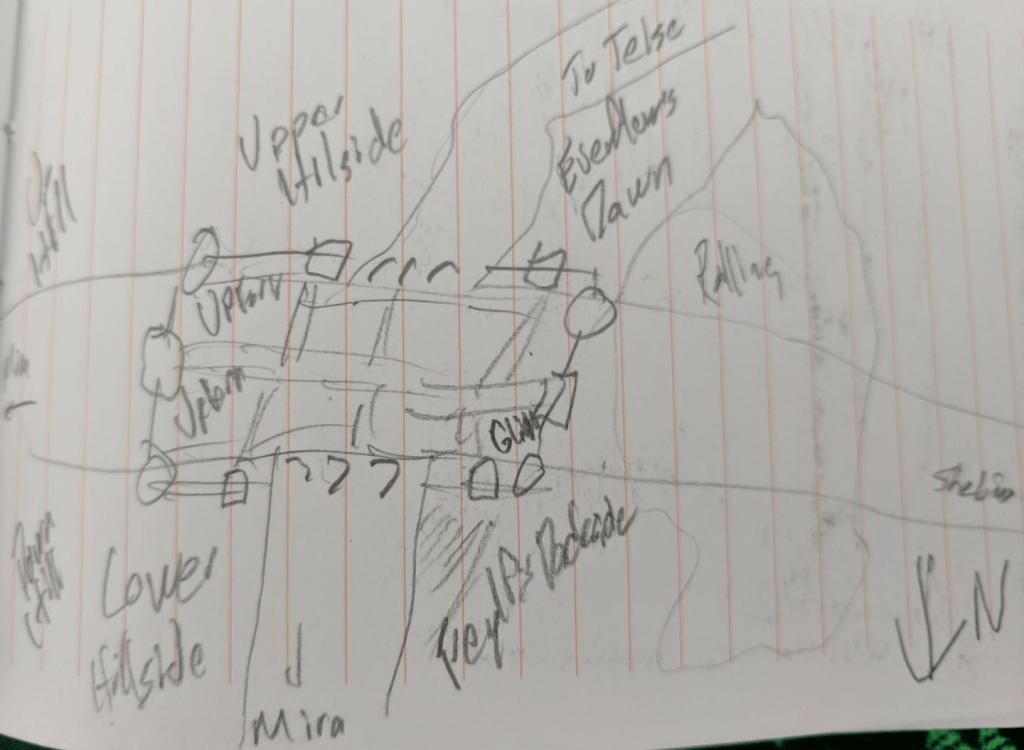
    The image is a hand-drawn sketch on lined notebook paper, depicting a rough map layout with various labeled areas and arrows indicating movement or direction. The map is oriented with "Up Hill" on the left and features several labeled sections, including "Upper Hillside," "Lower Hillside," and "Rolling." There are geometric shapes, such as squares and circles, possibly indicating buildings or points of interest, with some labeled "Upper," "GLAV," and "Verde Breezde." Lines and arrows point toward different labeled areas like "To Telee" and "Esedelens Tavern."

    Fort Ooshar is a bridge-town that turned into a fortress when Sheljar fell to the Necromancer. This quick sketch lays out the neighborhoods of the bridge-town, the gates, the fields and the nearby hills.

    Yes, a better mapmaker would be better. My favorites are Deven Rue and Dyson Logos. I support both via Patreon and use their works in my games.

    But sometimes I want something that is unique to my world. That leaves me with my lack of art. I then build a word map.

    Keys to making a quick word map.

    1. Decide on the central space
    2. Build outward using relative distance to represent a unit of time
    3. Include evocative names, especially when in tight focus
    4. If building a dungeon, point crawl or town having connective tissue — this can be a road, river, or other path
    5. Leave yourself space to build details and add discoveries

    Doing this as a player

    Old school D&D involved at least one player making highly detailed maps. But a word map may be all that’s necessary to prevent your party from getting lost. Using a room-and-halls word map by the player helps represent how the characters think.

    In essence you are channeling the concept of ‘turn left after the big red barn, go over Herringbone Bridge, take the third path’ into a simplistic drawing.

    These are quick, simple and can be done on a 3-by-5 card or as a sketch in something as simple as Paint, Slides, Canva or even in a Spreadsheet (the Six Kingdoms started as a spreadsheet).

    One of the special powers of the word map is that they’re quick. You don’t need to search for anything. It’s a sketch that can be done in a few seconds.

    Whether as a player or a DM this tool can help you understand your fantasy world better than without a map at all.

    Fediverse Reactions
  • Four ways to use Oleg Dolya’s new Neighborhood maps

    Four ways to use Oleg Dolya’s new Neighborhood maps

    There are certain DMs (me) who aren’t good at drawing and or mapping. For us, a few dollars a month towards various map makers helps us create our worlds. Even if you don’t commission specific works, the services of Dyson Logos (my favorite dungeons), Two Minute Tabletop (my favorite battlemaps), Deven Rue (my favorite regional maps), and Watabou (my favorite procedural maps) can add depth to your gaming sessions — even when you don’t use miniatures.

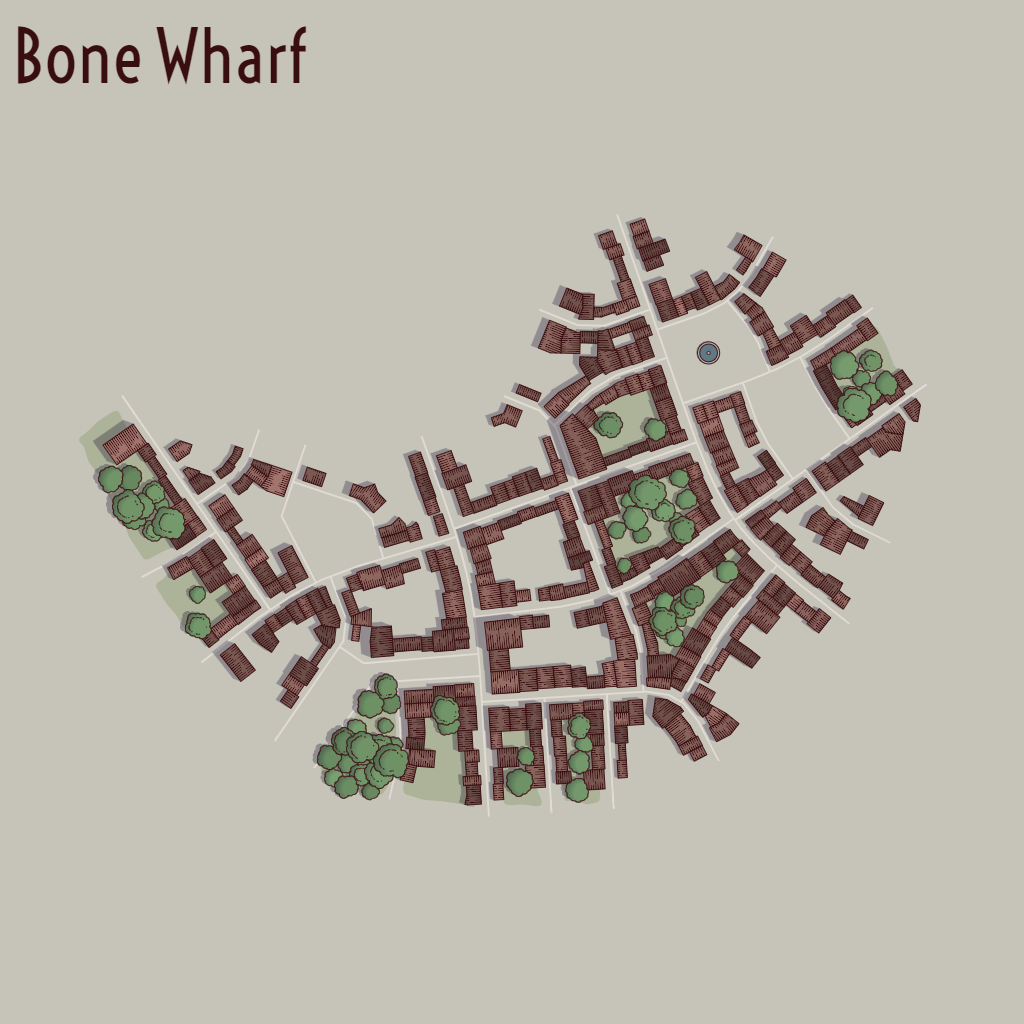
    Oleg Dolya, the person behind Watabou, just released neighborhoods.

    This is vital for me. Uprising & Rebellion takes place in large city. Having maps of districts and neighborhoods within that is important for the game. Being able to create one on the fly as my players head off script is vital. Players will always go off script. Just because you think they’re going to have a battle in the Docks doesn’t mean they won’t visit North Shore, the Ward of Mighty Trees, the University or Silk Row.

    Created using Watabou

    Will I have two or three of these printed out just for the flavor of the next neighborhood over? Yes.

    Here are three other ways you can use the Neighborhood maps.

    1. Stitch together an assembly of several of them to create a city. The unnatural gaps make perfect sense as mountains, lakes, rivers, etc. A whole city at this level of detail would be interesting. Make certain to use the same color set for each.
    2. Some of the generations for the neighborhood map make sense as compact villages. Yes, Dolya has a village creator, but those don’t have wells, fountains, and ponds in them. The neighborhoods can.
    3. The map can be an underground cavern in the Dwarven city trope. First shift the colors using the ‘0’ key to one that has some darkness to it. Pretend that the trees are mushrooms, and that the streets are the passageways and tunnels to the rest of the world. Bone Wharf is now a Mountain Dwarf city.
    Created using Watabou

    The key to using a procedural map is that you aren’t going to get exactly what you want, or even close to what you want. You are going to get a usable map, fast. Let the oddities of the creation guide you towards creating the people and the space. That long road running from lower-left to upper-right on Silk Row? That’s obviously the Silk Row itself. The fountain is where the various traders and merchants gather to discus their deals. The light smattering of trees are for the very richest of households, those that raise silkworms in the climate that isn’t proper for them. There are some roads that run parallel to the Silk Row, those are for supporting businesses, not the wealthy traders. The non-enclosed squares like the large one up-and-right are areas that are pack animal friendly. You are the DM (or when you use as a player to describe a hometown the creator). Let the algorithm take you to answers you could never find on your own.

    What else do you see in Silk Row? Why is the dwarven city called Bone Wharf? What makes Bone Wharf unique?

  • Library D&D and other playdates during the pandemic

    Library D&D and other playdates during the pandemic

    Throughout the Covd-19 pandemic libraries and community centers have had to find new ways to keep their communities connected and informed. Virtual D&D has been quite popular with libraries around the US and Canada. Now that pandemic-related restrictions are being reduced, in-person play of Dungeons and Dragons is starting to ramp up. The game has been especially important for school-age children who lose the connections that schools traditionally build.

    Newspapers, magazines, and websites around the world are covering the booming phenomena, and not calling it a Satanic ritual that leads to murder.

    Today’s Lore Collage is focused on playing the game in libraries, other community spaces, and advice for players and dungeon masters.

    Photo by Janko Ferlic on Pexels.com

    Library D&D

    The Manhattan Public Library recommends finding inspiration in the Player’s Handbook and Art & Arcana.

    Other community events

    General D&D advice

    With so many people picking up this intimidating hobby there are a lot of questions about how to play. Much of that can be answered by watching or listening to actual plays on YouTube, Twitch, or your favorite podcasting app. But, some people are like me, readers, so here’s some general Dungeons & Dragons advice.

    Advice for players

    Advice for DMs

    Quick random NPCs are handy.

    As Always, Maps

    From Boing Boing, we discover a way that non-artists can create maps, which I need! Or just play the Legend of Zelda map.

    Maps don’t have to look like maps. They can be art that represents the scene and not just a place to move miniatures around.

  • 7 reasons I’m excited for Witchlight and Strixhaven

    7 reasons I’m excited for Witchlight and Strixhaven

    There was a ton of news about tabletop Dungeons and Dragons last week, and hints at much more this week. The Week of Legend Lore announced two new books, some Dark Alliance news, and the 300th episode of Dragon Talk included the announcement of D&D Celebration from Sept. 24-26. The buildup to Celebration includes a contest for the Best DM in D&D.

    D&D Live is being presented by G4 on July 16 and 17. That’s when the flood of details about The Wild Beyond the Witchlight will come out, and probable a few other tabletop D&D news items.

    On Tabletop Tuesday my focus is on the two new books, and what intrigues me about them.

    Strixhaven: Curriculum of Chaos

    From the product page

    Right up front, I have to admit that during the pandemic I turned into a near nightly player of Magic: The Gathering Arena. I’m already a bit familiar with the lore around Strixhaven thanks to that. The card game got me quite interested in the magical university. Seeing how it transforms into a D&D world excites me. But there are a few reasons I’m more excited for Strixhaven than I was Theros or Ravnica.

    • Coming of Age stories are common in the mage school trope. Whether you enjoy Winx Saga, The Magicians, or that more famous property all of them capture that middle school to college vibe of discovering who you are. That genre has not yet been a focus of D&D.
    • Zero-to-Hero tales are related to that, and D&D as a leveling game embraces those quite well. Strixhaven has a solid mix of card strength so it does this too (some other MtG planes focus on big mana and others on small).
    • The Space for Mundane Students lets those that aren’t magical join your party. Where Potterworld just uses the mundane as an excuse for discrimination and The Magicians basically ignores them, Strixhaven is more like Winx in that non-casters are included (even if only mildly so). These warriors and such help defend the school from threats. Not every D&D party member needs to cast spells.
    • I miss college (DLI). Those stresses were different than the stresses I have no. Exploring some of them through the lens of D&D will be fun, and different from how I explored them playing Vampire on the streets of Pacific Grove, CA in the mid-90s.

    Also, there’s an Unearthed Arcana testing out archetypes that apply to multiple classes. Each of them represent one of the five colleges at Strixhaven. SyFy has a newser covering the book and the UA subclasses. Tribality breaks down the power level of test.

    The Wild Beyond the Witchlight

    Alt cover by Hydro74 will be available in local stores

    The next adventure from Wizards of the Coast is a jaunt to the feywild. Details at this time are still fairly sparse, but there is a fey carnival run by Mr. Witch and Mr. Light, that parallels the carnival in Ravenloft. This is lower on my purchase spectrum, mainly because I don’t want to be tempted into spoilers for an adventure in which I want to play. But, I still want it.

    • The World of the Everflow treats dragons, elves, dwarves, gnomes, and other inherently magical thinking beings as Fey. Witchlight can help me refine those other-earthly mindsets for my world.
    • The pseudo-Victorian look reminds me of Carnival Row. Having literature and shows that echo D&D helps me embrace the themes. It also helps when you pitch the adventure to people who don’t know D&D.
    • Anthropomorphic animals are fun. Back in the early 90s I played Albedo. The first fantasy series I read to completion was Narnia. Sweet Tooth is one of the best fantasy series of the modern era. Players looking for angles based on those elements will probably have them as the UA released with Feywild in its title had a rabbitfolk and owlfolk (this is probably also going to be in Strixhaven).

    Polygon has my favorite newser on Witchlight. There’s more at IGN.

    There’s still more Van Richten’s Guide to Ravenloft reactions

    From the official D&D blog talking about how 5e Ravenloft is more an exploration of genre buy-in rather than a power battle between players and monsters, to a Nerdists guide to how to run horror when you don’t like horror, the book is still being unwrapped. If you need help understanding the Domains of Dread there is little better than Black Dice Society. Watch a couple episodes before you run a campaign set in the Mists.

    The book exploded into the best-sellers scene with a 4th place in non-fiction in week one.

    Odds and Ends

    There’s a new DM screen coming out.

    Yahoo! has an intro to D&D, which is eternally handy.

    Once upon a time the changes to Drow were expected to be the big news around D&D this summer. Those are now on the backburner a bit. They look intriguing.

    As Always, Maps

    Also, if you are a Patron of Deven Rue you can submit to have her make a map. Yes, I’m submitting, two areas in fact. One with be the bridge-city of Fort Ooshar and the other the region around Kirtin-on-the-Lake.