Tag: homebrew

  • West Thundermoon Trading Post, home the Maltunyns

    West Thundermoon Trading Post, home the Maltunyns

    Traveling the harsh lands of the Ferments? Find everything you need at WEST THUNDERMOON TRADING POST!!! Settled in the foothills of the Thundermoon Mountains a half a day’s ride west of Ourten, WEST THUNDERMOON TRADING POST is the go to location to find all of your hunting and travelling needs.

    Run by the Maltunyn family for generations, they’re knowledge of the local terrain, as well as their selection of only the finest gear will ensure your travels will be safe and comfortable. Or you could pick up some of the finest furs and rations provided by master hunter Velthuria Maltunyn, and her daughter Keesrah. If you need a quick repair, or even an herbal remedy or two, Cay Maltunyn has you covered.

    With the experience of generations, and a deep love of the land and air, the WEST THUNDERMOON TRADING POST is a must for any serious travelers of the Thundermoon Mountains. Visit the WEST THUNDERMOON TRADING POST today!!!

    You can find that brochure throughout the villages and homesteads of the Thundermoon Mountains in The Ferments.

    Keesrah Maltunyn, a human guide and drakewarden ranger with a raven named Crow, is the player character who calls the trading post home.

    The West Thundermoon Trading Post is about two days south by southeast from Orten. The post is on the southerly road towards a desert region. That road runs roughly parallel to the Thundermoon River. In the hills and mountains are a few fishing and hunting families.

    The Location

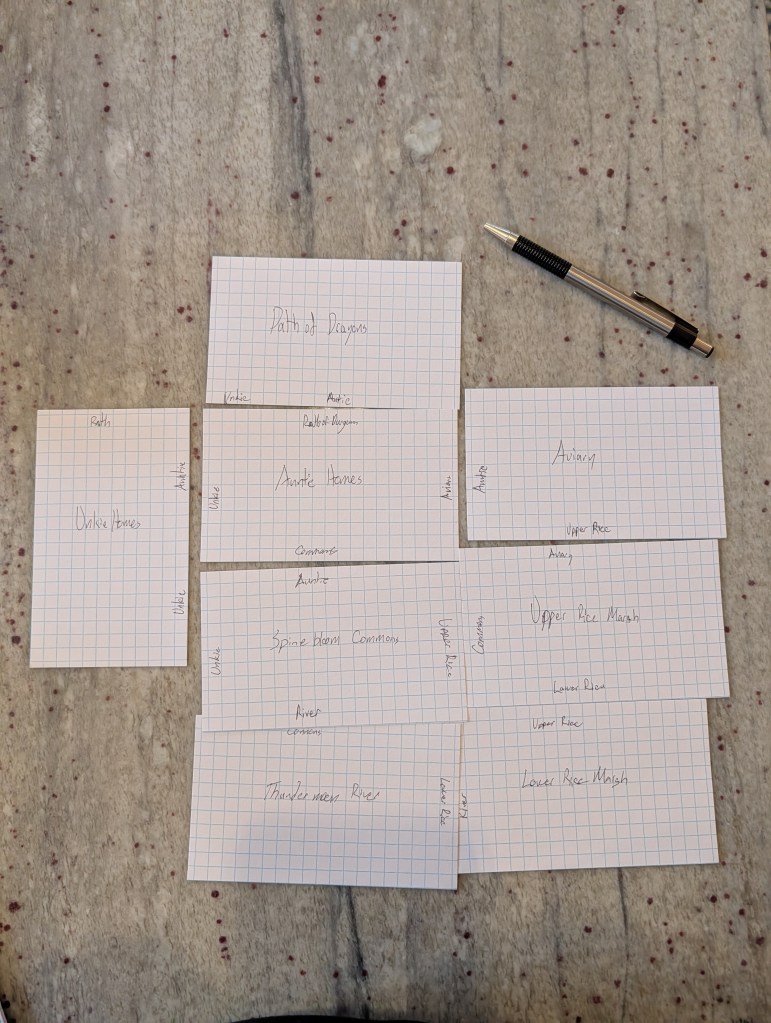
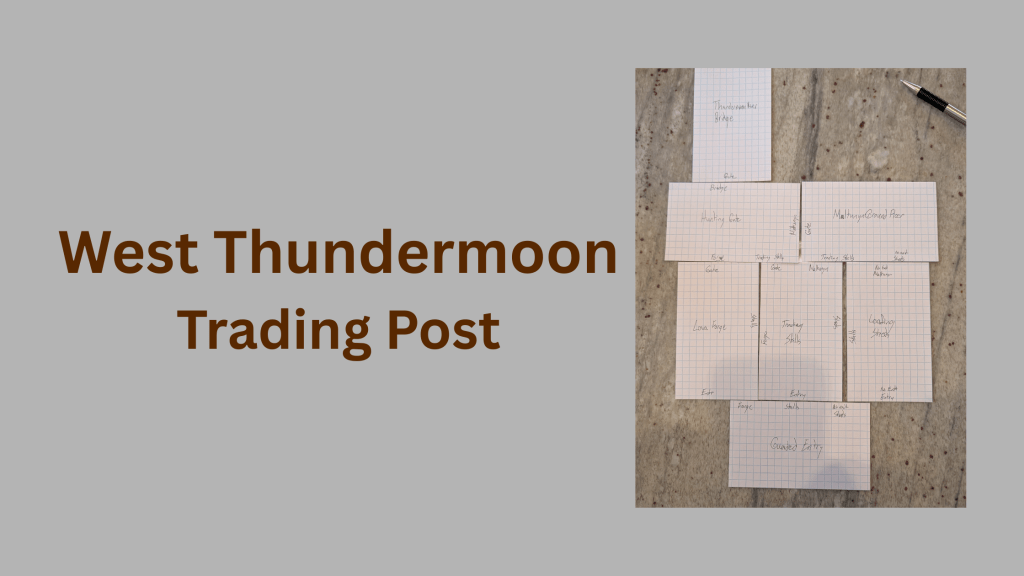
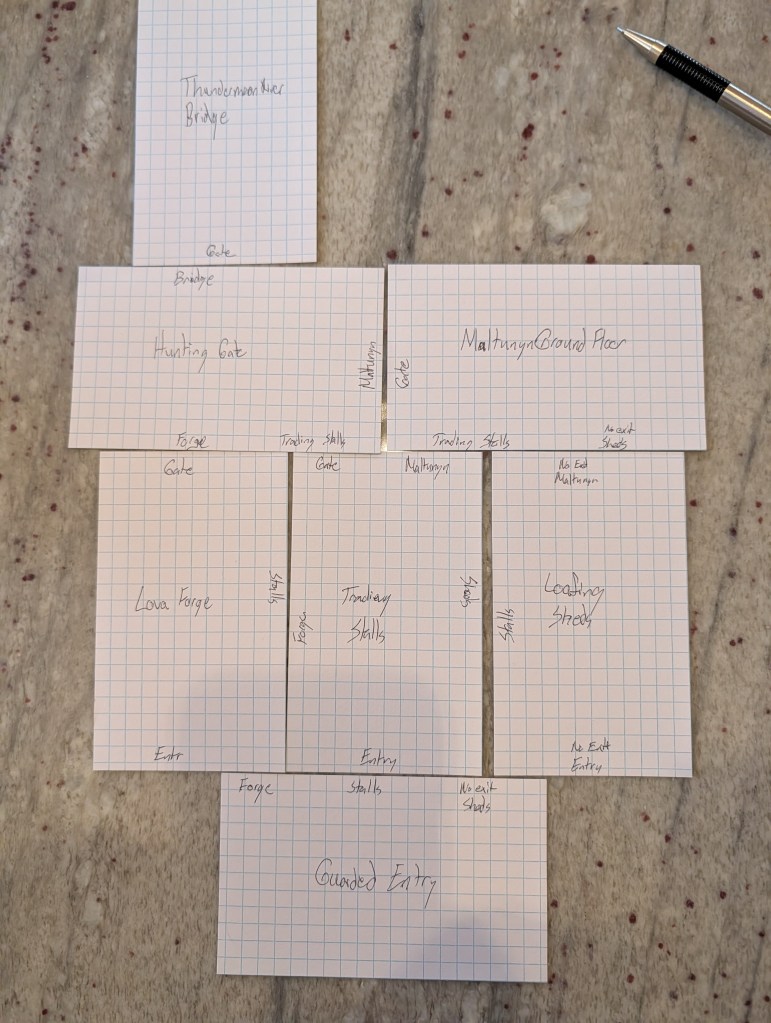
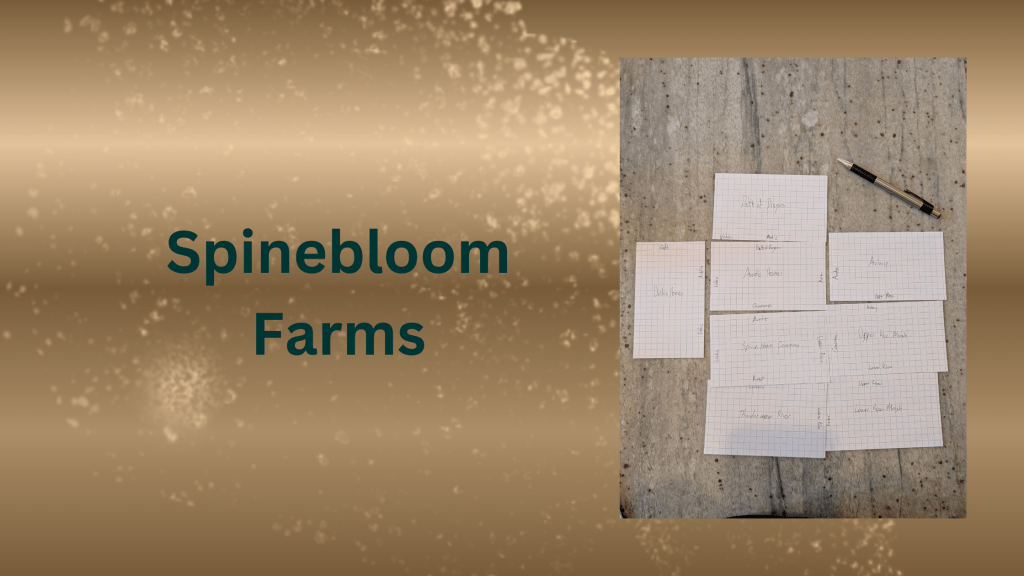
    The image displays a set of seven rectangular index cards arranged on a speckled stone surface. The cards have a grid pattern and are covered with handwritten notes. The cards are arranged in a T-shape with four cards on top and three below. Each card contains various textual labels such as locations and descriptive phrases. In the top row, the central card is labeled "Maltunyn Ground Floor," flanked by cards labeled "Bridge" and "Trading Stalls." The topmost central card features "Thundermoon River Bridge." Other notable labels on the cards include "Hunting Gate," "Lava Forge," "Guarded Entry," and areas denoted as "Stalls" and "Sheds." A pen is positioned at the upper right corner of the image.
    Zonal word map of the Trading Post

    Guarded entry

    A wooden wall surrounds the Trading Post. The entry is where all merchants and visitors arrive. There are two large doors, which are barred at night. A guard stand rises to the left of the doors, as one exits. It can hold one medium creature and grants them half cover. A ladder provides access.

    • Elemental affinity: None.
    • Hazards: Breaking down the closed door requires a DC: 15 Strength check.
    • Allies: The goblins and family can provide ranged or melee Militia Actions.
    • Max occupancy: Five medium creatures.

    The guarded entry connects to the lava forge, the merchant stalls and the loafing sheds.

    Lava Forge

    A small semi-open air forge where Cay works as a sometime smith. The heat and bellows are from an active fissure where magma surges underneath the trading post. Malk, the goblin captain, now helps out. Malk and Borkin also store their own clutter there, including the smog-buggy.

    • Elemental affinity: Earth, fire, lava
    • Hazards: Those knocked prone who fail their DC by five or more take 1d8 fire damage from the forge. Forced movement can result in the tools of the trade being knocked all over, turning the Lava Forge into difficult terrain. Oh, and beware of a lava flare — who knows when that will happen.
    • Allies: Cay, Malk and Borkin may be present
    • Occupancy: Four medium creatures.

    The lava forge connects to the guarded entry, to the trading stalls and the hunting gate.

    Trading stalls

    One large and two smaller open stalls sit in the large enclosed central space of the post. Various homesteads and outsiders come through with their wares on a seasonal basis. There’s a central fire pit with some large stones and simple benches frequently with a stew pot and hot beverages available.

    • Elemental affinity: Fire, air
    • Hazards: The cook pit can become a fire hazard, doing 1d8 damage to those who fall into it and setting their flammable gear on fire. It provides 10′ of bright light and 10′ of dim light at night.
    • Allies: Neighbors may be present depending on the season. They will almost always limit their help to rallying the Maltunyns.
    • Occupancy: 3 in the large stall, 2 in each small stall and room for 12 more medium creatures.

    The trading stalls connect to every other zone except the hunting gate.

    Loafing sheds

    Like everyone in the Six Kingdoms the Maltunyns have space for beloved animals. These sheds are designed for equines, canines as well as the rare bovine or more exotic companions. There are small cabinets for feed and tack.

    • Elemental affinity: Cold, air
    • Hazards: When occupied the animals could be feisty.
    • Allies: None typically
    • Occupancy: 7 medium creatures.

    The loafing shed connects to the guarded entry, the trading stalls and the Maltunyn home.

    Hunting gate

    Known for the gate that Caile leaves open it’s actually the place where Cay raises herbs. There’s also the gate to the hills where Keesrah and Velthuria hunt. It’s also a lower land, near the river.

    • Elemental affinity: Water, plants
    • Hazards: During heavy rains the mud creates difficult terrain. A rapid freeze after rains can lead to icy conditions.
    • Allies:
    • Occupancy:

    Thundermoon River bridge

    A few weeks ago there was a small wooden bridge over the river. Then the mephit mudslide took it out. Now a ford those that cross must be wary of mud mephits who settled in the area after the slide. Heavy rains may bring them back and upriver there is a threat that the open lava could change the river’s path.

    • Elemental affinity: Mud, water, maybe lava
    • Hazards: During floods the ford is impassable terrain without aids — ropes, other people or animal companions. Mud mephits may strike at random, the little chaos beasties they are.
    • Allies: One of the Maltunyn animal companions are frequently in the area.
    • Occupancy: This is a large space without a limit as it connects to the hills and mountains.

    Thundermoon River bridge connects to the hunting gate.

    Maltunyn home

    A two-story wooden building, the ground floor of the home is mostly accessible to the general public. The main room is a mix of general store with goods on consignment, smithed tools, dried or smoked meats and a few tables with chairs for visitors. This room can be entered from either the hunting gate through a small side door or the main entry connecting to the trading stalls. An outer stair to the second floor reaches the roof of the loafing sheds and a narrow platform along the wall running to the guard stand. There’s a small open kitchen/stove with a root cellar stretching under the homestead wall near the river.

    The second floor is two bedrooms and a small aviary.

    • Elemental affinity: Smoke
    • Hazards: Bar fights are rare, mostly because Cay is a smith and Velthuria is a scout.
    • Allies: If the trading post has visitors one of the family or goblins is always present.
    • Occupancy: 10 medium creatures
    The image is a stylized fantasy map depicting a region with diverse geographical features. The terrain is primarily sandy with scattered trees and mountain ranges. At the top left corner, the title "The Ferments" is displayed, with the region stretching across to the "Thundermoon Range" at the top center. Various areas are marked, including "Fatwoods" and "Palemarsh" to the west, represented with dense forests. "Sands Of Ar" is a large desert area in the center. To the south lies a large body of water labeled "Dark Wassr," depicted in a light blue-green color. Key locations such as "Raven Watch," "Sanctum Of The Black Witch," "Brightshelt," and "Ourten" are marked with symbols like houses or skull icons. A compass rose is placed near the water, aiding orientation. Paths, indicated by dashed lines, connect various locations.
    Created using Perilous Shores

    Allies

    Velthuria is Keesrah’s mother. A human scout with a small dog, she is the primary hunter and runs the operations such as rentals of the three stalls for merchants.

    Cay is Keesrah’s father. A human smith with a miniature pony, he uses a magma powered forge, Cay can craft anything with metals. He also grows herbs.

    Caile is Keesrah’s brother, a human with a small dog. Smitten with one of the Drudzhar Caile sometimes wanders off on his own. Ally, but adversary sometimes.

    Malk is a goblin captain and was saved in session one. A colonialist they are searching for resources for the Queen. They may become an adversary.

    Borkin is a goblin cart driver. They are less colonial and more willing to help the Maltunyns, especially in defense and general labor. Malk is still their boss.

    Henkel family

    River fishers in the ponds and streams of the low Thundermoons the Henkel family are halflings with river dogs. They are indebted to Keesrah after she rescued Taier one of their younger teens.

    Adversaries

    Clan Drudzhar

    A group of goliaths who live higher in the Thundermoon Mountains. Clan Drudzhar and the Maltunyn’s have been arguing, and sometimes openly fighting, over hunting territory in the mountains for years. One of their children is in love with Caile.

    Their home is high in the scrub mountains and was recently near the mud mephit floods. They and the Maltunyns use different styles of traps and will frequently destroy each other’s snares. Birds of prey are their most common companions.

    Elements of mud and lava

    Mud mephits, magmin and lava elementals roam the Thundermoons. These adversaries are manifestations of The Ferments, a land that refuses to be tamed.

    Children of Chorl

    Punch chickens raided a market stall, but quick action by Keesrah and her acquaintance Ellis ended the theft and the punch chickens. The two later learned that the Children of Chorl raided Ourten too. These human-animal hybrids seem to be hiding in the hills or plateau near Pirna Farms, now Ellis Mill.

    Kon colonialists

    While saving the lives of Malk and Borkin pushed off the investigation by the Queen’s goblins into how the resources of The Ferments could replace the tar trees of their homeland. That colonial raid and investigation may expand.

    Downtime and Quests

    Keesrah is researching how to create Serpent Scale Mail armor. She’s learned that the elemental drakes do not leave behind enough resources. The dragonkin raiding Spinebloom Farms do.

    Previously some work was done to reinforce the guarded entry which connects to the road Outsiders arrive along.

  • Ferments, Sessions three & four: Mud mephit slide, wake, fey chwinga

    Ferments, Sessions three & four: Mud mephit slide, wake, fey chwinga

    In session three the focus was on Keesrah. A duet session handled on Discord due to let turnout, session three was a fine example of the intent behind The Ferments campaign — always find a way to play D&D.

    Session four was held at Logan Brewing in Burien, as is typical. Keesrah and Guarese attended.

    What did the other characters do? We’ll use downtime to talk about the use of their homesteads as bastions, Xanathar’s downtime actions and/or improving their defenses for Militia Actions. And, due to player feedback we’re including traps in Militia Actions to embrace the case where a homestead may be solo or light on membership.

    The Ferments reading;

    Session three

    Keesrah heads into the scrub mountains for food to celebrate the visit of the liquor-creating family of halflings from downway. Her mom is on the trip.

    During this trip in horrific weather a mudslide forces a change in path, and eventually she is attacked by mud mephits. It’s a fierce encounter on the edge of failure. But together the two managed to hold off the mephits.

    Later in the trip home they notice a fox, Rennard. Using spellcraft, Keesrah learns that fox is the companion to Taier Henkel. Tier is missing, and presumed dead.

    Keesrah and her mother, Velthuria, need to cross the mudflow to return home. Using some craft, luck and Crow the Raven the two managed to safely cross the mud mephit slide. Keesrah is punched by a mud mephit swimming through the flow.

    After the flow and storm subsides Keesrah and Caile (the brother) head into the hills to talk to the Henkels and then the Drudzhars. One of these conversations goes much better than the other.

    As a sign of fellowship, and because of Caile, Taier’s memorial is to be held at the Trading Post — there’s also easy access to the liquors from the visiting family.

    The celebration goes well, except for the fight between Caile and Keesrah.

    Learned clues

    • Keesrah Maltunyn learned that the Henkel halflings get along with Clan Drudzhar.
    • Caile is friendly with both the Henkel halflings and Drudzhar.
    • Taier Henkel washed away in the mephit mudslide.
    • Keesrah rescued Taier’s fox Rennard.
    • Taier’s body was encased in mud by chwingas claiming he gave them a piece of his soul.
    • Chwingas released Taier when Guarase Spinebloom said he’d find them another bit of soul — maybe his.
    • Ken raiders with an ambush drake made their presence known. One donated its soul.
    • Guarase earned a Charm of Heroism granted by the semi–domesticated fey chwinga that now live in the Spinebloom’s rice marsh.

    Session four

    This was the first session featuring the Spinebloom homestead. It is a series of mostly underground dome structures in a desert environment. Many Spineblooms have some druidic magic and they use this and their traditional growing methods to have the least influence on the environment as possible.

    The same river that goes past the Maltunyn’s flows to the Spineblooms. Since The Ferments are infested with extreme elemental influences the desert and scrub mountains are close than is practical in a typical world.

    Keesrah and Caile travel along that river to try to find Taier’s remains. That journey includes meeting Guarase who helps them search. There is a mud casing hidden in the rice marsh the Spineblooms farm.

    Unfortunately there are also chwingas, little elemental sprites whose morality is not the same as humanity. These chwingas rescued Taier, but kept him cased as a way to protect him during the mephit mudslide.

    In order to get Taier free the chwingas demand another soul. Somewhat confused, Guarase agrees. Then the goliath figures out that they mean his soul.

    During this exchange the non-chwingas notice two advancing elves and an ambush drake. Keesrah sends Caile and Taier home.

    Guarase and Keesrah fend off the elves, while the drake and those elves destroy a third of the rice marsh including many chwingas. When one of the elves is dropped unconscious in the marsh a chwinga captures its soul.

    The elves also damage a Spinebloom home.

    Keesrah and Guarase learn of more threats to The Ferments, more friends that could be made and the challenges to come in a land that threatens their livelihood.

    Fediverse Reactions
  • Inkling Dragon

    Inkling Dragon

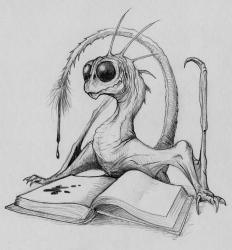
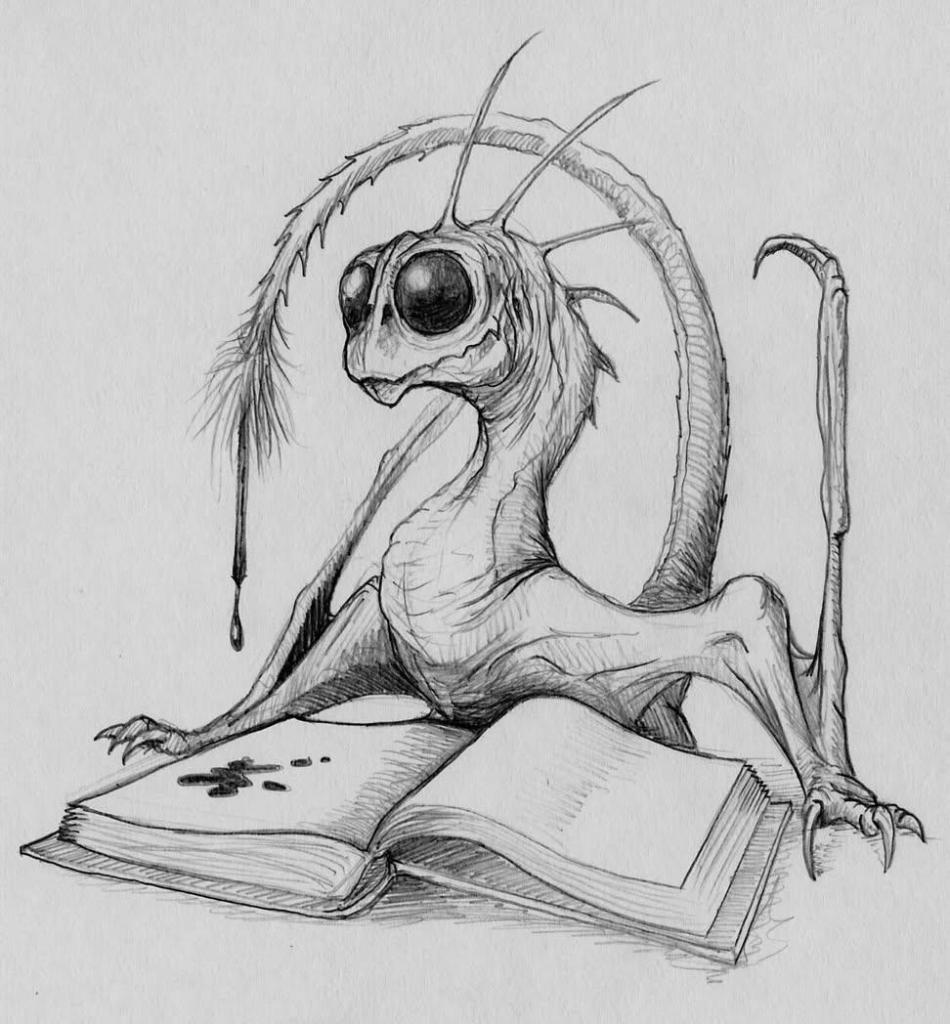
    Inkling Dragons are thought to be related to pseudodragons, but where the pseudodragon is a wilderness lover the inkling dragon is generally an urban drake that enjoys being surrounded by books, scrolls and pamphlets.

    Generally the size of a large rat or small cat inkling dragons can be mistaken for an immature jaculus drake. As all dragonkin hoard something, an inkling dragon is consumed with the pursuit of knowledge and writing, similar to paper drakes.

    An inkling dragon without a companion can be found in libraries, universities, bardic colleges and wherever records are kept. Some are creatives writing fiction and song. Others are historians, tracking the world through the written word. At least one inkling dragon is known to only write in mathematics. This inkling dragon, Aymon, is a friend of transmuters, tax collectors and merchants often working as a clerk or calculator.

    The Inkling Dragon was created as part of a limited commission in the upcoming book Dragons of the Dwindling by Dragons of Wales (Andy Frazer).
    Follow Dragons of Wales on Instagram, Threads and Mastodon. Support Dragons of Wales on Patreon.

    Inkling Dragon companions

    Frequently inkling dragons and writers bond over their love of the written word. Sought after by many wizards and writers, an inkling dragon chooses their companion as much as their companion chooses them — the tiny dragon has to find the work engaging and relevant to their own writing.

    1. Wizard
    2. Bard
    3. Propagandist
    4. Novelist
    5. Poet
    6. Merchant
    7. Tax collector
    8. Cleric
    9. Clerk
    10. Noble

    This work includes material taken from the Black Flag Reference Document 1.0 (“BFRD 1.0”) by Kobold Press and available at Black Flag Roleplaying

    Pencil sketch of a tiny dragon resting on a book. The pointy tail arches over the back with drips of ichor coming out of a feathered tip. The arms seem to be vestigial wings with opposing fingers capable of handling obects
    Art by Dragons of Wales in the forthcoming book Dragons of the Dwindling

    Inkling Dragon stat block

    Inkling Dragon (CR 1/4)
    Tiny Dragon

    Armor Class 14 (natural armor, small size)
    Hit Points 8
    Speed 10 ft., fly 30 ft.
    Perception 11 Stealth 12
    Resistant none | charmed
    Senses darkvision 30 ft., keensense 10 ft.
    Languages Common and four other languages (or cultures)

    STRDEXCONINTWISCHA
    -3+2-1+4+1+1

    Heightened Senses. The inkling dragon’s Perception is 20 when perceiving by sight. Ability checks for Perception using sight use Intelligence.

    Magic Resistance. The inkling dragon has advantage on saves against spells and other magical effects.

    Limited Telepathy. The inkling dragon can magically communicate simple ideas, emotions, and images telepathically with any creature within 30 feet of it that can understand a language it knows.

    Copying a Spell into the Book. When an inkling dragon or its companion finds an Arcane spell of 1st circle* or higher, the inkling dragon can add it to a spellbook if it is of a spell circle the companion can prepare and if they can make time to decipher and copy it. For each circle of the spell, the process takes 1 hour with no gp costs. Once the inkling dragon spends this time, the companions can prepare the spell just like their other Arcane spells. Copying a spell from a scroll into a spellbook doesn’t consume or destroy the scroll. Non-magical writing is written four times as fast when compared to humans. The inkling dragon produces ink from its tail as long as it isn’t at level two exhaustion or higher.
    * Black Flag uses circle as D&D uses spell level.

    Ritualist. An inkling dragon with its own book can be a Ritualist, per the Black Flag Talent. The spell source is Arcane. Intelligence is their spellcasting ability. The inkling dragon knows one 1st circle ritual (typically Identify). If the inkling dragon is a companion to a spellcaster it can learn rituals at the same circle and source as their spellcasting companion.

    1st circle Arcane rituals

    • Alarm
    • Create Familiar (these can only be common beasts)
    • Identify
    • Illusory Script
    • Unseen Servant

    ACTIONS

    Sting. Melee Weapon Attack: +4 to hit, reach 5 ft., one
    creature. Hit: 4 (1d4 + 2) piercing damage and the target must succeed on a DC 11 DEX save or be poisoned for 10 minutes. If the creature fails the save by 5 or more, it is stained by ink per Ink Stain below. This staining does not count against the number of uses per day.

    Ink Stain (1/short rest). On a successful sting the inkling dragon can mystic mark (Ranger) one creature. While a creature is marked (including for the attack that triggered the mark), the inkling dragon and allies deal an extra 1d4 damage to it (of the same damage type as the weapon) each time you successfully hit it with a weapon attack. A marked creature can use an Action to remove the Ink Stain. An inkling dragon that is a familiar or companion to a character may use this ability proficiency bonus (of that character) times per day rather than once per short rest.

    Fediverse Reactions
  • Black Flag is in the Creative Commons, now what? Backgrounds!

    Black Flag is in the Creative Commons, now what? Backgrounds!

    Over the past decade the 5th edition of Dungeons & Dragons grew three main offshoots from its original 2014 release by Wizards of the Coast. These three trunks are all now in the Creative Commons thanks to Kobold Press’s announcement this week.

    A5e is the Systems Reference Document for LevelUp, from EN Publishing. This branch of 5e places much greater emphasis on social and exploration, while also being a more complex combat engine. It’s “advanced” 5e.

    2024 D&D by Wizards of the Coast (the 5.2.1 SRD) is an evolution of the most popular version of the game in history. It adds minor layers of complexity, and removes most bioessentialism.

    Now, Black Flag, the SRD for Tales of the Valiant is also in the Commons under the CC BY 4.0. The primary changes within Black Flag are replacing Inspiration with Luck, adding Dread and similar to A5e uses both nature and nurture to define an upbringing.

    All three modern offshoots add a unique element to every monster. Rather than have merely have bigger numbers, monsters do something different — a Commoner in Black Flag has Angry Mob, while in A5e Commoners have a Stone (they can also be a Group) and in 5.2.1 they have Training.

    What can a DM/GM/designer do with all four in the same license?

    1. I am not a lawyer. Nor am I your lawyer. Use an actual lawyer if you have questions and are publishing for money.
    2. Read all relevant SRDs as well as their related FAQs.
    3. Find the place you want fiddle with and become an expert at that before you try to be an expert at everything.
    4. At your home table, borrow liberally from every system. If you don’t find yourself handing out 2014 Inspiration and don’t like 2024 D&D’s mechanical implementation, use Luck from Black Flag. Use everyone’s monsters — they’re balanced enough for the elastic system that is 5e — your players will have fun interacting with different commoners doing different things.

    Maybe you’re thinking “that’s nice advice Dave, but what are you going to do?”

    Backgrounds!

    Full Moon Storytelling’s most popular types of stories are various Backgrounds. The ones on this site focus on empowering a wider variety of tales within our 5e games, while leaning into short-form personality, a spread of Feats/Talents for each and sometimes a cantrip.

    Each of the main trunks of 5e do something different from the 2014 version of the game. That’s good! Your table can use a Background from any of the modern versions and there will be no balance issues. That means dozens of more origin stories for your heroes.

    For myself it means my eternal project becomes a simple project. A few dozen new Backgrounds with methodology to fit in all four trunks of 5e.

    Custom Backgrounds for 5th edition Dungeons & Dragons

    Photo by Canan YAu015eAR on Pexels.com

    The Tinker

    This week the Tinker is my most popular Background. Tuning it for each version of 5e doesn’t take much.

    2014 5e by WotC

    It’s already released, but the key point is the feature “I Can Fix It.” The feature helps in exploration situations, mostly, as it means the Tinker will usually have a way to MacGyver there way through a problem even if they don’t have the proper supplies.

    2024 5e by WotC

    If you leave Ability Score Improvements within the Background rather than have them float the Tinker would choose between Dexterity, Intelligence and Charisma.

    Origin Feats

    Choose one;

    • Crafter
    • Magic Initiate (Wizard)
    • Skilled
    • Tavern Brawler
    • and from Tasha’s Artificer Initiate

    Black Flag from Kobold Press

    Choose a Talent

    • Far Traveler
    • Polyglot
    • Trade Skills
    • Scrutinous
    • Ritualist (Arcane)

    A5e from EN Publishing

    ASI – Tinkers typically grant a +1 in Dexterity

    Connections – Tinkers might know a caravanserai, an innkeeper, a ferien, a smith, a group of bandits, a sergeant from a warring nation, a local farmer, a maker of fine meed, a faerie that’s a cheesemonger.

    Memento – Tinker memento options could include a letter from home, a chapbook of poetry, a metal they’ve never been able to bend or smelt, a strap of leather from their first failed project, the stein from their favorite inn, or a book of cantrips though they don’t know any.

    Adventures and Advancement – A Tinker who repaired a notable authority’s broken item may be granted a writ of access granting the Tinker expertise on Persuasion rolls.

    Feature – same as the original on Full Moon Storytelling.

    Now, these examples are quick looks at a future project that will include the score of Backgrounds already on the site, plus the four Everflow specific Backgrounds that didn’t get their own entry. And more as my reading expands.

    With four versions of 5e available in the Creative Commons (CC BY 4.0) how will you create for your table?

    Fediverse Reactions
  • Xabal’s Workshop

    Xabal’s Workshop

    In our Age of Myths campaign the party acquired a keep. Though the party is many days travel by airship away from the keep, their former leader Artok (originally played by John) now runs the keep.

    Each of us gets a Special Feature for what is now our group Bastion. At this time Artok has a Sanctuary. We’ll want to get him a Barracks and Armory soon, because we aren’t around to defend the Bastion very often.

    Xabal Gaitee Quarter-Flagged Optigraph Balaneer nox Free Tink and non-Commissioned Officer of the Sadijh (on leave in absence), my goblin artillerist artificer, established a Workshop. He’s also interested in the Arcane Study, but first a workshop.

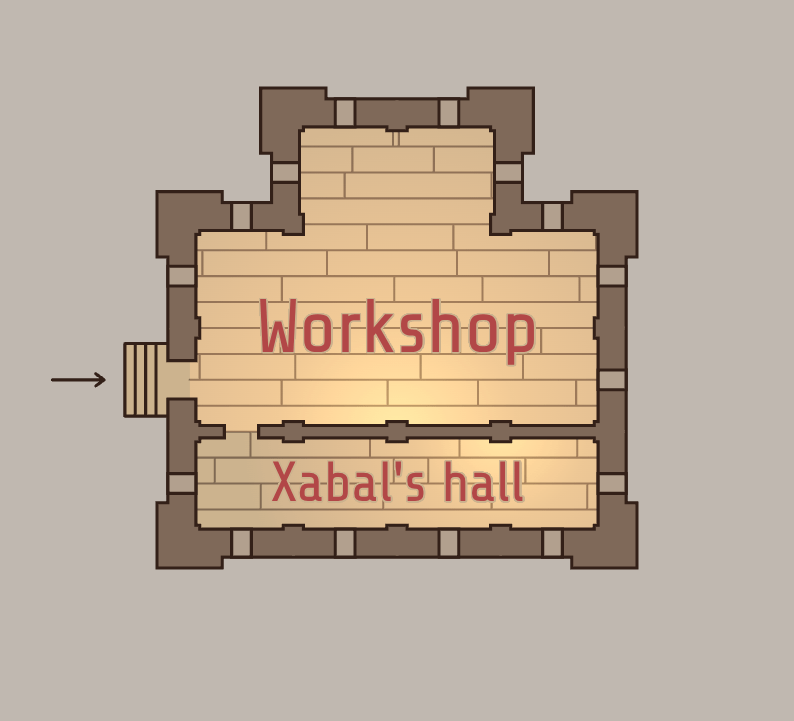
    Xabal and Crag took over the two store rooms in the keep. Xabal’s is on the left.

    The image depicts a hand-drawn map on graph paper. It outlines a fortified area, possibly a castle or fort, surrounded by a flowing body of water indicated by blue wavy lines, and red hatching marks representing elevation or terrain. The map includes labeled structures such as a "Keep" located centrally and surrounded by various buildings including "Stone barracks," "Stables wooden," and "Stores." There is an "Archery range" and a circular "Melee Practice" area. Paths and roads are sketched in black, with dotted lines representing different routes. Additional topographical features include a "Waterfall from mtns above into valley" on the right side of the map and a path labeled "Cart Path to main road." The map is oriented vertically, with features labeled throughout in a combination of print and cursive handwriting.
    Xabal took over the left most of the stores.

    What I like about the concept of Bastions/Strongholds/etc is that it gives players the opportunity for some ‘lonely fun.’ With a chill weekend at home I spent time thinking about D&D, but not actually playing the game.

    The image is a top-down view of a rectangular room layout with beige and brown tones, resembling a floor plan. The main space is labeled "Workshop," situated at the top center. Below it, the space is divided by a thick line and labeled "Xabal's hall." The flooring appears to be composed of rectangular tiles laid in a brick pattern. The room is surrounded by a darker brown border, representing walls, with protruding sections at the corners, suggesting architectural features. On the left side, a small protruding area features parallel lines indicating steps leading up, with an arrow pointing to the right.
    Xabal’s workshop interior floorplan created using watabou’s Dwellings Generator

    Using watabou’s Dwellings creator I found something as close as possible to the space on the DM’s map of the keep. Then I added a bit of lore around the minor change (there’s an aviary so it isn’t a pure rectangle).

    And then I discovered the steps and main door should be on the right rather than left. That error will go down as a function of Xabal’s quite-distracted memory and the difficulty of communicating over long distances

    One thing that Xabal trusted Artok to do was hire three artisans to help in the workshop. He hasn’t yet met them, but Flasfur and Chofs started working already.

    Hirelings

    Below the three current hirelings are described including their “stats” for social encounters and their short-form personalities.

    Flasfur Wreltor with Blackbirds

    Photo by Siegfried Poepperl on Pexels.com

    A goliath with a flock of blackbirds that stay in the newly added aviary. He’s a cobbler and leather worker. The blackbirds help Flasfur with fine work required of those professions.

    Nearly eight feet tall, Flasfur was the one said he wouldn’t join the workshop without a small improvement, the aviary for his small flock of blackbirds.

    He’s from a small town in the hills between Mihrstone, Sheljar and Artok’s Keep.

    Strength, constitutionGoliath (2014)
    Negative dexterityCobbler, leatherworker
    Investigative
    Heavy leather apronSheljar
    Small awl (dagger)large aviary for the birds
    Modest lifestyleOpen, respectful, fatalistic, absent minded

    Chofs Chupmolea badged al-Chems

    The image depicts a minimalist, stylized drawing of a small castle-like building with a light brown background. The structure is rectangular with a crenellated parapet along the top. It features two arched windows on either side of a central arched door. The roof is angular and tiled, with a warm tan color. Two lantern-style lamps flank the door. The building is surrounded by sparse grass, adding to the scene's simplicity and rustic charm.
    Exterior drawing of Xabal’s Workshop in Artok’s Keep created using watabou’s Dwellings Generator.

    A goblin who is insistent in studying the corruption. She’s a jeweler and glassblower.

    Chofs recently travelled through the area scouting out a new source of gems not from her hometown. From Bel’an’faire in the south of Sheljar lands, she works with jewels and glass to create art and rarely implements of war.

    She also does etching and some other things that border on chemistry or alchemy.

    Dexterity, IntelligenceGoblin
    Negative charisma, strength, constitutionJeweler and fine arts, perceptive
    Lightweight, close fitting dressesBel’an’faire
    Caltrops to aid her escapeUse the corruption to power art
    Modest lifestyleBrilliant, excitable, religious

    Bolnis Abica nox Qawaha

    Where Chofs is a common goblin in their structured society Bolnis is a wanderer similar to Xabal. She’s potter and tinker who travelled through the land with simple coffee gear.

    Bolnis doesn’t like tea, but has some with her. Most of her time is in the hills and coast between Sheljar and Mira, if people insist on discovering where she’s from it’s Ooshar. She considers her hometown a backwater.

    There’s a chance that Bolnis invents fancy coffee gear, but right now it’s simple. Her passion is to discover new ways to use tek to create new foods, tisanes, poultices, and more.

    Intelligence, CharismaGoblin
    Negative strength, constitutionPotter, tinker, coffee gear
    Insight
    Lightweight travelling pantsOoshar
    Mug (club)An espresso machine
    Comfortable lifestyle, though paid at modestGenerous, meticulous, sensual

    I’m already thinking about how Xabal will interact with these hirelings and what knives they give the DM. Chofs offers someone that could be corrupted through those who study it. Bolnis clearly has twice the income of the others. How is she getting that money? Flasfur’s blackbirds could distract him from running the shop.

  • Militia actions for 5e systems

    Militia actions for 5e systems

    Sometimes in D&D and similar games you need to empower the players to manage groups of allies supporting the narrative, without precise actions by individuals. When running a rebellion, skirmish or base defense you can use militia actions representing the training a character conducted with a group of commoners.

    1. On every PC’s turn they now have a Militia Action. This is independent of their character’s actions and reflect the training that the character put into the small unit (think squad sized) during downtime.
    2. In initiative the Militia Action happens after all player actions and the actions of that character’s companions (familiars, pets, constructs, etc)
    3. A militia is a Swarm of Commoners (AC: 10, HD: 6, PB: 0, all abilities are 10, a Swarm may have a tool proficiency or skill for flavor). Every time it is attacked it makes a Wisdom ability check against the damage dealt. It gains a bonus from the controlling character’s Charisma (Persuasion). Each failure removes a Hit Die. When it drops below 3 HD it loses one of its damage dice. Do not track damage.
      Suggestion: Use a d6 to track the HD of a Swarm of Commoners.
    4. Pick one of the following actions
      • Ranged attack – this attack is rolled with an Attack Bonus of + controlling character’s Charisma+PB (and whichever ability they use to command). Range is 30/60 to represent inaccurate and improvised weapons. Damage is 2d4.
      • Melee attack – this attack is rolled with an Attack Bonus of + controlling character’s Charisma+PB (and whichever ability they use to command). Reach is 10′ to represent pitchforks, spears, and other implements. Damage is 2d6.
      • Funnel – the swarm moves 20′ and creates an 10×10 area of difficult terrain. If the terrain is already difficult it now costs twice that movement. After that the terrain becomes impassable except through magical means.
      • Rally – the militia energizes an ally, enabling it to expand an Hit Die. If the ally is another militia it regains a Hit Die.
      • Pester – if an opponent is in reach of the militia the unit can distract it so that the next attack against the opponent is at Advantage.
      • Move and/or Hide – the militia unit can move 20′ and then if cover is available it can make its defensive check at advantage.
      • Activate terrain, traps, spell craft or siege weapons – If a siege weapon is nearby a Swarm of Commoners has as many Utilize Actions as it does damage dice. It can also activate Magic Items, Rituals or Terrain as allowed by the scenario and dungeon master.
    5. A player may choose to use a second Bonus Action (if they have one) to make another Militia Action.

    A character may only command one Swarm of Commoners unless they are a Propagandist or Inspiring Leader (PB number of Swarms).

    This is a refined approach on the earlier Introducing Militia Actions to support base defense in urban rebellion play.

    Fediverse Reactions
  • My best of 2024

    My best of 2024

    I didn’t do quite as much writing for public consumption as I have in most years since I started blogging regularly in 2008. Some of that reduction was due to me taking a step back at Sounder at Heart, focusing my work content on video briefings and emails, and Full Moon Storytelling being a “when inspired” project rather than an income generator.

    Here at Full Moon Storytelling my most popular writings over the past year were older materials.

    My custom backgrounds and my take on Sports in D&D remain popular as well.

    In fact, that’s where my biggest D&D related project ever came from, and one of my favorites of 2024. I helped out with Worlds To-Go: The Elysians.

    My contributions were five custom backgrounds, most completely new, plus formalization of sports rules including inventing two new sports — The Pentiad and Constellations (a team juggling sport that creates constellations).

    Here on FMS my favorite of the year was Goodbye Alignment. Hello short-form personality. In that article I encourage people to continue to use personality traits in their games, but make them as short as alignment! Then the DM and other players can grant Inspiration based off of something small enough to remember as opposed to the original 5e personality system that was six long sentences that no one remembered.

    There was also a quick review of the 2024 Player’s Handbook.

    If you ever need a quick 5-room dungeon and associated adventure, pick a pop song and convert it into one. That article may not have been well read, but I’ll refer to it when I’m back behind the DM screen.

    I stutter. Sometimes a little. Sometimes a lot. A personal essay I felt compelled to write after a re-watch of Agents of SHIELD, it also falls into the not-well-read column, but it meant a lot for me to share this about myself. It was not the only personal essay of the year. The other was about how the fragmented storytelling technique of D&D may fit me better than novels or short fiction.

    Soccer stories

    For the most part at Sounder at Heart I’m now the weekly columnist, sending out a large newsletter that covers one important topic, plus everything else you need to know for the week.

    Choosing the best of these was easy, because one of them helped change the approach from the organization towards the US Open Cup — Ship’s Log, May 7: Let’s win trophies again.

    My second favorite was about using the Club World Cup to sell the world’s best players on the region that I’ve chosen as home for all of my adult life — Ship’s Log, Dec. 6: Selling Seattle.

    I still dipped into journalism, covering Defiance’s new coach and the new practice facility. Walking through history is one of my favorite pieces of soccer writing ever (and there’s about 5000 of those).

    Factal

    Most of my writing at Factal is in emails. Some additional material is in the various Global Security Briefings I hosted this year, covering news like the Key Bridge collapse, bomb cyclones, DANA storms, mpox, Olympics security and more. On the blog I supplemented editors’ writings on Olympics security and for our year in review.

    Finding me on social

    • Mastodon or a bridge if you are on Bluesky (where I prefer to have most of my RPG and soccer thoughts)
    • Threads (a wider mix of who I am)
    • Instagram (mostly pics of my dog, the moon and soccer stuff)
    • LinkedIn (almost all safety news, intelligence and marketing)

    P.S. That jersey on the header was for the soccer team I sponsored this fall. I’ll be sponsoring again in the spring, because supporting my friends is fun.

    Fediverse Reactions
  • Integrating pop songs into the five-room dungeon system

    Integrating pop songs into the five-room dungeon system

    You have limited time for gaming. Pulled in so many directions, you need to find ways to reduce prep time and focus the game on action.

    Two innovations help those efforts quite a bit when playing a D&D style game.

    But, you’re still left trying to be creative within those techniques.

    Take the five-room dungeon, the short essay of dungeons. It’s an introduction/guardian, puzzle/social encounter, trick/setback, climax/big bad, and the resolution or plot twist.

    This generally follows the basic plot graph in literature. It’s familiar, fast and can be done in one sitting if you time things well.

    How do you fill that out? What’s the source of creativity?

    Use pop songs!

    No, really, they often follow a similar arc, but have a chorus that echoes the main theme of the song. This idea first sprung to mind with Apollo, by SYML.

    Rather than five-rooms, we’re going to go with seven events because of the chorus. The song provides the creative prompts to fill these out.

    Introduction/Entry — on the steps of a temple the party sees a golden altar being shined, hears talks of other wonders when a dark cloud blots the sky. A raven and a wolf rush to the altar, tossing it aside, fleeing to the countryside.

    Note: after the intro the PCs determine the order of approach.

    Social encounter — Interview the group talking of other wonders and the goals for the faith. Secrets and clues include a song that is unsung and a build up of a military force by the faith.

    Choral echo — Tracking the raven and wolf leads to a moonlit glade with an empty space framed by 7 monoliths.

    Setback — The huntress on wolf back, she rides with bow drawn, ready to fight. If the party sings the unsung song there is an attack. She only appears at night, under a full moon.

    Choral echo — If the party rights the altar themselves and shines it to bright gold they discover a medallion that prevents the poison on the arrows from taking effect on the group (immunity from the poison condition in an emanation of 10′ from the one wearing the medallion).

    Climax — The songmaker arrives when one of the party bends their knee (falling unconscious qualifies, as does voluntary submission)

    Resolution (always last) — When the songmaker and huntress are both defeated a flock of ravens blots out the full moon. The wonders fall and a song echoes at their altars “I am. I was. I will be.”

    Yes, that’s quick and dirty. Tuning that to a party shouldn’t be too difficult. Maps and expanding on the secrets can turn it into a decent short adventure facing off against avatars of gods in any D&D world.

    Sure, that works for Apollo, but what about other songs?

    Quicker and dirtier with Last Great American Dynasty by Taylor Swift.

    Intro — In history there was a party with many attendees scheduled at any outsider’s home. Celebrations are held in town honoring the host and diminishing the current leaders

    Chorus — One of the hosts dies, their partner is blamed in efforts by the current leadership to reduce influence

    Puzzle — How did the person die? Clues include a neighbor’s dog, poor health, a nearby sea, a long drink together prior to the party

    Chorus — The commoners in the community ignore the other surviving families, focusing instead on the surviving partner as both suspect and hero

    Setback — Both partner-hosts haunt the house, interfering with ideas at solutions, causing the group to collect extra clues that may or may not be relevant.

    Climax — PCs discover that the old money in the area is the reason for the death, as they didn’t want the new money to interfere. If the PCs share this with the commoners there is an uprising.

    Resolution — The house remains haunted, after the PCs solve the mystery of the death, though the group can live there undisturbed.

    Did you just use a Taylor Swift song?

    Yes, I did.

    Not every pop song will work

    Just like not every TV show, movie or book is a good inspiration for a D&D adventure or campaign, not every song is.

    But, if you find out at 9 in the morning that you’re DMing in the afternoon you can adapt the five-room dungeon using the chorus to help with theme and secrets.

    Playing the song that inspires you on repeat can help you focus your energy. Sketch out the quick map including notable fantastic elements, make certain your secrets and clues work in a multi-nodal fashion.

    Fill the monsters or opponents that fit the song (ravens, wolves, ghosts). The NPCs are in the song as well (commoners from LGAD or clergy in Apollo).

    Connect a couple events to the characters and/or past adventures.

    The chorus can either be tucked into various other scenes, can be dream sequences, portents, or speeches from various NPCs rather than specific events.

    Have fun gaming

    Fediverse Reactions
  • Enable your table to embrace wider stories using 2024 D&D Backgrounds

    Enable your table to embrace wider stories using 2024 D&D Backgrounds

    There are significant changes between the 2014 5th edition Dungeons & Dragons Backgrounds and the way 2024 5e D&D manages the same design space. 5e14 used backgrounds to expand on the social and exploration pillars of the game while encouraging roleplay via traits, ideals, bonds and flaws.

    5e24 abandons that, turning backgrounds into a space with more mechanical heft than ever before — adding Ability Score Increases and Origin Feats. This also differs from alt-5e systems like Black Flag (no ASIs, talents are Feats) and Advanced 5e (no ASI, no Feat, single ASI adding connections, momentos and advancement).

    By nature 5e24 reduces the story available via Backgrounds. Every Soldier is a Savage Attacker and never Tough. There’s no personality assigned everywhere, not even a highly detailed matrix of choices that results in 100s of combinations. There are also assigned ability scores, which means that Soldiers aren’t wise, for example.

    So how do you inject story back into your table as you transition to 2024 5e?

    Remove ASIs from Background

    They can go back to floating like they were with Tasha’s or just included in the standard array/point buy like Black Flag.

    This has absolutely zero impact on the power balance of the game.

    Associate multiple Feats/Talents with a Background

    Tough Soldiers exist! So could a soldier trained in magic in a high fantasy world (see the Second Army in the Grishaverse). A solider could be trained in Healing or Linguistics. Make the assigned Feat the one that most members of the Background have, but do not confine your story to that.

    Pick a Feat and then justify it with a single clause in your backstory (backstories for Tier 1 play should fit in a text-based social post).

    For myself, I’ll be using a chart that puts the most common Feat in the middle with the next most common next to them and rares on the outside. This small curve helps define the world in which you play.

    Here’s an example for the Tinker

    2. Magic Initiate
    3. Tough
    4. Linguist
    5. Actor
    6. Skilled
    7. Ritual Caster
    8. Artificer Initiate

    This doesn’t impact the power level at the table at all.

    Use custom Backgrounds to expand your world’s lore

    Add more Backgrounds to enrich your world. Similar to how official Wizards of the Coast settings books have added a couple Backgrounds to help define those stories. Dragonlance added Wizards of High Sorcery and the Knights.

    Take this lesson and use it at your table.

    Do your stories consist of a world on the edge of Renaissance technology? Add in Optical Telegraph Far Talkers. Is there something inspired by the Silk Road? Add the Caravanserai. Are airships common? Those shouldn’t have sailors, but flyers. It’s a different skill set and a different story.

    Again, there’s no power imbalance.

    Add personality back to the game

    Even though WotC, and the alt-5es too, got rid of personality you don’t need to. The 5e14 system is long and clunky. Alignment is tired and dated.

    Instead, use short-form personality. Having 3-5 words or phrases isn’t a bulky system. Still grant Inspiration off of this — your players should be rewarded in game for playing their role. If you’re shifting to Black Flag or borrowing their Luck system do that instead.

    This has a minimal amount of power disruption while encouraging more story through play.

    These four simple steps don’t disrupt the power balance of 5e (and variants). They add lore to your world and story to your characters.

    Best of all is that they can all be done while playing using DnD Beyond or any other virtual character sheet.

    Fediverse Reactions
  • Age of Myths, the Uncoupling: Campaign One Sheet

    Age of Myths, the Uncoupling: Campaign One Sheet

    For the first time I’m going to be playing a character in my world. One of my players in the last two campaigns is going to DM and together we set up the one-sheet so as to not change too much lore. One of the ideas I came up with early, was by playing in the Age of Myths, because any lore changes can just be referenced as legend when we play in the current era.


    The Road to the Uncoupling

    Your story begins in a prosperous world of togetherness and mutual can-do spirit.  Before the battle for the heart of Kirtin on the Lake (KotL) or the sacking of Kirtin in the Sky (KotS), before the Proctors spread death and misery in Sas Rurulit, and before the unprecedented events of the Awakening and the finding of Lorebooks, there was The Uncoupling.  The apocalypse that destroyed the weave of magic for the Kin and Kon, leaving Ken and the 5 coloured dragons of the Chromatic Convocation in complete possession of magik. 

    Players are part of a select group that were born with innate magical ability (you’ve been everflow touched) that is prized even in this magic-rich world.  Possibly you inherited your trait from a bloodline trait or ancestral ties to deeper magik of the Everflow.  It has shaped your early years, possibly enrolled at a young age by family in the scholarly studies to become part of the magik ruling core of society or you hid your talent and nurtured it on your own. 

    However, recently there have been rumblings, rumors about a shadow organization unhappy with the status quo, who seek to eliminate the existing ruling council and rule not by consensus but by force.  You’ve each been selected by the bronze Dragonborn Artok, tasked with this mission by his patron, the adult Bronze Dragon (Othimbane) who sits on the council, to identify and either infiltrate or forcefully break these fools of their notions and ensure that no other plots are forthcoming. 

    A global map of the world centered on the spaces where play in the campaign has occurred to this point.

    The following is written by the DM for this campaign.

    Premise 

    • This campaign takes at least three millennia before the Born Generation and the return of magic to the Lands of the Everflow.
    • Gain information about “The Shadows”, a secretive organization bent on wiping out the Ruling Council of Aur.
      • Artok has the rough information about several potential members that could lead you to a hideout or meeting place. 
    • Infiltrate or brute force your way into the group. 
    • Identify other members and find potential leads about who is the power behind “The Shadows”.
      • Keep (human council) and (gnome council) members apprised of your investigation. 
    • Possibly assist the council with additional tasks at your discretion.  

    Factions  (NPC names to come soon)

    • The Ruling Council of Aur (RCoA) – A group of 9 members, three of each Ken, Kin, and Kon, and 4 dragons, two each of metallic and chromatic. 
      • The RCoA is the “federational government” of Aur, with different cultures/regions governing in their own way and answering to the RCoA.
      • Kin: Human (F), Goliath (they), Halfling (M)
      • Ken: Elf (F), Elf (M), Dwarf (M)
      • Kon: Goblin (M), Bugbear (They), Hobgoblin (They)
      • Dragons:
        • Elder Metallic (Silver) – Tanargnyvur
        • Adult Metallic (Bronze) – Othimbane
        • Elder Chromatic (White) – Dwargauth
        • Adult Chromatic (Blue) – Nymaryxon
    • In occurrence with the rise of The Dragon moon (the fourth moon of the Aurian system), the dragons withdraw from the council for a year (draakmoeten) and meet at an undisclosed location with the world dragon (a deep time dragon) named Andarawus Del-mos. 
    • The Metallic Dragons
    • The Chromatic Dragons 
    • The Shining Order of Dreki – Holy dragonborn order who serve the Draconic races as paladins, clerics, and religious personages located across the world. Some that choose a more individual path travel and assist as Priests and Mortuary persons in smaller towns and villages.
      • Necromantic magic is thought to primarily flow through the draconic race). 
    • The Shadows – A heretofore unknown organization/cult/religion(?) focused on the overthrow of the RCoA, and to rule through force and oppression rather than through consensus. 

    Campaign Facets 

    • 2nd & 3rd tier drop in/out campaign play, starting at 5th level 
    • All PCs start at lv.5 with the added feat “Everflow Touched”, adding a +1 to spell attack modifier and adding one free 1st level spells (from any school except necromancy, unless your PC is dragonborn) to your spell list which can be cast once per long rest.
      • Material components will not be needed.
      • at lv. 9 this will increase to +2 and an additional spell (2nd lv.) can be learned.
    • Rules used are core 2014 WotC D&D, plus most player facing options from WotC
      • Check with the DM about using setting-specific feats, subclasses and spells
    • Allowed races are Kin (human, halfling, goliath), Kon (goblin, hobgoblin, bugbear), Ken (elf, dwarf, non-rock gnomes) and dragonborn/kobold as shining order of Dreki
    • Divine magic is thought to come from the forces of nature and the philosophies, there is no active pantheon of faith, beyond those who worship the dragons.
    • Potential for multiple pathways to quest completion
    • Player driven story creation in a sandbox setting
    • Wide regional/worldwide settings with airship and/or teleportation travel 
    • Actions may become legend
    • Milestone leveling – several sessions per level gain; saves time when we all don’t have to track XP