Within the literature that inspires Dungeons & Dragons we see many tales of those born to magic. Some of these peoples are untrained, their magic barely controlled. In 5th edition D&D these are represented by Wild Magic Sorcerers. Not all fit the narrative around Sorcerers, because they are more than just an in-born mage. They have hints of spellcasting, but because it is born rather than learned control is not there.
Yes, multiclassing can solve this. So can a Feat.
The desire with Born to be Wild is to capture the feeling of those who have a tiny bit of innate magic in their bodies, but no control. Their magic sparks bizarre occurrences that range from helpful to destructive. Maybe they get trained someday. Maybe they are a warrior who can heal an ally, or a thief that can blast with missiles of power. Whoever they are, they struggle with innate powers and the impact of casting.
Choose a cantrip from the following list: Prestidigitation, Thaumaturgy, Druidcraft. [This represents that you have innate minor powers]
Choose any 1st level spell. You may now cast this spell once per short rest, but when you do you roll on the Wild Magic Surge table of the Wild Magic Sorcerer. This spell may be added to your spell list, but whenever cast does cause a surge. [There is a temptation to have the player roll on the table twice and let them choose the better effect.]
Your spellcasting ability for these spells is Constitution. [This is to represent that the magic courses through your body.]
Design notes
The intent here is to be similar in power to Magic Initiate, but to embrace the chaos of the Wild Magic Sorcerer. Dropping one cantrip and upping the usage of the spell is similar to the Artificer Initiate. Adding Metamagic would give the holder of the Feat control, which is in opposition to the intent.
Animal Companions, or Bonded Companions, or a key element of life in Kin. The Kin are the people of friendship, loyalty of loving those around them. This extends towards their non-humanoid companions as well. Where an elf might group in a land where spells are used to do mundane things, in Kin when a goliath needs a bit of string to finish sewing they send their swallow off to do it, or their heron to fish. Halflings have dogs that pull, push, fetch, hunt, fish, carry, and many other tasks. Human bonds with goats, rams, dogs, birds and horses are quite common. Bonds of Kin are a very essence of life. Almost everyone has one.
This ruleset needs to do a few things.
Scale like cantrips, attacks and proficiency. The companion is expected to live alongside their friend for some time.
Build in a reason that having a Bond die is bad for the PC
Not destroy the action economy
As a bonus, can it be simplified for usage in gaming outside the World of Everflow?
Feat: Bonded Companion
Prerequisite: Wisdom of 13 or higher. Kin and Rangers ignore this prerequisite. This feat can be taken more than once.
You have an intense bond with a beast. These beasts cannot have a higher Intelligence than the character. In certain worlds the bonded companion can be a monstrosity. At this point I considered just granting access to the Bonded Companion system in a similar manner as to how Magic Initiate works, but instead built it within the Feat. The rule could be built by making Bonded Companion a Class Feature and Feat, but I digress. Taking the feat gives you Companion Points. You also gain companion points in the following manners;
Rangers at 1st, 3rd, 5th, 11th, and 17th levels
Druids at 1st and 5th level.
Clerics with the Nature domain at 1st level.
Your Wisdom modifier
Those points can be spent on a single companion or multiple companions. A character can bond with a number of Companions equal to their Wisdom modifier +1 (minimum 1). Each new companion takes a number of weeks to establish a bond as their cost in companion points. This can be done as downtime, or could be a solo adventure. A character may only spend new points when they take the feat or if they are a Ranger or Druid at their higher levels that earn Companion Points.
The following chart lists various Companions and their Companion Point cost.
One
Two
Three
Five
Seven
Ten
Herd dog
Sled Dog
Warhound *
Giant Eagle *&
Rhino &
Mammoth *&
Retriever
Mastiff *
Axebeak *&
Bison
Elephant *
Wyvern *&
Terrier
Bloodound
Ostrich &
Bear *&
Dire Wolf *&
Roc *&
Sentry Dog
Guard dog *
Elk &
Lion *&
Owlbear *&
Sprinter
Raven
Panther *&
Worg *&
Griffon *&
Heron
Eagle *&
Bear Cub *&
Hippogriff *&
Pegasus *&
Pigeon
Falcon *
Wolf *&
Peryton *&
Sparrow
Parrot
Tiger *&
Awakened Tree &
Pony/Mule
Draft Horse
Warhorse *
Fox
Riding Horse
Ape &
Goat/Sheep
Monkey
Awakened Shrub &
Cow
Legend: The ‘&’ is used to indicate an animal companion that can only be paired with a Ranger, Druid or Nature Cleric. They are normally wild. The ‘*’ is used to indicate animals that can enter combat on command.
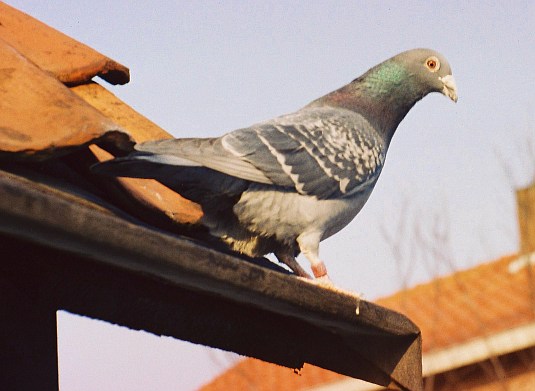
“Postduif” – Licensed under Public Domain via Wikimedia Commons
As a Bonus Action the Bonder can command their animal. These commands are Attack, Dash, Disengage, Dodge, or Help. An animal without a * can only attack if the Bonder passes a Wisdom (Animal Handling) DC: 20 check. The Companion will continue that action until the combat is complete or another Bonus Action is used (ie they will Attack the directed target until that target is no longer participating in the combat). Some Companions have other actions that can be taken (A Retriever can Fetch as an action). Check with your DM for these other actions.
When separated a Bonder and Companion that are on the same plane know the direction and rough travel time between them.
If someone tries to control a Companion it is an opposed Animal Handling check for the Bonder and whatever skill or spell is appropriate for the attempt to control the Companion. The duration of the control is per the appropriate spell or skill.
If a Companion dies the Bonder takes half their Companion’s hit points in psychic damage. If they make a Wisdom save (DC: 15) they then take one quarter of their Companion’s hit points in psychic damage.
Variant Rule in Kin: At first level and below halflings usually bond with canines and goliaths usually bond with avians. All Kin start with an additional Companion Point.
When I step away from reality for a few days, playing D&D is difficult. Visiting family or friends isn’t the best time to schedule a Dungeons & Dragons game (except for when it is). But that space away from the table is also fuel for new ideas (the Vintner Background is on its way). Dungeon Mayhem was also a great way to get light-D&D themes while playing with single-digit kids.
Whenever I visit a town I stop by a local café, a local brewery/winery, and their local gaming store. Book & Game was stocked full of D&D.
On Tuesdays Lore Collage focuses on the D&D game of dice and paper.
D&D’s best year ever (Forbes, PC Gamer) isn’t expected to lead to a slow down. It’s part of a planned slow-growth design that was amplified by the covid-19 pandemic.
“From the outside, D&D looks like math,” he added. “But you watch people livestreaming D&D, and you think, ‘it’s a group of friends drinking beer and making each other laugh. I didn’t know there was a game for that.’ It really helps make it more approachable. The game’s a sort of social lubricant.”
Wizards’ own streaming show, D&D Live, is scheduled for July 16-17, billed as a special two-day event. Its schedule includes interviews, special product announcement, and a Dungeon Masters’ roundtable discussion, but is centered around four “star-studded” live-play games. The exact lineup for this year’s games has yet to be announced at time of writing.
This program is aimed at complete groups (6 players) looking for specific games, at specific times, and perhaps even with a specific DM. This is not for single players trying to make the perfect schedule (that makes my head hurt). For our initial beta of the program we are going to limit it to a handful of groups to work out the kinks and make sure we are offering what you want, that it is scalable and repeatable, and that the program has value.
Eighty percent of the reason I do Lore Collage is because it helps me keep track of what I’m reading and discovering about my passions. The other twenty percent is so that I share it with you.
Not much of a surprise to find out that the Realms are the focus. D&D is it’s most fun when settings are explored, and why not feature the one with more novels, comic books, and official products than any other.
One of the things that still gives me a little bit of difficulty when I’m DMing is tracking time in the game’s fiction when the characters are in exploration mode. Combat is simple, the 6 second rounds are codified, and we know that 10 rounds is a minute in the game world, 5 rounds is just :30 seconds, and so on. Which means most fights are resolved in just under :20 seconds! Wow!
Social encounters are also fairly easy to determine, as it’s usually real time conversations, with perhaps some minor adjudications of time passing as you negotiate and wait around for the car salesman to go talk to his manager about the offer you made him, etc…
But inside the dungeon, as the players are exploring, that’s a whole different…eh… monster. Now, the game offers a bit of rules in that regard… the DMG tells us that PCs moving…
Full Moon Storytelling is brought to you by Kristin Clark of Keller-Williams Lake Washington If you are looking to buy or sell a home in King or Pierce County, Washington support Full Moon Storytelling by supporting Kristin.