Marketing new tabletop roleplaying game supplements and games is harder than ever. Social media is less dominated by a single platform than at any time since 2010. Successful crowdfunding seems to demand being a previously known brand. No one clicks on links any more.
Probably the most frustrating nature of the zero-click world is that the early tricks are now also being suppressed — “link in comment/bio” doesn’t help. Second most annoying is that even on platforms that do not suppress links no one clicks on links.
For authors and other RPG creators that’s horrible. You have a product to sell and all the tracking data and systems you grew on no longer work.
Sales are down because for a decade or longer you pointed people where to go and they went there. Big tech changed and people changed behaviors. Small tech didn’t solve that.
Your new book feels dormant. Your maps aren’t selling. Your Etsy page is dead.
What can you do?
Lean into Zero Click Marketing.
First coined by Amanda Natividad, Zero Click Marketing is the general concept that if people aren’t clicking on your links you must interest them in ways that make them seek your product and/or brand. Natividad and her full-time boss at SparkToro have a book coming that explains the concept.
Applying these concepts can be a difficult transition for those of us that worked in marketing for the past 15 years or so. Being trained on calls to action, UTM tracking, click-through rates and more established a system you wanted to work forever. It didn’t last.
Zero click feels wrong at first. Attribution is harder than ever for numerous reasons (dark social, generative AI, Google summaries). And yet you need to sell your game, your supplement, your art.
Here’s how TTRPG creators can lean into zero click marketing to help others find their products
Now, I’m going to include more links. I don’t pretend that you will click all of them. I don’t need you to do that, because these fundamentals are what I’m currently using in my full-time marketing gig and how I see others who buy-in to zero-click marketing operate.
Remonstered! The Monsters Know What They’re Doing
Owning a lot of Ammann’s books, I’m going to present practical examples building on his latest book. These examples may be extremely basic or they may be new ideas for Keith Ammann and his team.
Find your audience
This isn’t necessarily a zero-click fundamental, but without it zero-click can’t work. Audience dispersal is huge. There’s more platform choice than at any point in the internet’s modern history — the Fediverse, ATProtocol, Meta’s suite, LinkedIn, forums, Discord, YouTube, TikTok (both versions), newsletters, blogs, etc. The gaming community on all of those is strong enough to sell unique products.
Being on all of them effectively is nigh-impossible for all but the largest gaming corporations. Do not attempt this.
Find your audience using your past, using an audience marketing tool like SparkToro, or copying those who are most like yourself. Then you build or continue to build there.
Exist on rented land
Yes, being on social platforms means you are likely on rented land and the owners of that land can tear away the systems and methods that used to work at any time. That can be devastating emotionally and for your business — unless you build on the rented land in a way that is natural, individual and participatory. No platform change has ever removed that.
You aren’t there to constantly push a product. You are there because you offer a unique personal voice about the games you love. Sometimes there’s a product involved. Mostly there’s not.
Case study: Remonstered! The Monsters Know What They’re Doing
According to SparkToro, D&D gamemasters improving monster combat tactics over index on the following social platforms when compared to the general public — reddit, Discord.
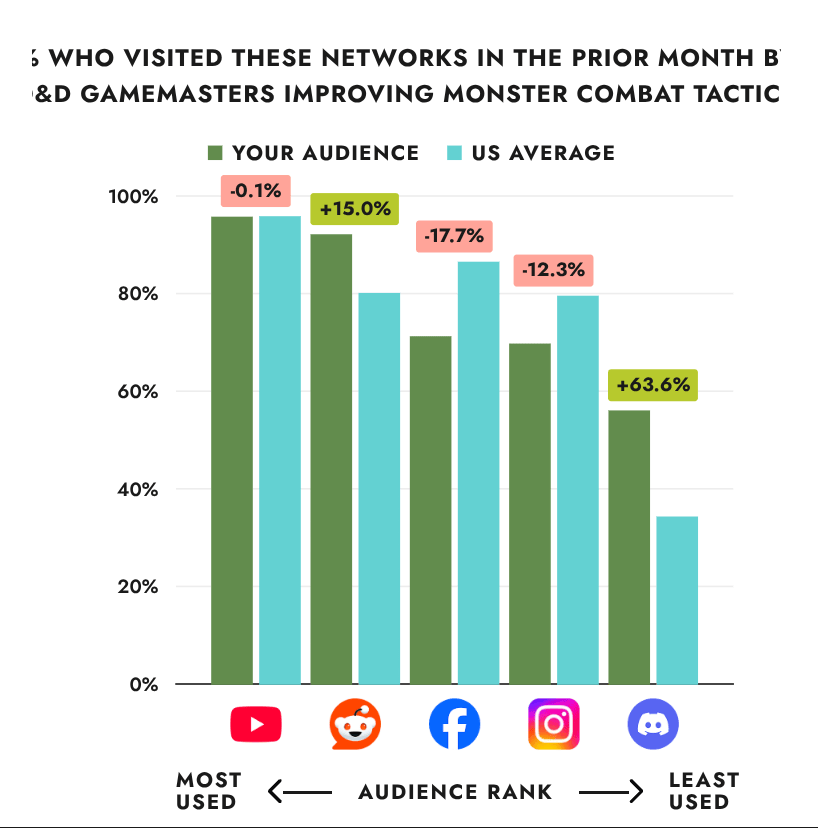
Yes, this is different from the two other similar audiences I tested. Non-D&D fantasy players tend to over-index on X/Twitter while D&D social players and world builders see Pinterest enter the top 5.
I’m using a free version of SparkToro for this example.
Ammann needs to be present where the conversations about D&D monster tactics happen. Being on Discord is an easier win because that audience is very present there. Reddit is also popular. Paid Sparktoro likely shows presence in Bluesky, TikTok, Threads and more.
Build your distinct voice there
Knowing where your audience is and where you are comfortable means that’s where you should build your brand for marketing. Those are often seen as dirty words because of the style of commodity marketing, click bait and outright lying that can exist.
Here, for the small creator when using the word brand I’m talking about the identity of yourself and your creations. When I’m talking about marketing that’s a reference to building interest in your creations. That’s it.
Your voice should have a clear identity, as should your products. If I were selling a creation from Full Moon Storytelling it would be “story creep within D&D that empowers more support for the social pillar, especially by leaning into third places, cultural differences and building distinct enemies who challenge player characters across all three pillars.” If I were building towards marketing a product I would extend those conversations without necessarily linking or even naming my product every time.
I would just be me, more often.
Case study: Remonstered! The Monsters Know What They’re Doing
Ammann does build on rented land currently. I think his most popular platform currently is Bluesky and Discord, though there are certainly other rented lands where he exists.
Extending those conversations regularly that lean into what Remonstered! is without necessarily mentioning it every time would be natural and normal.
It’s not about selling; it’s not even about marketing.
It’s about identity.
There’s another gap that Ammann could build towards — the second most important website for his audience is DnDBeyond.
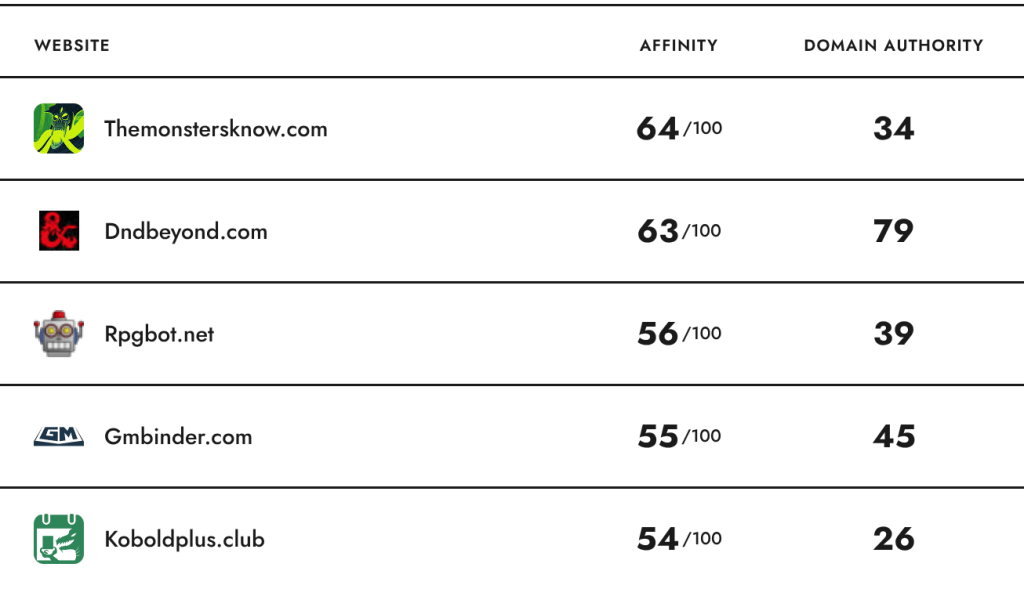
It’s awesome to see that the audience description already knows of Keith’s owned land (I’ll discuss that more in a bit).
There are two ways to take advantage of that massive audience Beyond.
- Offer advice on how to build in ideas from the book within Beyond. That could include how to use Homebrew, how to use the new scene prep or how to structure encounters within Beyond. Those tips should capture audience interest.
- Participate in their forums. According to SparkToro Beyond has more than 7 million monthly visitors. Wizards of the Coast uses a much larger number, recently claiming 20 million. Whichever is accurate doesn’t matter. What matters is that this is rented land where an identity can be built via their forums.
Own your territory
Rented land must be used. There’s a potential to go viral there that is impossible on your own blog these days. But that doesn’t mean you abandon your blog.
It means your blog posts can become fragments to share on social platforms, useful references for your product, a way to send emails (every blog and newsletter service can do both things now) and establishes the home where you clearly link your purchasable products, crowdfunding and sponsorship opportunities (Patreon, ko-fi, itch, etc).
Your land is where you build what you send elsewhere.
This reinforces your identity when people search for it — zero-click marketing is essentially owning a search for your identity. Your clips and shorter content on various social platforms show people who you are in small bites. Your land (blog/newsletter) show people how to support that.
Case study: Remonstered! The Monsters Know What They’re Doing
The Monsters Know does a great job of owning the space. Remember that chart above? Gamemasters who want to know how to more effectively use the monsters in D&D and other fantasy games go there.
Ammann also sends out newsletters from that blog. It can be followed via RSS and it auto-posts to a few social platforms as well. You should do this with your blog too. Just don’t think that auto-posts are enough. That link back to your blog will be clicked so infrequently it won’t matter, until it does.
Chunking out your posts to send to the rented land is great. Don’t give away the whole hog though. Give people enough from a blog post that they are both smarter than they were while also searching to learn more.
Maintain your identity
No matter the platforms you are on you have to be yourself. Small RPG studios and independent creators don’t need to be everything at once. They can’t be.
Your identity, your brand, should be tight and understood quickly. It can still be diverse. See my presence as a story-first social DM who also enjoys sports, coffee and Puget Sound — that’s my space.
Use hashtags or topics to clarify specific posts, to connect a statement to a specific product, but also know that a distinct identity is what people want to see.
You may want to know what your audience is talking about throughout the open internet. While Google Alerts used to be a good way of tracking that I find it misses most social conversations.
AlertMouse can replace that for a single topic for free. I use AlertMouse to understand ways that other creators are using the 5e ecosystem to expand on non-combat pillars of play. Then I participate in those conversations either here on the blog or on their social platforms.
Case study: Remonstered! The Monsters Know What They’re Doing
Not studying Ammann’s presence on his primary platforms recently I’ll need to work from memory when we first met on a platform neither of use now, and his known presence on shared Discords.
On those Discords he’s present offering advice on tactics, on writing, on discoveries when using other systems. This is excellent.
One thing I’d like to see more is the chunking out of lessons from the old book to the new one — show us a bit of what’s changing. Show us the why.
Take those bits from the owned land and share them on the platforms where the audience either exists already or where he wants to build it. If either of those include Bluesky (ATProtocol) or Mastodon (Fediverse) setting up BridgyFed can dramatically expand that audience without more work.
*I asked Keith Ammann if I could feature his latest book in this blog post, but am not compensated for this work. Some of these ideas may not work for Remonstered! Some may. Modern marketing requires more experimentation and effort than the 20-teens.
*SparkToro, nor Amanda Natividad, sponsored this post either. I use their tools professionally in my full-time work and would do so if I ever decide to make gaming products. I strongly recommend Amanda’s podcast for short-form audio to understand modern marketing.
*I also use AlertMouse to track and build various stories on Full Moon Storytelling. Using this code gives you more tracking over the conversations that you need to monitor.
In review
No one clicks on links any more.
People are still buying things, usually using a search to find what they want after being interested in the product over time.
Establish an identity with creations that people are interested in using both rented (social platforms) and owned (blog, newsletter, podcast) land.
Participate as a unique individual worthy of support with consistent themes.
Blog again, and then use those posts as the foundation of smaller content. Do not include links, not even in comments, on most platforms.
No one clicks on links any more. Don’t worry about that.