Tag: RPG

  • Using word-maps for quick reference during your games

    Using word-maps for quick reference during your games

    You don’t have to be a map maker to make adequate maps for gaming. A map can be as simple as showing the relative relationship between distance and location of the important elements. Even putting a few words on a page can be a map.

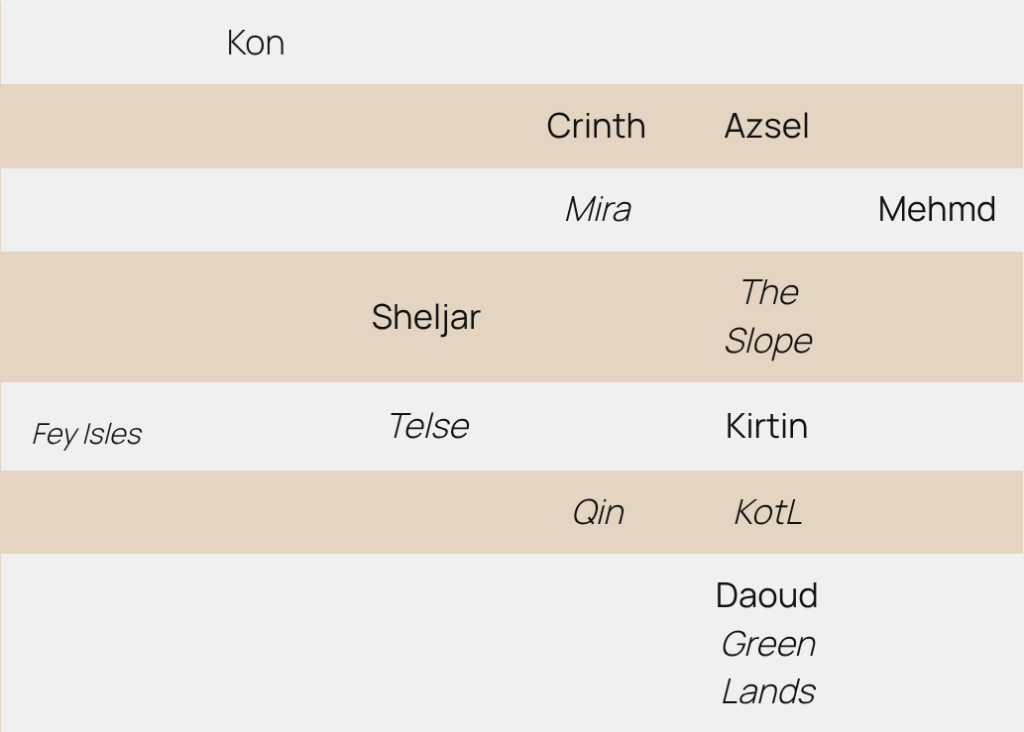
    Take the word map of the Six Kingdoms. It shows the relative locations and rough distances between the various kingdoms, their major cities and the other lands that interact in the World of the Everflow.

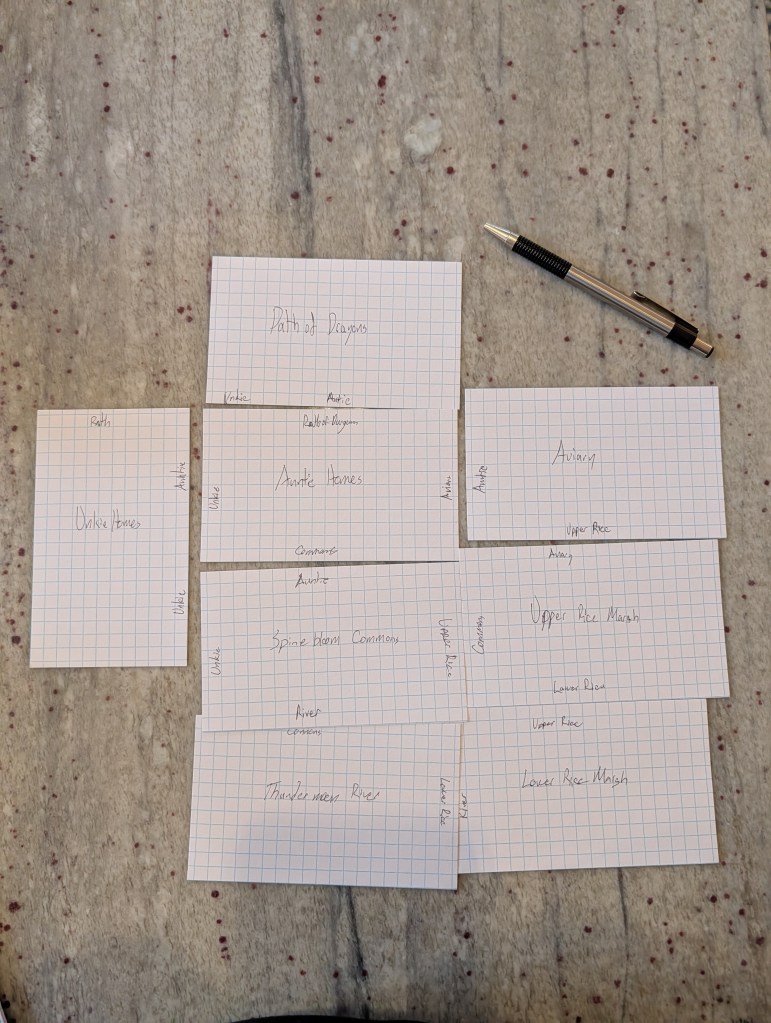
    Word maps can also represent a homestead, village or neighborhoods of a city.

    The image shows a group of seven index cards laid out on a speckled stone surface. Each card features a grid pattern and contains handwritten text in pencil. On the top left, there is a small vertical card with "Path" and "Divide" written along its edges. Adjacent to it on the right is a horizontal card labeled "Path of Dreams" with "Prairie" and "Auntie Houses" along the sides. Below are three more cards: the left card reads "Prairie" and "Auntie Houses," the middle card reads "Spine Bloom Common," and the right card says "Upper Rice Marsh." The bottom row features two horizontal cards, one labeled "Thunder Maker River" and the other, "Lower Rice Marsh." A pen with a black grip lies horizontally above the cards to the right.

    Any player can take a quick glance and know what each location is and what they connect to within the compound. More thorough descriptions in a blog post and in the character’s notes, but these quick notecards reminds us of Spinebloom Farms at the table.

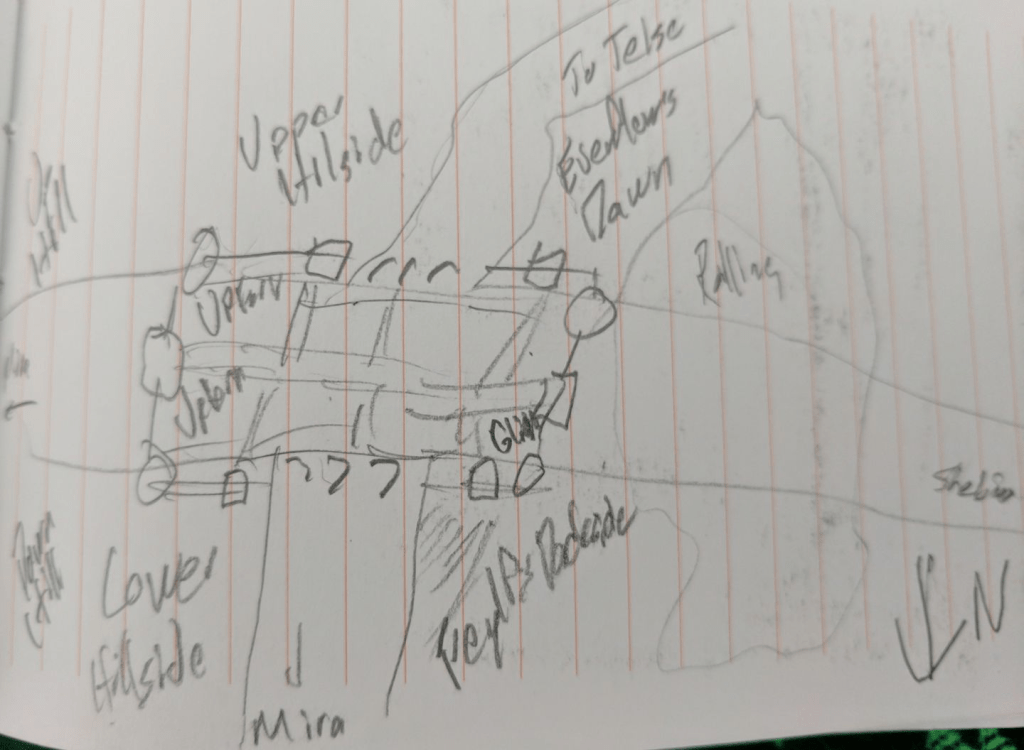
    The image is a hand-drawn sketch on lined notebook paper, depicting a rough map layout with various labeled areas and arrows indicating movement or direction. The map is oriented with "Up Hill" on the left and features several labeled sections, including "Upper Hillside," "Lower Hillside," and "Rolling." There are geometric shapes, such as squares and circles, possibly indicating buildings or points of interest, with some labeled "Upper," "GLAV," and "Verde Breezde." Lines and arrows point toward different labeled areas like "To Telee" and "Esedelens Tavern."

    Fort Ooshar is a bridge-town that turned into a fortress when Sheljar fell to the Necromancer. This quick sketch lays out the neighborhoods of the bridge-town, the gates, the fields and the nearby hills.

    Yes, a better mapmaker would be better. My favorites are Deven Rue and Dyson Logos. I support both via Patreon and use their works in my games.

    But sometimes I want something that is unique to my world. That leaves me with my lack of art. I then build a word map.

    Keys to making a quick word map.

    1. Decide on the central space
    2. Build outward using relative distance to represent a unit of time
    3. Include evocative names, especially when in tight focus
    4. If building a dungeon, point crawl or town having connective tissue — this can be a road, river, or other path
    5. Leave yourself space to build details and add discoveries

    Doing this as a player

    Old school D&D involved at least one player making highly detailed maps. But a word map may be all that’s necessary to prevent your party from getting lost. Using a room-and-halls word map by the player helps represent how the characters think.

    In essence you are channeling the concept of ‘turn left after the big red barn, go over Herringbone Bridge, take the third path’ into a simplistic drawing.

    These are quick, simple and can be done on a 3-by-5 card or as a sketch in something as simple as Paint, Slides, Canva or even in a Spreadsheet (the Six Kingdoms started as a spreadsheet).

    One of the special powers of the word map is that they’re quick. You don’t need to search for anything. It’s a sketch that can be done in a few seconds.

    Whether as a player or a DM this tool can help you understand your fantasy world better than without a map at all.

    Fediverse Reactions
  • Rebranding Downtime into the Fourth Pillar it deserves to be

    Rebranding Downtime into the Fourth Pillar it deserves to be

    D&D and its variants are often referred to as “combat simulations” or “tactical combat games” or “dungeon crawling miniature games” in a somewhat dismissive way that seeks to reduce the other things that players have their characters do during sessions and campaigns.

    These mostly heroic characters do have a lot of combat support. A vast majority of the rules support violence portrayed in what is now six-second rounds. Combat’s scenes in 5th edition are done in expanded time taking many real minutes for less than thirty seconds of cinematic action.

    But combat is not all of modern Dungeons & Dragons. Other pillars are supported.

    The three main pillars of D&D play are social interaction, exploration, and combat.

    5.2.1 SRD / Wizards of the Coast / CC BY 4.0

    Social interaction in the modern game is mostly done in scenes lasting a few minutes. These scenes take place in real time at the table. Ritual spells do not make sense in the context of social interaction because of the nature of social interaction. Other spell casting is less frequent than in combat, while it can still fit. The main engine of social interaction within the rules are skills (Charisma, Wisdom and Intelligence) and a light dusting of feature from class, archetype, feat or species.

    Taking a longer period of time, historically measured in ten-minute chunks, is Exploration. This is abstracted in an opposite fashion from Combat in that where combat sees time expanded, Exploration compresses it. Some, but not all travel makes sense as exploration. Rituals are frequently used. Spells are common. Certain spells and features may make classic exploration challenges meaningless (Goodberry or Find & Remove Traps). But Exploration, the delve into dungeons, the searching the wildes, the entry to a wondrous temple or the site of a majestic floating city is and always will be a part of the D&D genre.

    There’s a fourth pillar.

    It’s so hidden, it’s not even part of the SRD.

    — Downtime —

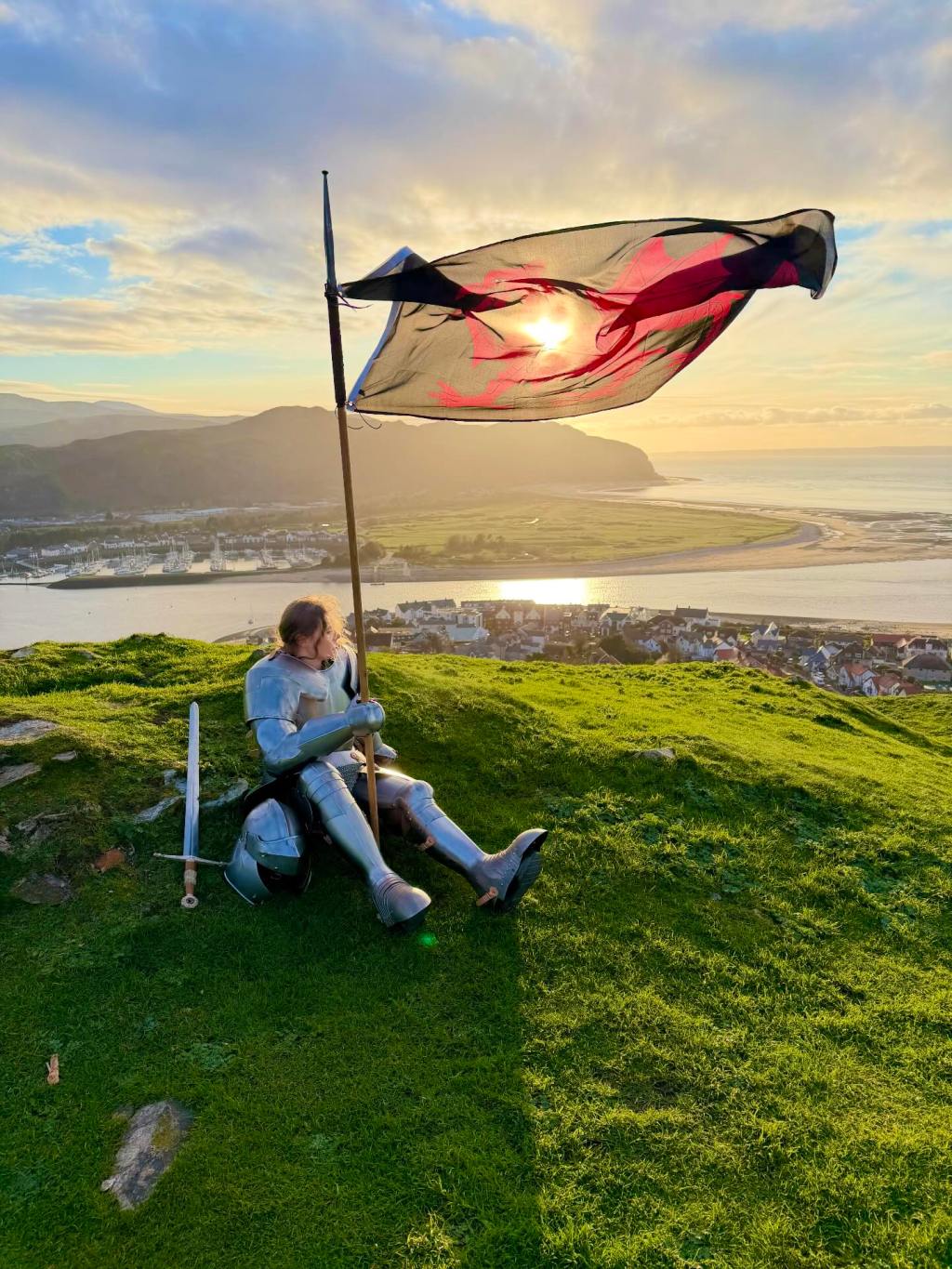
    A person in shining medieval-style armor sits on a grassy hill under a dramatic sky, holding a large flagpole with a flag waving in the wind. The flag features a bright red dragon silhouetted against the setting sun, which casts a warm glow over the scene. Beside them on the grass rests a sword and helmet. The background reveals a panoramic view of a small coastal town with a river flowing into a bay, surrounded by rolling hills. The sky is mostly clear with some clouds catching the golden light of the sunset, creating a serene and picturesque atmosphere.
    (Arthurian symbolism by That Girl from Avalon)

    Between the 2014 core books, and Xanathar’s there are 37 sometimes overlapping options for what can be done with Downtime. The 2024 core books and the Forgotten Realms expansions add many Bastion and Crafting options onto this.

    Most downtime choices are measured in weeks, though small projects are within days. These scenes are time-compressed frequently taking only a roll or two per character to resolve as weeks, months, maybe even seasons pass. In film, TV and books the montage is how downtime is presented. Pick your favorite heroic montage — we’ll get back to it.

    Every class supports downtime activities in some capacity, especially with the 2024 ruleset adding on Bastions. Skill challenges, as adopted to 5e by some homebrewers, make sense as resolution systems for downtime, exploration and sometimes social events.

    But downtime is often viewed by players and DMs as accounting, boring academics, spreadsheet management.

    Even the name is boring.

    Downtime has a branding problem

    Stories and adventures are an assembly of beats, eventually leading to rising action, climax and resolution. There are sometimes downbeats, setback.

    Downbeats.

    Who wants downbeats? Who wants downtime.

    Even how downtime is presented, either by name or by style of play (Bastions and Crafting), it is shown as an appendage with little support. Downtime is a thing to rush past, not to enjoy.

    A Bastion offers a character temporary refuge from the dangerous world of adventuring, and it provides opportunities for a character to craft magic items, conduct research, harvest poisons, build ships, and carry out a range of other activities.

    2024 Dungeon Master’s Guide

    Heroes do not want a refugee from danger!

    They do want the ability to craft magic items, research mysteries, harvest fantastic elements, carouse, gamble, set sail across an astral sea, or plot the overthrow of a corrupt regime.

    Those are all upbeats, not downtime.

    Downtime also a massive part of the game

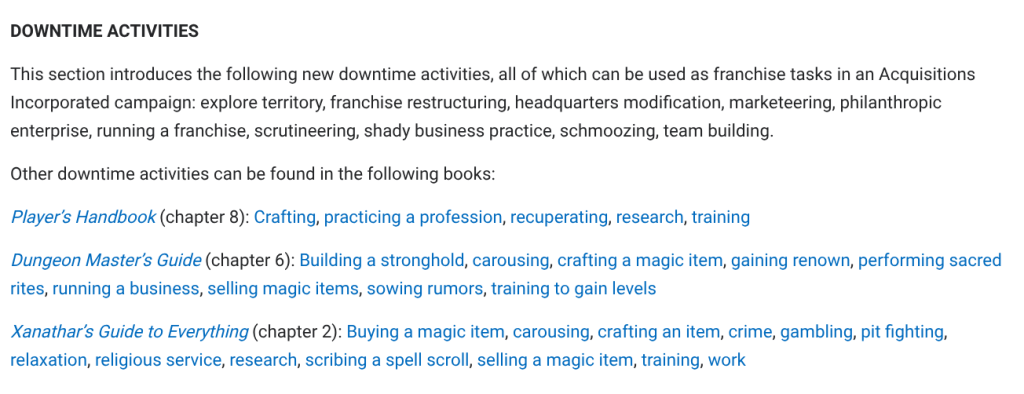
    Acquisitions Inc combines D&D and modern franchise capitalism for fun. It contains franchise rules. It also lists every one of the 2014 options in downtime at its point of publication.

    DOWNTIME ACTIVITIES

This section introduces the following new downtime activities, all of which can be used as franchise tasks in an Acquisitions Incorporated campaign: explore territory, franchise restructuring, headquarters modification, marketeering, philanthropic enterprise, running a franchise, scrutineering, shady business practice, schmoozing, team building.

Other downtime activities can be found in the following books:

Player’s Handbook (chapter 8): Crafting, practicing a profession, recuperating, research, training

Dungeon Master’s Guide (chapter 6): Building a stronghold, carousing, crafting a magic item, gaining renown, performing sacred rites, running a business, selling magic items, sowing rumors, training to gain levels

Xanathar’s Guide to Everything (chapter 2): Buying a magic item, carousing, crafting an item, crime, gambling, pit fighting, relaxation, religious service, research, scribing a spell scroll, selling a magic item, training, work

    These choices are things heroes do!

    The options above belong at your table. At some tables the options in Dragon Heist, Acq Inc, Tasha’s (Group Patrons), Strixhaven (schooling) and other official and unofficial books expand your campaign in ways that make sense too.

    Think of your favorite montage scenes in your personal Appendix N. Do they involve plotting the overthrow of a corrupt leader? Do they involve building a guild? Do they involve carousing to gain information? Do they involve long study to craft a previously unknown spell? Do you have a favorite montage that includes sowing rumors? Or mayhap one that involves training for new skills? You probably have one where the heroes prepare for a test of skill, chance or magic?

    In traditional D&D that’s downtime.

    In the fiction these things advance the plot and add excitement.

    Downtime has a branding problem.

    That’s why you are going to start scheming.

    Scheming

    From the 2014 DMG as an example of studying Lore
    • making intelligent, secret plans, often to deceive others
    • behaviour or activities that involve making clever secret plans intended to deceive people

    In British English schemes aren’t necessarily deceptive or secret. They are plots and advancements, plans and procedures. They are the many days, weeks, months processes.

    Both versions work for modern D&D, but the American concept of intelligent, secret plans especially fits my preferred themes.

    Why Scheming? Other considerations

    Concerns – while this captured the idea of the character being in charge of things it felt less involved in the plot and continued the ‘set aside’ concept of Downtime.

    Occupations – but who wants to do work? That’s spreadsheet life, not plot advancement and fantastic discoveries.

    Rejuvenation – is wonderful for healing, but poor for plot advancement and heroic actions over time.

    Strategic play – this conveys the proper tone and your schemes should be strategic while other pillars are tactical.

    Schemes involve rising action by heroes and antiheroes to get ready for the messy work that needs doing. Schemes are active plots and machinations (maybe that belongs above). Sometimes they are down notes, sometimes they are upbeats. They build rising action.

    Unifying disparate subsystems into Scheming

    Oracles ready to provide advice after a sacred rite (Photo by Dave Clark)

    Crafting, Bastions, Franchises, Group Patrons, Schooling, Carousing, Sacred rites, Grand rituals, Research, Business operations, Running a faction, Guild matters, Training militias, Communal defense, Grand voyages ….

    The list goes on.

    When these are schemes they are multi-check montages where failure matters and the results fuel the story. They either help or hinder a character or party on their quest. They take time.

    Whatever you take to calling downtime (and do include Bastions and Crafting when appropriate for your campaign) you need to unify this set of systems together.

    1. Describe the quest with the amount before the pace of action changes again. Set the expectation that there is time to Scheme.
    2. Players describe their goals using the above activities or a combination thereof to achieve that goal within the amount of time (measure in weeks).
    3. Narrate the results of the actions. These may require skill checks, use of various features or cooperation in the party. If there isn’t meaningful failure there is not a check unless extraordinary success matters. Use an odd number of checks (3 or 5 are best) mimicking skill challenges or use group checks if everyone is cooperating. Or combine the two.
    4. Move on from the Scheme into action with a faster pace taking note of how much time passed and what that means for those that oppose the group.

    If that resolution system feels familiar it is because it is the basic rhythm of play at the table, while capturing the montage and compressed time nature of a Scheme.

    It’s not a scheme if the activities are passive. It’s not a scheme if it doesn’t advance a quest or plot. It’s not a scheme if it is fast. It’s not a scheme if it is tactical.

    Frankly it’s not worth doing at the table if the activity is passive and/or doesn’t advance the quest

    Schemes are strategic, long-term, montage-y activities that advance the action fitting a rising narrative building the eventual heroes towards a climax. They should not be the climax, nor the resolution. A denouement can be a scheme as it preps for the next campaign.

    Ways to add Schemes to common campaign types

    Try working in schemes into your campaign. Use a timehop that creates challenges because the enemy is building a grand army. The timehop also gives the heroes time to train a militia (as in Wheel of Time).

    In a heist adventure use a scheme as the way to collect the necessary materials or information, setting up the background before the strike on the location (as the Crows in Shadow & Bone).

    Maybe the scheme is to collect a group of allies to help the party cross a perilous ocean or astral sea, commissioning a ship and its crew (as in One Piece).

    Play a scheme at your table inspired by the fictions that inspire your D&D.

    Fediverse Reactions
  • Professional failure

    Professional failure

    Professionals fail all the time — in roleplaying games, in elite athletics, in special operations, in life.

    The idea that they shouldn’t miss in a game is built on a foundation of water, not even sand.

    There are still some valid reasons that one wouldn’t roll to hit, but they have nothing to do with professionalism.

    Matt Colville on Mastering Dungeons

    In a recent edition of Mastering Dungeons Matt Colville talked extensively about the business of RPGs. It’s a wonderful listen.

    Something stood out to me though.

    “You’re professionals; you shouldn’t roll to hit.”

    Now, the idea of not rolling to hit is part of Colville’s quite intentional design. I’m certain he’s said it before and will say it again. There are reasons in games to not roll to hit.

    They have nothing to do with the character being a professional.

    Let’s break down the idea of professionals not needing to roll to hit.

    Elite Failure

    Elites fail regularly. They fail when contested. They fail when on their own. Failure at elite levels may not be as common as for us normal people, but it happens.

    This is true for the real, actual elites, not those mere professionals. My personal history is blessed to experience a few elites in fashions that many do not.

    Special operations

    Assigned to 5th Special Forces as a peacetime soldier my Army days were defined by the Quiet Professionals — the Green Berets. Working alongside these masters in warfare I saw failure every single day.

    On the range those trained to be snipers, an uncontested contest in gaming terms, missed. There are reasons for each miss, but missing happened.

    When soldiers, even in highly trained units such as the Special Forces, go to war they miss even more. The human brain does not like to kill things, plus there is chaos all around you. Errors happen. They always will.

    Elite failure isn’t limited to elite warfare.

    High-level sports

    Leaving 5th Group I decided I wanted nothing to do with my high school dreams or hard journalism. I turned to sports. During that era I worked as a producer for the Sonics broadcasting network, baseball’s best postgame show, as an on-air analyst for soccer and founded Sounder at Heart.

    At the field and court level I’ve watched Ichiro, Ken Griffey Jr., Gary Payton, Michael Jordan, Megan Rapinoe, Kasey Keller and many others.

    The list of these Hall of Fame talents failing would be immense.

    But let’s use hard numbers.

    Ichiro is the best contact hitter of the modern era. The ten-time All Star and MVP had a batting average on balls in play forty points higher than his contemporaries, but it was still only .338.

    Jordan’s shooting percentage was just under 50%.

    Now, both of those are contests. What about the best athletes when uncontested? Steph Curry makes only 91% of his free throws.

    It doesn’t matter which sport we consider. Kasey Keller stops 74% of shots he faces. Megan Rapinoe put ~40% of her shots on frame, and scored even fewer of those.

    Failure among the elite is regular and normal. They roll to hit and fail.

    Business

    Pick your favorite business leader and their success rate is higher than average, but whether its Howard Schultz launching a magazine, or Steve Jobs launching NeXT, or Warren Buffet investing in a shoe company, they fail too.

    Gaming reasons to not roll to hit

    So professionals do miss. Elites miss.

    Are there good reasons to not roll to hit? Yes, absolutely, as part of intentional design choices for a style of play that has nothing to do with professionalism of the character

    Hit points vs meat points

    The long standing D&D debate about hit points being more than meat points can be ignored here. Games developing to-hit rolling or direct-to-damage techniques do not need to burden them with Gygax’s decisions.

    Direct-to-damage rolling is excellent when hit points are, as in D&D, a symbol of morale, luck, fortitude, energy and more than merely meat. Since every attempt to physically damage an opponent wears away at those elements you don’t necessarily need to roll to hit. Missing still costs luck, energy, mental health and morale.

    The meat of the opponent can be damaged eventually, even without rolling to hit.

    Speed of play

    Colville did this in MCDM monster design for his 5e books — minions and the like can be hit easily. And then eliminated easily. This speeds up the action at the table and mimics narratives from movies, TV, video games within role playing games. Slicing and dicing through waves of small threats feels great. Having that take only a few moments rather than many minutes is good.

    Additionally in games like Draw Steel, with extensive tactical choices being a goal, eliminating a set of rolling helps speed gameplay up. This is a wise and intentional design choice that amplifies the other intent of bundling morale with meat.

    This supports the designer’s desires for their game — and need not be connected to reality or even lore.

    A wrong justification, with the right idea

    Professionalism in the real-world elite activities includes failure. Even the arts that inspire our gaming include failure. Black Widow misses. Skywalkers miss. Robin Hood misses.

    Designers should embrace failure when missing, because Ichiro, Rapinoe, every special forces soldier, every business leader, every legendary hero misses.

    And when they do design away the miss they should do so with intent that supports their game, no matter what reality and lore suggest. Just as Colville’s done in Draw Steel.

    Fediverse Reactions
  • Roleplaying games are stories

    Roleplaying games are stories

    They’re different from novels, short stories, comics, theater, movies, and most other forms of storytelling. That does not remove the tale being told nor the concept of story.

    If anything they are most similar to communal storytelling around a campfire and improv dramas. For the most part roleplaying games are communal events with a group.

    How did I bump into this well-worn debate? Via a recent thread on EN World, the rare bright spot in RPG discourse.

    Let’s talk about “plot”, “story”, and “play to find out.”

    My response there focused mostly on the story and plot aspects, and the power of having more voices (something rare in written fiction, but common in other forms of storytelling).

    There are people who are not good authors, nor good directors, nor good actors who are good roleplayers/gamemasters/etc. By leaning into the ways that community, plot and play-to-find-out work the creation displays, maybe even demands, story emerges.

    This is the Potential of games like D&D.

    Sometimes conventional Western storytelling formats can lean into the things that make the emergent and divergent story that happens in RPGs. This can be magical — because it shows how all story is really a reflection of point of view, or in our hobby — spotlight.

    RPGs-as-story feel messy when considered through a lens of a literature class or mainstream television.

    But, stories are quite messy

    Two people can read the same story, watch the same film, listen to the same podcast and come away with different meanings, see different main plots even.

    A campfire and a full moon

    To me, RPGs are stories in the way that campfire tales are. They involve a lot of wandering, forgotten threads, lack firm outlines and are at their best when the tale is woven through multiple voices providing input.

    Can they be a traditional novel after the campaign? Absolutely! But during the telling of the tale they are similar to writers who don’t edit as they go or a director who over films alternative concepts that aren’t on the script.

    One of the more thrilling things about RPGs is that it is an ensemble cast of both PCs and recurring NPCs. Together they’re important, but the tale and spotlight as to who is most important can easily shift. Use any of them as the point of view to change the story as you understand it. Each can be vital.

    The messiness is the fun part of RPGs as story.

    The messiness is what helps me discover tales I cannot tell on my own. That’s part of the power of the table and broad casts in ensemble stories.

    You think you’ve seen stories like this before, so you can guess what’s going to happen. Who’s important and who isn’t, but that’s because you’re trapped in your POV.
    – later –
    When you file people away as sidekicks you don’t realize their importance to the story, and this story belongs to a lot more people than you think. Where to shelve a book, it’s not a little thing. You’re telling the world what to value. Who to value.

    From The Magicians, Side Effect (S4, E7).

    RPGs are very much like that.

    They remove your assumptions. You don’t know what’s going to happen. The POV constantly shifts and the importance of the broader cast shifts constantly.

    From RPGs-as-Story we learn what and who to value by including others.

  • Protected: RPGs as Natural Disaster Prep

    This content is password-protected. To view it, please enter the password below.