Tag: Bastions

  • Spinebloom Farms, a riverside desert

    Spinebloom Farms, a riverside desert

    Not all desert communities are near an oasis. Long ago the Spineblooms settled in a desert area where the West Thundermoon River took a slow bend. Along that bend in the shallow salty marsh they do their best to raise some rice, as well as some fruited cacti, peppers, vines and largeflower onions in pods.

    Originally the Spineblooms were a group of goliath druids, frequently connected to storms and fire. For many generations they’ve lived on The Bend in earthen huts only partially protruding from the ground.

    Now, most are not magical. Instead they raise birds — herons (to fish), mynahs (pest control), bulbuls (warnings), waders (fishers) — in an aviary. They frequently trade their rice and catch upriver at the Multunyn Trading Post.

    The Location

    • Based on a sketch by the player that included domed buildings mostly underground
    • Using zone-based combat by Sly Flourish and enabling active locations similar to location moves.
    • Ensuring environmental oddities of The Ferments are included.
    Thundermoon River

    Slow, wide and muddy at The Bend, the Thundermoon River floods every early spring and during storms. It is the source of water which has to be filtered prior to use.

    Auntie Dauthia Spinebloom kée Dustcaller is here during the daytime, fishing.

    • Elemental affinity: Water
    • Hazards: People frequently get stuck in the sands, animals do not. Every second round in the river a person must make a DC: 12 Strength check or be restrained.
    • Allies: Birds from the aviary are common here.
    • Max occupancy: 10 medium creatures.

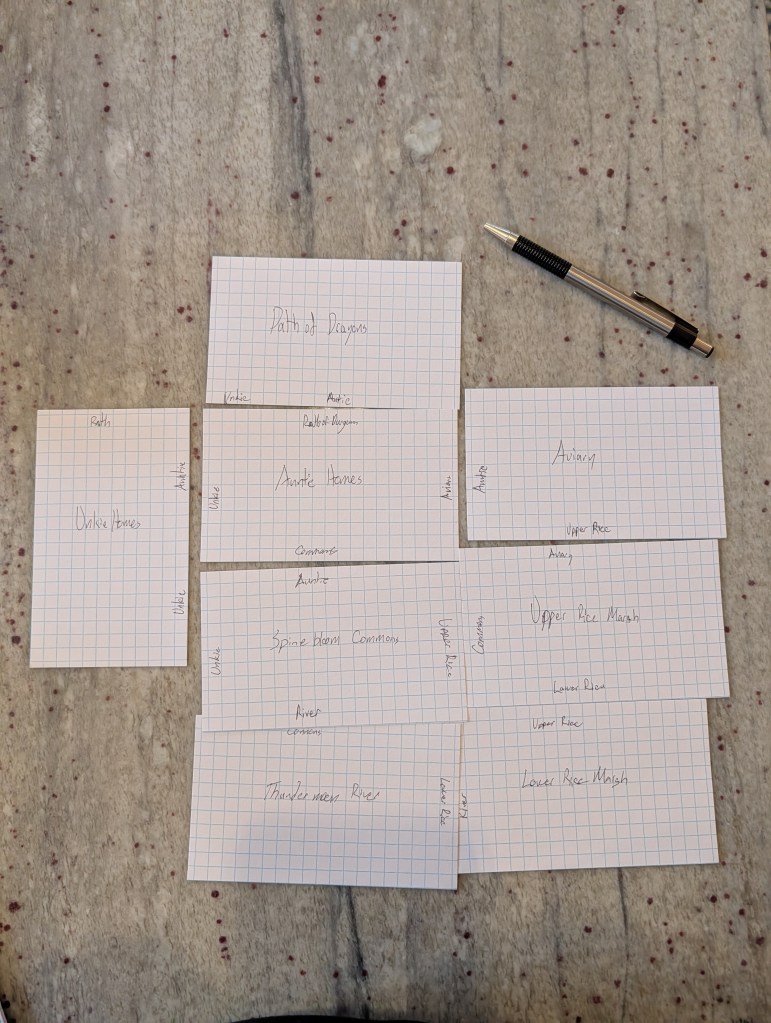
    The River connects to Spinebloom Commons (the main home) and lower river marsh.

    Lower rice marsh

    Less productive than upper marsh, the lower marsh is an edge of wild marsh plants and some rice that isn’t farmed. Within the plants one may find a mud mephit rehydrating, or the chwinga family that settled in the Farm.

    • Elemental affinity: Mud, water, salt
    • Hazards: Some chwingas settled here after the mephit flood.
    • Allies: The chwingas may insist they are allies while acting like foes, or they are foes acting like allies.
    • Occupancy: 5 medium creatures.

    Lower rice marsh connects to the Upper Marsh, Spinebloom Commons and to Thundermoon River.

    Spinebloom commons

    The main home is inside the Commons. It has a large kitchen and a conversation pit with several small beds cut into the earth at the edges. These ‘rooms’ are frequently sectioned off with blankets or robes, with only a tiny shelf for personal goods. At the entry to the hut is a placement for staves, cudgels and gardening equipment.

    Every member of the Spineblooms spends significant portions of their days in the Commons. They will clean items, repair them, play, and gather. All property is communal and the next person will want to use it shortly — it gets left there.

    • Elemental affinity: Hearth, dust, earth
    • Hazards: Interior has several changes in elevation. The kitchen has many flare ups that could occur. During certain lunar conditions the conversation pit has a dust devil in the center.
      Exterior is cluttered with loose tools, toys, cleaning pans and other small chore sites. It is difficult terrain and an improvised weapon is always at hand. Creatures knocked prone may take damage from the clutter.
    • Allies: There are always Spinebloom children present. Roll 2d4 to see how many. Half will be small. 1d4-1 adults are also present.
    • Occupancy: 8 medium creatures outside and 8 medium creatures inside.

    Spinebloom Commons is centrally located and connects to every other zone, except the Path of Dragons.

    Guarase traded for many, many books. This works as a Library from Bastions with a single research project per week of Scheming.

    Upper rice marsh — also known as Marsh Chwinga

    Once upon a time the upper marsh was highly productive for rice, eels and herbs. Now it has long furrows of damage from two dragon/ken invasions and the curse of the chwingas make it flourish for foods while everyone dreads entering the space.

    • Elemental affinity: Water, mud, plants
    • Hazards: Chwingas may take a soul. When a creature drops to zero HP and fails two or more death saves the chwingas can choose to stabilize it, mud wrap the body and have it kept until the mud breaks.
      There is currently an elven mage encased. The Spineblooms have not attempted to free the elf as its group tried to damage their home.
    • Allies: In this space the Chwingas act through their blue thoughts, sideways from morality of people.
    • Occupancy: 7 medium creatures.

    Chwinga marsh connects to the lower marsh, the Commons and the aviary.

    Unkie homes

    Adult and middle aged men are the Unkies. They are kept aside from the Commons and the Aunties. They maintain the extremely competitive nature of goliaths, using their abilities and size to show off during the days.

    Most of the Spinebloom Unkies came of age during The Awakening. The elements rage within them, frequently out of control. Lalok is peaceful. Others have wandered away with the few that stay not quite fitting in with the farm’s demeanor weaving with nature and kin to grow and thrive as one.

    • Elemental affinity: Hearth, fire, air, water
    • Hazards: These homes have doors with locks and they can be barred from the outside. Random spouts of elemental anger pop up regularly.
    • Allies: Unkies are usually around, but disorganized and will wrestle solo.
    • Occupancy: 5 medium creatures outside. Each hut fits 1.

    Unkie homes connect to the Aunties, to the Commons, to the River and to the path.

    The Unkies are also trained to Rally and Funnel (militia actions).

    Auntie homes

    Most of the women of the family live in smaller huts here by ones and twos. These small dugouts are protection from the elements, but few have cooking hearths.

    Two took significant damage during a dragon attack, one of which collapsed and is now a pit.

    • Elemental affinity: Hearth, dust
    • Hazards: The pit-home is a ten-foot fall.
    • Allies: Aunties are frequently in the area able to help with militia actions.
    • Occupancy: This is a larger space able to hold 12 medium creatures outside.

    Auntie homes connect to the Unkie homes, the path, the aviary and the Commons.

    Fruitful Aviary

    A mix of cacti and spined bushes the aviary is the home of the non-waterfowl that companion with the Spineblooms. Some of the cacti have fruits that the family eat, turn into jam, and use for meads.

    Unkie Lalok Goateye Spinebloom is found at the aviary most times of the day, sometimes sleeping near the spiney bushes. He can create a small pool of water for the bird bath if need be.

    • Elemental affinity: Plants, water
    • Hazards: The maze of briars and cacti are spiny everywhere. Those knocked prone will take damage.
    • Allies: Many birds and Unkie Lalok are present
    • Occupancy: 4 medium creatures usually separated by the plants.

    The fruitful aviary connects to the Commons, the Path of Dragons, the auntie homes and the upper marsh.

    Inside the fruitful aviary is an optical telegraph that looks like a large, janky spire. The telegraph connects to Ellis Mills at Pirna Farms. Three small mousekin operate it and stay in a small hut at its base.

    Path of dragons

    A few months ago this path was simply “the path.” It is bare trail with scratched ruts in hard dirt that heads towards the West Thundermoon Mountains.

    Then dragons and their ken attacked. They attacked again. Since the river is where the Maltunyans visit, the path is now the Path of Dragons. Everyone assumes more dragons are coming soon. They left one of their own behind.

    • Elemental affinity: Dust, sand
    • Hazards: Drakes, dragons and their Ken may come at any time.
    • Allies: None
    • Occupancy: There is no limit.

    The Path connects to the Auntie and Unkie homes.

    Recently Guarase created a system of locks and canals to flood the path of dragons. A militia action can activate these. When this happens the Path of Dragons becomes difficult terrain and the rushing waters cause disadvantage on Dex-based d20 Tests.

    The image is a stylized fantasy map depicting a region with diverse geographical features. The terrain is primarily sandy with scattered trees and mountain ranges. At the top left corner, the title "The Ferments" is displayed, with the region stretching across to the "Thundermoon Range" at the top center. Various areas are marked, including "Fatwoods" and "Palemarsh" to the west, represented with dense forests. "Sands Of Ar" is a large desert area in the center. To the south lies a large body of water labeled "Dark Wassr," depicted in a light blue-green color. Key locations such as "Raven Watch," "Sanctum Of The Black Witch," "Brightshelt," and "Ourten" are marked with symbols like houses or skull icons. A compass rose is placed near the water, aiding orientation. Paths, indicated by dashed lines, connect various locations.
    Created using Perilous Shores

    Allies

    Auntie Dauthia Dustcaller

    Ask a Spinebloom and Auntie Dauthia is a Spinebloom. If you can convince Duathia to talk she may, eventually tell you she’s a Dustcaller, a separate desert goliath collective that lives even more remotely. She’s mastered the ability to use small dust devils to carry fishing lures and nets around the river, until she catches something.

    Every member of the family has a different tale about what Auntie Dauthia did before they found her injured along the path. She was a thief, a sorcerer, clergy with the Reformed Church of Quar, a warrior of the wilds or some other mystical thing. They all agree that there is no better fisher in all the land and likely the world.

    Unkie Lalok Goateye Spinebloom

    Lalok once left the home to work in a caravan. He’s wandered the Ferments and Western Wildes, seen Telse and the Evereflow, visited the Cliffs of Galinor, and Fort Ooshar. He’s seen everything.

    He’ll never tell you about his encounters protecting the caravan. It”s the cities and his friends he tells tales of while sipping on cacti mead and with a flutter of sandpipers around him. He still has a massive pike, a shield the size of a table and a helm missing a third of an eye ridge where is slightly bulging ‘goateye’ is.

    Adversaries

    Chwingas

    These elemental sprites act on their own will, with purposes that center the elements, not people. Though intelligent, it is impossible for normal kin to understand what the chwingas want. They are extremely active when Unkies or ken are in the area. If someone tries to visit the encased elf the chwingas attempt to block that path through mischief and thievery.

    Dragons and their ken

    Twice ken and dragons struck at the Farm. They damaged upper marsh while attacking the Auntie homes and the Commons. These powerful magic users are not local to The Ferments and remind most of the myths of a time unification, before companionship.

    Goblins

    A recent raiding party from the south indicated that these goblins know how they can harvest the fires and flames of The Ferments to power their smog-buggies and other creations — as long as someone from The Ferments is with them.

    One goblin is now trapped with the chwinga.

    Downtime and Quests

    Guarase is searching for answers as to why the dragons and their ken came to the Spineblooms. The two attacks leave few clues and lots of damage.

    There is a body and two members of the family were away during The Awakening when magic came back to The Ferments.
  • Rebranding Downtime into the Fourth Pillar it deserves to be

    Rebranding Downtime into the Fourth Pillar it deserves to be

    D&D and its variants are often referred to as “combat simulations” or “tactical combat games” or “dungeon crawling miniature games” in a somewhat dismissive way that seeks to reduce the other things that players have their characters do during sessions and campaigns.

    These mostly heroic characters do have a lot of combat support. A vast majority of the rules support violence portrayed in what is now six-second rounds. Combat’s scenes in 5th edition are done in expanded time taking many real minutes for less than thirty seconds of cinematic action.

    But combat is not all of modern Dungeons & Dragons. Other pillars are supported.

    The three main pillars of D&D play are social interaction, exploration, and combat.

    5.2.1 SRD / Wizards of the Coast / CC BY 4.0

    Social interaction in the modern game is mostly done in scenes lasting a few minutes. These scenes take place in real time at the table. Ritual spells do not make sense in the context of social interaction because of the nature of social interaction. Other spell casting is less frequent than in combat, while it can still fit. The main engine of social interaction within the rules are skills (Charisma, Wisdom and Intelligence) and a light dusting of feature from class, archetype, feat or species.

    Taking a longer period of time, historically measured in ten-minute chunks, is Exploration. This is abstracted in an opposite fashion from Combat in that where combat sees time expanded, Exploration compresses it. Some, but not all travel makes sense as exploration. Rituals are frequently used. Spells are common. Certain spells and features may make classic exploration challenges meaningless (Goodberry or Find & Remove Traps). But Exploration, the delve into dungeons, the searching the wildes, the entry to a wondrous temple or the site of a majestic floating city is and always will be a part of the D&D genre.

    There’s a fourth pillar.

    It’s so hidden, it’s not even part of the SRD.

    — Downtime —

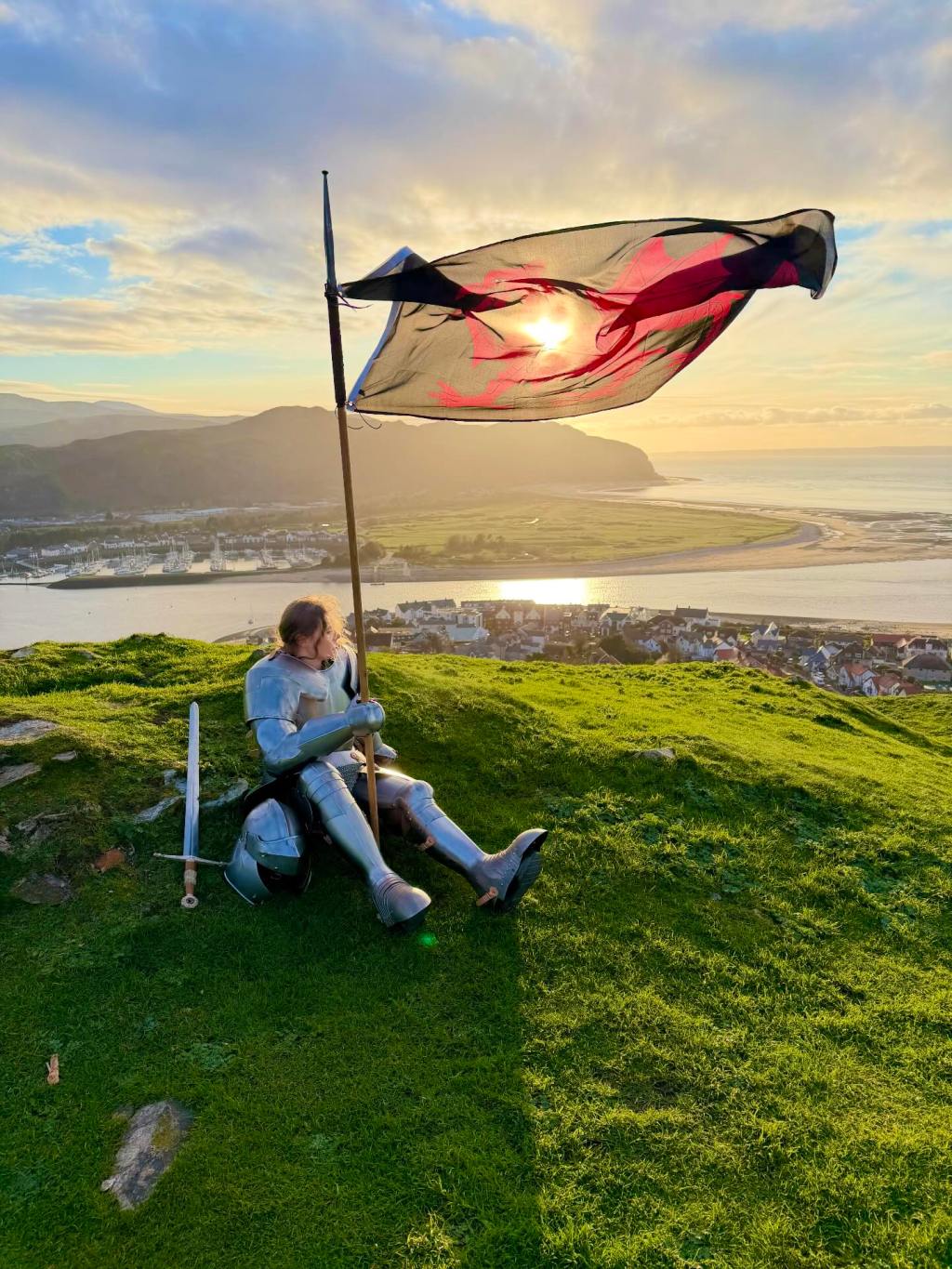
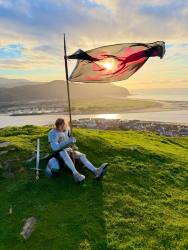
    A person in shining medieval-style armor sits on a grassy hill under a dramatic sky, holding a large flagpole with a flag waving in the wind. The flag features a bright red dragon silhouetted against the setting sun, which casts a warm glow over the scene. Beside them on the grass rests a sword and helmet. The background reveals a panoramic view of a small coastal town with a river flowing into a bay, surrounded by rolling hills. The sky is mostly clear with some clouds catching the golden light of the sunset, creating a serene and picturesque atmosphere.
    (Arthurian symbolism by That Girl from Avalon)

    Between the 2014 core books, and Xanathar’s there are 37 sometimes overlapping options for what can be done with Downtime. The 2024 core books and the Forgotten Realms expansions add many Bastion and Crafting options onto this.

    Most downtime choices are measured in weeks, though small projects are within days. These scenes are time-compressed frequently taking only a roll or two per character to resolve as weeks, months, maybe even seasons pass. In film, TV and books the montage is how downtime is presented. Pick your favorite heroic montage — we’ll get back to it.

    Every class supports downtime activities in some capacity, especially with the 2024 ruleset adding on Bastions. Skill challenges, as adopted to 5e by some homebrewers, make sense as resolution systems for downtime, exploration and sometimes social events.

    But downtime is often viewed by players and DMs as accounting, boring academics, spreadsheet management.

    Even the name is boring.

    Downtime has a branding problem

    Stories and adventures are an assembly of beats, eventually leading to rising action, climax and resolution. There are sometimes downbeats, setback.

    Downbeats.

    Who wants downbeats? Who wants downtime.

    Even how downtime is presented, either by name or by style of play (Bastions and Crafting), it is shown as an appendage with little support. Downtime is a thing to rush past, not to enjoy.

    A Bastion offers a character temporary refuge from the dangerous world of adventuring, and it provides opportunities for a character to craft magic items, conduct research, harvest poisons, build ships, and carry out a range of other activities.

    2024 Dungeon Master’s Guide

    Heroes do not want a refugee from danger!

    They do want the ability to craft magic items, research mysteries, harvest fantastic elements, carouse, gamble, set sail across an astral sea, or plot the overthrow of a corrupt regime.

    Those are all upbeats, not downtime.

    Downtime also a massive part of the game

    Acquisitions Inc combines D&D and modern franchise capitalism for fun. It contains franchise rules. It also lists every one of the 2014 options in downtime at its point of publication.

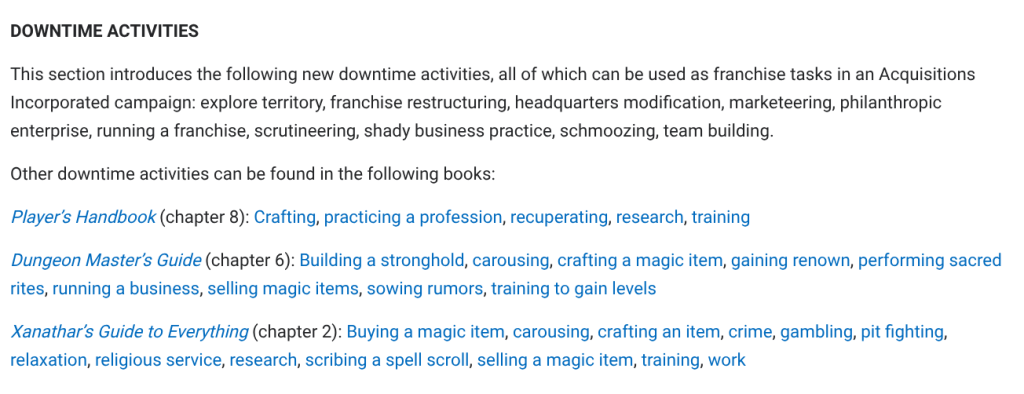
    DOWNTIME ACTIVITIES

This section introduces the following new downtime activities, all of which can be used as franchise tasks in an Acquisitions Incorporated campaign: explore territory, franchise restructuring, headquarters modification, marketeering, philanthropic enterprise, running a franchise, scrutineering, shady business practice, schmoozing, team building.

Other downtime activities can be found in the following books:

Player’s Handbook (chapter 8): Crafting, practicing a profession, recuperating, research, training

Dungeon Master’s Guide (chapter 6): Building a stronghold, carousing, crafting a magic item, gaining renown, performing sacred rites, running a business, selling magic items, sowing rumors, training to gain levels

Xanathar’s Guide to Everything (chapter 2): Buying a magic item, carousing, crafting an item, crime, gambling, pit fighting, relaxation, religious service, research, scribing a spell scroll, selling a magic item, training, work

    These choices are things heroes do!

    The options above belong at your table. At some tables the options in Dragon Heist, Acq Inc, Tasha’s (Group Patrons), Strixhaven (schooling) and other official and unofficial books expand your campaign in ways that make sense too.

    Think of your favorite montage scenes in your personal Appendix N. Do they involve plotting the overthrow of a corrupt leader? Do they involve building a guild? Do they involve carousing to gain information? Do they involve long study to craft a previously unknown spell? Do you have a favorite montage that includes sowing rumors? Or mayhap one that involves training for new skills? You probably have one where the heroes prepare for a test of skill, chance or magic?

    In traditional D&D that’s downtime.

    In the fiction these things advance the plot and add excitement.

    Downtime has a branding problem.

    That’s why you are going to start scheming.

    Scheming

    From the 2014 DMG as an example of studying Lore
    • making intelligent, secret plans, often to deceive others
    • behaviour or activities that involve making clever secret plans intended to deceive people

    In British English schemes aren’t necessarily deceptive or secret. They are plots and advancements, plans and procedures. They are the many days, weeks, months processes.

    Both versions work for modern D&D, but the American concept of intelligent, secret plans especially fits my preferred themes.

    Why Scheming? Other considerations

    Concerns – while this captured the idea of the character being in charge of things it felt less involved in the plot and continued the ‘set aside’ concept of Downtime.

    Occupations – but who wants to do work? That’s spreadsheet life, not plot advancement and fantastic discoveries.

    Rejuvenation – is wonderful for healing, but poor for plot advancement and heroic actions over time.

    Strategic play – this conveys the proper tone and your schemes should be strategic while other pillars are tactical.

    Schemes involve rising action by heroes and antiheroes to get ready for the messy work that needs doing. Schemes are active plots and machinations (maybe that belongs above). Sometimes they are down notes, sometimes they are upbeats. They build rising action.

    Unifying disparate subsystems into Scheming

    Oracles ready to provide advice after a sacred rite (Photo by Dave Clark)

    Crafting, Bastions, Franchises, Group Patrons, Schooling, Carousing, Sacred rites, Grand rituals, Research, Business operations, Running a faction, Guild matters, Training militias, Communal defense, Grand voyages ….

    The list goes on.

    When these are schemes they are multi-check montages where failure matters and the results fuel the story. They either help or hinder a character or party on their quest. They take time.

    Whatever you take to calling downtime (and do include Bastions and Crafting when appropriate for your campaign) you need to unify this set of systems together.

    1. Describe the quest with the amount before the pace of action changes again. Set the expectation that there is time to Scheme.
    2. Players describe their goals using the above activities or a combination thereof to achieve that goal within the amount of time (measure in weeks).
    3. Narrate the results of the actions. These may require skill checks, use of various features or cooperation in the party. If there isn’t meaningful failure there is not a check unless extraordinary success matters. Use an odd number of checks (3 or 5 are best) mimicking skill challenges or use group checks if everyone is cooperating. Or combine the two.
    4. Move on from the Scheme into action with a faster pace taking note of how much time passed and what that means for those that oppose the group.

    If that resolution system feels familiar it is because it is the basic rhythm of play at the table, while capturing the montage and compressed time nature of a Scheme.

    It’s not a scheme if the activities are passive. It’s not a scheme if it doesn’t advance a quest or plot. It’s not a scheme if it is fast. It’s not a scheme if it is tactical.

    Frankly it’s not worth doing at the table if the activity is passive and/or doesn’t advance the quest

    Schemes are strategic, long-term, montage-y activities that advance the action fitting a rising narrative building the eventual heroes towards a climax. They should not be the climax, nor the resolution. A denouement can be a scheme as it preps for the next campaign.

    Ways to add Schemes to common campaign types

    Try working in schemes into your campaign. Use a timehop that creates challenges because the enemy is building a grand army. The timehop also gives the heroes time to train a militia (as in Wheel of Time).

    In a heist adventure use a scheme as the way to collect the necessary materials or information, setting up the background before the strike on the location (as the Crows in Shadow & Bone).

    Maybe the scheme is to collect a group of allies to help the party cross a perilous ocean or astral sea, commissioning a ship and its crew (as in One Piece).

    Play a scheme at your table inspired by the fictions that inspire your D&D.

    Fediverse Reactions
  • West Thundermoon Trading Post, home the Maltunyns

    West Thundermoon Trading Post, home the Maltunyns

    Traveling the harsh lands of the Ferments? Find everything you need at WEST THUNDERMOON TRADING POST!!! Settled in the foothills of the Thundermoon Mountains a half a day’s ride west of Ourten, WEST THUNDERMOON TRADING POST is the go to location to find all of your hunting and travelling needs.

    Run by the Maltunyn family for generations, they’re knowledge of the local terrain, as well as their selection of only the finest gear will ensure your travels will be safe and comfortable. Or you could pick up some of the finest furs and rations provided by master hunter Velthuria Maltunyn, and her daughter Keesrah. If you need a quick repair, or even an herbal remedy or two, Cay Maltunyn has you covered.

    With the experience of generations, and a deep love of the land and air, the WEST THUNDERMOON TRADING POST is a must for any serious travelers of the Thundermoon Mountains. Visit the WEST THUNDERMOON TRADING POST today!!!

    You can find that brochure throughout the villages and homesteads of the Thundermoon Mountains in The Ferments.

    Keesrah Maltunyn, a human guide and drakewarden ranger with a raven named Crow, is the player character who calls the trading post home.

    The West Thundermoon Trading Post is about two days south by southeast from Orten. The post is on the southerly road towards a desert region. That road runs roughly parallel to the Thundermoon River. In the hills and mountains are a few fishing and hunting families.

    The Location

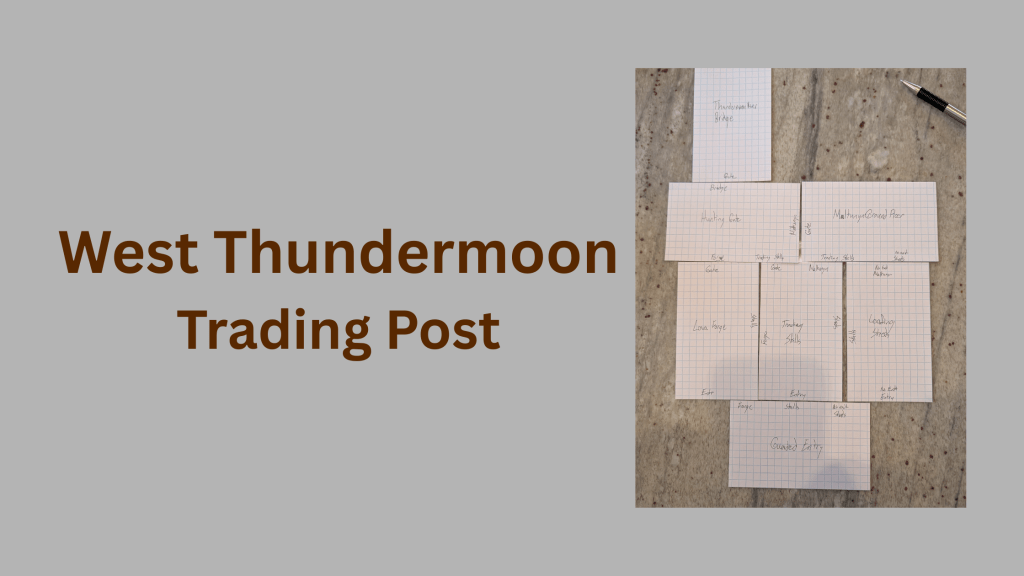
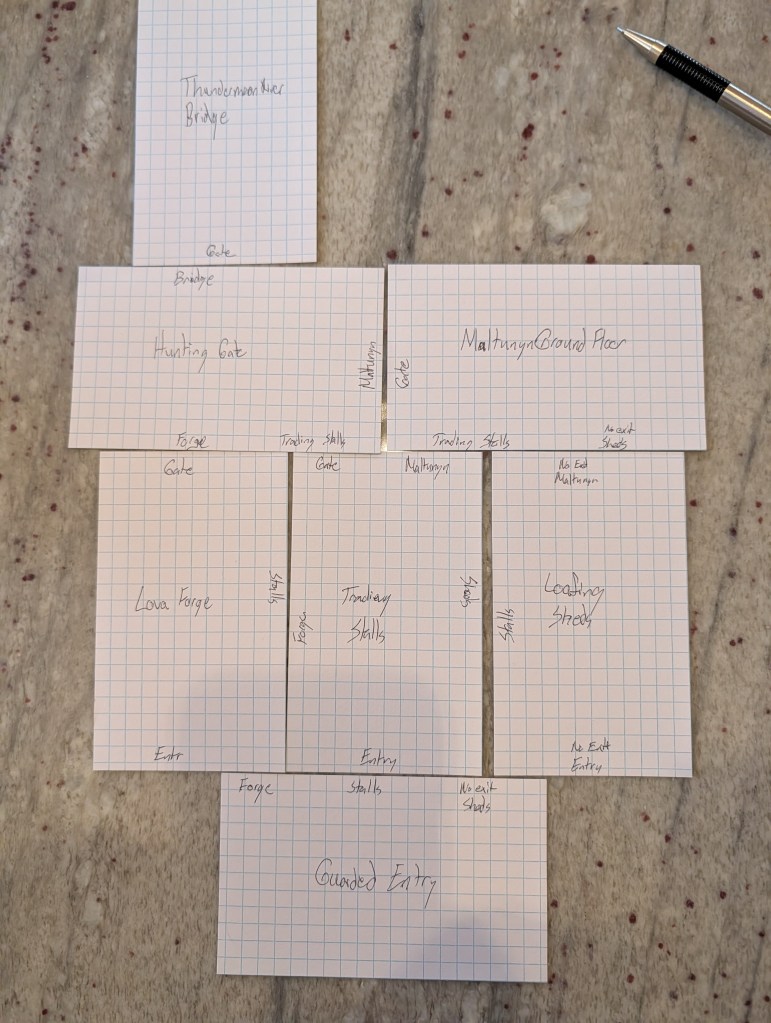
    The image displays a set of seven rectangular index cards arranged on a speckled stone surface. The cards have a grid pattern and are covered with handwritten notes. The cards are arranged in a T-shape with four cards on top and three below. Each card contains various textual labels such as locations and descriptive phrases. In the top row, the central card is labeled "Maltunyn Ground Floor," flanked by cards labeled "Bridge" and "Trading Stalls." The topmost central card features "Thundermoon River Bridge." Other notable labels on the cards include "Hunting Gate," "Lava Forge," "Guarded Entry," and areas denoted as "Stalls" and "Sheds." A pen is positioned at the upper right corner of the image.
    Zonal word map of the Trading Post

    Guarded entry

    A wooden wall surrounds the Trading Post. The entry is where all merchants and visitors arrive. There are two large doors, which are barred at night. A guard stand rises to the left of the doors, as one exits. It can hold one medium creature and grants them half cover. A ladder provides access.

    • Elemental affinity: None.
    • Hazards: Breaking down the closed door requires a DC: 15 Strength check.
    • Allies: The goblins and family can provide ranged or melee Militia Actions.
    • Max occupancy: Five medium creatures.

    The guarded entry connects to the lava forge, the merchant stalls and the loafing sheds.

    Lava Forge

    A small semi-open air forge where Cay works as a sometime smith. The heat and bellows are from an active fissure where magma surges underneath the trading post. Malk, the goblin captain, now helps out. Malk and Borkin also store their own clutter there, including the smog-buggy.

    • Elemental affinity: Earth, fire, lava
    • Hazards: Those knocked prone who fail their DC by five or more take 1d8 fire damage from the forge. Forced movement can result in the tools of the trade being knocked all over, turning the Lava Forge into difficult terrain. Oh, and beware of a lava flare — who knows when that will happen.
    • Allies: Cay, Malk and Borkin may be present
    • Occupancy: Four medium creatures.

    The lava forge connects to the guarded entry, to the trading stalls and the hunting gate.

    Trading stalls

    One large and two smaller open stalls sit in the large enclosed central space of the post. Various homesteads and outsiders come through with their wares on a seasonal basis. There’s a central fire pit with some large stones and simple benches frequently with a stew pot and hot beverages available.

    • Elemental affinity: Fire, air
    • Hazards: The cook pit can become a fire hazard, doing 1d8 damage to those who fall into it and setting their flammable gear on fire. It provides 10′ of bright light and 10′ of dim light at night.
    • Allies: Neighbors may be present depending on the season. They will almost always limit their help to rallying the Maltunyns.
    • Occupancy: 3 in the large stall, 2 in each small stall and room for 12 more medium creatures.

    The trading stalls connect to every other zone except the hunting gate.

    Loafing sheds

    Like everyone in the Six Kingdoms the Maltunyns have space for beloved animals. These sheds are designed for equines, canines as well as the rare bovine or more exotic companions. There are small cabinets for feed and tack.

    • Elemental affinity: Cold, air
    • Hazards: When occupied the animals could be feisty.
    • Allies: None typically
    • Occupancy: 7 medium creatures.

    The loafing shed connects to the guarded entry, the trading stalls and the Maltunyn home.

    Hunting gate

    Known for the gate that Caile leaves open it’s actually the place where Cay raises herbs. There’s also the gate to the hills where Keesrah and Velthuria hunt. It’s also a lower land, near the river.

    • Elemental affinity: Water, plants
    • Hazards: During heavy rains the mud creates difficult terrain. A rapid freeze after rains can lead to icy conditions.
    • Allies:
    • Occupancy:

    Thundermoon River bridge

    A few weeks ago there was a small wooden bridge over the river. Then the mephit mudslide took it out. Now a ford those that cross must be wary of mud mephits who settled in the area after the slide. Heavy rains may bring them back and upriver there is a threat that the open lava could change the river’s path.

    • Elemental affinity: Mud, water, maybe lava
    • Hazards: During floods the ford is impassable terrain without aids — ropes, other people or animal companions. Mud mephits may strike at random, the little chaos beasties they are.
    • Allies: One of the Maltunyn animal companions are frequently in the area.
    • Occupancy: This is a large space without a limit as it connects to the hills and mountains.

    Thundermoon River bridge connects to the hunting gate.

    Maltunyn home

    A two-story wooden building, the ground floor of the home is mostly accessible to the general public. The main room is a mix of general store with goods on consignment, smithed tools, dried or smoked meats and a few tables with chairs for visitors. This room can be entered from either the hunting gate through a small side door or the main entry connecting to the trading stalls. An outer stair to the second floor reaches the roof of the loafing sheds and a narrow platform along the wall running to the guard stand. There’s a small open kitchen/stove with a root cellar stretching under the homestead wall near the river.

    The second floor is two bedrooms and a small aviary.

    • Elemental affinity: Smoke
    • Hazards: Bar fights are rare, mostly because Cay is a smith and Velthuria is a scout.
    • Allies: If the trading post has visitors one of the family or goblins is always present.
    • Occupancy: 10 medium creatures
    The image is a stylized fantasy map depicting a region with diverse geographical features. The terrain is primarily sandy with scattered trees and mountain ranges. At the top left corner, the title "The Ferments" is displayed, with the region stretching across to the "Thundermoon Range" at the top center. Various areas are marked, including "Fatwoods" and "Palemarsh" to the west, represented with dense forests. "Sands Of Ar" is a large desert area in the center. To the south lies a large body of water labeled "Dark Wassr," depicted in a light blue-green color. Key locations such as "Raven Watch," "Sanctum Of The Black Witch," "Brightshelt," and "Ourten" are marked with symbols like houses or skull icons. A compass rose is placed near the water, aiding orientation. Paths, indicated by dashed lines, connect various locations.
    Created using Perilous Shores

    Allies

    Velthuria is Keesrah’s mother. A human scout with a small dog, she is the primary hunter and runs the operations such as rentals of the three stalls for merchants.

    Cay is Keesrah’s father. A human smith with a miniature pony, he uses a magma powered forge, Cay can craft anything with metals. He also grows herbs.

    Caile is Keesrah’s brother, a human with a small dog. Smitten with one of the Drudzhar Caile sometimes wanders off on his own. Ally, but adversary sometimes.

    Malk is a goblin captain and was saved in session one. A colonialist they are searching for resources for the Queen. They may become an adversary.

    Borkin is a goblin cart driver. They are less colonial and more willing to help the Maltunyns, especially in defense and general labor. Malk is still their boss.

    Henkel family

    River fishers in the ponds and streams of the low Thundermoons the Henkel family are halflings with river dogs. They are indebted to Keesrah after she rescued Taier one of their younger teens.

    Adversaries

    Clan Drudzhar

    A group of goliaths who live higher in the Thundermoon Mountains. Clan Drudzhar and the Maltunyn’s have been arguing, and sometimes openly fighting, over hunting territory in the mountains for years. One of their children is in love with Caile.

    Their home is high in the scrub mountains and was recently near the mud mephit floods. They and the Maltunyns use different styles of traps and will frequently destroy each other’s snares. Birds of prey are their most common companions.

    Elements of mud and lava

    Mud mephits, magmin and lava elementals roam the Thundermoons. These adversaries are manifestations of The Ferments, a land that refuses to be tamed.

    Children of Chorl

    Punch-chickens raided a market stall, but quick action by Keesrah and her acquaintance Ellis ended the theft and the punch chickens. The two later learned that the Children of Chorl raided Ourten too. These human-animal hybrids seem to be hiding in the hills or plateau near Pirna Farms, now Ellis Mill.

    Kon colonialists

    While saving the lives of Malk and Borkin pushed off the investigation by the Queen’s goblins into how the resources of The Ferments could replace the tar trees of their homeland. That colonial raid and investigation may expand.

    Downtime and Quests

    Keesrah is researching how to create Serpent Scale Mail armor. She’s learned that the elemental drakes do not leave behind enough resources. The dragonkin raiding Spinebloom Farms do.

    Previously some work was done to reinforce the guarded entry which connects to the road Outsiders arrive along.

  • Xabal’s Workshop

    Xabal’s Workshop

    In our Age of Myths campaign the party acquired a keep. Though the party is many days travel by airship away from the keep, their former leader Artok (originally played by John) now runs the keep.

    Each of us gets a Special Feature for what is now our group Bastion. At this time Artok has a Sanctuary. We’ll want to get him a Barracks and Armory soon, because we aren’t around to defend the Bastion very often.

    Xabal Gaitee Quarter-Flagged Optigraph Balaneer nox Free Tink and non-Commissioned Officer of the Sadijh (on leave in absence), my goblin artillerist artificer, established a Workshop. He’s also interested in the Arcane Study, but first a workshop.

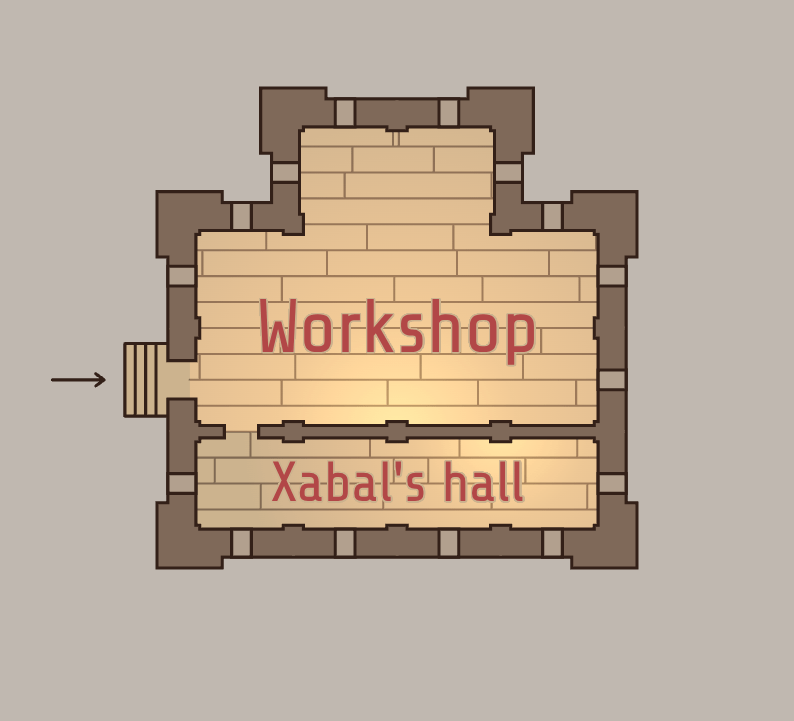
    Xabal and Crag took over the two store rooms in the keep. Xabal’s is on the left.

    The image depicts a hand-drawn map on graph paper. It outlines a fortified area, possibly a castle or fort, surrounded by a flowing body of water indicated by blue wavy lines, and red hatching marks representing elevation or terrain. The map includes labeled structures such as a "Keep" located centrally and surrounded by various buildings including "Stone barracks," "Stables wooden," and "Stores." There is an "Archery range" and a circular "Melee Practice" area. Paths and roads are sketched in black, with dotted lines representing different routes. Additional topographical features include a "Waterfall from mtns above into valley" on the right side of the map and a path labeled "Cart Path to main road." The map is oriented vertically, with features labeled throughout in a combination of print and cursive handwriting.
    Xabal took over the left most of the stores.

    What I like about the concept of Bastions/Strongholds/etc is that it gives players the opportunity for some ‘lonely fun.’ With a chill weekend at home I spent time thinking about D&D, but not actually playing the game.

    The image is a top-down view of a rectangular room layout with beige and brown tones, resembling a floor plan. The main space is labeled "Workshop," situated at the top center. Below it, the space is divided by a thick line and labeled "Xabal's hall." The flooring appears to be composed of rectangular tiles laid in a brick pattern. The room is surrounded by a darker brown border, representing walls, with protruding sections at the corners, suggesting architectural features. On the left side, a small protruding area features parallel lines indicating steps leading up, with an arrow pointing to the right.
    Xabal’s workshop interior floorplan created using watabou’s Dwellings Generator

    Using watabou’s Dwellings creator I found something as close as possible to the space on the DM’s map of the keep. Then I added a bit of lore around the minor change (there’s an aviary so it isn’t a pure rectangle).

    And then I discovered the steps and main door should be on the right rather than left. That error will go down as a function of Xabal’s quite-distracted memory and the difficulty of communicating over long distances

    One thing that Xabal trusted Artok to do was hire three artisans to help in the workshop. He hasn’t yet met them, but Flasfur and Chofs started working already.

    Hirelings

    Below the three current hirelings are described including their “stats” for social encounters and their short-form personalities.

    Flasfur Wreltor with Blackbirds

    Photo by Siegfried Poepperl on Pexels.com

    A goliath with a flock of blackbirds that stay in the newly added aviary. He’s a cobbler and leather worker. The blackbirds help Flasfur with fine work required of those professions.

    Nearly eight feet tall, Flasfur was the one said he wouldn’t join the workshop without a small improvement, the aviary for his small flock of blackbirds.

    He’s from a small town in the hills between Mihrstone, Sheljar and Artok’s Keep.

    Strength, constitutionGoliath (2014)
    Negative dexterityCobbler, leatherworker
    Investigative
    Heavy leather apronSheljar
    Small awl (dagger)large aviary for the birds
    Modest lifestyleOpen, respectful, fatalistic, absent minded

    Chofs Chupmolea badged al-Chems

    The image depicts a minimalist, stylized drawing of a small castle-like building with a light brown background. The structure is rectangular with a crenellated parapet along the top. It features two arched windows on either side of a central arched door. The roof is angular and tiled, with a warm tan color. Two lantern-style lamps flank the door. The building is surrounded by sparse grass, adding to the scene's simplicity and rustic charm.
    Exterior drawing of Xabal’s Workshop in Artok’s Keep created using watabou’s Dwellings Generator.

    A goblin who is insistent in studying the corruption. She’s a jeweler and glassblower.

    Chofs recently travelled through the area scouting out a new source of gems not from her hometown. From Bel’an’faire in the south of Sheljar lands, she works with jewels and glass to create art and rarely implements of war.

    She also does etching and some other things that border on chemistry or alchemy.

    Dexterity, IntelligenceGoblin
    Negative charisma, strength, constitutionJeweler and fine arts, perceptive
    Lightweight, close fitting dressesBel’an’faire
    Caltrops to aid her escapeUse the corruption to power art
    Modest lifestyleBrilliant, excitable, religious

    Bolnis Abica nox Qawaha

    Where Chofs is a common goblin in their structured society Bolnis is a wanderer similar to Xabal. She’s potter and tinker who travelled through the land with simple coffee gear.

    Bolnis doesn’t like tea, but has some with her. Most of her time is in the hills and coast between Sheljar and Mira, if people insist on discovering where she’s from it’s Ooshar. She considers her hometown a backwater.

    There’s a chance that Bolnis invents fancy coffee gear, but right now it’s simple. Her passion is to discover new ways to use tek to create new foods, tisanes, poultices, and more.

    Intelligence, CharismaGoblin
    Negative strength, constitutionPotter, tinker, coffee gear
    Insight
    Lightweight travelling pantsOoshar
    Mug (club)An espresso machine
    Comfortable lifestyle, though paid at modestGenerous, meticulous, sensual

    I’m already thinking about how Xabal will interact with these hirelings and what knives they give the DM. Chofs offers someone that could be corrupted through those who study it. Bolnis clearly has twice the income of the others. How is she getting that money? Flasfur’s blackbirds could distract him from running the shop.